
Research article · 2023 · Full text
International Journal of Veterinary Sciences and Animal HusbandryEffective management of traumatic laceration in a Russell's viper (Daboia russelii): A case study on rapid intervention and recovery
Volume 8(6) · Pages 103–104 · DOI: 10.22271/veterinary.2023.v8.i6b.819 ↗
Research areasRabies epidemiology and controlTurtle Biology and ConservationVeterinary Orthopedics and Neurology
Abstract
Author-writtenThis case study outlines the successful treatment of a severe laceration in a Russell's viper (Daboia russelii), a species of significant medical and ecological importance, following an automobile accident. The viper presented with an elongated laceration along the right side of its cranial ribs. Due to the emergency nature of the injury, standard fasting protocols were bypassed, and immediate surgical intervention was undertaken. The wound was cleaned, desensitized, and sutured using a simple interrupted pattern with catgut. Post-operative care included administration of meloxicam and enrofloxacin, avoiding restrictive bandaging to mitigate stress and potential complications.This case underscores the unique challenges in reptilian trauma management, emphasizing the importance of anatomical considerations, pharmacological aspects, and tailored post-operative strategies. The full recovery and subsequent release of the viper within 10 days of treatment exemplify the efficacy of minimalistic yet precise veterinary interventions in wildlife rescue scenarios.
Summary
Source-checkedPlain-language reading of the full paper, prepared with AI and checked against the text. Each point links to the authors' own words.
Why it matters
- The Russell's viper is medically significant because of the potency of its venom. View evidence ↗
- There is currently a lack of extensive literature regarding how to manage physical trauma in Russell's vipers. View evidence ↗
The question
- The study aims to document the successful treatment of a severe laceration in a Russell's viper caused by an automobile accident. View evidence ↗
What they did
- The subject of the case study was a mature male Russell's viper. View evidence ↗
- The snake presented with an elongated laceration located on the right side of its cranial ribs. View evidence ↗
- Because the injury was an emergency, the veterinary team skipped standard fasting protocols to perform immediate surgery. View evidence ↗
- The wound was prepared by cleaning it with povidone-iodine and using 2% lignocaine for local anesthesia. View evidence ↗
- The laceration was closed using a simple interrupted suture pattern with polyglycolic acid no. 0. View evidence ↗
- Post-operative medication included subcutaneous meloxicam at 0.2 mg/kg and intramuscular enrofloxacin at 5 mg/kg. View evidence ↗
- Restrictive bandaging was avoided during recovery to reduce stress and prevent complications. View evidence ↗
What they found
- The viper achieved full recovery and was released within 10 days of the treatment. View evidence ↗
- The primary injury affected the skin and scales, while the axial musculature remained intact despite slight abrasion. View evidence ↗
- The natural elasticity and regenerative capacity of snake skin were critical factors in the successful repair and healing of the wound. View evidence ↗
What it means
- The authors conclude that prompt and tailored veterinary interventions are critical for successful wildlife rescue. View evidence ↗
- The authors recommend continued research to develop best practices for reptilian veterinary medicine and wildlife rehabilitation. View evidence ↗
Visual summary
1 visualsIllustrations explain the paper; they do not show study data.
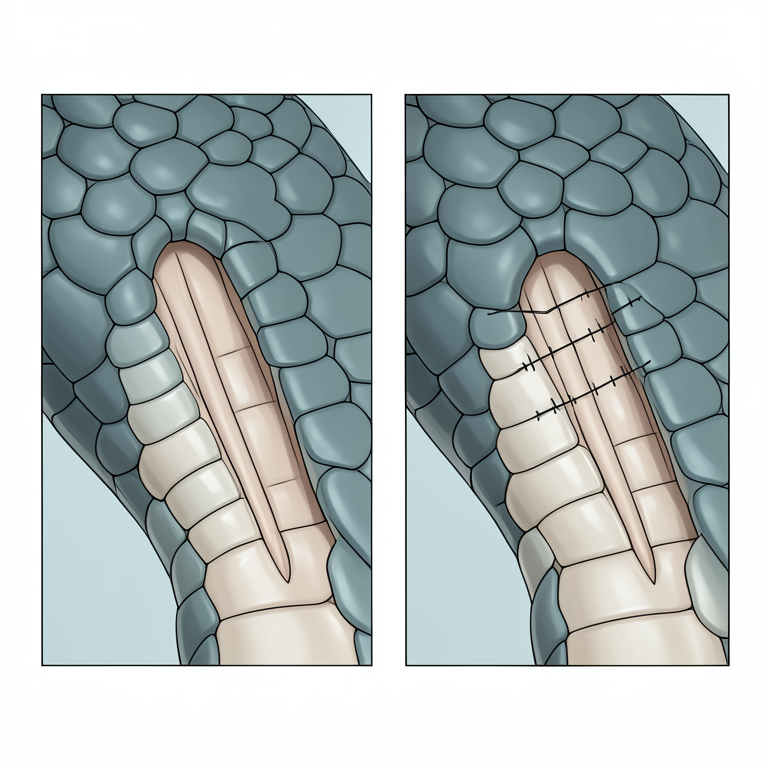
Surgical Site Concept
AI-generated conceptual illustration (Russell's viper (Daboia russelii)). It explains the idea and does not show study data.
View source evidence ↗Figures & tables
From the original paper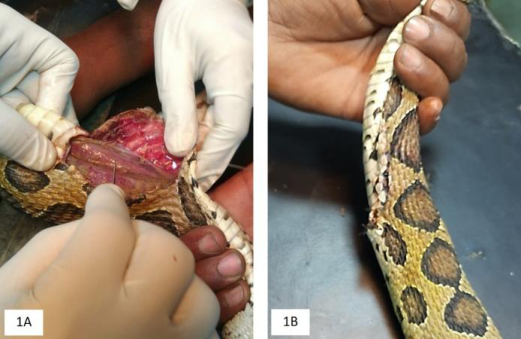 Figure 1
Introduction
This case study documents the successful treatment of a Russell's viper (Daboia russelii) after sustaining a severe lacerated wound from an automobile accident. Russell's viper is a species known for its medical significance due to venom potency (Warrell, D. A., 1989) [11], but there is limited literature on physical trauma management in these species. Case Presentation A mature male Russell's viper was presented with a history of an automobile accident.
The viper exhibited an elongated laceration along the right side of the cranial ribs. Notably, the axial musculature, including the levator costa iliocostalis supracostalis lateralis superior and inferior, was intact but showed slight abrasion, with major injury involving the skin and scales (Gasc Jean-Pierre, 1981) [5].
Material And Methods
Given the emergency nature, standard fasting protocols (Fowler M. and Miller E., 2012) [3] were bypassed. The injury was cleaned, scrubbed with povidone-iodine, and desensitized using local infiltration with 2% lignocaine. Using polyglycolic acid no. 0, a simple interrupted suture pattern was employed. Post-operatively, the snake received meloxicam (0.2 mg/kg) subcutaneously and enrofloxacin (5 mg/kg) intramuscularly (Carpenter J., 2013) [2] VET 2023; 8(6): 103-104 Ushma Patel 1.
Ph.D. Scholar, Department of Veterinary Surgery and Radiology, Nagpur Veterinary College, MAFSU, Nagpur, Maharashtra, India 2. Vet Beyond Basics, Nagpur, Maharashtra, India Soham Mukherjee 1. Life Science Education Trust, Bangalore, Karnataka, India 2.
Wildroost, Ahmedabad, Gujarat, India Ushma Patel 1. Ph.D. Scholar, Department of Veterinary Surgery and Radiology, Nagpur Veterinary College, MAFSU, Nagpur, Maharashtra, India 2. Vet Beyond Basics, Nagpur, Maharashtra, India
Result And Discussion
The snake fully recovered in 10 days, showcasing the resilience of reptiles to surgical interventions and the efficacy of minimalistic post-operative care in such cases. The immobilization of the surgical part in reptiles is challenging, and application of bandages could interfere with their feeding habits, potentially leading to suffocation (Mader, D. R., 2006) [8]. The management of traumatic injuries in reptiles, particularly venomous snakes like https://www.veterinarypaper.com 2.
Carpenter J. Exotic Animal Formulary (4th ed.). Missouri: c2013. ISBN 978-1-4377-2264-2. 3.
Fowler M, Miller E. Fowler’s Zoo and Wild Animal Medicine Current Therapy, Chapter 17: Fundamentals of Zoo Animal Surgery. 2012;7:129-135. 4. Fry BG. The Toxicogenomic Multiverse: Convergent Recruitment of Proteins Into Animal Venoms.
Annual Review of Genomics and Human Genetics. 2009;10:483- 511. 5. Gasc JP. Axial musculature. In C.
Gans & T. S. Parsons (Eds.), Biology of the Reptilia Morphology C. Academic Press. 1981;11:355-435. 6.
Gilbert S. Veterinary Management of Tortoises and Turtles. Wiley-Blackwell; c2012. 7. Jacobson ER.
Infectious Diseases and Pathology of Fig 1: Local infiltration of the lacerated wound with diluted lignocaine hydrochloride 2% post flushing with normal saline (1A); Reptiles. CRC Press; c2007. 8. Mader DR. Reptile Medicine and Surgery (2nd ed.).
Saunders Elsevier; c2006. 9. Plumb DC. Plumb’s Veterinary Drug Handbook (7th ed.). Wiley-Blackwell; c2011. 10.
Warwick C. Health and Welfare of Captive Reptiles. Springer; c2013. 11. Warrell DA.
Clinical Toxicology of Snakebite in Asia. In J. A. Campbell & W.
W. Lamar (Eds.), Venomous Reptiles of the World; c1989, p. 493-594. The wound immediately post suturing using PGA no. 0 (1B). Russell's viper, poses unique challenges.
The successful recovery of the Russell's viper in this case study underscores several key considerations in reptilian veterinary medicine and wildlife rehabilitation. The resilience of reptilian tissue to trauma and subsequent surgical interventions is noteworthy. Reptiles' skin, particularly in snakes, exhibits significant elasticity and a remarkable capacity for regeneration (Alibardi, L., 2010) [1]. This elasticity was a crucial factor in the surgical repair and healing process of the viper's laceration.
The use of meloxicam and enrofloxacin in this case aligns with the recommended practices in reptilian medicine (Mader, D. R., 2006) [8]. However, the pharmacokinetics of drugs in reptiles can vary significantly from mammals, necessitating careful dosing and monitoring (Plumb, D. C., 2011) [9].
The minimally invasive approach in post-operative care, avoiding the use of bandages, is consistent with the recommended practices for reptilian surgery (Jacobson, E. R., 2007) [7]. Reptiles often exhibit stress and complications with restrictive bandaging, highlighting the importance of tailored post-operative strategies (Warwick, C., et al., 2013) [10] This case highlights the importance of specialized knowledge and facilities for the rescue and rehabilitation of wildlife, particularly for species that are less commonly treated due to perceived dangers or lack of expertise (Gilbert, S., et al., 2012) [6], especially for species like Russell’s viper, which may pose additional risks due to their venomous nature (Fry, B. G., et al., 2009) [4].
Conclusion
This case underlines the critical role of prompt and tailored veterinary interventions in wildlife rescue scenarios. The successful treatment and subsequent release of the Russell's viper demonstrate the feasibility and importance of such interventions in conserving wildlife, even for species that are often overlooked due to their venomous nature. This case also reinforces the need for continued research and development of best practices in reptilian veterinary medicine and wildlife rehabilitation.
References
1 in the original paper- Alibardi L. Morphological and Cellular Aspects of Tail and Limb Regeneration in Lizards: A Model System With Implications for Tissue Regeneration in Mammals. Advances in Anatomy Embryology and Cell Biology, 2010;207:1-109.