
Research article · 2023 · Full text
International Journal of Statistics and Applied MathematicsA remark on the Δ function
Volume 8(6) · Pages 25–29 · DOI: 10.22271/maths.2023.v8.i6a.1398 ↗
Research areasStatistical Mechanics and Entropy
Abstract
Author-writtenA probability distribution over an infinite interval is discussed. The probability density function is equal to zero everywhere, but its integral over the whole interval is equal to one. Some properties of the function are pointed out. The Δ function is treated as the limit case of a probability density function defined over an interval of length L. Unlike in a possible definition of the function δ of Dirac, the limit is taken with the length L approaching infinity. This way, the value of the Δ function tends to zero everywhere, but the integral of the function over [−∞, ∞] is equal to one. This is a generalized function that can be interpreted as a uniform density function defined on the whole independent variable axis.Some properties of the Δ function are discussed, like the cumulative function and superposition with other density functions. It is shown that the corresponding cumulative function is equal to 1/2 everywhere on (−∞, ∞). Treating Δ as a density function over (−∞, ∞), we can see that, while randomly shooting, the probability of hitting any point within a finite interval is equal to zero. Note, however, that such event is not impossible.
Summary
Source-checkedPlain-language reading of the full paper, prepared with AI and checked against the text. Each point links to the authors' own words.
Why it matters
- In probability theory, an event with a probability of zero is not necessarily an impossible event. View evidence ↗
- The author considers the scenario of randomly selecting a point on an infinite x-axis where every point has an equal probability of being hit. View evidence ↗
- The Dirac delta function (δ) is a well-known generalized function used in fields such as signal processing and probability theory. View evidence ↗
The question
- The paper aims to discuss and define a probability distribution over an infinite interval where the density is zero everywhere but the total integral is one. View evidence ↗
What they did
- The Δ function is defined as the limit of a probability density function as the length of the interval (L) approaches infinity. View evidence ↗
- Alternatively, the Δ function is defined as the probability density function for randomly selecting a point from the interval (-∞, ∞). View evidence ↗
What they found
- The Δ function is a generalized function whose integral over the entire interval from -∞ to ∞ is equal to one. View evidence ↗
- The value of the Δ function tends to zero at every point on the axis. View evidence ↗
- The Δ function has an expected value of zero and an infinite variance. View evidence ↗
- The cumulative distribution function F(x) corresponding to the Δ function is equal to 1/2 for any finite value of x. View evidence ↗
- When using the Δ density, the probability of hitting any point within a subset of finite total measure is zero. View evidence ↗
- The author notes a similarity between the Δ function and the Dirac delta function if the variable axes are switched. View evidence ↗
What it means
- The author concludes that while the Δ function is defined in an opposite manner to the Dirac delta function, they share similarities under coordinate transformation. View evidence ↗
- The Δ function effectively describes a uniform probability distribution over an infinite interval where the total probability is one, but the probability for any finite interval is zero. View evidence ↗
Visual summary
1 visualsIllustrations explain the paper; they do not show study data.
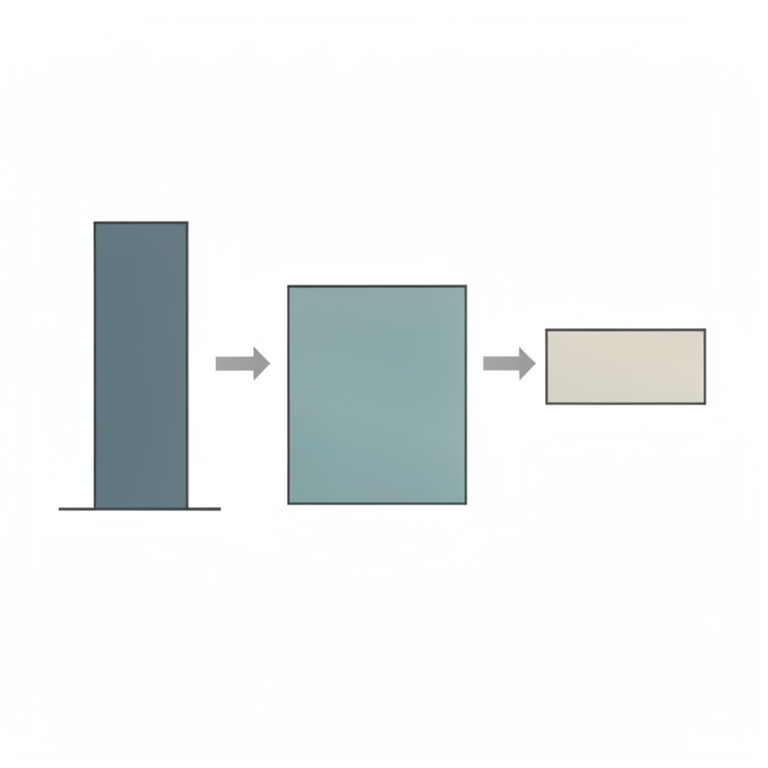
Limit Process of the Δ Function
AI-generated conceptual illustration (a mathematical probability density function represented as a geometric rectangle on a horizontal axis). It explains the idea and does not show study data.
View source evidence ↗Introduction 1. Probability zero
One of the facts, perhaps somewhat contradicting our intuitive understanding of probability, is that an event which probability of occurrence is equal to zero, is not an impossible event. Consider the set of points inside a unit circle. Imagine that we throw a needle, and hit a point in the set. Assume that the needle is" ideal", so that we hit only one point. Obviously, the probability of hitting the center of the circle is equal to zero (a subset with area zero). However, the event is not impossible because the center point of the circle does exist. Now, look at the set [-∞, ∞] (the x-axis). In the similar way, consider the event that consists of throwing an ideal needle towards the x-axis randomly, when the probability of hitting any particular point is equal for all points in the interval [-∞, ∞]. Again, the positive outcome of hitting a fixed point P or a finite interval I has zero probability. However, such outcome is not impossible because the point P and the interval I do exist. Now, recall the definition of the Dirac delta (δ distribution) function. This is a generalized function that satisfies the following equation: (1) We can also define the δ function as the limit of a sequence of functions, (in the distributional sense), as follows (2) where (3) In fact, as f(x, n) we can use any density function, for example that of the normal distribution, with expected value zero and standard deviation approaching zero. Thus, the δ(x) function is equal to zero everywhere, except x = 0, and equal to infinity at x = 0. Moreover,
The above property makes the δ function different from just a function defined as infinity in zero, and zero otherwise. In other words, δ(x) is a distribution. An overview of this, and other contributions of Paul Dirac, see [1] . The δ function has multiple applications in the probability theory, dynamic systems, sampled-data control systems (the z-transform) and signal processing, consult [2] . We mention here the δ function because we are going to define another distribution, in a somewhat opposite way. Consult also the basic book of Feller, on probability theory [3] . Other sources on the theory of distributions are [4,5] . In the present paper, we focus on some kind of the uniform probability distribution. This distribution may appear to be simple and easy to use. However, it is not always the case. To generate random numbers with uniform distribution on a computer, sophisticated numerical algorithms are used, and as the result we always achieve certain approximation of the ideal uniformly distributed numbers. A more detailed characterization of the uniform distribution is discussed by Dasgupta [6] . A generalization of this kind of distribution is described by Hussein and Al-Kadim [7] . Sankaran and Jayakumar [8] consider the shape properties, moments, distributions of the order statistics and derived entropies. The definitions and various applications of generalized functions are provided in many sources, see for example Craven [9] . Some more practical applications are mentioned by McDonald [10] , with relation to the size distribution of income. Another remarks and properties can be found in the paper of Steinbauer and Vickers [11] .
The Δ function
Let us repeat here the definition of the functions f(x, n), as in the previous section. Definition 2 Δ(x) is the probability density function for an event that consists in randomly selecting a point x from the interval (-∞, ∞).
Properties of the Δ function Property A
(6) This is a simple consequence of the definition of Δ ( * ). However, remember that Δ ( * ) is a generalized function, not just a function. We also have (7) Simply because (8) Property B Note that the function f(x, n), eq.( 3), used in the definition of Δ(x), has the expected value equal to zero. This means that in the limit, the expected value Δ(x) is also equal to zero. The variance of Δ(x) is infinite.
Property C
Denote by F(x) the cumulative function that corresponds to Δ(x) (9) We have Property C F(x) = 1/2 for any finite x.
Proof
As a simple consequence of the definition of Δ(x) we have (10) Let x be a fixed point, 0<x<∞. Calculate F(x) as follows. (11) because the integral of Δ over any finite interval is equal to
End proof
In the similar way we can see that Observe also that F(-∞) = 0, and F(∞) = 1, as a consequence of eq.( 8). We also have For any finite x.
Property D Consider a function (12)
where h(x) is a probability density function defined on a finite non-empty interval I = [a, b]. Assume 0 < u < 1. The cumulative function of g is as follows (see eq. ( 11)). ( 13) Property E Denote by J a subset of (-∞,∞) with finite total measure. Like for a finite interval I, while randomly shooting with density Δ, the probability of hitting a point x Є J is equal to zero. Define the function Δ* as the density function for the event of hitting any point of (-∞,∞) except the points in J. It can be seen that Δ* is also the Δ distribution.
Δ function and δ of Dirac
Here, we do not discuss the function Δ(x)δ(x), because this may result in a discussion how much is ∞×0. Recall also that the multiplication of generalized functions is not well defined. Let us define (14) Function Δ+ is the uniform density function over [0,∞). Denote by y the dependent variable. Now, switch the coordinates, x axis directed upwards. It can be seen that Let g(x) be an integrable function, such that g -1 (y) is well defined. So, from the properties of function δ(x), we have In other words, z is the solution to the equation g(x) = 0.
Final remark
The fact that may look strange, and somebody could argument that this is false because (15)
Recall that Δ is a distribution (generalized function) and not just a function. See equations ( 4) end (8). The integral of Δ(x) over [-∞, ∞] is as follows (16)
Where f(x, n) is defined in eq.( 4).
Conclusion
Here, we have discussed some interesting properties of a generalized function Δ(x) that is the uniform probability distribution over the interval I=(-∞,∞). It describes the probability of hitting a point inside the infinite interval. Note that the probability of hitting any point is equal to one, while the probability of hitting a point inside any finite, non-empty interval is equal to zero. However, this event is not impossible because the interval exists. The cumulative function for this distribution is equal to ½ everywhere in I. The Δ function is defined in quite opposite way as the function δ of Dirac. However, there is certain similarity that can be seen if we switch the variable axes.
References
5 in the original paper- Dasgupta S, Goswami A, Rao BV. On a Characterization of Uniform Distributions, Journal of Multivariate Analysis. 1993;44(1):102-114. ISSN 0047-259X, https://doi.org/10.1006/jmva.1993.1006.
- Hussein SR, Kareema Abad Al-Kadim KA. Generalized Uniform Distribution Using the Exponential Quantile Function, J Phys. Conf. Ser. 2021;1897:012002. DOI 10.1088/1742-6596/1897/1/012002
- Sankaran KK, Jayakumar K. A New Extended Uniform Distribution, International Journal of Statistical Distributions and Applications. 2016;2(3):35-41. DOI:10.11648/j.ijsd.20160203.12
- McDonald JB. Some Generalized Functions for the Size Distribution of Income. Econometrica. 1984;52(3):647-63. JSTOR, 2023 https://doi.org/10.2307/1913469. Accessed 6 July
- Steinbauer R, Vickers JA. The use of generalized functions and distributions in general relativity Quantum Grav. 2006, 23(10). DOI 10.1088/0264-9381/23/10/R01