
Research article · 2023 · Full text
International Journal of Veterinary Sciences and Animal HusbandrySuper Napier as a perennial fodder availability to milch animals
Volume 8(5) · Pages 485–487 · DOI: 10.22271/veterinary.2023.v8.i5h.793 ↗
Research areasLivestock Management and Performance ImprovementAnimal Diversity and Health Studies
Abstract
Author-writtenThe present study (Front Line Demonstration) was conducted in promotion of the super Napier fodder as a perennial multi-cut fodder variety which aided in year-round fodder availability to the milch animals. The demonstration has been carried out by selecting 10 farmers from the KVK adopted villages for the period of 3 years i.e. 2020-2023 where each farmer was distributed with 10,000 no. super Napier fodder slips for cultivation. The demonstration resulted in benefiting the farmers with an additional source of income generation of 30,000/-(4 farmers), 25,000/-(3 farmers) & 20,000 (3 farmers) by the sale of the slips in addition to the extension of the fodder area cultivation for feeding to animals. The study also depicted with the production of good quality and quantity of milk and maintenance of good animal health conditions by feeding of super Napier in the treatment group when compared to the control group where routine feeding practice was with locally available fodder Jowar (CSH-31) to milch animals.
Summary
Source-checkedPlain-language reading of the full paper, prepared with AI and checked against the text. Each point links to the authors' own words.
Why it matters
- Dairy farming in India serves as a critical independent enterprise that provides farmers with a steady income, particularly when extreme weather like floods or droughts damage other crops. View evidence ↗
- India faces a significant fodder crisis due to limited land availability, with reported shortages of 61.1% for green fodder and 21.95% for dry fodder. View evidence ↗
- Approximately 97% of farmers rely on crop residues and poor-quality fodder, which leads to decreased animal productivity and poor health. View evidence ↗
The question
- The study aimed to promote super Napier as a perennial, multi-cut fodder variety to ensure year-round fodder availability for milch animals. View evidence ↗
What they did
- The demonstration involved 10 selected farmers from KVK adopted villages over a three-year period (2020-2023), with each farmer receiving 10,000 super Napier fodder slips. View evidence ↗
- The study compared a treatment group fed with super Napier against a control group fed with locally available Jowar (CSH-31) fodder. View evidence ↗
What they found
- Super Napier provided an average of 8 cuttings per year, whereas the CSH-31 practice only provided 3. View evidence ↗
- The average plant height for super Napier was 171.18 ± 1.18 cm, which was higher than the 158.62 ± 0.98 cm observed for CSH-31. View evidence ↗
- Animals fed with super Napier had a higher average milk yield of 7.37 ± 0.58 kg/animal/day compared to 5.45 ± 0.32 kg/animal/day for those fed with CSH-31. View evidence ↗
- Milk quality improved with super Napier, showing a higher average fat percentage (4.54 ± 0.31% vs 3.68 ± 0.23%) and SNF percentage (8.01 ± 0.13% vs 7.89 ± 0.67%) than the control. View evidence ↗
- The net profit per acre per year from the sale of slips for three harvests was calculated at 24,000 + 0.75 rupees. View evidence ↗
What it means
- The authors conclude that super Napier significantly increases household income (up to 30,000 rupees per acre per year) while simultaneously providing essential fodder for livestock. View evidence ↗
- The authors state that the adoption of super Napier helped maintain animal health and fostered entrepreneurship and self-esteem among rural youth. View evidence ↗
Visual summary
2 visualsIllustrations explain the paper; charts are replotted from the paper's own table values.
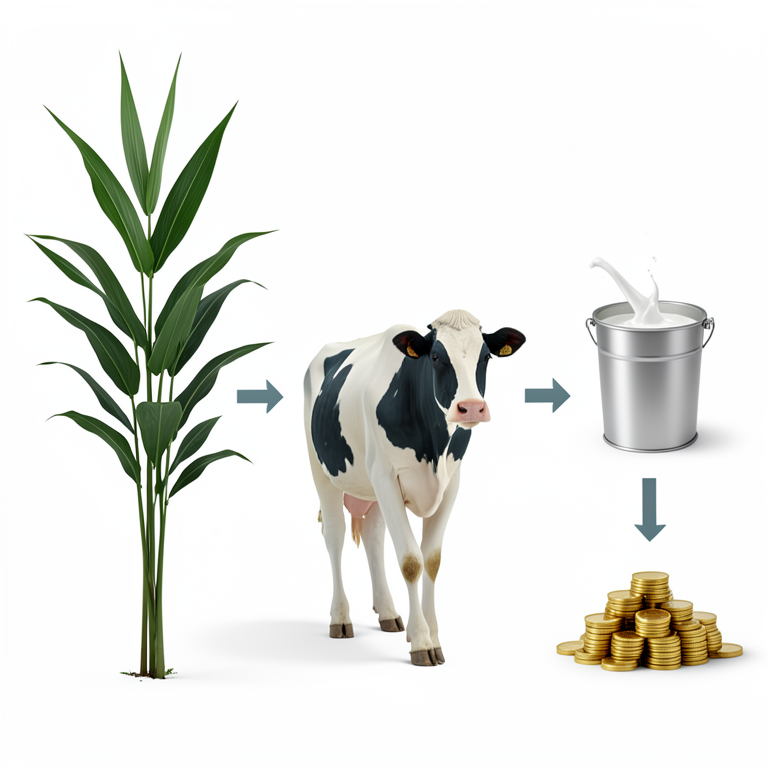
Benefits of Super Napier Integration
AI-generated conceptual illustration (Super Napier grass and Holstein Friesian cows). It explains the idea and does not show study data.
View source evidence ↗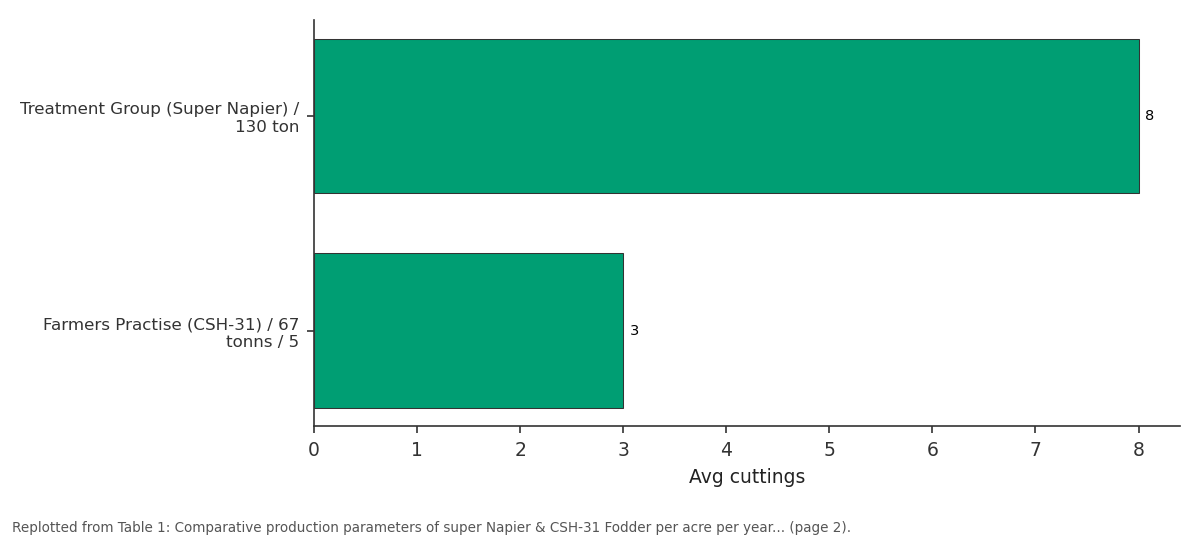
Avg cuttings: Treatment Group (Super... vs Farmers Practise...
Replotted from Table 1 (page 2) of the original paper. Every bar is the paper's own table value.
View source evidence ↗Figures & tables
From the original paper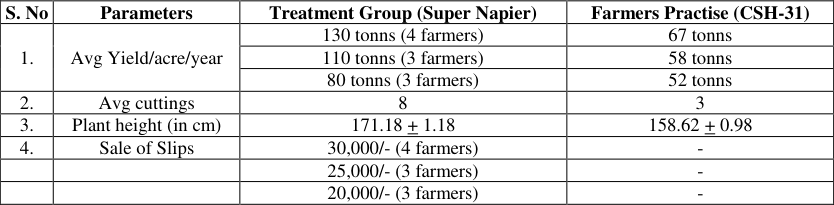 Table 1
 Table 2
 Table 3
Introduction
As the Livestock population continues to grow, the demand for feed and fodder has been increasing to meet the economically viable dairy enterprise. In India, dairy farming is one of the independent enterprises that provides regular income to farmers either by sale of milk or its by-products as an alternate source of income especially during crop damage incurred with extreme environment changes leading to drought and flood. However, success in the dairy sector depends on the feeding of quality feed & fodder of high nutritional value which accounts for 70% of the expenses of animal feed Kumar et al. (2012) [11] . The most challenging key faced by farmers is the deficit/steady supply of high-quality fodder for milch animals. The crisis for fodder in Indian conditions is due to the limited availability of land for fodder cultivation and it was reported with a shortage of 61.1 & 21.95 of green & dry fodder respectively (IGFRI 2011) [9] . The Majority of farmers feed the animals on crop residues & poor quality fodder which accounts for around 97% and feeding animals with these poorquality fodder causes ill health to animals & a decline in productivity Hegde (2012) [7] ., Aher et al. (2003) [2] . Here comes the solution for high-yielding fodder variety i.e. super Napier with an average biomass of 500 tonnes per hectare & resistant to pests & diseases. The first harvest of the super Napier fodder is at 60 days after which every cut is made with a gap of 45-60 days. The average number of harvests recorded is about 8 per year. Super Napier fodder has good nutritive value and the short intervals of the harvest are to feed at an early stage as the nutritive value depends on harvest intervals. Hybrid Napier is one among the fodder varieties that is widespread with perennial multi-cut nature & yields more biomass per year and profuse tillage Pandey & Roy (2011) [14] . The preservation of Napier fodder by silage results in high palatability and good aroma Kung & Shaver (2002) [12] . by the production of lactic acid, Acetic acid, and butyric acid during the fermentation process Miyagi et al (1993) [13] . replacing the deficit of green fodder, especially during droughts. As per Hatam et al (2001) [6] the performance regarding the production of good quantity & quality milk relies on the feeding of green fodder at various intervals during the year.
Most of the forage crops are nutritious but seasonal by which shortage of fodder is noticed and the adaptability of grasses to all types of climatic conditions & soils is more compared to forage trees February and Higgins (2010) [5] .
Methodology
The super Napier slips of 10,000 no. were initially procured from fodder seed multiplication farm (FSMF), Reddipalli, Animal husbandry department. These were initially cultivated in 1 acre of land at Krishi Vigyan Kendra farm, Reddipalli which were further extended to 4 acres of land and distributed to selected farmers under FLD trial. A total of 10,000 no slips to each farmer constituting 1 Lakh super Napier slips were distributed to 10 selected beneficiaries from KVK, Adopted villages. Prior to distribution & cultivation, farmers were given awareness programs & demonstrations to promote the utilization of super Napier fodder for milch animals feeding. The demonstration was conducted by pulverizing the soil before cultivation and the slips were planted in a slant direction by allowing a 2 ft distance apart between two slips & 3 ft distance between each row. The study was carried out for a period of 3 years from June 2020 to May 2023 and the data was collected and analyzed Statistically Snedecor & Cochran (1994).
Results and Discussion
Results and Discussion
Yield per acre per year
As depicted in Table 1. 4 farmers have shown an average fodder yield of 130t/acre, 3 farmers with 110t/acre & remaining 3 farmers have resulted with an average yield of 80t/acre. The high yield in the present study is in accordance with Biradar et al. (2014) [3] and Zac (2018) [18] . who reported high yields of super Napier varieties. The variations in the production yield of fodder are due to seasonal variations as reported by Anindo et al. (1994) [1] . Delena and Fulpagare (2015) [4] reported the high yield of super Napier with good nutritive value aids in fodder preservation by silage.
| S. No | Parameters | Treatment Group (Super Napier) | Farmers Practise (CSH-31) |
|---|---|---|---|
| 1. | Avg Yield/acre/year | 130 tonns (4 farmers) | 67 tonns |
| 110 tonns (3 farmers) | 58 tonns | ||
| 80 tonns (3 farmers) | 52 tonns | ||
| 2. | Avg cuttings | 8 | 3 |
| 3. | Plant height (in cm) | 171.18 + 1.18 | 158.62 + 0.98 |
| 4. | Sale of Slips | 30,000/- (4 farmers) | - |
| 25,000/- (3 farmers) | - | ||
| 20,000/- (3 farmers) | - |
Table text extracted from the original PDF; superscript letters are shown inline. The original table image is below.
View original table image
Production Parameters in Milch Animals
The present study concurrently aimed at a comparision of milk production parameters & quality of milk by estimation of Fat% & SNF% in the selected animals fed with fodder. The findings were in coincidence with Iqbal et al. (2006) [10] .; Hukkeri et al. (1977) [8] .; and Sattar et al. (1994) [17] . They observed that Napier fodder contains desirable forage characteristics viz., high dry matter yield, high protein concentration, high energy concentration (high digestibility), and high intake potential (low fiber content). This might be the reason for increasing the milk yield and milk quality parameters such as fat percent and SNF content in milk when compared to the farmer's practice fed with CSH-31 fodder.
Economics
Income generated by the sale of slips @ 60p/slip was observed in the majority of farmers by the sale of 50,000 slips per 3 harvests per year (Table 1) which is in accordance with Potter et al. (1987) who reported inventory of feed resources for small animals. Roy et.al (2016) [16] reported that the existing production and marketing system of fodder in the Meherpur district of Bangladesh is a livelihood activity. The increased income in the present study might be due to better production of fodder and additional income generation by the sale of slips. Purchase of 10,000 slips per acre/farmer @60p/slip 6000/-2.
Net income per acre/year for 3 harvests by sale of slips 30,000/-3.
Net Profit per acre/year for 3 harvests by sale of slips 24,000 + 0.75
Conclusion
The results from the present study concluded that production of super Napier depicted with a significant increase in an additional source of income of 30,000/-per acre per year for a single household apart from fodder yield for feeding the livestock. This study resulted in the development of selfesteem & entrepreneurship skills among rural youth & maintenance of animal health.
Acknowledgement
Authors would like to express gratitude to Krishi Vigyan Kendra Reddipalli, ANGRAU for providing resources for conduction of demonstration.
Figures and tables from the paper
| S.no | Parameters | Treatment Group | Farmers Practise |
|---|---|---|---|
| 1. | Average Milk Yield (kg/animal/day) | 7.37 + 0.58 | 5.45 + 0.32 |
| 2. | Avg Fat% | 4.54 + 0.31 | 3.68 + 0.23 |
| 3. | Avg SNF% | 8.01 + 0.13 | 7.89 + 0.67 |
Table text extracted from the original PDF; superscript letters are shown inline. The original table image is below.
View original table image
| S. No | Parameter | Rs. |
|---|---|---|
| 1. | Purchase of 10,000 slips per acre/farmer @60p/slip | 6000/- |
| 2. | Net income per acre/year for 3 harvests by sale of slips | 30,000/- |
| 3. | Net Profit per acre/year for 3 harvests by sale of slips | 24,000 + 0.75 |
Table text extracted from the original PDF; superscript letters are shown inline. The original table image is below.
View original table image
References
12 in the original paper- Aher VB, Tambe AB, Manjare MR, Desale JS. Forage Research in Maharashtra. Book Published by Forage Research Project. 2003;2(1):1-5.
- Biradar SA, Shreedhar JN, Ubhale P. Economics and varietal performance of Hybrid Napier and guinea grass under irrigated conditions of northern Karnataka. Forage Research. 2014;40(2):95-97.
- Delena MF, Fulpagare YG. Characteristics of Silage Prepared from Hybrid Napier, Maize, and Lucerne. IOSR Journal of Agriculture and Veterinary Science. 2015;8(5):13-16.
- February EC, Higgins SI. The distribution of trees and grass roots in savannas in relation to soil nitrogen and water. South African Journal of Botany. 2010;76:517-52.
- Hegde NG. Combating drought in the western region. The BAIF Journal. 2012;33:7-9.
- Hukkeri SB, Shukla NP, Rajput RK. Effect of levels of soil moisture and nitrogen on the fodder yield of oats on two types of soils. Indian J Agron. 1977;47:204-209.
- IGFRI. Vision 2030. Indian Grassland and Forage Research Institute, Jhansi; c2011.
- Iqbal A, Ayub M, Zaman H, Ahmed R. Impact of nutrient management and legume association on agroqualitative traits of maize forage. Pak J Bot. 2006;38:1079-1084.
- Kumar S, Agrawal RK, Dixit AK, Rai AK, Singh JB, Rai SK. Forage production technology for arable lands. Indian Grassland and Fodder Research Institute, Jhansi. 2012;2(8):40-43.
- Miyagi EY, Kawamoto Z, Koja Y, Masuda, Goto I. The effect of cutting interval on quality and palatability of Napier grass (Pennisetum purparuem schum) silage. Japan Grasil Science. 1993;39:51-56.
- Roy BK, Sarker NR, Alam MK, Huque KS. Existing production and marketing system of fodder under Meherpur District as Livelihood Activity. Bang Journal of Livestock Research. 2016;19(1-2):24-32.
- Sattar MA, Haque MF, Rahman MM. Intercropping maize with broadcast rice at different row spacing. Bangladesh J Agric. Res. 1994;19:159-164.