
Research article · 2023 · Full text
International Journal of Veterinary Sciences and Animal HusbandryIn ovo and early post hatch feeding and its effect on hatchability and broiler chick’s quality
Volume 8(5) · Pages 368–370 · DOI: 10.22271/veterinary.2023.v8.i5f.769 ↗
Research areasAnimal Nutrition and Physiology
Abstract
Author-writtenA biological experiment was carried out to investigate the effect of in ovo and early post-hatch feeding of early chick nutritional supplement (ECNS) on the hatchability and chick quality of broiler chicken. Five hundred and forty embrocated eggs were injected with 0.5 ml of normal saline, 10 per cent glucose, lysine, 0.5 per cent threonine, and 0.5 per cent β-hydroxy-β-methylbutarate (HMB) into amniotic fluid of 18 days old embryos. The hatched-out 288 broiler chicks were randomly allocated to six treatments of 48 chicks each. The steamed corn-soyabean and fish meal based early chick nutritional supplement (ECNS) was provided to broiler chicks immediately after hatch and continued till they were packed in the transport box. The data on hatchability, hatchling weight, egg/chick weight ratio, and transit weight loss of broiler chicks were recorded. In ovo feeding significantly (p
Summary
Source-checkedPlain-language reading of the full paper, prepared with AI and checked against the text. Each point links to the authors' own words.
Why it matters
- The first seven days of a commercial broiler's life represent 17% of its total growing period, making early nutrition critical. View evidence ↗
- Broiler chicks often face fasting periods of 24 to 36 hours during vaccination, packing, and transport before reaching the farm. View evidence ↗
- Transportation can lead to a body weight loss of 4 g per day in broiler chicks due to dehydration and the use of yolk and muscle glycogen. View evidence ↗
The question
- The study aimed to investigate how in ovo and early post-hatch feeding affect hatchling weight, the egg/chick weight ratio, and transit weight loss in broiler chicks. View evidence ↗
What they did
- Following hatching, 288 chicks were assigned to six treatment groups of 48 birds each, with three replicates of 16 birds per group. View evidence ↗
- An early chick nutritional supplement (ECNS) consisting of steamed corn, soybean, and fish meal was provided immediately after hatching until the chicks were packed for transport. View evidence ↗
- Data were analyzed using SPSS software, and means were compared using the Duncan multiple range test with a significance level of p < 0.05. View evidence ↗
What they found
- In ovo feeding significantly increased hatchability to 99.67%, compared to 92.22% in the control group (p < 0.01). View evidence ↗
- In ovo delivery of glucose, lysine, or HMB significantly increased hatch weight (48.69 to 49.01 g) compared to the control group (47.73 g) (p < 0.05). View evidence ↗
- The egg/chick weight ratio was significantly lower in the treatment groups (1.40 to 1.43) compared to the control group (1.44). View evidence ↗
- Transit weight loss was significantly reduced in groups receiving both in ovo and ECNS feeding (4.66% to 6.46%) compared to the control group (6.60%) (p < 0.05). View evidence ↗
- Early feeding via in ovo nutrients or ECNS did not have a statistically significant effect on chick mortality during the first week. View evidence ↗
What it means
- The authors conclude that combined in ovo and early post-hatch feeding can be used in field conditions to improve chick quality and production by reducing transit weight loss and eliminating ketosis. View evidence ↗
Visual summary
2 visualsIllustrations explain the paper; charts are replotted from the paper's own table values.
Early Nutrition Timeline
AI-generated conceptual illustration (broiler chicken embryos and hatchlings). It explains the idea and does not show study data.
View source evidence ↗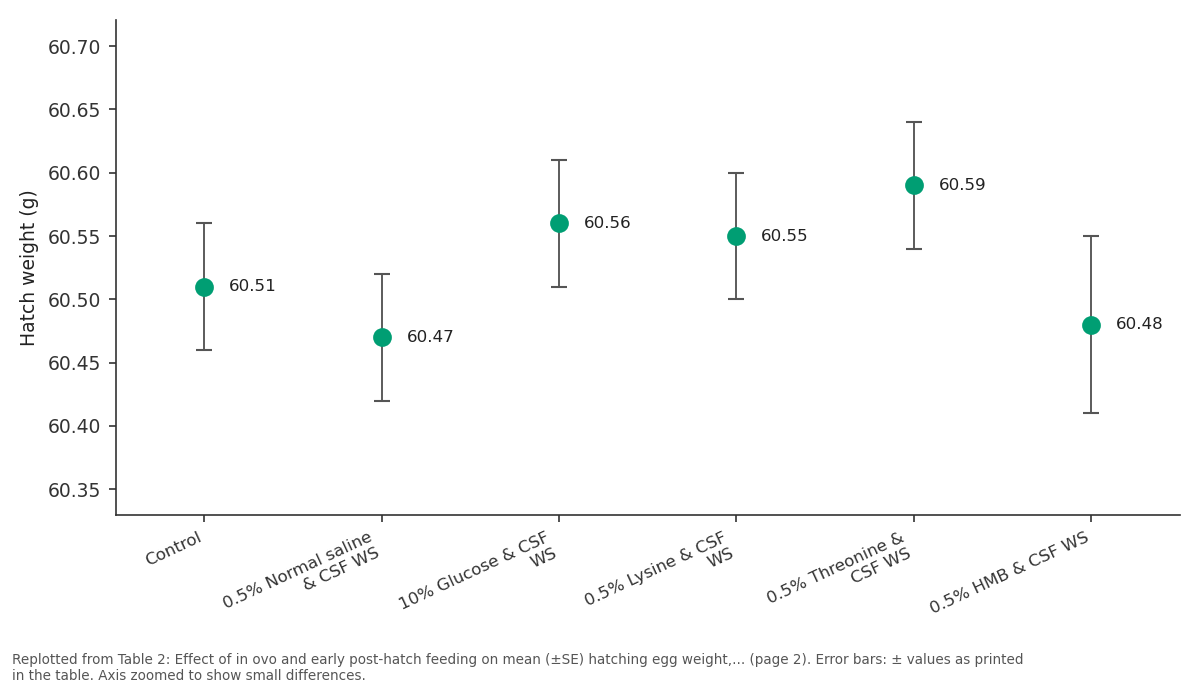
On 18th d of Incubation / (N=90): Control vs 0.5% Normal saline &... vs 10% Glucose & CSF WS vs 0.5% Lysine & CSF WS vs 0.5% Threonine & CSF WS
Replotted from Table 2 (page 2) of the original paper. Every bar is the paper's own table value.
View source evidence ↗Figures & tables
From the original paper Table 1
 Table 2
Introduction
The first seven days of fast-growing commercial broilers accounts for 17 per cent of its growing period. These broilers are forced to fasting of in their 5-7 per cent of life due to a wide "hatching window". Moreover, broiler chicks were further subjected to fasting of 24 -36 hours till it reaches the farm due to vaccination, packing, and transport. Bhanja et al., 2009) [1] reported that the broiler chicks lose their body weight by 4 g per day due to dehydration and utilization of yolk and pectoral is muscle glycogen utilization during transportation time. The chicks are also more susceptible to disease causing organisms (Dibner et al., 1996) [2] , and hampers the growth of vital tissues (Halevy et al., 2000) [3] . Noy et al., 2001 [4] reported that a good start leads to a good 7 th day weight of uniform flock size which is directly correlated with marketing weight of the broilers. Early feeding in commercial broilers has beneficial effects such as eliminating ketosis, reducing transit weight loss, minimizing slow starters, improving appetite, increasing growth performance, enhancing immunity, improving survivability, minimizing carcass rejections, increasing carcass weight and meat yield in broilers (Panda et al., 2013) [5] . Rapid growth potential within a short growing period of time in commercial broilers has provoked scientist's interest in early chick nutrition. At present minimal study has been carried out under field conditions. Therefore, this nutritional study was conducted to investigate the effect of in ovo and early post-hatch feeding on the hatchling weight, egg/chick weight, and transit weight loss of broiler chicks.
Materials and Methods
Five hundred and forty hatching eggs with uniform size (68 ± 1g) were divided into nine treatments and sub divided in to three replicates of each 30 eggs.
The embryonated eggs were injected with various nutrient solutions as per the method described by Noor et al. (1995) [6] method. Each of 90 embryonated eggs were injected with different treatment solutions viz., 10 per cent glucose, lysine, 0.5 per cent threonine, and 0.5 per cent β-hydroxy-βmethylbutarate (HMB) into amniotic fluid of 18 days old embryos. One group is kept as injected control who is injected with 0.5 ml of Normal Saline to assess the stress of injection and handling, The control eggs were subjected to similar conditions i.e., kept for 15 minutes in the same environment to normalize the conditions for all the treatment groups. After hatching, 288 broiler chicks were divided in to six treatments of 48 chicks each and further subdivided in to three replicates of 16 chicks. The steamed corn-soya and fish meal based early chick nutritional supplement (ECNS) was fed to broiler chicks immediately after hatch and continued till they were packed in the transport box. The control (T1) birds were fasted for 24 h similar to that occur under field conditions. The experimental birds were fed ad libitum with pre-starter diet from 1-7 days, starter mash from 8-21 days and finisher mash from 22 days till marketing. The experimental diets were prepared as per as per BIS (2007) [7] recommendations. Data on the weight of the hatching egg, hatchling, and chick were recorded with 0.2 g accuracy by using electronic balance. The hatchability, and egg/chick weight ratio were calculated. The body weight of the broiler chicks was recorded at the hatch, and at the farm after transportation to calculate transit weight loss. Data collected in this experiment were statistically by Statistical Package for Social Science (SPSS, 1999) [8] software and the means were compared by Duncan multiple range test at a five per cent significance (p<0.05) level.
The Institutional Animal Ethics Committee of the Tamil Nadu Veterinary and Animal Sciences University, Chennai -600 051 assessed and approved all institutional guidelines and experimental procedures used in this experiment.
Results and Discussion
The data on weight of hatching egg, hatchability, day-old chick weight, ratio of egg/chick weight and transit weight loss in broiler chicks experimented with in ovo and early posthatch feeding is presented in Table 2.
| Treatments | Hatching egg weight (g) | — | Hatch weight (g) | Egg / Chick weight ratio | Hatchability (%) | Transit Weight Loss (%) | Early chick mortality (%) |
|---|---|---|---|---|---|---|---|
| On Setting | On 18th d of Incubation | ||||||
| (N=90) | (N=90) | (N=48) | (N=48) | (N=3) | (N=48) | ||
| Control | 68.81±0.05 | 60.51±0.05 | 47.73b±0.29 | 1.44a±0.01 | 92.22b±0.02 | 6.60a±0.25 | 1.54±0.90 |
| 0.5% Normal saline & CSF WS | 68.77±0.05 | 60.47±0.05 | 48.39ab±0.30 | 1.42ab±0.01 | 96.67a±0.00 | 6.02a±0.24 | 0.00±0.00 |
| 10% Glucose & CSF WS | 68.86±0.05 | 60.56±0.05 | 48.69a±0.17 | 1.42bc±0.00 | 96.67a±0.00 | 6.46a±0.25 | 0.00±0.00 |
| 0.5% Lysine & CSF WS | 68.85±0.05 | 60.55±0.05 | 48.93a±0.32 | 1.41bc±0.01 | 96.67a±0.00 | 6.05a±0.22 | 0.00±0.00 |
| 0.5% Threonine & CSF WS | 68.89±0.05 | 60.59±0.05 | 48.34ab±0.31 | 1.43ab±0.01 | 96.67a±0.00 | 5.75a±0.30 | 0.00±0.00 |
| 0.5% HMB & CSF WS | 68.78±0.07 | 60.48±0.07 | 49.01a±0.22 | 1.40c±0.01 | 96.67a±0.00 | 4.66c±0.23 | 1.19±0.19 |
| Statistical significance | NS | NS | * | * | ** | * | NS |
Table text extracted from the original PDF; superscript letters are shown inline. The original table image is below.
View original table image
The hatching egg weight was between 68.77 and 65.89g on the day of set in the incubator. On the day of in ovo feeding, which ranged from 60.47 to 64.59 g i.e., on the 18 th day of incubation. The hatchability was improved significantly (P<0.01) by in ovo feeding (99.67 percent) compared to control (92.22 per cent) and was witnessed by Kulandaivel (2007) [9] who reported that the in ovo feeding increased the per cent hatchability by 7 per cent over that of control. The hatch weight of broilers was significantly (p<0.05) increased (48.69 to 49.01 g) by in ovo delivery of glucose, lysine, HMB nutrients than that of normal saline, threonine and control (47.73 g). This finding is in line with the results of Kulandaivel (2007) [9] who recorded higher hatch weight in treatment groups (37.76 to 37.85 g) than of control (37.66 g).
The egg/chick weight ratio of broilers recorded in this study was significantly affected in this study (1.40 to 1.43) than 1.44 of control was in agreement with the findings of Kulandaivel (2007) [9] who also found significant variations in the ratio ranged from 1.32 to 1.39 in treatment groups and 1.39 in control.
The transit weight loss of the broiler chick was significantly (p<0.05) reduced in both in ovo and ECNS-fed groups (6.46 to 4.66 per cent) compared to the control (6.60 per cent). On perusal of literature, no scientific report could be found to justify this research findings. The mortality of the chick during first week was not statistically influenced by in ovo feeding of glucose, lysine, and threonine and early post-hatch feeding of ECNS. The beneficial effect of reducing the transit weight loss, stress, and early mortality in chicks might be due to the prevention of dehydration of chicks during holding and transit time to the farm. The improved performance might be due to early development of gastrointestinal tract of the broilers by the nutrients supplied by the by the in ovo and post-hatch feeding of CSF WS ECNS. In addition the secretion of brush border enzymes by the stimulus of the presence of nutrients and feed particles could played a vital role in the digestion and absorption of nutrients.
Conclusion
In ovo feeding increased hatchability in this study, Combined feeding of both in ovo and CSF WS ECNS significantly increased hatch weight, egg/chick weight ratio, and significantly reduced transit weight loss in chicks whereas chick mortality during first week was not significantly affected by early feeding. With regard to the overall long term beneficial effect of ovo and early post hatching feeding on broiler performance, since it decreases transit bodyweight loss; mitigates slow starts by eliminating ketosis without affecting chick viability, this product is able to be used under field conditions for improving chicks' quality and subsequent production. This helps in obtaining higher returns and better growing charges for the farmers involved in the contract farming system.
Acknowledgement
The author has given great credit to Tamil Nadu Veterinary and Animal Sciences University, Chennai-51, for providing all the infrastructure and funds needed to carry out this work.
Figures and tables from the paper
| In ovo feeding | — | — | Early post hatch feeding | — | — | — |
|---|---|---|---|---|---|---|
| Treatments | Eighteen days old embryonated eggs utilized for injection (Nos) | CSF WS ECNS* feeding after hatch (No. of birds utilized) | ||||
| R1 | R2 | R3 | R1 | R2 | R3 | |
| Control | 30 | 30 | 30 | 16 | 16 | 16 |
| Normal saline 0.5 ml | 30 | 30 | 30 | 16 | 16 | 16 |
| 10 % glucose 0.5 ml | 30 | 30 | 30 | 16 | 16 | 16 |
| 0.5 % lysine 0.5 ml | 30 | 30 | 30 | 16 | 16 | 16 |
| 0.5 % Threonine 0.5 ml | 30 | 30 | 30 | 16 | 16 | 16 |
| 0.5 % β-hydroxy-β methylbutarate (HMB) 0.5 ml | 30 | 30 | 30 | 16 | 16 | 16 |
Table text extracted from the original PDF; superscript letters are shown inline. The original table image is below.
View original table image
References
6 in the original paper- Bhanja SK, Devi C, Panda AK, Shyamsunder G. Effect of post hatch feed deprivation on yolk sac utilization and performance of young broiler chickens. AsianAustralasian Journal of Animal Sciences. 2009;22(8): 1174-1179.
- Dibner JJ, Kitchwell ML, Atwell CA, Ivey FJ. The effect of dietary ingredients and age on the microscopic structure of the gastrointestinal tract in poultry. The Journal of Applied Poultry Research. 1996;5:70-77.
- Halevy OA, Geyra M, Barak Z, Uni D, Sklan D. Early post hatch starvation decreased satellite cell proliferation and skeletal muscle growth in chicks. Journal of Nutrition. 2000;130:858-64.
- Noy Y, Geyra A, Sklan D. The Effect of early feeding on growth and small intestinal development in the posthatch poult. Poultry Science. 2001;80:912-919.
- Panda AK, Bhanja SK, Shyam Sundar G. Early post hatch nutrition on growth and a development in commercial broiler chickens: A review. Animal Nutrition Feed Technology. 2013;13:323-333.
- Noor SM, Husband AJ, Widders PR. In-ovo vaccination with Campylobacter jejuni establishes early development of intestinal immunity in chickens. Poultry Science. 1995;36:563-573.