
Research article · 2023 · Full text
International Journal of Advanced Biochemistry ResearchComparative study on hermetic and non-hermetic storage of Pearl millet (Pennisetum glaucum)
Volume 7(2S) · Pages 349–352 · DOI: 10.33545/26174693.2023.v7.i2se.233 ↗
Research areasGABA and Rice Research
Abstract
Author-writtenMillets are one of the major cereal grains consumed worldwide, especially in arid and semi-arid areas of Africa and Asia (India and China). Storage is one of the vital post-harvest operations, where the country stores the food commodities in huge capacities for maintaining the buffer stock for future purpose. During long-term storage, Pearl millet (Pennisetum glaucum) storage is essential to maintain its quality and prevent spoilage. A comparative study of hermetic and non-hermetic bags on Pearl millet was conducted in four different storage bags viz. gunny bags (control), polypropylene bags, Grainpro hermetic storage bags, Proharvest hermetic storage bags. Hermetic storage of Pearl millet shows that GrainPro hermetic bags & Proharvest hermetic bags were superior with respect to nutrient retention, no visible mold or pest infestation. It is desirable to use hermetic bags for the storage of millets when it is intended for small scale storage.
Summary
Source-checkedPlain-language reading of the full paper, prepared with AI and checked against the text. Each point links to the authors' own words.
Why it matters
- Millets are significant cereal grains consumed globally, particularly in the arid and semi-arid regions of Asia and Africa. View evidence ↗
- Annual millet storage losses can reach 20-30% due to moisture, diseases, and pests. View evidence ↗
- Effective storage is necessary to protect grain quality and prevent spoilage and pest infestation. View evidence ↗
The question
- The study aimed to explore how hermetic and non-hermetic storage affect the germination, internal moisture, temperature, and relative humidity of Pearl millet. View evidence ↗
What they did
- The researchers compared four types of storage bags: gunny bags (control), polypropylene bags, GrainPro hermetic bags, and Proharvest hermetic bags. View evidence ↗
- Triplicated 1 kg samples were stored for four months under ambient conditions of 30±4 °C and 60±10% relative humidity. View evidence ↗
- Germination and moisture content were analyzed as quality parameters on a monthly basis. View evidence ↗
What they found
- After 120 days, moisture content increased to 11.15 ± 0.14% in gunny bags and 10.45 ± 0.09% in polypropylene bags, while remaining lower at 9.61 ± 0.21% in hermetic bags. View evidence ↗
- T. castaneum infestation occurred in gunny bags by day 30 and polypropylene bags by day 60, but no infestation was found in hermetic bags through day 120. View evidence ↗
- Visible mold growth occurred in non-hermetic (gunny and polypropylene) bags, but was absent in hermetic bags. View evidence ↗
- Germination dropped drastically to 17.36% and 25.43% in gunny and polypropylene bags, while hermetic bags maintained high germination rates of 92.12% and 93.32% from an initial 97.33%. View evidence ↗
- Nutrient composition remained stable in hermetic bags, while slight changes in protein content were observed in non-hermetic bags. View evidence ↗
What it means
- The authors conclude that GrainPro and Proharvest hermetic bags are superior for nutrient retention and preventing mold and pests, making them ideal for small-scale storage. View evidence ↗
- Hermetic storage is recommended as an eco-friendly technique that maintains food quality by avoiding chemical fumigants and reducing storage losses. View evidence ↗
Visual summary
3 visualsIllustrations explain the paper; charts are replotted from the paper's own table values.
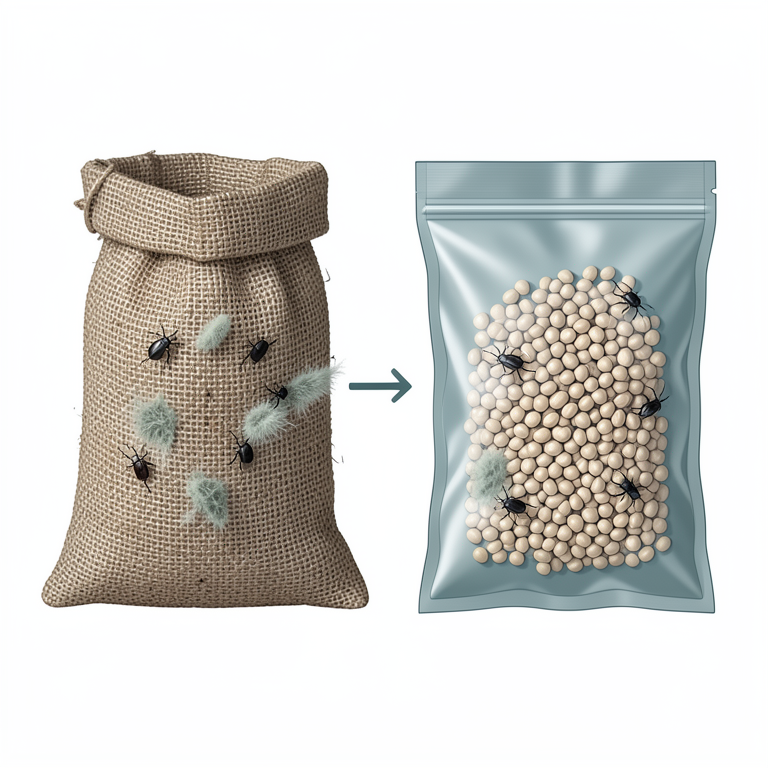
Comparison of Storage Environments
AI-generated conceptual illustration (Pearl millet grains in storage bags). It explains the idea and does not show study data.
View source evidence ↗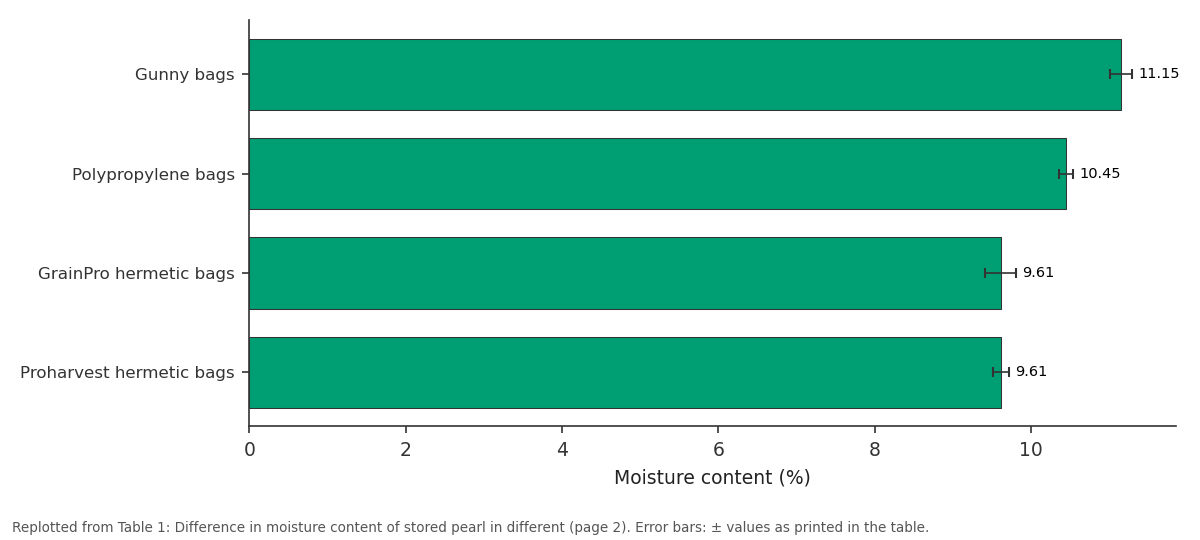
Final (120th day): Gunny bags vs Polypropylene bags vs GrainPro hermetic bags vs Proharvest hermetic bags
Replotted from Table 1 (page 2) of the original paper. Every bar is the paper's own table value.
View source evidence ↗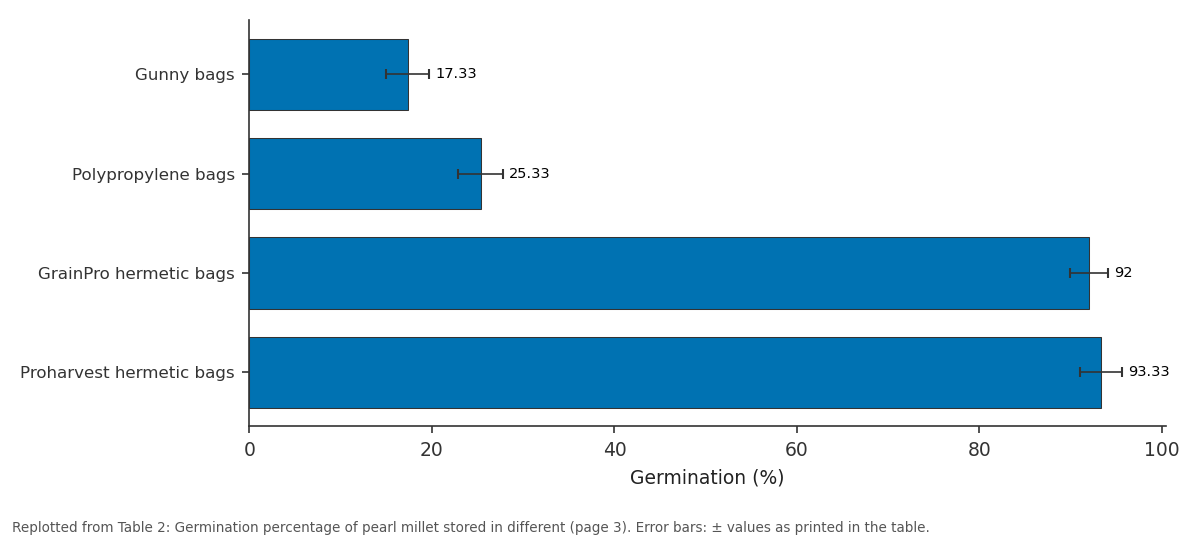
Final: Gunny bags vs Polypropylene bags vs GrainPro hermetic bags vs Proharvest hermetic bags
Replotted from Table 2 (page 3) of the original paper. Every bar is the paper's own table value.
View source evidence ↗Figures & tables
From the original paper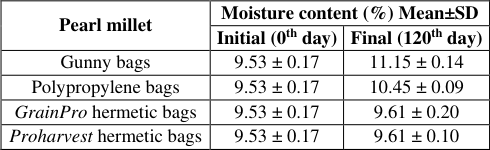 Table 1
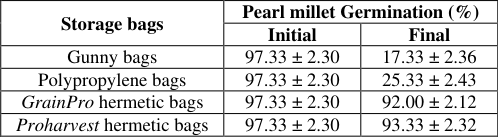 Table 2
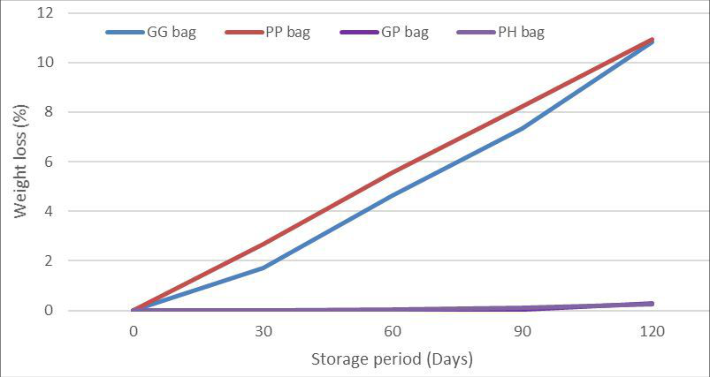 Figure 1
Introduction
Millets are one of the oldest human food and believed to be the first domestic cereal grain (Michaelraj & Shanmugam, 2013) [5] . India is the world's largest producer of millet with the production of 11.5 MMT (FAOSTAT, 2020) [3] . Food safety and storage are major concern to the world's population. Storage is one of the vital post-harvest operation, where the country store the food commodities in huge capacities for maintaining the buffer stock for future purpose (Mishra, Prabuthas, & Mishra, 2012) [6] . Storing pearl millet, like storing any grain, can present numerous challenges. Proper storage is important to prevent spoilage, maintain grain quality, and protect it from pests. During long-term storage, proper sorghum storage is essential to maintain its quality and prevent spoilage. By addressing these common storage problems, you can ensure that pearl millet remains in good condition for extended periods. Pearl millet, as reported by Sade (2009) [7] , exhibits higher protein (14.01%), fat (5.71%), fiber (2.10%), and ash (2.21%) content compared to major cultivated cereal crops like wheat, rice, and sorghum. Additionally, research by Yadav et al. (2014) [8] highlights its greater protein quality, with notable levels of amino acids like tryptophan and threonine. Along with, increased calcium, iron, and zinc content, rendering this crop highly valuable for human consumption. Commonly it is cultivated in India, Nepal, Sri Lanka, East China and Bangladesh, Kenya, Tanzania etc. Millet storage losses per year can vary depending on the region and storage conditions, but can be as high as 20-30%. This is due to a variety of factors, including pests, diseases, and moisture (FAOSTAT, 2020) [3] . In this research, the impact of internal moisture, germination, temperature and relative humidity on Pearl millet (Pennisetum glaucum) will be explored in hermetic and non-hermetic storage.
Materials and Methods
Materials and Methods
Raw materials and storage bags used
Pearl millet (Pennisetum glaucum) used in this experiment were procured from local market of Raipur, Chhattisgarh, India. Pearl millet was cleaned to remove the dirt, dust and chaff materials. Proharvest and GrainPro hermetic bags was purchased from Universal Enterprises, India and PCI, India, respectively. Gunny bags and polypropylene bags are purchased from local market of Raipur, Chhattisgarh, India.
Determination of moisture content
Moisture content of pearl millets was determined using standard hot air oven method (AOAC 2006) [1] . Three samples of 5 g each were drawn randomly from each bag that were used for the storage study. Temperature of the hot air oven was set to 110 °C and the sample was kept inside the chamber for 3 hours.
Estimation of weight loss
Grain weight losses is the quantitative loss that occurs due to insect infestation and moisture variation with respect to storage environment. Percent weight change in Pearl millet was calculated by using the equation:
Where, I = initial weight observed before the storage study begins F = final weight observed after storage study on monthly basis
Estimation of changes in colour
The CIE colour values (L*, a*, b*) of pearl millets were analyzed using Hunter lab colorimeter with D 25 optical sensor (Hunter Associates Laboratory, Reston, VA). The change in colour was estimated using the equation:
Where, L = level of lightness, ranging from 0 (black) to +100 (white); a = -100 (greenness) to +100 (redness) and b = -100 (blueness) to +100 (yellowness) Note: All the capital letters (L, A, B) and small letters (l, a, b) used in the equation stands for initial and final values, respectively
Assessment of pest infestation
Stored food commodities are affected by biotic and abiotic factors. Among these, pest infestation is a major issue which leads to contamination making the food unsafe for human consumption (Moses at el., 2015) [9] . Pest infestation in Pearl millet during the storage period was observed visually by removing the grains from bags in tray after opening the stored bags.
Visual mold growth assessment
Visible mold growth gives possibilities of mycotoxin production on the product. High temperature, relative humidity and high pest infested commodities are more prone to mold infestation. The visible mold growths in samples were visually observed by removing the grains in open tray and were also viewed in stand-alone LCD digital microscope (POLY UM038).
Estimation of germination percentage
Germination is one of the important factors to be considered during storage of grains. It is used as an index to test the viability of the grains. For the germination test, Petri dish of 9 cm diameter was taken and Whatman No. 3 filter paper was placed in it. 5.5 ml of distilled water was added into the Petri dish and each petri dish was stacked and covered by using polyethylene bag. This covered Petri dish was then kept in incubator at 25°C for 4 days. Then, polyethylene bag was removed from the incubator and was kept under normal room temperature for 3 days. The germination percentage of seeds were calculated after 7 days by following formula (Chandraprabha and Sharon, 2021) [10] .
Temperature and relative humidity
Temperature and relative humidity were recorded using HTC easy log data logger model inside the cocoon to observe any changes that result during storage. At the end of the storage period, data on temperature and relative humidity were recorded by transferring the data to the data logger using software and the data were subjected to statistical analysis.
Statistical analysis
All analysis for the study were performed in triplicates. The difference among the means were tested by one-way ANOVA, at 95% CI (p<0.05), using statistical software SPSS version 25.
Results
Results
Moisture content of Pearl millet
Grain moisture content plays an important role, which affects the storage quality. Variation in moisture content of stored Pearl millet in gunny bags, polypropylene bags, GrainPro bags and Proharvest bags were analysed. Initial average level of moisture content in procured Pearl millet 9.53 ± 0.17% wb. There was no significance difference were found in hermetic storage conditions but there was significance difference were observed in control storage device gunny bag as well as in polypropylene bag. After 120 th day of storage of Pearl millet moisture content of pearl millet was analysed 11.15 ± 0.14% in gunny bag, 10.45 ± 0.09% in polypropylene bag, 9.61 ± 0.21% in hermetic storage devices.
Assessment of pest infestation
In the present study T. castaneum damage in pearl millet were recorded in gunny bags of from 30 th day of storage itself. Pearl millet stored in polypropylene bags were infested by T. castaneum 60 th day of storage. There was no insect infestation in pearl millet stored in hermetic bags till the end of the storage period (120 th days).
Determination of visual mold growth
Visible mold growth was observed in pearl millet stored in gunny and polypropylene bags. This could be due to environmental effect, increase in moisture content, water activity and pest infestation in gunny and polypropylene bags there was no visible mold growth observed in pearl millet stored in hermetic bags.
Estimation of germination test
Germination percentage was calculated for pearl millet. The initial and final germination percentage of pearl millets are mentioned below in Table 2. Pearl millet stored in gunny and polypropylene bags affected the germination drastically and recorded very low germination percentage (17.36, 25.43%). The GrainPro and Proharvest hermetic bags recorded (92.12 & 93.32%) germination compared to initial germination percentage of 97.33%. Grain pro and Proharvest hermetic bags do not show any variation in germination percentage and maintained the same up to 120 days of storage period.
| Storage bags | Pearl millet Germination (%) | — |
|---|---|---|
| Initial | Final | |
| Gunny bags | 97.33 ± 2.30 | 17.33 ± 2.36 |
| Polypropylene bags | 97.33 ± 2.30 | 25.33 ± 2.43 |
| GrainPro hermetic bags | 97.33 ± 2.30 | 92.00 ± 2.12 |
| Proharvest hermetic bags | 97.33 ± 2.30 | 93.33 ± 2.32 |
Table text extracted from the original PDF; superscript letters are shown inline. The original table image is below.
View original table image
Temperature and relative humidity
Temperature and relative humidity were analysed by using the Easy Temperature Humidity software of HTC easy log data logger which was kept in laboratory. The average Temperature 30±4 °C and relative humidity 60±10% was recorded.
Biochemical analysis of stored pearl millet
Proximate analysis consists nutrient profile of pearl millet protein content, fat, fibre, ash was analysed before (0 th day) & after (120 th day) storage in different packaging devices. Study on storage of pearl millet there was no much changes with respect to nutrient composition of millets stored in packaging in the hermetic bags (GrainPro bag and Proharvest bag) compared with non-hermetic bags (gunny bag and polypropylene). Slight changes were observed in protein content of the pearl millet stored in gunny and polypropylene bags. This might be due to increase in moisture content and temperature variation.
Discussion
Hermetic storage of pearl millet shows that GrainPro hermetic bags & Proharvest hermetic bags were superior with respect to nutrient retention, no visible mold or pest infestation. It is desirable to use hermetic bags for the storage of millets when it is intended for small scale storage. Insect infestation not only affect the quality and quantity of the food grains, also cause negative impact on human health, viability of the grain, and loss in nutritional value and reduces the commercial value (Kumar et al., 2017) [4] .
Pearl millet is damaged by a number of insect pests, which leads to quantitative and qualitative losses. The common and affective pest is rice weevil (Sitophilus oryzae) in stored pearl millet. Germination is also an important factor vary based on the storage and loss of viability and nutrients in grains like pearl millets were reported due to non-scientific storage practices (Dejene, 2004) [2] . Hermetic storage is a promoting eco-friendly technique the help to increase the shelf life of stored food commodities without compromising the quality. Hermetically stored Food commodities showed better quality retention than conventional storage practices. Hermetic storage can be adopted for long and short term storage for both bulk and small scale storage of food commodities. Hermetic storage of pearl millets were effective in maintaining the quality parameters by avoiding insect and mold growth over four months of storage as compared with conventional gunny bags and polypropylene bags. The quality paramters like weight loss, moistute content, water activity, visible mold growth and pest infestation were increased over storage period in pearl millet stored in gunny bags and polypropylene bags. Whereas no variation in hermetic storage was recorded.
Conclusion
Hermetic storage of pearl millet shows that GrainPro hermetic bags & Proharvest hermetic bags were superior with respect to nutrient retention, no visible mold or pest infestation. It is desirable to use hermetic bags for the storage of millets when it is intended for small scale storage. Farmers and manufacturers are facing huge post-harvest storage losses. Lack of low-cost storage structures with ease of convenience can solve the storage problems effectively. Among the different storage structures, hermetic storage bags are found to be effective. Hermetic storage is a promoting eco-friendly technique the help to increase the shelf life of stored food commodities without compromising the quality. Hermetically stored Food commodities showed better quality retention than conventional storage practices. Hermetic storage can be adopted for long and short term storage for small-scale storage of food commodities. This technique avoids the use of chemical fumigants during storage & avoid pest infestation and storage losses, thus helps in maintaining the quality of the foods. In the present study hermetic storage of millets showed better quality retention by no pest and visible mold growth throughout storage period.
Figures and tables from the paper
| Pearl millet | Moisture content (%) Mean±SD | — |
|---|---|---|
| Initial (0th day) | Final (120th day) | |
| Gunny bags | 9.53 ± 0.17 | 11.15 ± 0.14 |
| Polypropylene bags | 9.53 ± 0.17 | 10.45 ± 0.09 |
| GrainPro hermetic bags | 9.53 ± 0.17 | 9.61 ± 0.20 |
| Proharvest hermetic bags | 9.53 ± 0.17 | 9.61 ± 0.10 |
Table text extracted from the original PDF; superscript letters are shown inline. The original table image is below.
View original table image
References
7 in the original paper- Kumar D, Kalita P. Reducing postharvest losses during storage of grain crops to strengthen food security in developing countries. Foods. 2017 Jan 15;6(1):8.
- Michaelraj PS, Shanmugam A. A study on millets based cultivation and consumption in India. International Journal of Marketing, Financial Services & Management Research. 2013 Apr;2(4):49-58.
- Mishra A, Prabuthas P, Mishra HN. Grain storage: methods and measurements. Quality Assurance and Safety of Crops & Foods. 2012 Sep;4(3):144.
- Sade FO. Proximate, antinutritional factors and functional properties of processed pearl millet (Pennisetum glaucum). Journal of Food Technology. 2009 Jan 1;7(3):92-7.
- Yadav DN, Sharma M, Chikara N, Anand T, Bansal S. Quality characteristics of vegetable-blended wheatpearl millet composite pasta. Agricultural Research. 2014 Sep;3:263-70.
- Moses JA, Jayas DS, Alagusundaram K. Climate change and its implications on stored food grains. Agricultural Research. 2015 Mar;4:21-30.
- Chandraprabha S, Sharon CL. Optimisation of conditions for barnyard millet germination. Plant Arch. 2021 Apr 1;21:1676-80.
Cited by 3
From OpenAlex, OpenCitations and reference lists read by Scinovex
- Engineering interventions, challenges, and strategies in processing and utilization of pearl millet ↗
P. Prashanth, Thirumal Sundaresan, Heena Sudhakar Kamdi, Shagolshem Mukta Singh, T. Jayasree Joshi, P. Srinivasa Rao · Food and Humanity · 2025
❝ 3 - Preserving pearl millet [Pennisetum glaucum (L.) R. Br)] seed quality and quantity in local informal seed systems in semi-arid areas: the potential of hermetic and traditional storage technologies ↗
Gracious Chingoma, Loveness Kuziwa Nyanga, Irene Kadzere, Brighton Marimanzi Mvumi · SSRN Electronic Journal · 2026
❝ 0PDF - Effectiveness of hermetic and traditional storage technologies in preserving pearl millet [Pennisetum glaucum (L.) R. Br)] seed quality in semi-arid areas of Zimbabwe's informal seed systems ↗
Gracious Chingoma, Loveness Kuziwa Nyanga, Irene Kadzere, Brighton Marimanzi Mvumi · Crop Protection · 2026
❝ 0