
Research article · 2023 · Full text
International Journal of Statistics and Applied MathematicsBridging the gap: Exploring farmer feedback on agricultural extension training
Volume 8(5S) · Pages 990–994 · DOI: 10.22271/maths.2023.v8.i5sn.1318 ↗
Research areasDiverse Educational Innovations StudiesAgricultural Innovations and Practices
Abstract
Author-writtenThe study was conducted to investigate farmer’s perceptions and response towards agricultural extension training programmes. The sample comprised of 101 trainees who attained training at Directorate of extension Education, Dr YS Parmar University of Horticulture & Forestry. The result of the study presented that the information provided in training sessions was perceived relevant by the trainee farmers. Most of the farmers agreed that training needs are realistic, useful and based on farming training programme. Respondents also agreed that their performance has increased after attending training programmes. Majority of the farmers enjoy the training session. Training programme increase both farm productivity and quality of farm productivity. The study dismisses the notion that extension is inefficient, ineffective and invisible. The overall finding suggests that the most of farmers believe that the extension training help to increase productivity and quality of farm quantity. On the other hand, the study found that trainers take too lengthy lectures and most of the training sessions are unplanned. Unplanned. The study also reported that there is lack of motivation and encouragement in training session.
Summary
Source-checkedPlain-language reading of the full paper, prepared with AI and checked against the text. Each point links to the authors' own words.
Why it matters
- Training is a systematic process used to acquire specific knowledge or skills, aiming to create permanent improvements in a person's job performance. View evidence ↗
- Farmer training consists of intensive learning activities led by experts to help farmers understand and practice the skills required to adopt new technologies. View evidence ↗
- Education and training are linked to a higher likelihood of farmers successfully changing their management practices. View evidence ↗
The question
- The study aimed to assess farmer feedback and perceptions regarding agricultural extension training. View evidence ↗
What they did
- The research was conducted with a sample of 101 farmers who received training at the Directorate of Extension Education, Dr Yashwant Singh Parmar University of Horticulture & Forestry in Himachal Pradesh. View evidence ↗
- Data was collected via personal interviews using a structured questionnaire, which included demographic information and Likert-scale statements to evaluate attitudes and satisfaction. View evidence ↗
What they found
- 84.14% of respondents perceived that the training increased both the productivity and the quality of their farm output. View evidence ↗
What it means
- The authors conclude that while agricultural training effectively increases productivity and quality, it is hindered by unplanned sessions and overly long lectures. View evidence ↗
- The authors recommend that training sessions be meticulously planned to be both informative and motivational to better encourage trainees. View evidence ↗
Visual summary
2 visualsIllustrations explain the paper; charts are replotted from the paper's own table values.
The Training Gap
AI-generated conceptual illustration (Small-scale vegetable farm and a training classroom). It explains the idea and does not show study data.
View source evidence ↗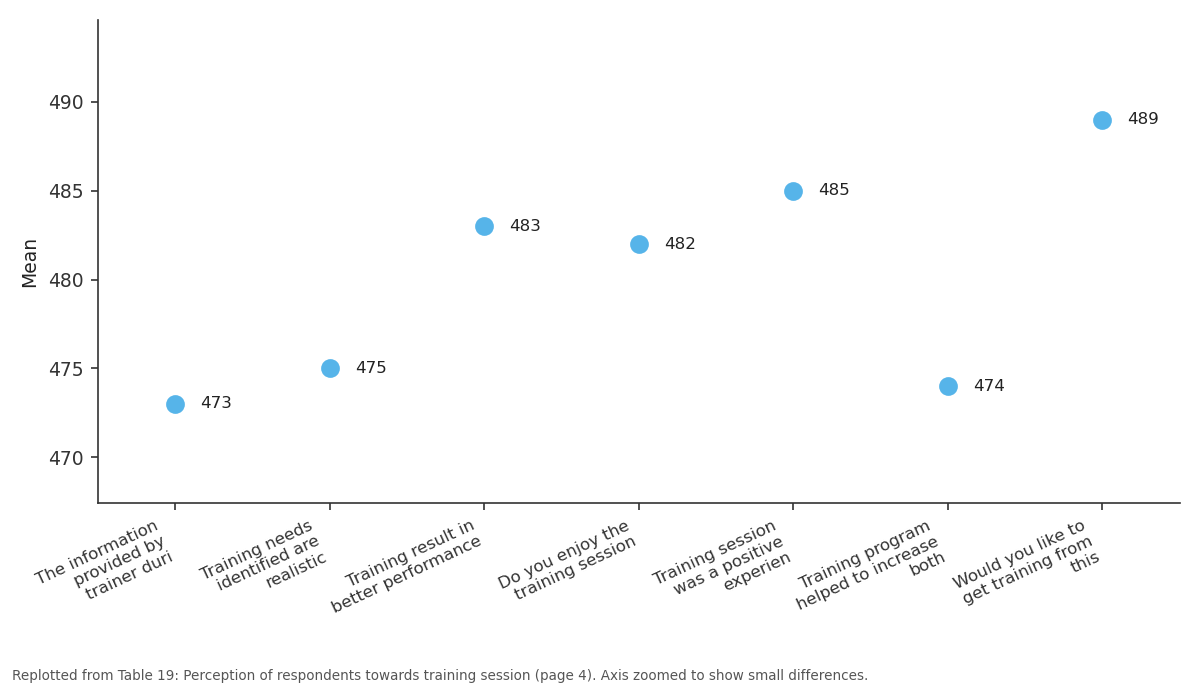
Total Score (Code*TR): The information... vs Training needs... vs Training result in... vs Do you enjoy the... vs Training session was a...
Replotted from Table 19 (page 4) of the original paper. Every bar is the paper's own table value.
View source evidence ↗Figures & tables
From the original paper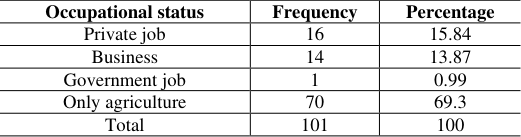 Table 5
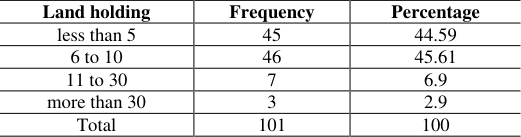 Table 6
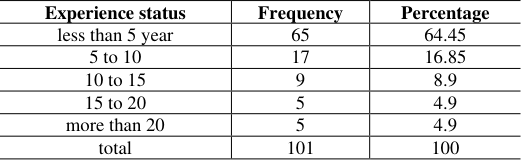 Table 7
 Table 1
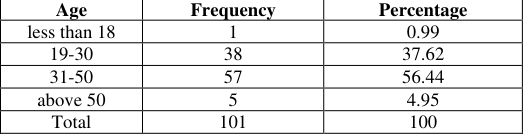 Table 2
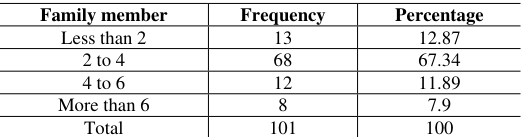 Table 8
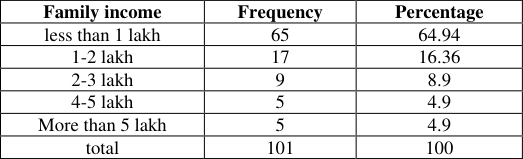 Table 3
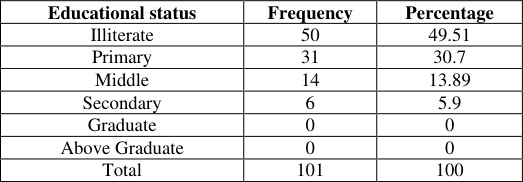 Table 4
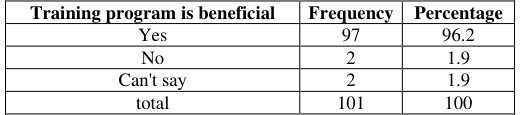 Table 9
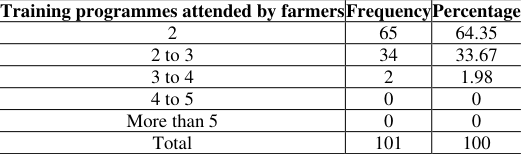 Table 10
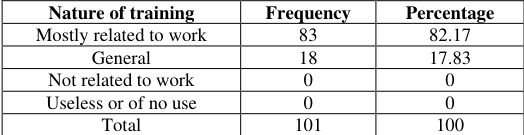 Table 14
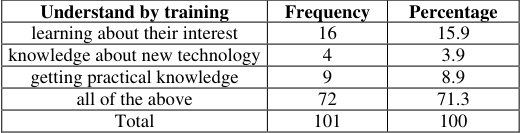 Table 11
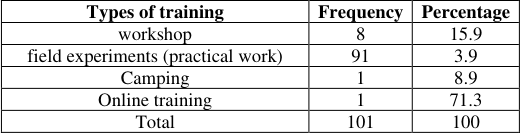 Table 12
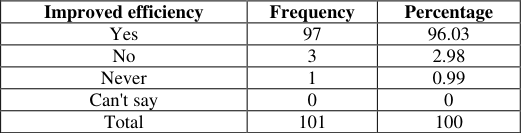 Table 13
 Table 13
 Table 15
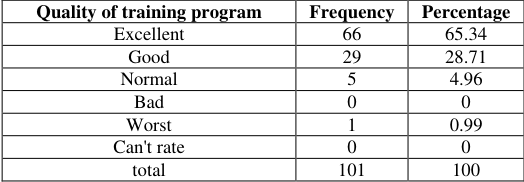 Table 16
 Table 17
 Table 18
 Table 19
Introduction
A training program is one of the remedies for organizational sluggishness, which can result from organizational inertia. Training is also defined as the systematic process of acquiring knowledge and/or skills for a specific purpose. The purpose of training is to provide an individual with a relatively permanent change that will improve his or her ability to perform on the job. Human resources are mainly procured and hired by the personnel department. To ensure that newly hired employees are competent for the jobs they will be handled, training should be imparted to them after they join the organization. Training is widely recognized as a necessity in modern industrial environments to keep employees abreast of technological advances. It is imperative that every company has a training program for its employees in order to develop them and help them grow. There is a difference between 'training' and 'development', as the former refers to teaching specific skills and the latter to developing an employee's overall personality. There are various methods of training and development used by various organizations, especially those involved in business and industry. Engaging your employees goes beyond your organization's goals. Career advancement and job security are both enhanced by this arrangement. In addition to being an asset to the organization, a skill acquired through training is also an asset to its employees. Investing in training pays off for a very long time. Technology may cause training to become obsolete only when it completely eliminates the desired skills and knowledge. A change in technology, a demanding customer, an emphasis on productivity, improved motivation, accuracy of output, and better management can all lead to the need for training. An intensive learning activity, led by competent trainers for a selected group of farmers, is referred to as farmers' training. It involves understanding and practicing the skills needed to adopt new technologies in an environment where adequate facilities are available and at a time and duration considered appropriate by farmer. Kilpatrick (1997) [11] investigated the impact of education and training on farm management practices. Farmers are more likely to make successful changes in their management practices when they receive training and education.
According to the study, training events provide participants with the opportunity to interact with expert trainers. Educators should design education and training programs to provide opportunities for interaction and skills sharing. Objective 1. To assess the feedback on training conducted. 2. To study the perception of farmers towards the training program.
Methodology
The The data provide insights into the occupational status, landholdings, experience, and family size of the surveyed individuals. According to survey respondents, agriculture accounts for 69.3% of their occupations, followed by private employment (15.84%) and business (13.87%). Almost no government employees are employed (0.99%). A balanced distribution of landholdings is observed, with 45% holding less than 5 acres, and 45.61% having 6 to 10 acres. The majority of respondents (64.45%) do not have more than five years of experience, and the majority (67.34%) have two to four family members. Agricultural extension and support programs need to be tailored to the diverse needs and characteristics of farmers in order to be effective. As for the training program's quality, 65.34 percent of farmers rated it "Excellent," while 28.71% rated it "Good." Only a small percentage of respondents rated the quality as "Normal" (4.96%), and a small proportion rated it as "Worst" (0.99%).
Results and Discussion
The high level of positive perception regarding the quality of the training program was evident from the fact that none of the respondents reported a "Bad" quality rating. The farmers were all motivated (100%) according to the survey, which indicates a high level of motivation and commitment. There is a very small percentage (1.99%) of farmers who are dissatisfied with the current training method, while the majority of farmers (98.01%) are satisfied. There is strong satisfaction with the current training approach as demonstrated by this finding. In general, the data indicates that the training program is of high quality, and farmers are highly motivated and satisfied with it. Clearly, participating farmers are motivated and satisfied by the training program, which demonstrates its effectiveness and well-receivedness.
Suggestions
An extensive majority of farmers believe that extension education plays a key role in enhancing both productivity and quality of farm produce. To ensure that trainees are encouraged and motivated, training sessions need to be meticulously planned, not only informative, but also motivational and encouraging. Furthermore, adequate resources need to be provided to trainees to enhance the quality of extension education services, which will make the training process more effective and conducive to knowledge enrichment. Agricultural Extension Officers should be encouraged to employ a diverse range of instructional techniques, and farmers should be introduced to various learning methods that can facilitate more efficient information transfer. Also, Krishi Vigyan Kendra's (KVKs) should intensify their efforts in imparting training and promoting improved agricultural practices as a result of this study. Consequently, several evaluation systems should be used in extension activities in order to enhance dissemination of knowledge and best practices.
Figures and tables from the paper
| Occupational status | Frequency | Percentage |
|---|---|---|
| Private job | 16 | 15.84 |
| Business | 14 | 13.87 |
| Government job | 1 | 0.99 |
| Only agriculture | 70 | 69.3 |
| Total | 101 | 100 |
Table text extracted from the original PDF; superscript letters are shown inline. The original table image is below.
View original table image
| Land holding | Frequency | Percentage |
|---|---|---|
| less than 5 | 45 | 44.59 |
| 6 to 10 | 46 | 45.61 |
| 11 to 30 | 7 | 6.9 |
| more than 30 | 3 | 2.9 |
| Total | 101 | 100 |
Table text extracted from the original PDF; superscript letters are shown inline. The original table image is below.
View original table image
| Experience status | Frequency | Percentage |
|---|---|---|
| less than 5 year | 65 | 64.45 |
| 5 to 10 | 17 | 16.85 |
| 10 to 15 | 9 | 8.9 |
| 15 to 20 | 5 | 4.9 |
| more than 20 | 5 | 4.9 |
| total | 101 | 100 |
Table text extracted from the original PDF; superscript letters are shown inline. The original table image is below.
View original table image
| Gender | Frequency | Percentage |
|---|---|---|
| Male | 74 | 73.26 |
| Female | 27 | 26.74 |
| Total | 101 | 100 |
Table text extracted from the original PDF; superscript letters are shown inline. The original table image is below.
View original table image
| Age | Frequency | Percentage |
|---|---|---|
| less than 18 | 1 | 0.99 |
| 19-30 | 38 | 37.62 |
| 31-50 | 57 | 56.44 |
| above 50 | 5 | 4.95 |
| Total | 101 | 100 |
Table text extracted from the original PDF; superscript letters are shown inline. The original table image is below.
View original table image
| Family member | Frequency | Percentage |
|---|---|---|
| Less than 2 | 13 | 12.87 |
| 2 to 4 | 68 | 67.34 |
| 4 to 6 | 12 | 11.89 |
| More than 6 | 8 | 7.9 |
| Total | 101 | 100 |
Table text extracted from the original PDF; superscript letters are shown inline. The original table image is below.
View original table image
| Family income | Frequency | Percentage |
|---|---|---|
| less than 1 lakh | 65 | 64.94 |
| 1-2 lakh | 17 | 16.36 |
| 2-3 lakh | 9 | 8.9 |
| 4-5 lakh | 5 | 4.9 |
| More than 5 lakh | 5 | 4.9 |
| total | 101 | 100 |
Table text extracted from the original PDF; superscript letters are shown inline. The original table image is below.
View original table image
| Educational status | Frequency | Percentage |
|---|---|---|
| Illiterate | 50 | 49.51 |
| Primary | 31 | 30.7 |
| Middle | 14 | 13.89 |
| Secondary | 6 | 5.9 |
| Graduate | 0 | 0 |
| Above Graduate | 0 | 0 |
| Total | 101 | 100 |
Table text extracted from the original PDF; superscript letters are shown inline. The original table image is below.
View original table image
| Training program is beneficial | Frequency | Percentage |
|---|---|---|
| Yes | 97 | 96.2 |
| No | 2 | 1.9 |
| Can't say | 2 | 1.9 |
| total | 101 | 100 |
Table text extracted from the original PDF; superscript letters are shown inline. The original table image is below.
View original table image
| Training programmes attended by farmers | Frequency | Percentage |
|---|---|---|
| 2 | 65 | 64.35 |
| 2 to 3 | 34 | 33.67 |
| 3 to 4 | 2 | 1.98 |
| 4 to 5 | 0 | 0 |
| More than 5 | 0 | 0 |
| Total | 101 | 100 |
Table text extracted from the original PDF; superscript letters are shown inline. The original table image is below.
View original table image
| Nature of training | Frequency | Percentage |
|---|---|---|
| Mostly related to work | 83 | 82.17 |
| General | 18 | 17.83 |
| Not related to work | 0 | 0 |
| Useless or of no use | 0 | 0 |
| Total | 101 | 100 |
Table text extracted from the original PDF; superscript letters are shown inline. The original table image is below.
View original table image
| Understand by training | Frequency | Percentage |
|---|---|---|
| learning about their interest | 16 | 15.9 |
| knowledge about new technology | 4 | 3.9 |
| getting practical knowledge | 9 | 8.9 |
| all of the above | 72 | 71.3 |
| Total | 101 | 100 |
Table text extracted from the original PDF; superscript letters are shown inline. The original table image is below.
View original table image
| Types of training | Frequency | Percentage |
|---|---|---|
| workshop | 8 | 15.9 |
| field experiments (practical work) | 91 | 3.9 |
| Camping | 1 | 8.9 |
| Online training | 1 | 71.3 |
| Total | 101 | 100 |
Table text extracted from the original PDF; superscript letters are shown inline. The original table image is below.
View original table image
| Improved efficiency | Frequency | Percentage |
|---|---|---|
| Yes | 97 | 96.03 |
| No | 3 | 2.98 |
| Never | 1 | 0.99 |
| Can't say | 0 | 0 |
| Total | 101 | 100 |
Table text extracted from the original PDF; superscript letters are shown inline. The original table image is below.
View original table image
| Regular updates | Frequency | Percentage |
|---|---|---|
| Yes | 79 | 78.21 |
| No | 22 | 21.79 |
| Total | 101 | 100 |
Table text extracted from the original PDF; superscript letters are shown inline. The original table image is below.
View original table image
| S. No. | Statements | Total Responses | — | — | — | — | Total Score (code*TR) | Mean | S.D. |
|---|---|---|---|---|---|---|---|---|---|
| 5 | 4 | 3 | 2 | 1 | |||||
| 1 | Takes too much time of farmers | 62 | 11 | 1 | 20 | 7 | 202 | 2 | 1.43 |
| 2 | Training Sessions are unplanned | 66 | 16 | 4 | 10 | 5 | 175 | 1.73 | 1.21 |
| 3 | Boring and not useful | 66 | 20 | 8 | 4 | 3 | 161 | 1.59 | 1 |
| 4 | Training staff are not cooperative and not trained | 72 | 13 | 1 | 6 | 9 | 170 | 1.68 | 1.29 |
| 5 | Lack of motivation among farmers about training | 60 | 15 | 2 | 15 | 9 | 201 | 1.99 | 1.42 |
| 6 | Irregularity of trainee’s attendance | 61 | 16 | 6 | 9 | 9 | 192 | 1.9 | 1.35 |
Table text extracted from the original PDF; superscript letters are shown inline. The original table image is below.
View original table image
| Quality of training program | Frequency | Percentage |
|---|---|---|
| Excellent | 66 | 65.34 |
| Good | 29 | 28.71 |
| Normal | 5 | 4.96 |
| Bad | 0 | 0 |
| Worst | 1 | 0.99 |
| Can't rate | 0 | 0 |
| total | 101 | 100 |
Table text extracted from the original PDF; superscript letters are shown inline. The original table image is below.
View original table image
| Motivation level of farmers | Frequency | Percentage |
|---|---|---|
| Yes | 101 | 100 |
| No | 0 | 0 |
| Total | 101 | 100 |
Table text extracted from the original PDF; superscript letters are shown inline. The original table image is below.
View original table image
| Satisfied with present method of training | Frequency | Percentage |
|---|---|---|
| Yes | 99 | 98.01 |
| No | 2 | 1.99 |
| Total | 101 | 100 |
Table text extracted from the original PDF; superscript letters are shown inline. The original table image is below.
View original table image
| S. No | Statements | Total Responses | — | — | — | — | Total Score (Code*TR) | Mean | S.D |
|---|---|---|---|---|---|---|---|---|---|
| 5 | 4 | 3 | 2 | 1 | |||||
| 1 | The information provided by trainer during the training session are relevant | 78 | 19 | 0 | 3 | 1 | 473 | 4.68 | 0.72 |
| 2 | Training needs identified are realistic and useful | 74 | 26 | 0 | 0 | 1 | 475 | 4.73 | 0.57 |
| 3 | Training result in better performance | 80 | 20 | 1 | 0 | 0 | 483 | 4.78 | 0.43 |
| 4 | Do you enjoy the training session | 79 | 21 | 1 | 0 | 0 | 482 | 4.77 | 0.44 |
| 5 | Training session was a positive experience | 81 | 20 | 0 | 0 | 0 | 485 | 4.8 | 0.4 |
| 6 | Training program helped to increase both the farm productivity and quality of farm quantity | 76 | 19 | 6 | 0 | 0 | 474 | 4.69 | 0.57 |
| 7 | Would you like to get training from this institute again | 86 | 14 | 1 | 0 | 0 | 489 | 4.84 | 0.39 |
Table text extracted from the original PDF; superscript letters are shown inline. The original table image is below.
View original table image
References
18 in the original paper- Agbarevo, Machiadikwe BN. Farmers Perception of Effectiveness of Agricultural Extension Delivery in Cross-River State, Nigeria. IOSR Journal of Agriculture and Veterinary Science. 2013;2:01-07.
- Aromolaran KA, Dare A, Olalekan O, Abiodun SE, Komolafe1 TL. Attitude of farmers to extension trainings in Nigeria: Implications for adoption of improved Agricultural technologies. Journal of Agricultural Sciences. 2017;62:423-443.
- Baharein NM, Kamariah D. Investigating Training Impact on Farmer's Perception and Performance. International Journal of Humanities and Social Science. 2011;1:6.
- Cloete P, Bahta YT, Marunga M, Lombard WA. Perception and Understanding of Agricultural Extension: Perspective of Farmers and Public Agricultural Extension in Thaba Nchu. South Africa Journal of Agricultural extension. 2019;47:14-3.
- Hossein A, Glen F. Comparative study of agricultural extension systems. Outlook on Agriculture. 2009;38:337347.
- Ibrahim H, Zhou J, Li M, Chen Q. Perception of Farmers on Extension Services delivered by extension personnel. Journal of Service Science and Management. 2014;7:5762.
- Inayatullah J, Khan H, Jalaluddin M. Analysis of Agricultural Extension System: A Discrepancy between Providers and Recipients of the Extension Services Empirical Evidence from North-West Pakistan. Sarhad J Agric. 2008;24:349.
- Kumar S, Devaki K, Subramanian R. Assessment of Effectiveness of training programmes through perception of Krishi Vigyan Kendra trainees. Indian Research Journal of Extension Education. 2014;14:96-98.
- Khan A, Akram M. Farmers perception of Extension methods used by Extension Personnel for Dissemination of New Agricultural Technologies. Sarhad Journal Agricultural. 2012;28:511-520.
- Kilpatrick S. Education and training: Impacts on farm management practice. The Journal of Agricultural Education and Extension. 1997;7:105-116.
- Meena BS, Singh B. Impact of training programs imparted by Krishi Vigyan Kendras. International Journal of Agricultural Sciences. 2010;6:213-215.
- Egbe OB, Eze SO. Farmers Perception of Effectiveness of Agricultural Extension delivery towards Aquaculture development. The International Research Journal International Researchers. 2014;3:126.
- Pandey RK, Doharey RK, Singh RK, Mishra AK, Pandey J, Kumar M, et al. A Critical Analysis on training needs of farmers about Mustard Production Technology. International Journal of Agriculture Sciences. 2015;7:892-895.
- Ranjitha G, Teza J, Veeraiah A. An impact study on training programme on Integrated Pest Management. International Journal of Current Microbiology and Applied Sciences. 2018;7:234.
- Rathod PK, Nikam TR, Landge S, Hatey A. Farmers Perception towards Livestock Extension Service. Indian Research Journal of Extension Education. 2012;2:1-5.
- Tsion T, Karippai RS, Tesfaye. Farmers training programme of Ethiopian Institute of Agricultural Research: An appraisal. African Journal of Agricultural Research. 2009;4:409-421.
- Tyagi AK, Tyagi BD. Assessment of Effectiveness of training programmes through perception of Krishi Vigyan Kendra trainees. Agriways. 2014;2:73-76.
- Sarnaik SD, Bhople PP, Mankar DM, Tekale VS. Perception of Farmers towards Effectiveness of Extension Services of KVK. Indian Journal of Extension Education. 2021;56:43.
Cited by 1
From OpenAlex, OpenCitations and reference lists read by Scinovex
- Assessment of agricultural training needs a case study of unisa urban agriculture community engagement project in katlehong township ↗
Christian Anayo Mbajiorgu, Dikeledi Petunia Malatji, Ebere Lovelyn Udeh, Matome Moshobane Simeon Maake, Mokgoshi John Mamashila, Noluyolo Nogemane et al. · Discover Sustainability · 2026
A survey was conducted at the Community Engagement (CE) project of the University of South Africa (UNISA) in Katlehong Engineering School of Specialization in Gauteng province, South Africa. The study aimed to assess the agricultural training needs of participants to determine the project's value and direction. A total of 61 participants, primarily females aged 18 to 92 (mean age =…
❝ 0PDF