
Research article · 2023 · Full text
International Journal of Biology SciencesThe effect of insect association on the productivity of some forest trees in Sudan
Volume 5(2) · Pages 30–33 · DOI: 10.33545/26649926.2023.v5.i2a.168 ↗
Research areasAfrican Botany and Ecology StudiesAgriculture and Rural Development ResearchEntomological Studies and Ecology
Abstract
Author-writtenThe effect of insect association on productivity of selected forest tree species in Sudan was investigated. The selected trees were Acacia senegal subsp. Senegal (Hashab), Butyrospermum paradoxum (Shea tree), Faidherbia albida (Haraz), Moringa oleifera (Moringa), Prosopis chilensis (Mesquites) and Salvadora persica (Arak, Tooth brush tree). The biology, distribution in Sudan and the economic importance of these selected tree species were reviewed. The insect species associated with the tree and their seeds were identified and their effects were summarized. Beneficial effects were reported for A. Senegal trees and specially on gum production. Other insects associated with other trees showed deleterious effect on the trees and their organs (leaves, seeds, and wood ete). The insects involved were: Agrilus nubeculosus (Fairm) in A. Senegal, Cirina butyrospermi, Anacridium moestum var. Melanorhodon, Ceratitis silvestrii, Pachmerus longus, Sinoxylon Senegal ense, caterpillars and locusts for Faidherbia albida, Eupterate mallifera for Moringa oleifera, Rhipibruchus allults and Crematogaster sp. For Prosopis chilensis and Lepidoptera colotis ephiae and Eriophyes for Salvadora persica. The effect of each insect on the tree and its organs is summarized.
Summary
Source-checkedPlain-language reading of the full paper, prepared with AI and checked against the text. Each point links to the authors' own words.
Why it matters
- In arid regions, non-timber forest products are often more critical to local economies and rural wellbeing than timber products. View evidence ↗
- The evolution of forestry over the last fifty years has emphasized the role of non-timber products in supporting rural development and food security. View evidence ↗
- There is significant international concern regarding the loss of species caused by the deterioration and destruction of tropical forest resources. View evidence ↗
The question
- The study aimed to summarize information on the production and economic importance of several major non-wood forest products in Sudan. View evidence ↗
- The researchers sought to identify insect pests associated with specific forest tree species and determine how these insects affect productivity. View evidence ↗
What they did
- The study was conducted by synthesizing information from previously published data and the authors' personal experience. View evidence ↗
- Six forest tree species were selected for review: Acacia senegal subsp. Senegal, Butyrospermum paradoxum, Faidherbia albida, Moringa oleifera, Prosopis chilensis, and Salvadora persica. View evidence ↗
What they found
- In Acacia senegal, the Buffalo tree hopper (Stictocephala bubalus) can destroy between 16.7% and 82.5% of the seeds. View evidence ↗
- Butyrospermum paradoxum is affected by defoliation from Cirina butyrospermi and Anacridium moestum var. melanorhodon, while Ceratities silvestrii attacks its ripe fruits. View evidence ↗
- In Faidherbia albida, various seed borers including Pachymerus longus and Bruchidius species can damage up to 51% of the seeds. View evidence ↗
- Moringa oleifera productivity is negatively impacted by the hairy caterpillar Eupterote mollifera, which causes defoliation. View evidence ↗
- Prosopis chilensis suffers significant losses due to beetles that attack the stems and feed on phloem sap, damaging the wood. View evidence ↗
- In Salvadora persica, the mite Eriophyes is responsible for the formation of leaf galls. View evidence ↗
What it means
- The authors conclude that insect associations can be beneficial, specifically citing the link between A. tuberculosis and high gum production in Acacia senegal. View evidence ↗
- The authors state that other insects, such as locusts, cause serious reductions in fodder by damaging the foliage of trees like F. albida and P. chilensis. View evidence ↗
- The authors note that the exact nature of the interactions between plants and insects remains obscure. View evidence ↗
Visual summary
1 visualsIllustrations explain the paper; they do not show study data.
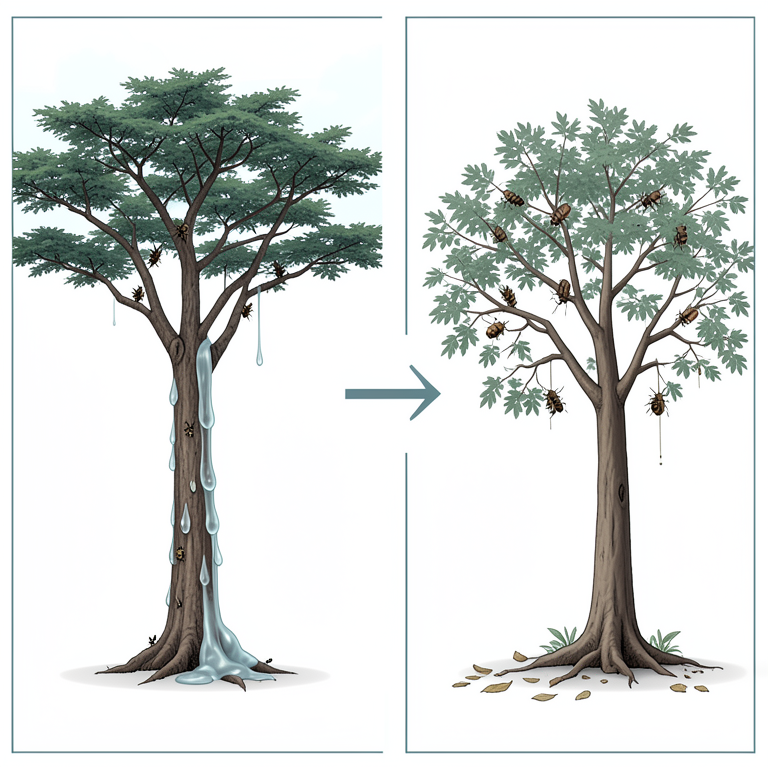
Dual Nature of Insect-Tree Associations
AI-generated conceptual illustration (Acacia senegal and Faidherbia albida trees). It explains the idea and does not show study data.
View source evidence ↗Figures & tables
From the original paper Table 1
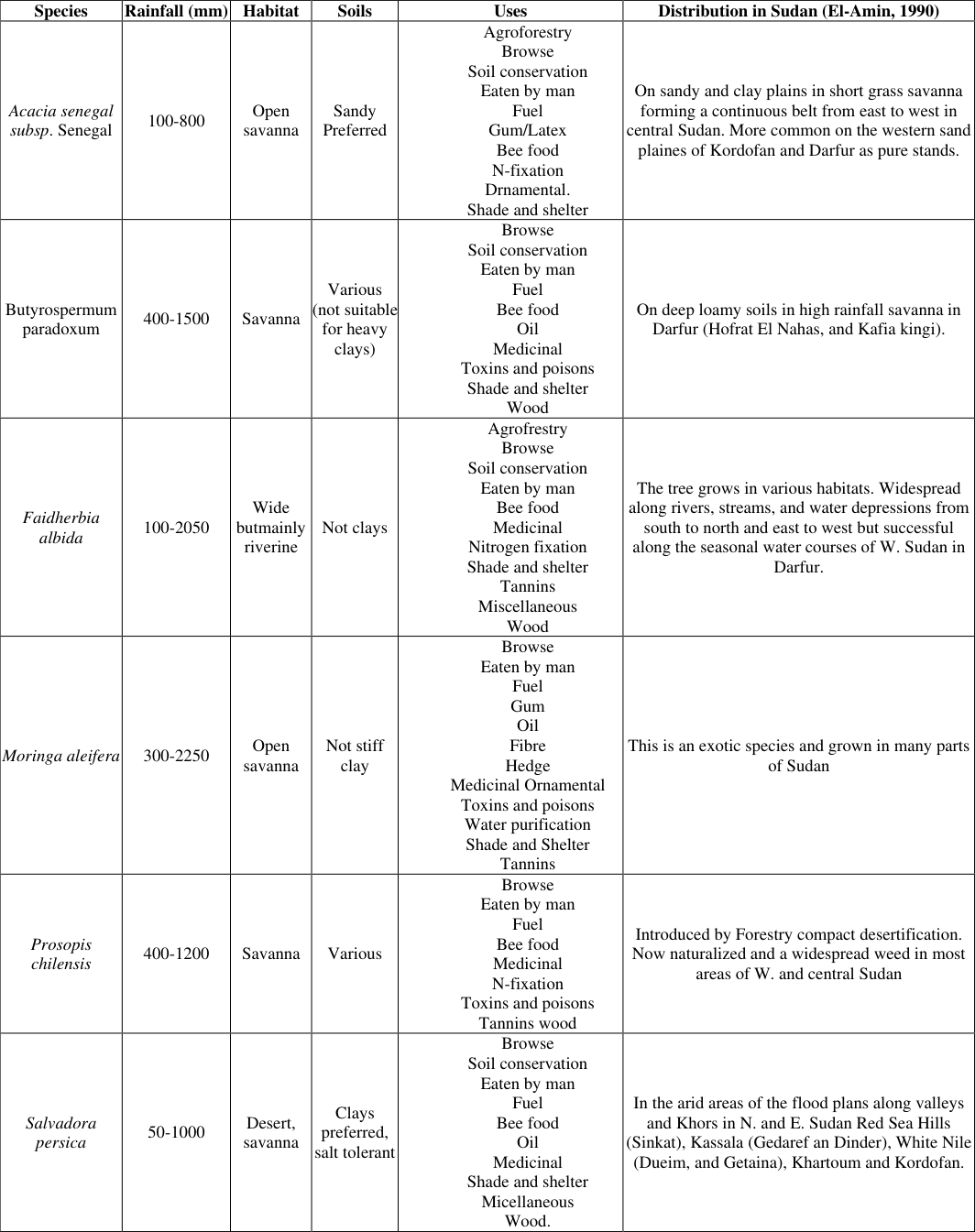 Table 2
Introduction
In many countries timber products are almost always seen as the only contribution of forestry to national economy. However, in dry areas, non-wood products are also very important and often, most significant to local economies and to the wellbeing of rural people. In dry area especially, these products make woody vegetation economically and socially relevant to rural people. There are many examples in Africa, Asia and Lain America of non-timber forest products being more important in economic and monetary terms than timber itself. Forestry had evolved in the last five decades and the importance of these products and related technology are highlighted to rural development and particularly to food security. The international organizations (e.g. FAO Council and the Committee on World Food Security) in 1985 had discussed the role of forestry in food security. They recognized that natural foods from forest were much more important in the food supplies of many countries than is generally realized; particular concern was expressed "at the loss of species resulting from destruction and deterioration of the tropical forest resources and attention was drawn to the fact that these forests constituted the world's largest resource of genetic diversity, including the wild relatives of important staple food plants. There is similar concern at the degradation and loss of savanna vegetation, which contains a multitude of forest species that contribute significantly to the diet of dry zone people, throughout the tropical world and particularly in Africa. This paper had two main objectives. The first one was to collect and summarize information on production of a few major non-wood products which are significant at the country level, and in particular to provide: 1) brief description of forest tree species, ii) assessment of production per tree, iii) and indication of the economic importance of the products. The second objective was to identify the insect pests associated with some selected forest species and their effect on tree productivity.
Materials and Methods
The information included in this study were collected from published data and from personal experience. The selected forest trees included in this study were: Acacia senegal subsp. Senegal, Butyrospermum paradoxum, Faidherbia albida, Moringa oleifera, Prosopis chilensis and Salvadora persica (Table 1).
| Scientific name | Common name | Family | Habit | Part used. |
|---|---|---|---|---|
| Acacia senegal subsp. Senegal | Hashab | Fabaceae | Tree | Gum |
| Butyrospermum paradoxum | Shea tree | Sapotaceae | Tree | Seeds |
| Faidherbia albida | Haraz | Fabaceae | Tree | Leaves, Fruits |
| Moringa oleifera | Moringa | Moringaceae | Tree | Leaves, Fruit, Seeds |
| Prosopis chilensis | Mesquite | Fabaceae | Tree | Leaves, Fruits |
| Salvadora persica | Arak | Salvadoraceae | Tree | Leaves, stem, Fruits |
Table text extracted from the original PDF; superscript letters are shown inline. The original table image is below.
View original table image
Results and Discussion
Table 2 summarizes the uses and environmental requirements of the tree species reviewed in the text. In addition the distribution of the trees in Sudan was also included.
| Species | Rainfall (mm) | Habitat | Soils | Uses | Distribution in Sudan (El-Amin, 1990) |
|---|---|---|---|---|---|
| Acacia senegal subsp. Senegal | 100-800 | Open savanna | Sandy Preferred | Agroforestry Browse Soil conservation Eaten by man Fuel Gum/Latex Bee food N-fixation Drnamental. Shade and shelter | On sandy and clay plains in short grass savanna forming a continuous belt from east to west in central Sudan. More common on the western sand plaines of Kordofan and Darfur as pure stands. |
| Butyrospermum paradoxum | 400-1500 | Savanna | Various (not suitable for heavy clays) | Browse Soil conservation Eaten by man Fuel Bee food Oil Medicinal Toxins and poisons Shade and shelter Wood | On deep loamy soils in high rainfall savanna in Darfur (Hofrat El Nahas, and Kafia kingi). |
| Faidherbia albida | 100-2050 | Wide butmainly riverine | Not clays | Agrofrestry Browse Soil conservation Eaten by man Bee food Medicinal Nitrogen fixation Shade and shelter Tannins Miscellaneous Wood | The tree grows in various habitats. Widespread along rivers, streams, and water depressions from south to north and east to west but successful along the seasonal water courses of W. Sudan in Darfur. |
| Moringa aleifera | 300-2250 | Open savanna | Not stiff clay | Browse Eaten by man Fuel Gum Oil Fibre Hedge Medicinal Ornamental Toxins and poisons Water purification Shade and Shelter Tannins | This is an exotic species and grown in many parts of Sudan |
| Prosopis chilensis | 400-1200 | Savanna | Various | Browse Eaten by man Fuel Bee food Medicinal N-fixation Toxins and poisons Tannins wood | Introduced by Forestry compact desertification. Now naturalized and a widespread weed in most areas of W. and central Sudan |
| Salvadora persica | 50-1000 | Desert, savanna | Clays preferred, salt tolerant | Browse Soil conservation Eaten by man Fuel Bee food Oil Medicinal Shade and shelter Micellaneous Wood. | In the arid areas of the flood plans along valleys and Khors in N. and E. Sudan Red Sea Hills (Sinkat), Kassala (Gedaref an Dinder), White Nile (Dueim, and Getaina), Khartoum and Kordofan. |
Table text extracted from the original PDF; superscript letters are shown inline. The original table image is below.
View original table image
Acacia senegal (L.) Wild subsp. Senegal
As shown in Table 2 the main product of A. Senegal is gum Arabic. The insect pests associated with the tree are the Buffalo tree hopper (Stictocephala bubalus) which destroy 16.7 -82.5% of seeds. Spiders (Cyclops sp.) may smother young growing apex (Cheema and Quadir, 1973; Duke, 1981). Also, the larval stage of Coleoptera (Bruchids) cause great damage. Locusts (Acridium melanorhodon) can defoliate vast areas over night (Awouda, 1974) [2] . Recently, Kalil and El-Tigani (2020) [11] have reported that the beetle Agrilus nubeculosus (Fairm.) lives in A Senegal (Hashab) environment and spend most of its time between trees during the tapping season. The presence of this insect during the tapping time can be used as an indication for high gum production. Also, they showed that three micro-organisms were isolated from A. tuberculosis, namely Cladosporium oxysporum, Aspergillus spp. and a nitrogen fixing bacterium. Butyrospermum paradoxum (Gaertner f.) Hepper. Subsp. niloticum (Syn. Vitellaria paradoxa Gaertner. The nuts of this tree form the main source of shea bulter. Caterpillars of Cirina butyrospermi (saturniid) and Anacridium moestum var. melanorhodon cause defoliation. Ceratities silvestrii attack the ripe fruits (Godin and Spensley, 1971; Maydell, 1983) [9,12] and Mussida nigrivenella lives on the nuts. Locust attacks can prevent fruit production over a large area (Anon, 1912) [1] . It can be concluded that these insects affect adversely shea butter production.
Faidherbia albida (Del.) A. Chev. (Syn. Acacia albida) The haraz tree is useful in agroforestry, soil conservation and in nitrogen fixation. The leaves and ripe fruit provide good fodder for domestic animals the fruits are also eaten by man. The seeds and trees are attacked by some insects. Seed borers Pachymerus longus and P. (Caryedon) pallidus, Bruchidius sp. Ear rufulus and B. silaceous can damage 51% of seeds; wood borer Sinoxylon senegalense can damage wood; termites may damage roots. Leaves susceptible to various insects, caterpillars and locusts (Wickens, 1969) [14] . As a result of the insect investation the forage produced is severally affected.
Moringa oleifera
Moringa tree provides good fodder, food and oil. The leaves, fruit, seeds form the most useful organs of the plant. The hairy caterpillar, Eupterote mollifera causes defoliation but can be controlled by insecticides as reported in India (Council of Scientific of Industrial Research, 1962). Other pests of Moringa include an aphid Aphis craccivora; caterpillars Tetragonia siva, Metanastria hyrtaca and Heliothis armigera; a scale insect, Ceroplastodes cajani; a borer Diaxenopsis apomecynoides and a fruit fly, Glitonia (Ramachandran et al., 1980) [13] . All these insects affect the productivity of Moringa trees.
Prosopis chilensis
Prosopis chilensis provides good fuel. It is a wide spread fast growing tree. The leaves and pods form a good fodder. Also, the sweet fruits are eaten by man. Beetls are reported to attack the stem of the trees and feed on the phloem sap. These insect damage the wood and causes great losses.
Salvadora persica L
The Arak tree is characterized by medicinally important metabolites (Glucosinolates, low calorie sweeteners. etc.) in their leaves and fruits. The tree is attacked by defoliating larvae of several beetles (Council of Scientific of Industrial Research, 1972) and leaves often attacked by caterpillars of the Lepidoptera Colotis ephiae (Brumer, 1983) [3] . The mite Eriophyes causes leaf galls (Kant and Arya, 1971) [10] . The tree grows in various habitats. Widespread along rivers, streams, and water depressions from south to north and east to west but successful along the seasonal water courses of W. Sudan in Darfur. In the arid areas of the flood plans along valleys and Khors in N. and E. Sudan Red Sea Hills (Sinkat), Kassala (Gedaref an Dinder), White Nile (Dueim, and Getaina), Khartoum and Kordofan.
Moringa aleifera
Moringa aleifera
Conclusion
It is clear from the above that insect association to forest tree species can be beneficial as in the case of A. tuberculosis with Acacia senegal trees in high production of gum. Other insects (e.g. locust) can cause great damage to foliage leaves which results in a serious reduction of fodder as in the case of F. albida and P. chilensis. The nature of interactions do occur between plants and insects is still obscure, but few studies suggested hormonal interactions are possible at many levels and depend on the ability of physiologically active chemicals to interact between the different types of the living organisms. More research is
Acknowledgement
International Journal of Biology Sciences https://www.biologyjournal.net needed to explain the interactions between plants and insects.
References
6 in the original paper- Anon. Shea nuts and Shea butter. Bulletin of the Imperial Institute. 1912;10:281-292.
- Cheema MSZA, Quadir SA. Autecology of Acacia senegal (L.) Willd. Vegetatio. 1973;27:131-162.
- Kant U, Arya HC. Anatomy of the leaf gall on Salvadora persica Linn. Induced by Eriophyes. Marcellia. 1971;37(1/2):45-57.
- Khalil SAA, El-Tigani S. Effect of metleyl jasmonate on Acacia senegal (Hashab treess) production and characteristics of gum. Africal Journal of Agricultural Research. 2020;16(12):1740-1747.
- Ramachandran C, Peter KV, Gopalakrishnan PK. Drumstick (Moringa oleifera): A Multpurpose Indian vegetable. Economic Botany. 1980;34(3):276-283.
- Wickens GE. A study of Acacia albida Del. (Mimosoideae). Kew Bulletin. 1969;23(2):181-202.