
Research article · 2023 · Full text
International Journal of Agriculture and NutritionPotential of water hyacinth compost and N, P, K, S fertilizers on K-available, K-uptake, and quality of shallots (Allium ascalonicum L.) in inceptisols of Jatinangor
Volume 5(2) · Pages 07–10 · DOI: 10.33545/26646064.2023.v5.i2a.122 ↗
Research areasPlant Growth and Agriculture TechniquesShallot Cultivation and Analysis
Abstract
Author-writtenCompost is the organic matter derived from plants, animals, and waste organic decomposition or fermentation subjected to the process. The addition of organic matter to the soil is very important so that plants get enough nutrients for growth. One of the materials in making compost is water hyacinth. Inorganic fertilizers are deliberately created by human beings in factories and contain high levels of certain. As for some commonly used inorganic fertilizers such as urea, SP-36, KCl, and ZA (Ammonium Sulphate). The research aimed to determine the effect of water hyacinth compost and N, P, K, and S fertilizer application on K-available, K-uptake, and yield of shallot plants. The experiment was carried out from June to September 2020 at the Experimental Garden of the Laboratory of Soil Chemistry and Plant Nutrition, Faculty of Agriculture, Universitas Padjadjaran, Jatinangor, Sumedang. The experimental design used was a randomized completely block design (RCBD) consisting of seven treatments with four repetitions, namely: control; 1 N, P, K, S recommendations; ¾ N, P, K, S recommendations; ½ compost + ¾ dose of N, P, K, S; 1 compost + ¾ dose of N, P, K, S; 1½ compost + ¾ dose of N, P, K, S; and 1 compost + 1 N, P, K, S. The compost used 25 Mg ha-1 water hyacinth compost and the recommended fertilizer was 200 kg urea, 300 kg SP-36, 200 kg KCl, and 500 kg ZA. The results showed that (1) a combination of water hyacinth compost with N, P, K, and S fertilizers was affected significantly K-available, K-uptake, and shallot bulb yield consisting of wet weight, dry weight, and number of bulbs; and (2) The ½ Compost + ¾ N, P, K, and S fertilizer treatment produces eight tubers per polybag with an average fresh tuber weight and dry stored tuber weight respectively weighing 113.24 g and 83.83 g polybag-1, this treatment is the most efficient in increasing the quantity of shallots because it did not show significantly different results from the 1 compost + ¾ N, P, K, S fertilizers treatment which produced the highest quantity among the other treatments.
Summary
Source-checkedPlain-language reading of the full paper, prepared with AI and checked against the text. Each point links to the authors' own words.
Why it matters
- Shallots are valuable commodities used as food flavorings and in traditional medicine due to their content of minerals, proteins, fatty acids, sugars, and carbohydrates. View evidence ↗
- Shallot productivity in Indonesia declined between 2014 and 2017, dropping from 10,223 Mg ha-1 to 9.31 Mg ha-1. View evidence ↗
- Inceptisols, which cover 40% of Indonesian agricultural land (70.52 million Ha), are immature clay soils characterized by low fertility and low organic matter content. View evidence ↗
The question
- The study aimed to evaluate how the application of water hyacinth compost and N, P, K, and S fertilizers affects the available potassium (K), potassium uptake, and the overall yield of shallot plants. View evidence ↗
What they did
- The experiment took place from June to September 2020 at the Universitas Padjadjaran Experimental Garden in Jatinangor, Sumedang. View evidence ↗
- The researchers used a Randomized Completely Block Design (RCBD) featuring seven different treatments, each repeated four times. View evidence ↗
- The treatments utilized water hyacinth compost at 25 Mg ha-1 and recommended inorganic fertilizers consisting of 200 kg urea, 300 kg SP-36, 200 kg KCl, and 500 kg ZA. View evidence ↗
- The study measured three primary responses: the amount of available potassium in the soil, the potassium uptake by the plants, and the final shallot yield. View evidence ↗
What they found
- Plant K-uptake peaked at 73.77 mg plant-1 in treatment E and was lowest in the control (treatment A) at 44.08 mg plant-1. View evidence ↗
- Treatment E produced the maximum yield, with 9 tubers per plant, a wet weight of 117.41 g, and a dry weight of 89.38 g. View evidence ↗
- The control group (Treatment A) showed the lowest yield, producing only 4 tubers with a wet weight of 74.10 g and a dry weight of 45.53 g. View evidence ↗
What it means
- The authors conclude that combining water hyacinth compost with N, P, K, and S fertilizers significantly improves available K, K uptake, and shallot bulb yield. View evidence ↗
Visual summary
2 visualsIllustrations explain the paper; charts are replotted from the paper's own table values.
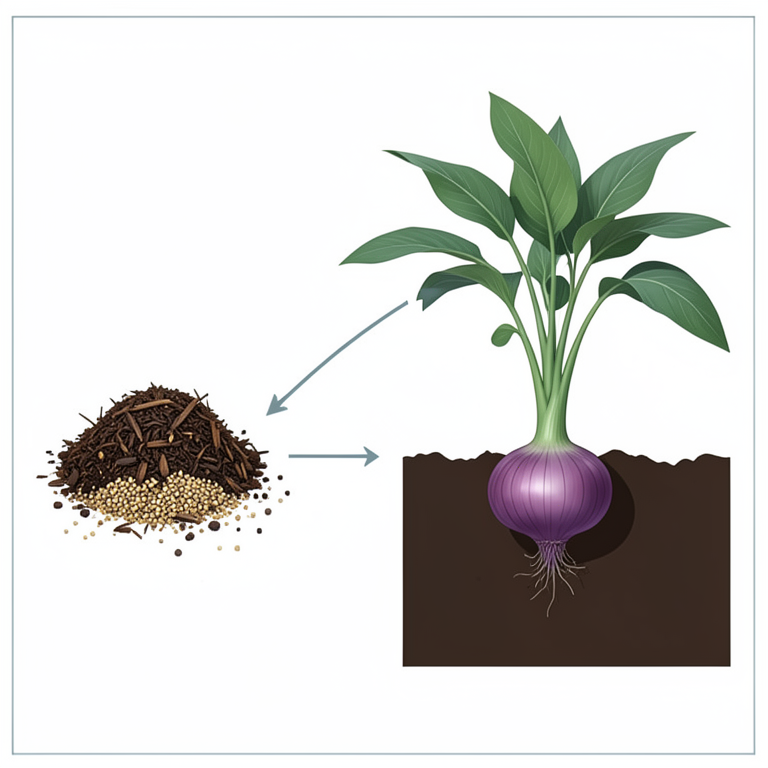
Synergistic Effect of Fertilizers
AI-generated conceptual illustration (shallot plants (Allium ascalonicum L.) in soil). It explains the idea and does not show study data.
View source evidence ↗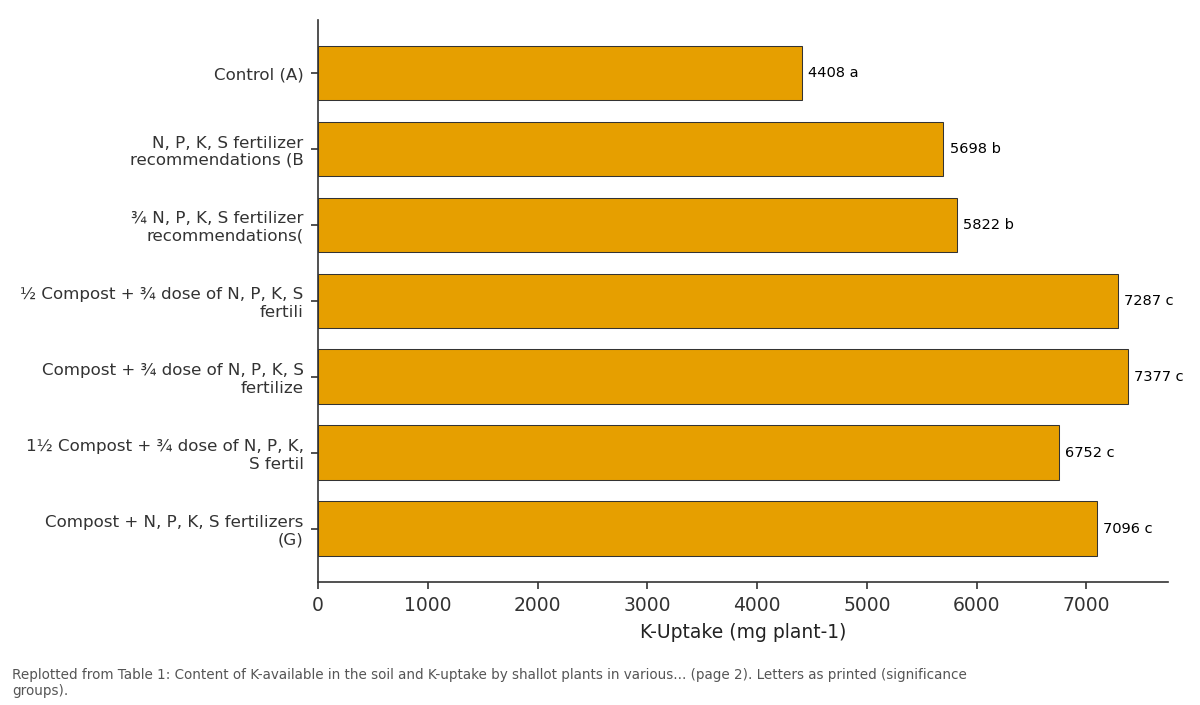
K-Uptake (mg plant-1): Control (A) vs N, P, K, S fertilizer... vs ¾ N, P, K, S fertilizer... vs ½ Compost + ¾ dose of... vs Compost + ¾ dose of N...
Replotted from Table 1 (page 2) of the original paper. Every bar is the paper's own table value.
View source evidence ↗Figures & tables
From the original paper Table 1
 Table 2
Introduction
Commodity of Shallots has many benefits, containing carbohydrates, sugar, fatty acids, protein, and other minerals. Onions have a function as a food flavoring and as an ingredient in traditional medicine because onions are part of a group of spices that do not have substitutes [1] . The demand for shallots will continue to increase in line with people's needs which continue to increase, according to data from BPS (2018) 2014 to 2018 the level of shallot consumption by the Indonesian population increased each year by 2.93%, with the consumption rate in 2014 amounting to 2,487 kg kap -1 year -1 increased to 2,764 kg kap -1 year -1 in 2018. Production in 2018 reached 1.5 million tons and increased compared to 2017 which reached 1.47 million tons [2] . However, this condition is not offset by a decline in shallot productivity, according to [3] from 2014 to 2017, shallot productivity in Indonesia experienced a decline, from initially 10,223 Mg ha -1 to 9.31 Mg ha -1 , meanwhile in the same year area of shallot harvested land increased, in 2014 the harvested land area reached 120,704 ha and in 2017 it became 156,779 ha. Several factors that influence increasing the quantity and quality of shallot plants are quality bulbs, soil conditions, type of variety, and fertilizer used.
Inceptisols occupy 40 percent of agricultural land in Indonesia with an area of 70.52 million Ha [4] . Inceptisols are immature soils that still resemble the parent material and when compared with mature soils, the development of their profile is weaker [5] . The texture of the entire soil solum is generally clay, the soil structure is crumbly, the consistency is loose, and the organic matter content is small. Inceptisols have a low level of soil fertility [6,7] but if proper treatment is carried out, the fertility and chemical properties can be increased [6] . Fertilization is a good step in increasing the fertility of the Inceptisols soil [21] . Stated that soil fertility conditions can be maintained if you combine organic fertilizer and inorganic fertilizer. This is because shallots have balanced needs with good quality through balanced fertilization technology while maintaining soil health. One organic fertilizer that can be used is water hyacinth compost, [20] stated that giving water hyacinth fertilizer can contribute nutrients, increase porosity, aeration, and soil microorganisms as well as increase the soil's water holding capacity, good root development, so that nutrient uptake increases and the result is growth and production to be better [22] . Stated that the provision of water hyacinth compost at a dose of 25 Mg ha -1 succeeded in increasing the growth and yield of shallot production. Shallot plants need Potassium (K) fertilizer, in addition to N and P fertilizer. Potassium (K) is an important macronutrient for plants because this element has a role as an activator of several enzymes in plant metabolism. The role of K in shallots is that K can provide better tuber yield, high quality, and storability of the bulbs and also the bulbs will remain dense even if stored for a long period [11] . The source of K for shallot plants is KCl fertilizer with a K requirement of 120 kg K2O ha -1 [12] . The research aimed to determine the effect of giving water hyacinth compost and N, P, K, and S fertilizer on Kavailable, K-uptake, and yield of shallot plants.
Materials and Methods
Materials and Methods
A. Materials and Tools
The materials used were planting media in the form of Inceptisols soil from Jatinangor, shallot seeds of the Batu Ijo variety, compost of water hyacinth, 200 kg of Urea, 300 kg of SP-36, 200 kg of KCl and 500 kg of Ammonium Sulphate (ZA) as well as various chemicals required for analysis of K-available and K-uptake. The tools used are polybags measuring 30 cm x 30 cm, analytical balance, caliper, cutter, and laboratory equipment such as a spectrophotometer, Chroma meter digestion block, and other laboratory equipment.
B. Experimental Design
The experimental design used was a Randomized Completely Block Design (RCBD) with 7 treatments, and each treatment was repeated 4 times with 2 experimental units namely: A = control B = N, P, K, S fertilizer recommendations C = ¾ N, P, K, S fertilizer recommendations D = ½ compost + ¾ dose of N, P, K, S fertilizer E = compost + ¾ dose of N, P, K, S fertilizer F = 1½ Compost + ¾ dose of N, P, K, S fertilizer G = compost + N, P, K, S fertilizer The design responses observed were K-available, K-uptake, and shallot yield.
C. Sampling
Plant samples in the form of leaf organs were taken when the shallots reached 5 weeks after planting to analyze K in the shallot plants. Leaf samples were taken by cutting the base of the leaf using a cutter, then the sample was stored in a paper envelope to maintain the humidity of the sample, then the sample was analyzed for nutrient uptake in the laboratory. Soil samples were taken before and after planting. Samples taken before planting were carried out to determine the initial soil analysis, while samples taken after planting were carried out to determine the K-available in the soil after treatment. Soil samples after planting were taken from the area around the plant roots as much as 200 g and put in plastic to be tested for soil K-availability in the laboratory. Plant samples in the form of tubers were obtained from the shallot harvest, both fresh weight and dry weight.
D. Response design
The data observed in the research were K-available, K uptake, and shallot crop yield.
E. Data analysis
Data analysis used variance and continued with Duncan's multiple range test.
Results and Discussions A. K-Available and K-Uptake:
The results of research on K-available content in soil and K-uptake by shallot plants in various fertilization treatments are presented in Table 1. The data in Table 1 shows that the treatment combination produces more available K compared to the control treatment (A) and the N, P, K, S treatment alone (B and C).
| Treatments | K-Available (cmol kg-1) | K-Uptake (mg plant-1) |
|---|---|---|
| Control (A) | 0,67 a | 44,08 a |
| N, P, K, S fertilizer recommendations (B) | 1,17 b | 56,98 b |
| ¾ N, P, K, S fertilizer recommendations(C) | 1,12 b | 58,22 b |
| ½ Compost + ¾ dose of N, P, K, S fertilizers (D) | 1,23 bc | 72,87 c |
| Compost + ¾ dose of N, P, K, S fertilizers (E) | 1,53 d | 73,77 c |
| 1½ Compost + ¾ dose of N, P, K, S fertilizers (F) | 1,50 cd | 67,52 c |
| Compost + N, P, K, S fertilizers (G) | 1,33 bcd | 70,96 c |
Table text extracted from the original PDF; superscript letters are shown inline. The original table image is below.
View original table image
Table 1: Content of K-available in the soil and K-uptake by shallot plants in various fertilization treatments in Jatinangor Inceptisols
The highest available K content, namely 1.53 cmol kg-1, was produced in the treatment of 1 water hyacinth compost + ¾ dose of N, P, K, S (E), and the lowest was produced in the control treatment, namely 0.67 cmol kg -1 . This situation shows that the combination of organic fertilizer and inorganic fertilizer can increase the availability of K in the soil. Research results [14] show that the application of ¾ N, P, K + ½ organic fertilizer can increase the content of Kavailable, N-total, P-available, and soil pH of Inceptisols. The data in Table 1, it shows that the highest plant K-uptake was produced in (E) treatment with an average K-uptake of 73.77 mg plant -1 . However, these results were not statistically significantly different compared to the K-uptake in the ½ compost + ¾ dose of N, P, K, and S treatment (D), namely 72.87 mg plant -1 , so the fertilizer dose in this treatment was considered sufficient to increase uptake. K plants. Meanwhile, the lowest K-uptake was produced in treatment A, namely control with an average K-uptake of 44.08 mg plant -1 .
B. Shallot crop Results
The results of research on the yield of shallot bulbs are presented in Table 2. The results of the research (Table 2) show that the application of a combination of the two fertilizers produced a greater number of tubers and higher wet weight and tuber fresh weight than the control treatment (A). Treatment A (Control) produced the lowest of tubers (4 tubers), the lowest of wet weight and dry weight, namely 74.10 g and 45.53 g. This is due to low K-available in the soil and Kuptake by shallot plants. The absence of nutrients N, P, K, and S hurts the growth and development of shallots. N deficiency will limit cell division and enlargement [15] . A lack of element K can inhibit growth, reduce disease resistance, and reduce shallot yields. P deficiency in shallots will reduce root and leaf growth, bulb size, and yield, but slow down optimal aging [16] . Meanwhile, if there is a lack of S elements, the plants will not grow well and the plants will become stunted, thin, and yellow leaves including newly emerged leaves [17] . Lack of these nutrients will result in low shallot yields. The research results also showed that treatment (E) produced the highest number of tubers (9 tubers), and the highest wet weight and dry weight, namely 117.41 g and 89.38 g. However, these results were not significantly different compared to the results in treatment D which produced the number of tubers (8 tubers), wet weight, and dry weight of tubers, namely 113.24 g and 83.83 g. The increase in shallot yield was influenced by the fulfillment of nutrients such as N, P, K, S from the treatment given, namely a combination of water hyacinth compost with N, P, K, S. As stated by [19] , the formation of shallot bulbs is influenced by the potassium element which comes from potassium fertilizer mixed with water hyacinth compost. Furthermore, Hanafiah (2010) [22] stated that potassium functions in increasing the activity of various growth enzymes, and carbohydrate metabolisms such as the formation, breakdown, and translocation of starch and nitrogen metabolism and protein synthesis. The availability of potassium in sufficient and balanced quantities has a positive impact on the translocation of assimilate from leaves to storage organs such as shallot bulbs. Research results [19] showed that the combination of potassium fertilizer with organic fertilizer increased plant height, number of bulbs, and fresh weight of shallot bulbs on Fluventic Dystrudept soil.
| Treatment | Number of Tubers | Wet Weight of Tubers (g) | Dry Weight of Tubers (g) |
|---|---|---|---|
| Control (A) | 4 a | 74,10 a | 45,53 a |
| N, P, K, S fertilizer recommendations (B) | 7 b | 95,19 b | 63,30 b |
| ¾ N, P, K, S fertilizer recommendations (C) | 8 bc | 96,28 b | 62,10 b |
| ½ Compost + ¾ dose of N, P, K, S fertilizers (D) | 8 bc | 113,24 c | 83,83 c |
| Compost + ¾ dose of N, P, K, S fertilizers (E) | 9 c | 117,41 c | 89,38 c |
| 1½ Compost + ¾ dose of N, P, K, S fertilizers (F) | 8 bc | 102,60 bc | 78,57 c |
| Compost + N, P, K, S fertilizers (G) | 8 bc | 108,33 bc | 80,68 c |
Table text extracted from the original PDF; superscript letters are shown inline. The original table image is below.
View original table image
The results of the research also showed that the highest number of tubers, and the highest wet and dry weights were produced in the treatment of (E), with the result being 9 tubers, 117.41 g wet weight and 89.38 g dry weights. However, these results were not significantly different compared to the results in the treatment of (D) which produced 8 numbers of tubers, 113.24 g wet weight, and 83.83 g dry weight. Increasing shallot yields is influenced by the fulfillment of nutrients such as N, P, K, and S from the treatment given, namely a combination of water hyacinth compost with N, P, K, and S fertilizers. The formation of shallot bulbs is influenced by the K element which comes from potassium fertilizer mixed with water hyacinth compost. [18] States that K in the soil of plant bodies functions in increasing the activity of various growth enzymes, and carbohydrate metabolisms such as the formation, breakdown, and translocation of starch and nitrogen metabolism and protein synthesis. The availability of K in sufficient and balanced quantities has a positive impact on the translocation of assimilate from leaves to storage organs such as shallot bulbs. The research results of [19] showed that the combination of K fertilizer with organic fertilizer increased plant height, number of bulbs, and fresh weight of shallot bulbs on Fluventic Dystrudept soil.
Conclusion
1. The application of a combination of water hyacinth compost with N, P, K, and S fertilizer has a significant effect on available K, K uptake and shallot bulb yield consisting of wet weight, dry weight, and number of bulbs. 2. Treatment ½ Compost + ¾ N, P, K, S (D) is the most efficient treatment by producing some tubers of 8 tubers polybag -1 , fresh tuber weight of 113.24 g in polybag -1 and weight of dry stored tubers of 83.83 g polybag -1 .
References
19 in the original paper- Tandi OG, Paulus J, Pinaria A. Growth and Production of Shallots (Allium ascalonicum L.) Based on the Application of Cow Biourine. Eugenia Journal. 2015;21(3):142-150.
- Wahyuningsih. Center for Agricultural Data and Information Systems, Secretariat General of the Ministry of Agriculture. Food Consumption Bulletin. 2018;09(01):32-42.
- Priambodo SR, Susila KD, Soniari NN. The effect of biological fertilizers and inorganic fertilizers on several soil chemical properties and the yield of spinach plants (Amaranthus Tricolor) in the inceptisol soil of Pedungan Village. Journal of Tropical Agroecotechnology. 2019;8(1):149-160. https://ojs.unud.ac.id/index.php/JAT/article/view/47894
- Amri AI, Armaini A, Amindo Purba MR. Application of Palm Oil Empty Bunch Compost and Dolomite in Inceptisol Sub Soil Medium for Oil Palm (Elaeis guineensis Jacq.) Seedlings in the Main Nursery. Journal of Agrotechnology. 2018;8(2):1. https://doi.org/10.24014/ja.v8i2.3349
- Damanik MM, Bachtiar EH, Sarrifudin, Hanum H. Soil fertility and fertilization. USU Press, Medan Repository USU ac. id accessed on June 5, 2018; c2010.
- Mathew EY, Dodo JD, Maton SM, Dalen MB. Assessment of persistent organic pollutants in soil and water of Kara Bisichi, Barkin Ladi Lga of Plateau state, Nigeria. International Journal of Advanced Chemistry Research. 2021;3(2):04-11. DOI: 10.33545/26646781.2021.v3.i2a.35
- Md. Hasan S, Md. Sardar RI. A production of bioethanol through the bioconversion of water hyacinth: A review. International Journal of Advanced Chemistry Research. 2021;3(2):25-33. DOI: 10.33545/26646781.2021.v3.i2a.39
- Chaturvedi RK, Singh B, Singh VK. A review on impact of ceramic fertilizers with slow release of nutrient elements for agriculture applications. International Journal of Agriculture and Food Science. 2021;3(1):01-04. DOI: 10.33545/2664844X.2021.v3.i1a.42
- Susila A, Situmorang R, Purnomo D. Determination of Potassium Fertilizer Needs for Tomato Cultivation Using Drip Irrigation and Polyethylene Mulch. Indonesian Journal of Agronomy. 2009;37(2):115-122. https://doi.org/10.24831/jai.v37i2.1403
- Rosliani R, Basuki RS. Effect of Variety, Soil K Status, and Potassium Fertilizer Dosage on Growth, Tuber Yield, and K Nutrient Uptake of Red Onion Plants. Journal of Horticulture. 2013;22(3):233. https://doi.org/10.21082/jhort.v22n3.2012.p233-241
- Alfian DF, Nelvia N, Yetti H. The Effect of Providing Potassium Fertilizer and a Compost Mixture of Empty Palm Oil Bunches with Boiler Ash on the Growth and Yield of Shallot Plants (Allium ascalonicum L.). Journal of Agrotechnology. 2015;5(2):1. https://doi.org/10.24014/ja.v5i2.1348
- Prasetyo IP. The Effect of Applying NPK Fertilizer and Compost on Several Chemical Properties of Inceptisol Soil Planted with Corn (Zea mays L.). Faculty of Agriculture, University of Lampung. Unila Digital Repository Accessed 15 September 2023; c2022.
- Napitupulu D, Winarto L. Effect of N and K Fertilizer Application on Shallot Growth and Production. Journal of Horticulture. 2010;20(1):136783. https://doi.org/10.21082/jhort.v20n1.2010.p
- Maulana A, Zuraida, Muyassir. Unsyiah Agricultural Student Scientific Journal Unsyiah Agricultural Student Science. 2018;3(3):380-390. www.jim.unsyiah.ac.id/JFP.https://doi.org/www.jim.un syiah.ac.id/JFP
- Wati YT, Nurlaelih EE, Santoso M. Effect of Biourin Application on Growth and Yield of Shallot Plants (Allium ascalonicum L.). Journal of Crop Production. 2015;2(8):613-619. https://doi.org/10.21176/PROTAN.V2I.
- Yetti H, Evawani E. Use of organic fertilizer and KCl on shallot plants (Allium ascalonicum L). Sago Journal. 2008;7(1):13-8.
- Istiqomah N, Hafizah N, Fuadi K. Vegetative and Generative Performance of Alabio Sweet Potato Plants with the Addition of Water Hyacinth Bokashi in Lebak Swamp Land. Ziraa'Ah Agricultural Scientific Magazine. 2019;44(2):170.
- Puspadewi S, Sutari W, Kusumiyati K. Effect of Liquid Organic Fertilizer Concentration (POC) and N, P, K Fertilizer Dosages on the Growth and Yield of Sweet Corn (Zea mays L. var Rugosa Bonaf). Talenta Cultivar. Cultivation. 2016;15(3):208-216. https://doi.org/10.24198/kltv.v15i3.11764
- Hendrawan D. The Effects of Water Hyacinth Composting and Planting. 2018;5:1-11.