
Research article · 2023 · Full text
International Journal of Statistics and Applied MathematicsIncreasing awareness of Dhaanya brand among the farmer community in particular territory Ambikapur
Volume 8(5S) · Pages 833–836 · DOI: 10.22271/maths.2023.v8.i5sl.1295 ↗
Research areasAgricultural Economics and PracticesInnovation and Socioeconomic Development
Abstract
Author-writtenDhaanya's fast success in the market place and acceptance of its products is a result of the focused approach to develop products based on customer requirements in different growing conditions and the ability to successfully reach the customers on time with the quality tested products and effective support, post sales. Rice is the most important and staple food crop for more than two third of the population of India. The slogan, rice is life, is most appropriate for India as this crop play a vital role in our national food security and is a mean of livelihood for million of rural household. Considering the great scope of hybrid paddy marketing, many private companies are looking forward to enter in this market with powerful marketing strategies. Results emphasized on the Dhaanya Seeds Limited's availability, cost, and quality as competitors. Currently,
Summary
Source-checkedPlain-language reading of the full paper, prepared with AI and checked against the text. Each point links to the authors' own words.
Why it matters
- Rice serves as the primary staple food for over two-thirds of India's population. View evidence ↗
- Rice is critical for India's national food security and provides a livelihood for millions of rural households. View evidence ↗
- Hybrid rice varieties have gained popularity in India due to a 15-20% yield advantage over check varieties. View evidence ↗
The question
- The study aimed to increase awareness of the Dhaanya brand in the Ambikapur district by identifying competitors, studying seed availability, and determining how to improve brand awareness among farmers. View evidence ↗
What they did
- The researchers randomly selected Rajpur and Ambikapur districts, choosing 44 paddy-growing villages from each to select a total of 1,717 farmers for the study. View evidence ↗
- The total sample size for the research consisted of 1,717 farmers and 2 distributors. View evidence ↗
- Primary data was gathered from farmers, dealers, and distributors using a pre-tested questionnaire. View evidence ↗
- Data analysis was performed using percentage methods and simple arithmetic averages. View evidence ↗
What they found
- In the rice seed market, Dhaanya has five competitors, with JK and VNR offering seeds at a lower cost than Dhaanya. View evidence ↗
- In the maize seed market, Dhaanya faces four competitors, all of whom provide seeds at a higher cost than Dhaanya. View evidence ↗
- Bayer and Pioneer are the strongest competitors in the Baster, Ambikapur region, maintaining higher sales volumes and percentages than Dhaanya. View evidence ↗
- The Dhaanya 748 variety is currently facing significant competition from the 27P31 variety in the Ambikapur district. View evidence ↗
What it means
- The authors recommend that the company improve its brand awareness, advertising, and extension activities. View evidence ↗
- Because many farmers are unaware of Dhaanya Seeds, the authors suggest implementing more farmer meeting programs for hybrid seeds. View evidence ↗
Visual summary
2 visualsIllustrations explain the paper; charts are replotted from the paper's own table values.
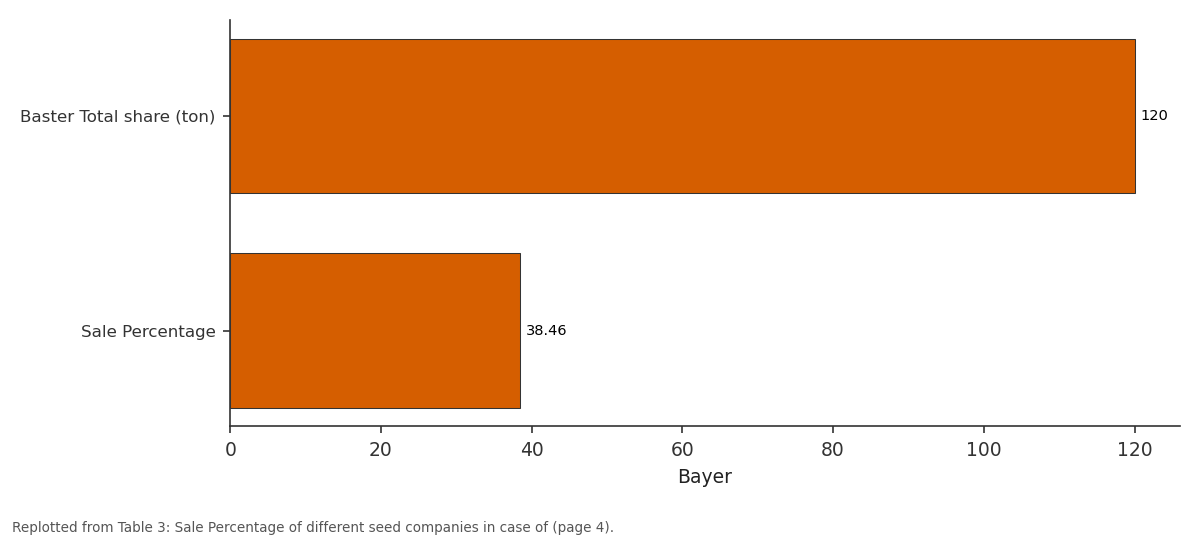
Bayer: Baster Total share (ton) vs Sale Percentage
Replotted from Table 3 (page 4) of the original paper. Every bar is the paper's own table value.
View source evidence ↗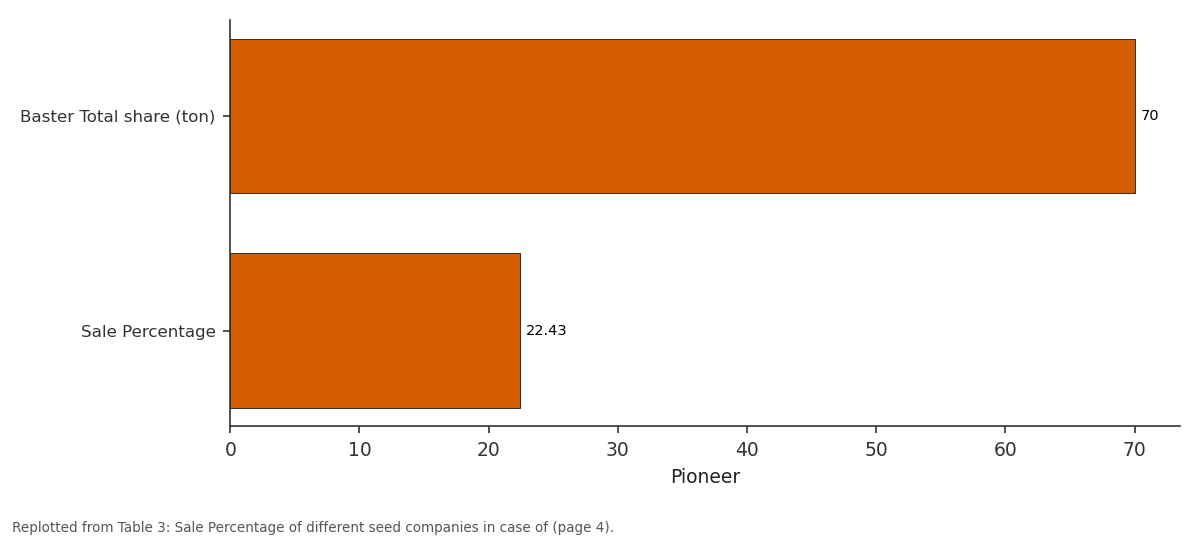
Pioneer: Baster Total share (ton) vs Sale Percentage
Replotted from Table 3 (page 4) of the original paper. Every bar is the paper's own table value.
View source evidence ↗Figures & tables
From the original paper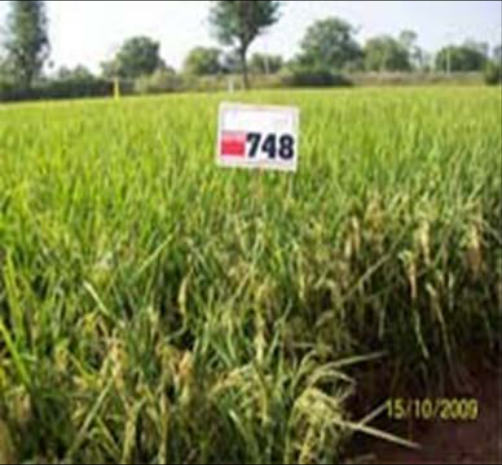 Figure 1
 Figure 2
 Figure 3
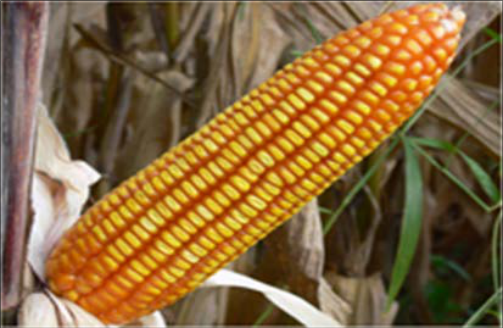 Figure 4
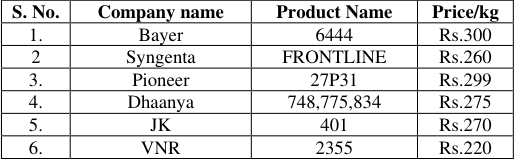 Table 1
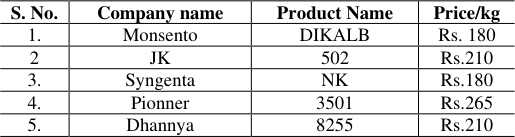 Table 2
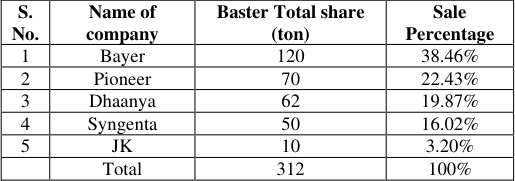 Table 3
Introduction
India is an agricultural country and its one-third population depends on agricultural sector directly or indirectly. Agriculture continues to be the mainstay of the India economy. Indian agricultural contribution to the national gross domestic product is about 18 per cent. Seed is a fundamental, crucial and yield enhancing input for sustained growth in farm production. The role of the seed sector is to ensure adequacy, seed quality and varietals diversity in agriculture. At present the use of hybrid seed is very low but awareness about the high yield and good quality product of hybrid seeds attracted the farming community to switch over to new varieties and hybrid seeds. The farmer's acceptance of modern technologies of farming and availability of hybrid seed in several regions is also positive indication for the growth of the seed industry. Rice is the most important and staple food crop for more then two third of the population of India. The slogan, rice is life, is most appropriate for India as this crop play a vital role in our national food security and is a mean of livelihood for million of rural household. Considering the great scope of hybrid paddy marketing, many private companies are looking forward to enter in this market with powerful marketing strategies. Many hybrid varieties have been released so far in India and among them the hybrids etc are cultivated on a large scale with the development of stable and widely adopted hybrids, large scale production technology is moving faster in present. Rice hybrids with a advantage of 15-20 percent over the check varieties have become popular in India, with enhanced productivity, hybrid paddy technology will enable farmers to get more yield from lees land, it means crop diversification develop the new hybrid seeds and better quality of product in coastal area and shallow low lands this technology will play a major role in significantly enhancing productivity of paddy in the country. (Renganthan, 1994) [4] . describe the significant relationship between farmers' exposure to mass media, radio, television and news print and their level of adoption in high yielding variety of seeds, chemicals, fertilizers, liquid and dust / granules plant protection. (Roy and Dutta, 2000) [5] .
Observed the development and private sector ensure that the critical inputs, like quality seeds of recommended rice and wheat cultivators, pesticide and canal water necessary for productive rice wheat farming are timely available. (Tandon and Shindhe, 1993) [6] . reveal rice in India is being grown on normal as well as on problems soils. This can thrive on soil suffering from complex physio-chemical problems and nutrient disorders the major problems soil are the saline sodic alkaline calcareous soils acid red and latric soils and the sulphate soils. The private companies have grown firstly, at present there are 60:40 ratio between the private and public sector. There are more than 200 private companies of which over 30 percent have global partners. In India, numbers of seed companies are established to introduce the hybrid seed of paddy and also some of them dominated in the hybrid seed market. When the Indian seed industry is compared with the global scenario, the estimated turn over ($ 900 million), with world trade expected to reach us $ 75 billion by 2020.
Development of hybrid paddy in India
Research programme was initiated during 1970 to develop hybrid paddy variety in the country; there was no success in this programme during the subsequent two decades. However the research programme was accelerated and identified from 1989 with a mission mode project. With this span of 5 years and more a dozen hybrids paddy varieties were developed from private and public sector. The first four hybrid paddy varieties were released in the country during 1994. Subsequently two more hybrid paddy varieties were also released. By the end of 2001, total 19 hybrid paddy varieties were released. At present there are more than 500 hybrid paddy varieties developed by different seed companies. So future of seed industries is very bright in coming years. Therefore the study was designed to increase the awareness of DHAANYA Brand in Ambikapur district with the following objectives: 1. To find out the competitors of Dhaanya Seeds 2. To study the availability of Dhaanya Seeds in particular territory(Ambikapur) 3. How to increase the awareness of "DHAANYA" brand among the farmer community in particular territory
Materials and Methods
Around 2 dealers from Ambikapur territory were also selected who deals the selected paddy, maize & vegetable crop seeds. The present study was an explanatory research with an objective to estimate the market potential and identifying relevant variables in decision making. As per the objectives of the project research methodology formulated was as below: 1) Company Profile and Product Information
2) The study area 3) Selection of respondents 4) The Data and method of collection 5) Data analysis
Company profile: Dhaanya's fast success in the market place and acceptance of its products is a result of the focused approach to develop products based on customer requirements in different growing conditions and the ability to successfully reach the customers on time with the quality tested products and effective support, post sales. Dhaanya introduces new and novel hybrids for each market in India after a systematic and objective evaluation of the hybrids in farmer field conditions. Dhaanya Seeds has the research support from Maturing in 110-120 days, the hybrid performs well in rain fed as well as irrigated conditions. Apart from being a high yielder, the hybrid has very good stand ability, tight husk cover (good protection from insect and water damage) and stays green at maturity (good for fodder purpose). The grains are highly attractive and deep orange in colour, which fetch good price to farmers at the time of commercial sale.
Selection of the Study Area
Ambikapur region of Chhattisgarh was selected purposively as it was assigned by sponsored organization for the study.
Selection of Respondents
After selection of district rajpur and ambikapur were randomly selected. From each 44 village that raised paddy crops were selected. In this way total 1717 farmers were selected for detailed study
The Sample Respondents Consist of Distributors 2 Farmers 1717
Method of Data Collection and Sources Primary Data
The primary data were collected from selected distributors, dealers and farmers with the help of pre tested questionnaire scheduled.
Secondary Data
Secondary data were collected from through company employees and individual contact.
Method of Analysis
The collected information and data from the various sources were systematically tabulated and analyzed by using simple arithmetic average and percentage method.
SWOT Analysis Strength
Their product is good. Product Quality is better than competitors. Farmer feedback among the dhaanya products is good. Products prices are low in the market.
Results and Discussions
To achieve the first purpose of the study that is to estimate the competitors of DHAANYA product, the survey was done by using tested questionnaire among the population of Ambikikapur and the results were found frame under the following tables: Table 2 show that there are 4 competitors of Dhaanya in Maize Brand. All brands are providing seeds at higher cost as compared to the Dhaanya.
| S. No. | Company name | Product Name | Price/kg |
|---|---|---|---|
| 1. | Monsento | DIKALB | Rs. 180 |
| 2 | JK | 502 | Rs.210 |
| 3. | Syngenta | NK | Rs.180 |
| 4. | Pionner | 3501 | Rs.265 |
| 5. | Dhannya | 8255 | Rs.210 |
Table text extracted from the original PDF; superscript letters are shown inline. The original table image is below.
View original table image
To study the availability of "Dhannya" in Ambikapur territory As the data have shown in the Table 3, it was found that two brands, Bayer brands and pioneer brands are strongest competitors as they are selling seeds in higher amount as compare to the DHAANYA brand and the sale percentage is also high as compare to the other brands in Baster, Ambikapur region.
| S. No. | Name of company | Baster Total share (ton) | Sale Percentage |
|---|---|---|---|
| 1 | Bayer | 120 | 38.46% |
| 2 | Pioneer | 70 | 22.43% |
| 3 | Dhaanya | 62 | 19.87% |
| 4 | Syngenta | 50 | 16.02% |
| 5 | JK | 10 | 3.20% |
| Total | 312 | 100% |
Table text extracted from the original PDF; superscript letters are shown inline. The original table image is below.
View original table image
Conclusion
The present study brings focus on the market evaluation of the available seeds to the farmers. It also lays emphasis on the competitors availability, price and quality of the Dhaanya seeds Limited. In present scenario at Ambikapur district "DHAANYA 748" is facing serious competition with 27P31 variety. It was found that most of the farmers had average level of satisfaction toward on the basis of price, availability and quality respect hence, it is recommended to improve brand awareness, advertisement and extension activities.
Recommendation In the present study that a large number of farmers are not aware about "DHAANYA SEEDS" so Company starts more farmers meeting programme of the Hybrid Seeds. Seeds are not easily available in the market, so company make more distributor channel in the block. Company promotes their wholeseller for the advertisement of their products.
Figures and tables from the paper
| S. No. | Company name | Product Name | Price/kg |
|---|---|---|---|
| 1. | Bayer | 6444 | Rs.300 |
| 2 | Syngenta | FRONTLINE | Rs.260 |
| 3. | Pioneer | 27P31 | Rs.299 |
| 4. | Dhaanya | 748,775,834 | Rs.275 |
| 5. | JK | 401 | Rs.270 |
| 6. | VNR | 2355 | Rs.220 |
Table text extracted from the original PDF; superscript letters are shown inline. The original table image is below.
View original table image
References
3 in the original paper- Spadaro JT, Renganathan V. Peroxidase-catalyzed oxidation of azo dyes: mechanism of Disperse Yellow 3 degradation. Archives of biochemistry and biophysics. 1994 Jul 1;312(1):301-7.
- Roy SD, Chaudhury S, Banerjee S. Isolated 3D object recognition through next view planning. IEEE Transactions on Systems, Man, and Cybernetics-Part A: Systems and Humans. 2000 Jan;30(1):67-76.
- Ribeiro SC, Tandon R, Grunhaus L, Greden JF. The DST as a predictor of outcome in depression: a meta-analysis. American Journal of Psychiatry. 1993 Nov 1;150(11):1618-29.