
Research article · 2023 · Full text
International Journal of Research in AgronomyPesticide residues and their microbial degradation in soil: A review
Volume 6(2) · Pages 10–12 · DOI: 10.33545/2618060x.2023.v6.i2a.179 ↗
Research areasPesticide and Herbicide Environmental Studies
Abstract
Author-writtenPesticides have been found a proven tool for the effective protection and improvement of the quality and quantity of food commodities. The extensive and indiscriminate use of these chemical compounds has created soil and plant health problems as well as water pollution problems which is unlikely to decrease in near future. Although, there is growing awareness among the consumers, farmers and scientific fraternity to the long lasting ill effects of these chemicals. Therefore, scientists are trying to develop the naturally benign chemicals which are eco-friendly and economically viable for plant protection. A practical solution of several approaches is to dissipate these chemicals from the environment through microbial decomposition. Micro-organisms in natural systems such as agricultural soils, water bodies and other environmental compartments are the important agents for degradation of pesticides. Results indicated that Bacteria and fungi are main the microbes involved in the degradation of different pesticides in soils. Specific group of bacteria and fungi are degrading specific group of pesticides. Soil properties (pH, temperature, water content & texture) affect the microbial degradation of different pesticides.
Summary
Source-checkedPlain-language reading of the full paper, prepared with AI and checked against the text. Each point links to the authors' own words.
Why it matters
- Pesticides are established tools used to protect crops and improve both the quality and quantity of food production. View evidence ↗
- The widespread and indiscriminate application of pesticides has led to persistent pollution of water and health issues for plants and soil. View evidence ↗
- According to WHO data, only 2-3% of applied chemical pesticides are effective against pests, with the vast majority remaining in the soil. View evidence ↗
The question
- The authors identify microbial decomposition as a practical solution for removing pesticide residues from the environment. View evidence ↗
What they did
- The review identifies bacteria and fungi as the primary microorganisms responsible for degrading various pesticides in soil. View evidence ↗
- The effectiveness of microbial degradation is influenced by soil properties, including texture, water content, temperature, and pH. View evidence ↗
What they found
- Inoculating soil with Burkholderia cepacia strain CH9 (50 µg ml-1) achieved 69% degradation of imidacloprid and 86% degradation of metribuzin within 20 days. View evidence ↗
- Bacillus sp. showed the highest degradation of oxyfluorfen (80-95.6%), outperforming other microbes like Arthrobacter sp. (82.2%) and Streptomyces sp. (68.9%). View evidence ↗
- Aspergillus Niger was able to achieve almost complete degradation of carbofuran within 6 days of pesticide addition. View evidence ↗
- Under optimized conditions, Aspergillus Niger (MCP1) degraded 90% of monocrotophos over a 10-day period. View evidence ↗
- Trichoderma viride demonstrated the highest butachlor reduction rate at 97.6% in 15 days, compared to Pseudomonas sp. at 94.7% in 21 days. View evidence ↗
- The use of a consortium including Aspergillus Niger, Aspergillus flavus, and Achaetomium strumarium reduced the degradation life of biofenthrin in soil to 27.4 days. View evidence ↗
- Complete degradation of parathion was achieved in 20 hours when flooded soil was incubated with Pseudomonas sp. View evidence ↗
- Pseudomonas stutzeri (CS1) degraded up to 66.8% of cypermetherin in 20 days compared to the control group. View evidence ↗
- Alpha and beta endosulfan showed almost 50% degradation in 12 hours and reached complete degradation within 48 hours. View evidence ↗
What it means
- The authors conclude that using microbes or microbial consortia with degradative abilities is the most cost-effective and efficient biological method for cleaning herbicide-contaminated sites. View evidence ↗
Visual summary
1 visualsIllustrations explain the paper; they do not show study data.
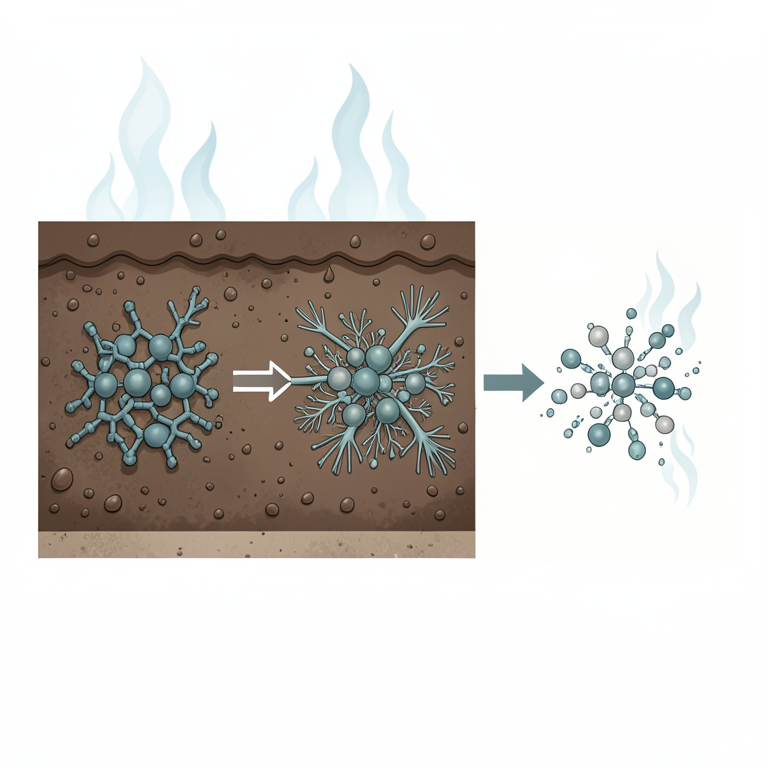
Microbial Degradation Process
AI-generated conceptual illustration (soil profile with bacteria and fungi). It explains the idea and does not show study data.
View source evidence ↗Introduction
Microbial degradation is one of the major processes of decomposition of herbicides in soil. The rate at which breakdown occurs depends on environmental conditions as well as inherent nature of herbicide. Generally warm and moist conditions favour microbial activity and hence the breakdown of herbicides. Some herbicides less only for a short time (eg. glyphosate), while others can persist for longer even more than one cropping season/year. Microorganisms decompose herbicide initially at a slow rate as detected by slow release of CO 2 from soil. It is called "lag phase" and in this phase they increase their population rapidly and build up intracellular or extracellular enzyme potential. Lag phase is later followed by rapid increase in the rate of CO 2 evolution which indicates rapid microbial activity. Due to shift of rural population to the urban areas, use of herbicides has become a widespread practice, in order to combat the weed situations. Despite their usefulness in the increment of food production, their extensive use has led to the presence of residues in food and environmental contamination. The World Health Organization (WHO) data show that only 2-3% of applied chemical pesticides are effectively used for preventing, controlling and killing pests, while the rest remains in soil (EPA, 2005). The ultimate "sink" of the pesticides applied in agriculture care in soil. Therefore, the surface soil containing residual pesticides cause toxicity in the surrounding environment. Real and perceived concerns about pesticide toxicity have promoted their strict regulation in order to protect human health and to support the compliance and enforcement of laws and regulations pertaining to food safety. At present, the pesticide waste in being treated by physico-chemical methods which are not efficient and effective. Among biological approaches, the use of microbes/consortia with degradative ability is considered the most efficient and cost effective option to clean herbicide contaminated sites. Soil being the store house of multitudes of microbes, in quantity and quality, receives the chemicals in various forms and acts as scavenger of harmful substances. The efficiency and the competence to handle the chemicals vary with the soil and its physical, chemical and biological properties.
Microorganisms play an essential role in the bioconversion and total breakdown of pesticides in the environment. Bioremediation is the breakdown (Biodegradation) of contaminationg compounds using microorganisms. These microbes often use contaminants as food source, thereby completely eliminating toxic compounds by changing them into basic elements such as carbon dioxide and water, a process known as mineralization. Incomplete degradation may also occur, or the partial breakdown of the original contaminant to a less complex form. Another result may be the transformation of a compound to a different chemical structure that may affect the toxicity and mobility of the original agent. Sometimes immobilization of a compound occurs where the agent overcome by the microbe but not eliminated or altered, which is often a potential benefit but rarely a final solution. Microbial degradation of persistent herbicides like pendimethalin, atrazine (Singh et al. 2007) [20] , fluchloralin (Singh and Kulshrestha, 1995) [19] , metalachlor and alachlor (Maisnam et al., 2009) was studied and potential microbes isolated for their rapid degradation. Similar studies are carried out with a persistant insecticide bifenthrin (Sharma et al., 2012) [12] and five different PAHs (Choudhary et al. 2011) [3] . In one of the recent studies a bio-surfactant producing bacteria was used as an additional amendment which itself was a slow degrader but helped in solubilizing the low water soluble pesticide and made it available for degradation.
Bacterial degradation
Patil et al. (1970) [14] reported that most of microbial cultural out of 16 which were capable of degrading the dieldrin were also able to degrade endrin, DDT its metabolites and aldrin. Siddaramappa et al. (1973) [17] reported that incubation of flooded soil with Pseudomonas sp. for 20 hrs resulted in complete degradation of parathion. Revealed that the organism Escherichia coli degraded 10% of the added lindane in 12 days and approximately 1% of the consumed lindane appeared as pentachlorocyclohexane (PCCH) (Francis et al. (1975) [6] . Bourquin (1977) [2] reported that 13 isolates of bacteria isolated from salt marsh environment exhibited malathion degradation capability in the range of 1 to 90% when malathion was the sole source of 'C'. Yu et al. (2003) [23] found that degradation capability of wheat rhizosphere soil enhanced when it was inoculated with rhizospheric bacterial community designated as HD. Singh et al. (2004) [18] found that residues of chlorpyrifos when spiked at the rate of 25 mg L -1 was degraded rapidely in the soil inoculated with Enterobacter strain B-14 when applied at the rate 10 6 cells/g soil than in uninoculated soil. Jia et al. (2006) [9] observed that degradation of residues of monocrotophos when applied at the rate of 50 mg kg -1 when the soil was inoculated with Paracoccus sp. M-1 (@10 6 cfu g -1 ) than uninoculated soil. Sorensen et al. (2008) [22] reported that consortium of Variovorax sp. SRS16 and Arthrobacter globiformis D47 mineralized the diuron in to 14 CO 2 in the range of 31 to 33% from soil when spiked at the rate of 15.5 to 38.9 µg L -1 . Madhuban et al. (2008) [11] reported that cypermetherin was degraded by CS1 (Pseudomonas stutzeri) up to 66.8% in 20 days over control. The half-life of cypermethrin was found 20 days. Shivaramaiah (2010) [16] recorded almost 50% degradation of alpha and beta endosulfan in 12 hrs and complete degradation was observed within 48 hrs with a simultaneous increase in bacterial biomass. The degradation of endosulfan by anabaena sp. ATCC 7210 may provide the basis for development of bioremediation strategies to remediate pollutants in the environment. Madhuban et al. (2011) [10] reported that inoculation of Burkholderia cepacia strain CH9 at the rate of 50 µg ml -1 resulted 69% and 86% degradation of imidacloprid and metribuzin in 20 days, respectively. Mohamed et al. (2011) [13] found that incubation of soil at 40 °C for 45 days provided comparatively higher degradation of oxyfluorfen herbicide with respect to incubation to 28 °C. They also recorded the highest oxyfluorfen degradation with Bacillus sp. (80-95.6%) followed by Pseudomonas sp., Arthrobacter sp. (82.2%), Aspergillus sp. (77.8%), Mycobacterium sp. (75.6%), Micrococcus sp. (73.3%) and Streptomyces sp. (68.9%). Chowdhury et al. (2014) [4] reported that pyrazosulfuron (25 g/ha) was found safe to its effect on soil microbes as it completely degraded before 50 DAS.
Fungal degradation
Gupta et al. (2012) [7] showed that the optimum temperature for the growth and carbofuran degradation for Aspergillus flavus, Aspergillus nidulans and Aspergillus Niger was found 27 o C. At pH 8.0 the biomass of all the three isolated strains was maximum and Aspergillus Niger showed almost complete degradation within 6 days after pesticide addition. On the contarary, Aspergillus flavus and A. nidulans showed significantly lesser carbofuran degrading ability of 96.2% and 95.1% at 9 and 10 days after pesticide addition, respectively. Jain et al. (2012) [7] observed that Aspergillus Niger sp. MCP1 grew optimally at pH 8.0 and 150 mg L -1 concentration of monocrotophos in a period of 10 days incubation. They also observed that Aspergillus Niger (MCP1) is capable of degrading 90% of monocrotophos under optimized condition in 10 days. Alrahman et al. (2013) [1] reported that Trichoderma viride had the highest degradation rate (97.6% butachlor reduction in 15 days) followed by Pseudomonas sp. (94.7% reduction in 21 days) and concluded that these organisms can be used for butachlor degradation. Biofenthrin pesticide is degraded by using consortium use of Aspergillus Niger, Aspergillus flavus and Achaetomium strumarium and degradation life of biofenthrin in soil could be reduced to 27.4 days (Singh et al., 2014) [21] .
References
19 in the original paper- Alrahman SF, Salem B. African journal of microbiology research. 2013;7(4):330-335.
- Bourquin AW. Applied and environmental microbiology. 1977;33(2):356-362.
- Chaudhary P, Sharma R, Singh SB, Nain L. Bioremedation of PAH by streptomyces sp. Bulletin of Environmental contamination and toxicology. 2011;86:268-271.
- Francis AJ, Spanggord RJ, Ouchi GI. Applied and Environmental microbiology. 1975;29(4):567-568.
- Gupta S, Garg V, Jain R. Pesticide Research Journal. 2012;24(1):37-41.
- Jain R, Garg V, Singh KP, Gupta S. International Journal of Environmental Sciences. 2012;3(2):841-850.
- Jia KZ, Cui Z, He J, Guo P, Li S. Federation of European Microbiological Socities Letter. 2006;263:155-162.
- Madhuban G, Dutta D, Uha SK, Kalra S, Bandyopadhyay S, Das SK. Pesticide Research Journal. 2011;23(1):36-40.
- Madhuban G, Jha SK, Ram N, Livleen S, Das SK. Pesticide Research Journal. 2008;20(2):275-277.
- Maisnam J, Singh SB, Kulshrestha G, Arya S. Persistance of alachlor in sandy loam soil. Ann. PI Protection Science. 2009;17(2):456-458.
- Mohamed AT, Hussein AA, Siddiq MA, Osman AG. Biotechnology. 2011;10:274-279.
- Patil KC, Matsumura F, Boush GM. Applied microbiology. 1970;19(5):879-881.
- Sharma D, Singh SB. Persistance of bifenthrin in sandy loam soil as affected by microbial community. Bulletin of Environmental contamination and toxicology. 2012;86:906908. 16. Shivaramaiah HM. Pesticide Research Journal. 2010;22(2):125-128.
- Siddaramappa R, Rajaram KP, Sethunathan A. Applied and Environmental microbiology. 1973;26(6):846-849.
- Singh BK, Walker A, Morgan JA, Wright DJ. Applied and Environmental microbiology. 2004;70(8):4855-4863.
- Singh SB, Kulshrestha G. Degradation of fluchloralin in soil under predominating anaerobic conditions. J. Environmental Science and Health. 1995;30:307-320.
- Singh SB, Lal SP, Pant S, Kulshrestha G. Degradation of atrazine by an acclimatized soil fungal isolate in soil under predominating anaerobic conditions. J Environmental Science and Health. 2007;43:27-33.
- Sorensen SR, Albers CN, Aamand J. Applied and environmental microbiology. 2008;74(8):2332-2340.
- Yu YL, Chen YX, Luo YM, Pan XD, He YF, Wong MH. Chemosphere. 2003;50:771-774.
Cited by 9
From OpenAlex, OpenCitations and reference lists read by Scinovex
- Role of pesticides in biodiversity loss ↗
Rani Kamlesh, Singh Santosh, Prakash Sudhakar, Arya Sunita · International Journal of Bioscience and Biochemistry · 2024
Pesticides are one of the important factors affecting biodiversity, along with habitat loss and climate change. They can have toxic effects in the short term in directly exposed organisms, or long-term effects by causing changes in habitat and the food chain. Aquatic and terrestrial biodiversity can be impacted by pesticides through their direct or indirect application, such as pesticide drift,
❝ 12Found by Scinovex - Earthworm-microbiome interactions: Unlocking next-generation bioindicators and bioengineered solutions for soil and environmental health ↗
Deepika Goswami · Journal of Entomology and Zoology Studies · 2025
Earthworms, long regarded as indicators of soil fertility and ecosystem stability, are now emerging as hosts to highly diverse and functionally dynamic microbiomes. These symbiotic microbial communities spanning the gut, nephridia, and cuticle play critical roles in nutrient cycling, organic matter decomposition, pollutant detoxification, and microbial soil network formation. This review synthesizes current advances in earthworm-microbiome research with a focus
- Legacy hexaconazole and tricyclazole residues hinder organic transition in paddy rice cultivation ↗
Suin Cho, Hye-In Joe, Taehwa Kim, Jong‐Woo Park, Byeong‐Jin Bae, Byeung Kon Shin et al. · Agricultural & Environmental Letters · 2026
Abstract Legacy pesticide contamination poses a critical barrier to organic certification of conventional rice farms. This 3‐year study (2021–2023) investigated hexaconazole and tricyclazole persistence in paddy soil, water, rice aboveground biomass (AGB), and grain following foliar application of a premixed formulation to rice ( Oryza sativa subsp. japonica ). Double‐exponential modeling revealed biphasic dissipation patterns for both fungicides: rapid initial…
❝ 0PDF - Exploring the safety profile of Doronicum hookeri: Insights and findings ↗
Fazlurrehman, Nazish Siddiqui, Sumbul Rehman, Sumera Sagheer · International Journal of Unani and Integrative Medicine · 2025
Background: Herbal medicines play a crucial role in traditional healthcare systems. According to the World Health Organization (WHO), an estimated 70-80% of the global population depends on traditional remedies for their health needs. These herbs are widely utilized for the treatment and prevention of various health conditions. However, the increasing popularity of herbal products has raised concerns about their safety.
- Biodegradation of Agrochemical Pollutants: The role of microbial biosurfactants in pesticide detoxification ↗
Aditi N Vyas, Jaynesh K Ambechada · Journal of Advances in Microbiology Research · 2025
Agrochemical pollutants, notably pesticides, present a persistent challenge to environmental sustainability and public health due to their widespread use, toxicity, and resistance to natural degradation. Biodegradation, driven by microbial activity, offers an eco-friendly solution for detoxifying these contaminants, with microbial biosurfactants playing a pivotal role in enhancing the process. Biosurfactants, amphiphilic compounds secreted by microorganisms, improve the solubility and bioavailability
- Assessing the impact of conventional urea and Nano-urea on soil microbial biomass and enzyme activities
Yashaswini KP, SM Prasanna · International Journal of Advanced Chemistry Research · 2025
Optimizing fertilizer application is critical for maintaining soil health, promoting crop productivity, and minimizing environmental degradation. The advent of nano-fertilizers offers new opportunities for efficient nutrient management. This study evaluated the effects of conventional urea and nano-urea on soil biological properties and enzyme activities in tomato cultivation. Significant differences were observed in soil pH among treatments, with the highest (7.51) pH recorded in T12 (50% RDN as basal dose + nano-urea (2 ml L-1) at 30 and 45 DAT). However, organic carbon content and soil micr
- Evaluation of the safety profile of “Talmakhana” the seed drug of Hygrophila auriculata (Schumach.) Heine used in Unani medicine ↗
Ameera Ayyub, Nadeem Siddiqui, Shamshad Alam, Ariz Ayyub · International Journal of Pharmacognosy and Life Science · 2025
Background: Talmakhana (Hygrophila auriculata (Schumach.) Heine), a widely used Unani seed drug, is valued for its aphrodisiac, diuretic, tonic, and hepatoprotective properties. Despite its therapeutic relevance, scientific evaluation of its safety parameters remains limited. Objective: To assess the safety profile of Talmakhana seeds through analysis of microbial load, heavy metals, aflatoxins and pesticide residues in accordance with WHO and ASU
- Chemical influence of charcoal and sawdust mulches on soil pH and nutrient composition in grape vineyards ↗
Leyla Karaman, Arman Hosseini, Samira Al-Rikabi · International Journal of Chemical Research and Development · 2025
Mulching has emerged as a fundamental soil management strategy in perennial fruit crops, particularly in grape vineyards where maintaining stable soil chemistry is essential for sustained productivity and vine longevity. The application of organic mulches such as charcoal and sawdust can substantially alter soil pH, nutrient availability, microbial processes, and water retention, thereby influencing vine growth and grape quality. This
- Academic evaluation of microbial consortia-based biofertilization strategies for sustainable brinjal (Solanum melongena L.) production ↗
Ama Serwaa Asiedu, Akua Owusu · International Journal of Advanced Academic Studies · 2024
Sustainable vegetable production in Africa requires innovative and low-cost soil fertility management strategies. Microbial consortia-based biofertilization integrates beneficial microorganisms that improve soil microbial health, nutrient mobilization, and crop productivity. This study evaluated the effects of bacterial and fungal consortia on soil enzyme activity, nutrient availability, and yield of brinjal (Solanum melongena L.) grown under tropical field conditions in Ghana. Treatments