
Research article · 2023 · Full text
International Journal of Veterinary Sciences and Animal HusbandryMeasurement of reproductive performance of Etawa-crossed goats managed in JK community
Volume 8(5) · Pages 225–228 · DOI: 10.22271/veterinary.2023.v8.i5d.730 ↗
Research areasLivestock Farming and ManagementFood and Agricultural Sciences
Abstract
Author-writtenThis study aimed to determine the reproductive performance of Etawa-crossed goats managed in JK Community. The research was conducted using descriptive method with direct measurement of 56 samples of Etawa-crossed goats. Observation variables are first mating age, litter size, kidding interval, and post partum estrus. The results showed that reproductive performance with the age of Etawa-crossed goat is 2 to 4 years. The first age of mating is average of 9.25 ± 0.84 months, litter size 2.02 ± 0.51 kids, kidding interval 8.79 ± 0.85 months, and post partum estrus with an average of 3.41 ± 0.49 months. The reproductive performance of Etawa-crossed goats managed in JK Community has been good.
Summary
Source-checkedPlain-language reading of the full paper, prepared with AI and checked against the text. Each point links to the authors' own words.
Why it matters
- Goat farming is considered a commodity with significant potential for development. View evidence ↗
- Etawa-crossed goats are specifically developed due to their high reproductive potential and ability to adapt to various environments. View evidence ↗
- Understanding reproductive performance is essential for measuring population growth and maximizing the goat farming business. View evidence ↗
The question
- The study aimed to determine the reproductive performance of Etawa-crossed goats managed within the JK Community. View evidence ↗
What they did
- The researchers used a descriptive method to directly measure a sample of 56 Etawa-crossed goats. View evidence ↗
- The study measured four key variables: age at first mating, litter size, kidding interval, and post partum estrus. View evidence ↗
- Data was collected through a combination of direct observations of the goats and interviews with the breeders. View evidence ↗
- The collected data were tabulated and analyzed descriptively using standard deviations and average values. View evidence ↗
What they found
- The average age at first mating for the goats was 9.25 ± 0.84 months. View evidence ↗
- The average litter size was 2.02 ± 0.51 kids. View evidence ↗
- The average kidding interval was 8.79 ± 0.85 months. View evidence ↗
- The average post partum estrus was 3.41 ± 0.49 months. View evidence ↗
- The sample of 56 goats, aged 2 to 4 years, had an average parity of 2.36 ± 0.47 times and an average body weight of 34.88 ± 7.72 kg. View evidence ↗
- Half of the sample (50.00%, 28 goats) were aged >2 years, with an average body weight of 33.35 ± 6.41 kg and a parity of 2.00 ± 0.00 times. View evidence ↗
What it means
- The authors concluded that the reproductive performance of the Etawa-crossed goats in the JK Community is good. View evidence ↗
- The authors summarize that the reproductive performance is quite good based on the measured averages for mating age, litter size, kidding interval, and post partum estrus. View evidence ↗
Visual summary
3 visualsIllustrations explain the paper; charts are replotted from the paper's own table values.
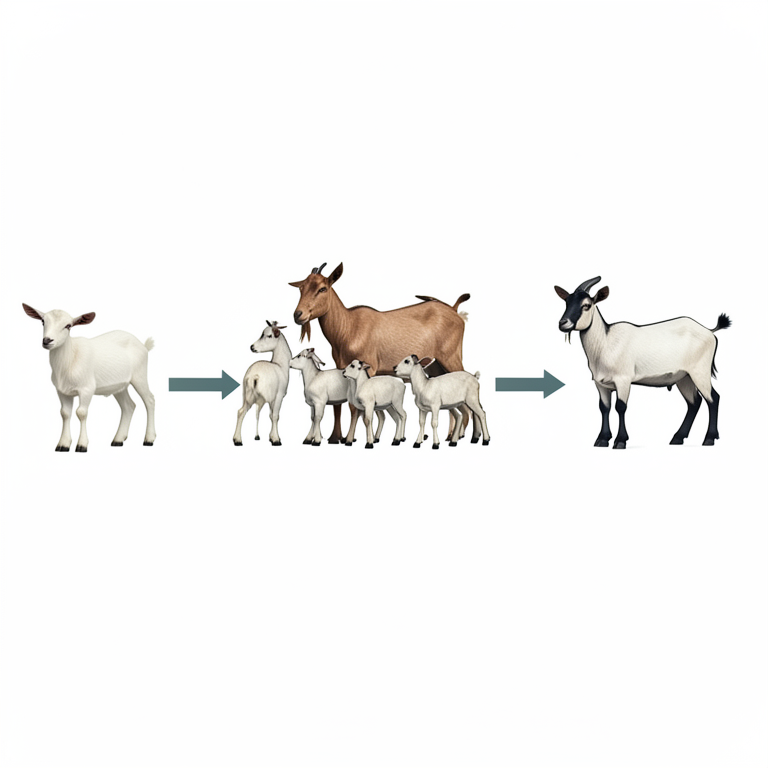
Reproductive Performance Indicators
AI-generated conceptual illustration (Etawa-crossed goats). It explains the idea and does not show study data.
View source evidence ↗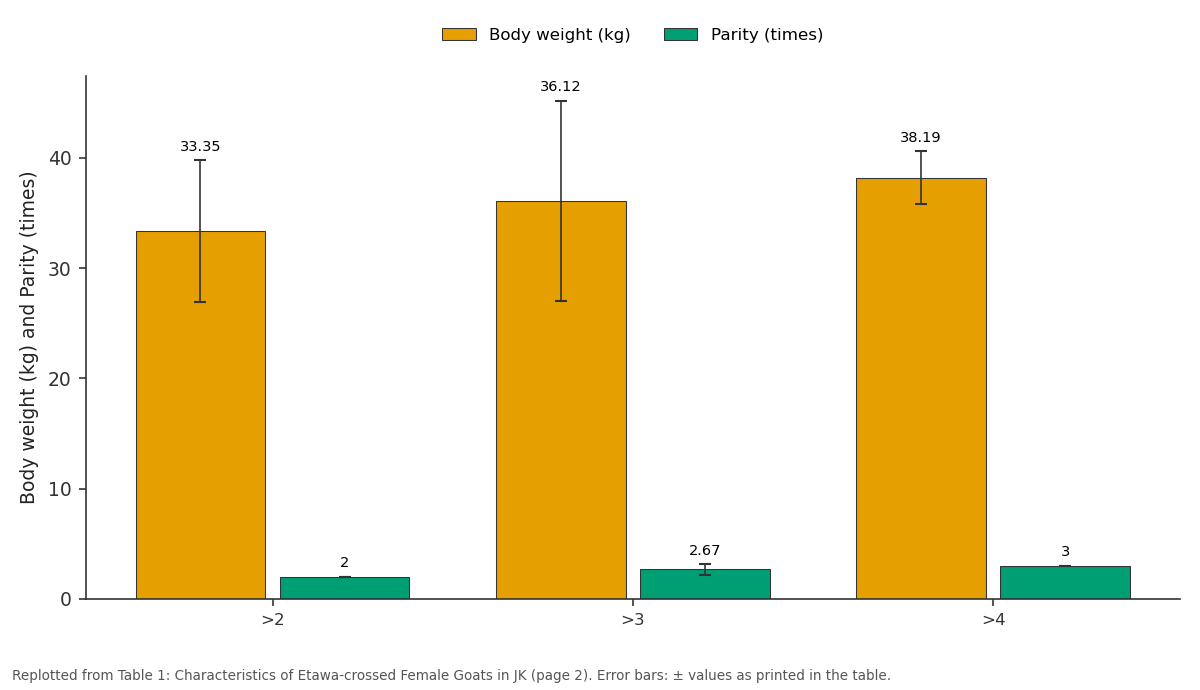
Body weight (kg) and Parity (times): >2 vs >3 vs >4
Replotted from Table 1 (page 2) of the original paper. Every bar is the paper's own table value.
View source evidence ↗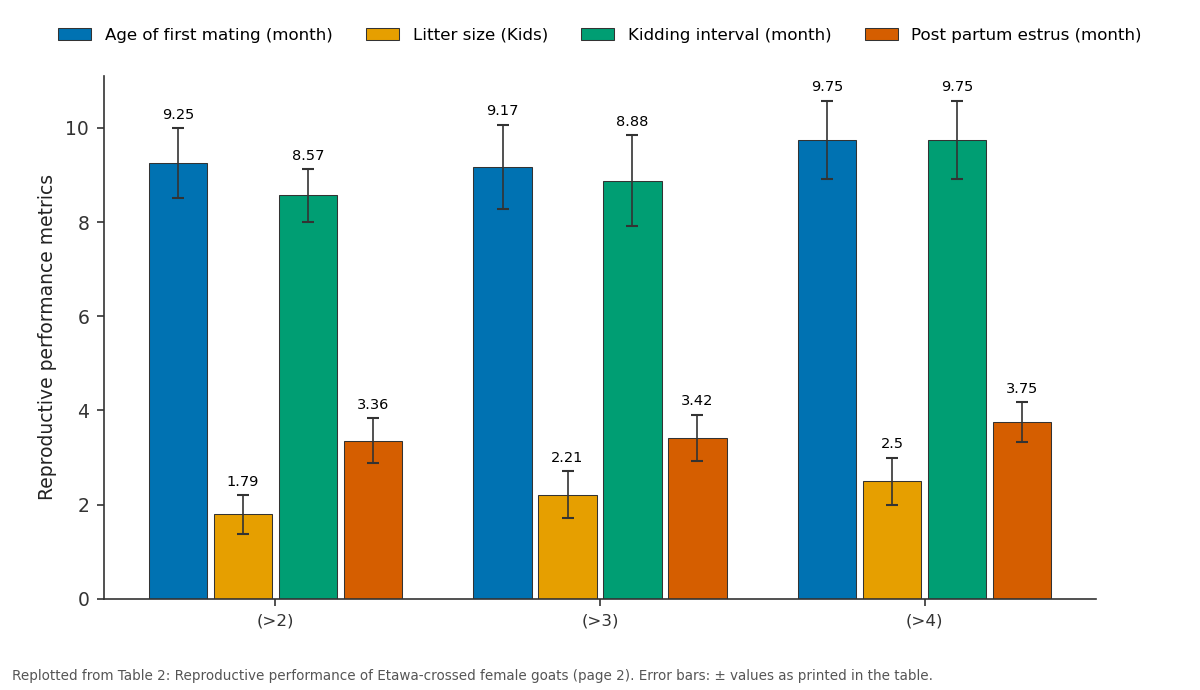
Age of first mating (month) and Litter size (Kids) and more: (>2) vs (>3) vs (>4)
Replotted from Table 2 (page 2) of the original paper. Every bar is the paper's own table value.
View source evidence ↗Figures & tables
From the original paper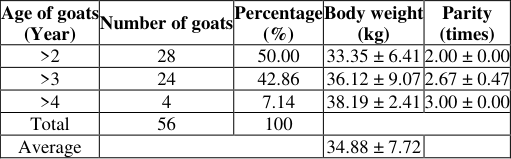 Table 1
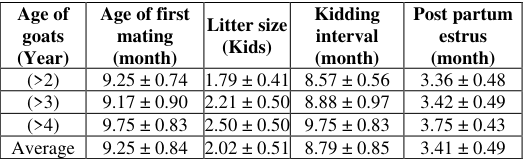 Table 2
Introduction
Goat farming is a commodity that has enormous potential to be developed. Currently in Polewali Mandar Regency, goat farming is used as a leading commodity which is supported by the availability of land and the community's habit of keeping livestock for generations. One of the types developed is the Etawa-crossed goat with the advantage of its high adaptability to various environmental conditions and high reproductive potential [1] . The suitability of a female animal in a livestock business can be seen from its reproductive performance. Measurement of reproductive performance is based on age at first mating, litter size, kidding interval, and post partum estrus [2,3] . Knowledge about reproductive performance can help in measuring the growth rate of the goat population, so that the development of the goat farming business will be maximized [4] . JK Community is one of the goat farming businesses in West Sulawesi, especially in Polewali Mandar, Tandassura Village, Limboro District. The types of goats developed at JK Community are Etawa-crossed and Boer. One of the basic components in farming management is recording. Recording needs to be done so that livestock development can be monitored with certainty and measurability [5] . This recording system will produce long-term benefits through controlling input and output in an effort to produce better livestock [6] . Knowledge regarding the performance of Etawa-crossed female goats in the JK Community is important to evaluate maintenance management so that livestock productivity can continue to be improved. It is necessary to conduct a study regarding the reproductive performance of Etawa-crossed female goats that managed in the JK Community.
Materials and Methods
Materials and Methods
Research variable
This study is a type of quantitative descriptive research, with the number of samples observed being 56 Etawa-crossed female goats. The research variables observed in this study included age at first mating, litter size, kidding interval, and post partum estrus.
Data Collection
The data collection technique in this research used the observation method, through direct observations of the objects studied, as well as direct interviews with breeders.
Data analysis
The data obtained to observe the reproductive performance of Etawa-crossed female goats managed at JK Community were tabulated and then analyzed descriptively using the average values and standard deviations of all observed variables.
Results and Discussion
Results and Discussion
A. Characteristics of Etawa-crossed Goat Female in JK Community
The reproductive performance of female goats can be seen from their ability to produce children. The suitability of a female animal in a livestock business can be seen from its reproductive potential [2] . The measurement of reproductive potential is based on the ability to give birth as seen in table 1. Livestock development in JK Community is carried out using an intensive maintenance system. An intensive system is maintenance carried out in cages with the aim of making it easier to control and feeding. The cage system in the JK Community is in colonies or groups female and male goats to facilitate the mating process. After the female goats have finished mating, they are separated from the group and moved to individual cages until the goats give birth. The results showed that the average body weight is smaller than the research results by Rasminati [7] that an average of 40 kg at 3-4 years of age. The difference in body weight of the Etawa-crossed goats based on different ages is due to growth factors and maintenance management of each breeder.
Increasing goat age will be followed by an increase in body weight. This is supported by Septian et al. [8] who stated that body weight and body size are increasing because livestock are in their growth period, the process of increasing body weight, muscle and body size as the age of the livestock increases. Parity is the stage at which a female gives birth to a kid. Parity needs to be a concern because it is related to productivity traits and also helps in the genetic selection process of livestock [9] . The productivity of an animal can be assessed based on the age, body weight, parity and litter size [10] . According to Pan et al. [11] that parity has a high correlation with the parent's age, body weight and litter size.
There is a tendency that increasing parental parity will be followed by an increase in litter size. In addition, the litter size tends to increase as the mother's age increases from 2-6 years.
B. Reproductive Performance of Etawa-crossed Female Goats in JK Community
Reproductive performance are aspects related to livestock reproduction. Reproductive performance can include age at first mating, litter size, kidding interval [12] and post partum estrus. Knowledge about livestock reproductive performance is very important for planning the process of improving of a farm which includes mating and rearing management [3] . The reproductive performance of female goats in research conducted at JK Community can be seen in Table 2.
Age of First Mating
Age at first mating is the age at which female are first mated. The aim of knowing the age at first mating is to maintain livestock productivity, so that by the time they are mated the livestock will be approaching maturity [3] . Differences in the age at first mating are usually due to differences in livestock growth rates which can be seen from livestock rearing methods and the farmer's experience.
Based on the results of research regarding the age at which goats are first mated in the JK Community, it showed an average of 9.25 ± 0.84 months. The age at first mating of the Etawa-crossed goats in the JK Community is in the normal category. Based on interviews conducted, goats are first mated at the age of 9-12 months. This is in accordance with Zein and Rahmatullah [3] where goats should be mated at the age of 10-12 months when the goat has reached body maturity. The results of this study are similar with the research of Jermias et al. [13] , at the age of 9.19 ± 1.37 months, while the research results of Sarina et al. [14], with an average of 11.17 months. In general, goats in Indonesia have a first mating age of around 8-12 months [15] . The livestock mating process is different due to differences in breeder maintenance management in each region.
Litter Size
Litter size is the number of offspring per birth to see the fertility level of the female. The litter size of a mother goat is influenced by several factors including the mother's age, body weight, environmental temperature, etc. Litter size in Etawacrossed female goat in JK Community has an average of 2.02 ± 0.51 kids. The body performance of Etawa-crossed female goat who give birth to twins appears to be greater than that single [16] . Twins will require a larger abdominal and uterine space.
The results of this research are in line with Kurniasih et al. [17] who stated that Etawa-crossed goat in Cimalaka District aged 3-4 years had multiple births with an average of 2.13 ± 0.5 kids. This is also in accordance with Budisatria and Udo [18] that Etawa-crossed goats kept in Bantul Regency showed a litter size of 1.7 when the female was >2 years old. Furthermore, according to Haldar et al. [10] that the litter size is influenced by the age of the animal, body weight, and body posture of the mother.
Kidding Interval
Kidding interval is determined by the length of pregnancy and the time of estrus after giving birth. Kidding interval or calving interval is the time interval calculated from calving to next calving. The shorter of the calving interval, the higher the mother's productivity. Calving interval is the most important character for assessing productivity and is the best index for evaluating reproductive efficiency. Based on the results of this study, the kidding interval for Etawa-crossed goats showed an average of 8.79 ± 0.85 months. The results are higher than Masrah et al. [19] that 7.16 months, while Utomo [20] in his research stated that the kidding interval for Etawa-crossed goats kept in coastal vs. mountainous areas was 9.3 months and 9.5 months.
The average kidding interval in this study is in the high category. Various of kidding intervals are related to uterine activity returning to normal size after giving birth. The slower the uterine involution, the slower the ovaries will return to activity so that in the end the female animal will be delayed in entering the next heat cycle. This is in accordance with the opinion of Kurniasih et al. [17] who stated that the kidding interval for goats varies due to sexual activity after giving birth and the farmer's level of knowledge.
Post Partum Estrus
Post partum estrus is used to determine estrus in female after giving birth. Post partum estrus is an important factor that influences reproductive efficiency in goats. The shorter the first heat interval after giving birth, the shorter the calving interval will be, and vice versa. The first heat that appears after giving birth is called post partum estrus. The results of research related to post partum estrus show that female goats aged 2 -4 years have an average post partum estrus of 3.41 ± 0.49 months. The results of this research are still within normal and standard figures. According to Murdjito et al. [21] that post partum estrus in Etawa-crossed goats of 3 to 5 months is still within the normal range. Furthermore, Utomo [20] stated that post partum estrus of Etawa-crossed goats is 3-5 months after giving birth, where this is relative depending on the condition of the feed provided and the influence of the breeder's level of knowledge in livestock management.
The results of interviews conducted with breeders in the JK Community showed that the adequacy of nutrients needed by livestock continues to be considered because feed can influence the process of development and maturation of oocytes. Nutrient aspects consisting of energy, protein, minerals and vitamins can affect reproduction and nutrient deficiencies are related to the reproductive performance of livestock. Post partum estrus is influenced by the female care after giving birth, especially in relation to adequate feed and nutritional perfection.
Conclusion
The reproductive performance of Etawa-crossed female goats managed at JK Community is quite good, with an average age at first mating of 9.25 ± 0.84 months, litter size of 2.02 ± 0.51 kids, kidding interval of 8.79 ± 0.85 months, and post partum estrus 3.41 ± 0.49 month.
References
20 in the original paper- Monintja FJ, Hendrik MJ, Pudjihastuti E, Ngangi LR. Ebservation of Doe-reproductive potensial raised traditionally around coastal areas of Tombariri district Minahasa Regency. Zootec. 2016;36(2):466-475.
- Zein R, Rahmatullah SN. Morphometrics Evaluation and First Mating Age of Crossbreed Female Ettawa in Samarinda City. Jurnal Peternakan Lingkungan Tropis. 2020;3(2):70-75.
- Swuandana R, Rahmatullah SN, Sulaiman A. Diversity of qualitative and quantitative traits of Ewe Jawarandu goats in smallholder farms and industry farms at east Kalimantan. Jurnal Ilmiah Fillia Cendekia. 2022;7(2):9197.
- Nuraini, Hidayat Z, Yolanda K. Final body weight performance, weight and percentage of carcass of Merawang chicken in different filial and gender. Sains Peternakan. 2018;16(2):69-73.
- Junaedi, Aryo, Khaeruddin, Suparman. Efforts to improve recording of goats through making livestock cards. Tarjih Journal of Community Empowerment. 2022;2(1):14-20.
- Rasminati N. Grade of Ettawa Crossbred Goats at Different Areas. Sains Peternakan. 2013;11:43-48.
- Septian AD, Arifin M, Rianto E. The growth pattern of kacang goat bucks in grobogan district. Animal Agriculture Journal. 2015;4(1):1-6.
- Naicy T, Venkatachalapathy RT, Aravindakshan TV, Radhika G, Raghavan KC, Mini M, Shyama K. Nerve Growth Factor gene ovarian expression, polymorphism identification, and association with litter size in goats. Theriogenology. 2016;86(9):2172-2178.
- Haldar A, Pal P, Datta M, Paul R, Pal SK, Majumdar D, et al. Prolificacy and Its Relationship with Age, Body Weight, Parity, Previous Litter size and Body Linear Type Traits In Meat-Type Goats. Asian-Australasian Journal of Animal Sciences. 2014;27(5):628-634.
- Pan S, Biswas CK, Majumdar D, Sengupta D, Patra A, Ghosh S, et al. Influence of age, body weight, parity and morphometric traits on litter size in prolific Balck Bengal goats. Journal of Applied Animal Research. 2015;43(1):104-111.
- Alemayehu G, Mamo G, Alemu B, Desta H, Wieland B. Toward objective measurement of reproductive performance of traditionally managed goat flocks in the drylands of Ethiopia. Tropical Animal Health and Production. 2021;53:156-166.
- Jermias C, Siwa IP, Souhoka DF. Reproductive potential of doe Lakor goat in Lakor District, Southwest Maluku Regency. Agrinimal Jurnal Ilmu Ternak dan Tanaman. 2021;9(1):9-16.
- Sarina K, Rahmatullah SN, Mayulu H. Phenotype diversity and reproductive status of female Ettawa (Pe) breedings in livestock traders in Samarinda city. Jurnal Peternakan Lingkungan Tropis. 2021;4(2):59-74.
- Siwa IP. Lakor Goat, The Indonesia Original Livestock Cluster From Maluku. Jurnal Kalwedo Sains. 2020;1(2):57-63.
- Zurahmah N. Observation of growth the peranakn etawacrossedh goats in intensive maintenance in Manokwari regency. Jurnal Ilmu Peternakan dan Veteriner Tropis. 2018;8(2):45-50.
- Kurniasih NN, Fuah AM, Priyanto R. Reproduction characteristics and population dynamics of Etawacrossedh grade goats on sand post-mining land. Jurnal Ilmu Produksi Dan Teknologi Peternakan. 2013;1(3):132-137.
- Budisatria IGS, Udo HMJ. Goat-Based Aid Programme in Central Java: An Effective Intervention for the Poor and vulnerable? Small Ruminant Research. 2013;109(23):76-83.
- Masrah, Hafid H, Saili T. Kajian Produktivitas Ternak Kambing Pada Sistem Pemeliharaan yang Berbeda Di Kecamatan Andoolo Barat Kabupaten Konawe Selatan. Jitro. 2016;3(1):40-51.
- Utomo S. Effect of altitude on the achievements of artificial insemination in Ettawa crossbred goats. Sains Peternakan. 2013;11(1):34-42.
- Murdjito G, Budisatria IGS, Ngadiyono N, Baliarti E. Performances of bligon goats kept by farmers at Giri Sekar Village, Panggang, Gunungkidul. Buletin Peternakan. 2011;35(2):86-95.