
Research article · 2023 · Full text
International Journal of Agriculture and NutritionLaboratory assessment of Annona reticulata Linn. (Annonaceae), Pongamia glabra Vent. (Fabaceae) and Piper nigrum Linn. (Piperaceae) against Bihar hairy caterpillars, Spilarctia obliqua Walker (Lepidoptera: Arciitidae)
Volume 5(2) · Pages 01–06 · DOI: 10.33545/26646064.2023.v5.i2a.121 ↗
Research areasInsect Pest Control StrategiesAgricultural pest management studiesEssential Oils and Antimicrobial Activity
Abstract
Author-writtenLaboratory experiment was conducted to evaluate comparative bio-efficacy of certain naturally occurring indigenous plant extracts against destruction of Bihar hairy caterpillars, Spilarctia obliqua Walker (Lepidoptera: Arctiidae) under mustard agro-ecosystem. The unripe fruits of Annona reticulata Linn. (Annonaceae), leaves of Pongamia glabra Vent. (Fabaceae), arial parts of Lantana camara Linn. (Fabaceae), leaves of Piper nigrum Linn (Piperaceae) were collected from Kanpur region. The collected plant materials were dried in shade, make them powder farm and extracted them with the help of soxhlet apparatus using alcohol as solvent. From stock solution different concentrations (0.5, 1.0 and 2.0%) were prepared from each plant extract. Three treatments were used and each treatment with three replication were introduced. The data were depicted from results that unripe fruits extract of Annona reticulata showed maximum larval mortality 67.90% and placed at top followed by leaves of Pongamia glabra 66.80%, leaves extract of Piper nigrum Linn 62.62% larval Mortality, whereas extract of Lantana camara gave only 50.57% larval mortality to the Bihar hairy caterpillars, Spilarctia oblique Walker under laboratory conditions.
Summary
Source-checkedPlain-language reading of the full paper, prepared with AI and checked against the text. Each point links to the authors' own words.
Why it matters
- Rapeseed-mustard is a globally significant oilseed crop, with India ranking as the third largest producer worldwide. View evidence ↗
- The Bihar hairy caterpillar (Spilarctia obliqua) is identified as the most damaging pest for various crops and vegetables. View evidence ↗
- While synthetic insecticides are used for pest management, they cause hazardous adverse effects on humans, wildlife, and the environment. View evidence ↗
The question
- The study aimed to evaluate and compare the bio-efficacy of several indigenous plant extracts in controlling the Bihar hairy caterpillar within a mustard agro-ecosystem. View evidence ↗
What they did
- The researchers used powder from the unripe fruits of Annona reticulata, leaves of Pongamia glabra, aerial parts of Lantana camara, and leaves of Piper nigrum. View evidence ↗
- Plant extracts were prepared using a Soxhlet apparatus, extracting 20 g of powder with 300 ml of alcohol and distilled water. View evidence ↗
- The insecticidal tests were conducted using three different concentrations of the plant extracts: 0.5%, 1.0%, and 2.0%. View evidence ↗
- The experiment involved releasing 10 third-instar larvae of S. obliqua, which had been starved for 24 hours, into each treatment and control set. View evidence ↗
- Larval mortality was recorded at three specific time intervals: 6, 12, and 24 hours after the larvae were released. View evidence ↗
What they found
- Annona reticulata (custard apple) extract was the most effective, resulting in the highest mean larval mortality of 67.90%. View evidence ↗
- Higher concentrations of the extracts were more effective, with the 2.0% concentration performing superiorly to the 1.0% and 0.5% concentrations. View evidence ↗
- The difference in larval mortality between the treated groups and the control group was statistically significant at the 0.5% level. View evidence ↗
What it means
- The authors conclude that Annona reticulata is the most effective botanical extract among those tested for controlling Bihar hairy caterpillars. View evidence ↗
Visual summary
3 visualsIllustrations explain the paper; charts are replotted from the paper's own table values.
Comparative Efficacy of Plant Extracts
AI-generated conceptual illustration (Bihar hairy caterpillars (Spilarctia obliqua) and plant leaves of Annona reticulata, Pongamia glabra, and Piper nigrum). It explains the idea and does not show study data.
View source evidence ↗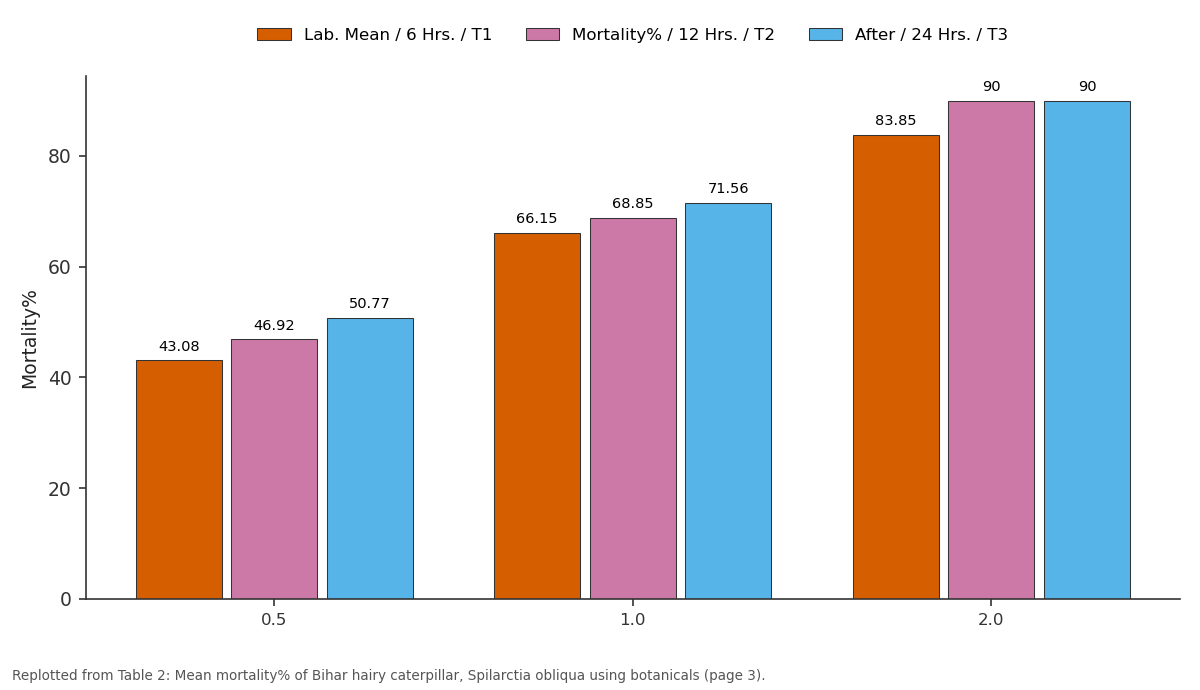
Lab. Mean / 6 Hrs. / T1 and Mortality% / 12 Hrs. / T2 and more: 0.5 vs 1.0 vs 2.0
Replotted from Table 2 (page 3) of the original paper. Every bar is the paper's own table value.
View source evidence ↗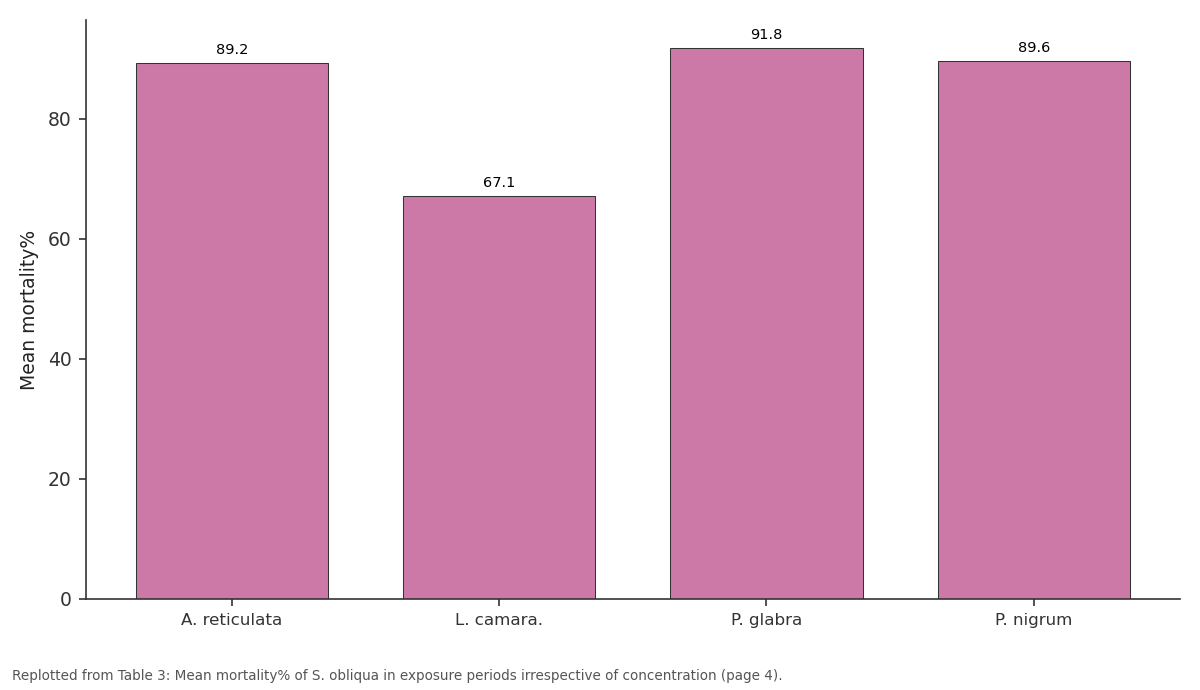
Hrs. / TBV3: A. reticulata vs L. camara. vs P. glabra vs P. nigrum
Replotted from Table 3 (page 4) of the original paper. Every bar is the paper's own table value.
View source evidence ↗Figures & tables
From the original paper Table 1
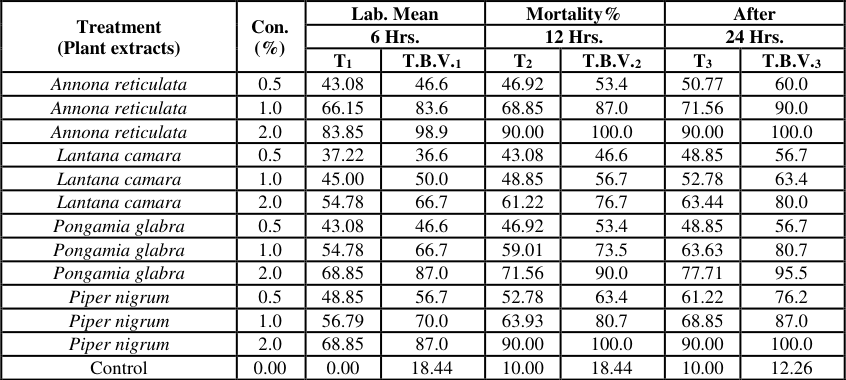 Table 2
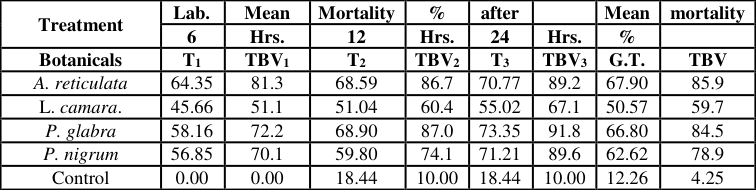 Table 3
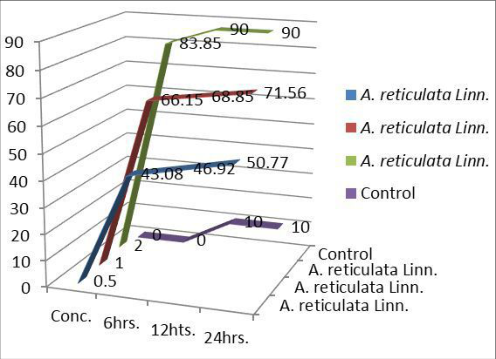 Figure 1
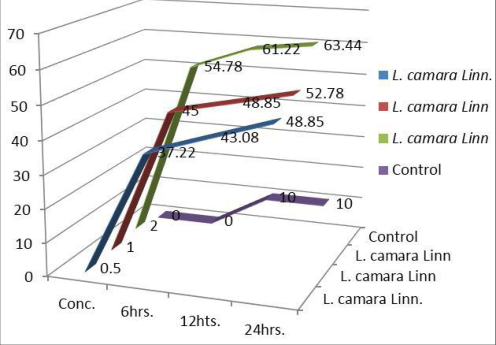 Figure 2
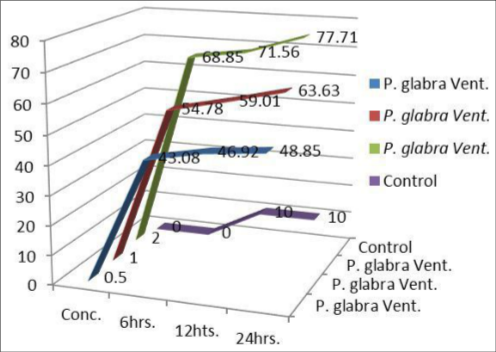 Figure 3
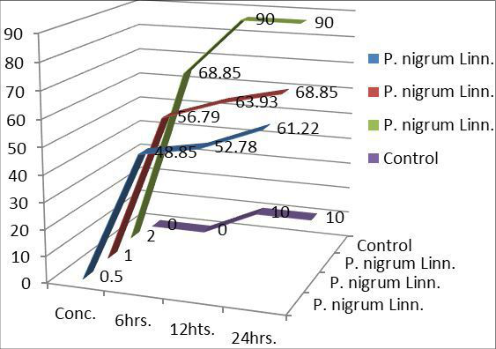 Figure 4
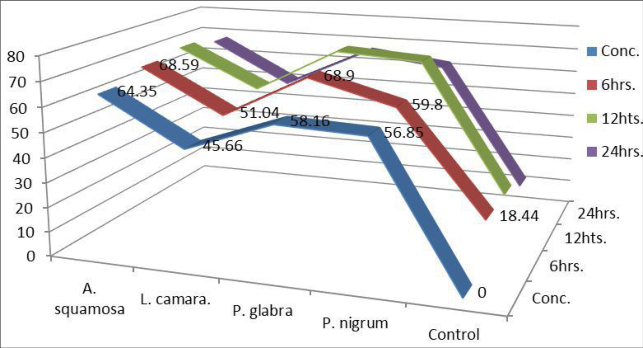 Figure 5
Text
In India, and Asian countries, mustard is popularly used in Indian cooking. India is number one in production of mustard oil mustard gives edible oil which is used as cooking in world over mustard seed is used as condiment in the preparation of vegetable and curries. India mustard varieties grown in India, world mustard seed production is about 530000 metric tons per year. Most of this production is destined as condiment and spice trade while Canada is the largest producer and also the biggest exporter of seeds. Trade in mustard seeds represent 0.0015% of total world trade mustard seeds are a part of other oily seeds. exports in 2021 the top exporters of mustard seeds were Canada ($95 m), Russia ($71.5 m), Germany ($31.1 m), India ($28.2 m), and Poland ($15.2 m). In India, and Asian countries, mustard is popularly used in Indian cooking. India is number one in production of mustard oil mustard gives edible oil which is used as cooking in world over mustard seed is used as condiment in the preparation of vegetable and curries. A large number of insect-pests as Bihar hairy caterpillar Spilarctia obliqua Walk [8,9,10] cabbage butterfly, Pieris Brassicae Linn. Tobacco caterpillar, Spodoptera litura Fabr. mustard aphid, Lipaphis erysimi Kalt. [11] , painted bug, Bagrada cruciferarum Kirk. Diamond backmoth, Plutella xylostella Linn. [12] , mustard sawfly, Athalia proxima Klug., cabbage borer, Hellula undalis Fabr., cabbage semilooper, Trichoplusia ni Hub., cabbage semilooper, Trichoplusia ni Hub., cabbage semilooper, Trichoplusia ni Hub., mustard aphid, (Lipaphis erysimi Kalt., Brevicoryne Brassicae Linn. and Myzus persicae Sulzer) and cabbage leaf webber Crocidolomia binotalis Zell. are limiting factors of crops and vegetables [13,14] . Among them, Bihar hairy caterpillar, Spilarctia obliqua Walk.) (Lepidoptera: Arctiidae) is the most damaging pest of vegetable and crops [15,16] . The insect-pests destroy more than one-third of the world's mustard production and this heavy crop losses global level can be successfully dealt with only through the intensive use of the pesticides (Butani and Verma 1976, Butani et al.`1977 [17,18] . If pesticides are not used, the graph of the crop losses may rise to 50.0% and even more in the developing countries (Golob and Webley 1980,) [19] . In India, in inflicts huge losses to early and late sown cauliflower and mustard. The pest is distractive in its larval stage (Chen and Chang, 1996) [20] . The synthetic insecticides are employed in the management of insect-pest on crops bearing direct hazardous adverse effects on humans, wildlife, aquatic life and the environment at large. However, there are concerns about the use of pesticides, because of their negative effects on the environment and human health (Yuan et al., 2014) [21] . Biorational herbal extractives are currently recognized as biodegradable, systemic, eco-friendly and nontoxic to mammals and are thus considered as safe alternatives (Ali et al.1983, Pascual et al.1990, Sarup, and Srivastava 2001) [22,23,24] . Insecticidal activities of certain neem, Azadirachta indica A. Juss extractives, products and derivatives on larvae of E. vittella was reported (Sharma et al.1980, Raghuraman and Singh 1999, El and El, 2000,) [25,26,27] . Oil extracted from various materials was used in the tropics as a dressing for livestock to control blowfly. Biopotency of plant extracts were reported by Gahukar, 2000 [28] . However, in his study, plant extracts taken like Annona reticulata Linn. (Annonaceae), Pongamia glabra Vent. (Fabaceae), Lantana camara Linn. (Fabaceae), and Piper nigrum Linn (Piperaceae for study were not tested against third instars larvae of S. obliqua. Hence, the present studies were undertaken in the field trials to study, the relative insecticidal efficacy of three plant extracts, one synthetic chemical (Endosulfan against third instar larvae of Bihar hairy caterpillar, Spilarctia obliqua Walker on mustard under laboratory condition.
Materials and Methods
Materials and Methods
Plant Materials collection and powder preparations:
The collected plant parts from cultivated fields of the farmers and wild areas from Kanpur region. The laboratory processing take place at the Zoology, D.B.S. College affiliated to C.S.J.M. University, Kanpur. The collected four types plant materials like unripe fruits of custard apple, Annona reticulate Linn. (Annonaceae), Karanj, leaves of Pongamia glabra Vent. (Fabaceae), arial parts of ariappl, Lantana camara Linn. (Verbanaceae), leaves of Black Pepper, Piper nigrum Linn (Piperaceae) were shade dried and make them powder.
Extraction Process:
The powder were passed through a 30-mesh sieve and kept in polythene bags at room temperature and properly sealed to prevent quality loss. For the extraction, Soxhlet Apparatus was used; about 20 g powder of each category was extracted with 300 ml of alcohol and distilled water). Extractions of each category of powder were done in about 12 hrs. The extracts were concentrated on rotary evaporator by removing the excess solvent under vacuum. After evaporation of solvent the remaining extracted material was kept on water bath for removing remaining solvent from the extracts. The extracts were stored at 4 °C prior to application. 2.4 Preparation of Stock Solution and 2.3. Formulations 50 ml. extract in each case was taken into reagent bottles and 50 ml. benzene was added in it to dissolve the constituents of the selected plant materials. The mouth of the bottles were stopper with airtight corks after which, these bottles containing the solutions were kept in refrigerator. The alcoholic extracts of Aforementioned were tested under laboratory against third instar larvae of D. obliqua, which is noxious insect pest of okra vegetables and crop. Three concentrations of plant extractives (0.5, 1.0, and 2.0 percent) were used for experiments on insecticidal tests in the field conditions. The different concentrations of the herbal extracts were prepared from the stock solution using benzene as solvent and Triton X-100 as emulsifier. The level of solvent and emulsifier were kept constant. 2.5 Apparatus used for experiment: More than one hundred glass petridishes (15 cm diameter) were used for the experiment, One hand compression poly sprayer and muslin cloth was required for covering the petri-dishes and ridges of plots either going or coming the larvae in the cruciferous leaves in the petridishes.
Collection of Bihar hairy caterpillar and rearing
Bihar hairy caterpillar, Spilarctia obliqua Walker were obtained from the mustard experimental farmers' fields of Ekghra village, Kanpur Nagar and maintained in the laboratory on natural diets. The collected larvae were kept for at least 2 days in the laboratory to check, whether or not, there are any other infections before using them for experiments. Spilarctia obliqua required for the study were mass reared on cruciferous leaves in the laboratory. The mass culturing was initiated by confining 10 larvae of Spilarctia obliqua in the plastic containers of 59 x 21 x 18 cm having green mustard leaves which were covered with muslin cloth and secured tightly with rubber band. Mass culturing of D. obliqua larvae was done at 28±2 ºC temperature in the plastic container and observed daily.
Experimental Protocol
Laboratory experiment was conducted to the insecticidal effect of four extractives viz; A. squamosa P. glabra L. camara P. nigrum against third instars larvae of Spilarctia obliqua, which are noxious insect pest of mustard vegetables and crop. For testing the insecticidal effect the mustard leaves were used as food against the third instar larvae of Spilarctia obliqua treated with different concentrations of four selected extractives insecticides under laboratory trials. The treated foods per perti-dish was covered with muslin cloths. Then 10 third instar, 24 hours starved larvae of S. obliqua were released in each set of extract and one control was introduced under laboratory trials. For control set the leaves were sprayed with Benzene + emulsified water only. After 6 hrs, 12 hrs and 24 hrs. hours of the release of larvae, the data was taken on the number of larvae dead at each treated set of perti-dish. Three replication of treatment were made. The insecticidal effect of each the plant extractives was judged by counting the mortality of larvae after 6, 12 and 24 hours and the larval mortality percentage were adjudged over control. All the values were calculated as per Abbott formula (Abbott 1925) [29] . The analysis of variance in table 2 and Figure 1 to four shows that the main effect of insecticide, concentrations and periods as well as "Control versus treated" in first order and periods, concentrations in second order interaction are more highly significant except the first order interaction "insecticide x concentration" and the Second order interaction" period x insecticide x concentration which is non-significant. The effect of control VS treatment is also significant, at 0.5 percent level of significance. Table 3 and Figure 5 indicated that extract of Annona reticulata Linn., Pongamia glabra Vent., Lantana camara Linn. and Piper nigrum Linn and their formulation ( 0.5, 1.0 and 2.0%) tested under lab trials. The data depicted from results that the extract of custard apple, Annona reticulata Linn. showed maximum larval mortality 67.90% and placed at top followed by Karanj, leaves extract of Pongamia glabra Vent. (66.80%), leaves of black Pepper, Piper nigrum Linn (62.62%) larval mortality, whereas ariapple, Lantana camara Linn. Gave only 50.57% larval mortality to the caterpillars of Spilarctia obliqua Walker under laboratory trials. Similarly, all the three concentration differed significantly to one another. The concentration 2.0% is superior to concentration 1.0 and 0.5%. It is observe that the difference in the percentage larvae of hairy caterpillar, Spilarctia obliqua Walker kill in concentration 2.0% and 1.0% is greater than the difference in concentration to kill the larvae in 1.0% and 0.5% in all the three periods. Our findings are in conformity with the findings of Chitra et al. (1993) evaluated insecticidal efficacy of certain plant products against H. Vigintioctopunctata. Petroleum ether leaves extract of Argemone mexicana gave (76.18%) mortality followed by A. indica leaves extract 0.1% showed 71.75% mortality, respectively [30] . Pandey and Raju, (2003) tested different eco-friendly insecticides against Plutella xylostella larvae among them NSKE 2.00% gave considerable mortality to the second instar larvae of Plutella xylostella [31] .
| Treatment | Lab. | Mean | Mortality | % | after | — | Mean | mortality |
|---|---|---|---|---|---|---|---|---|
| 6 | Hrs. | 12 | Hrs. | 24 | Hrs. | % | ||
| Botanicals | T1 | TBV1 | T2 | TBV2 | T3 | TBV3 | G.T. | TBV |
| A. reticulata | 64.35 | 81.3 | 68.59 | 86.7 | 70.77 | 89.2 | 67.90 | 85.9 |
| L. camara. | 45.66 | 51.1 | 51.04 | 60.4 | 55.02 | 67.1 | 50.57 | 59.7 |
| P. glabra | 58.16 | 72.2 | 68.90 | 87.0 | 73.35 | 91.8 | 66.80 | 84.5 |
| P. nigrum | 56.85 | 70.1 | 59.80 | 74.1 | 71.21 | 89.6 | 62.62 | 78.9 |
| Control | 0.00 | 0.00 | 18.44 | 10.00 | 18.44 | 10.00 | 12.26 | 4.25 |
Table text extracted from the original PDF; superscript letters are shown inline. The original table image is below.
View original table image
| Treatment (Plant extracts) | Con. (%) | Lab. Mean | — | Mortality% | — | After | — |
|---|---|---|---|---|---|---|---|
| 6 Hrs. | 12 Hrs. | 24 Hrs. | |||||
| T1 | T.B.V.1 | T2 | T.B.V.2 | T3 | T.B.V.3 | ||
| Annona reticulata | 0.5 | 43.08 | 46.6 | 46.92 | 53.4 | 50.77 | 60.0 |
| Annona reticulata | 1.0 | 66.15 | 83.6 | 68.85 | 87.0 | 71.56 | 90.0 |
| Annona reticulata | 2.0 | 83.85 | 98.9 | 90.00 | 100.0 | 90.00 | 100.0 |
| Lantana camara | 0.5 | 37.22 | 36.6 | 43.08 | 46.6 | 48.85 | 56.7 |
| Lantana camara | 1.0 | 45.00 | 50.0 | 48.85 | 56.7 | 52.78 | 63.4 |
| Lantana camara | 2.0 | 54.78 | 66.7 | 61.22 | 76.7 | 63.44 | 80.0 |
| Pongamia glabra | 0.5 | 43.08 | 46.6 | 46.92 | 53.4 | 48.85 | 56.7 |
| Pongamia glabra | 1.0 | 54.78 | 66.7 | 59.01 | 73.5 | 63.63 | 80.7 |
| Pongamia glabra | 2.0 | 68.85 | 87.0 | 71.56 | 90.0 | 77.71 | 95.5 |
| Piper nigrum | 0.5 | 48.85 | 56.7 | 52.78 | 63.4 | 61.22 | 76.2 |
| Piper nigrum | 1.0 | 56.79 | 70.0 | 63.93 | 80.7 | 68.85 | 87.0 |
| Piper nigrum | 2.0 | 68.85 | 87.0 | 90.00 | 100.0 | 90.00 | 100.0 |
| Control | 0.00 | 0.00 | 18.44 | 10.00 | 18.44 | 10.00 | 12.26 |
Table text extracted from the original PDF; superscript letters are shown inline. The original table image is below.
View original table image
Conclusion
Conclusively, the present investigation revealed that the data depicted from results that the extract of custard apple, Annona reticulata Linn. showed maximum larval mortality 67.90 percent and placed at top followed by Karanj, leaves extract of Pongamia glabra Vent. (66.80 percent), leaves of black Pepper, Piper nigrum Linn (62.62 percent) larval mortality, whereas ariapple, Lantana camara Linn. gave only 50.57%% larval mortality to the Bihar hairy caterpillars, Spilarctia obliqua Walker under mustard agroecosystem.
Acknowledgement
AcknowledgementThe authors are thankful to Dr. J.P. Shukla, Head, Department of Botany, D.B.S. College, and Kanpur for providing the necessary facilities. Prof. N.D. Pandey, farmer Head, Division of Entomology, C S Azad University of Agriculture and Technology, Kanpur for rendering their support and help for the completion of this work.
Figures and tables from the paper
| Scientific Name | Family | Common Name | Parts Used |
|---|---|---|---|
| Annona reticulata Linn. | Annonaceae | Custard apple | Unripe fruits |
| Lantana camara Linn. | Verbanaceae | Ariapple | Arial parts |
| Pongamia glabra Vent. | Fabaceae | Karanj | Leaves |
| Piper nigrum Linn. | Piperaceae | Black Pepper | Unripe fruits |
Table text extracted from the original PDF; superscript letters are shown inline. The original table image is below.
View original table image
References
29 in the original paper- Rathod RR. Chemical control of mustard aphid, Lipaphis erysimi Kaltenbach. Indian Journal of Plant Protection. 1980;8(2):151-53.
- Bakhetia DRC, Arora R. Control of insect pests of toria, sarson and Rabi. Indian Farming. 1986;36(4):41-44.
- Bakhetia DRC, Sekhon BS. Insect pests and their management in rapeseed-mustard. Journal of Oilseeds Research. 1989;6:269-73.
- Singh PK, Premchand. Yield loss due to mustard aphid, Lipaphis erysimi (Kalt.) in Eastern Bihar Plateau. Journal of Applied Zoological Research. 1995;6:97100.
- Choudhury S, Pal S. Population dynamic of mustard aphid on different Brassica cutlivars under Terai agroecological conditions of West Bengal. The Journal of Plant Protection Sciences. 2009;1(1):83-86.
- Chandel BS, Srivastava SC, Dwivedi ND, Shukla S, Dubey A. Bioefficacy of certain Asteraceous plants on growth, development, nutrition and reproduction of Spilarctia obliqua Walker., Nat Journal Life Science. 2004;1(2):4460-4577
- Tandon S, Mittal AK, Kasana, Pant AK. Effect of essential oil of Elsholtzia densal. On growth and reproduction of Spilosoma obliqua (Walker) Indian Journal of Entomology. 2004;66(3):206-208.
- Dubey A, Rishu G, Chandel BS. Efficacy of Acorus calamus, Vitex negundo and Ageratum conyzoides against tobacco caterpillar Spilarctia obliqua Walk. Indian Journal of Entomology. 2004;66(3):238-240.
- Chen CC, Chang SJ. Deterrent effective of the chinaberry extract on oviposition of the diamondback moth, Plutella xylostella Linn. (Lepodoptera: International Journal of Fauna and Biological Studies Journal Applied Entomology. 1996;120(3):165-169.
- Desh R, Lakhanpal GC, Verma SC. Impact of weather factors on population build-up of aphid infesting rapeseed mustard (Brassica campestris L.) at Palampur, Himachal Pradesh. Pest Management and Economic Zoology. 2002;10(1):11-16.
- Devi DI, Raj ND. Population build up of aphid complex (Lipaphis erysimi Kalt., Brevicoryne Brassicae Linn. and Myzus persicae Sulzer) on rapeseed, Brassica campestris var. brown sarson vis-a-vis impact of abiotic factors. Journal of Entomological Research. 2001;25(1):21-25.
- Gour IS, Pareek BL. Field evaluation of insecticides against mustard aphid, Lipaphis erysimi (Kalt.) under semi-arid region of Rajasthan. Indian Journal of Plant Protection. 2003;31(2):25-27.
- Sekhon SS, Sajjan SS, Kanta U. Chemical control of mustard aphid, Lipaphis erysimi on seed crop of radish. Journal of Entomological Research. 2008;32(1):41-43.
- Singh SS, Lal MN. Seasonal incidence of mustard aphid, Lipaphis erysimi (Kalt.) on mustard crop. Journal of Entomological Research. 1999;23(2):165-167.
- Butani DK, Verma S. Insect pests of vegetables and their control. Pesticides. 1976;10(7):31-37.
- Butani DK, Jotwani MG, Verma S. Insect pest of vegetables and their control: Cole Crops. Pesticides. 1977;11(5):19-24.
- Golob P, Webley DJ. The use of plants and minerals as traditional protectants of stored products. Tropical Products Institute G. 1980;138:1-32.
- Chen CC, Chang SJ. Deterrent effective of the chinaberry extract on oviposition of the diamondback moth, Plutella xylostella Linn. (Lepodoptera). International Journal of Fauna and Biological Studies Journal Applied Entomology. 1996;120(3):165-169.
- Yuan Y, Chen C, Zheng C, Wang X, Yang G, Wang Q. Residue of chlorpyrifos and cypermethrin in vegetables and probabilistic exposure assessment for consumers in Zhejiang Province, China. Food Control. 2014;36(1):63-68.
- Ali SI, Singh OP, Misra US. Effectiveness of plant oils against pulse beetle, Callosobruchus chinensis Linn. Indian Journal of Entomology. 1983;45(1):6-9.
- Pascual N, Marco MP, Belles X. Azadirachtin induced imaginal moult deficiencies in Tenebrio molitor L. (Coleoptera: Tenebrionidae). The Journal of Stored Products Research. 1990;26(1):53-57.
- Sarup P, Srivastava VS. Observations on the damage of neem (Azadirachta indica A. Juss) seed kernel in storage by various pest and efficacy of the damaged kernel as an antifeedant against the desert locust, Schistocerca gregaria F. Indian Journal of Entomology. 1971;33(2):228-230.
- Disruption by Neam, Azadirachta indica seed fractions. Journal of Applied Entomology. 1980;90(5):439-444.
- Raghuraman S, Singh RP. Biological effects of neem, Azadirachta indica seed oil on an egg parasitoid, Trichogramma chilonis. Journal of Economic Entomology. 1999;92(6):1274-1280.
- El SMM, El SED. Toxicity of neem, Azadirachta indica insecticides to certain aquatic organisms. Journal of the Egyptian Mathematical Society Parasitology. 2000;30(1):221-231.
- Gahukar RT. Use of neem products/pesticides in cotton pest management. International Journal of Pest Management. 2000;46(2):149-160.
- Abbott WS. A method of computing the effectiveness of an insecticide. Journal of Economic Entomology. 1925;18(2):265-267
- Chitra KC, Rao S, Janardhan, Rao P, Kameswara, Magaioh K. Field evaluation of certain plant products in the control of brinjal pest complex. Indian Journal of Entomology. 1993;55(3):237-240.
- Pandey R, Raju SVS. Log dose probit studies of different eco-friendly insecticides against Plutella xylostella larvae. Indian Journal of Entomology. 2003;65(1):141-143.