
Research article · 2023 · Full text
International Journal of Veterinary Sciences and Animal HusbandrySuccessful therapeutic management of notoedric mange in a Persian Kitten: Case report
Volume 8(5) · Pages 173–174 · DOI: 10.22271/veterinary.2023.v8.i5c.716 ↗
Research areasDermatological diseases and infestationsStudy of Mite SpeciesHelminth infection and control
Abstract
Author-writtenA 4-month-old Persian kitten suffering from anorexia, intense pruritis, alopecia, hyperkeratosis, dry crusty and scaly lesions of the face, ears and legs for three weeks was presented to the Veterinary Clinical Complex, College of Veterinary Science, Mamnoor. Laboratory examination of the skin scraping under a light microscope revealed the presence of numerous live Notoedres cati mites. Additionally, the kitten displayed positive signs of pinna pedal reflex. The kitten was treated with Inj. Ivermectin @0.2 mg/kg b. wt once in a week for four doses. Supportive therapy was given with syrup. Vita best derm and advised bath with Petben shampoo once in a week. Kitten showed mild recovery after 2nd dose and complete remission of clinical signs after 4th dose of Ivermectin. The present study was taken up for enumerating the effective, minimum medicinal treatment protocol for effective and faster treatment of Notoedres cati infection in cats, especially kittens.
Summary
Source-checkedPlain-language reading of the full paper, prepared with AI and checked against the text. Each point links to the authors' own words.
Why it matters
- Notoedric mange is caused by Notoedres cati mites; it is an unusual and highly contagious disease that can affect cats, kittens, dogs, and humans. View evidence ↗
- The condition can be fatal, as self-trauma from itching can lead to secondary bacterial infections that worsen clinical symptoms. View evidence ↗
- The disease manifests as severe itching, hair loss, and crusting because female mites burrow into the skin and destroy keratinocytes, triggering inflammation. View evidence ↗
The question
- The study aimed to determine an effective, minimum medicinal treatment protocol to achieve fast recovery from Notoedres cati infection in cats and kittens. View evidence ↗
What they did
- The subject was a four-month-old female Persian kitten presenting with intense itching and skin lesions on the legs, ears, and face for three weeks. View evidence ↗
- Diagnosis included testing for the pinna pedal reflex, where the kitten scratched its ear with the same-side hind limb when the ear canal was scrubbed. View evidence ↗
- Mites were detected and identified by examining skin scrapings and hair plucks under a light microscope, with some scrapings digested in a 10% NaOH solution. View evidence ↗
- The primary treatment consisted of injectable Ivermectin administered at 0.2 mg/kg body weight once per week for a total of four doses. View evidence ↗
- Supportive care included weekly baths with Petben shampoo and the administration of Vitabest derm syrup at 1ml/kg body weight. View evidence ↗
What they found
- Microscopic examination confirmed the presence of numerous live Notoedres cati mites in the kitten's skin scrapings. View evidence ↗
- The kitten began to show mild recovery after receiving the second dose of Ivermectin. View evidence ↗
- Following the fourth dose of Ivermectin, all clinical signs disappeared and skin scrapings tested negative for mites. View evidence ↗
What it means
- The authors conclude that notoedric mange in a Persian kitten can be successfully managed using injectable Ivermectin combined with minimal supportive care. View evidence ↗
- To prevent infection, the authors recommend avoiding contact with stray or diseased cats, avoiding unclean grooming facilities, and treating all cats in a household if one is infected. View evidence ↗
Visual summary
1 visualsIllustrations explain the paper; they do not show study data.
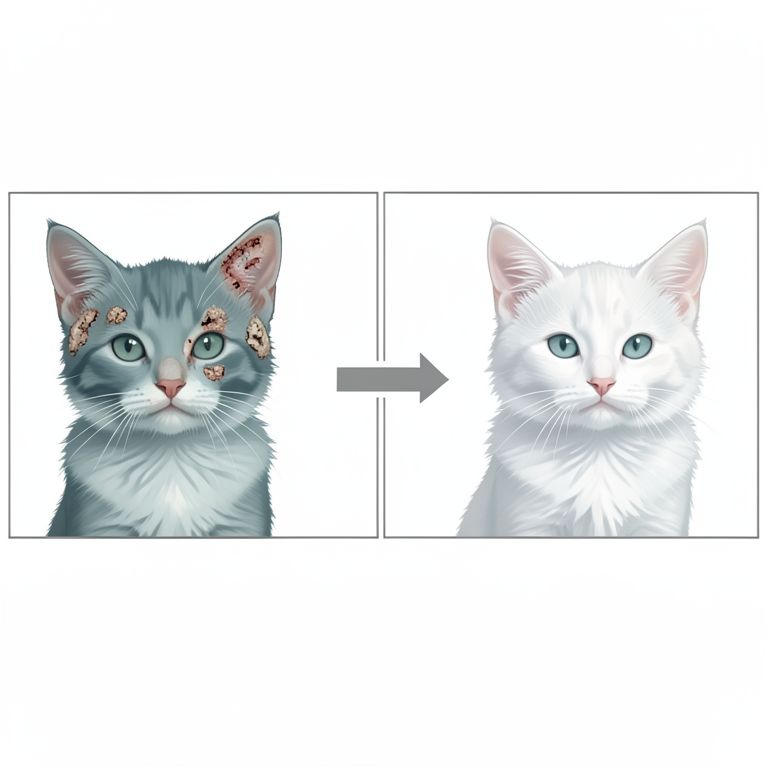
Treatment Timeline
AI-generated conceptual illustration (Persian kitten). It explains the idea and does not show study data.
View source evidence ↗Figures & tables
From the original paper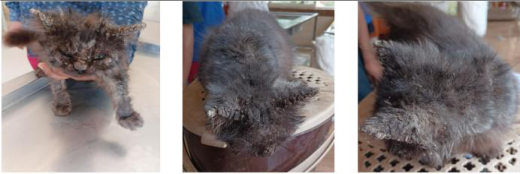 Figure 1
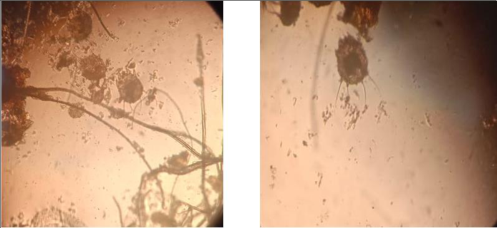 Figure 4
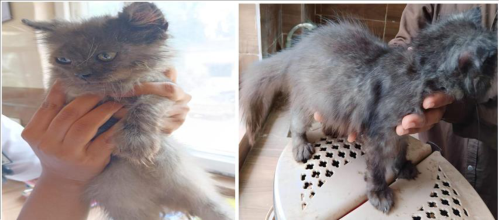 Figure 6
Introduction
One of the most prevalent clinical conditions in domesticated pets is dermatosis. Cats are particularly susceptible to manage and suffer from a wide range of parasite illnesses (Scott et al., 2001) [1] . Cat sarcoptid mites are known as Notoedres cati. However, it is also an opportunistic infection of other animals, including humans and canines. It is the causative agent of notoedric mange, an unusual and extremely contagious disease of cats and kittens (Sivajothi et al., 2015) [2] . The condition is extremely contagious and mostly spreads through contact with infected bedding, areas that recently had infected animals visit, or direct contact between animals (Friberg, 2006) [3] . Lesions from notoedric mange include hyperkeratosis, localized alopecia and hyperpigmentation. The disease may turn out to be fatal and the clinical symptoms tend to get worse by secondary bacterial infections produced by the excoriations from self-trauma (Fadok, 1980) [4] . The condition can be grossly diagnosed through the microscopic identification of the mite acquired from superficial skin scrapings. Ivermectin, when administered orally or intravenously, has been shown to be effective in the treatment of ascariasis among the several acaricides that have been used to control the condition (Eraslan et al., 2010 [5] and Scott et al., 2001 [1] ). In the current research, ivermectin therapy is described as a successful method for treating notoedric mange in domestic cats.
Materials and methods
A four-month-old female Persian kitten was brought to the Teaching Veterinary Clinical Complex, College of Veterinary Science, Mamnoor with a history of skin lesions on the face, ears and legs, associated with intense pruritus for three weeks. The kitten was anorectic for one week and had occasional regurgitation of food material immediately after feeding. Upon clinical eexamination of the cat revealed scales, crusts, erythema and alopecia (Fig. 1,2,3). The physiological parameters were as follows -Temperature (102.8 0 F), Heart rate -115 beats /min and the conjunctival mucus membrane (CMM) was pale. The kitten also showed positive signs of pinna pedal reflex. The procedure involves lying on the animal in lateral recumbency as the cat scratches with the ipsilateral hind limb while the ear canal is being scrubbed (Keith et al., 2017) [6] . Skin scrapping and hair pluck examination were done for the detection of mites, to be visualized using a light microscope. Upon examination under a low power, microscope revealed numerous live Notoedres cati mites (Fig 4 ,5). After being digested in 10% NaOH solution, skin scrapings were examined under a microscope for morphology, which revealed a circular body and short legs. According to Walker (1994) [7] , the mites were identified based on their morphology and the presence of spines, which clearly distinguish N. cati from Sarcoptes sp. Notoedres mites are smaller than Sarcoptes, feature 'thumb print'-like dorsal striations, shorter limb stalks and dorsal anus as compared to terminal anus, dorsal legs and spines as observed in Sarcoptes species (Quesenberry and Carpenter, 2004) [8] .
Results and Discussion
The notoedric mange-affected kitten was treated with Inj. Ivermectin @0.2 mg/kg b.wt once in a week for 4 doses. Supportive therapy with Syrup. Vitabest derm @1ml/kg b.wt was given and advised to bath with Petben shampoo once in a week. Kitten showed mild recovery after 2 nd dose and complete remission of all the clinical signs after 4 th dose and also showed negative for skin scraping examination (Fig 6 ,7). Cats from the Sarcoptidae family rarely have Notoedres cati.
According to Chakrabarti (1986) [9] and Sivajothi et al. (2015) [2] , the infected cat should be treated immediately and appropriately as it is zoonotic. Both the larvae and the nymphs are highly contagious. Because it is a zoonotic parasite of humans, care should be taken while handling affected cats (Chakrabarti, 1986) [9] . According to Wall et al.
(1997) [10] , the female mites' burrowing activity destroys the skin's keratinocytes, which causes the release of the cytokine (IL-1) and cutaneous inflammation as well as severe itching, alopecia, scale, and crust formation. The clinical signs, such as alopecia, erythema, scales, crusts and hyperkeratosis on the head and pinnae and malodorous lesions, are in accordance with earlier reports (Ngetich, 2019 [11] and Stevanovic et al.
2019 [12] ). Ivermectin is known to affect GABA neurotransmission at two or more sites, preventing the interneuronal activation of excitatory motor neurons and resulting in flaccid paralysis. Ivermectin may affect glutamate-gated Cl-ion conductance at the postsynaptic membrane or neuromuscular endplate (Adams, 2001) [13] . It is necessary to emphasize that immunosuppression is one aspect to consider in the development of notoedric mange, other supportive medication besides ivermectin should be used to regulate the immune response (Foley et al. 2016) [14] . The easiest way to prevent infection is to keep healthy cats away from stray or diseased cats. Avoid boarding or grooming your cat in places with poor cleanliness. It is frequently advised to treat all cats in the family if there are several of them since they can be harboring mites.
Conclusion
Present communication reports a case of notoedric mange in a Persian kitten which was successfully treated with Inj. Ivermectin and minimal supportive medication.
References
9 in the original paper- Scott DW, Miller WH, Griffin CE. Parasitic skin diseases. Muller and Kirk's small animal dermatology. (6th. Edn.), Philadelphia, W. B. Saunders Co, 2001, 483484 and 1449.
- Sivajothi S, Sudhakara Reddy B, Rayulu VC, Sreedevi C. Notoedres cati in cats and its management. J Parasit Dis. 2015;39:303-5.
- Friberg C. Feline facial dermatoses. Vet. Clin. Small Anim. 2006;36:115-140.
- Fadok VA. Miscellaneous parasites of the skin (Part II). Comp. Cont. Ed. 1980;2:782-787.
- Eraslan G, Kanbur M, Liman BC, Cam Y, Karabacak M, Altınordulu S. Comparative pharmacokinetics of some injectable preparations containing ivermectin in dogs. Food Chem. Toxicol. 2010;48:2181-2185.
- Chakrabarti A. Human notoedric scabies from contact with cats infested with Notoedres cati. Int J Dermatol. 1986;25:646-8.
- Ngetich W. Mange in an adult domestic short haired cat case report. Archives of Animal Husbandry & Dairy Science. 2019;1:1-3.
- Stevanovic O, Vujani D, Dobrijevic M, Nedic D, Trbojevic I. Notoedrosis in a household cat -case report. Archives of Veterinary Medicine. 2019;12:39-47.
- Foley J, Serieys L, Stephenson N, Riley S, Foley C, Jennings M, et al. A synthetic review of notoedres species mites and mange. Parasitology. 2016;143:18471861.