
Research article · 2023 · Full text
International Journal of Veterinary Sciences and Animal HusbandryA case report of unusual dystocia relief: Triplets in a single birth with breech presentation in a Holstein Friesian crossbreed cattle
Volume 8(5) · Pages 118–120 · DOI: 10.22271/veterinary.2023.v8.i5b.704 ↗
Research areasReproductive Physiology in Livestock
Abstract
Author-writtenA Holstein Friesian crossbreed cow, in its third parity and at an advanced stage of pregnancy came to attention with the history of restlessness and persistent straining after successful delivery of a live female calf. Upon vaginal examination, it was found that a live fetus was presenting in the posterior position with a Dorso sacral position and bilateral hip flexion (Breech presentation). A live female fetus was successfully delivered with manual correction. Surprisingly, yet another fetus also found on another vaginal examination presenting in the breech presentation. Subsequently, the third live female fetus was delivered. Placenta was shed normally. All three calf were able to suckle and in good health condition. Examination of the fetuses were suggestive of monozygotic twins. The dam recovered uneventfully.
Summary
Source-checkedPlain-language reading of the full paper, prepared with AI and checked against the text. Each point links to the authors' own words.
Why it matters
- Dystocia is a condition where an animal has difficulty expelling a fetus during birth, which often necessitates human intervention. View evidence ↗
- Dystocia significantly impacts the productivity and future reproduction of cattle and can result in trauma, infection, or the death of the dam and fetus. View evidence ↗
- Cattle and buffalo are susceptible to dystocia, with a higher incidence observed in larger breeds such as Holstein, Hereford, and Brown Swiss. View evidence ↗
The question
- The authors aim to report a rare case of a cow experiencing dystocia resulting from the birth of triplets, specifically where two of the fetuses were in a breech position. View evidence ↗
What they did
- The subject was a Holstein Friesian crossbreed cow in her third parity at an advanced stage of pregnancy. View evidence ↗
- The veterinary team used liquid paraffin for lubrication and employed the repulsion and traction method to correct fetal posture. View evidence ↗
- Treatment included 2 liters of 5% Dextrose Normal Saline intravenously for dehydration and 3 ml of 2% lignocaine via epidural anesthesia to desensitize the hindquarters. View evidence ↗
- Post-delivery care on the first day included 1 liter of 25% Dextrose, 1 liter of Ringer's Lactate, and 450 ml of Calcium Borogluconate intravenously, followed by 5 gm of Streptopenicillin and 15 ml of Chlorpheniramine Maleate intramuscularly for three days. View evidence ↗
What they found
- The cow showed labor signs for about 12 hours, and after the allantochorionic sac ruptured 2 hours prior, a live female fetus was delivered normally in an anterior presentation. View evidence ↗
- A second live female fetus was found in a breech presentation (posterior position, Dorso sacral position, and bilateral hip flexion) and was delivered via manual correction. View evidence ↗
- A third live female fetus, also in a breech presentation, was identified and delivered vaginally. View evidence ↗
- All three female calves were in good health and able to suckle, and the placenta was shed normally. View evidence ↗
- Phenotypic examination of the fetuses suggested they were monozygotic twins. View evidence ↗
- The dam recovered without any complications following the delivery of the triplets. View evidence ↗
What it means
- The authors conclude that because twin and triplet pregnancies increase the risk of stillbirths, early detection and proper dystocia management are essential for the health of the dam and calves. View evidence ↗
Visual summary
1 visualsIllustrations explain the paper; they do not show study data.
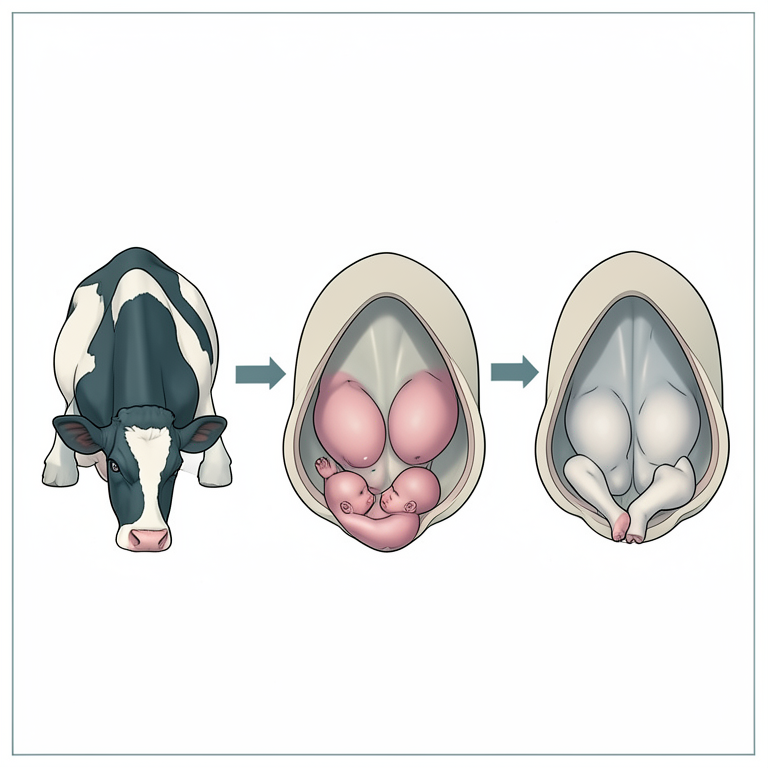
Breech Presentation Concept
AI-generated conceptual illustration (Holstein Friesian crossbreed cattle). It explains the idea and does not show study data.
View source evidence ↗Figures & tables
From the original paper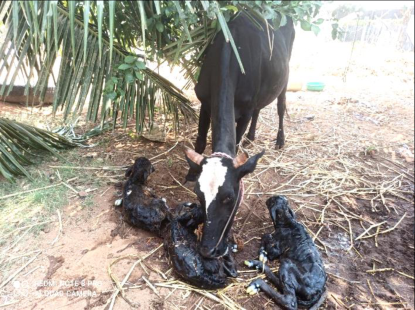 Figure 1
Introduction
Dystocia is a condition in which an animal faces difficulty in expelling the fetus during parturition, often requiring human intervention. It can be categorized into two main origins: maternal and fetal. Maternal causes involve issues like constriction of the birth canal or a lack of expulsive forces (Youngquist and Threlfall, 2007) [13] . Constrictive forms of maternal causes, such as pelvic inadequacies, incomplete cervical dilation, ring womb, and uterine torsion, are particularly significant (Linde-Forsberg and Eneroth, 2000) [6] . The fetal-related causes include an oversized fetus, forelimb flexion head deviation, breech presentation and fetal malformations (Noakes, 2018; Bhattacharyya et al., 2015) [8,1] . Cattle and buffalo among domestic animals are notably susceptible to dystocia (Purohit et al., 2011) [10] , with larger breeds like Holstein, Brown Swiss, and Hereford showing a higher incidence (Mee, 2008) [7] . Dystocia is more common in heifers than in mature cattle. In cattle, dystocia is often caused by feto-pelvic disproportion, especially in heifers where either the maternal pelvis is relatively undersized or the fetus is unusually large (Kebede et al., 2017) [5] . While twins are rare in cattle, they should be considered in dystocia cases (Hillman and Gilbert, 2008; Purohit et al., 2012) [3,11] . The impact of dystocia on the productivity and future reproductive capabilities of dairy and beef cattle is significant. It can lead to the death of both the fetus and the dam, as well as the risk of trauma and infection. While dystocia cannot be entirely prevented in a herd, its incidence can be significantly reduced through effective management decisions made before the breeding season and during pregnancy. The present case report signifies the unusual occurrence of triplets in a cow with dystocia due to two live twins in the breech position.
Case History and Observation
A Holstein Friesian crossbreed cow, in its third parity and at an advanced stage of pregnancy, came to attention at a local farmer's house in Puliyampatti village of Namakkal district. The cow exhibited restlessness and persistent straining, despite having successfully delivered a live female calf.
According to the owner, the cow had been showing signs of labor for approximately 12 hours and the allantochorionic sac had ruptured 2 hours before, resulting in the normal delivery of a live female fetus in an anterior presentation. During the general clinical examination, the animal displayed normal activity and alertness, with all physiological parameters within the normal range. Notably, the udder was engorged and the Sacrosciatic ligament had relaxed, indicating the impending birth process. Upon vaginal examination, it was found that the birth canal was fully dilated, and a live fetus was presenting in the posterior position with a Dorso sacral position and bilateral hip flexion (Breech presentation). A live female fetus was successfully delivered with manual correction. Surprisingly, even after the successful delivery of the second fetus, the cow remained restless. Another vaginal examination was conducted, revealing yet another fetus also presenting in the breech presentation. Subsequently, the third live female fetus was delivered vaginally. This case report highlights the rare occurrence of triplets in a cow and the simultaneous identification of dystocia due to two live twins presenting in the breech position.
Treatment
After performing the obstetrical examination of the animal, two liters of 5% Dextrose Normal Saline were administered intravenously to address dehydration and maintain energy levels. Subsequently, epidural anaesthesia with 3 ml of 2% lignocaine was administered to desensitize the hindquarters of the animal. Following proper lubrication of the birth canal with liquid paraffin, the fetal posture was corrected using the repulsion and traction method. This involved gently pushing the fetus back into the uterine cavity, grasping the cranial aspect of the tibia and flexing the fetal leg into a hock-flexed posture while simultaneously pushing the fetal hindquarters forward and upward with grasping the hoof and rotating the hindleg medially and extending it backward. The live fetus was manually delivered by applying gentle traction to the hind limbs. A subsequent vaginal examination revealed another live fetus in the same breech presentation, which was also assisted in delivery. Totally three live female fetuses were born in a single birth (Fig 1). Placenta was expelled approximately four hours later. Further phenotypic examination of the fetuses revealed that they were suggestive of monozygotic twins. The cattle received treatment that included intravenous administration of 1 liter of 25% Dextrose solution, 1 liter of Ringer's Lactate and 450 ml of Calcium Borogluconate on the first day. Additionally, antibiotics (Inj. Streptopenicillin 5 gm) and antihistamine (Chlorpheniramine Maleate 15 ml) were given intramuscularly for three consecutive days.
Discussion
Cattle are typically monotocous animals, they usually give birth to one calf at a time. In contrast, sheep and goats have a higher rate of twinning, with about 60-70% of births resulting in twins. However, in dairy cattle, the occurrence of Natural twins is relatively low, at around 1.04%, and in mares, it ranges from 0.5-1.05% (Roberts 1986) [12] . The likelihood of twins can vary depending on factors such as breed, parity, and the environment. To increase the chances of having twins, one can select genetically favourable animals, use hormones, or employ embryo transfer techniques (Özden Çobanoğlu, 2010) [9] . Twins in cattle can be classified as either identical (monozygotic) or fraternal (dizygotic). Monozygotic twins are genetically and physically identical because they develop from a single fertilized egg that splits into two identical halves during early embryonic development. Therefore, both individuals are always the same sex (Hancock, 1954) [2] . On the other hand, dizygotic or fraternal twins result from two different sperm fertilizing two separate ova at the same time. This means that two distinct oocytes are ovulated and fertilized, leading to dizygotic twins. Dizygotic twins are not genetically or phenotypically identical, and they are not necessarily the same sex as opposed to monozygotic twins. They can be as similar or different as any two siblings born from the same parents during different gestations. Dizygotic twins are the most common type of twin and may be of the same or different sex, accounting for more than two-thirds of live twin births (Johanson et al., 2001) [4] . Twin pregnancies in cattle can also result in chorionic blood vessel fusion and shared blood supply, leading to increased fetal mortality, freemartin syndrome in females born with males, shorter gestation periods, lower calf birth weights, higher incidence of retained placental membranes, and elevated rates of dystocia and stillbirths (Özden Çobanoğlu, 2010) [9] .
Conclusion
Dystocia poses a significant emergency situation for veterinarians. Twin and triplet pregnancies increase the likelihood of stillborn calves during labor, emphasizing the importance of early twin detection and appropriate dystocia management. These measures are vital for the well-being of both the calf and the dam, as well as the future fertility of the dam.
References
8 in the original paper- Bhattacharyya HK, Bhat FA, Buchoo BA. Prevalence of dystocia in sheep and goats: a study of 70 cases (20042011). Journal of Advanced Veterinary Research. 2015;5:14-20.
- Johanson JM, Bergert PJ, Kirkpatrick BW, Dentine MR. Twinning rates for North American Holstein sires. Dentine J Dairy Sci. 2001;84:2081-2088.
- Kebede A, Mohammed A, Tadessse W, Abera D, Nekemte E. Review on Economic Impacts of Dystocia in Dairy Farm. Int. J Phar. & Biomedi. Rese. 2017;7(3):111.
- Linde-Forsberg C, Eneroth A. Abnormalities in pregnancy, parturition and the periparturient period. Textbook of Veterinary Internal Medicine. 2000;2:152738.
- Mee JF. Prevalence and risk factors for dystocia in dairy cattle: A review. The Veterinary Journal. 2008;176:93101.
- Özden Çobanoğlu. Twinning in Cattle: Desirable or Undesirable? J Biol. Environ. Sci. 2010;4(10):1-8.
- Purohit GN, Barolia Y, Shekhar C, Kumar P. Maternal dystocia in cows and buffaloes: a review. Open journal of Animal sciences. 2011;1:41.
- Purohit GN, Kumar P, Solanki K, Shekher C, Yadav SP. Perspectives of fetal dystocia in cattle and buffalo. Veterinary Science Development. 2012;2:e8-e8.