
Research article · 2023 · Full text
International Journal of Advanced Biochemistry ResearchResearch on chilli (Capsicum annuum L.) genetic diversity
Volume 7(2S) · Pages 204–206 · DOI: 10.33545/26174693.2023.v7.i2sc.211 ↗
Research areasAgricultural Economics and PracticesAgricultural Practices and Plant Genetics
Abstract
Author-writtenAn effective selection of parents for hybridization requires a plant breeder to consider the genetic variety of the available germplasm, hence research on genetic diversity were carried out with 20 genotypes of chilli (Capsicum annuum L.) at the Crop Research Institute.Center-1, School of Agriculture, ITM University, Gwalior (Madhya Pradesh), during Rubi season of 2022-23. The D2 Twenty genotypes were examined for genetic divergence using statistics. These genotypes were broadly divided into three clusters based on genetic distance. The most genotypes were found in Clusters 1 and 2, with 7, followed by Cluster 3 with 6. Among the different characters studied, Number of fruits per cluster (11.02%) contributed the days to 50% flowering provide the greatest to the total genetic diversity among the genotypes. (10.90%), days to first flowering (10.61%), yield per plant (8.76%), number of flowers per cluster (7.95%) and fruit diameter (7.54%). Cluster 2 displayed a minimum intra-cluster distance of (2.283) while cluster 1 had a maximum inter-cluster distance of (2.719). The genetically more diverse genotypes from the cluster with the greatest intercluster distance could be used in hybridization programmes to produce promising segregants.
Summary
Source-checkedPlain-language reading of the full paper, prepared with AI and checked against the text. Each point links to the authors' own words.
Why it matters
- Chilli is one of the most important vegetable plants grown in India. View evidence ↗
- Chillies are economically vital, representing approximately 33% of India's total spice exports and 16% of the global spice trade. View evidence ↗
- The ability to improve a crop depends on the level of genetic variability present in its germplasm. View evidence ↗
The question
- The study aimed to research the genetic diversity of 20 chilli genotypes to help plant breeders effectively select parents for hybridization. View evidence ↗
What they did
- The research was conducted at the ITM University research farm in Gwalior, Madhya Pradesh, during the 2022-23 period. View evidence ↗
- Twenty different chilli genotypes were evaluated based on their growth and yield characteristics. View evidence ↗
- The researchers used D2 statistics and Tocher's approach, following Mahalanobis and Rao, to cluster the genotypes. View evidence ↗
What they found
- The traits contributing most to genetic diversity were number of fruits per cluster (11.02%), days to 50% flowering (10.90%), and days to first flowering (10.61%). View evidence ↗
- The greatest genetic distance between clusters (inter-cluster distance) was 5.00, found between Cluster II and Cluster III. View evidence ↗
- Cluster 2 showed the minimum intra-cluster distance of 2.283. View evidence ↗
- Cluster III exhibited the largest intra-cluster distance at 2.510. View evidence ↗
- Cluster II had the highest mean yield per plant at 223.06 g, compared to 168.00 g for Cluster I and 217.18 g for Cluster III. View evidence ↗
- Cluster II showed the largest mean fruit diameter (8.78 mm), while Cluster I had the smallest (4.52 mm). View evidence ↗
What it means
- The authors conclude that genotypes from clusters with the highest inter-cluster distance should be used in hybridization programs to create better segregants. View evidence ↗
- The authors state that the selected genotypes show wide variability in economically significant traits, making crop improvement programs for chilli advantageous. View evidence ↗
Visual summary
3 visualsIllustrations explain the paper; charts are replotted from the paper's own table values.
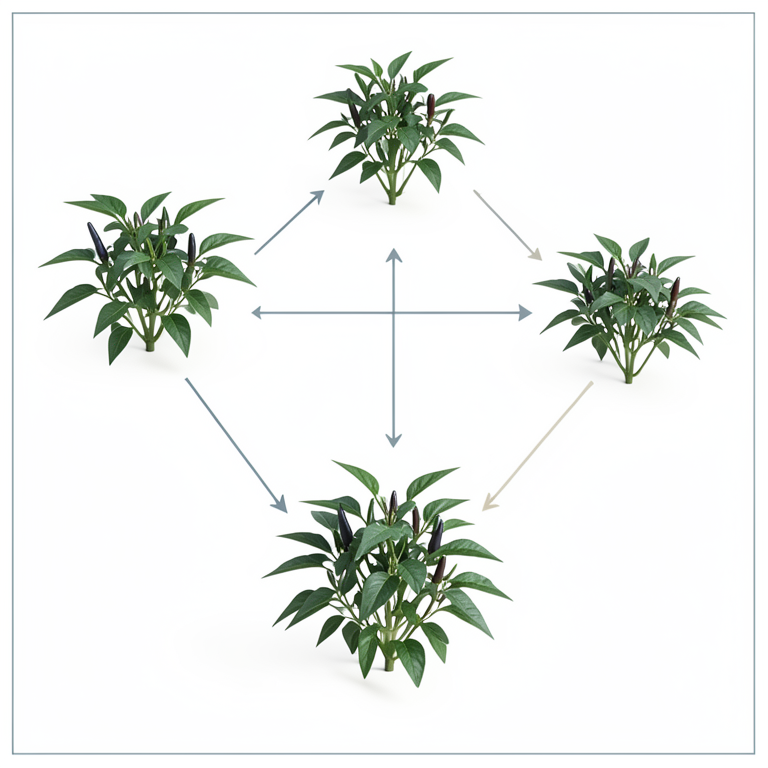
Genetic Clustering Concept
AI-generated conceptual illustration (chilli plants (Capsicum annuum L.)). It explains the idea and does not show study data.
View source evidence ↗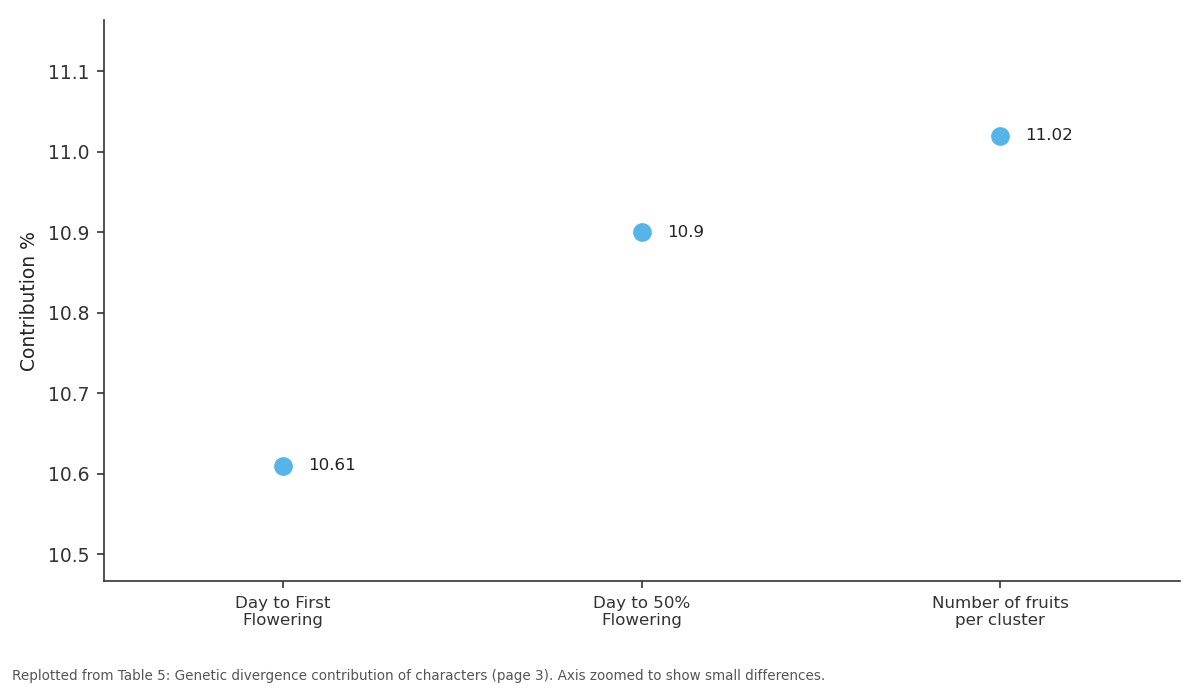
Contribution %: Day to First Flowering vs Day to 50% Flowering vs Number of fruits per...
Replotted from Table 5 (page 3) of the original paper. Every bar is the paper's own table value.
View source evidence ↗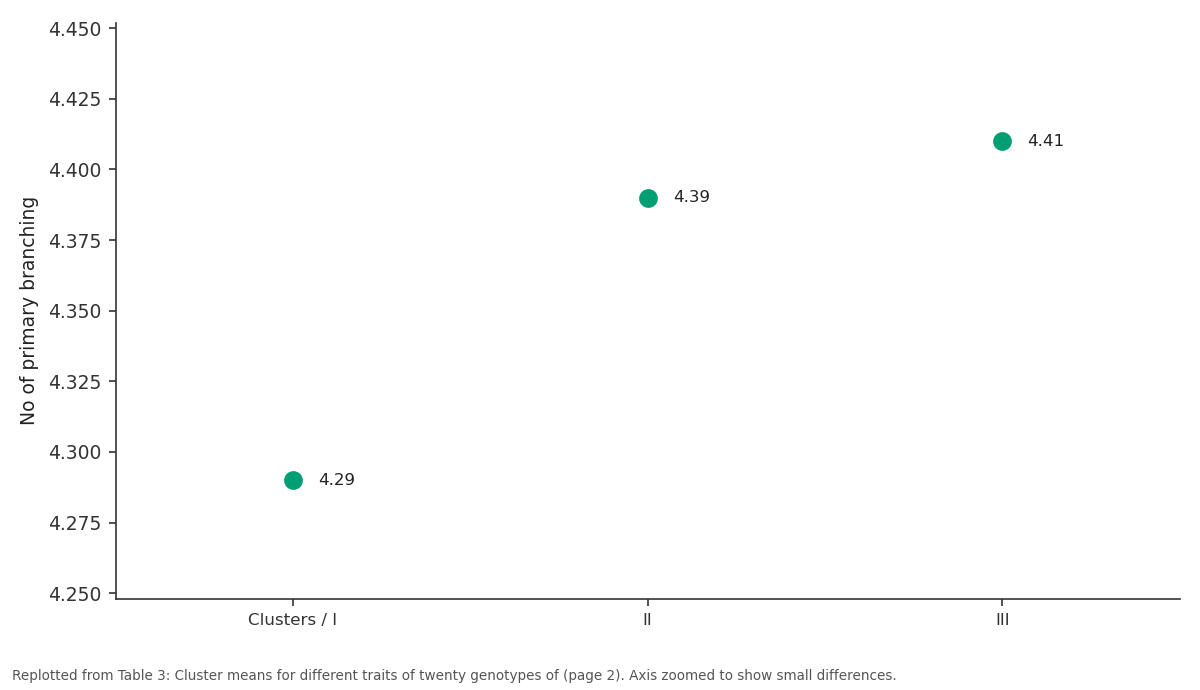
No of primary branching: Clusters / I vs II vs III
Replotted from Table 3 (page 2) of the original paper. Every bar is the paper's own table value.
View source evidence ↗Figures & tables
From the original paper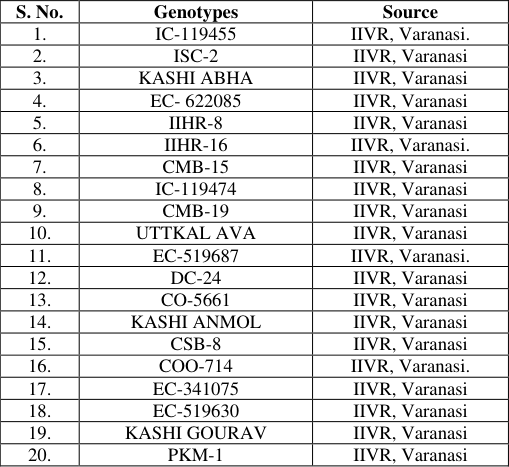 Table 1
 Table 2
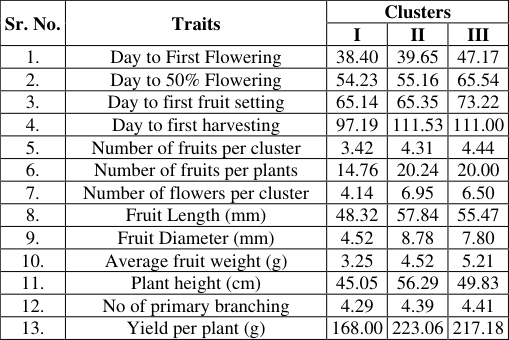 Table 3
 Table 4
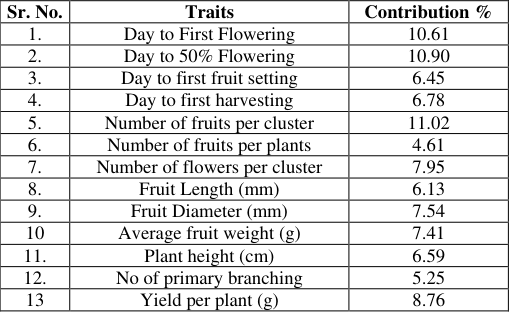 Table 5
Introduction
One of the most significant vegetable plants growing in India is the chilli. It is a member of the family Solanaceae. It is grown for export as well as for domestic market. Chilli is native to India but originated in South America" and was made available by the Portuguese in the late the 15th century. One of the most significant is the chilli and widely produced spice plants in Asia. The major chilli growing countries in the world are Bangladesh, Pakistan, Ghana, India, China, Ethiopia, Myanmar, Mexico, Peru, and the United States. Among all these countries, India tops the list of chilli exports. They account for about 33% of India's total spice exports and about 16% of the global spice trade. The major Indian Andhra Pradesh, Karnataka, Maharashtra, Orissa, Tamil Nadu, Madhya Pradesh, West Bengal, and Rajasthan are states that grow chillies. Capsicum is derived from the Greek word "capsicum", which means to bite. 22 wild species, three variations, five domestic species, and their wild relatives make up the genus Capsicum. In general, the domesticated species have larger but fewer fruits than their wild relatives, although the seeds per plant are about the same size. The chilli plant is an annual under plant, fruits differ in size, colour, pungency, form, and texture. The annual or perennial capsicum plant is herbaceous or semi-woody. Oval-shaped leaves are pointed, dark green on top and pale green on the underside, up to 15 cm tall. Flowers are white, tiny, and they can be seen on leaf axils alone or in groups of two or three. Proteins, Ca, Mg, P, K, Cu, and S are all abundant in green chilies. Vitamin C, riboflavin, and thiamine, among others. Curry powder's primary constituents are chillies. Chilli contains a number of essential nutrients and bioactive compounds known to have antioxidant, antimicrobial, antiviral, anti-inflammatory and anti-cancer properties. It is an excellent source of vitamins A, B, C, E, and P (Quresh et al., 2015) [8] . It is also a good source of 'oleoresin' which allows better distribution of colour and flavour in foods (Chattopadhyay et al., 2011) [3] . The improvement potential of any crop is proportional to the extent of genetic variability in the germplasm. The greater the variability, the greater the chance of selecting the desired genotypes after validating the heterogeneity in different features among various genotypes, improvement can be put into practise. By dividing the correlation coefficient, path coefficient analysis distinguishes between direct and indirect effects based on these and other associated variables (Hasanuzzaman and Golam, 2011) [5] .
Materials and Methods
The present investigation was done at research farm of the department of horticulture science ITM University Gwalior Madhya Pradesh during year 2022-23. Twenty genotypes (Table 1) were evaluated for plant growth and yield characters. The seedling was during the third week of November, transplanted. The same set of guidelines and plant protection measures that apply to universities were followed. Recommendation during the crop period. Growth parameters such as days to first flowering, day to 50% Flowering, day to first fruit setting, day to first harvesting, number of fruits Per cluster, number of fruits Per Plant, number of flowers per Cluster, Fruit length (cm), Fruit dimeter, Fruit Weight (g), Plant height(cm), number of Primary branching per plant, Fruit yield per plant. The genotypes were clustered Mahalanobis (1936) [7] and Rao (1952) [9] recommended utilising Tocher's approach and D2 statistics, while Panse & Sukhatme (1985) [10] recommended analysing and presenting observation data. According to Lush (1949; Burton, 1953) [2] , GCV and PCV were calculated, while GA and heritability (in the wide sense) were calculated using Johnson et al.'s percent of mean at 5% selection intensity.
| S. No. | Genotypes | Source |
|---|---|---|
| 1. | IC-119455 | IIVR, Varanasi. |
| 2. | ISC-2 | IIVR, Varanasi |
| 3. | KASHI ABHA | IIVR, Varanasi |
| 4. | EC- 622085 | IIVR, Varanasi |
| 5. | IIHR-8 | IIVR, Varanasi |
| 6. | IIHR-16 | IIVR, Varanasi. |
| 7. | CMB-15 | IIVR, Varanasi |
| 8. | IC-119474 | IIVR, Varanasi |
| 9. | CMB-19 | IIVR, Varanasi |
| 10. | UTTKAL AVA | IIVR, Varanasi |
| 11. | EC-519687 | IIVR, Varanasi. |
| 12. | DC-24 | IIVR, Varanasi |
| 13. | CO-5661 | IIVR, Varanasi |
| 14. | KASHI ANMOL | IIVR, Varanasi |
| 15. | CSB-8 | IIVR, Varanasi |
| 16. | COO-714 | IIVR, Varanasi. |
| 17. | EC-341075 | IIVR, Varanasi |
| 18. | EC-519630 | IIVR, Varanasi |
| 19. | KASHI GOURAV | IIVR, Varanasi |
| 20. | PKM-1 | IIVR, Varanasi |
Table text extracted from the original PDF; superscript letters are shown inline. The original table image is below.
View original table image
Results and Discussion
In this study we are used 20 genotypes for genetic divergence studies and these were divided into five clusters and it facilitates to easy identification genotypes which are similar features. Are given the (Table 4) The genotype collections from various locations demonstrated independence from their sources, with cluster I (7) having the greatest number of genotypes and other clusters like II (7) and III (6) following. For all plant development and yield parameters, the analysis of variance revealed substantial genotype differences. It also reveals the greatest genetic divergence among the 20 genotypes produced in CRC-1 Gwalior (Madhya Pradesh). According to the data, cluster III (2.510) had the largest intra-cluster distance. The largest inters cluster distance, however, of 5.00 was measured between clusters III and II. The averages for fruit length, average fruit weight, fruit weight, chlorophyll 'a' content, chlorophyll 'b' content, and dry fruit yield per plant were documented. Similar opinions were also reported by Gogate et al. (2006) [11] . The ascorbic acid content, initial flowering date, 50% flowering date, and fruit seed count of Cluster II were highlighted. It seemed most likely that the desired traits could be combined by crossing between the genotypes of two clusters. In the current examinations, clusters III and II were discovered to be more divergent, and there will be a greater likelihood of obtaining better segregants in F2 and later. The most fruits and vegetables were observed by Ajjapplavara (2009) [1] ; Datta and Das (2013) [4] ; external influences. To increase yield in chilli, yield traits with high genetic variation and heritability, Considerations should be made for factors including fruit length, fruit diameter, and fruit weight. Therefore, it is fair to conclude that the genotypes chosen have a wide range of variability among all economically significant traits and that the crop improvement programme for chilli continues to be advantageous.
| Clusters | No of genotypes | Genotypes |
|---|---|---|
| I | 7 | EC-622085, IIHR-8, IC-119474, EC-519687, EC-341075, EC-519630 |
| II | 7 | ISC-02, KASHIABHA, IIHR-16, DC-24, CO-5661, CSB-08, PKM-1 |
| III | 6 | IC-119455, CMB-8, CMB-19, UTTKAL AVA, COO-714, KASHI GOURAV |
Table text extracted from the original PDF; superscript letters are shown inline. The original table image is below.
View original table image
Acknowledgement
Authors are thankful to Dean, School of Agriculture, ITM University, Gwalior (M.P.) for providing all the necessary facilities required for conducting the research work.
Conclusion
According to the study, there is a large level of genetic variation across the 20 genotypes for the characteristics of the chilli germplasms that affect plant development, yield, and quality. Cluster I whereas cluster I and cluster II had the lowest intra-cluster distances, cluster III had the most. Genotypes from clusters I, III, and II have the potential to be used directly or indirectly as varieties and as possible breeding stock for chilli crop improvement programmes.
Figures and tables from the paper
| Cluster | I | II | III |
|---|---|---|---|
| I | 2.719 | 4.514 | 2.283 |
| II | 4.514 | 2.283 | 5.00 |
| III | 5.00 | 2.973 | 2.510 |
Table text extracted from the original PDF; superscript letters are shown inline. The original table image is below.
View original table image
| Sr. No. | Traits | Clusters | — | — |
|---|---|---|---|---|
| I | II | III | ||
| 1. | Day to First Flowering | 38.40 | 39.65 | 47.17 |
| 2. | Day to 50% Flowering | 54.23 | 55.16 | 65.54 |
| 3. | Day to first fruit setting | 65.14 | 65.35 | 73.22 |
| 4. | Day to first harvesting | 97.19 | 111.53 | 111.00 |
| 5. | Number of fruits per cluster | 3.42 | 4.31 | 4.44 |
| 6. | Number of fruits per plants | 14.76 | 20.24 | 20.00 |
| 7. | Number of flowers per cluster | 4.14 | 6.95 | 6.50 |
| 8. | Fruit Length (mm) | 48.32 | 57.84 | 55.47 |
| 9. | Fruit Diameter (mm) | 4.52 | 8.78 | 7.80 |
| 10. | Average fruit weight (g) | 3.25 | 4.52 | 5.21 |
| 11. | Plant height (cm) | 45.05 | 56.29 | 49.83 |
| 12. | No of primary branching | 4.29 | 4.39 | 4.41 |
| 13. | Yield per plant (g) | 168.00 | 223.06 | 217.18 |
Table text extracted from the original PDF; superscript letters are shown inline. The original table image is below.
View original table image
| Sr. No. | Traits | Contribution % |
|---|---|---|
| 1. | Day to First Flowering | 10.61 |
| 2. | Day to 50% Flowering | 10.90 |
| 3. | Day to first fruit setting | 6.45 |
| 4. | Day to first harvesting | 6.78 |
| 5. | Number of fruits per cluster | 11.02 |
| 6. | Number of fruits per plants | 4.61 |
| 7. | Number of flowers per cluster | 7.95 |
| 8. | Fruit Length (mm) | 6.13 |
| 9. | Fruit Diameter (mm) | 7.54 |
| 10 | Average fruit weight (g) | 7.41 |
| 11. | Plant height (cm) | 6.59 |
| 12. | No of primary branching | 5.25 |
| 13 | Yield per plant (g) | 8.76 |
Table text extracted from the original PDF; superscript letters are shown inline. The original table image is below.
View original table image
References
9 in the original paper- Ajjapplavara PS, Channagoudra RF. Studies on variability, heritability and genetic advance in chilli (Capsicum annuum L.). Asian Journal of Horticulture. 2009;4(1):99-101.
- Burton GW, Devane DE. Estimating heritability in tall fescue (Festuca arundinacea) from replicated clonal material. Agronomy journal. 1953;45(10):478-481.
- Chattopadhyay A, Sharangi AB, Dai N, Dutta S. Diversity of genetic resources and genetic association analyses of green and dry chilies of Eastern India. Chilean Journal of agricultural research. 2011;71(3):350.
- Datta S, Das L. Characterization and genetic variability analysis in (Capsicum annuum L.) germplasm. SAARC Journal of Agriculture. 2013;11(1):91-103.
- Hasanuzzaman M, Golam F. Gene actions involved in yield and yield contributing traits of chilli (Capsicum annuum L.). Australian Journal of Crop Science. 2011;5(13):1868-1875.
- Johnson HW, Robinson HF, Comstock RE. Estimates of genetic and environmental variability in soybeans. Agronomy journal. 1955;47(7):314-318.
- Quresh W, Alam M, Ullah H, Jatoi SA, Khan WU. Evaluation and Literature and Cited 75 characterization of Chilli (Capsicum annuum L.) germplasm for some morphological and yield characters. Int. J Pure and App. Bio. 2015;4:628-635.
- Panse VG, Sukhatme PV. Statistical methods for agricultural research. ICAR, New Delhi. 1985;8:30818.
- Gogate LJ, Bolzani LH, Betancourt EA. Attention to maternal multimodal naming by 6-to 8-month-old infants and learning of word-object relations. Infancy. 2006 Apr 1;9(3):259-88.