
Research article · 2023 · Full text
International Journal of Veterinary Sciences and Animal HusbandryStudy on reproductive performance of Nellore Jodipi sheep in RKVY and non-RKVY flocks under field conditions
Volume 8(5) · Pages 40–43 · DOI: 10.22271/veterinary.2023.v8.i5a.690 ↗
Research areasLivestock Management and Performance ImprovementGenetic and phenotypic traits in livestockAgricultural Economics and Practices
Abstract
Author-writtenA study was conducted to evaluate the reproductive performance of Nellore Jodipi sheep, native sheep breed of Andhra Pradesh in RKVY and Non-RKVY flocks of farmers in Andhra Pradesh. The data on reproductive traits viz., age at first mating, age at first lambing, service period, lambing interval were acquired from the sheep farmers via structured questionnaire. Twenty-eight farmers were interviewed in order to obtain information on sheep breeding operations and reproductive performance in their flocks. The overall least squares mean for age at first mating in rams, age at first mating in ewes, age at first lambing, service period and lambing interval were 584.17 ± 4.92, 643.34 ± 6.11, 837.95 ± 4.70, 162.78 ± 1.54 and 408.93 ± 7.67 days, respectively.
Summary
Source-checkedPlain-language reading of the full paper, prepared with AI and checked against the text. Each point links to the authors' own words.
Why it matters
- India possesses significant sheep biodiversity, with 44 registered breeds and a total population of 74.26 million, representing 13.83% of the country's livestock. View evidence ↗
- The Nellore sheep is the tallest breed in India used for mutton and is primarily found in the Chittoor, Prakasam, and Nellore districts of Andhra Pradesh. View evidence ↗
- Studying reproductive traits in Nellore Jodipi sheep is critical because reproduction directly determines the productivity of ewes. View evidence ↗
The question
- The study aimed to determine the impact of the Rashtriya Krishi Vikas Yojana (RKVY) program on the reproductive performance of Nellore Jodipi sheep in field-based farmer flocks. View evidence ↗
What they did
- The research was conducted in the Chittoor district of Andhra Pradesh, comparing sheep in RKVY flocks (those that received rams from the Livestock Research Station, Palamaner) and non-RKVY flocks. View evidence ↗
- The study measured four key reproductive parameters: age at first mating, age at first lambing, service period, and lambing interval, all expressed in days. View evidence ↗
What they found
- The researchers found no statistically significant difference in any of the studied reproductive traits between RKVY and non-RKVY flocks. View evidence ↗
- The overall mean age at first mating for rams was 584.17 ± 4.92 days, with RKVY rams maturing slightly earlier (578.25 ± 5.12 days) than non-RKVY rams (590.10 ± 6.02 days). View evidence ↗
- For females, the overall mean age at first mating was 643.34 ± 6.11 days, with RKVY ewes maturing earlier (606.23 ± 7.71 days) than non-RKVY ewes (680.45 ± 6.84 days). View evidence ↗
- The overall mean age at first lambing for ewes was 837.95 ± 4.70 days, with RKVY flocks averaging 825.25 ± 5.24 days and non-RKVY flocks averaging 850.65 ± 6.75 days. View evidence ↗
- The overall mean service period was 162.78 ± 1.54 days, which was shorter in RKVY flocks (150.24 ± 3.12 days) compared to non-RKVY flocks (175.33 ± 5.65 days). View evidence ↗
- The overall mean lambing interval was 408.93 ± 7.67 days, with RKVY flocks showing a shorter interval (395.23 ± 10.48 days) than non-RKVY flocks (422.63 ± 9.23 days). View evidence ↗
What it means
- The authors conclude that the lack of significant differences between the flocks is likely because farmers did not follow prescribed breeding practices under field conditions. View evidence ↗
- The authors recommend supplying breedable rams according to state policy and adopting a formal breeding policy to improve ewe productivity and safeguard the Nellore Jodipi germplasm. View evidence ↗
Visual summary
3 visualsIllustrations explain the paper; charts are replotted from the paper's own table values.
Study Comparison Framework
AI-generated conceptual illustration (Nellore Jodipi sheep). It explains the idea and does not show study data.
View source evidence ↗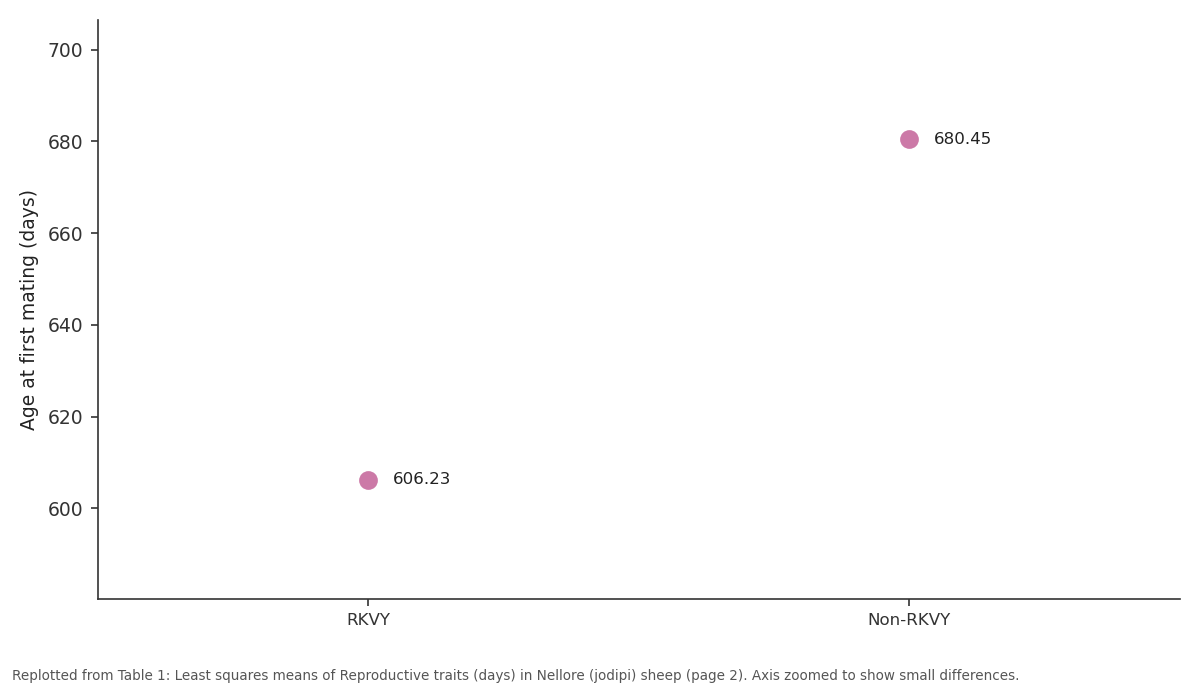
Mean: RKVY vs Non-RKVY
Replotted from Table 1 (page 2) of the original paper. Every bar is the paper's own table value.
View source evidence ↗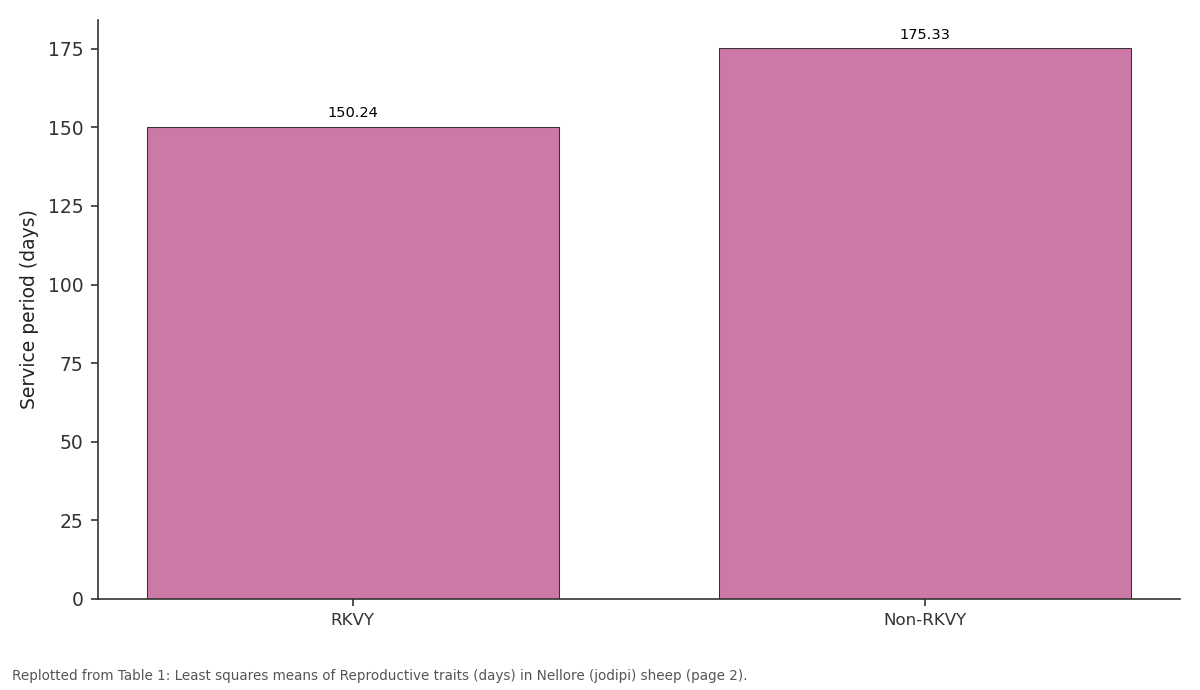
Mean: RKVY vs Non-RKVY
Replotted from Table 1 (page 2) of the original paper. Every bar is the paper's own table value.
View source evidence ↗Figures & tables
From the original paper Table 1
Introduction
India has rich sheep biodiversity with 44 registered sheep breeds with the total population of 74.26 million accounting for 13.83 per cent of the total livestock population of India. Sheep population of Andhra Pradesh is about 17.6 million coming around 23.73 per cent of the total sheep population of the country, ranking second in the country (20 th Livestock Census, 2019) [1] . Nellore, India's tallest mutton purpose sheep breed, is predominantly distributed in Nellore, Prakasam and Chittoor districts of Andhra Pradesh. The Rashtriya Krishi Vikas Yojana (RKVY) programme was established to advance agriculture and related sectors, among other government policies and programmes that the Government of India has put into place to increase farmers' income. From 2009 to 2010, the RKVY project is being carried out at the Livestock Research Station (LRS), Palamaner by Sri Venkateswara Veterinary University of Andhra Pradesh, one of the nodal organisations. This project provided superior Nellore Ram germplasm to the needy farmers in order to improve the genetic makeup of their flocks, which in turn improved the socioeconomic status of rural poor people. Reproductive traits in Nellore Jodipi sheep were studied as reproduction is an important factor in determining productivity of the ewes. Evaluating the reproductive parameters will help in knowing the reproductive performance of flock under field settings, one of the most significant economic attributes of sheep which in turn will aid in understanding the issues pertaining to changed reproductive performance. Therefore, the goal of the current inquest is to ascertain how the RKVY Program has impacted the Nellore Jodipi Sheep's reproductive performance in the farmer's flocks under field conditions.
Materials and Methods
The current study on Nellore Jodipi sheep was carried out in Chittoor district of Andhra Pradesh to assess the reproductive performance of sheep in RKVY and Non-RKVY flocks. The flocks that received rams from Livestock Research Station (LRS), Palamaner were named as RKVY flocks and others as non-RKVY flocks.
Data on reproductive performance and their management practices were collected through observation and interaction with the flock owners and shepherds using structured questionnaires from eight villages in the Yerpedu and Srikalahasti mandals. Based on information acquired from the farmers/owners of the animals via structured questionnaires, the following reproductive parameters were assessed. Age at first mating is the time interval between the date of birth and first mating of the animal was taken as age at first mating which was expressed in days. Age at first lambing is the period between the birth of the animal and the first lambing was taken as age at first lambing and is expressed in days. Service period is the number of days elapsed from lambing till the subsequent fertile conception is termed as service period. Lambing interval (days) is the time interval between first and second lambing. The data collected were subjected to standard statistical procedures as per Snedecor and Cochran (1994) [2] .
Results and Discussion
Twenty-eight farmers were interviewed in order to obtain information on sheep breeding operations and reproductive performance in their flocks. The results pertaining to reproductive traits under study are presented in Table 1. There was no significant difference in any of the reproductive traits studied, between RKVY and non-RKVY flocks.
| — | AFM (M) | — | — | AFM (F) | — | — | AFL | — | — | SP | — | — | LI | — | — |
|---|---|---|---|---|---|---|---|---|---|---|---|---|---|---|---|
| n | Mean | S. E | n | Mean | S. E | n | Mean | S. E | n | Mean | S. E | n | Mean | S. E | |
| Overall | 135 | 584.17 | 4.92 | 538 | 643.34 | 6.11 | 538 | 837.95 | 4.70 | 538 | 162.78 | 1.54 | 538 | 408.93 | 7.67 |
| Flocks | NS | NS | NS | NS | NS | ||||||||||
| RKVY | 63 | 578.25 | 5.12 | 292 | 606.23 | 7.71 | 292 | 825.25 | 5.24 | 292 | 150.24 | 3.12 | 292 | 395.23 | 10.48 |
| Non-RKVY | 72 | 590.10 | 6.02 | 246 | 680.45 | 6.84 | 246 | 850.65 | 6.75 | 246 | 175.33 | 5.65 | 246 | 422.63 | 9.23 |
Table text extracted from the original PDF; superscript letters are shown inline. The original table image is below.
View original table image
Age at first mating in males
The overall least squares mean for Age at first mating in rams was 584.17 ± 4.92 days and the respective ages in RKVY and non-RKVY flocks were 578.25 ± 5.12 and 590.10 ± 6.02 days. The flocks had no significant influence on age at first mating in males and the males matured at an early age in RKVY flocks when compared to non-RKVY flocks. The age at first mating in males obtained in the present study corroborated with the findings of Dass et al. (2004) [3] in Marwari, Rajanna et al. (2012) [4] in Nellore, Harini et al. (2019) [5] in Nellore Palla sheep. Lower values have been reported by Jagatheesan et al. (2004) [6] , Karunanithi et al. (2005) [7] , Chandran et al. (2009) [8] and Gangaraju et al. (2010) [9] in Mecheri, Mecheri, Vembur and Vizianagaram sheep, respectively. However, higher value for these traits has been reported by Dey and Poonia (2005) [10] in Nali and Chander (2012) [11] in Magra sheep breeds.
Age at first mating in females
The overall least squares mean for age at first mating in females was 643.34 ± 6.11 days. The mean age at first mating among the flocks varied from 606.23 ± 7.71 days in RKVY flocks to 680.45 ± 6.84 days in non-RKVY flocks. The ewes in RKVY flocks matured at an early age compared to flocks of non-RKVY which might be due to the fact that the ewes gained mature body weights earlier due to the effect of superior germplasm. However, differences were insignificant. These findings were in concurrence with Gohil (2010) [12] in Marwari, Chander (2012) [13] in Magra, Rajanna et al. (2012) [4] in Nellore and Rani et al. (2016) [14] in Nellore Jodipi sheep. However, the Nellore Jodipi sheep in this study have better age at maturity than other breeds reported by Dey and Poonia (2005) [10] in Nali sheep, who, reported higher mean values for age at first mating (AFM) in females. The means in the present study were higher than the values reported in Vembur (Chandran et al., 2009) [8] , Vizianagaram (Gangaraju. 2010) [9] and Nellore palla (Harini et al., 2019) [5] .
Age at first lambing
The mean age at first lambing in ewes was 837.95 ± 4.70 days and the means ranged from 825.25 ± 5.24 to 850.65 ± 6.75 days in RKVY and Non-RKVY flocks, respectively. The present value for age at first lambing was found close to the findings of Shipra (2003) [15] in non-descript indigenous sheep of Bhanjanagar area of Orissa and Rani et al. (2016) [14] in Nellore Jodipi sheep. Reddy (1980) [16] reported higher values for age at first lambing in Nellore sheep. The present values were higher than those reported by Bemji et al. (2001) [17] , Gbangboche et al. (2004) [18] , Akthar et al. (2007) [19] , Nayak et al. (2010) [20] , Rajanna et al. (2012) [4] , Kumar et al. (2018) [21] and Harini et al. (2019) [5] in Yankasa, Djallonke, Hissardale, Ganjam, Nellore, Harnali and Nellore Palla sheep breeds, respectively.
Service period
The overall least squares mean for service period was 162.78 ± 1.54 days with the means varying from 150.24 ± 3.12 (RKVY) to 175.33 ± 5.65 days (non-RKVY). The means recorded in the present study were within the range of means reported by Singh and Koli (1996) [22] in Bharat Merino sheep. The obtained means were lower, when compared with the reports of Gohil (2010) [12] in Marwari and Jahan et al. (2013) [23] in Balochi sheep. The overall means for service period in present study were higher than those reported by Dixit et al. (2002) [24] in Bharat Merino, Shipra (2003) [15] in non-descript indigenous sheep of Bhanjanagar area of Orissa, Pan et al. (2004) [25] in Garole, Patro et al. (2006) [26] in Kendrapada, Tailor et al. (2007) [27] in Sonadi, Siddhalingamurthy et al. (2017) [28] in Mandya sheep.
Lambing interval
The overall least squares mean for lambing interval was 408.93 ± 7.67 with a range of means from 395.23 ± 10.48 to 422.63 ± 9.23 among RKVY and non-RKVY flocks. The means noticed in the present study were well coincided with the previous findings of Purushotham (1978) [29] in Nellore and Mandya sheep, Gupta (2000) [30] in Australian Merino, Jain et al. (2005) [31] in Bellary, Lalit et al. (2016) [32] in Harnali and Rani et al. (2016) [14] in Nellore Jodipi sheep. Nimbkar (1993) [33] in Deccani and Gupta (2000) [30] in Merino and Rambouillet sheep observed higher values of lambing interval than the present findings. However, the means in the present study were higher than the values reported in Ganjam and Bolangir sheep (Mohanty, 1991) [34] , Garole (Bose et al., 2000) [35] , Yankasa sheep (Bemji et al., 2001) [17] , non-descript indigenous sheep of Bhanjanagar area of Orissa (Shipra, 2003) [15] , Garole sheep (Pan et al., 2004) [25] , Malpura (Kumar et al., 2008) [36] , Ganjam (Nayak et al., 2010) [20] and Mandya sheep (Siddhalingamurthy et al., 2017) [28] . [14] in Nellore Jodipi sheep and Harini et al. (2019) [5] in Nellore Palla sheep. There was no significant difference in any of the reproductive traits studied, between RKVY and non-RKVY flocks, which can be attributed to the fact that there were no prescribed breeding practices being followed in the farmers flocks under field conditions and the rams are left in the flocks along with ewes for mating throughout day and night.
Conclusion
Reproductive traits in Nellore Jodipi sheep were studied as reproduction is an important factor in determining productivity of the ewes. The ewes maturing at an early age and lambing at a regular interval helps not only in quick build-up of the flock through increased rate of replacement but also enhance the rate of genetic progress by way of reduction in generation interval along with increased income source to rural poor sheep farmers. Breedable rams may be supplied to farmers in accordance with state sheep breeding policy in order to boost ewe productivity. The adoption of a breeding policy will safeguard the indigenous sheep germplasm, ensuring the survival and improvement of the Nellore Jodipi sheep breed.
Acknowledgement
Acknowledgement (if any)The authors are grateful for the resources and funding provided by Sri Venkateswara Veterinary University in carrying out this research. It is also duly acknowledged that the Animal Husbandry Department of Andhra Pradesh provided invaluable assistance throughout the entire study period.
References
26 in the original paper- Dass G, Singh VK, Mohd Ayub. Growth and performances of Magra sheep under hot arid climate. Indian Journal of Animal Sciences. 2004;74(4):441-443.
- Rajanna N, Mahendar M, Raghunandan T, Sreenivasarao D, Nagalakshmi D, Thammiraju D. Reproductive performance of Nellore sheep in different agroclimatic zones of Telangana. Animal Science Reporter. 2012;6(4):142-145.
- Harini KS, Punyakumari B, Vinoo R, Babu DS, Bharathi G. Morphometric characterization, productive and reproductive performance of Nellore Palla sheep under field conditions. Indian Journal of Small Ruminants (The). 2019;25(2):156-160.
- Jagatheesan PNR, Arunachalam S, Sivakumar T, Selvaraju M. Reproductive performance of Mecheri sheep in its home tract. Indian Veterinary Journal. 2004;81(1):109-111.
- Karunanithi K, Purushothaman MR, Thiruvenkadan AK, Singh G, Sadana DK, Murugan M. Breed characteristics of Mecheri sheep. Animal Genetic Resources of India. 2005;37:53-62.
- Chandran PC, Kandasamy N, Paneerselvam S. Distribution characteristics and management of Vembur sheep. Indian Journal of Animal Science. 2009;79(1):7377.
- Dey B, Poonia JS. Reproductive performance of Nali sheep. Indian Journal of Small Ruminants. 2005;11(1):10-13.
- Chandran PC, Kandasamy N, Paneerselvam S. Distribution characteristics and management of Vembur sheep. Indian Journal of Animal Science. 2009;79(1):7377.
- Rani M, Ekambaram B, Kumari BP. Production and Reproduction Performance of Nellore Sheep in (Native rearing) Chittoor District of Andhra Pradesh. Journal of Research (PJTSAU), Part I. 2016;44(4):54-57.
- Bemji MN, Osmowo OA, Ehoche OW, Aduku AO. ASSET-Series A-Agriculture and environment. 2001;1(2):37-44.
- Gbangboche AB, Hounzangbe ASM, Doko SY, Famir F, Detilleux J, Leroy PL. Production of Djltonke sheep at an experimental station in the Guinean zone of Benin. Reproduction performance and influence of non-genetic factors. Revue-Africaine-Sante-et-de-ProductionsAnimales. 2004;2(1):55-61.
- Akhtar P, Abdullah M, Younas M, Aslam Mirza M. Heritability estimates of some growth traits in Hissardale sheep of Pakistan. Indian Journal of Animal Sciences. 2007;77(2):181-183.
- Nayak S, Mohapatra AK, Barik N. Reproductive performance and disease prevalence in Ganjam sheep of Orissa. Indian Journal of Small Ruminants. 2010;16(1):148-150.
- Kumar S, Dahiya SP, Malik ZS, Patil CS, Magotra A. Genetic analysis of performance traits in Harnali sheep. Indian Journal of Animal Research. 2018;52(5).
- Singh G, Koli OP. Factors affecting reproduction traits of Bharat Merino sheep under hot semi-arid climate. Indian Journal of Small Ruminants. 1996;2(2):17-23.
- Jahan M, Tariq MM, Kakar MA, Waheed A. Reproductive performance of Balochi sheep in different ecological zones of Balochistan, Pakistan. The Pakistan Veterinary Journal. 2013;33:37-40.
- Dixit SP, Dhillon JS, Singh G. Sources of Variation in reproductive traits of Bharat Merino Sheep. Indian Journal of Animal Sciences. 2002;72(4):328-331.
- Patro BN, Mallick CR, Rao PK, Panda P. Production performance of indigenous meat type sheep in Kendrapara district of coastal Orrisa. Indian Journal of Small Ruminants. 2006;12(1):42-47.
- Tailor SP, Gupta L, Nagda RK. Productive and reproductive performance of Sonadi sheep in their native tract. The Indian Journal of Small Ruminants. 2007;13(1):51-54.
- Siddalingamurthy HK, Manju GU, Roopadevi YS, Manjunatha SS, Sreesujatha RM. Nongenetic factors affecting birth and weaning weight in Mandya sheep. International Journal of Advanced Research. 2017;5:345348.
- Purushotham C, Ramachandra-Rao L, Krishna-Reddy K, Krishnamacharyulu E. Study on some reproduction traits in Nellore and Mandya sheep in Andhra Pradesh. Livestock adviser. Animal breeding abstract. 1978;48:3130.
- Jain A, Kulkarni VS, Govindaiah MG, Sadana DK, Aswathanarayan T, Pandey AK, et al. Sheep genetic resource of India: Bellary monograph -2005. National Bureau of Animal Genetic Resources, Karnal, India; c2005.
- Lalit, Malik ZS, Dalal DS, Patil CS, Dahiya, Dev K. Reproductive performance of Harnali sheep. Indian journal of small ruminants. 2016;22(2):234-236.
- Nimbkar C. The goats and sheep of the Deccan plateau in Maharashtra state of India. Animal Genetic Resources Information. 1993;12:81-91.
- Bose S, Dutta GR, Mitra DN. Reproductive performance of Bengal sheep (Garole) in Sundarbans. Indian Journal of Animal Production and Management. 2000;15(4):157160.
- Kumar A, Singh U, Kumar S, Sharma RC, Arora AL. Malpura: A mutton breed of sheep needs to be conserved. Indian Journal of Animal Sciences. 2008;78(7):740-745.
Cited by 1
From OpenAlex, OpenCitations and reference lists read by Scinovex
- Effects of oral herbal powder supplements on the adaptive capabilities of heat stressed Kenguri sheep based on changes in physiological and molecular response ↗
E. Binuni Rebez, Chinnasamy Devaraj, J. Ninan, Mullakkalparambil Velayudhan Silpa, Srinivasan Perumal, ARTABANDHU SAHOO et al. · Tropical Animal Health and Production · 2025
❝ 0