
Research article · 2023 · Full text
International Journal of Statistics and Applied MathematicsA statistical performance analysis of three double-layer homomorphic encryption schemes for cloud enterprise resource planning (ERP) data
Volume 8(5) · Pages 31–39 · DOI: 10.22271/maths.2023.v8.i5a.1195 ↗
Research areasCryptography and Data SecurityCloud Data Security SolutionsChaos-based Image/Signal Encryption
Abstract
Author-writtenThis study presented a statistical performance analysis of three double-layer homomorphic encryption schemes for cloud Enterprise Resource Planning (ERP) data. In this study, Abukari et al. (2021) proposed a hybrid of two homomorphic encryption scheme and compared with the state-of-the-art Usha (2018) and Bellafqira et al. (2017) double layer homomorphic encryption schemes using the combination of the RSA cryptographic algorithm and the modified Paillier cryptosystem in a hybrid approach. The Multivariate Analysis of Variance (MANOVA) was used to test whether the mean encryption times of the three schemes differ significantly across the data sizes as well as determine which encryption times among the three schemes have the largest difference for each of the data sizes. Preliminary analysis revealed that our new proposed scheme Abukari et al. (2021) has the lowest mean mean encryption times of 5.4150, 10.6570 and 39.9770 across the different data sizes of 7MB, 14MB and 200MB compared to the existing state-of-the-art Bellafqira et al. (2017) and Usha (2018). The MANOVA test revealed that there is a statistically significant difference in encryption times of the various schemes across the different data sizes, F (6, 52) = 8.827, p
Summary
Source-checkedPlain-language reading of the full paper, prepared with AI and checked against the text. Each point links to the authors' own words.
Why it matters
- Cybersecurity challenges, specifically regarding data confidentiality and privacy, have become a primary focus for researchers due to the proliferation of computing devices. View evidence ↗
- Single-layer encryption schemes are considered inadequate for modern security needs and are believed to be vulnerable to Chosen Ciphertext Attacks (CCA). View evidence ↗
- Double-layer encryption schemes are proposed to provide enhanced security, including protection against cyber-attacks and keylogging. View evidence ↗
The question
- The objective of this research is to use statistical analysis to evaluate the performance of three different double-layer homomorphic encryption schemes. View evidence ↗
What they did
- The study compares a proposed hybrid scheme (Abukari et al., 2021) combining RSA and a modified Paillier cryptosystem against two existing schemes: Usha (2018) and Bellafqira et al. (2017). View evidence ↗
- The performance was measured using simulated encryption times across three data sizes: small (7MB), medium (14MB), and large (reported as both 20MB and 200MB in the text). View evidence ↗
- Multivariate Analysis of Variance (MANOVA) was employed to determine if mean encryption times differed significantly across the schemes and data sizes. View evidence ↗
What they found
- The proposed Abukari et al. (2021) scheme exhibited the lowest mean encryption times (5.4150, 10.6570, and 39.9770) for 7MB, 14MB, and 200MB data sizes, respectively. View evidence ↗
- MANOVA results confirmed a statistically significant difference in encryption times across the schemes and data sizes (F(6, 52) = 8.827, p < 0.005). View evidence ↗
- Approximately 51% of the multivariate variance in mean encryption times is attributed to the different data sizes (partial η² = 0.505). View evidence ↗
- The Abukari et al. (2021) scheme had the lowest grand mean encryption time of 18.683 (SE ±0.139), indicating higher efficiency than the other two schemes. View evidence ↗
- Univariate results showed that the Abukari et al. (2021) scheme had the largest effect size (partial η² = 0.998) compared to Usha (0.971) and Bellafqira et al. (0.870). View evidence ↗
- Unlike the other schemes, the Bellafqira et al. (2017) scheme showed no significant difference in encryption time between small and medium data sizes. View evidence ↗
What it means
- The authors conclude that their proposed hybrid scheme combining RSA and a modified Paillier cryptosystem outperforms the other two investigated double-layer schemes. View evidence ↗
- The study noted a violation of the equality of variance-covariance assumption (p = 0.000), which required the use of the more robust Pillai's trace criterion. View evidence ↗
Visual summary
3 visualsIllustrations explain the paper; charts are replotted from the paper's own table values.
Comparison of Encryption Architectures
AI-generated conceptual illustration (cloud server hardware and digital data packets). It explains the idea and does not show study data.
View source evidence ↗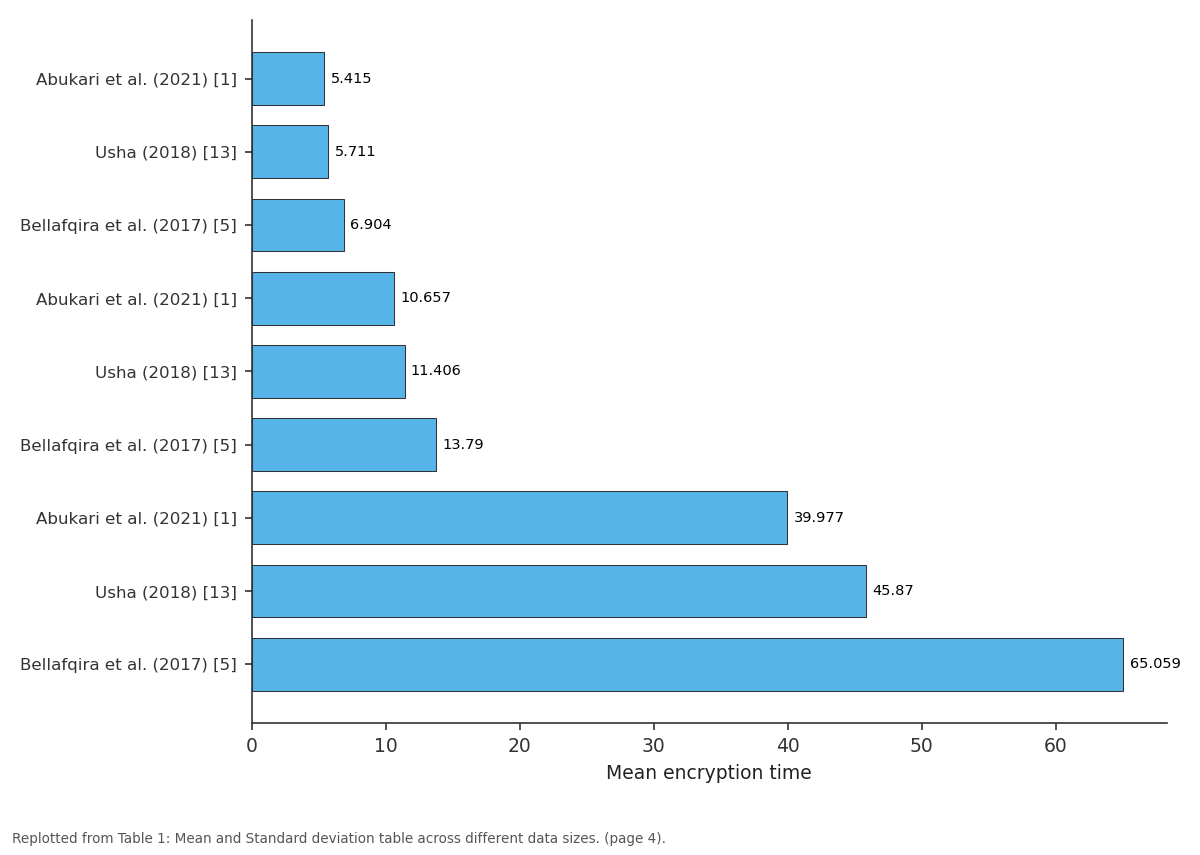
Mean: Abukari et al. (2021)... vs Usha (2018) [13] vs Bellafqira et al.... vs Abukari et al. (2021)... vs Usha (2018) [13]
Replotted from Table 1 (page 4) of the original paper. Every bar is the paper's own table value.
View source evidence ↗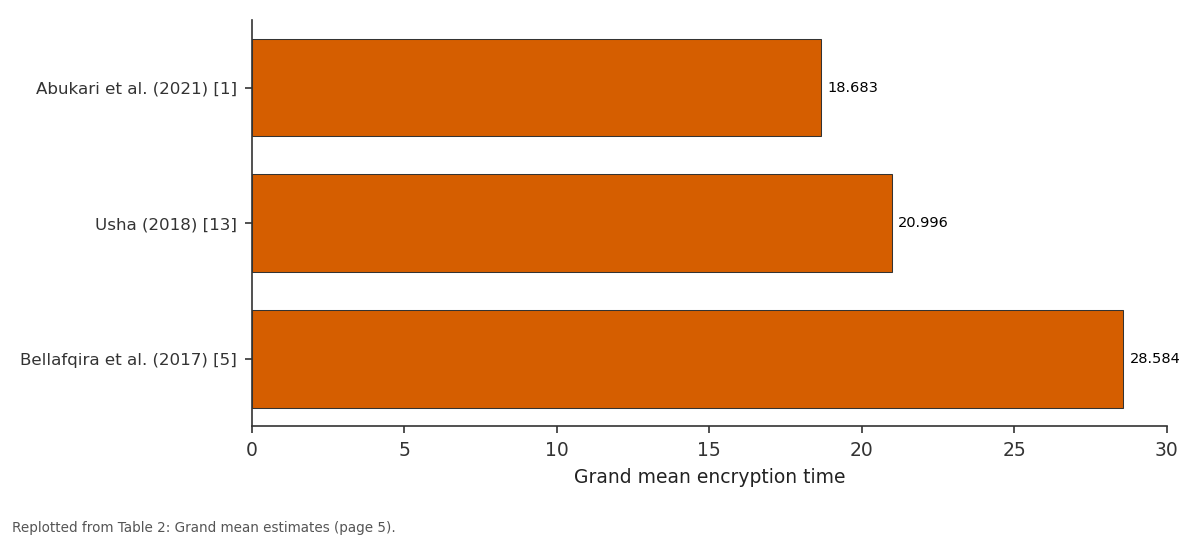
Mean: Abukari et al. (2021)... vs Usha (2018) [13] vs Bellafqira et al....
Replotted from Table 2 (page 5) of the original paper. Every bar is the paper's own table value.
View source evidence ↗Figures & tables
From the original paper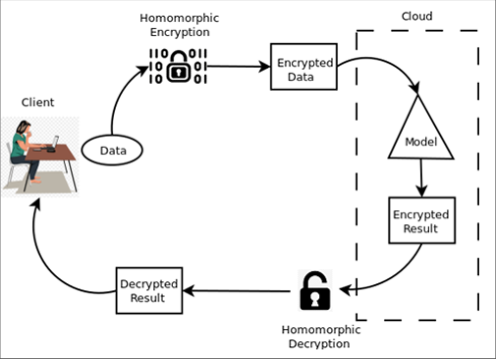 Figure 1
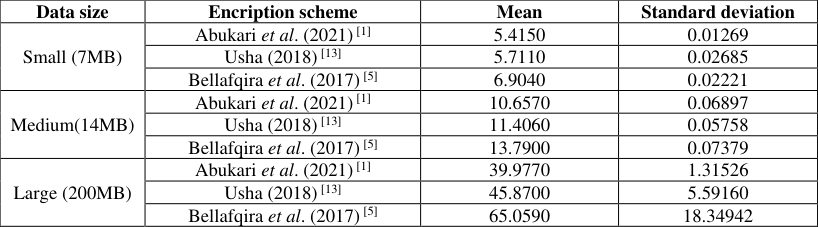 Table 1
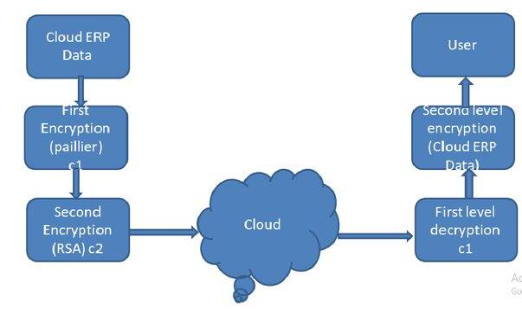 Figure 2
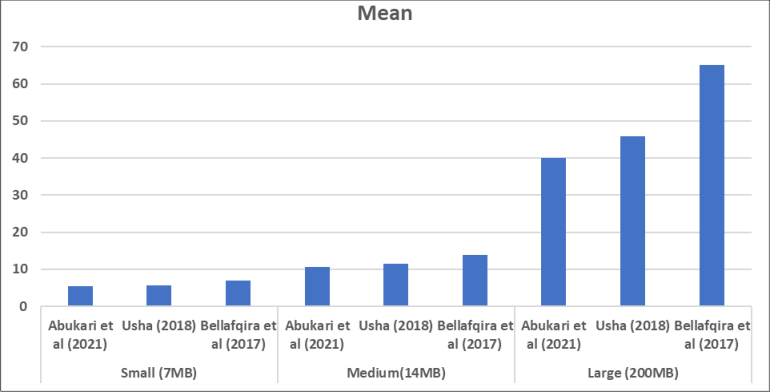 Figure 3
 Table 2
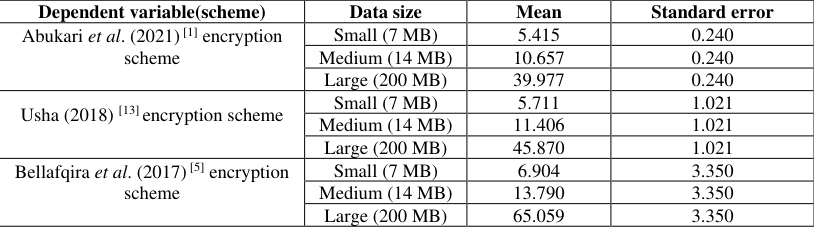 Table 3
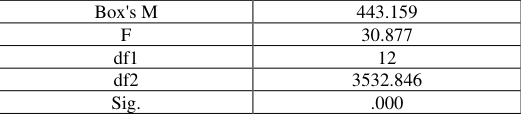 Table 4
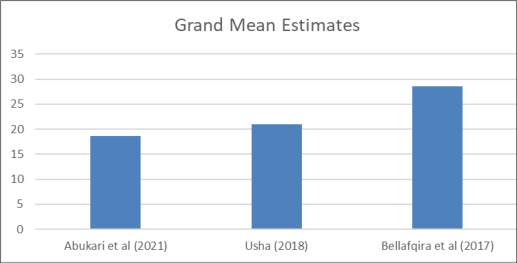 Figure 4
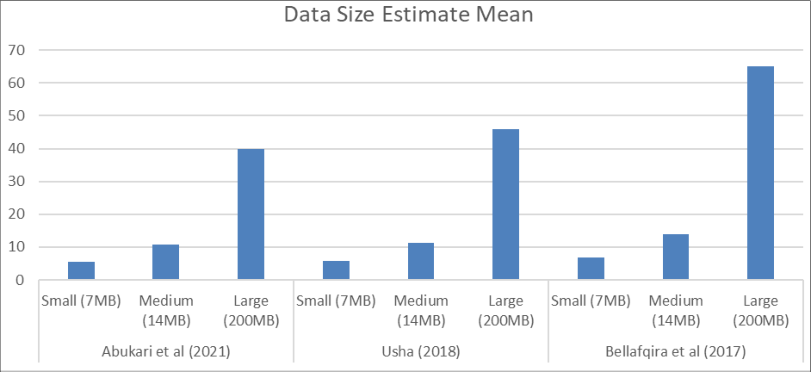 Figure 5
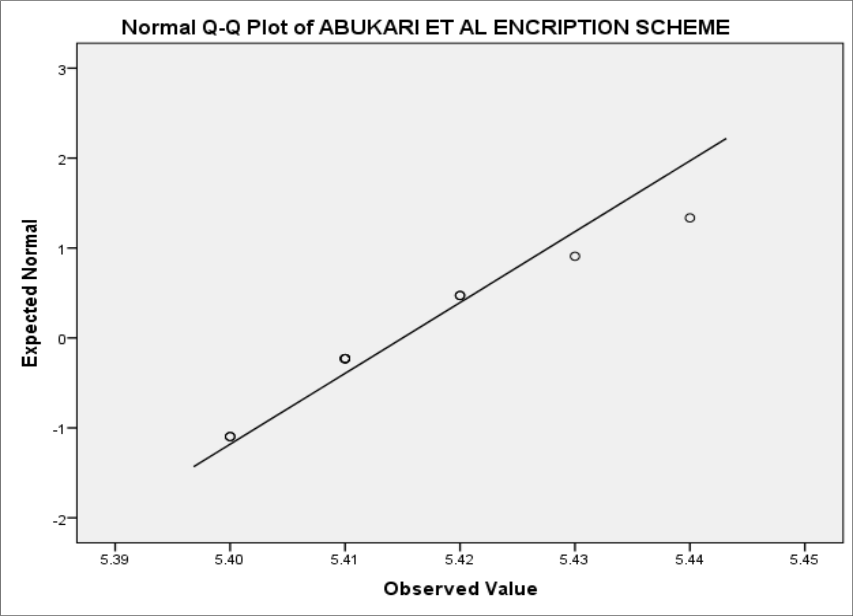 Figure 6
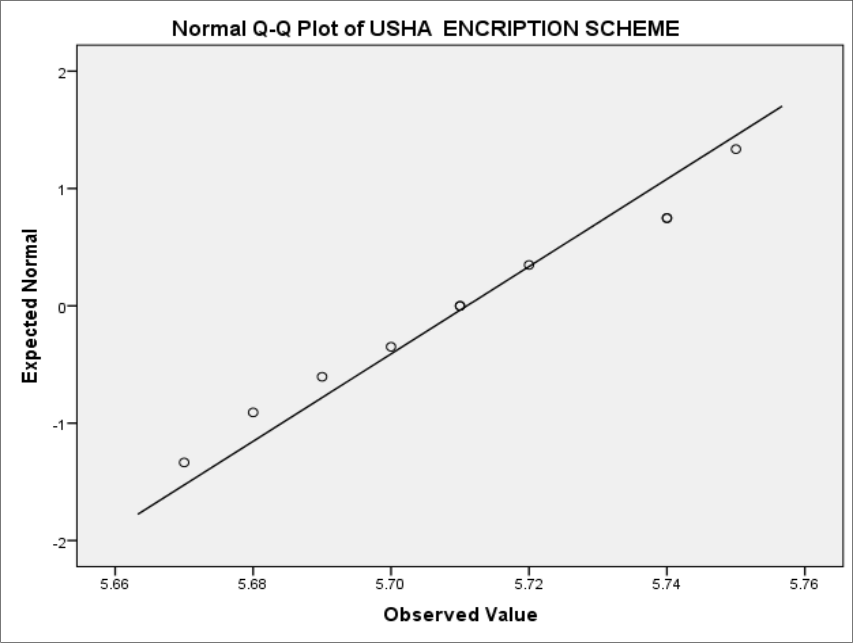 Figure 7
 Table 5
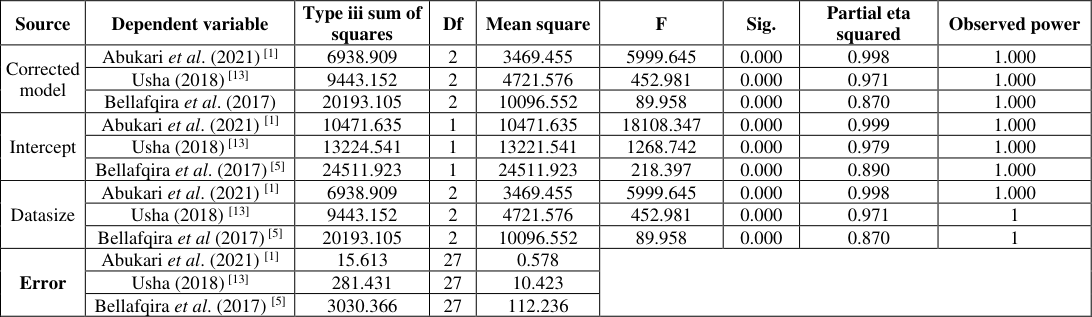 Table 6
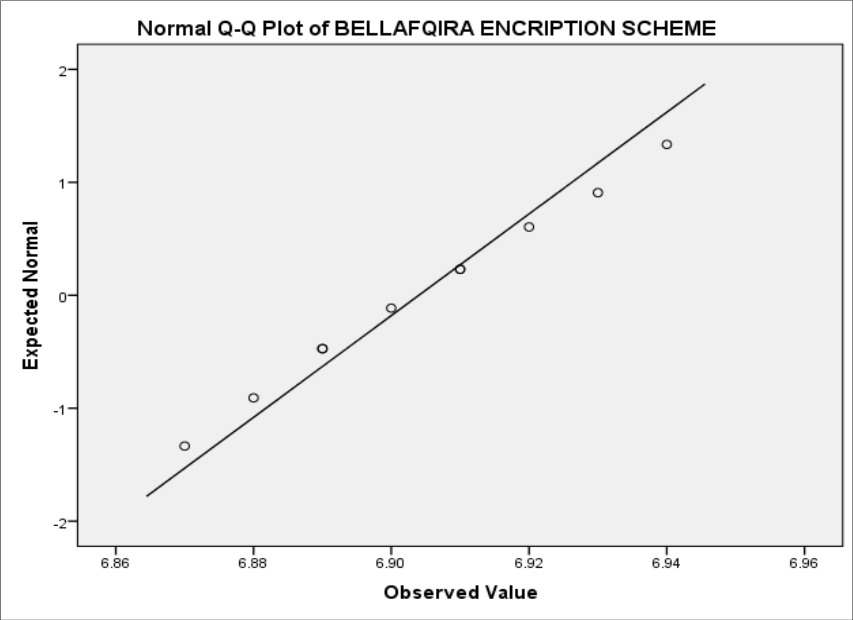 Figure 8
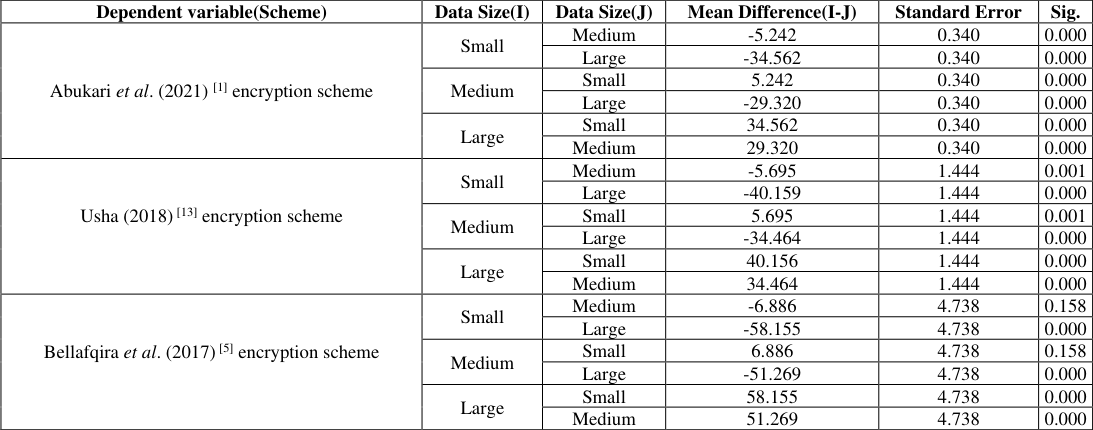 Table 7
Introduction
The use of computing devices and technological advancement continues to grow astronomically across the globe. This significant growth comes with challenges that require attention from researchers, manufacturers and the end-users. Notably among the challenges is cyber security. Data confidentiality and data privacy has taken center stage in the quest of
Homomorphic Encryption
According to Rocha and Lopez (2019) [11] , Homomorphic encryption is the process of performing a mathematical operations on encrypted data (ciphertext) without having access to the actual data itself (plaintext). The operations are conducted on the ciphertext without revealing the content or identity of the plaintext. Decryptions are performed to obtain the desired output. The Homomorphic concept of encryption has contributed significantly in addressing data security concerns in computing devices especially in the area of cloud computing security. As stated by Li et al (2018), the concept of homomorphic encryption has contributed greatly in the processing of medical data, outsourcing of financial transactions, preservation of patients records and anonymous database queries among several others. The homomorphic encryption comes in three forms namely Somewhat Homomorphic Encryption, Partially Homomorphic Encryption and Fully Homomorphic Encryption Schemes (Rocha, 2019) [11] .
Where Enc is the algorithm for the encryption and M is the plaintext. The Homomorphic encryption operates on four parameters namely KeyGen, Enc, Dec and Eval. The KeyGen is responsible for the generation of public keys and private keys for the encryption scheme. The KeyGen, Enc and Dec functions are largely applied to most encryption schemes but the Eval function is Homomorphic Encryption (HE), specific function. The Eval function takes in the ciphertext as input and perform operations on it to output the desired result.
Somewhat homomorphic encryption
The Somewhat Homomorphic Encryption scheme is a type of homomorphic encryption scheme that supports mathematical operations on only addition and multiplication (Rocha, 2019) [11] . Researchers have demonstrated that the Somewhat Homomorphic encryption has limited operations largely attributed to the buildup of noise in the data. The buildup of noise from the ciphertext causes more computational overheads and thereby makes the execution of the Somewhat Homomorphic encryption scheme very slow. The Somewhat Homomorphic Encryption (SHE) undergoes through series of steps. An asymmetric public and private keys are generated based on a polynomial function as indicated in equation 2 below:
Where the parameter n has a power of 2. The Public Key (P k ) and the Private key (S k ) are generated using equation 2 and equation 3 respectively:
is the ciphertext of the encryption, g and h are generated by the KeyGen algorithm and r is a set of random numbers (0,1,2,…,n-1) whiles m is the message to be encrypted. 𝑚 = 𝐷𝑒𝑐(𝑐) = log 𝑔 𝑠 𝑘 (𝑔 𝑚 ℎ 𝑟 ) 𝑠 𝑘 (4)
Double-layer encryption
The dangers associated with computing devices and online presence of information systems needs an additional layer of security to ensure the protection of these information systems online and computing devices of individuals and organizations. The encryption scheme that adds extra layer security is termed as Double-layer Encryption. In the Doublelayer encryption scheme, two different encryption schemes could be combined at different layers to ensure a more secured system or data security without compromising on computational speed. One encryption scheme may also be applied twice in two different layers to also enhance the security of the information system or data protection. The double-layer encryption schemes have some advantages when implemented. Some of the advantages presented by Doublelayer encryption schemes according to researchers are enhanced security, protection against keylogging, protection against cyber-attacks and improved security in general. The implementation of the double-layer encryption scheme ensures data protection for the data-owner in the cloud (Usha, 2018) [13] . As stated by Usha (2018) [13] , the double layer encryption is designed with the aggregation of key generation encryption approach.
Bellafqira Et al. (2017) [5] The Paillier cryptosystem is one of the popular encryption algorithms that has caught the attention of researchers interested in cyber security, data security and cryptography.
The need for a secured cloud environment using a double layer encryption scheme saw Bellafqira et al. (2017) [5] proposing a double layer encryption scheme built from the application of the Paillier cryptographic Scheme. The concept of the Bellafqira et al. (2017) [5] proxy re-encryption scheme or double layer encryption scheme do not require a user to reupload a data shared by another user. The researchers in Bellafqira et al. (2017) [5] used the help of a Secure Linear Congruential Generator (SLCG) to perform the computations in the cloud which serves as the proxy. The public key and private key of the Paillier cryptographic algorithm be (g, p k ) and p s such that:
Where p and q are two large prime integers. The Private key p s is also determined using equation 2 below:
The value of g is selected by the application of the multiplicative inverses modulo p k . The Paillier cryptographic system is used to encrypt the message using equation 7 below:
The value r is a random integer that is associated with m. To decrypt this encrypted data using the private key p s , the following equation is applied:
Bellafqira et al. (2017) [5] applied the Paillier cryptosystem twice to encrypt the data and the decryption was also done twice. Despite the double layer encryption achieved by Bellafqira et al. (2017) [5] , a study conducted by Abukari et al.
(2021) [1] revealed that the encrypted data using Paillier Cryptosystem are sent to the cloud through the internet which could be intercepted by hackers or unauthorised user. Using the same random value to encrypt the ciphertext was also considered problematic by Abukari et al. (2021) [1] . It was also revealed that the cloud was trusted to host the proxy reencryption generator. These challenges identified by Abukari et al. (2021) [1] led to the proposed Hybrid of two Homomorphic Encryption Scheme presented by Abukari et al. (2021) [1] .
USHA (2018) [13] The Usha (2018) [13] proposed double-layer homomorphic encryption used the RSA (Rivest, Shamir and Adleman) encryption algorithm for the encryption of both of the two layers. The RSA Algorithm is one of the widely used cryptographic schemes in the world and it uses public key for encryption and a secret or private key for decryption. The security of the RSA Cryptographic algorithm is based on the complexities in factoring huge integers in the decryption process. The implementation of the RSA Cryptographic algorithm involves three steps namely Key generation, encryption and decryption. The Key generation algorithm is presented in Algorithm 1 below:
Algorithm 1: Key Generation Phase 1) Choose two different prime numbers, p and q 2) Find t such that t = pq 3) Calculate f(t) = (p-1)(q-1) 4) Choose e such that 1<e<f(t) and such that e and f(t) are relatively prime 5) Use modular arithmetic to determine d = 1 (mod f(t)) 6) Public key = (e, t) 7) Private key = (d, t)
The key generation phase uses two prime numbers such that their product will generate the value of t and the values of e and d are calculated to determine the public key and private key for the encryption to be carried out. The encryption phase of the Usha (2018) [13] double layer homomorphic encryption scheme is presented in algorithm 2 below: Algorithm 2: Encryption Phase 1) Data owner transmits public key to user 2) Data owner converts message (m) into an integer using reversible protocol known as padding scheme such that 0 < m < n 3) The ciphertext (c) is calculated using c = m e (mod n) 4) The data owner uploads the encrypted data c to the cloud.
The data owner first converts the message to be sent in to an integer using the reversible padding scheme. The ciphertext is then calculated and upload in the cloud for the user to access it. The user having the public key perform computations on the encrypted data to decrypt as indicated in the algorithm 3.
Algorithm 3: Decryption Phase 1) User recovers the message using m = c d (mod n) 2) A reverse padding scheme is conducted to fully recover the message
The decryption phase performs two operations to in order to reveal the original message of the plaintext. The first layer decryption converts the second layered encrypted data to the ciphertext of the first encryption and another operation converts the first encrypted data to the plaintext. [1] Abukari et al. (2021) [1] proposed a Hybrid of two homomorphic encryption scheme using two different homomorphic encryption schemes, the RSA cryptographic algorithm and the Paillier cytptosystem. Abukari et al. (2021) [1] applied the Paillier Cryptosystem for the first layer encryption. To ensure the first layer encryption, a public key p k and private key p s is calculated using the below equations:
Abukari et al. (2021)
The first layer ciphertext is computed using equation 11 below:
Abukari et al. (2021) [1] presented a faster version of the Paillier Cryptosystem by introducing a new parameter by letting g f = r g + g and modified the Paillier cryptosystem as presented in equation 12.
𝑐 = 𝐸𝑛𝑐 [𝑚, 𝑟] = (1 + 𝑚𝑝
Applying the new parameter g f proposed, the encryption of the first layer was done using equation 13 below to get the first ciphertext c 1 :
The c 1 serves as a plaintext that is passed to the second layer for another encryption process using the RSA cryptographic algorithm. Another set of public and private keys to be used for the second layer encryption are determined using the RSA algorithm. The second layer encryption is calculated using equation 14. [1] proposed Double-layer Encryption Scheme
Multivariate analysis of variance (MANOVA)
The Multivariate analysis of variance (MANOVA) procedure provides regression analysis and analysis of variance for multiple dependent variables by one or more factor variables or covariates. The factor variables divide the population into groups. Using this general linear model procedure, you can test null hypotheses about the effects of factor variables on the means of various groupings of a joint distribution of dependent variables. If more than one dependent variable is specified, the MANOVA using Pillai's trace, Wilks' lambda, Hotelling's trace, and Roy's largest root criterion with approximate F statistic are provided as well as the univariate analysis of variance for each dependent variable. In addition to testing hypotheses, MANOVA produces estimates of parameters.
Fundamentally, MANOVA has basic assumptions of normality, equality of variance covariance and Linearity.
Data
In MANOVA, the dependent variables should be quantitative. Factors are categorical and can have numeric values or string values. The data under consideration was the simulated encryption times of three different schemes measured across different data sizes. Our dependent variable was the encryption times of the schemes: Abukari et al (2021), Usha (2018) [13] and Bellafqira et al. (2017) [5] . The independent variable was the data sizes which was categorized as: 1. Small data size (7MB), 2. Medium Data size (14MB) 3. Large data size (20MB).
Results and Discussions Preliminary Analysis
The table below shows the summary measures of the various encryption times of the schemes across the different data sizes.
Data size Encription scheme Mean Standard deviation
Abukari et al. (2021) [1] 5.4150 0.01269 Usha (2018) [13] 5.7110 0.02685 Bellafqira et al. (2017) [5] 6.9040 0.02221
Medium(14MB)
Abukari et al. (2021) [1] 10.6570 0.06897 Usha (2018) [13] 11.4060 0.05758 Bellafqira et al. (2017) [5] 13.7900 0.07379
Large (200MB)
Abukari et al. (2021) [1] 39.9770 1.31526 Usha (2018) [13] 45.8700 5.59160 Bellafqira et al. (2017) [5] 65.0590 18.34942
It is observed from the above table 1 that Abukari et al.
| Data size | Encription scheme | Mean | Standard deviation |
|---|---|---|---|
| Small (7MB) | Abukari et al. (2021) [1] | 5.4150 | 0.01269 |
| Usha (2018) [13] | 5.7110 | 0.02685 | |
| Bellafqira et al. (2017) [5] | 6.9040 | 0.02221 | |
| Medium(14MB) | Abukari et al. (2021) [1] | 10.6570 | 0.06897 |
| Usha (2018) [13] | 11.4060 | 0.05758 | |
| Bellafqira et al. (2017) [5] | 13.7900 | 0.07379 | |
| Large (200MB) | Abukari et al. (2021) [1] | 39.9770 | 1.31526 |
| Usha (2018) [13] | 45.8700 | 5.59160 | |
| Bellafqira et al. (2017) [5] | 65.0590 | 18.34942 |
Table text extracted from the original PDF; superscript letters are shown inline. The original table image is below.
View original table image
(2021) [1] scheme has the lowest means of 5.4150, 10.6570 and 39.9770 across the different data sizes of 7MB, 14MB and 200MB compared to Bellafqira et al. (2017) [5] and Usha (2018) [13] as well as the lowest standard deviation. These indicates that Abukari et al. (2021) [1] scheme is efficient compared to Bellafqira et al. (2017) [5] and Usha (2018) [13] .
Figure 3, further demonstrated a steady increase in the encryption times over the schemes as the data sizes increases. As stated in literature, the larger the data the longer it takes for both encryption and decryption. Despite this, Abukari et al. (2021) [1] still maintained a better performance compared to Usha (2018) and Bellafqira et al. (2017) [5] across the different data sizes.
Grand Mean Estimates
The study also considered the grand mean estimates of Abukari et al. (2021) [1] encryption scheme, Usha (2018) encryption scheme and Bellafqira (2017) [5] encryption scheme. The results are presented in table 2. [1] 18.683 0.139 Usha (2018) [13] 20.996 0.589 Bellafqira et al. (2017) [5] 28.584 1.934
| Dependent variable (Encription scheme) | Mean | Standard error |
|---|---|---|
| Abukari et al. (2021) [1] | 18.683 | 0.139 |
| Usha (2018) [13] | 20.996 | 0.589 |
| Bellafqira et al. (2017) [5] | 28.584 | 1.934 |
Table text extracted from the original PDF; superscript letters are shown inline. The original table image is below.
View original table image
Table 2 indicates Abukari et al. (2021) [1] scheme has the lowest grand mean of 18.683 and a standard error of +/-0.139 which further supports that Abukari et al. (2021) [1] scheme is efficient compared to Bellafqira et al. (2017) [5] and Usha (2018) [13] at 95% confidence interval.
Data Sizes Estimates
The data sizes used in the simulation of the three different proposed encryption schemes are presented with their various means and standard errors table 3. Usha (2018) [13] encryption scheme Small (7 MB) [5] encryption scheme Small (7 MB)
| Dependent variable(scheme) | Data size | Mean | Standard error |
|---|---|---|---|
| Abukari et al. (2021) [1] encryption scheme | Small (7 MB) | 5.415 | 0.240 |
| Medium (14 MB) | 10.657 | 0.240 | |
| Large (200 MB) | 39.977 | 0.240 | |
| Usha (2018) [13] encryption scheme | Small (7 MB) | 5.711 | 1.021 |
| Medium (14 MB) | 11.406 | 1.021 | |
| Large (200 MB) | 45.870 | 1.021 | |
| Bellafqira et al. (2017) [5] encryption scheme | Small (7 MB) | 6.904 | 3.350 |
| Medium (14 MB) | 13.790 | 3.350 | |
| Large (200 MB) | 65.059 | 3.350 |
Table text extracted from the original PDF; superscript letters are shown inline. The original table image is below.
View original table image
Further analysis
We further subjected the data to further analysis by conducting MANOVA to test whether the mean encryption times of the three schemes differ significantly across the data sizes as well as determine which encryption times among the three schemes have the largest difference for each of the data sizes. Then we assess the differences between the groupings (data sizes) and finally examine the univariate results of the individual encryption times of the three schemes. We investigated the normality assumption of the encryption times of the three schemes by using the Box M test with the Hypothesis that their variance-covariances are the same. The analysis indicated that their covariances are not equal with a p value of 0.000 which is less than 0.05. See table 1 below. This indicates a violation of the assumption, hence we used the Pillai's trace criterion because it is more robust to departures from assumptions (Tabachnick, Fidell, & Ullman, 2007) [12] . .000
Normality Test
Normality Test
Figures and tables from the paper
| Box's M | 443.159 |
|---|---|
| F | 30.877 |
| df1 | 12 |
| df2 | 3532.846 |
| Sig. | .000 |
Table text extracted from the original PDF; superscript letters are shown inline. The original table image is below.
View original table image
| — | Value | F | Hypothesis df | Error df | Sig. | Partial Eta Squared | Noncent. Parameter | Observed Powerc |
|---|---|---|---|---|---|---|---|---|
| Pillai's trace | 1.009 | 8.827 | 6.000 | 52.000 | .000 | .505 | 52.962 | 1.000 |
| Wilks' lambda | .002 | 179.048a | 6.000 | 50.000 | .000 | .956 | 1074.291 | 1.000 |
| Hotelling's trace | 498.979 | 1995.916 | 6.000 | 48.000 | .000 | .996 | 11975.495 | 1.000 |
| Roy's largest root | 498.968 | 4324.387b | 3.000 | 26.000 | .000 | .998 | 12973.160 | 1.000 |
Table text extracted from the original PDF; superscript letters are shown inline. The original table image is below.
View original table image
| Source | Dependent variable | Type iii sum of squares | Df | Mean square | F | Sig. | Partial eta squared | Observed power |
|---|---|---|---|---|---|---|---|---|
| Corrected model | Abukari et al. (2021) [1] | 6938.909 | 2 | 3469.455 | 5999.645 | 0.000 | 0.998 | 1.000 |
| Usha (2018) [13] | 9443.152 | 2 | 4721.576 | 452.981 | 0.000 | 0.971 | 1.000 | |
| Bellafqira et al. (2017) | 20193.105 | 2 | 10096.552 | 89.958 | 0.000 | 0.870 | 1.000 | |
| Intercept | Abukari et al. (2021) [1] | 10471.635 | 1 | 10471.635 | 18108.347 | 0.000 | 0.999 | 1.000 |
| Usha (2018) [13] | 13224.541 | 1 | 13221.541 | 1268.742 | 0.000 | 0.979 | 1.000 | |
| Bellafqira et al. (2017) [5] | 24511.923 | 1 | 24511.923 | 218.397 | 0.000 | 0.890 | 1.000 | |
| Datasize | Abukari et al. (2021) [1] | 6938.909 | 2 | 3469.455 | 5999.645 | 0.000 | 0.998 | 1.000 |
| Usha (2018) [13] | 9443.152 | 2 | 4721.576 | 452.981 | 0.000 | 0.971 | 1 | |
| Bellafqira et al (2017) [5] | 20193.105 | 2 | 10096.552 | 89.958 | 0.000 | 0.870 | 1 | |
| Error | Abukari et al. (2021) [1] | 15.613 | 27 | 0.578 | ||||
| Usha (2018) [13] | 281.431 | 27 | 10.423 | |||||
| Bellafqira et al. (2017) [5] | 3030.366 | 27 | 112.236 |
Table text extracted from the original PDF; superscript letters are shown inline. The original table image is below.
View original table image
| Dependent variable(Scheme) | Data Size(I) | Data Size(J) | Mean Difference(I-J) | Standard Error | Sig. |
|---|---|---|---|---|---|
| Abukari et al. (2021) [1] encryption scheme | Small | Medium | -5.242 | 0.340 | 0.000 |
| Large | -34.562 | 0.340 | 0.000 | ||
| Medium | Small | 5.242 | 0.340 | 0.000 | |
| Large | -29.320 | 0.340 | 0.000 | ||
| Large | Small | 34.562 | 0.340 | 0.000 | |
| Medium | 29.320 | 0.340 | 0.000 | ||
| Usha (2018) [13] encryption scheme | Small | Medium | -5.695 | 1.444 | 0.001 |
| Large | -40.159 | 1.444 | 0.000 | ||
| Medium | Small | 5.695 | 1.444 | 0.001 | |
| Large | -34.464 | 1.444 | 0.000 | ||
| Large | Small | 40.156 | 1.444 | 0.000 | |
| Medium | 34.464 | 1.444 | 0.000 | ||
| Bellafqira et al. (2017) [5] encryption scheme | Small | Medium | -6.886 | 4.738 | 0.158 |
| Large | -58.155 | 4.738 | 0.000 | ||
| Medium | Small | 6.886 | 4.738 | 0.158 | |
| Large | -51.269 | 4.738 | 0.000 | ||
| Large | Small | 58.155 | 4.738 | 0.000 | |
| Medium | 51.269 | 4.738 | 0.000 |
Table text extracted from the original PDF; superscript letters are shown inline. The original table image is below.
View original table image
References
5 in the original paper- Abukari AM, Bankas EK, Iddrisu MM. A Secured Video Conferencing System Architecture using A Hybrid of Two Homomorphic Encryption Schemes: A Case of Zoom. International Journal of Engineering and Technical Research. 2020;9:237.
- Ateniese G, Fu K, Green M, Hohenberger S. Improved proxy re-encryption schemes with applications to secure distributed storage, ACM Transactions on Information and System Security (TISSEC). 2006;9(1):1?30.
- Bellafqira R, Coatrieux G, Bouslimi D, Quellec G, Cozic, M. Sharing Data Homomorphically Encryptedwith Different Encryption Keys. 2017;arXiv:1706.01756v1 [cs.CR].
- Li T, Huang Z, Li P, Liu Z, Jia C. Outsourced privacypreserving classification service over encrypted data. Journal of Network and Computer Applications. 2018;106:100-110.
- Subramaniyaswamy V, Jagadeeswari V, Indragandhi V, Rutvij H, Jhaveri V, Ketan V, et al. Somewhat Homomorphic Encryption: Ring Learning with Error Algorithm for Faster Encryption of IoT Sensor SignalBased Edge Devices. Security and Communication Networks. 2022;10:2022. Article ID 2793998, https://doi.org/10.1155/2022/2793998