
Research article · 2023 · Full text
International Journal of Agriculture and NutritionNutritive values of most preferred forage species eaten by giraffe (Giraffa camelopardalis) in Sumu wildlife park, Bauchi state, Nigeria
Volume 5(1) · Pages 125–128 · DOI: 10.33545/26646064.2023.v5.i1b.109 ↗
Research areasRabbits: Nutrition, Reproduction, HealthAnimal Diversity and Health Studies
Abstract
Author-writtenThis study evaluated the nutritive values of most preferred forage species eaten by Giraffa camelopardalis in Sumu Willdlife park, Bauchi State, Nigeria. The most preferred forage species were obtained following the time spent on sighting the animal browsing on each of the species among the individuals. Time spent was measured between 1 - 30 minutes and 30 - 60 minutes on species preferred. The nutritive values of the most preferred forage species were obtained using proximate analysis following the Association of Analytical Chemist (AOAC). Results obtained revealed that during the wet season, the most preferred species was Acacia senegal while the least preferred was Comburetum hebeclada. During the dry season, the most preferred was Acacia albida while the least preferred was Andropogon gayanus. The results of their chemical composition indicated that Acacia albida had the highest moisture content (83.3%), Balanites aegyptiaca had the highest dry matter content (39.9%), crude protein was highest in Acacia senegal (22.6%), crude fibre indicated that Pennisetum purpureum had highest value (29.0%), ether extract showed highest value from Mimosa asperata (4.7%), ash content had the highest value in Acacia senegal (27.1%) and nitrogen free extract indicated that Balanites aegyptiaca had the highest value of (40.6%). These results showed that most preferred forage species were nutritionally rich which is good for growth and development of the giraffe in the park. However, it was observed that the forage species were threatened by the incidence of fire outbreaks and drought hence the need to provide water and other silvicultural practices needed by the plants. This will go a long way in enhancing the growth of the forage species while still developing and boosting tourism.
Summary
Source-checkedPlain-language reading of the full paper, prepared with AI and checked against the text. Each point links to the authors' own words.
Why it matters
- Giraffes are important as attractions in wildlife parks and zoos. View evidence ↗
- Forage species in the study area are threatened by drought and fire outbreaks, which endangers the giraffes' food supply. View evidence ↗
The question
- The study aimed to evaluate the nutritional values of the forage species most preferred by giraffes in Sumu Wildlife Park, Nigeria. View evidence ↗
What they did
- The research was conducted in the 8km² Sumu Wildlife Park in Bauchi State, Nigeria. View evidence ↗
- Preference was determined by direct observation of the time giraffes spent browsing on specific plant species, categorized into 1-30 and 30-60 minute intervals. View evidence ↗
- Nutritional properties, including crude protein, fiber, and moisture, were analyzed using AOAC (2010) methods. View evidence ↗
What they found
- In the wet season, Acacia senegal was the most preferred species (1.77%), while Combretum hebeclada was the least preferred (0.44%). View evidence ↗
- In the dry season, Acacia albida was the most preferred species (3.21%), and Andropogon gayanus was the least preferred (0.52%). View evidence ↗
- Acacia albida had the highest moisture content at 83.3%, whereas Balanites aegyptiaca had the lowest at 60.1%. View evidence ↗
- Balanites aegyptiaca contained the highest dry matter (39.9%), while Acacia albida had the lowest (16.2%). View evidence ↗
- Acacia senegal had the highest crude protein content (22.6%), while Balanites aegyptiaca had the lowest (12.6%). View evidence ↗
- Mimosa asperata had the highest ether extract (4.7%), while Acacia seyal had the lowest (1.2%). View evidence ↗
- Acacia senegal had the highest ash content (27.1%), while Mimosa asperata had the lowest (18.4%). View evidence ↗
- Balanites aegyptiaca had the highest nitrogen-free extract (40.6%), while Ziziphus mucronata had the lowest (27.4%). View evidence ↗
What it means
- The authors conclude that the most preferred forage species are nutritionally rich and available across seasons, supporting giraffe growth and reproduction. View evidence ↗
- The authors recommend enrichment planting of preferred species and silvicultural practices to mitigate the impact of fire outbreaks. View evidence ↗
Visual summary
3 visualsIllustrations explain the paper; charts are replotted from the paper's own table values.
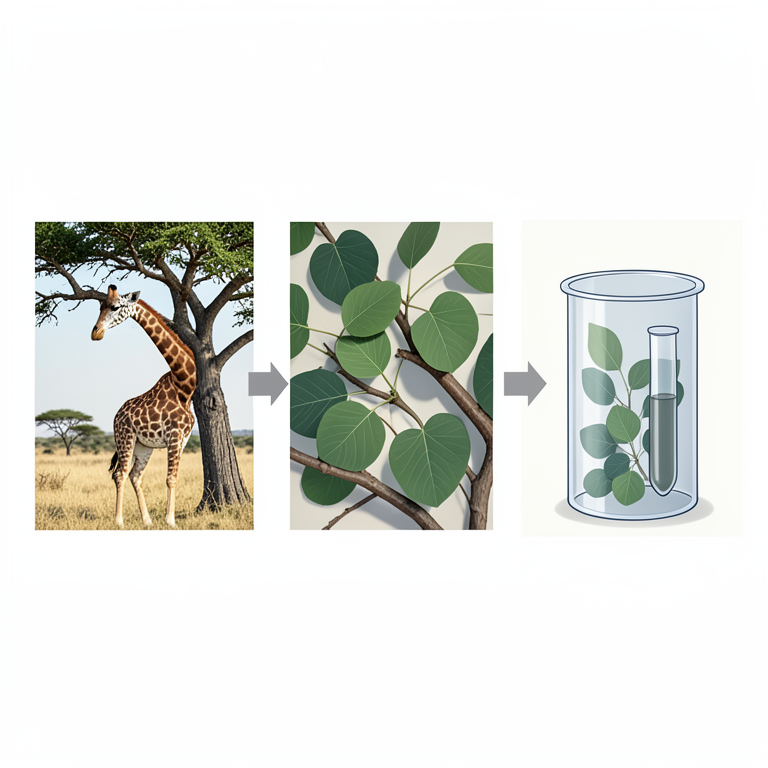
Research Workflow
AI-generated conceptual illustration (Giraffa camelopardalis (giraffe) and native forage plants). It explains the idea and does not show study data.
View source evidence ↗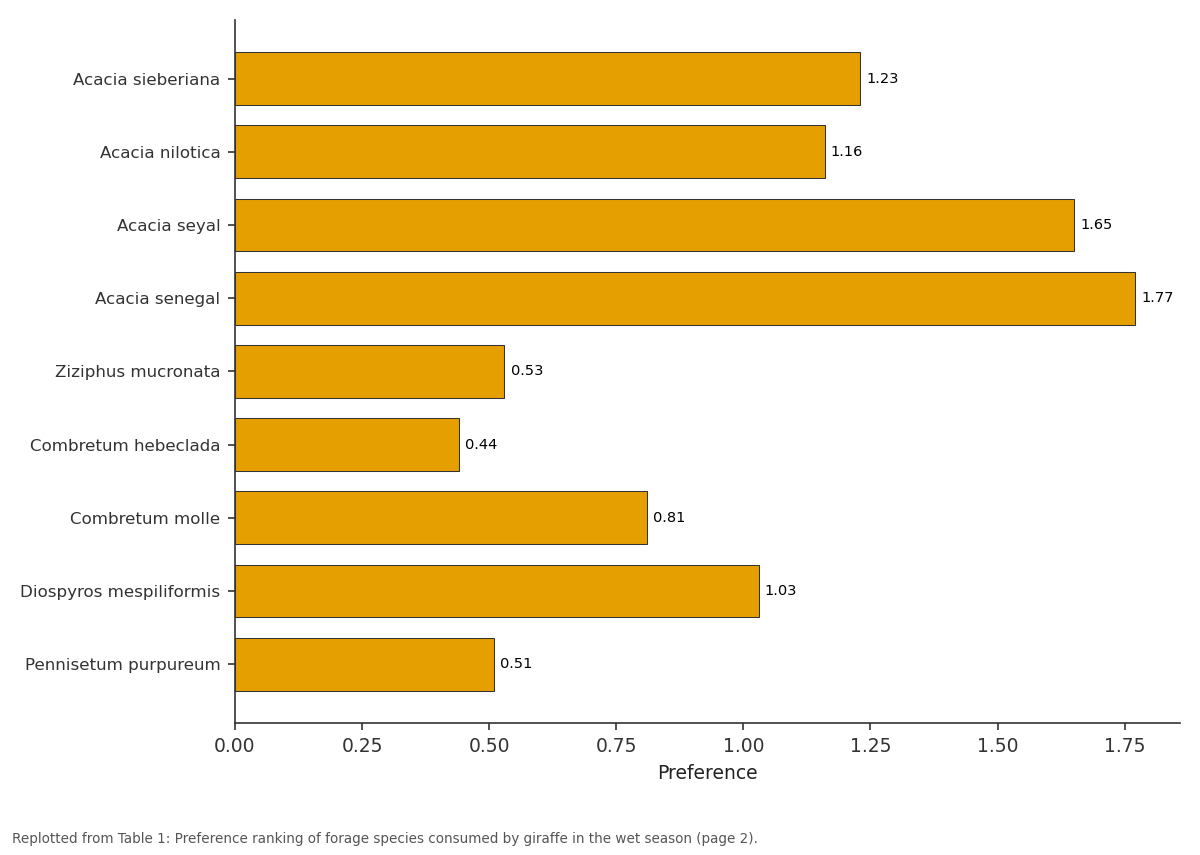
Preference: Acacia sieberiana vs Acacia nilotica vs Acacia seyal vs Acacia senegal vs Ziziphus mucronata
Replotted from Table 1 (page 2) of the original paper. Every bar is the paper's own table value.
View source evidence ↗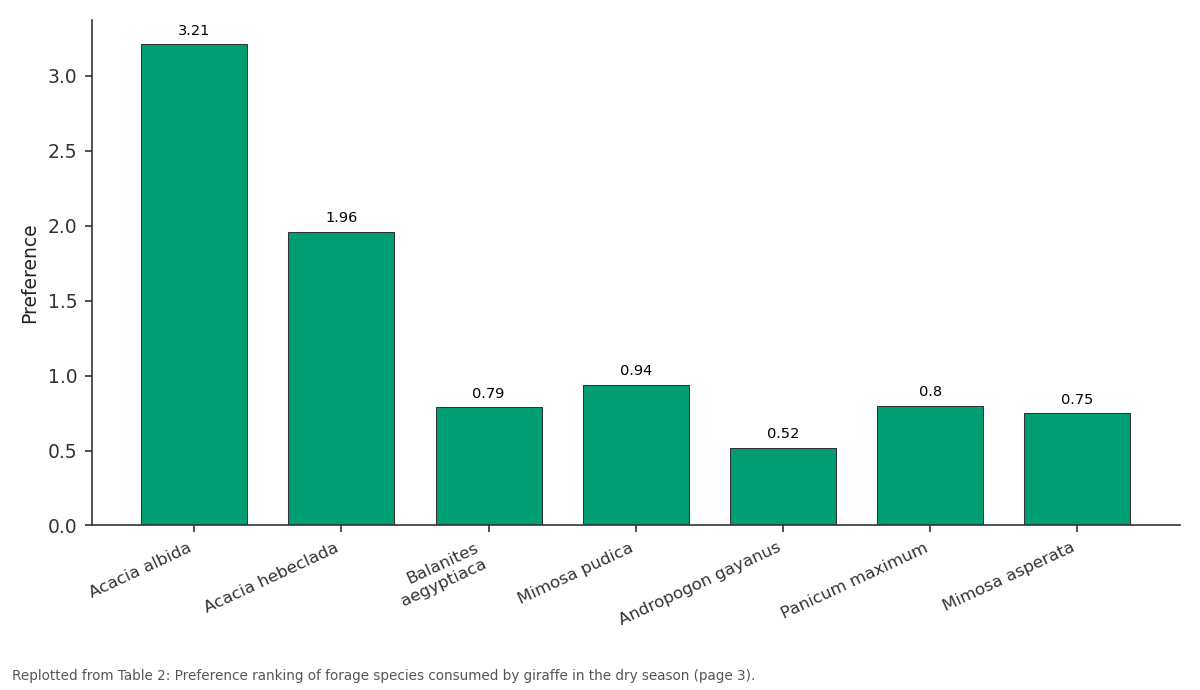
Preference: Acacia albida vs Acacia hebeclada vs Balanites aegyptiaca vs Mimosa pudica vs Andropogon gayanus
Replotted from Table 2 (page 3) of the original paper. Every bar is the paper's own table value.
View source evidence ↗Figures & tables
From the original paper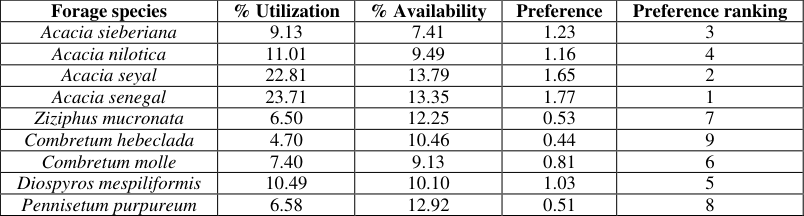 Table 1
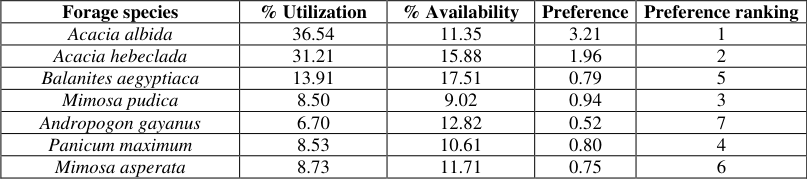 Table 2
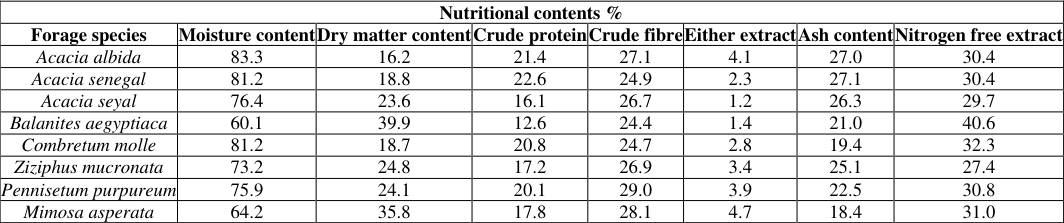 Table 3
Introduction
Giraffe (Giraffa camelopardalis) is one of the tallest land animals with an average height of up to 5.5m (male), 4-4.5 m (Female) and the average life body weight of about 800kg to 1, 800 kg. Neck elongated, with a short, erect mane, shoulders much higher than croup but limbs of nearly equal length. It has a tail, hock with long black terminal turf and horns: the pair is up to 13.5cm, borne by both sexes, the ends knobbed and hairless in adult males, thin and tufted in females and young; a median, lumpy horn and 4 or smaller bumps in males only. Colour is usually brown up into patches by a network of light-colored hair, the pattern individually unique; males darken with age and adult males have a pungent odour (Williams, 2011) [14] . The animal is aided by its 45mm tongue and a modified atlas axis joint that enables the head to tilt to the vertical, a giraffe can feed on crowns of small trees. Matured bulls can reach up to 5.8m, nearly a meter higher than cows. Where a choice exists between high and low browse, there is a clear ecological separation between the sexes, the bulls browsing the high while females concentrate on regenerating trees and shrubs below 2m. The sexes of distant giraffes can usually be predicted by whether the animals are feeding high or bending low. Differences in feeding ecology as well as lower vulnerability to predators (based on size and absence of parental responsibility) allow males to enter taller and denser woodland more readily than females, leading also to major spatial separation of the sexes (Richard, 1992) [12] . Giraffes social interaction is flexible as they are considered as solitary individuals but also gather in clusters of 20-40 animals, with solitary bulls being more common than solitary cows (Bercovitch et al., 2010) [4] .
Adult giraffes do not have strong social bonds, though they do gather in loose aggregations if they happen to be moving in the same general direction. Males establish social hierarchies through "necking" which are combat bouts where the neck is used as a weapon. Dominant males gain mating access to females, which bear the sole responsibility for raising the young. Although giraffes were found across sub-Saharan Africa and even in parts of North Africa, today they are extinct from much of their historically vast natural range with only small, isolated populations remaining in the handful of regions in Central Africa. Further South giraffe population are considered to be stable and are even growing in some areas due to an increase in demand for them on government and private ranches (Lorraine, 2002) [10] . In many zoos and wildlife parks, giraffe serve as attraction. The thick skin can be made into bucket, resin, whips, strops for herness and musical instruments. They are also killed for their meat and hide (Brown et al. 2007) [15] However, despite the importance and population of giraffe in the study area, the incidence of fire outbreaks in the park and drought has continued to pose a great danger to the forage species. This study will help provide management with establishment and enrichment options for the most preferred forage species for the conservation of giraffe while still boosting tourism.
Materials and Methods
Materials and Methods
Study area
The study area is Sumu Wildlife Park which has an area of 8km 2 and situated at Kafin-madaki of Ganjuwa Local Government Area of Bauchi State. The park lies between latitutes 10 o 40 1 N and 11 o 20 1 N and longitudes 10 o 9 1 E and 11 o 30 1 E (Bauchi State Government Dairy BSGD, 2016) [16] . The area has a tropical climatic condition with an annual rainfall ranging from 1021mm to 2410mm. The driest month is December with zero rainfall. Heaviest rainfall is recorded in August and the warmest month is April. Temperature ranges from 24.6 °C to 35.3 °C (With average temperature of 30.3 °C) (BSGD, 2016) [16] . The vegetation of the park is typical of the savanna zone and the various forage species (woody plants) found include Acacia spp, Combretum spp, Ziziphus spp, Annona senegalensis, Diospyros mespiliformis, Balanites aegyptiaca, etc. Plant species like Andropogon spp, Pennisetum spp, Aristicae spp, Mimosa spp, Panicum maximum, Imperita cylindrical among others are also found. The fauna species in the park are Giraffe (Giraffa camelopardalis), Zebra (Equus quagga), Eland (Taurotragus oryx), Kudu (Tragelaphuss trepsoceros) and Impala (Aepyceros melampus).
Study design
Preliminary survey of the area was done for familiarization. The study area was then divided into six study sites (Riparian, montane Acacia, open grassland, shrubland, open woodland) based on vegetation of the park. From each study site, one hectare was chosen using ramdom sampling technique. A herd of giraffe consisting of 18 members was chosen comprising three adult males, six adult females, five juvinile females and four juvinile males.
Data collection
Data for forage species most preferred by giraffe were obtained following direct observation of the types and time spent browsing/feeding on a plant species by an individual. Time spent browsing/feeding was measured between 1 -30 minutes and 30 -60 minutes on a species preferred. Data was collected for the period of eight months on the food eaten by giraffe herd in both raining and dry seasons as outlined by Mitchell and Skinner (2004) [11] .
Data analysis
The preference of species was calculated using the formula: Species preferences = % 𝑈𝑡𝑖𝑙𝑖𝑧𝑎𝑡𝑖𝑜𝑛 %𝐴𝑣𝑎𝑖𝑙𝑎𝑏𝑖𝑙𝑖𝑡𝑦 (as adopted by Cecilia 2011) [6] Preference ranking of the species was gotten through the selectivity ratio of the species according to their ranking order of magnitude from the highest to the lowest. The chemical and nutrient properties (moisture content, crude protein, crude fiber, nitrogen free extract and ash content) of the forage species mostly preferred by the giraffe were determined using the method of Association of Analytical Chemist (AOAC) (2010) [2] as adopted by Abubakar et al., (2014) [1] .
Result and Discussion
The results of forage species preference by giraffes in Sumu wildlife park during the wet season showed that Acacia senegal was the most preferred forage species (1.77%) followed by Acacia seyal (1.65%), Acacia sieberiana (1.23%), Acacia nilotica (1.16%), Diospyros mespiliformis (1.03%), Combretum molle (0.81%), Ziziphus mucronata (0.53), Pennisetum purpureum (0.51%), and Combretum hebeclada (0.44%) (Table 1) while the most preferred species in the dry season showed that Acacia albida was most preferred (3.21%) followed by Acacia hebeclada (1.96%), Mimosa pudica (0.94%), Panicum maximum (0.80%), Balanites aegyptiaca (0.79%), Mimosa asperata (0.74%), and Andropogon gayamus (0.52%) (Table 2). It was observed that the dominant food source for the giraffe are trees and shrubs, Acacia spp formed the major part of the diet of the giraffe population. This agrees with the report of Sauer (1983) [13] who also observed that most preferred plants by giraffe is the Acacia spp. The trend of preference shown for forage species by the giraffes may be attributed to the nature of the leaves that possess some defense mechanism to ensure the daily nutritional intake which is crucial for survival, the giraffe must continually modify its feeding behavior for example, spending more time foraging when biomass and quality of the ingested food decline in the dry season, this is in conformity with the report of Lauren et al. (2003) [9] . The results of proximate analysis of some forage species preferred by giraffe in Sumu wildlife park revealed that Acacia albida had the highest moisture content (83.3%), Acacia senegal (81.2.%) while Mimosa aspera (64.2%), Balanites aegyptiaca (60.1%) had the lowest moisture content (Table 3). This findings agrees with the result of Kwaga et al., (2017) [8] who also reported high water content in Acacia spp. Nutritive value of a forage plant plays a vital role in food selection by giraffe and the moisture content of such species. The moisture content of the forage species eaten by giraffe in Sumu wildlife park indicated that it was high in the most preferred species (Acacia albida) which may be the bases of its preferences. Dry matter content result indicated that Balanites aegyptiaca had the highest (39.9%) followed by Mimosa asperata (35.8%) while least values were recorded in Combretum molle (18.7%) and Acacia albida (16.2%) (Table 3). The crude protein content result of the most preferred species showed that Acacia senegal had the highest value of (22.6%) followed by Acacia albida (21.4%) while the least values were obtained in Acacia sayel (16.1%) and Balanites aegyptiaca (12.6%) (Table 3). This agree with the findings of Kwaga et al., (2017) [8] who also reported high crude protein content in Acacia spp. The Acacia spp have the highest dry matter and crude protein. This suggest that crude protein consumed in Sumu wildlife park is adequate indicating a high potential for growth, reproduction and regulation of body function of the giraffes. The crude fibre content of the most preferred forage species in the park indicated that Pennisetum pupureum had the highest value of (29.0%) followed by Mimosa asperata (28.1%) while the least value were obtained in Combretum molle (24.7%) and Balanites aegyptiaca (24.4%) (Table 3). Ether extract of the preferred species by giraffes in the park revealed that Mimosa asperata had the highest value (4.7%) followed by Acacia albida (4.1%) while Balanites aegyptiaca and Acacia seyal had the least values of 1.4% and 1.2% respectively (Table 3).
| Nutritional contents % | — | — | — | — | — | — | — |
|---|---|---|---|---|---|---|---|
| Forage species | Moisture content | Dry matter content | Crude protein | Crude fibre | Either extract | Ash content | Nitrogen free extract |
| Acacia albida | 83.3 | 16.2 | 21.4 | 27.1 | 4.1 | 27.0 | 30.4 |
| Acacia senegal | 81.2 | 18.8 | 22.6 | 24.9 | 2.3 | 27.1 | 30.4 |
| Acacia seyal | 76.4 | 23.6 | 16.1 | 26.7 | 1.2 | 26.3 | 29.7 |
| Balanites aegyptiaca | 60.1 | 39.9 | 12.6 | 24.4 | 1.4 | 21.0 | 40.6 |
| Combretum molle | 81.2 | 18.7 | 20.8 | 24.7 | 2.8 | 19.4 | 32.3 |
| Ziziphus mucronata | 73.2 | 24.8 | 17.2 | 26.9 | 3.4 | 25.1 | 27.4 |
| Pennisetum purpureum | 75.9 | 24.1 | 20.1 | 29.0 | 3.9 | 22.5 | 30.8 |
| Mimosa asperata | 64.2 | 35.8 | 17.8 | 28.1 | 4.7 | 18.4 | 31.0 |
Table text extracted from the original PDF; superscript letters are shown inline. The original table image is below.
View original table image
| Forage species | % Utilization | % Availability | Preference | Preference ranking |
|---|---|---|---|---|
| Acacia albida | 36.54 | 11.35 | 3.21 | 1 |
| Acacia hebeclada | 31.21 | 15.88 | 1.96 | 2 |
| Balanites aegyptiaca | 13.91 | 17.51 | 0.79 | 5 |
| Mimosa pudica | 8.50 | 9.02 | 0.94 | 3 |
| Andropogon gayanus | 6.70 | 12.82 | 0.52 | 7 |
| Panicum maximum | 8.53 | 10.61 | 0.80 | 4 |
| Mimosa asperata | 8.73 | 11.71 | 0.75 | 6 |
Table text extracted from the original PDF; superscript letters are shown inline. The original table image is below.
View original table image
| Forage species | % Utilization | % Availability | Preference | Preference ranking |
|---|---|---|---|---|
| Acacia sieberiana | 9.13 | 7.41 | 1.23 | 3 |
| Acacia nilotica | 11.01 | 9.49 | 1.16 | 4 |
| Acacia seyal | 22.81 | 13.79 | 1.65 | 2 |
| Acacia senegal | 23.71 | 13.35 | 1.77 | 1 |
| Ziziphus mucronata | 6.50 | 12.25 | 0.53 | 7 |
| Combretum hebeclada | 4.70 | 10.46 | 0.44 | 9 |
| Combretum molle | 7.40 | 9.13 | 0.81 | 6 |
| Diospyros mespiliformis | 10.49 | 10.10 | 1.03 | 5 |
| Pennisetum purpureum | 6.58 | 12.92 | 0.51 | 8 |
Table text extracted from the original PDF; superscript letters are shown inline. The original table image is below.
View original table image
The high fibre content of the preferred forage species is in conformity with the findings of Daben et al., (2017) [7] while the either extract in the park was generally low when compered with the findings of Daben et al., (2017) [7] . Ash content of the most preferred forage species eaten by giraffes in the pack showed that Acacia senegal had the highest content of (27.1%) followed by Acacia albida (27.0%) while the least values obtained were Combretum molle (19.4%) and Mimosa asperata (18.4%). The nitrogenfree extract content revealed that Balanites aegyptiaca had the highest value of (40.6%) followed by Pennisetum purpureum (30.8%) while the least values were recorded in Ziziphus mucronata (27.4%). This results indicated that the ash content is in a favorable condition and the high nitrogen free extract content of the preferred forage species is also in conformity with the findings of lauren et al., (2003) [9] .
Conclusion
The study in Sumu wildlife park has shown the availability of most preferred forage species through the seasons and are nutritionally high where the animals can utilize throughout the years for growth, development and reproduction. The problem of fire outbreaks destroying the forage species in the park can be addressed through enrichment planting of the most preferred species and other silvicultural practices to keep the plant succulent and highly digestible to the consuming animals which will positively affect the animal's growth, development and performance. This will aid in the conservation of the giraffes and also boost tourism.
References
9 in the original paper- Abubakar S, Godwin HO, Paul CO, Omotoye O, Reecca WN. Evaluating the Nutritional Potential of Acacia sieberiana (DC) Growing in North West of Nigeria. Journal of Biology and Life Science. 2014;5(2)P:25.
- Singh Y, Gurjwar RK, Lodhi R, Rao RJ. People perception on wildlife in national Chambal sanctuary, Madhya Pradesh, India. International Journal of Biology Sciences. 2020;2(1):08-15. DOI: 10.33545/26649926.2020.v2.i1a.16
- Bercovitch FB, Berry PS. Ecological determinants of herd size in the thornicroft's giraffe of Zambia. African Journal of Ecology. 2010;48(4):962-971
- Adebayo RK, Hassan UF, Adamu HM, Hassan HF, Baba H, Ajiya DA. Levels of heavy metals and their health risk assessment from wastewater irrigated International Journal of Agriculture and Nutrition https://www.agriculturejournal.net spinach in railway quarters, Bauchi, Bauchi state, Nigeria. Int. J Adv. Chem. Res. 2020;2(2):12-17. DOI: 10.33545/26646781.2020.v2.i2a.22
- Kwaga BT, Kwallameji LB, Ali A, Khobe D. Assessment of Food and Feeding Habit of Giraffe (Giraffa camelopardalis) in Sumu Wildlife Park of Ganjuwa Local Government Area of Bauchi State, Nigeria. Report and Opinion. 2017;9(7):36-43.
- Lauren EC, William MS, Allen G. Female Tannin Avoidance: A Possible Explanation for Habitat and Dietary Segregation of Giraffes (Giraffa camelopardis peralla) in Niger. African Journal of Ecology. 2003;41:201-210.
- Mitchell G, Skinner JD. Giraffe thermoregulation: A Review" Transactions of the Royal Siciety of South Africa: Proceeding of a Colloquium on Adaptations in Desert Fauna and Flora. 2004;59(2):49-57.
- Sauer JJC. Seasonal Changes in Food Selection by Giraffe in Relation to Changes in Chemical Composition of the Leaves Selected. South Africa Journal Animal Science. 1983;13:40-43.
- Brown DM, Brenneman RA, Koepfli KP, Poolinger JP, Mila B, Georgiadis NJ, et al. Extensive population Genetic Structure in the Giraffe. BMC Biology. 2007;5(1):57.