
Research article · 2023 · Full text
International Journal of Statistics and Applied MathematicsEconomic analysis of energy use pattern in cotton cropping system
Volume 8(5S) · Pages 11–15 · DOI: 10.22271/maths.2023.v8.i5sa.1161 ↗
Research areasEnergy and Environment ImpactsWater-Energy-Food Nexus Studies
Abstract
Author-writtenThis article explores the integral relationship between energy consumption and crop productivity within Indian agriculture, with a specific focus on cotton cultivation. Acknowledging agriculture as the bedrock of the Indian economy, the study examines how energy utilization profoundly influences different farming activities. Energy use and agriculture production are inextricably linked, and shortages and rising energy prices can impede agricultural expansion and negatively impact crop productivity. The study emphasizes the importance of optimizing limited energy resources to support agricultural development, requiring energy conservation techniques while sustaining the agricultural production system. The research employs a comprehensive approach to categorize energy sources as direct (electricity, fuel, human and animal labour) and indirect (fertilizers, chemicals, equipment), using conversion factors to standardize energy units. Comparative analyses reveal the interdependence of energy usage and agricultural production across different nations. The primary energy sources for various cropping systems are identified using specific mathematical models. The research focuses on cotton cultivation in Tamil Nadu's Perambalur district, showcasing the energy distribution across different inputs. Human labour constitutes 40.01%, electricity for irrigation 4.19%, seed usage 1.16%, fertilizer application 52.77%, and pesticide utilization 1.84% of the total energy expenditure, amounting to 4547.28 MJ/ha. This breakdown underscores the proportional allocation of energy sources and highlights the significance of labour, irrigation, seed, fertilizer, and pesticides in cotton farming. The study offers insights into energy-efficient and sustainable agricultural practices, informing future decisions for ecologically conscious agricultural development.
Summary
Source-checkedPlain-language reading of the full paper, prepared with AI and checked against the text. Each point links to the authors' own words.
Why it matters
- Agriculture serves as the fundamental basis of the Indian economy and consumes a significant amount of energy. View evidence ↗
- Increasing energy prices and shortages are expected to hinder agricultural growth and negatively affect crop productivity and the environment. View evidence ↗
- To maintain production systems, it is necessary to implement energy conservation techniques that optimize consumption patterns. View evidence ↗
The question
- The study aimed to identify the primary energy sources used across different cropping systems. View evidence ↗
What they did
- Cotton was selected for the study because it is the most widely grown fiber crop in Tamil Nadu, covering 1.121 lha. View evidence ↗
- Agricultural input and output data were converted into standardized energy values using specific conversion factors. View evidence ↗
- The study utilized conversion factors from the Indian Council of Agricultural Research (ICAR) to standardize energy units into mega joules (MJ). View evidence ↗
What they found
- The total energy expenditure for cotton cultivation was calculated to be 4547.28 MJ/ha. View evidence ↗
- Fertilizer application was the largest energy consumer, accounting for 52.77% of the total energy at 2399.85 MJ/ha. View evidence ↗
- Human labor was the second largest energy contributor, representing 40.01% of the total at 1819.54 MJ/ha. View evidence ↗
- Electricity used for irrigation contributed 4.19% of the total energy, amounting to 190.6 MJ/ha. View evidence ↗
- Pesticide application accounted for 1.84% of the energy expenditure, totaling 84.09 MJ/ha. View evidence ↗
- Seed production and planting had the lowest energy impact, contributing 1.16% or 53.2 MJ/ha. View evidence ↗
What it means
- The authors conclude that energy consumption patterns must be optimized to ensure that agricultural practices remain efficient and sustainable. View evidence ↗
- The authors suggest that understanding input energy dynamics allows farmers and policymakers to increase productivity while reducing environmental harm. View evidence ↗
Figures & tables
From the original paper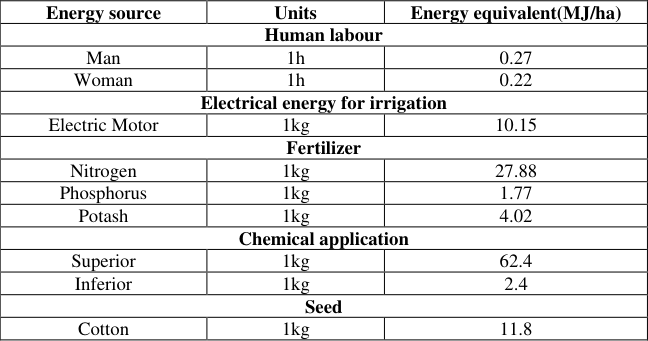 Table 1
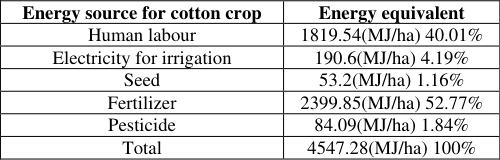 Table 2
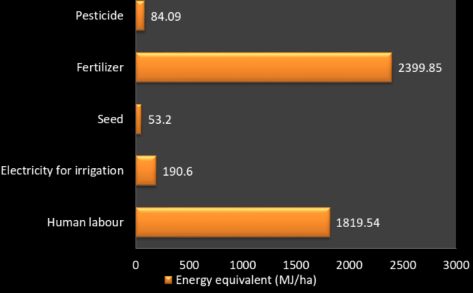 Figure 1
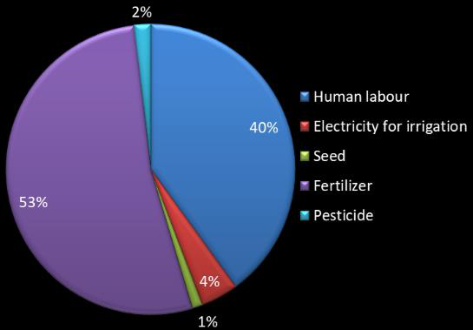 Figure 2
Introduction
Agriculture is the foundation of the Indian economy and a significant user of energy. Crop productivity is determined by the amount of energy used in different agricultural activities. Energy use and agriculture production are inextricably linked. Shortages and rising energy prices will impede agricultural expansion and have a negative influence on crop productivity in the near future, in addition to substantial environmental implications. As a result, it is critical to make optimal use of limited energy resources in order to support agricultural development. This demands energy conservation techniques in order to optimise the energy consumption pattern while maintaining the agricultural production system. Energy is essential in the agricultural business, since it is required for a variety of operations such as land preparation, sowing, cultivation, harvesting, and post-harvest practises. Aside from electricity, other sources of energy are necessary, such as human and animal work, as well as commercial energy such as gasoline, diesel, and kerosene. The quantity of energy derived from human and animal effort varies widely, but animal power remains vital in Indian agricultural practises, albeit it is increasingly being replaced by machine power. The energy content of different inputs utilised in the production system must be considered when budgeting overall energy use for agricultural output.
In agriculture, crop production is tightly linked to energy use. Agriculture's energy needs are classed as direct and indirect. On farms and fields, direct energy is used for a variety of agricultural production operations such as land preparation, irrigation, harvesting, and transportation. In contrast, indirect energy comprises the energy used in the manufacture, packing, and shipping of fertilisers, pesticides, and agricultural machinery. On the farm, indirect energy is not directly utilised. Fertilisers, seeds, equipment production, and pesticides are major sources of indirect energy. When comparing energy use in affluent countries like the United States to rising countries like India, the link between energy consumption and agricultural production is clear. For example, rice farming in the United States consumes 1.88 times more energy than in India, despite paddy yield being just 1.62 times greater. Similar trends may be seen in maize production. These comparisons illustrate the interdependence of energy usage and agricultural production by various nations or regions, which allows us to adjust our energy consumption pattern (Bhatnagar and Panesar, 1989). Direct and indirect energy sources are two kinds of energy sources. Electricity, fuel, and human and animal work are direct sources, whereas fertilisers, chemicals, equipment, and other comparable inputs are indirect sources. The Indian Council of Agricultural Research (ICAR) has created conversion factors that allow different energy inputs to be converted into a standardised unit, mega joules (MJ) (Mittal and Dhawan, 1988) [28] . Based on their economic worth, energy sources may alternatively be classed as commercial or non-commercial. Commercial energy sources include bought commodities such as seeds, fertilisers, insecticides, electricity, fuel, and other equipment. Self-produced products such as home-grown seeds, human effort, animal labour, farmyard trash, and similar inputs are examples of non-commercial energy sources. Renewable energy comes from replenishable sources such as seeds, human work, animal labour, and farmyard trash. Non-renewable energy sources include equipment (diesel), electricity, fertilisers, pesticides, and so on (Singh and Mittal, 1992) [44] . Energy ratios, which measure the connection between the energy value of outputs and the sum of all direct and indirect inputs, are often used to analyse energy efficiency in agricultural and food systems. Pimentel proposed the notion of energy ratio, with greater ratios reported in systems that depend only on human work and do not utilise fossil fuels (Pimentel et al., 1973) [45] . With this in mind, our study sought to identify the primary energy source in various cropping systems.
Methods and materials 2.1 Selection of Crop
Cotton was used as the crop for this research. Cotton has the highest area of 1.121 lha in the state of Tamil Nadu in terms of fibre crops. In terms of area and relative period, this crop's energy usage pattern is comparatively higher than those of other crops.
Selection of District
The research is based on primary and secondary data obtained from agricultural families in Perambalur districts using a purposive sampling approach. Perambalur district was chosen in the initial stage of the cotton farming scheme. Perambalur district has the state's largest cotton cropping system, representing both irrigated and rained conditions, with the biggest area (9014 hectares) in Tamil Nadu. In the second step, one taluk was picked from that district based on area, and thirty farm samples were taken at random from the randomly selected two villages within that taluk.
Coefficients of energy conversion
All agricultural inputs and output (cotton) data were gathered and translated into equivalent energy values using suitable conversion factors. [10,35]
Specific mathematical models for calculating energy balance
Energy inputs per hectare during Cotton production included manual (human) labour, electrical energy, seed, fertilizer and pesticide (chemical) and were computed using the equations adopted by Khambalkar, et al., (2010) [24] ; Chaudhary, et al., (2006) [10] ; Bockari-Gevao et al., (2005) [8] .
Human energy
Human energy
Results and Discussion
The provided data presents the distribution of energy sources and their corresponding energy equivalents for cultivating a cotton crop per hectare. Human labour contributes the highest share at 40.01%, accounting for 1819.54 MJ/ha, followed by electricity for irrigation at 4.19% with 190.6 MJ/ha. Seed production and planting constitute 1.16% with 53.2 MJ/ha, while fertilizer application represents the largest portion at 52.77% with 2399.85 MJ/ha. Pesticide application accounts for 1.84% with 84.09 MJ/ha. The total energy expended for these activities sums up to 4547.28 MJ/ha, with the respective contributions adding up to 100%. This breakdown highlights the proportional distribution of energy sources in cotton farming, emphasizing the significance of labour, irrigation, seed, fertilizer, and pesticide inputs in the overall energy expenditure.
Summary and conclusion
The article focuses on the intricate relationship between energy usage and crop productivity in Indian agriculture, particularly emphasizing the cultivation of cotton. It highlights the fundamental role of agriculture in the Indian economy and the critical impact of energy on various agricultural activities. The article discusses the connection between energy scarcity, rising energy prices, agricultural expansion, and environmental consequences. To ensure sustainable agricultural development, the article underscores the need for efficient energy utilization and conservation techniques. Various energy sources, including human and animal labour, commercial energy, and renewable sources, are examined in the context of their contributions to farming operations. The study primarily seeks to identify the primary energy sources in different cropping systems and presents mathematical models for energy balance calculations. The research method involves the selection of cotton as the focus crop and the Perambalur district in Tamil Nadu for data collection. Conversion coefficients for different energy sources are provided, allowing for the translation of inputs and outputs into standardized energy units (MJ/ha). Specific mathematical models are employed to quantify energy inputs from human labour, electrical energy for irrigation, fertilizer application, seed usage, and pesticide application.
In the results, the distribution of energy sources in cotton cultivation is presented, with human labour accounting for 40.01%, electricity for irrigation at 4.19%, seed usage at 1.16%, fertilizer application at 52.77%, and pesticide usage at 1.84% of the total energy consumption, totalling 4547.28 MJ/ha. This breakdown highlights the significant contributions of different energy sources and underscores their proportional allocation in cotton farming.
In conclusion, the article underscores the vital role of energy in Indian agriculture, particularly in cotton cultivation. The study reveals the distribution of energy sources and their respective contributions, shedding light on the significance of human labour, electricity, seeds, fertilizers, and pesticides in crop production. The findings highlight the need for optimized energy consumption patterns to ensure efficient and sustainable agricultural practices. By understanding the energy dynamics of various inputs, farmers and policymakers can make informed decisions to enhance productivity while minimizing environmental impact. The study serves as a valuable resource for guiding future efforts in energy-efficient and environmentally conscious agricultural development.
Figures and tables from the paper
| Energy source | Units | Energy equivalent(MJ/ha) |
|---|---|---|
| Human labour | ||
| Man | 1h | 0.27 |
| Woman | 1h | 0.22 |
| Electrical energy for irrigation | ||
| Electric Motor | 1kg | 10.15 |
| Fertilizer | ||
| Nitrogen | 1kg | 27.88 |
| Phosphorus | 1kg | 1.77 |
| Potash | 1kg | 4.02 |
| Chemical application | ||
| Superior | 1kg | 62.4 |
| Inferior | 1kg | 2.4 |
| Seed | ||
| Cotton | 1kg | 11.8 |
Table text extracted from the original PDF; superscript letters are shown inline. The original table image is below.
View original table image
| Energy source for cotton crop | Energy equivalent |
|---|---|
| Human labour | 1819.54(MJ/ha) 40.01% |
| Electricity for irrigation | 190.6(MJ/ha) 4.19% |
| Seed | 53.2(MJ/ha) 1.16% |
| Fertilizer | 2399.85(MJ/ha) 52.77% |
| Pesticide | 84.09(MJ/ha) 1.84% |
| Total | 4547.28(MJ/ha) 100% |
Table text extracted from the original PDF; superscript letters are shown inline. The original table image is below.
View original table image
References
29 in the original paper- Abubakar MS, Ahmad D. Pattern of energy consumption in millet production for selected farms in Jigawa, Nigeria. Australian Journal of Basic and Applied Sciences. 2010;4(4):665-672
- Abubakar MS, Umar B, Ahmad D. Energy use pattern in sugar production: A case study of Savannah sugar company, Numan, Adamawa state, Nigeria. Journal of Applied Sciences Research. 2010;6(4):377-382.
- Badal PS, Singh RP. Technological change in maize production: A case study of Bihar. Indian Journal of Agricultural Economics. 2001;56(2):211-219.
- Baran MF. Energy Efficiency Analysis of Cotton Production in Turkey: A Case Study for Ad yaman Province. American-Eurasian Journal Agricultural and Environment Science. 2016;16(2):229-233.
- Bockari-Gevao SM, Wan Ishak WI, Azmin Y, Chan CW. Analysis of energy consumption in low land rice-based cropping system of Malaysia. Songklanakarin Journal of Science and Technology. 2005;27(4):819-826.
- Chaudhary VP, Gangwar B, Pandey DK, Gangwar KS. Energy auditing of diversified rice-wheat cropping systems in Indo-gangetic plains. Energy. 2009;34:10911096.
- Deshmukh SC, Patil VA. Energy conservation and audit. International Journal of Scientific and Research Publications. 2013;3(8):2250-3153.
- Dhakal SC, Regmi PP, Thapa RB, Sah SK, KhatriChhetri DB. Productivity and profitability of maizepumpkin mix cropping in Chitwan, Nepal. Journal of Maize Research and Development. 2015;1(1):112-122.
- Firouzi S, Aminpanah H. Energy use efficiency for groundnut (Arachis hypogaea L.) production in a semimechanized cultivation system. Annals of Biological Research. 2012;3(8):3994-3997.
- Gaddi GM, Mudinamami SM, Patil SA. Yield gaps, constraints and potential in cotton production in north Karnataka -an econometric analysis. Indian Journal of Agricultural Economics. 2002;57(4):722-734.
- Gökdoğan O, Sevim B. Determination of Energy Balance of Wheat Production in Turkey: A Case Study of Eskil District of Aksaray Province. Journal of Tekirdag Agricultural Facult. 2016;13(04):36-43.
- Hamedani SR, Keyhani A, Alimardani R. Energy use patterns and econometric models of grape production in Hamadan province of Iran. Energy. 2011;36:6345-6351
- Karale DS, Khambalkar VP, Bhende SM, Sharddha BA, Wankhede PS. Energy economic of small farming crop production operations. World Journal of Agricultural Sciences. 2008;4(4):476-482.
- American-Eurasian Journal of Agricultural and Environmental Science. 2008;4(2):165-71.
- Khambalkar V, Pohare J, Katkhede S, Bunde D, Dahatonde S. Energy and economic evaluation of farm operations in crop production, Journal of Agricultural Science. 2010;2(4):191-200.
- Khosruzzaman S, Asgar MA, Karim N, Akbar S. Energy intensity and productivity in relation to agricultureBangladesh perspective. Journal of Agricultural Technology. 2010;6(4):615-630.
- Komleh SHP, Keyhani A, Rafiee S, Sefeedpary P. Energy use and economic analysis of corn silage production under three cultivated area levels in Tehran province of Iran. Energy. 2011;36:3335-3341.
- Kizilaslan H. Input-output analysis of cherries production in Tokat province of Turkey. Applied Energy. 2009;86:1354-1358.
- Mohammadi A, Omid M. Economical analysis and relation between energy inputs and yield of greenhouse cucumber production in Iran. Energy. 2009;87:191-196.
- Olaoye OS, Adefajo AA, Ekundayo SO. Energy analysis of a wheat processing plant in Nigeria. ARPN Journal of Engineering and Applied Sciences. 2014;9(9):1586-1591.
- Ozturk HH. Energy use for wheat cultivation in southeast Anatolia region of Turkey. Argicultural Mechanization in Asia,Africa and Latin America. 2016;47(3):47-52.
- Pelesaraei AN, Sadeghzadeh A, Payman MH, Mobtaker HG. Energy flow modeling, economic and sensitivity analysis of eggplant production in Guilan province of Iran. International Journal of Agriculture and Crop Sciences. 2013;5(24):3006-3015.
- Shahidi, Chandrasekara A. Millet grain phenolics and their role in diseases risk reduction and health promotion: a review. Journal of Functional Foods. 2013;5(2):570581.
- Sidhpuria MS, Sangwan PS, Jhorar BS, Mittal SB, Sharma SK, Kumar A. Resource conservation practices in rainfed rearl millet-energy input-output analysis. Indian Journal Dryland Agricultural Research. and Developmen. 2014;29(2):83-86.
- Vekaria SB, Shiyani RL. Impact of an irrigation project on groundnut production in South Saurashtra Zone of Gujrat. Agricultural Economics Research Review. 1999;12(2):7-11.
- Walsh ME, De La Torre Ugarte D, Slinsky S, Graham RL, Shapouri H, Ray D. Economic analysis of energy crop production in the US-location, quantities, price and impacts on traditional agricultural crops. Bioenergy 98: Expanding Bioenergy Partnerships. 1998;2:1302-1310.
- Yadav RS, Khandelwal NK. Effect of various energy inputs on energy requirement for wheat production in agro-climatic region (Kamore plateau and Satpura Hill), M.P. India. International Journal of Engineering Research and Applications. 2013;3(3):531-536.
- Yildiz T. An input-output energy analysis of wheat production in Çarşamba district of Samsun Province. Journal of Agricultural Faculty of Gaziosmanpasa University. 2016;33(3):10-20.
- Pimentel D, Hurd LE, Bellotti AC, Forster MJ, Oka IN, Sholes OD, et al. Food production and the energy crisis. Science. 1973 Nov 2;182(4111):443-9.
Cited by 1
From OpenAlex, OpenCitations and reference lists read by Scinovex
- Evaluating Energy Efficiency and Carbon Emissions in Banana Cultivation: the Case of Antalya Province in Türkiye ↗
Serhan Candemir, Kemalettin Ağızan, Hasan Gökhan Doğan, Zeki Bayramoğlu · Applied Fruit Science · 2025
❝ 11