
Research article · 2023 · Full text
International Journal of Biology SciencesEcofriendly management of mosaic disease of chilli (Capsicum annuum L.) with plant products
Volume 5(2) · Pages 14–18 · DOI: 10.33545/26649926.2023.v5.i2a.165 ↗
Research areasAgricultural pest management studiesAgricultural Practices and Plant GeneticsInsect Pest Control Strategies
Abstract
Author-writtenA field experiment was conducted between the agricultural seasons of 2022 and 2023. Neem (Azadirachta indica L.) oil 0.03% 5ml/lit is one of seven plant products. 5% seed kernel extract of neem (Azadirachta indica L.) @ 6 ml/lit. 5 ml Karanj (Pongamia pinnata L.) oil per lit. Nimbecidine 0.03% at 4 ml/lit, Achook 0.03% at 3ml/lit, Neem gold 0.15% at 2 ml/lit, and Nimastin 0.15% at 2 ml/lit were tested against vector activity to lower the prevalence of mosaic disease. The treatment T2 with two sprayings of neem seed kernel extract 5% @ 5 ml /lit. at ten-day intervals had the lowest disease incidence (23.45%) and the highest fruit output (64.45 q/ha) during the Rabi, 2022-23 cropping season. Control has the highest disease incidence (35.45%). The mosaic disease of the chilli has a detrimental impact on yield contributing qualities during Rabi season.
Summary
Source-checkedPlain-language reading of the full paper, prepared with AI and checked against the text. Each point links to the authors' own words.
Why it matters
- Chilli is a widely grown and important spice crop. View evidence ↗
- Mosaic disease is one of the primary viral diseases affecting chilli crops. View evidence ↗
- The mosaic virus is primarily spread in the field by various aphid vectors. View evidence ↗
The question
- The study aimed to manage chilli mosaic disease using biochemicals and host resistance. View evidence ↗
What they did
- The field trial was conducted at the Plant Pathology field of M. L. K. PG. College in Balrampur, Uttar Pradesh. View evidence ↗
- The experiment used chilli variety G-4 in a Randomized Block Design during the 2022-23 Rabi season. View evidence ↗
- Eight treatments were tested with three replications each, including various neem-based products, Karanj oil, and a control group. View evidence ↗
- Plant products were applied via two foliar sprays: the first at 35 days after transplanting and the second 10 days later. View evidence ↗
What they found
- Neem seed kernel extract (T2) was the most effective treatment, reducing disease incidence to 23.45%, compared to 35.45% in the control group. View evidence ↗
- The highest disease reduction over the control was achieved by T2 (33.86%), followed by T1 (30.52%) and T4 (30.19%). View evidence ↗
- T2 (neem seed kernel extract) produced the highest fruit yield of 64.45 q/ha during the 2022-23 Rabi season. View evidence ↗
- Treatment T2 resulted in the best growth metrics, including a mean plant height of 37.95 cm and a mean fruit weight per plant of 45.05 gm. View evidence ↗
- Neem seed kernel extract was the most effective bio-pesticide against vector activity, while Karanj oil was the least effective. View evidence ↗
What it means
- The authors strongly recommend the use of neem seed kernel extract to prevent chilli mosaic disease by controlling vector activity. View evidence ↗
- The study concludes that neem-based botanical pesticides are a viable, eco-friendly alternative to synthetic chemicals for sustainable agriculture. View evidence ↗
Visual summary
3 visualsIllustrations explain the paper; charts are replotted from the paper's own table values.
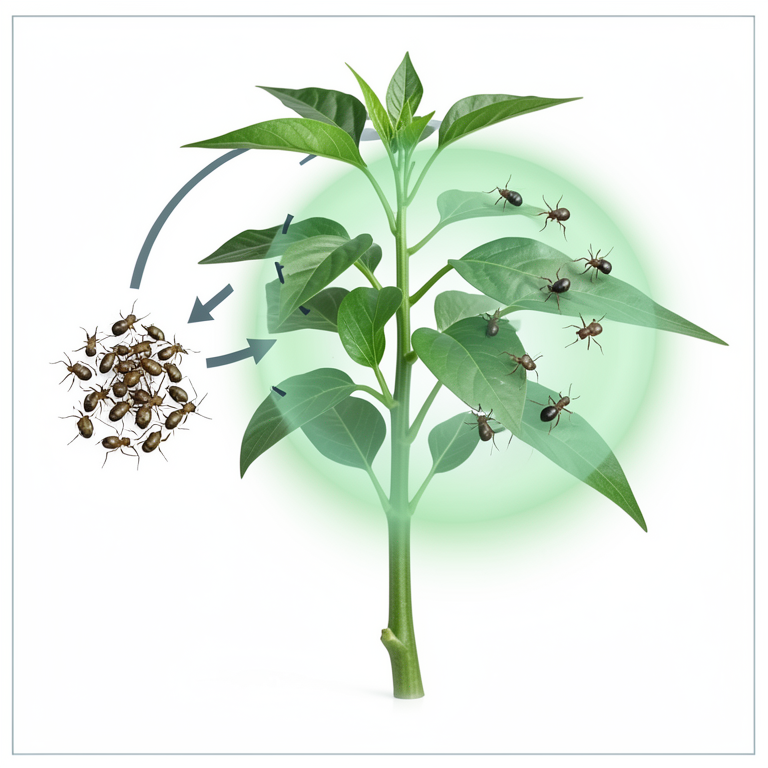
Mechanism of Bio-pesticide Action
AI-generated conceptual illustration (chilli plants (Capsicum annuum L.) and aphids). It explains the idea and does not show study data.
View source evidence ↗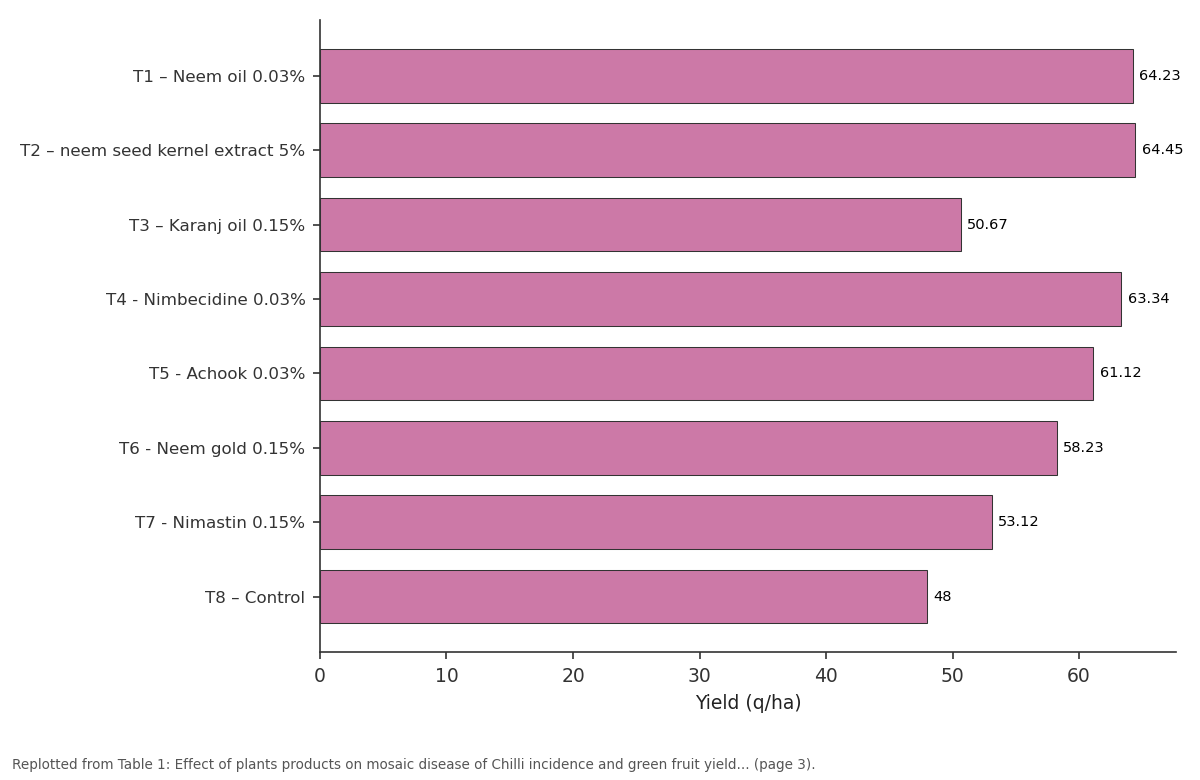
Yield (q/ha): T1 – Neem oil 0.03% vs T2 – neem seed kernel... vs T3 – Karanj oil 0.15% vs T4 - Nimbecidine 0.03% vs T5 - Achook 0.03%
Replotted from Table 1 (page 3) of the original paper. Every bar is the paper's own table value.
View source evidence ↗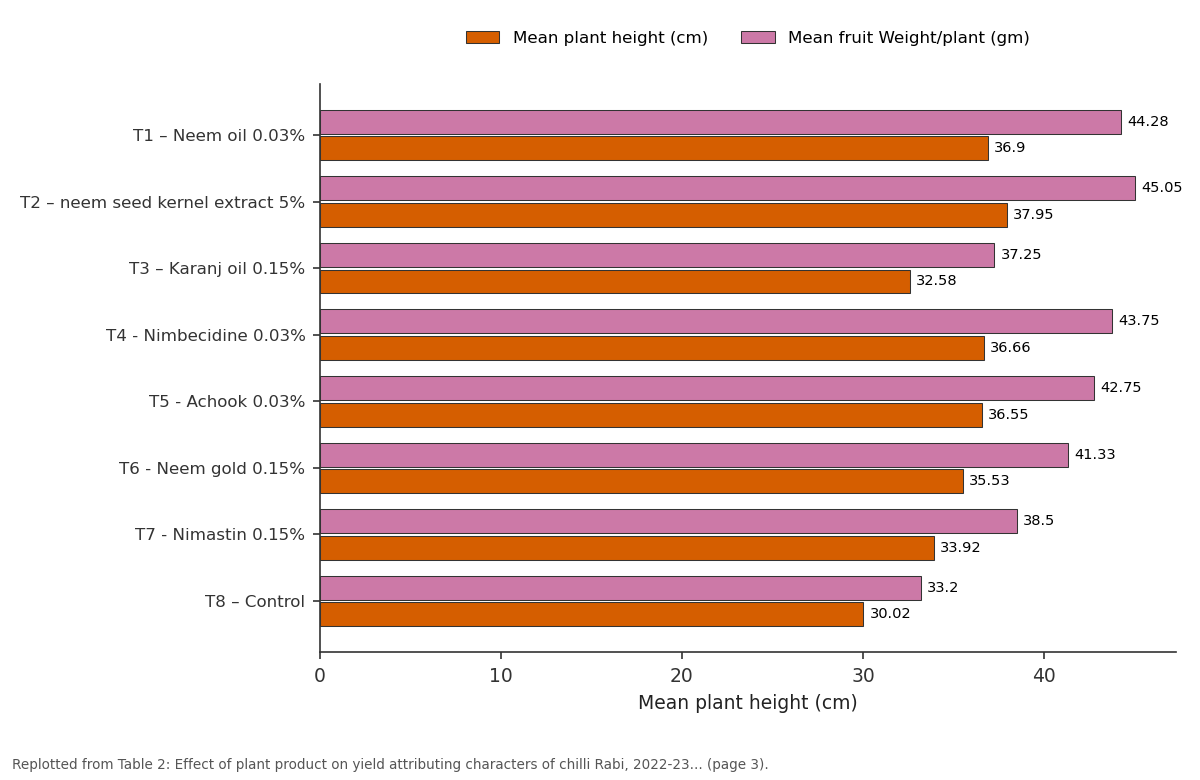
Mean plant height (cm) and Mean fruit Weight/plant (gm): T1 – Neem oil 0.03% vs T2 – neem seed kernel... vs T3 – Karanj oil 0.15% vs T4 - Nimbecidine 0.03% vs T5 - Achook 0.03%
Replotted from Table 2 (page 3) of the original paper. Every bar is the paper's own table value.
View source evidence ↗Figures & tables
From the original paper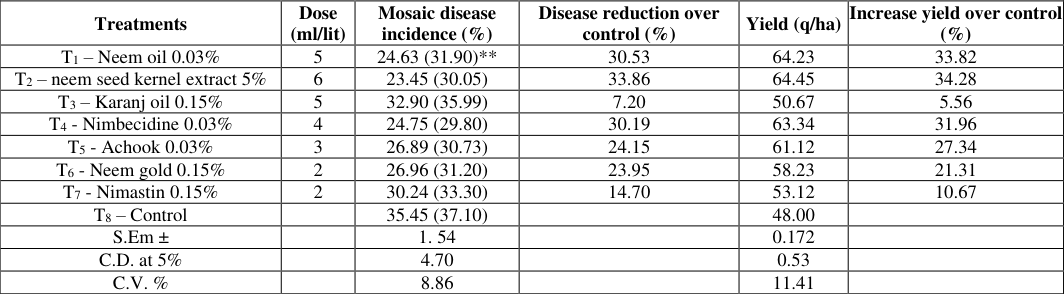 Table 1
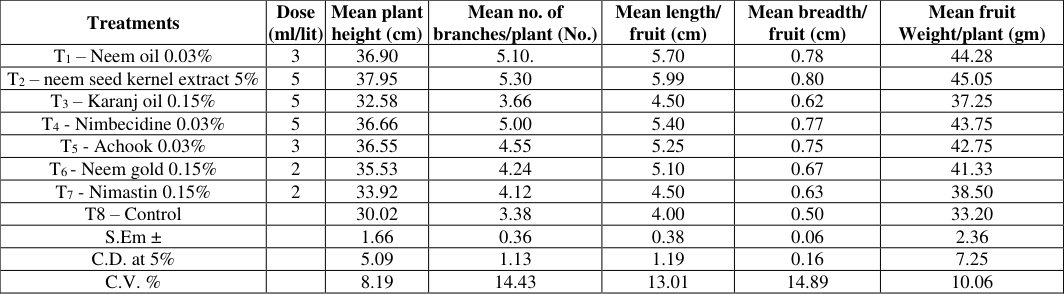 Table 2
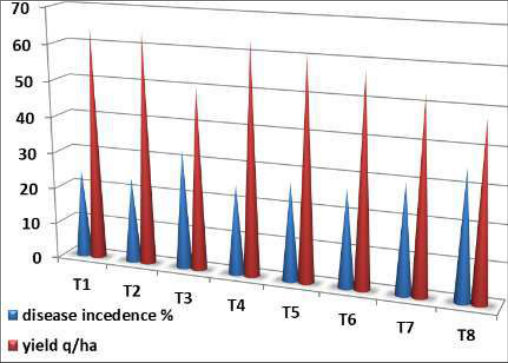 Figure 1
Introduction
Chilli (Capsicum annum L.) is one of the most important crops among the spices and grown widely around the year. It belongs to the family Solanaceae and genus Capsicum. It is a good source of potassium and folic acid and contains more vitamin A and C than carrots and citrus fruits (Howard, 2000; Marin et al., 2004) [12,19] . Among the viral diseases chilli mosaic disease is one of the major diseases. The disease was first reported from India by Kulkarni (1924) [15] and McRae (1924) [15] . The disease was reported to be caused by large number of viruses, out of which, only eight viruses were found in India, of which Pepper vein banding virus (PVBV) and Cucumber mosaic virus (CMV) are the most predominant ones, causing heavy loss in yield (Prasad Rao, 1976; Bidari, 1982; Nagaraju and Reddy, 1983) [24,21,3] . Chilli mosaic virus disease under field conditions spread mainly by different aphid vectors. The important vectors which are actively involved in transmission of chilli mosaic disease are Aphis gossypii¸ Aphis craccivora, Myzus persicae (Dubey and Joshi, 1974; Khatri and Sekhon, 1974) [42,14] . In Uttar Pradesh, the disease occurs at regular intervals in different chilli growing areas resulting in great loss to the crop. The information regarding the status and serological detection of the chilli mosaic virus is very scanty as no work has been done regarding the early detection of the disease by serological mean. So considering all the aspects, the present study was undertaken for the management of the disease through host resistance and bio chemicals.
Materials and Methods
A field trial were done in the experimental compound of the Plant Pathology field, department of Botany, M. L. K. PG. College, Balrampur, U.P., to investigate the efficiency of seven plant products on the incidence of mosaic disease of chilli, fruit production, and yield attributing features. The field trial used the variety G-4 and was conducted in Randomized Block Design (RBD) throughout the Rabi, 2022-23 crop seasons. There were eight different treatments, each with three replications. The plot was 3 m x 1.5 m in size. In the control plots, sterile distilled water was sprayed with each spray. In each plot, the required concentrations of all seven plant components were sprayed twice. The first foliar treatment was done 35 days after transplanting, and the second spraying was applied 10 days later. N: P: K and FYM fertilizer dosages were applied at 100:60:50/ha and 200 q/ha, respectively. The 35-day-old seedlings were transplanted.
The following were the treatment specifics T 1 -0.03% neem (Azadirachta indica L.) oil @ 5.5 ml/lit, T 3 -Karanj (Pongamia pinnata L.) oil @ 4.5 ml/lit, T 2 -neem seed kernel extract 5% @ 6 ml/lit, T 4 -Nimbecidine 0.03% @ 3 ml/lit, T 5 -Achook 0.03% @ 3ml/lit, T 6 -Neem gold 0.15% @ 2 ml/lit, T 7 -Nimastin 0.15% @ 2 ml/lit, T 8 -Control. The total number of plants and diseased plants were counted in each plot to determine disease incidence. Percent disease incidence was calculated by following formula suggested by Nene (1972) [22] . % disease incidence = no.of disease unit total no.of assessed unit × 100
Percent disease reduction was calculated by following formula:
Where, C -Percent disease incidence in untreated plants, T -Percent disease incidence in treated plants. The per cent increase of yield in treatment over control was calculated from the following formula (Vanisree et al., 2013) [37] .
Results and Discussion
A lot of diseases harm the chilli crop. The mosaic disease of chilli is the most prevalent of these. During Rabi, 2022-23 cropping season, seven plant products, namely Neem oil, Neem Seed Kernel Extract, Achook, Neem gold, Nimastin, Nibicidine, and Karanj oil, were tested for their impacts on vector activity, disease incidence, and yield contributing features. Commercially, neem products are widely established as botanical pesticides (Gurjar et al., 2012) [10] . The data (Table -1) demonstrated that all of the plant items considerably reduce illness incidence when compared to the control. Two sprayings of 6% neem seed kernel extract (T 2 ) were shown to be the most effective botanical in terms of illness incidence reduction (23.45%). T 2 (neem seed kernel extract 6%) was followed by T 1 (neem oil 0.03%), with an illness incidence of 24.63%. Control had the highest disease incidence (35.45 percent). T 2 (5% neem seed kernel extract), T 1 (0.03% neem oil), and T 4 (0.03% Nimbecidine) were considerably comparable. T 2 had the greatest illness reduction above control (33.86%), followed by T 1 (30.52%) and T 4 (30.19%). During the Rabi cropping season (2022-23), the maximum mean plant height (37.95 cm), mean number of branches per plant (5.30), mean length per fruit (5.99 cm), mean breadth per fruit (0.80 cm), and mean fruit weight per plant (45.05 gm) were recorded in treatment T 2 , followed by T 1 (two foliar sprays of Neem oil 0.03%) and T 4 (two foliar sprays of Nimbecidine 0.03%). All therapies were shown to be more effective than control. Several previous researchers reported similar findings. Rashid and Khan (2000) [27] , Harbant et al. (1999) [11] , and Singh and Sharma (1999) [31] demonstrated the use of botanicals, milk, or cow urine in minimizing insect vectors, reducing viral illness in crops, and increasing yield. Smitha (2002) [41] , Varghese (2003) [38] , and Gundannavar (2007) [9] have previously reported on the effect of neem products on chilli yield. They reported that neem-based chemicals performed better and are thus superior to RPP in terms of chilli yield. Similarly, Ukey and Saroda (2001) [36] discovered that using neem seed kernel extract alone resulted in increased chilli yield. Similarly, neem derivatives such as neem oil, Comnhoxcomnol Nekhex, Repelin, and orgocide demonstrated their superiority by recording the lowest virus percentage virus transmission and highest percent aphid mortality (Mariappan et al., 1993) [18] . Neem seed kernel extract (0.5%) + Nimbecidine (2ml/lit) was found to be the most effective treatment among the various indigenous materials used to control thrips and mites. This combination also produced the highest chilli yield (10.64 q/ha), as well as lower thrips and mite counts (0.4 LCI/plant and 0.7 LCI/plant, respectively). Mallikarjuna Rao et al. (1999) [17] reported on the efficiency of neem oil against chilli thrips. They discovered that 1% neem oil emulsion used as seedling root dip was efficient against S. dorsalis, a chilli thrips pest. Neem Gold ® (3%) and NO (3%) were two of the neem products tested in the field that showed promise (Naik et al., 2004) [20] . Neem gold (3 ml/l), Vitex (5%) and Clerodendron (5%) were all efficient against yellow mite in chilli, but when used only once, they were outperformed by chemicals (Subba Rao et al., 2007) [34] . Chakraborti (2000) [5] found that neem-based pesticides increased the amount of fruits per plant. Bagle (1988) [4] , Smitha (2002) [41] , Varghese (2003) [38] , and Mallapur et al. (2001) [16] showed similar results of lowered Leaf Curl Index (LCI) by spraying botanicals, neem products, and indigenous materials in chilli crop. Many workers in India on chilli crop fields have well documented the efficiency of many bio-pesticides in the management of mosaic disease of chilli and controlling of insect pests (Venzon et [40,23,8] . The current study found that two sprayings of neem seed kernel extract 5% @ 5 ml/lit. were the best treatment for checking vector activity of mosaic disease of chilli, resulting in the lowest mosaic disease of chilli incidence (23.45 percent) and the highest fruit yield of 64.45 q/ha during the Rabi 2022-23 crop season than other treatments. Two sprays of neem oil were the next successful treatment, with a disease incidence of 24.63 percent and a yield of 64.23 q/ha. Neem seed kernel extract reduced disease by 33.86 percent compared to the control, whereas neem oil reduced disease by 30.53 percent. Other researchers had found similar findings in the past. The most effective anti-Bemisia tabaci agent was neem seed kernel extract. It was also discovered that neem seed kernel extract possessed both virucidal and insecticidal effects (Singh et al., 1988; Raghupathi and Veeraragavathatham, 2002) [31,25] . This could be owing to the existence of complex insecticidal constituents. Azadiractin is reported to have a variety of impacts on a variety of insect species. Because neem seed kernel extract contains a number of physiologically active components (Alkaloids), it has demonstrated repellency, anti-feedency, anti-growth, and direct toxicity against a variety of insects (Schmutterer, 1990; Chakraborty and Chatterjee, 1999) [28,6] . The maximum mean plant height, number of branches per plant, fruit length, fruit breadth, and fruit weight were measured using neem seed kernel extract followed by Neem oil spraying. These phenotypic characteristics were shown to be statistically significant. Khalaequazzawan et al. (2016) [13] found a similar conclusion on the influence of bio pesticides on yield contributing features of chilli. They discovered that bio insecticides had a considerable effect on chilli yield and yield contributing characteristics. However, within treatments, plant height was not statistically significant. According to Ahmed et al. (2001) [1] neem oil application at 5 ml/l resulted in a 34.28 percent reduction in chilli mite above control. The assessment of botanicals in field conditions revealed that botanicals effectively lower disease resistance when compared to controls. Overall, among the investigated plant products, neem seed kernel extract was shown to be the most effective bio-pesticide against vector activity, followed by neem oil and Nimbecidine, and karan oil was found to be the least effective. In comparison to the control, all of the studied plant items dramatically reduced vector activity and effectively reduced the mosaic disease of chilli incidence. As a result, the study highly suggests using neem seed kernel extract against vector activities to prevent mosaic disease of chilli.
Conclusion
The study effectively evaluated several botanicals for their efficacy in managing mosaic disease of chilli during the Rabi season of 2022-23. Neem-based treatments, particularly neem seed kernel extract at 6% concentration, emerged as the most promising bio-pesticide, significantly reducing disease incidence by 33.86% and enhancing yield by 34.28% compared to the control. Neem oil at 0.03% also demonstrated substantial disease reduction (30.53%) and yield improvement (33.82%). These findings are consistent with previous research highlighting the effectiveness of neem derivatives in disease management and yield enhancement in chilli crops. The study underscores the practical viability of botanical pesticides like neem products in sustainable agricultural practices, offering farmers an ecofriendly alternative to synthetic chemicals for crop protection and productivity improvement.
Acknowledgement
AcknowledgementAuthors are grateful to principal of M.L.K. PG. College, Balrampur, U.P. for providing necessary laboratory facilities.
Figures and tables from the paper
| Treatments | Dose (ml/lit) | Mosaic disease incidence (%) | Disease reduction over control (%) | Yield (q/ha) | Increase yield over control (%) |
|---|---|---|---|---|---|
| T1 – Neem oil 0.03% | 5 | 24.63 (31.90)** | 30.53 | 64.23 | 33.82 |
| T2 – neem seed kernel extract 5% | 6 | 23.45 (30.05) | 33.86 | 64.45 | 34.28 |
| T3 – Karanj oil 0.15% | 5 | 32.90 (35.99) | 7.20 | 50.67 | 5.56 |
| T4 - Nimbecidine 0.03% | 4 | 24.75 (29.80) | 30.19 | 63.34 | 31.96 |
| T5 - Achook 0.03% | 3 | 26.89 (30.73) | 24.15 | 61.12 | 27.34 |
| T6 - Neem gold 0.15% | 2 | 26.96 (31.20) | 23.95 | 58.23 | 21.31 |
| T7 - Nimastin 0.15% | 2 | 30.24 (33.30) | 14.70 | 53.12 | 10.67 |
| T8 – Control | 35.45 (37.10) | 48.00 | |||
| S.Em ± | 1. 54 | 0.172 | |||
| C.D. at 5% | 4.70 | 0.53 | |||
| C.V. % | 8.86 | 11.41 |
Table text extracted from the original PDF; superscript letters are shown inline. The original table image is below.
View original table image
| Treatments | Dose (ml/lit) | Mean plant height (cm) | Mean no. of branches/plant (No.) | Mean length/ fruit (cm) | Mean breadth/ fruit (cm) | Mean fruit Weight/plant (gm) |
|---|---|---|---|---|---|---|
| T1 – Neem oil 0.03% | 3 | 36.90 | 5.10. | 5.70 | 0.78 | 44.28 |
| T2 – neem seed kernel extract 5% | 5 | 37.95 | 5.30 | 5.99 | 0.80 | 45.05 |
| T3 – Karanj oil 0.15% | 5 | 32.58 | 3.66 | 4.50 | 0.62 | 37.25 |
| T4 - Nimbecidine 0.03% | 5 | 36.66 | 5.00 | 5.40 | 0.77 | 43.75 |
| T5 - Achook 0.03% | 3 | 36.55 | 4.55 | 5.25 | 0.75 | 42.75 |
| T6 - Neem gold 0.15% | 2 | 35.53 | 4.24 | 5.10 | 0.67 | 41.33 |
| T7 - Nimastin 0.15% | 2 | 33.92 | 4.12 | 4.50 | 0.63 | 38.50 |
| T8 – Control | 30.02 | 3.38 | 4.00 | 0.50 | 33.20 | |
| S.Em ± | 1.66 | 0.36 | 0.38 | 0.06 | 2.36 | |
| C.D. at 5% | 5.09 | 1.13 | 1.19 | 0.16 | 7.25 | |
| C.V. % | 8.19 | 14.43 | 13.01 | 14.89 | 10.06 |
Table text extracted from the original PDF; superscript letters are shown inline. The original table image is below.
View original table image
References
33 in the original paper- Ahmed K, Hanumantha Rao V, Purnachandra Rao P. Resistance of chilli cultivars to yellow mite, Polyphagotarsonemus latus Banks. Indian Journal of Agricultural Research. 2001;35(2):95-99.
- Chakraborti S. Neem based integrated schedule for the control of vectors causing apical leaf curling in chilli. Pest Management and Economic Zoology. 2000;8(1):79-84.
- Chakraborti S, Chatterjee ML. Effect of azadirachtin and other neem pesticides on survival, growth and development of the red cotton bug, Dysdercus koenigii Fabr. Journal of Insect Science. 1999;12(2):129-133.
- Omar MEDM, Sharaf A. Microtopography change of agricultural lands during leaching by establishing internal field canal and drain network for soil salinity control in Sahl El-tina area, Egypt. Int. J Agric. Nutr. 2022;4(2):07-16. DOI: 10.33545/26646064.2022.v4.i2a.56
- Asare-Bediako1 E, Addo-Quaye A, BiKusi A. Comparative Efficacy of Plant Extracts in managing Whitefly (Bemisia tabaci Gen) andmosaic disease of chilliin Okra (Abelmoschus esculentus L). American Journal of Agricultural Science and Technology. 2014;2(1):31-41.
- Gurjar MS, Ali S, Akhtar M, Singh S. Efficacy of plant extracts in Plant disease management. Agricultural Sciences. 2012;3(3):425-433.
- Howard LR. Changes of phytochemicals antioxidant activity of selected pepper cultivars (Capsicum species) as influenced by maturity. Journal of Agricultural and Food Chemistry. 2000;48:1713-1720.
- Khalequzzaman KM, Naznin S, Khair A. Effect of Biopesticids in Controlling Leaf Curl Virus of Chilli. Asia Pacific Journal of Energy and Environment. 2018;5(2):75-80.
- Khatri HL, Sekhon IS. Studies on a virus causing mosaic disease of chilli. Journal of Mycology and Plant Pathology. 1974;4(2):121-125.
- Kulkarni GS. Mosaic and other related diseases of crops in Bombay Presidency. The Poona Agricultural College Magazine. 1924;16(1):6-12.
- Mallapur CP, Kubsad VS, Hulihali UK. Effect of ethion on mites and thrips causing leaf curl in chilli. Karnataka Journal of Agricultural Science. 2001;14(3):668-670.
- Mallikarjuna Rao CN, Muralidhara Rao G, Tirumala Rao K. Efficacy of neem products and their combinations against chilli thrips Scirtothrips dorsalis Hood. Pestology. 1999;23(3):10-12.
- Marin A, Ferreres F, Barberan FAT, Gil M. Characterization and quantization of antioxidant constituents of sweet pepper (Capsicum annuum L.). Journal of Agricultural and Food Chemistry. 2004;52(12):3861-3869.
- Naik DJ, Tyagaraj NE, Kumar D, Madaiah M, Dinesh, Belavadi VV. Effect of neem based insecticides for the control of thrips and shoot and capsule borer of cardamom. In: Abstracts of pa-Plant products for pest and disease management 8 pers, Symposium on Spices and Aromatic Crops: Commercialization of Spices, Medicina and Aromatic Crops, Calicut. Indian Society for Spices, Calicut. 2004;(1-2):24-25.
- Nagaraju, Reddy HR. Occurrence of CMV in bell pepper. Journal of Mycology and Plant Pathology. 1983;12:217-219.
- Nene YL. A survey of viral diseases of pulse crops in Uttar Pradesh. G.B. Pant. Univ. Agric. Technol. Pantnagar Res. Bull. 1972;4:911.
- Pandey SK, Mathur AC, Srivastav M. Management of mosaic disease of Chilli (Capsicum annuum L.), International Journal of Virology. 2010;6(4):246-250.
- Prasad Rao RDVJ. Characterization and identification of some chilli mosaic viruses. Ph.D. Thesis, University of Agricultural Sciences, Bangalore, India. 1976;2:175198.
- Ragupathi N, Veeraragavathatham D. Management of chilli mosaic virus disease using insecticides, botanical and barrier crop. South Indian Horticulture. 2002;50(1/3):273-275.
- Rajasri M, Reddy GPV, Krishnmurthy M, Prasad VD. Bioefficacy of certain newer insecticides and neem products against chilli pest complex. Indian Cocoa, Arecanut & Spices Journal. 1991;15(2):42-44.
- Rashid A, Khan MA. Evaluation of antagonistic microbes and bio-insecticides against leaf curl virus and bacterial blight of cotton. Pakistan Journal of Phytopathology. 2000;12(2):137-141.
- Schmutterer H. Properties and potential of natural pesticides from the neem tree, Azadirachta indica. Annual Review of Entomology. 1990;35(1):271-297.
- Senanayake DMJB, Mandal B, Lodha S, Verma AA. First report of chilli leaf curl affecting chilli in India. Journal of Food, Agriculture and Environment. 2006;4:171-174.
- Shanker JS, Parmar BS. Recent developments in botanicals and biopesticides. Indian Journal of Plant Protection. 1999;27(1/2):139-154.
- Singh SS, Sharma RK. Control trial on chilli mosaic virus after inhibiting their infectivity by leaf juices of some angiospermic plants. Journal Living World. 1999;6(2):18-21.
- Singh UC, Reeti S, Nagaich KN. Reaction of some promising chilli varieties against major insect pests and leaf curl disease. Indian Journal of Entomology. 1998;60(2):181-183.
- Mavuso B, Nxumalo KA, Oseni TO, Masarirambi MT. Effects of shading material on the growth, yield and quality of green pepper (Capsicum annum L.) grown under hot and humid climatic conditions. International Journal of Agriculture and Food Science. 2020;2(2):25-31. DOI: 10.33545/2664844X.2020.v2.i2a.39
- Subba Rao AK, Reddy S, Ramesh P. Protecting soil health under conventional agriculture and organic farming. Green Farming. 2007;1(1):1-9.
- Tiwary A, Kaushik MP, Pandey KS, Dangy RS. Adoptability and production of hottest chilli variety under Gwalior agroclimatic conditions. Current Science. 2005;88(10):1545-1546.
- Ukey SP, Saroda SV. Management of fruit borer and bred borer of chilli through integrated approach. Punjab Rao Deshmukh Krishi Vidyapeeth Research Journal. 2001;25(1):24-29.
- Vanisree K, Upendhar S, Rajasekhar P, Ramachandra Rao G, Srinivasa Rao V. Field evaluation of certain newer insecticides against chilli thrips, Scirtothrips dorsalis (Hood). Science Park Research Journal. 2013;1(20):1-13.
- Venzon M, Consolac-ao RM, Adrian Jose MR, Silveira DV, Rondinelli, Angelo P. Acaricidal efficacy of neem against Polyphagotarsonemus latus (Banks) (Acari: Tarsonemidae). Crop Protection. 2008;27(3-5):869-872.
- Dubey LN, Joshi RD. Transmission studies on chilli mosaic by vector Aphis gossypii Glover. Bangladesh Journal of Botany. 1974;3(1):93-97.