
Research article · 2019 · Full text
International Journal of Agriculture and Food ScienceToxicological biopotency of Azadirachta indica A. Juss (neem) extractive and derivatives as grain protectant to lesser grain borer, Rhyzopertha dominica Fabr on wheat, Triticum aestivun Linn. (Poaceae)
Volume 1(3) · Pages 38–42 · DOI: 10.33545/2664844x.2019.v1.i3a.139 ↗
Research areasInsect Pest Control StrategiesAgricultural pest management studiesInsect Resistance and Genetics
Abstract
Author-writtenSeveral synthetic pesticides used for the management of stored pests were applied during the storage period, providing total protection. At the same time, the chemicals' hazardous effects have several negative consequences for humans and the environment. To discover an alternate method, the adulticidal and larvicidal activities of neem leaf extract, neem seed kernel extract and deoiled neem seed kernel powder suspension and azadirachtin, and neemazal formulations were investigated in the current study. An experiment was conducted to evaluate the comparative insecticidal bio-potency of neem extractive and neem products as grain protectants to lesser grain borer, Rhyzopertha dominica Fabr on wheat, Triticum aetivun Linn. (Poaceae) in the Department of Botany, D.B.S. College, CSJM University, Kanpur. On the basis of Lc50 value under laboratory conditions the descending order of toxicity of different insecticides was Azadirachtin > Neemazal > NSKE > DNSKPS > NLE and their respective LC50 values were 0.9805, 0.9262, 0.8174, 0.6421 and 0.4593, respectively. Out of these five neem products thus tested only Azadirachtin, Neemazal and NSKE of them were found to be highly toxic while the other were found to have moderate toxicity to Rhyzopertha dominica and NLE is taken as unit. So these herbal products could be use as ecofriendly alternative measures of synthetic hazardous chemicals in grain protection under storage conditions.
Summary
Source-checkedPlain-language reading of the full paper, prepared with AI and checked against the text. Each point links to the authors' own words.
Why it matters
- Insect infestations cause significant global agricultural losses, estimated at 20% of world production annually. View evidence ↗
- The lesser grain borer, Rhyzopertha dominica, is one of the most common and damaging pests of stored grains. View evidence ↗
- Synthetic chemical pesticides used for grain protection have serious drawbacks, including toxic residues, pest resistance, and health hazards to users. View evidence ↗
The question
- The study aimed to evaluate and compare the insecticidal potency of various neem extracts and products as protectants for wheat against the lesser grain borer. View evidence ↗
What they did
- The researchers tested five neem-based treatments: neem leaf extract (NLE), neem seed kernel extract (NSKE), deoiled neem seed kernel powder suspension (DNSKPS), Azadirachtin, and Neemazal. View evidence ↗
- Extracts were dissolved in petroleum to create concentrations of 4.0%, 6.0%, and 8.0%, alongside a control group. View evidence ↗
- Insect mortality was measured and recorded at 24, 48, and 72 hours after treatment. View evidence ↗
What they found
- Based on LC50 values, the toxicity of the treatments followed a descending order: Azadirachtin (0.9805), Neemazal (0.9262), NSKE (0.8174), DNSKPS (0.6421), and NLE (0.4593). View evidence ↗
- Azadirachtin, Neemazal, and NSKE were classified as highly toxic to the lesser grain borer, while the other tested products showed moderate toxicity. View evidence ↗
- In terms of relative protectivity, Azadirachtin (2.1347) provided the highest protection, followed by Neemazal (2.0165), NSKE (1.7796), DNSKPS (1.3979), and the benzene control (1.0002), with NLE (1.0) being the least effective. View evidence ↗
- The researchers observed that the neem extracts produced a strong, irritating, and unpleasant odor during application. View evidence ↗
What it means
- The authors conclude that neem-based natural products serve as an excellent alternative to synthetic pesticides for controlling the lesser grain borer. View evidence ↗
- The authors recommend encouraging the use of neem-treated storage bins or bags as a practical preservation method for rural areas lacking modern facilities. View evidence ↗
Visual summary
2 visualsIllustrations explain the paper; charts are replotted from the paper's own table values.
Toxicity Hierarchy of Neem Products
AI-generated conceptual illustration (Lesser grain borer beetles (Rhyzopertha dominica) on wheat grains (Triticum aestivum)). It explains the idea and does not show study data.
View source evidence ↗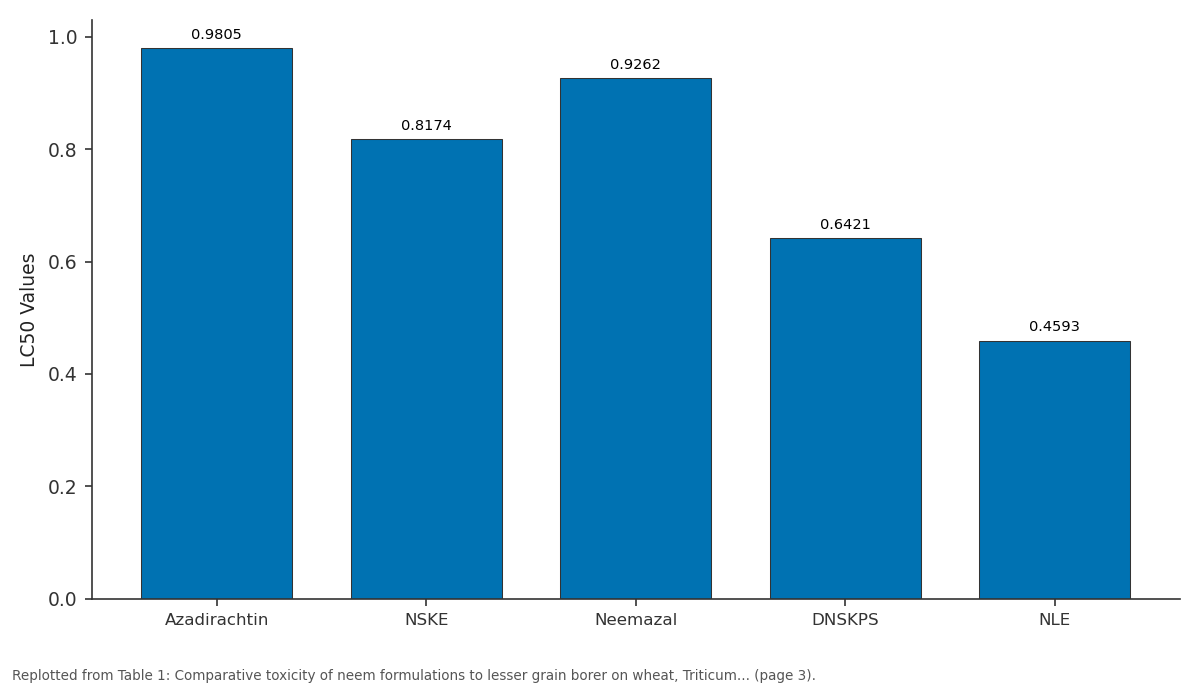
LC50 Values: Azadirachtin vs NSKE vs Neemazal vs DNSKPS vs NLE
Replotted from Table 1 (page 3) of the original paper. Every bar is the paper's own table value.
View source evidence ↗Figures & tables
From the original paper Table 1
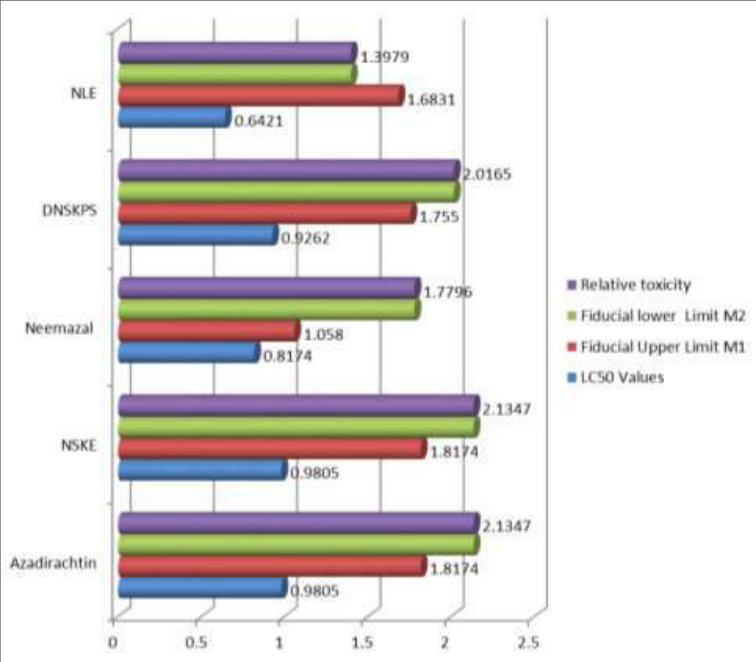 Figure 1
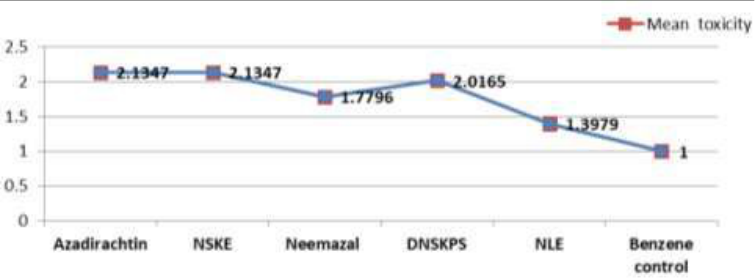 Figure 2
Introduction
Wheat, Triticum aestivum Linn. (Poaceae) is one of the world's oldest and most widely used food crops domesticated more than 10,000 years ago. Together, the global three staple cereals (wheat, rice, maize) comprise a major component of the human diet, accounting for nearly 50 per cent of the world's food calorie and two-fifths of protein intake. Wheat alone plays a particularly crucial role in ensuring global nutritional security (Salem et al. 2007) [1] . India is one of the major producers of wheat, T. aestivum a key staple for a significant population, and the crop damage scenario also comes against the backdrop of persisting high inflation and food security woes globally amid geopolitical uncertainties. In India, the major wheat-growing states of Punjab, Haryana, Uttar Pradesh and Madhya Pradesh have received unseasonal rains accompanied by thunderstorms, hailstorms and gusty winds due to the Western disturbances at a time when the crop was almost ready for harvesting. Wheat, Triticum aestivum Linn. is a major cereal kept under storage after harvesting at individual and at large scale in order to meet the demand of local people and to export it to other countries for financial benefits. It is staple food for humans in many countries. Among the major stored grain insect-pest the khapra beetles Trogoderma granarium (Coleoptera: Dermestidae), red flour beetles Tribolium castaneum (Coleoptera: Tenebrionidae) and lesser grain borer Rhyzopertha dominica (Coleoptera: Bostrichidae) are known worldly and are notorious for their attack on whole wheat and its by-products. Losses due to insect infestation are the most serious problem in storage loss may also be significant in developing countries (70%) (Kavita 2004) [2] . It has been estimated that about 15-20% of the world agricultural production is lost every year due to insect infestation (Wright 1985) [3] . In Bangladesh, the annual grain losses cost over taka 100 cores whereas in India losses caused by insects accounted for 6.5% of stored grain (Kumar 2009) [4] . The climate and storage conditions, especially in the tropics, are often highly favourable for insect growth and development (Jacobson 2004) [5] . Their attacks reduce both the quantity and quality of stored seed. Rhyzopertha dominica Fab. (Coleoptera: Bostrichidae) is the most common and injurious to stored grains having an important position among the storage pests. It is a field-to-store pest and cause economic damage (Adedire 2001) [6] . Both the adults and grubs causes' serious damage to stored grains and stored products and adult beetles are more harmful which destroy healthy grains and reduced them to frass. They destroy far more than they consume. Similar to this these also feed and consume other cereals and plenty of stored products. R. dominica the lesser grain borer, which has got the status of one of the major storage pests attacking stored grains. R. dominica feed voraciously on sound wheat grains and convert them to shells when attack heavily. Wheat is the primary host for these both species and is equally susceptible to their attack in storage. Previous literature shows that in eight month laboratory studies trial on wheat infestation by maximum weight loss in R. dominica (12.4 per cent (Adedire and Lajide 2003) [7] . Their presence is frequently detected in homes, mills, retail stores and storage places for cereals and other commodities. R. dominica is an internal feeder of whole grains which feeds on whole grains and its larvae develop inside the individual wheat kernels [8] .
The tests insect lesser grain borer, Rhyzopertha dominica Fabr. (Coleoptera: Bostrichidae) is a cosmopolitan insect pest of stored grains causing damage to wheat, rice, maize, jowar, barley, gram and dried fruits etc. Beside the quantitative loss, the insect infestation in wheat grains reduce germination and produce unpleasant odour, dirty appearance and abhorrent taste due to contamination with insect fragments and excrement. The adult lesser grain borers chew s grain voraciously causing damage, which may facilitate infestation by a secondary pest. It is a strong flyer and may rapidly migrate from infested grain to begin new infestations elsewhere. Synthetic chemical pesticides have been used for many years to control stored grain pests. Fumigation of stored food grains with toxic gases is effective but not applicable at the farm level because the storage structures are not airtight. Furthermore, control of insects by insecticides has serious drawbacks, such as the toxic residues on stored grains, development of resistance by target species, pest resurgence and lethal effects on nontarget organisms in addition to direct toxicity to users and health hazard. This situation indicates the need for safe but effective, biodegradable pesticides with no toxic effects on non-target organisms for pest control in storage (Ileke and Oni 2011, Ileke and Olotuah 2012, Ileke and Olotuah 2012) [9][10][11][12] . Recently, there is a steady increase in the use of indigenous plant products as a cheaper and ecologically safer means of protecting stored products against infestation by insects reported by Patnaik et al., 1987, Ahmed 1995, Schmutterer, 1995, Patel and Jhala, 1995, Batra et al. 1998, Biswas et al. 2002 [13][14][15][16][17][18] .
Materials and Methods
The details of methodology employed in the experiments are given in the following headings:
Collection of neem, (Azadirachta indica A. Juss.) parts
Fresh neem leaves, Neen seed kernels extracts and deoiled neem seed kernel powder suspension were used against R. dominica in the Biopesticide and plant products laboratory, Department of Botany, D.B.S. College, CSJM University, Kanpur, India. They were collected around the college and university campus. They were washed in running water and kept in laboratory for 7 days air drying. After drying they were made powder separately by an electric grinder. The extracts were prepared according to (Chandel et al. 2005) [19] with minor modifications. For making extracts, 100 g of neem seed kernel and leaves powders were dissolved in 300 ml of petroleum ether solvent and stirred for 30 min. in a magnetic stirre (Chandel et al. 2009) [20] . The mixture was allowed to stand for 72 hours and shaking several intervals. It was filtered through a filter paper (Whatman no. 1) and to evaporate the solvents (Chandel et al. 2011,2017) [21,22] . The condensed extracts were preserved in tightly corked-labeled bottles and stored in a refrigerator until their further use while azadirachtin and Neemazal herbal insecticides were purchased from local pesticidal market.
Collection of wheat grains:
Healthy wheat grains, Triticum aestivum (L.) were purchased from the local market of Dinajpur town, cleaned thoroughly and sun dried. The grains were cooled at 8-10% moisture level and stored at room temperature in air tight plastic bag for experimental use (Chandel,2017, Chandel and Sengar, 2018) [23,24] .
Mass rearing of Test Insect, Lesser grain borer,
Mass rearing of Test Insect, Lesser grain borer,
Rhyzopertha dominica
For the proposed study, the lesser grain borer, Rhyzopertha dominica Fabr. were collected from the naturally infested wheat grains from the local market of Kanpur and was mass reared in the laboratory at ambient room temperature (28±0.5 o C) in glass jars (47 cm height × 4 cm dia). Approximately 200 adults were released in each glass jar containing 500 g of wheat grains and the mouth was closed with a piece of cloth fastened with rubber band to prevent contamination and escape of insect. After oviposition, the adults were separated from the grains by sieving and seeds along with eggs were left in the container for emergence of next generation. The newly emerged adults (1-7days-old) were collected and again allowed for oviposition with new grains in different containers to maintain a stock culture of the test insect. The process was containing for getting enough pest throughout the study.
Tools Used
The tools like egg laying apparatus, glass jars petridish a 100 mesh sieve, plastic jars with perforated top, Camel hair brush, muslin cloth, chemical balance, complete with weight box, magnifying hand lens and a binocular microscope etc. was used in the present investigation.
Evaluation of toxicity of neem extracts and products
Toxicity test were conducted according to minor modifications. The extracted materials were weighed and dissolved in petroleum for making different concentration (4.0, 6.0 and 8.0 % along with control). Pilot experiments were done to obtain the appropriate dose. Before applying extracts to the thorax of the insect, 10 minutes chilling were done with 4 0C in refrigerator. Then 1 μl of prepared solution was applied to the dorsal surface of each insect using a micropipette. Ten insects per replication were treated and each treatment was replicated Effect of some indigenous plant extracts on R. dominica 33 thrice. In addition, the same numbers of insects with petroleum ether solvent only were treated as control. After treatment, the insects were transferred into petridishes (9 cm diameter). Mortality was recorded after 24, 48, and 72 hours treatment (HAT) (Talukdar and Howse 1993) [25].
Method of Calculation
Average larval period and average period for complete development was calculated by taking the totals of larval periods and periods for complete development and dividing by the number of pupae formed and the number of adults emerged respectively. Average pupal period was obtained by subtracting the average larval period from the average period for complete development.
It is the ratio of emerged males and females. For this, number of females was calculated with respect of the number of males, keeping as one i.e. how many females would be if only one male is emerged. The value of the period for complete development percentage adult emerged and growth index obtained on different varieties was, subject to the statistical analysis. The variance ratio tested by applying 'F' test at 1.0 per cent level of significance and critical difference between the individual varieties (Abbott, 1987) [26] .
Results and Discussions
The bio-efficacy of five plants extracts are shown in Table 1, was tested against this pest. The various formulations of neem extractives and derivatives were tested against adults lesser grain borer, R. dominica Fabr. .0002 * = In these cases x 2 were found to be significant heterogeneous at P = 0.05. y = Probit Kill, x = log (concentration x 10 2 ), Lc50 = Concentration calculated to give 50 per cent mortality. It is evident from the Table 1 that three neem extracts and two neem products along with one control were tested by film technique method against the adults of Rhyzopertha dominica were not equally effective and were heterogeneous in the action of insecticidal property but it is apparent that all have afforded good toxic property against the pest. On the basis of Lc 50 value under laboratory conditions the descending order of toxicity of different insecticides was Azadirachtin > Neemazal > NSKE > DNSKPS > NLE and their respective LC 50 values were 0.9805, 0.9262, 0.8174, 0.6421 and 0.4593, respectively. Out of these five neem products thus tested only Azadirachtin, Neemazal and NSKE of them were found to be highly toxic while the other were found to have moderate toxicity to Rhyzopertha dominica and NLE is taken as unit. In the agreement of above findings several researcher gave positive results of grain protection reported by Singh et al.1988; Sharma, 1995; Baitha et al. 2000; Gahukar et al. 2000; Srinivasan and Sundara Babu, 2000; Kilonzo et al.2001; Singh,2003 [27][28][29][30][31][32][33] . The above findings indicated that highest grin protection was noticed in treatment of wheat with Azadirachtin which was followed by Neemazal whereas neem leaf extracts showed the leat effective in controlling the R. dominica infestations under laboratory trials and taken as unit. Based on relative protectivity entire result can be arranged in following desending order as Azadirachtin (2.1347) > Neemazal (2.0165) > NSKE (1.7796) > DNSKPS (1.3979) > Benzene control (1.0002) > NLE (1.0), respectively. During the spraying of the neem formulations, it was noticed that extracts gave a strong irritating and unpleasant odour.
| Plant extract | Heterogeneity | Regression Equation | LC50 Values | Fiducial Limit | Fiducial Upper Limit M1 | Fiducial lower Limit M2 | Mean mortality |
|---|---|---|---|---|---|---|---|
| Azadirachtin | X2 (3) = 0.850 | Y = 1.1427 x + 7.3147 | 0.9805 | 2.2521 | 1.8174 | 2.1347 | 2.1347 |
| NSKE | X2 (3) = 12.09 | Y = 0.6808 x + 8.0223 | 0.8174 | 4.7090 | 1.058 | 1.7796 | 1.7796 |
| Neemazal | X2 (3) = 19.77 | Y = 2.4203 x + 4.7414 | 0.9262 | 2.1694 | 1.7550 | 2.0165 | 2.0165 |
| DNSKPS | X2 (3) = 1.70 | Y = 1.1799 x + 7.5721 | 0.6421 | 1.9299 | 1.6831 | 1.3979 | 1.3979 |
| NLE | X2 (3) = 5.99 | Y = 1.4273 x + 7.2628 | 0.4593 | 1.8698 | 1.5682 | 1.0000 | 1.0000 |
| Benzene control | Y = 0.1399 x + 4.5721 | 0.4594 | 0.1732 | 1.0038 | 1.0002 | 1.0002 |
Table text extracted from the original PDF; superscript letters are shown inline. The original table image is below.
View original table image
Future consideration and Conclusions
Although the use of synthetic pesticides, including fumigants, continues to be the chief method of controlling stored products pests, neem materials, such as leaves, seed or kernel powder, and oil can be used economically to achieve acceptable levels of pest control in villages and rural areas in developing countries, where neem is widespread (Abdul Kareem et al.1989) [34] . Neem materials, having insect repellent, antifeedant, and insect growth and development inhibitory properties, offer a timetested, novel approach to the management of stored products pests. This approach can be quite practical and preferable over other methods, such as fumigation, which lose effectiveness after some time, leaving the stored commodity vulnerable to reinfestation. A promising method for preserving stored products in villages and rural areas, which do not have access to modern storage facilities, will be through encouraging the use of neem-treated storage bags or bins. The neem, Azadirachtin > Neemazal > NSKE > DNSKPS > NLE formulations were chosen for this investigation. Its efficacies in insecticidal activities against the stored grains pest, the lesser borer grains R. dominica, were examined. The efficacy of various solvent extracts and products of neem, Azedirachta indica A.Juss was tested at different concentrations were recorded and computed. The data about the above experiments reveal that the extracts and products of neem produced remarkable results against the R. dominica for all the concentrations and for different exposure times. So it concluded that natural products, primarily neem -based chemicals offer an excellent alternative to synthetic pesticides.
Acknowledgement
We are thanks full to Dr. J.P. Shukla, Head Department of Botany, D.B.S. College, CSJM University, Kanpur. We are very much thank full to Principal, DBS College, Kanpur for providing the necessary research facilities to carry out this work.
Figures and tables from the paper
References
32 in the original paper- Salem SA, Abou-Ela RG, Matter MM, El-Kholy MY. Entomocidal effect of Brassica napus extracts on two store pests, Sitophilus oryzae (L.) and Rhyzopertha dominica (Fab.) (Coleoptera). J Appl. Sci. Res. 2007;3:317-322.
- Kavita HN. Abiotic and biotic factors affect efficacy of chlorfenapyral for control of stored-product insect pests. J. Food Prot. 2004;74(8):1288-1299.
- Wright EH. Electron beam fluidized bed processing of foodstuffs. Irradiation food packaging recent devel. 1985;10(4):27-42.
- Jacobson HV. Nutritional preferences of the lesser grain borer, Rhyzopertha dominica (F.) (Coleoptera: Bostrichidae) under conditions of free choice of food. J Plant Prot Res. 2004;46(4):359-367.
- Adedire CO, Obembe OO, Akinkurolele RO, Oduleye O. Response of Callosobruchus maculatus (Coleoptera: Chysomelidae: Bruchinae) to extracts of cashew kernels. J Plant Dis Protect. 2011;118(2):75-79.
- Adedire CO, Lajide L. Ability of extract of ten tropical plant species to protect maize grains against infestation by the maize weevil Sitophilus zeamais during storage. Nigerian J Expt. Biol. 2003;4(2):175-179.
- Udo IO. Potential of Zanthoxylum xanthoxyloides (Lam.) for the control of stored product insect pests. J Stored Prod Posthav Res.2011;2(3):40-44.
- Ileke KD, Oni MO. Toxicity of some plant powders to maize weevil, Sitophilus zeamais (Coleoptera: Curculionidae) on stored wheat grains. African J Agricul Res. 2011;6(13):3043-3048.
- Ileke KD, Odeyemi OO, Ashamo MO. Insecticidal activity of Alstonia boonei De Wild powder against cowpea bruchid, Callosobruchus maculatus (F.) (Coleoptera: Chrysomelidae) in stored cowpea seeds. Intern J Biol. 2012;4(2):125-131.
- Oni MO, Ileke KD. Fumigant toxicity of four botanical plant oils on survival, egg laying and progeny development of the dried yam beetle, Dinoderus porcellus (Coleoptera: Bostrichidae). Ibadan J Agricul Res. 2008;4(2):31-36.
- Ileke KD, Olotuah OF. Bioactivity of Anacardium occidentals and Allium sativum powders and oils extracts against cowpea bruchid, Callosobruchus maculatus (F.) (Coleoptera: Chrysomelidae). Intern J Biol. 2012;4(1):96103.
- Patnaik NC, Panda N, Bhuyan K, Mishra BK. Development aberrations and mortality of the mustard sawfly larvae, Athalia proxima Klug by neem oil. Neem Newsl. 1987;4:18-19.
- Patel GP, Jhala RC. Oviposition deterrent, antifeedant and larvicidal action of neem-based formulations on sawfly, Athalia lugens proxima (Klug) (Tenthredinidae: Hymenoptera) infesting radish, Raphanus sativus Linnaeus. Pestology. 1999;23:68-71.
- Batra CP, Mittal PK, Adak T, Sharma VP. Efficacy of neem-water emulsion against mosquito immatures. Indian J Malariol. 1998;35:15-21.
- Biswas K, Chattopadhyay I, Banerjee RK, Bandopadhyay U. Biological activities and Medicinal properties of Neem (Azadirachta indica). Current Sci. 2002;82(11):1336-1345.
- Chandel BS, Dwivedi ND, Yadav S, Gupta R, Dubey A, Shukla S. Larvicidal activity of extracts of certain indigenous plants against Aedes aegypti Linn and Culex quinquefasciatus Say. Journal of Insect Science. 2005;18(2):72-78.
- Chandel BS, Katiyar A, Misra N, Tyagi RN. Insecticidal Properties of indigenous Verbenaceous products against Henosepilachna vigintioctopunctata on Brinjal. Annals of Plant Protection Sciences. 2009;17(2):292-294.
- Chandel BS, Rajeev T, Shail B, Atul SA. Toxicity of azadirachtin, β-asarone, acorenone, Acorus calamus Linn. and Azadirachta indica A. Juss against painted bug, Bagrada cruciferarum Kirk.(Hemiptera: Pentatomidae). Life Science Bulletin. 2011;8(2):194-198.
- Chandel BS, Arti Singh. Entomotoxicity of Chromolaena odorata, Tagetes minuta and Reichardia tingitana in suppressing oviposition and adult emergence of Callosobruchus chinensis (L) infesting stored chickpea seeds in U.P. International Journal of Zoology Studies. 2017;2(6):38-44.
- Chandel BS. Toxicological Bio -Efficacy of Azadirachta indica, Vitex negundo and Adhatoda vasica extract against pulse beetle, Callosobruchus chinensis Linn. (Coleoptera: Bruchidae) J Bio-Sci. 2017:31(2):180-185.
- Chandel BS, Sengar HS. Insectifuge effect of neem, Azadirachta indica A. Juss and their derivatives against sawfly, Athalia lugens proxima Klug. (Hymenoptera: Tenthredinidae). International Journal of Zoology Studies. 2018;3(1):33-59.
- Talukder FA, Howse PE. Isolation of secondary plant compounds from Aphanamixis polystachya as feeding deterrents against adult Tribolium castaneum (Coleoptera: Tenebrionidae). Journal of Stored Products Research. 2000;107:395-402.
- Abbott WS. A method of computing the effectiveness of an insecticide, Journal of the American Mosquito Control Association. 1987;3(2):302-303.
- Singh RP, Devakumar C, Dhingra S. Activity of neem, Azadirachta indica A. Juss. seed kernel extracts against the mustard aphid, Lipaphis erysimi. Phytoparacitica. 1988;16(3):225-230.
- Kareem A, Saxena RC, Boncodin MEM, Krishnasamy V, Seshu DV. Neem as seed treatment for rice before sowing: effects on two homopterous insects and seedling vigor. J. Econ. Entomol. 1989;82:1219-1223.
- Sharma RK. Laboratory studies on the efficacy of neem leaf powder and cob ash against Rhizopertha dominica Fabr. in stored maize. Indian J Ent.1995;57(1):15-17.
- Baitha A, Hameed SF, Singh R. Evaluation of neem products as insecticide on the grain yield of rice. Indian J Ent. 2000;62(2):168-170.
- Gahukar RT. Use of neem products/pesticides in cotton pest management. International J Pest Management. 2000;46(2):149-160.
- Srinivasan G, Sundara Babu PC. Comparative efficacy of neem products against brinjal leaf hopper, Amrasca biguttula biguttula. Indian J Ent. 2000;62(1):18-23.
- Kilonzo BS, Ngomuo AJ, Sabuni CA, Mgode GF. Effect of Azadirachta indica (neem) extract on livestock fleas in Morogoro District Tanzania, Insect. Sci. Applic. 2001;2(1):137-141.
- Singh SC. Effect of neem leaf powder on infestation of the pulse beetle, C. chinenesis in stored Khesari. Indian J Ent. 2003;65(2):188-192.
- Abdul Kareem A, Sadakathulla S, Vennugopal MS, Subramanium TS. Efficacy of two organotin compounds and neem extract against the sorghum shootfly. Phytopharasitica. 1974;2(2):127-130.