
Research article · 2023 · Full text
International Journal of Veterinary Sciences and Animal HusbandryEffect of various cutting on nutritional quality of different Bajra Napier hybrids
Volume 8(4S) · Pages 32–35 · DOI: 10.22271/veterinary.2023.v8.i4sa.629 ↗
Research areasCrop Yield and Soil FertilityAgricultural Science and FertilizationLivestock Management and Performance Improvement
Abstract
Author-writtenField experiment was conducted to study the effect of different Bajra Napier Hybrids and cutting intervals on Nutritional quality during 2021. Consist five Bajra Napier Hybrids (IGFRI-7, Supriya, CO-5, KKM-1, NB-37) and three cutting interval (30, 45 and 60 days) and replicated three times during during February to June, 2021 at Forage farm of Department of Livestock Production Managemen S.K.N. College of Agriculture, Jobner (Rajasthan). The quality parameters viz., DM, CP, EE, CF, Total Ash, OM, NFE and IVDMD. Result indicated among the Bajra Napier hybrids, hybrid CO-5 were recorded significantly higher crude protein content (13.40%), crude fibre (30.06%), ether extract (2.48%), ash content (12.48%) and dry matter content (24.41%). While, higher organic matter content (89.17%) was found in hybrid Supriya. However, the nitrogen free extract was found higher in hybrid IGFRI-7 (51.91%). At 30 days cutting interval was found significantly higher with respect to crude protein content (13.95%), ether extract (2.64%) and ash content (12.77%) as compared to 45 days and 60 days cutting intervals. While, significantly higher crude fibre content (29.41%), dry matter content (22.84%), organic matter content (88.43%) and nitrogen free extract (47.85%) recorded at 45 days cutting interval over 30 days cutting interval which were at par with 60 days cutting interval. Hybrid Supriya recorded significantly higher in vitro dry matter digestibility (69.07%). In vitro dry matter digestibility of the bajra napier hybrid was significantly higher when cut at a 30 day interval (60.25%) compared to 45 and 60 day intervals.
Summary
Source-checkedPlain-language reading of the full paper, prepared with AI and checked against the text. Each point links to the authors' own words.
Why it matters
- High-nutritional value feed and fodder are critical for dairy farming success, representing 65-70% of total animal production expenses. View evidence ↗
- India faces a shortage of high-quality green fodder, with only 8.6 mha of land available for its cultivation. View evidence ↗
- Bajra Napier hybrids are valuable fodder grasses because they provide a rich source of crude protein, fiber, and ether extract. View evidence ↗
The question
- The study aimed to identify the optimal harvesting stage for various Bajra Napier hybrids using chemical and in vitro digestibility analysis to improve livestock performance. View evidence ↗
What they did
- Nutritional quality was measured using AOAC (2005) standard methods for parameters including crude protein, crude fiber, dry matter, ether extract, organic matter, total ash, nitrogen-free extract, and in vitro dry matter digestibility. View evidence ↗
What they found
- Among the hybrids, CO-5 showed significantly higher levels of crude protein (13.40%), crude fiber (30.06%), ether extract (2.48%), ash (12.48%), and dry matter (24.41%). View evidence ↗
- Hybrid Supriya exhibited the highest organic matter content at 89.17%. View evidence ↗
- Hybrid IGFRI-7 had the highest nitrogen-free extract content at 51.91%. View evidence ↗
- A 30-day cutting interval resulted in significantly higher crude protein (13.95%), ether extract (2.64%), and ash content (12.77%) compared to 45 and 60-day intervals. View evidence ↗
- A 45-day cutting interval produced significantly higher crude fiber (29.41%), dry matter (22.84%), organic matter (88.43%), and nitrogen-free extract (47.85%) than a 30-day interval, performing similarly to the 60-day interval. View evidence ↗
- Hybrid Supriya achieved the highest in vitro dry matter digestibility at 69.07%. View evidence ↗
- In vitro dry matter digestibility was significantly higher at a 30-day cutting interval (60.25%) compared to 45 and 60-day intervals. View evidence ↗
What it means
- The authors concluded that hybrid CO-5 is superior to other tested Bajra Napier hybrids in terms of nutritional quality. View evidence ↗
- Based on chemical composition and digestibility, the authors recommend a 45-day cutting interval as the optimum harvesting stage for maximum nutrient utilization. View evidence ↗
Visual summary
3 visualsIllustrations explain the paper; charts are replotted from the paper's own table values.
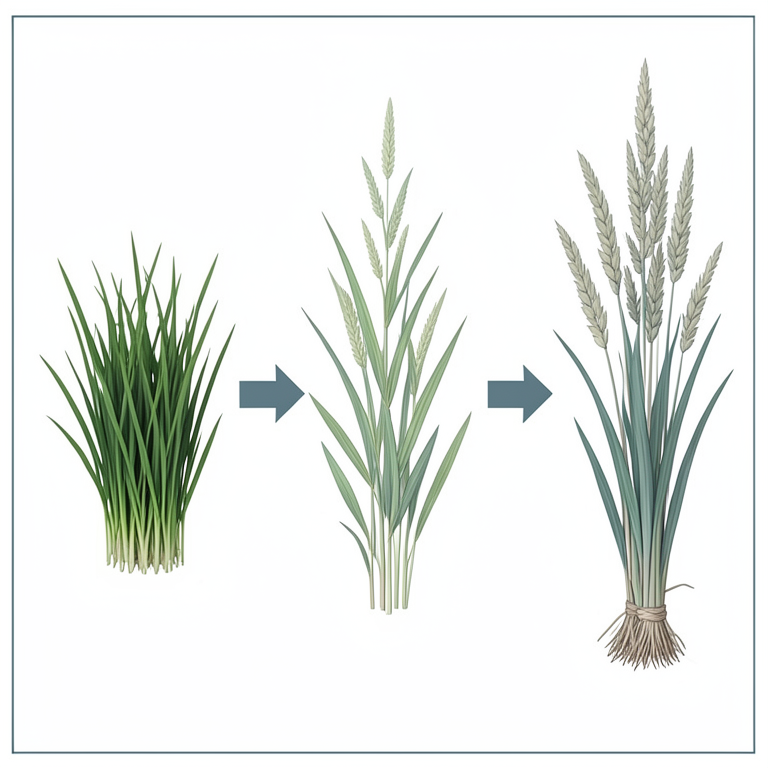
Nutritional Trade-off by Cutting Interval
AI-generated conceptual illustration (Bajra Napier grass hybrids). It explains the idea and does not show study data.
View source evidence ↗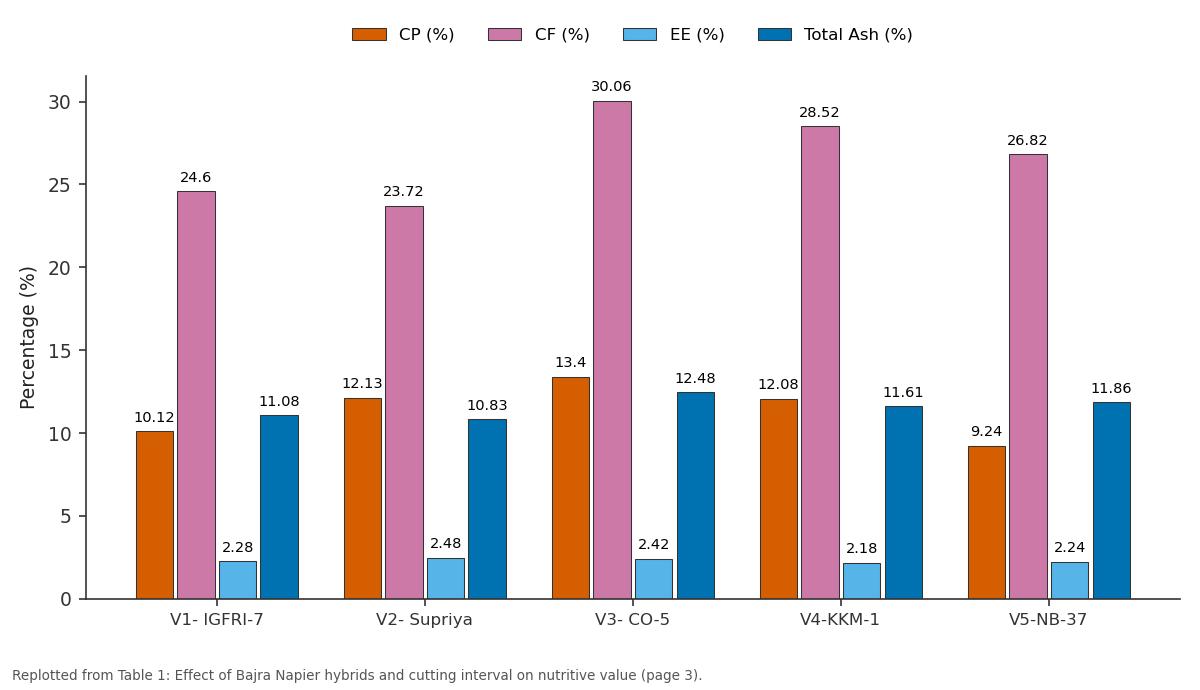
CP (%) and CF (%) and more: V1- IGFRI-7 vs V2- Supriya vs V3- CO-5 vs V4-KKM-1 vs V5-NB-37
Replotted from Table 1 (page 3) of the original paper. Every bar is the paper's own table value.
View source evidence ↗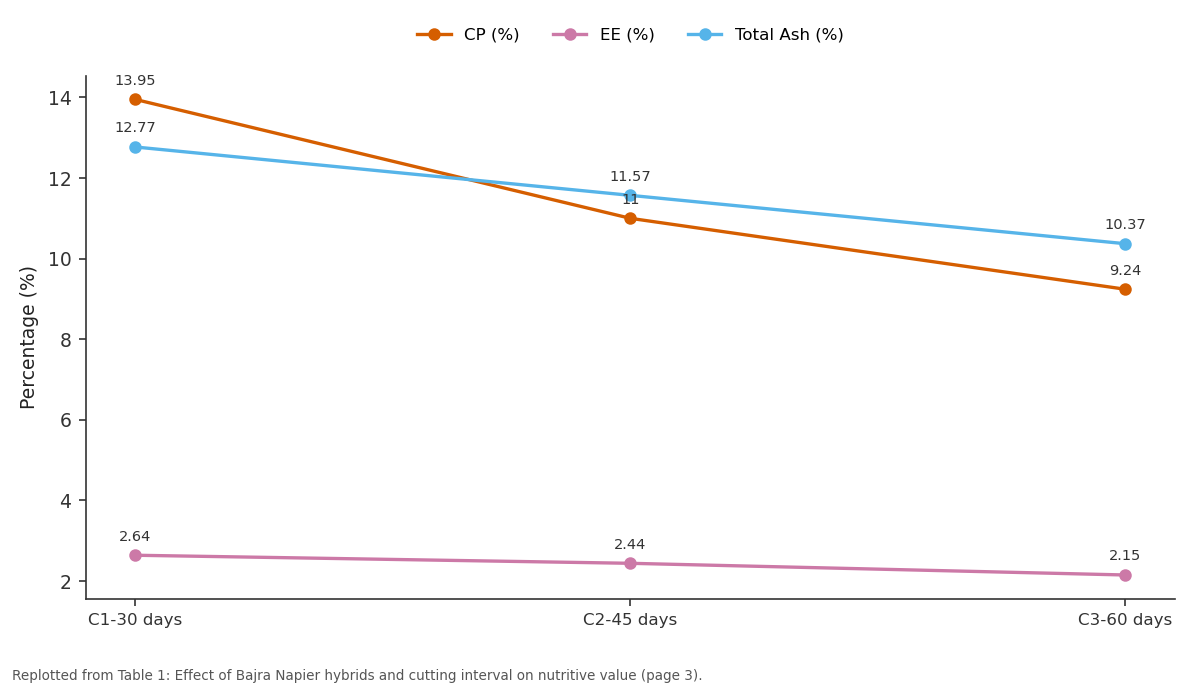
CP (%) and EE (%) and more: C1-30 days vs C2-45 days vs C3-60 days
Replotted from Table 1 (page 3) of the original paper. Every bar is the paper's own table value.
View source evidence ↗Figures & tables
From the original paper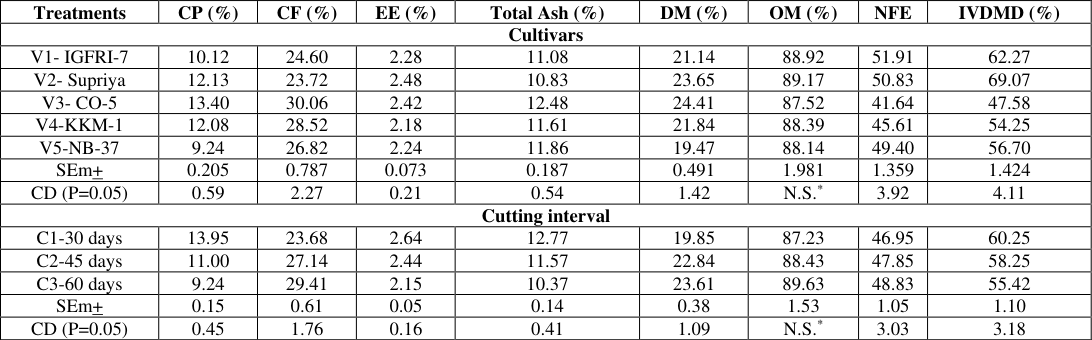 Table 1
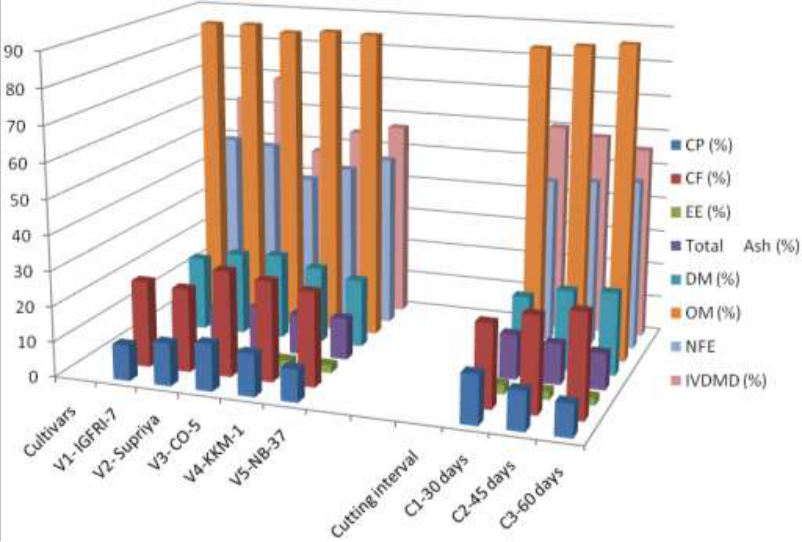 Figure 1
Introduction
The fodder crops are economic source of nutrients for the livestock. The success of dairy farming largely depends on the feed and fodder of high nutritional value, which accounts for 65-70 per cent of total expenses incurred in animal production (Kumar et al., 2012) [8] . There is a big disparity between the supply and demand of high quality green fodder in India. In India, a very limited land area is just 8.6 mha available for fodder cultivation (Kumar et al., 2012) [8] . Storage of fodder and feeds together with low nutritive value of available feeds has lowered the productivity and fertility of Indian livestock. Cereal fodder crops and residues are important feed sources, but the nutritional value of these forage crops is not sufficient to meet the high demand for milk production and improve animal health. To complete the nutritional requirement of livestock, it is necessary to provides feed the animals with good quality green fodder crops. Generally, grasses contain more crude fiber than legumes. Hence, grasses like Bajra Napier hybrids have potential nutritional values include a rich source of fiber, crude protein and ether extract etc. It has wider adaptability under different agro-climatic condition, low cost of cultivation, resistant to pest, pathogen and drought resistant. These bajra napier hybrids in comparison to Napier grass have been found to be superior in quality, palatability, nutritive value, fodder yield, growth, less hairy and with better regeneration capacity (Gupta, 1975) [5] . Presently the work on impact of cutting intervals on quality parameters of different Bajra Napier Hybrids. The cutting intervals and different Bajra Napier Hybrids affect the nutritive value during the investigation. Crude protein content is an important quality parameter which was decreased with increasing in cutting interval (Tessema and Alemayehu, 2010) [13] .
The crude fibre content was increased with increasing in cutting interval. (Reddy and Reddy, 2012) [11] . The aim of this study was to determine the optimum stage of harvesting of different Bajra Napier hybrids based on chemical and In vitro digestibility analysis so as to get better performance from livestock by feeding.
Material and Method
The field study was carried out at forage farm, Department of Livestock Production Management, SKN College of Agriculture, Jobner, Jaipur (Rajasthan). The region is located in agro-climatic zone III-A (semi-arid eastern plain zone of Rajasthan). The characteristic semi-arid climate of this area is marked by temperature extremes in both the summer and the winter. The experiment was initiated in February (2021) and completed in June (2021). The experimental plot's initial soil study revealed that the soil was loamy sand with low accessible nitrogen (132.60 kg ha -1 ), medium phosphorus (18.78 kg ha-1 ), and high potassium (152.03 kg ha -1 ) levels as well as a pH of 8.2 that was just slightly alkaline in reactivity. The Bajra Napier hybrids is sterile and does not produce viable seeds although it could indicate an inflorescence or spike. It is propagated by stem cutting. The field experiment was laid out in Factorial design. The treatment consists of fifteen plots of combinations including five cultivars (IGFRI-7, Supriya, CO-5, KKM-1, NB-37) planting material and three cutting intervals C1-30 days, C2-45 days and C3-60 days. Thus, there were forty five treatment combinations replicated three times. In February, stem cuttings were planted 60 x 60 cm 2 apart from plant to plant and row to row. Gap filling was carried out 12 days following stem cutting planting in order to maintain the ideal plant population. The first weeding of the bajra Napier hybrids was carried out 20 days after planting, and the second weeding was carried out right after the first common cut. During the trial, stopped weeds from overtaking the experimental area. Farm yard manure was applied uniformly and effectively into the soil at a rate of 25 t/ha when fertilizers and manures were used to prepare the land. According to the package of practices recommendations (IGFRI, Jhansi 2007), the recommended amount of fertilizer was 60, 50, and 40 kg N, P 2 O 5 , and K 2 O/ha, respectively. After each cutting 30 kg N/ha was applied. The standard analytical methods were used for quality parameters viz., crude protein and crude fibre, dry matter, ether extract, organic matter, total ash, nitrogen free extract and In vitro dry matter digestibility (%) by A.O.A.C., (2005) [3] .
Statistical Analysis: The experiment's data were statistically analyzed using Fisher's method of analysis of variance (Fisher, 1950), and the significance test was carried out in accordance with the instructions provided by Panse and Sukhatme (1978) [15] . CD values have been provided in tabular data in the text for comparison.
Result and Discussion
Crude protein (CP) content gives an approximate value of protein content in the fodder. Significant differences were observed between bajra Napier hybrids with respect to crude protein content because there were significant differences in nitrogen content among the hybrids. In fodder grass Crude protein content is an important quality parameter in which increasing cutting time crude protein content decreased. In bajra Napier hybrids, hybrid CO-5 was recorded in significantly higher crude protein content (13.40%) over rest of the hybrids. When compared to cutting intervals of 45 and 60 days (11.00% and 9.24%), the average crude protein content of the bajra Napier hybrid was significantly greater during the 30 day cutting interval (13.95%). The following researchers also observed similar findings: Zewdu et al. (2002), Premaratne and Premalal (2006) [9] , Ram et al. (2007) [10] , Tessema and Alemayehu (2010) [13] , Bora et al. (2011) [4] , and Reddy and Reddy (2012) [11] . The crude fibre (CF) content was significant different between the bajra Napier hybrids. Crude fibre content was observed significantly higher in hybrid CO-5 (30.06%) and lower in hybrid Supriya (23.72%). At cutting intervals of 30 days, the average crude fiber content in bajra Napier hybrids was significantly lower (23.68%) than at intervals of 45 and 60 days (27.14% and 29.41%, respectively). The crude fibre content was increased with increasing in cutting time. A longer cutting interval results in the conversion of sugar to cellulose as long chain polysaccharides, resulting in the creation of fiber like structure in the bajra Napier hybrid. finally shorter period of cutting interval can reduce fibre content. The similar results were also observed by Bora et al. (2011) [4] and Reddy and Reddy (2012) [11] . In hybrid CO-5 (12.48%), the average ash content was significantly higher. In the course of the experiment, the total ash content was significantly higher at the 30-day cutting interval (12.77%) than at the 45-day and 60-day cutting intervals. higher mineral absorption during the initial development stage may explain the greater ash level during the 30-day cutting interval (12.77%). The results of Aganga et al. (2005) [1] , Premaratne and Premalal (2006) [9] , and Tessema and Alemayehu (2010) [13] agree with these findings. Ether extract (EE) may include fatty acid esters, fats, and fatsoluble vitamins and hence are often referred to as crude fat. Mainly the ether extract content formed by lipids such as phospholipids, triglycerides and galactolipids. The ether extract content was found to be significantly higher in the hybrid Supriya (2.48%), and the results revealed important variations between the bajra Napier hybrids. During the course of the experiment, the ether extract content level was significantly higher at the 30 day cutting interval (2.64%) than at the 45 and 60 day cutting intervals. Ether exract content in bajra Napier hybrid decreases with increase in cutting interval. Anthony and Thomas (2014) [16] also observed similar result in bajra Napier hybrids ether extract percentage of the leaves ranged from 2.80 per cent to 1.47 per cent and that of the stem from 1.10 per cent to 1.58 per cent. The dry matter content was recorded significantly higher in Hybrid CO-5 (24.14%) as compared to rest of the bajra Napier hybrids. When compared to cutting interval at 30 days, the dry matter content was significantly higher at 45 days cutting interval (22.84%) but stayed at par with the cutting interval of 60 days (23.61%). The dry matter content in bajra Napier hybrids increased with increase in cutting time. According to Islam et al. (2003) [6] , Napier grass typically contains 20% dry matter. However, Schreuder et al. (1993) [12] observed that dry matter content varied with climate, soil fertility, and management. The organic matter content in different bajra Napier hybrid and different cutting interval did not varied significantly. Organic matter per cent ranged between 87.52 per cent to 89.17 per cent. Among bajra Napier hybrids, hybrid IGFRI-7 was recorded significantly higher in Nitrogen free extract (NFE) 51.91 per cent. In the investigation at cutting interval 45 days observed significantly higher NFE (47.85%) than 30 days cutting interval which was at par with 60 days cutting interval. The nitrogen-free extract content is proximate principle and represents soluble carbohydrates like sugar and starch. For Australian Napier and Thumburmuzhy-I, Xavier et al. (2010) [14] observed nitrogen free extract 49.2 per cent and 50.2 per cent, respectively. The difference could arise from the investigation's high percentage of crude fiber compared to the findings. Anthony and Thomas (2014) [16] observed, the nitrogen free extract in leaves ranged from 47.02 per cent to 51.88 per cent and the nitrogen free extract in stems ranged from 53.01 percent to 55.73 per cent in bajra napier hybrids. In vitro dry matter digestibility (IVDMD) is assessed by constructing an artificially temperature, CO 2 and anaerobic environment outside of the animal's body, together with rumen enzymes. In the present study the In vitro dry matter digestibility (IVDMD) of hybrid Supriya (69.07%) was recorded significantly higher over rest of Bajra Napier hybrids. The lowest IVDMD was recorded in CO-5. In vitro dry matter digestibility of bajra Napier hybrid was significantly higher at 30 days cutting interval (60.25%) over 45 days and 60 days cutting interval. The increase in cutting interval decreases the In vitro dry matter digestibility in bajra Napier hybrid. The digestibility decreases as lignification of plant material increases with grass maturity (Agnanga et al., 2005) [1] . The results of the current study are consistent with the results reported by Bora et al. (2012) [17] , who found that Bajra Napier hybrid grass had significantly higher IVDMD in its early stages and decreased as the plant matured.
Conclusion
On the basis of present investigation result indicated that CO-5 was superior to other bajra Napier hybrids with respect to nutritional quality. The hybrid Supriya is also at par to CO-5 in most of the characters. Based on chemical composition and In vitro Dry matter digestibility (IVDMD) of dry matter, 45 day cutting interval growth was considered as optimum stage of harvesting the forage for maximum utilization of nutrients.
Figures and tables from the paper
| Treatments | CP (%) | CF (%) | EE (%) | Total Ash (%) | DM (%) | OM (%) | NFE | IVDMD (%) |
|---|---|---|---|---|---|---|---|---|
| Cultivars | ||||||||
| V1- IGFRI-7 | 10.12 | 24.60 | 2.28 | 11.08 | 21.14 | 88.92 | 51.91 | 62.27 |
| V2- Supriya | 12.13 | 23.72 | 2.48 | 10.83 | 23.65 | 89.17 | 50.83 | 69.07 |
| V3- CO-5 | 13.40 | 30.06 | 2.42 | 12.48 | 24.41 | 87.52 | 41.64 | 47.58 |
| V4-KKM-1 | 12.08 | 28.52 | 2.18 | 11.61 | 21.84 | 88.39 | 45.61 | 54.25 |
| V5-NB-37 | 9.24 | 26.82 | 2.24 | 11.86 | 19.47 | 88.14 | 49.40 | 56.70 |
| SEm+ | 0.205 | 0.787 | 0.073 | 0.187 | 0.491 | 1.981 | 1.359 | 1.424 |
| CD (P=0.05) | 0.59 | 2.27 | 0.21 | 0.54 | 1.42 | N.S.* | 3.92 | 4.11 |
| Cutting interval | ||||||||
| C1-30 days | 13.95 | 23.68 | 2.64 | 12.77 | 19.85 | 87.23 | 46.95 | 60.25 |
| C2-45 days | 11.00 | 27.14 | 2.44 | 11.57 | 22.84 | 88.43 | 47.85 | 58.25 |
| C3-60 days | 9.24 | 29.41 | 2.15 | 10.37 | 23.61 | 89.63 | 48.83 | 55.42 |
| SEm+ | 0.15 | 0.61 | 0.05 | 0.14 | 0.38 | 1.53 | 1.05 | 1.10 |
| CD (P=0.05) | 0.45 | 1.76 | 0.16 | 0.41 | 1.09 | N.S.* | 3.03 | 3.18 |
Table text extracted from the original PDF; superscript letters are shown inline. The original table image is below.
View original table image
References
10 in the original paper- Aganga AA, Omphile UJ, Thema T, Baitshotlhi JC. Chemical composition of Napier grass (Pennisetum purpureum) at different stages of growth and Napier grass silages with additives. Journal of Biological Sciences. 2005;5(4):493-496.
- Bora S, Bhuyan R, Sarma DN, Sharma KK, Bora A. Effect of Variety and Stage of Harvest on the Yield, Chemical Composition and In-vitro Digestibility of Hybrid Napier (Pennisetum purpureum × Pennisetum americanum). Indian Journal of Animal Nutrition. 2011;28(4):418-420.
- Gupta VP. Fodder improvement in pennisetums. Forage Research. 1975;1:54-60.
- Islam MR, Saha CK, Sarker NR, Jalil MA, Hasanuzzaman M. Effect of variety on proportion of botanical fractions and nutritive value of different Napier grass (Pennisetum purpureum) and relationship between botanical fractions and nutritive value. AsianAustralasian Journal of Animal Sciences. 2003;16(6):837-842.
- Premaratne S, Premalal GGC. Hybrid Napier (Pennisetum purpureum x Pennisetum americarnum) var. CO-3: A resourceful fodder grass for dairy development in Sri Lanka. Journal of Agriculture Science. 2006;2(1):22-33.
- Ram SN, Suresh G, Singh KK. Effect of planting geometry and cutting management on productivity, quality and economics of mixed pasture under rainfed conditions. Indian Journal of Agronomy. 2007;52(3):154162.
- Reddy G Jangi, Reddy B Seshi. Nutritive value of ratoon regrown Hybrid Napier (NB-21). Indian Journal of Animal Nutrition. 2012;3(2):128-131.
- Tessema ZK, Alemayehu M. Management of Napier grass (Pennisetum purpureum) for higher yield and nutritional quality in Ethiopia. Ethiopian Journal of Animal Production. 2010;10(1):73-94.
- Cloët IC, Bentz W, Thomas AW. Role of diquark correlations and the pion cloud in nucleon elastic form factors. Physical Review C. 2014 Oct 6;90(4):045202.
- Bora E, Fornito A, Pantelis C, Yücel M. Gray matter abnormalities in major depressive disorder: A metaanalysis of voxel based morphometry studies. Journal of Affective Disorders. 2012 Apr 1;138(1-2):9-18.