
Research article · 2023 · Full text
International Journal of Veterinary Sciences and Animal HusbandryRuns of homozygosity from different goat genotypes in Kenya
Volume 8(1) · Pages 32–35 · DOI: 10.22271/veterinary.2023.v8.i1a.463 ↗
Research areasGenetic and phenotypic traits in livestockGenetic diversity and population structureAnimal Diversity and Health Studies
Abstract
Author-writtenThere is limited genetic information available in most African goat populations. However, improvements in genomic technologies have enabled easy and effective analysis of different genetic parameters. This study used Single Nucleotide Polymorphism (SNP) data of four goat genotypes from Kenya; Galla (n = 12), Alpine (n = 28), Saanen (n = 24) and Toggenburger (n = 30). After SNP quality control, 48808 SNPs that were available for analysis. Runs of homozygosities (ROHs) were detected to analyse the distribution and inbreeding coefficients. Across the genotypes, 348 ROHs were detected with the highest number observed in Toggenburger and lowest in Galla. ROHs that described recent inbreeding were observed in Alpine. The highest mean sum of ROH was observed on the long ROHs category (>16 Mb) which have a negative effect on animals performance. Distribution of ROHs per chromosome was breed-specific without a clear pattern across the genotype. Furthermore, 32 genomic regions with the high frequency of ROHs were detected. Sixteen genes (missense and synonymous) were identified to determine their effects on animal performance. High inbreeding coefficient values were observed in all exotic genotypes suggesting continuous use of few breeding bucks. Toggenburg was found to be the most inbred genotype with the highest breeding coefficient of 0.68 compared to other genotypes. To maintain and improve the genetic diversity in Kenya, these findings will be useful for the strategic implementation of genetic improvement and conservation programs to ensure continual contribution to food security.
Summary
Source-checkedPlain-language reading of the full paper, prepared with AI and checked against the text. Each point links to the authors' own words.
Why it matters
- Goat production is vital for improving rural livelihoods in Kenya by providing income, milk, and meat. View evidence ↗
- Low genetic diversity can lead to inbreeding through the mating of close relatives, which reduces the overall fitness of the animals. View evidence ↗
- Estimating inbreeding coefficients from Runs of Homozygosity (ROHs) is currently the most effective method for measuring inbreeding in populations. View evidence ↗
What they did
- The researchers analyzed SNP data from 94 randomly selected goats across four genotypes: Galla, Saanen, Alpine, and Toggenburg. View evidence ↗
- ROH lengths were categorized into four classes: 2–4 Mb, 4–8 Mb, 8–16 Mb, and above 16 Mb. View evidence ↗
- The inbreeding coefficient (FROH) was calculated by dividing the total ROH length by the goat autosomal genome length of 2399.4 Mb. View evidence ↗
What they found
- A total of 348 ROHs were detected across the genotypes, averaging 4.703 per individual. View evidence ↗
- Toggenburger goats exhibited the highest number of ROHs, while Galla goats had the lowest. View evidence ↗
- The majority of the mean sum of ROH coverage occurred in the >16Mb category, which indicates recent inbreeding across the studied genotypes. View evidence ↗
- Toggenburger goats were the most inbred with an FROH of 0.68, followed by Saanen (0.35), Alpine (0.23), and Galla (0.09). View evidence ↗
- The local Galla genotype had the lowest inbreeding coefficient (0.09), suggesting its genetic material is relatively well-managed in Kenya. View evidence ↗
- The study identified more missense genes than synonymous genes in high-frequency ROH regions, which may be linked to immunity, reproduction, and genetic disorders. View evidence ↗
What it means
- The authors conclude that exotic goat genotypes in Kenya have higher inbreeding levels than local ones, indicating a lack of controlled breeding. View evidence ↗
- To improve genetic diversity and conservation, the authors recommend using artificial insemination or introducing different lines of exotic genotypes. View evidence ↗
Visual summary
3 visualsIllustrations explain the paper; charts are replotted from the paper's own table values.
Comparison of Inbreeding Coefficients
AI-generated conceptual illustration (Goat genotypes (Galla, Alpine, Saanen, and Toggenburger)). It explains the idea and does not show study data.
View source evidence ↗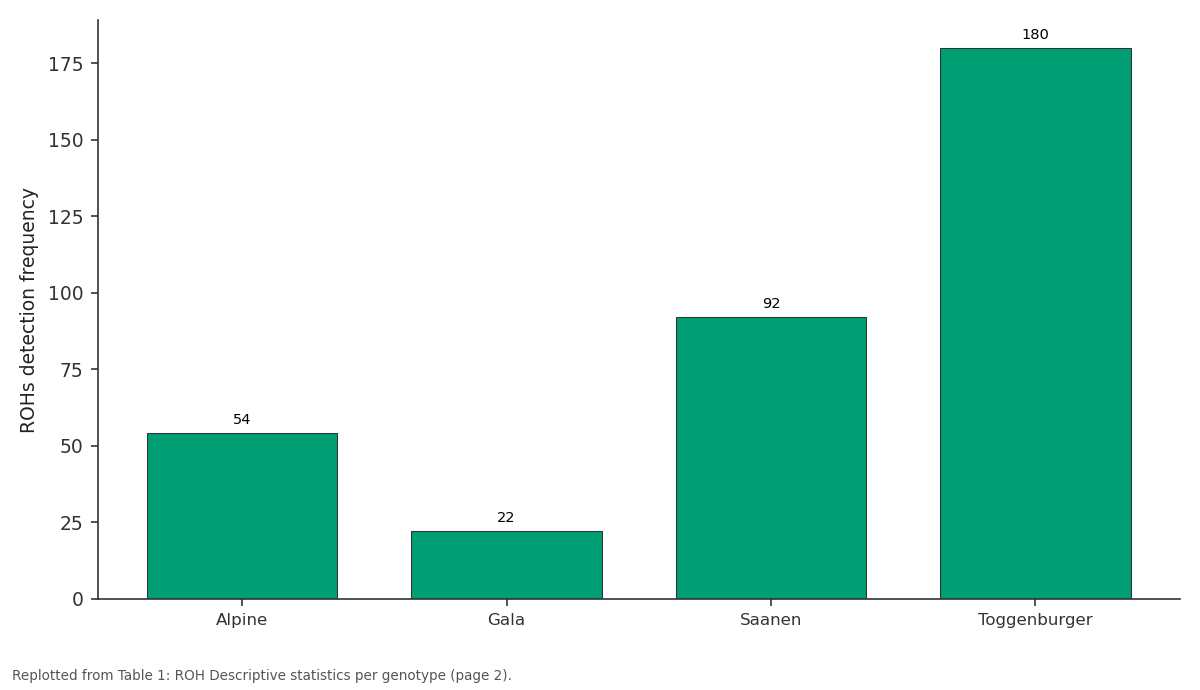
ROHs detection frequency: Alpine vs Gala vs Saanen vs Toggenburger
Replotted from Table 1 (page 2) of the original paper. Every bar is the paper's own table value.
View source evidence ↗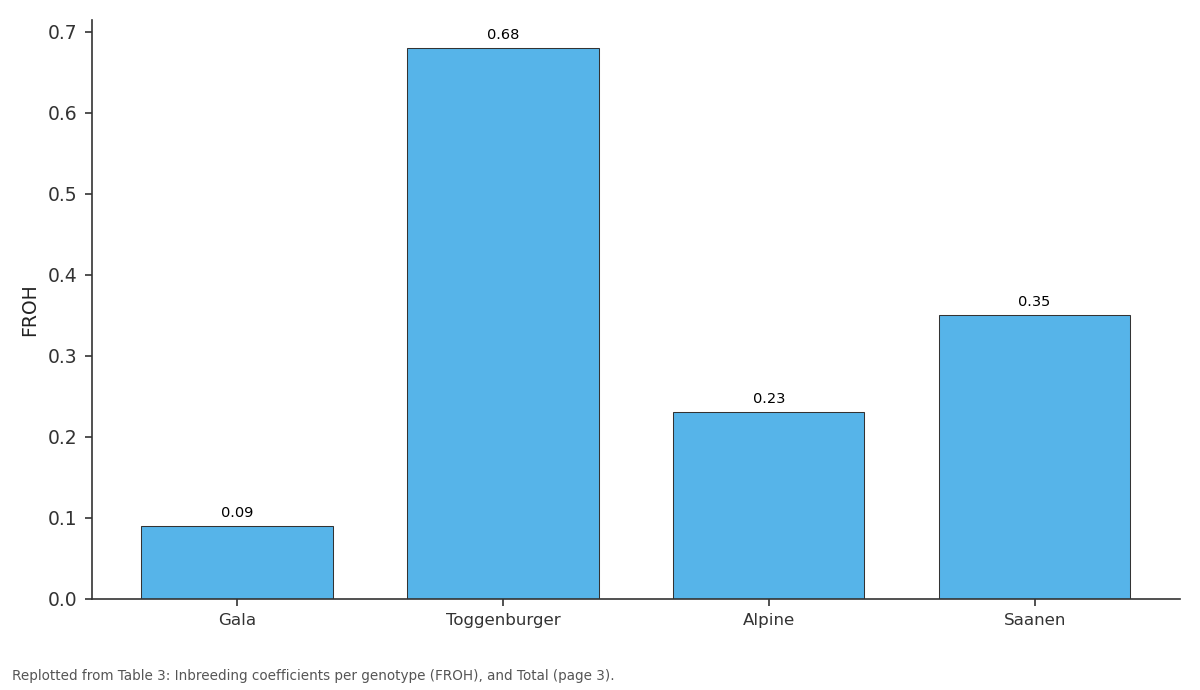
FROH: Gala vs Toggenburger vs Alpine vs Saanen
Replotted from Table 3 (page 3) of the original paper. Every bar is the paper's own table value.
View source evidence ↗Figures & tables
From the original paper Table 1
 Table 2
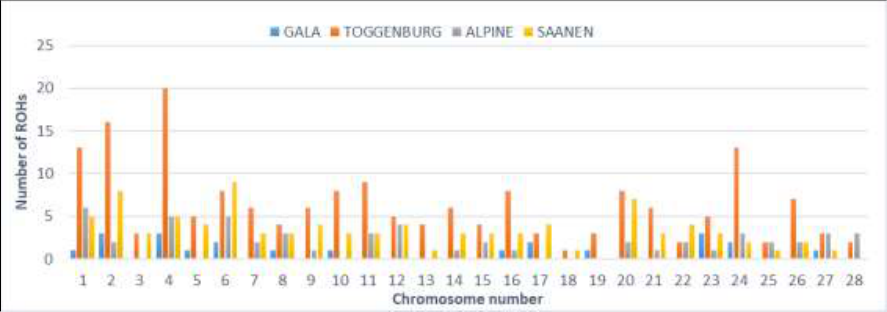 Figure 1
 Table 3
Introduction
Goat production is practised world-wide with different genetic diversity and structure. In most African nations including Kenya, goat production helps in improving rural livelihood through the provision of meat, milk, income among other benefits [12] . Kenya is also reported to have a diverse genetic structure of goats for both exotic and local genotypes essential for genetic improvement programs [15,7] . The shape of the animal genome in any structure depends on many factors such as geographical location, production and breeding systems which has the potential to increase or decrease genetic diversity [2] . When genetic diversity is low in a population, there is mating of close relative individuals leading to inbreeding which reduce animals fitness. Inbreeding levels can be measured at both individual and population levels. Due to improvement in genomic technologies, the most effective way of measuring inbreeding in a population is through estimation of inbreeding coefficients from Runs of Homozygosity (ROHs) [14,15] . The ROHs are continuous homogenous regions of the genome in an individual which occurs due to the inheritance of identical alleles from their parents [3] . Unlimited artificial selection for beneficial alleles in a population can also increase homozygosity in genomic regions. ROHs can either be long or short in a genome and they are not randomly distributed in the animal genome [18] . Recent inbreeding is presented by long ROHs while short ROHs indicate the ancient individual relationships which are not accounted for due to lack of pedigree information. The Presence of ROHs patterns in specific genomic regions in selected individuals provides different information. For instance, previous studies have used ROHs patterns to describe the demographic history, gene mapping or differences between livestock genotypes among other genetic information [5] . Using Single Nucleotide Polymorphism (SNP) data, this study focused on genomic characterisation of ROH distribution and inbreeding coefficients among exotic and local goat genotypes found in Kenya. Apart from the genetic diversity and structure of Kenyan goat genotypes being known, information on various genetic parameters such as ROHs within the genotypes is still limited. This study information will enable farmers and livestock breeders to know inbreeding levels and their implications in the population. Therefore, implemetation of strategic breeding which will enhance goat productivity and conservation of unique traits.
Materials and Methods
Materials and Methods
Sampling
The study used Single Nucleotide Polymorphism (SNP) data from Kenya obtained from 94 goats from four goat genotypes (Galla, Saanen, Alpine and Toggenburg) randomly selected in different sub-counties. The areas include; Nyeri (Mukurweini Sub-county), Meru (Central Imenti Sub-County) and Homa Bay (Homa Bay town) located in the Central (wet-dry), Eastern (wet) and Western regions (Wet area) of Kenya.
DNA extraction, genotyping and Quality control
Blood samples were collected using EDTA tubes followed by DNA extraction using the Qiagen DNeasy Blood and Tissue Kits. Purified DNA quality and quantity were validated using the Qubit dsDNA BR (Broad-Range) Assay Kit on the Qubit 2.0 and Nanodrop Spectrophotometer (Nanodrop ND-1000). Genotyping was conducted using the Illumina goat SNP50 Bead chip developed by International Goat Genome Consortium (IGGC). Quality control procedures of SNPs was done in PLINK v 1.9 [4] . The standard parameters of SNP filtering was applied; all SNPs less than 95% call rate, less than 0.05 Minor Allele Frequency (MAF < 0.05), Hardy-Weinberg Equilibrium (< 0.001) and more than 10% missing genotypes were removed remaining with 48, 808 SNPs for downward analysis.
Statistical analysis Distribution of ROH
Total number, frequency and length distribution of Runs of Homozygosity (in Megabases) were identified per individual and per genotype in PLINK v1.9 [4] . Distribution of ROH length in each genotypes was done into four classes thus 2-4 Mb, 4-8 Mb, 8-16 Mb and above 16 Mb.
Estimation of inbreeding coefficient
Inbreeding coefficient in this study was estimated per individual and per genotype. F ROH was determined by dividing the total length of ROH (L ROH ) in an individual genome with the autosomal genome length (L AUTO ) of goats (2399.4 Mb), [5] .
Genomic Regions with high ROH frequency
The percentage of SNP occurrence was determined by calculating the number of times each SNP occurred in the ROH throughout the populations. Top 10% of ROHs observed in each genotype was identified as genomic regions with a high frequency of ROH and were extracted using vcftools and uploaded in the ENSEMBL goat Capra hircus using the Variant Effect Predictor (VEP) for function annotation.
Results
Results
Detection of ROH and ROH patterns
348 ROH were detected across the goat genotype with a mean of 4.703 per individual. The descriptive statistics of ROHs per genotype are in table one. The ROHs detected per chromosome vary according to genotype in all the 28 chromosomes (Fig 2). The number of ROHs per genotype according to length category are presented in table two.
Inbreeding coefficients
The overall inbreeding coefficients calculated from runs of homozygosity in this study was 1.35, the variations of inbreeding per genotype are presented below (Table 3). Genomic regions with high frequency of ROH Runs of homozygosity islands and SNP percentage were evaluated in all the four goat genotypes where 32 genomic regions were identified. Sixteen genes were identified from these genomic regions with missense and synonymous effects.
| Genotype | Gala | Toggenburger | Alpine | Saanen |
|---|---|---|---|---|
| FROH | 0.09 | 0.68 | 0.23 | 0.35 |
| Total ROH Length | 211.17 | 1631.53 | 554.92 | 846.67 |
Table text extracted from the original PDF; superscript letters are shown inline. The original table image is below.
View original table image
Discussions
Discussions
Runs of homozygosities
According to [2] , the formation of ROH in a population is a factor of demographic events and recombination rate hence the observed variation in the formation of ROHs. All genotypes in this study have ROHs in their genome whose presence vary in terms of the total number, length and distributions. This is similar to the distribution of ROHs observed in 11 cattle breeds of Poland [16] . The mean ROH length tends to be higher in Galla compared to Alpine and Saanen which recorded low numbers of ROHs. This trend was also observed in a related study done on indigenous greek goat breeds [11] . Furthermore, the distribution pattern of ROH per chromosome across the genotypes was non-specific concuring with the fact that distribution of ROH per chromosome are breed-specific [10] . The highest number of ROHs in chromosome four of Tottenburg suggest continuous transfer of ancestral genes specific for chromosome four. The higher mean sum of ROH coverage in the long ROHs observed in all the studied genotypes, suggests high levels of recent inbreeding. This can be attributed to artificial selection of best breeding bucks or the presence of few replacement stocks for breeding in the population. This agrees with the findings of Asian pigs and Italian goats [2,9] . On the contrary, the mean length of ROHs were found to be more common in short ROHs than long ROHs as observed in related ROH studies of goats and sheep [13] . Generally, the majority of the mean sum of ROH coverage are reported at the length of >16Mb suggesting recent inbreeding across the genotypes. This information is important for planning better breeding programs since most deleterious variants are reported to be carried in the long ROHs. Individual genomic inbreeding coefficients measured from ROH are generally low ranged from 0.00 to 0.07 indicating non-inbred individuals. For instance, the inbreeding levels per individual for Alpine goats were reported below 0.05 in this study which is similar to the findings of [16] . According to [7] , a population with low inbreeding levels must have inbreeding coefficient levels of less than 0.1. In this study, only local Gala recorded F ROH value of 0.09 which corresponds with the observed low numbers of ROHs suggesting that the genetic material for this genotype is at least well managed in Kenya but measures must be implemented to maintain recommended inbreeding levels. The exotic genotypes on the other hand recorded moderate to high inbreeding coefficients above 0.1 (Table 3). This observation is in agreement with inbreeding coefficient values of goats observed from different geographical locations by [1] and it can be eluded to the extensive use of exotic bucks for breeding in smallholder farmers since these genotypes were brought in Kenya to improve local goat productivity. From the genomic regions associated with high frequency of ROHs, this study focused on the presence synonymous and missense genes. More missense genes were identified compared to synonymous which are associated with genetic disorders or diseases, reproduction and general body immunity. Therefore, breeding programs should target reducing the presence of missense genes that has the potential to reduce the Populations fitness.
Conclusions and Recommendations
High numbers of ROHs and inbreeding levels have been confirmed in exotic goat genotypes compared to the local genotype in Kenyan goat populations. This shows that there is no controlled breeding among the studied populations which lead to increase in homozygosities. If breeding is not controlled in these populations, the genetic diversity will decline leading to loss of important genetic materials. Therefore, special considerations should therefore be made to have different lines of exotic goat genotypes or use of Artificial Insemination. This will ensure effective genetic improvement and conservation programs.
Acknowledgement
This study was approved by the Egerton University Research Ethics Committee, Nakuru, Kenya Approval No. EUREC/APP/138/2021 and also the National Commision for Science, Technology and Innovation (NACOSTI), license No. NACOSTI/P/21/14174. Author ORCIDs T. Chikoko https://orcid.org/0000-0002-6176-4093 K. Ngeno https://orcid.org/0000-002-9271-7839 T. Muasya https://orcid.org/0000-0002-8758-7961 AcknowledgementThe authors acknowledge the staff of Egerton University -Department of Animal Science for their technical contributions on the manuscript. Lastly we acknowledge the Sustainable Agriculture and Agribusiness Management (CESAAM) -Egerton University for providing financial support towards the project.
Figures and tables from the paper
| ROH Length Category | Gala | — | — | Toggenburger | — | — | Alpine | — | — | Saanen | — | — |
|---|---|---|---|---|---|---|---|---|---|---|---|---|
| ROH No. | n | Mean Length (Mb) | ROH No. | n | Mean Length (Mb) | ROH No. | n | Mean Length (Mb) | ROH No. | n | Mean Length (Mb) | |
| 2-4Mb | 0 | 0 | 0 | 0 | 0 | 0 | 0 | 0 | 0 | 0 | 0 | 0 |
| 4-8Mb | 12 | 5 | 6.13 | 102 | 27 | 5.99 | 30 | 17 | 6.33 | 50 | 22 | 5.91 |
| 8-16Mb | 8 | 5 | 12.02 | 59 | 22 | 10.45 | 16 | 12 | 12.02 | 32 | 14 | 10.68 |
| >16Mb | 2 | 2 | 20.76 | 19 | 13 | 21.25 | 8 | 4 | 24.84 | 10 | 8 | 20.95 |
Table text extracted from the original PDF; superscript letters are shown inline. The original table image is below.
View original table image
References
17 in the original paper- Bertolini F, Cardoso TF, Marras G, Nicolazzi EL, Rothschild MF, Amills M, et al. Genome-wide patterns of homozygosity provide clues about the population history and adaptation of goats. Genetics Selection Evolution. 2018;50(1):1-12.
- Bosse M, Megens HJ, Madsen O, Paudel Y, Frantz LA, Schook LB, et al. Regions of homozygosity in the porcine genome: consequence of demography and the recombination landscape. PLoS Genetics. 2012;8(11):115.
- Ceballos FC, Joshi PK, Clark DW, Ramsay M, Wilson JF. Runs of homozygosity: windows into population history and trait architecture. Nature Reviews Genetics. 2018;19(4):220.
- Chang CC, Chow CC, Tellier LC, Vattikuti S, Purcell SM, Lee JJ, et al. Second-generation PLINK: rising to the challenge of larger and richer datasets. Gigascience. 2015;4(1):01-16.
- Islam R, Li Y, Liu X, Berihulay H, Abied A, Gebreselassie G, et al. Genome-wide runs of homozygosity, effective population size, and detection of positive selection signatures in six Chinese goat breeds.- Genes. 2019;10(11):938.
- Luigi-Sierra MG, Cardoso TF, Martínez A, Pons A, Bermejo LA, Jordana J, et al. Low genome-wide homozygosity in 11 Spanish ovine breeds. Animal Genetics. 2019;50(5):501-511.
- Marete AG, Jung'a JO, Mosi RO. An analysis of inbreeding levels and factors affecting growth and reproductive traits in the Kenya Alpine dairy goat. Livestock Research for Rural Development. 2011;23(12):259.
- Mastrangelo S, Di Gerlando R, Sardina MT, Sutera AM, Moscarelli A, Tolone M, et al. Genome-Wide Patterns of Homozygosity Reveal the Conservation Status in Five Italian Goat Populations. Animals. 2021;11(6):1510.
- Mastrangelo S, Tolone M, Sardina MT, Sottile G, Sutera AM, Di Gerlando R, et al. Genome-wide scan for runs of homozygosity identifies potential candidate genes associated with local adaptation in Valle del Belice sheep. Genetics Selection Evolution. 2017;49(1):1-10.
- Michailidou S, Tsangaris GT, Tzora A, Skoufos I, Banos G, Argiriou A, et al. Analysis of genome-wide DNA arrays reveals the genomic population structure and diversity in autochthonous Greek goat breeds. PloS One. 2019;14(12):e0226179.
- Monau P, Raphaka K, Zvinorova-Chimboza P, Gondwe T. Sustainable utilization of indigenous goats in Southern Africa. Diversity. 2020;12(1):20.
- Onzima RB, Upadhyay MR, Doekes HP, Brito L, Bosse M, Kanis E, et al. Genome-wide characterization of selection signatures and runs of homozygosity in Ugandan goat breeds. Frontiers in Genetics. 2018;9(318):1-13.
- Peripolli E, Munari DP, Silva MVGB, Lima ALF, Irgang R, Baldi F. Runs of homozygosity: current knowledge and applications in livestock. Animal Genetics. 2017;48(3):255-271.
- Rebelato AB, Caetano AR. Runs of homozygosity for autozygosity estimation and genomic analysis in production animals. Pesquisa Agropecuária Brasileira. 2018;53(9):975-984.
- Szmatoła T, Gurgul A, Jasielczuk I, Ząbek T, RopkaMolik K, Litwińczuk Z, et al. A comprehensive analysis of runs of homozygosity of eleven cattle breeds representing different production types. Animal. 2019;9(12):1024.
- Waineina RW, Ngeno K, Okeno TO, Ilatsia ED. Genetic diversity and population structure among indigenous and imported goat breeds in Kenya. In Genetic Resources. 2021;(3):25-35.
- Zhang Q, Guldbrandtsen B, Bosse M, Lund MS, Sahana G. Runs of homozygosity and distribution of functional variants in the cattle genome. BMC Genomics. 2015;16(1):1-16.