
Research article · 2023 · Full text
International Journal of Veterinary Sciences and Animal HusbandryTherapeutic management of canine papilloma: a study of six cases
Volume 8(3) · Pages 81–82 · DOI: 10.22271/veterinary.2023.v8.i3b.525 ↗
Research areasVeterinary Oncology ResearchMicrobial infections and disease researchVirus-based gene therapy research
Abstract
Author-writtenClinical study was conducted in six different dog breeds aged between one to nine years were presented to Veterinary Clinical Complex, Rajiv Gandhi Institute of Veterinary Education and Research, Puducherry with a history of multiple cauliflower like outgrowths on various parts of the body. Treatment was carried out with subcutaneous injection of auto vaccine weekly once along with oral Homeopathic drug Thuja occidentalis 30C twice daily for a month. Resolution of papilloma was noticed over the course of the treatment and complete recovery was achieved.
Summary
Source-checkedPlain-language reading of the full paper, prepared with AI and checked against the text. Each point links to the authors' own words.
Why it matters
- Canine papilloma, commonly known as warts, are benign, cauliflower-like growths that appear on the skin and oral mucosa of dogs. View evidence ↗
- Dogs suffering from papillomatosis generally have a good prognosis and low mortality, often remaining immune for the rest of their lives. View evidence ↗
- There are several existing treatment options for canine papillomatosis, ranging from surgical excision and cryotherapy to various medications and homeopathy. View evidence ↗
The question
- The study aims to describe the effectiveness of a combined therapy using an auto-vaccine and the homeopathic drug Thuja occidentalis for managing canine papilloma. View evidence ↗
What they did
- The clinical study involved six dogs of different breeds, aged between one and nine years, at the Veterinary Clinical Complex in Puducherry. View evidence ↗
- The auto-vaccine was prepared by excising older wart samples, mincing them in normal saline, inactivating the virus with formalin (0.4 ml per 100 ml), and adding Strepto-pencillin (2 mg/ml). View evidence ↗
- Treatment consisted of 2-3 drops of oral Thuja occidentalis 30C twice daily for one month, combined with weekly subcutaneous injections of the prepared auto-vaccine. View evidence ↗
What they found
- The papillomas resolved over the course of the treatment, leading to complete recovery for the animals. View evidence ↗
What it means
- The authors conclude that the combination of Thuja occidentalis and an auto-vaccine is a successful approach for treating canine papilloma. View evidence ↗
Visual summary
1 visualsIllustrations explain the paper; they do not show study data.
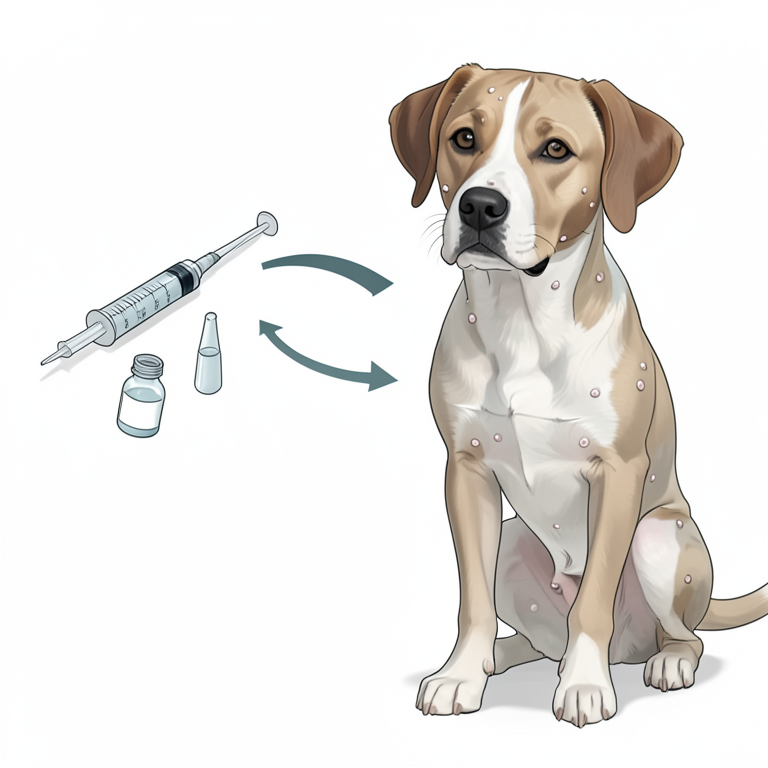
Combined Treatment Workflow
AI-generated conceptual illustration (domestic dog with skin papillomas). It explains the idea and does not show study data.
View source evidence ↗Figures & tables
From the original paper Table 1
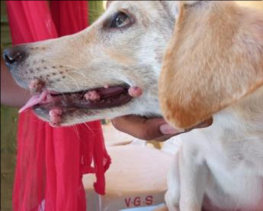 Figure 1
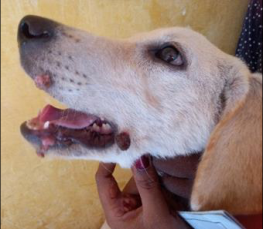 Figure 2
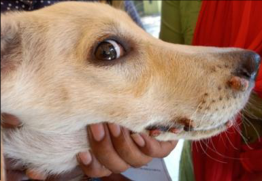 Figure 3
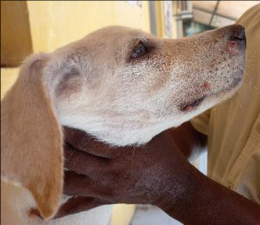 Figure 4
Introduction
Canine papilloma or warts is a multiple, benign cauliflower - like appearance on the skin and oral mucosa which may be seen as sessile or pedunculated growth results as a source of infection (Vail and Withrow, 2007; Bianchi et al., 2012) [5, 1]. Animal suffering from papillomatosis stays immune for the rest of life with good prognosis and low mortality (Raj et al., 2020) [3]. Various therapeutic approaches are available for treating canine papillomatosis such as autoimmune therapy, surgical excision, cryotherapy, hemotherapy, azithromycin, ivermectin, vincristine sulphate, homeopathy and corticosteroids (Singh and Bhardwaj, 2014). The present paper describes about the combined therapy of auto vaccine and homeopathy drug Thuja occidentalis in management of canine papilloma. 2.
Case history and Observation Clinical study was conducted in six different dog breeds aged between one to nine years were presented to Veterinary Clinical Complex, Rajiv Gandhi Institute of Veterinary Education and Research, Puducherry with a history of multiple cauliflower like outgrowths on various parts of the body. Animal particulars and location of the wart are presented in the Table 1. Physiological parameters were within normal range. On clinical examination, multiple, well circumscribed, firm, raised, cauliflower shaped growth were noticed on oral mucosa, oral commissure, upper lips, growth on the right paw, inner ear, vulval lips and ventral abdomen of animals.
| Case no. | Breed | Age (yr) | Sex | Location of the wart |
|---|---|---|---|---|
| 1 | German Shepherd | 2 | Female | Oral mucosa and lips |
| 2 | Shih Tzu | 3 | Female | Oral commissure and upper lips |
| 3 | Nondescript | 9 | Female | Paw |
| 4 | Labrador Retriever | 1 | Male | Oral commissure, upper lips and inner ear |
| 5 | Nondescript | 2 | Male | Forehead and lips |
| 6 | Siberian Husky | 1 | Female | Vulval lips and ventral abdomen |
Table text extracted from the original PDF; superscript letters are shown inline. The original table image is below.
View original table image
On physical examination, these warts were pink in colour Fig 1. Different samples were collected from each animal separately and sent for auto vaccine. 3. Preparation of wart vaccine Wart samples from the older growths of affected animals were excised under aseptic conditions by ligating the ends and were suspended in normal saline and minced properly using mortar and pestle. To inactivate the virus the minced sample were filtered through muslin cloth and treated with formalin (0.4 ml per 100 ml of filtrate) and kept overnight.
Strepto-pencillin 2 mg/ml was also added to the filtrate, transferred into vials and kept at 0 to 40 0C until use. 4. Vaccination Protocol Prepared auto vaccine was administered subcutaneously for three to four weeks interval and evaluation of papilloma regression was recorded as described by Marins et al., 2006 [2]. Srinivas M Under Graduate Student, Department of Veterinary Surgery and Radiology, Rajiv Gandhi Institute of Veterinary Education and Research (RIVER), Kurumbapet, Puducherry, India M Vigneswari Assistant Professor, Department of Veterinary Surgery and Radiology, Rajiv Gandhi Institute of Veterinary Education and Research (RIVER), Kurumbapet, Puducherry, India https://www.veterinarypaper.com treatment which is in accordance with Marins et al., 2006 [2]. According to Verissimo et al., 2002 [6], different drug protocols were used in the management of bovine papillomas and reported that use of autovaccine along with homeopathy drug were found to be more effective.
Likewise, in our study use of Thuja occidentalis combined with wart vaccine found to be more successful in the treatment of canine papilloma. 5. Treatment All the animals were initiated with oral homeopathic drug Thuja occidentalis 30 0C (Dr Reckeweg Thuja Occidentalis Dilution 30 0C, 200 0C) 2-3 drops twice daily for a month along with subcutaneous injection of auto vaccine weekly interval and regression of papilloma was observed over the course of treatment Fig 2, 3 &4.
Results And Discussion
All the animals showed marked reduction in the size of wart and changes in the colour noticed during the 3 weeks of Table 1: Animal particulars and location of the wart Case no. Breed Age (yr) Sex Location of the wart 1 German Shepherd 2 Female Oral mucosa and lips 2 Shih Tzu 3 Female Oral commissure and upper lips 3 Nondescript 9 Female Paw 4 Labrador Retriever 1 Male Oral commissure, upper lips and inner ear 5 Nondescript 2 Male Forehead and lips 6 Siberian Husky 1 Female Vulval lips and ventral abdomen Fig 1: Multiple wart lesions around the oral mucosa
Acknowledgement
The authors are thankful to The Dean, Rajiv Gandhi College of Veterinary and Animal Sciences, Puducherry for the facilities provided to conduct this study. 8. Conflict of interests The authors declared no potential conflicts of interest with respect to the research, authorship, and / or publication of this article. 9. Reference 1. Bianchi MV, Casagrande RA, Watanabe TTN, Wouters ATB, Wouters F, Boos GS, et al.
Canine papillomatosis: a retrospective study of 24 cases (2001-2011) and immunohistochemical characterization. Small Animal Diseases. Pesquisa Veterinaria Brasileira. 2012;32(7):653-657. 2. Marins RSQS, Travassos CEPF, Pereira SRFG, Pereira Fig 2: Regression of wart lesions during the 1st week of treatment MAVC, Vieira LFP.
Appraisal of efficiency of homeopathy and herbal therapy in the treatment of bovine cutaneous papillomatosis. Brazilian Journal of Veterinary Research and Animal Science. 2006;13(1):10- 12. 3. Raj P, Pavulraj S, Kumar MA, Sangeetha S, Shanmugapriya R, Sabithabanu S, et al. Therapeutic evaluation of homeopathic treatment for canine oral papillomatosis.
Veterinary World. 2020;13(1):206-213. 4. Singh J, Bhardwaj Y. Clinical management of oral papillomas in a dog. Intas Polivet. 2014;15(I):34-35. 5.
Sundberg JP, Smith EK, Herron AJ, Jenson AB, Burk Fig 3: Regression of wart lesions during the 2st week of treatment RD, Van Ranst M, et al. Involvement of canine oral papillomavirus in generalized oral and cutaneous verrucosis in a Chinese Shar Pei dog. Veterinary Pathology. 1994;31(2):183-7. 6. Vail MD, Withrow JS.
Chapter 18 - Tumors of the Skin and Subcutaneous Tissues. Withrow & Mac Ewen's Small Animal Clinical Oncology (Fourth Edition), W.B. Saunders; c2007, p. 375-401. 7. Veríssimo ACC, Silva LAF, Viana Filho PRL, Matos Fig 4: Regression of wart lesions during the 3st week of treatment ELS, Castro GR, Silva MAM, et al.
Avaliação da eficácia da cirurgia associada a diferentes protocolos medicamentosos no tratamento da papilomatose peniana bovina. Brazilian Journal of Veterinary Research and Animal Science. 2002;9(1):266-268.