
Research article · 2022 · Full text
International Journal of Veterinary Sciences and Animal HusbandryPotential carrying capacity of corn straw land for beef cattle in Tanjung Selamat village, Deli Serdang Regency
Volume 7(6) · Pages 49–52 · DOI: 10.22271/veterinary.2022.v7.i6a.456 ↗
Research areasLivestock Farming and ManagementFood and Agricultural Sciences
Abstract
Author-writtenThe purpose of this study was to analyze the potential of the area in the form of visualization of the potential of corn straw as a local feed source, find out which areas could be used as beef cattle development centers and formulate a strategy for utilizing corn straw as a source of beef cattle feed. This research was conducted in Tanjung Selamat Village, Sunggal District, Deli Serdang Regency. The research took place for 3 months starting from June to August 2019. This research used a survey method (purposive sampling) / sampling based on certain objectives and considerations with the conditions for sampling, namely agricultural plants that are suitable for harvesting and have large harvest areas. The research results obtained from the production of agricultural waste, namely corn straw from the samples in Tanjung Selamat Village, Sunggal District as much as 2.20 kg, total DM 425.46 tons, carrying capacity 186.5 ST, capacity to increase the cattle population was obtained at 186.5 ST. Corn straw agricultural waste has not been given optimally to cattle, corn straw given without fermentation based on dry matter needs can accommodate 186.42 ST/harvest/year, based on crude protein needs can accommodate 135.99 ST/harvest/year, straw utilization optimally corn is still able to increase the livestock population of 186.5 ST.
Summary
Source-checkedPlain-language reading of the full paper, prepared with AI and checked against the text. Each point links to the authors' own words.
Why it matters
- Meat consumption in Indonesia is increasing significantly due to population growth and improved economic status. View evidence ↗
- Forage availability is hindered by land conversion from forage sources to residential, food crop, and industrial land. View evidence ↗
- Corn crop forage waste is a viable feed source that can be used fresh or processed into hay and silage. View evidence ↗
The question
- The study aimed to analyze the potential of corn straw as a local feed source and identify areas suitable for beef cattle development centers. View evidence ↗
What they did
- The research was conducted over three months, from June to August 2022, in Tanjung Selamat Village, Deli Serdang Regency. View evidence ↗
- The researchers used a survey method with purposive sampling to collect data. View evidence ↗
- Sampling was performed using measuring plots of approximately 2x1 meters per stretch. View evidence ↗
- Fresh weight was determined by cutting corn straw 10 cm above the soil surface. View evidence ↗
- Carrying capacity calculations assumed one ruminant livestock unit (1 ST) requires 2281.25 kg of dry matter and 21.9 kg of crude protein per year. View evidence ↗
What they found
- Based on crude protein needs, the corn straw can accommodate 135.99 ST per harvest per year. View evidence ↗
- The carrying capacity of corn straw is 186.5 ST, which exceeds the current livestock population of 160 ST. View evidence ↗
- The analysis indicates a potential capacity to increase the cattle population by 186.5 ST. View evidence ↗
What it means
- The authors conclude that corn straw waste is currently underutilized and lacks processing to improve quality and shelf life. View evidence ↗
- The authors state that the village has great potential to increase cattle production by utilizing corn straw. View evidence ↗
- A limitation noted is that most breeders do not use processing technologies like silage or hay making to manage seasonal waste abundance. View evidence ↗
Visual summary
1 visualsIllustrations explain the paper; charts are replotted from the paper's own table values.
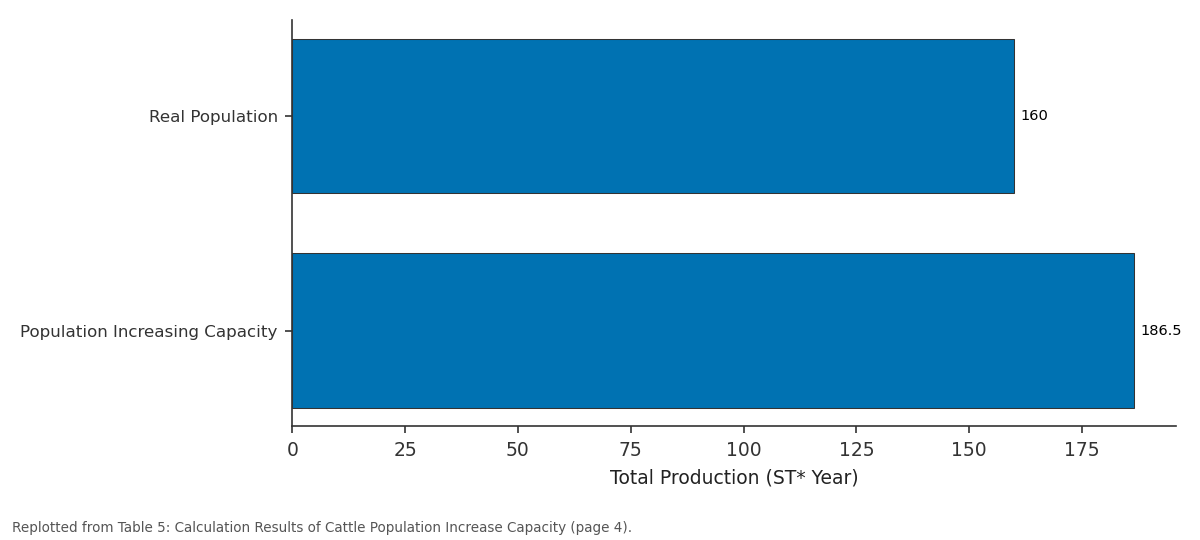
Total Production (ST* Year): Real Population vs Population Increasing...
Replotted from Table 5 (page 4) of the original paper. Every bar is the paper's own table value.
View source evidence ↗Figures & tables
From the original paper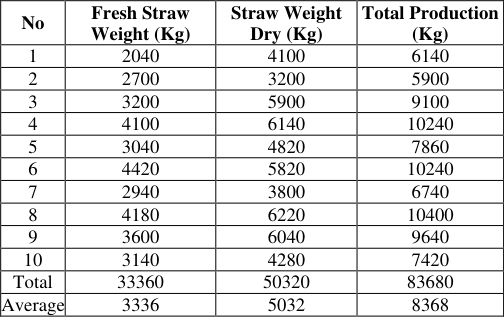 Table 1
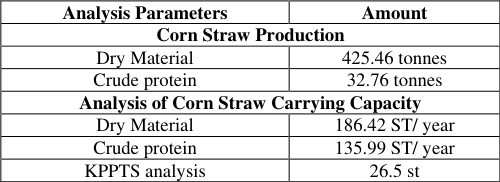 Table 2
 Table 4
 Table 3
 Table 5
Introduction
Tanjung Selamat Village is part of the Medan Tuntungan District, Medan City which is directly adjacent to Deliserdang Regency, with an area of ± 330.5 Ha with the following boundaries: To the north it is bordered by Asam Kumbang Village, Medan Selayang District, to the South it is bordered by Kelurahan Namo Gajah/Kemenangan Tani, on the east it is bordered by Tanjung Sari Village, Medan Selayang District, on the west it is bordered by the Belawan River, Deli Serdang Regency, this village is a village which was originally an agrarian village where the people made their main livelihood as farmers. Based on the aspect of road infrastructure, especially roads across factories in transporting raw goods and finished goods, they have undergone improvements with asphalt to the entire village. These conditions show that in Tanjung Selamat Village there have been many changes, from the old condition which was originally a village with large agricultural land and the original inhabitants working as farmers are now dry land with various industrial buildings standing, thus making significant changes to livelihoods. Villagers. Changes in livelihoods caused by land conversion are important to study because changes in work orientation for the people of Tanjung Selamat Village can not only have positive impacts, but also negative impacts. The issue of land conversion is not only a threat to farmers, the physical environment, the economy, and the social environment in that place, but land conversion can have a broad effect, Corn crop forage waste can be given directly to livestock and can also be given in processed form, such as hay and silage. Processed forage waste can be stored for a long time to be used/consumed during the dry/dry season when field grass is difficult to obtain. The potential of this animal feed waste can be utilized to support the Deli Serdang Regency Government's program in the field of beef cattle development. In addition, the Provincial Government of North Sumatra also has a special program for the development of beef cattle. The trend of increasing meat consumption in Indonesia shows a significant increase, in line with population growth, increased income and economic status of the Indonesian people.
Several factors hindered the provision of forage, namely the change in the function of land which was previously used as a source of forage into residential land, land for food crops and industrial crops. In addition, in general the availability of forage is also influenced by climate, so that during the dry season there is a shortage of forage for livestock and vice versa during the rainy season the amount is abundant. To overcome the shortage of grass, one of which is the use of agricultural waste as feed [1] . Some of these problems are also faced by farmers/breeders in Tanjung Selamat Village, Sunggal District, Deli Serdang Regency. Beef cattle as ruminants can consume forage in a day as much as 10-15 percent of their body weight. A cow weighing 350 kg requires consumption of 52.5 kg of grass (forage) per day. This large amount of forage needs must always be available continuously every day. Provision of grass (forage) to cattle can be given in fresh form and can also be in the form of processed feed in the form of hay and silage. Hay-shaped feed is feed derived from dried forage, usually made when forage production is abundant and can be stored for a long time for use during the dry/dry season when grass (forage) is difficult to obtain. Meanwhile, silage is processed feed derived from forage through an anaerobic preservation process (fermentation) which at the same time can also increase the digestibility of the feed itself. This study aims to analyze the potential carrying capacity of corn straw as animal feed for beef cattle farming with the research target to determine the carrying capacity of corn straw as feed for beef cattle in Tanjung Selamat Village, Sunggal District, Deli Tengah Regency.
Research Methods
Research Methods
Place and time of research
This research was conducted in Tanjung Selamat Village, Sunggal District, Deli Serdang Regency. The research lasted for 3 months starting from June to August 2022.
Tools and materials
The tools used in this study were sickle knives used to cut forage, plastic rope, scissors, wooden stakes, scroll meters, sacks, analytical scales, stationery, calculators and cameras. The material used in this research is corn waste. The material was taken from agricultural land in Tanjung Selamat Village, Sunggal District, Deli Serdang Regency.
Research methods
This study uses a survey method. The survey method used in this research is purposive sampling. Purposive sampling is a sampling method based on certain objectives and considerations from the researcher. With the conditions for sampling, namely agricultural crops that are suitable for harvesting and have a large harvest area. Sampling was carried out in accordance with the required sample requirements and the required sample size was not questioned. This method is used to obtain quantitative information to analyze problems regarding corn straw waste.
Data collection
The data used in this study consisted of primary data, namely data obtained from field surveys and secondary data obtained from related agencies or offices such as the Livestock Service Office, the Food Crops and Horticulture Service, the Regional Development Planning Agency and the Central Bureau of Statistics. Primary data is obtained from sampling from calculations by: 1. Determine the corn cropland as a sampling site by using the purposive sampling method and measuring plots around 2x1 m per stretch for careful analysis. 2. Prepare sampling equipment such as knives, sickles, sacks, plastic bags, scales, plastic straps, tape measure, stationery, calculators and cameras. 3. Sampling was carried out by cutting 10 cm of corn straw above the soil surface and then weighing it to determine the fresh weight of corn straw. 4. Each research plot took 1 stalk of corn straw and then chopped it for analysis in the laboratory.
Observed Parameters 2.5.1 Production of corn straw fresh weight
The production of fresh weight of corn straw is the total weight of corn straw after the production of corn is harvested and before it withers due to loss of water.
Corn straw dry weight production
Production of corn straw dry weight is the total weight of fresh corn straw after heating at 33.8 °C for 7 hours.
Corn straw crude protein
Corn straw crude protein is the amount of crude protein contained in feed ingredients obtained from the multiplication of nitrogen content with a conversion factor of 6.225 using the Kjeldahl method.
Corn straw feed carrying capacity
The carrying capacity of corn straw feed is calculated by knowing the production of corn straw BK divided by the number of livestock BK needs. Livestock requirement assuming that one ruminant livestock unit (1 ST) requires an average dry matter of 6.25 kg/day or 2281.25 kg/year and a crude protein requirement of 0.06 kg/day or 21.9 kg/year [2] 2.6 Data analysis Data analysis of corn straw holding capacity including production of fresh weight, dry weight production, crude protein and feed carrying capacity of corn straw were analyzed descriptively.
Research result 3.1 Production of fresh corn straw
Corn straw production fresh based on the tiled snippets carried out are listed in table 1. Based on the data in table 3 above and the sample area data, the production of fresh corn is16,680 kg/ha
| Parameter | Total Production (Tons/ ha) |
|---|---|
| Dry Material | 425,46 |
| Crude protein | 32.76 |
Table text extracted from the original PDF; superscript letters are shown inline. The original table image is below.
View original table image
| No | Fresh Straw Weight (Kg) | Straw Weight Dry (Kg) | Total Production (Kg) |
|---|---|---|---|
| 1 | 2040 | 4100 | 6140 |
| 2 | 2700 | 3200 | 5900 |
| 3 | 3200 | 5900 | 9100 |
| 4 | 4100 | 6140 | 10240 |
| 5 | 3040 | 4820 | 7860 |
| 6 | 4420 | 5820 | 10240 |
| 7 | 2940 | 3800 | 6740 |
| 8 | 4180 | 6220 | 10400 |
| 9 | 3600 | 6040 | 9640 |
| 10 | 3140 | 4280 | 7420 |
| Total | 33360 | 50320 | 83680 |
| Average | 3336 | 5032 | 8368 |
Table text extracted from the original PDF; superscript letters are shown inline. The original table image is below.
View original table image
Cattle capacity
The results of the recapitulation of the analysis of the capacity of cattle using corn straw obtained during the study are presented in table 5 as in Appendix 2.
| Parameter | Total Production (ST* Year) |
|---|---|
| Real Population | 160 |
| Population Increasing Capacity | 186.5 |
Table text extracted from the original PDF; superscript letters are shown inline. The original table image is below.
View original table image
Corn straw production
The results of calculating corn straw production obtained during the study are presented in table 3. Explained that the dry matter obtained was 425.46 and the crude protein obtained was 32.76. Corn straw is the second largest production of agricultural waste which can be used as cattle feed after rice straw. Syamsu, et al. [3] added that the largest production of agricultural waste was rice straw 85.81%, corn straw 5.84%, peanut straw 2.84%, soybean straw 2.54%, cassava shoots 2.29% and cassava straw. Narrow 0.68%. The content of agricultural waste (corn straw) that has not been processed from the laboratory results of the Sei Putih Goat Goat Research Workshop is 63.75% DM and 7.70% PK. The results of the nutritional content of corn straw given to livestock are influenced by the harvest period. Corn plants are harvested young, the water content of corn plants is high, conversely, the older the harvested corn, the less water it will contain [4] . Forages derived from corn plants are expected to be used as a substitute for grass for ruminant livestock.
Corn forages in the form of stems and leaves (corn straw) which are still dry or fresh are chopped to be made into silage thereby increasing straw nutrition and livestock palatability [5] . Forage for livestock is not only natural grass or cultivated grass, but forage derived from agricultural waste. The research results obtained from the production of agricultural waste, namely corn straw from the samples in Tanjung Selamat Village, Sunggal District, amounted to 2.20 kg. The total production of BK of corn straw was 425.46 tons, this amount was lower when compared to the results of research [6] which was 8490.18 tons of BK. The low production of corn straw in Tanjumg Selamat Village, which is located in the lowlands, is caused by the relatively higher ambient temperature (25.4°). High temperatures will cause avapotranspiration so that the percentage of water content in corn straw decreases because the plants tend to be dehydrated and result in a lower weight of corn straw in the lowlands [7] . added that high ambient temperatures will affect the water content of the leaves and will experience a water deficit. This is consistent with observations when sampling corn straw at the research location, corn straw seems to experience aging/drying faster so that the weight of corn straw is lower.
Rainfall factor also greatly affects the low production of corn straw [8] . Stated that normal rainfall for the growth of corn plants is 200-250 mm per month. Dry matter production depends on the availability of nutrients in the soil. Even though the same fertilizer was given at the study site, the effectiveness of its use was also influenced by microbial life in the plant root risorfer environment. This is supported by the opinion [9] which states that soil that is sufficiently moist and not dry soil microorganisms grow and function properly, to assist the process of providing and absorbing nutrients. Soil microbial activity in a moist and non-dry soil environment results in a better nitrogen mineralization process.
Support corn straw feed
The results of the calculation of the analysis of the carrying capacity of the feed from corn straw obtained during the study are presented in table 4. Based on table 4 above it can be explained that the dry matter obtained is equal to186,42 and crude protein obtained by 135.99.Carrying capacity is the ability to provide forage for livestock in the form of natural grass and agricultural waste products from a grazing area. According to [10] carrying capacity is the amount of environmental ability to support animal life, which is expressed by the number of tails per unit of land. The number of animals that can be supported depends on the amount of biomass (plant organic matter) available to the animals. Carrying capacity can be determined by the amount of plant organic matter formed from photosynthesis per unit area and time, which is called primary productivity.
| Parameter | Total Production (ST/Year) |
|---|---|
| Dry Material | 186,42 |
| Crude protein | 135.99 |
Table text extracted from the original PDF; superscript letters are shown inline. The original table image is below.
View original table image
The capability of an area can be assessed if the amount of available fodder is greater than the number of livestock accommodated. The carrying capacity index is the result of dividing the potential forage available by the amount of feed needed.
The feed carrying capacity index (IDDP) is used to see the comparison of the availability of forage from food crop waste with the number of ruminant livestock populations in an area. IDDP is obtained from the total production of forage, waste and ram banks available in an area (ST) divided by the number of rumansia livestock population in that area (ST) or the carrying capacity of potential forage divided by the total population [11] . IDDP scores are grouped into three categories, namely low category, medium category, and high category. Utilization of agricultural waste, namely corn straw, can support the ability of an area to provide forage for livestock.
The results of the calculation of the carrying capacity of corn straw in Tanjung Selamat Village, Sunggal District, are 186.5 ST, while the total livestock population is 160 ST. This shows that Sunggal District, Deli Serdang Regency can support the availability of feed from agricultural waste (corn straw).
Analysis of cattle population increase capacity
The results of the calculation of the capacity analysis for increasing the cattle population obtained during the study are presented in table 5 below.
Acknowledgement
AcknowledgmentsThe authors would like to thank Animal Husbandry Study Program, Faculty of Sciences and Technology, Pembangunan Panca Budi University.
Figures and tables from the paper
| Analysis Parameters | Amount |
|---|---|
| Corn Straw Production | |
| Dry Material | 425.46 tonnes |
| Crude protein | 32.76 tonnes |
| Analysis of Corn Straw Carrying Capacity | |
| Dry Material | 186.42 ST/ year |
| Crude protein | 135.99 ST/ year |
| KPPTS analysis | 26.5 st |
Table text extracted from the original PDF; superscript letters are shown inline. The original table image is below.