
Research article · 2023 · Full text
International Journal of Advanced Biochemistry ResearchNature within us: A sustainable lifestyle approach to connect with nature
Volume 7(2S) · Pages 85–88 · DOI: 10.33545/26174693.2023.v7.i2sb.191 ↗
Research areasEnvironmental Education and SustainabilityUrban Transport and AccessibilityImpact of Light on Environment and Health
Abstract
Author-writtenUrbanization, industrialization, technological development and changes in human lifestyles have limited access to nature, wildlife and green spaces in and around us. The present paper provides an overview of the benefits of the natural environment in order to connect each individual with it and thus improve the quality of life. Research attempts to examine the importance of natural environment for the individual. The research also clarifies the responsible influence of technology and digital lifestyle. The research targets the community participants (N=100), which includes college students (62%), working professionals (22%) and non-working groups (16%). 82% of the population agreed that nature reduces stress. The study also reported that the time spent outdoors is longer on weekends compared to weekdays. 45% of the sample population spends less than 5 hours/day on digital screens (mobile phones, laptops, television etc.). 6% of the population do not have digital screens of which 4% are from non-working groups especially older people and 2% from low-income professionals.
Summary
Source-checkedPlain-language reading of the full paper, prepared with AI and checked against the text. Each point links to the authors' own words.
Why it matters
- Modern factors like urbanization and technological growth have restricted human access to nature and green spaces. View evidence ↗
- Global urban living is increasing, with 55% of the population currently in cities and a projection of 68% by 2050. View evidence ↗
- Disconnection from the natural world can lead to 'Nature deficit disorder,' which is characterized by a decrease in quality of life. View evidence ↗
The question
- The study aims to provide an overview of the benefits of the natural environment to encourage individual connection and improve quality of life. View evidence ↗
- The research seeks to examine the importance of the natural environment for individuals and the role of digital lifestyles in creating disconnection. View evidence ↗
What they did
- The study employed a dual methodology consisting of literature reviews and questionnaire surveys. View evidence ↗
- The survey included 100 participants: 62% college students, 22% working professionals, and 16% non-working groups. View evidence ↗
- The survey was conducted in Bilaspur City, Chhattisgarh, India, with participants aged between 20 and 60 years. View evidence ↗
- The questionnaire measured preferences for outdoor environments, time spent outdoors on weekdays and weekends, and time spent using digital screens. View evidence ↗
What they found
- A large majority (82%) of the study population agreed that spending time in nature reduces stress. View evidence ↗
- Less than half (45%) of the sample population spends fewer than 5 hours per day on digital screens. View evidence ↗
- Only 6% of the population do not use digital screens, consisting of 4% from non-working groups (mostly older people) and 2% from low-income professionals. View evidence ↗
- While most respondents prefer outdoors on weekends, non-working groups showed the opposite preference, favoring outdoors on weekdays. View evidence ↗
- Outdoor locations like forests, mountains, and rivers were highly rated by 75% of the population (scores 8-10). View evidence ↗
What it means
- The authors conclude that connecting with nature is a cost-effective method to improve psychological, emotional, and mental health across all age and employment groups. View evidence ↗
- The authors recommend that people should actively expand their boundaries to appreciate and connect with the natural environment. View evidence ↗
Visual summary
2 visualsIllustrations explain the paper; charts are replotted from the paper's own table values.
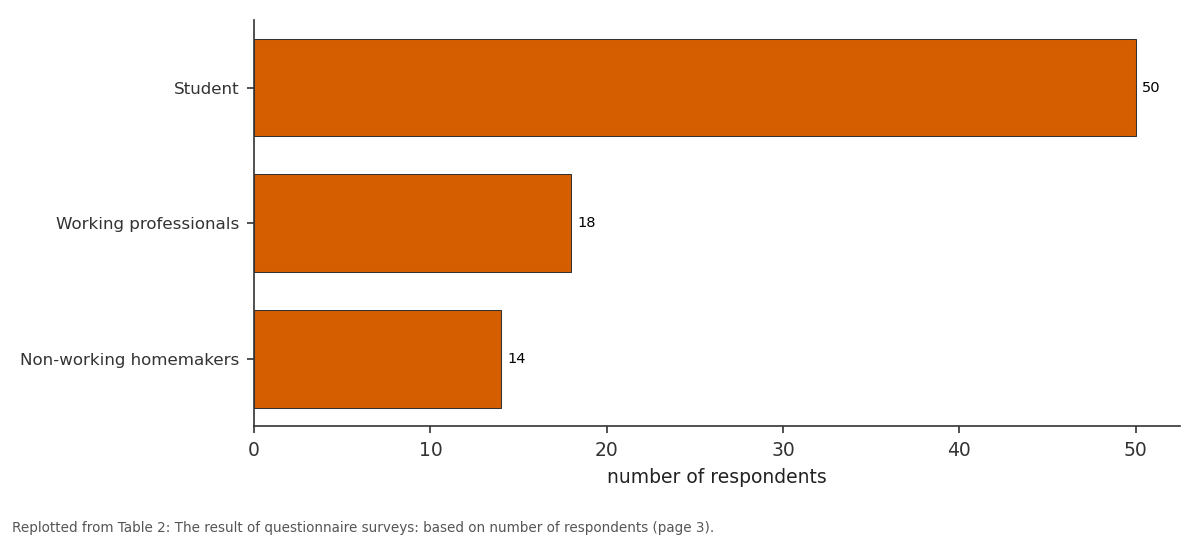
Nature reduces stress / Yes: Student vs Working professionals vs Non-working homemakers
Replotted from Table 2 (page 3) of the original paper. Every bar is the paper's own table value.
View source evidence ↗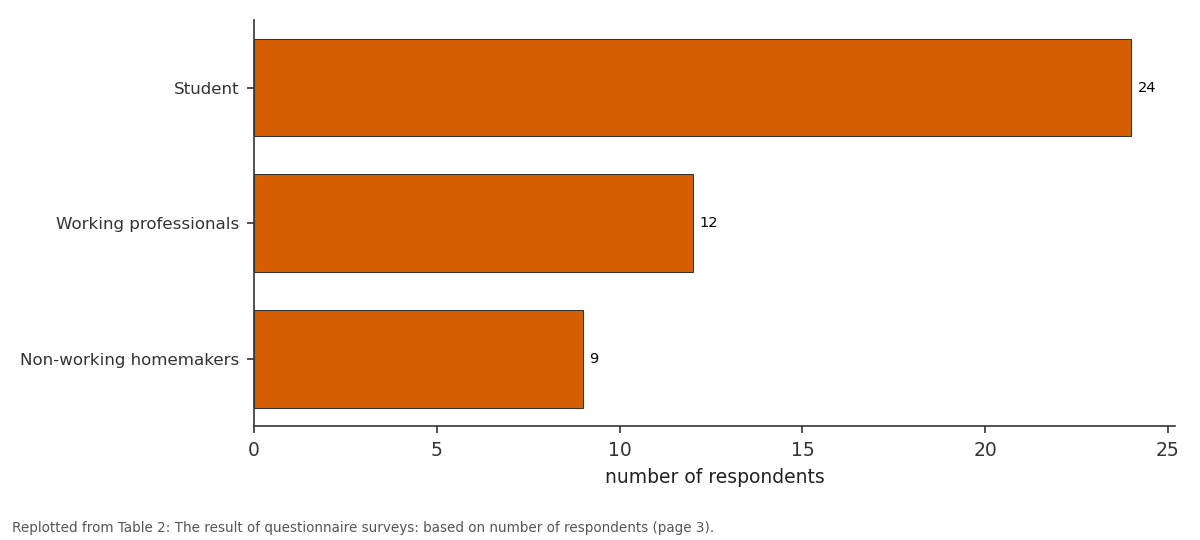
< 5 Hours: Student vs Working professionals vs Non-working homemakers
Replotted from Table 2 (page 3) of the original paper. Every bar is the paper's own table value.
View source evidence ↗Figures & tables
From the original paper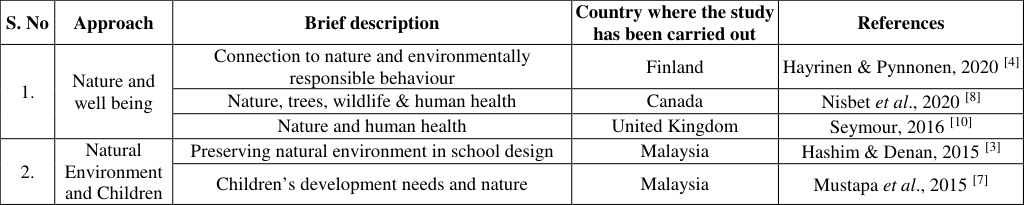 Table 1
 Table 2
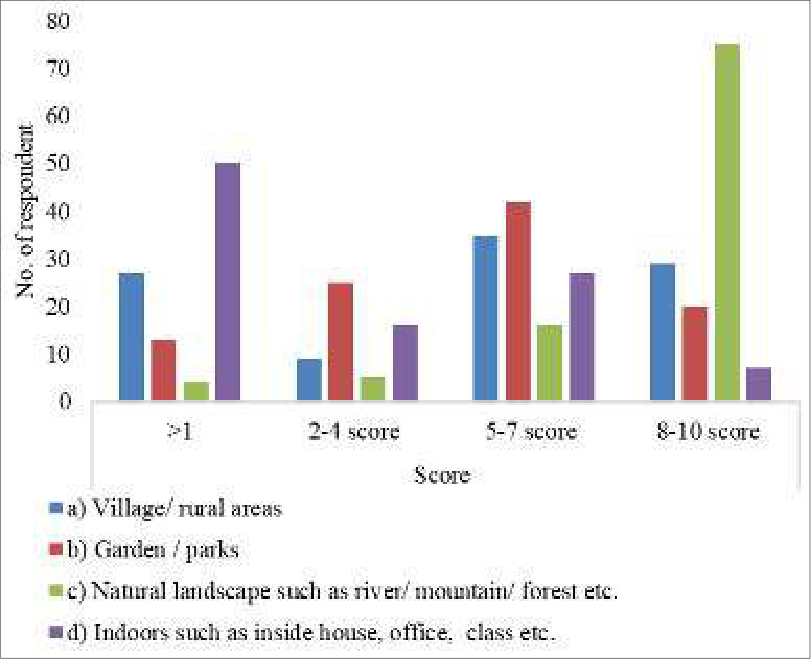 Figure 1
Introduction
Environment plays a very important role in human lifestyle and vice versa. There are numerous hidden aspects of human lifestyle that affect the natural and built environment. Urbanization (Turner et al., 2004) [13] , industrialization, and technological development have led to a flourishing of indoor and virtual leisure opportunities (Mahato, 2021) [6] . This has led to a disconnect from the natural environment. Changes in human lifestyles have limited access to nature, wildlife and green spaces in and around us. As an integral part of nature, human existence is threatened when the natural environment is damaged and degraded. Around 55% of the world's population currently lives in cities, which is projected to increase to 68% by the year 2050 (United Nations, 2018) [14] . The apartment culture of housing, smaller and dense communities, nuclear families, reduced social life, and increased use of screens i.e. television, and mobile phones further aggravated the situation. Technological advancement such as computer/ mobile phone, easy access to the internet etc. has created a gap among humans, especially youth and students when it comes to observing, analysing, understanding and solving real-life problems. Despite evidence of the benefits of nature, humans spend less time interacting with the natural environment. Louv (2005) [5] coined the term; "Nature deficit disorder" means a decrease in quality of life due to disconnection from the natural world. The present study provides an overview of the connectivity of nature between different sample populations. The paper also illustrates that the reliance on advanced technology and digital screens for this dis-connectedness.
Methodology
Two methods were considered for the present study, including reviews and questionnaire surveys. Literature searches on natural environment, environment and human health, connection/disconnection from nature, human lifestyle, and child/ school environment were conducted from online databases such as Science Direct, IOP publishing, MDPI, books and articles. Reviews, empirical and theoretical works on the respective topic were selected from the publications between 2004 and 2021. The questionnaire survey was conducted from Bilaspur City in the state of Chhattisgarh, India. Three groups of people were selected for the study viz. students, working professionals and non-working homemakers. The sample population includes undergraduate and postgraduate college students, while professionals include teachers and office workers. The non-working group mainly include housewives and older people. All respondents were between 20 and 60 years old. The questionnaire was designed to measure the selected sample population's preference for the outdoor environment, and the time they spend outdoors on weekdays and weekends. The study also takes into account the time spent using digital screens (Table 2). The present paper also assesses the emotional, physical and mental status of the sample population when visiting places of natural importance such as villages/ rural areas, parks and gardens, places of natural landscapes such as rivers/ mountains/ forests etc. and indoor places such as in home, office, class etc.
| Sample Population | Gender | — | Time spent on digital screens per day | — | — | — | — | Time spent outdoors during weekdays per day | — | — | — | Time spent outdoors during weekends | — | — | — | Nature reduces stress | — | — |
|---|---|---|---|---|---|---|---|---|---|---|---|---|---|---|---|---|---|---|
| M | F | No digital screen | < 5 Hours | 5-8 Hours | 8-10 Hours | > 10 Hours | < 2 Hours | 2-3 Hours | 3-4 Hours | > 5 Hours | < 2 Hours | 2-4 Hours | 4-6 Hours | 6-8 Hours | Yes | No | May be | |
| Student | 32 | 30 | 0 | 24 | 19 | 10 | 9 | 42 | 11 | 4 | 5 | 32 | 4 | 16 | 10 | 50 | 0 | 12 |
| Working professionals | 12 | 10 | 2 | 12 | 03 | 04 | 01 | 18 | 3 | 1 | 0 | 18 | 4 | 0 | 0 | 18 | 0 | 4 |
| Non-working homemakers | 6 | 10 | 4 | 9 | 2 | 1 | 0 | 13 | 2 | 1 | 0 | 6 | 6 | 4 | 0 | 14 | 0 | 2 |
Table text extracted from the original PDF; superscript letters are shown inline. The original table image is below.
View original table image
Result and Discussion
For this preliminary study, the results of both methods were successfully compiled within one month. Literature research illustrates approaches to closeness to nature (Table 1). The questionnaires were answered successfully. One hundred questionnaires were analyzed. Table 2 and Figure 1 show the results of the questionnaire survey. 62% of the respondents were students, 22% were professionals, 16% did not belong to non-working group. 50% of the sample population were male and 50% female. 45% of the population spends less than 5 hours in front of digital screens, while 10% spend more than 10 hours in front of digital screens (Table 2). Most respondents prefer to spend time outdoors on weekends than on weekdays. Nonworking groups prefer to stay indoors on weekends but prefer to spend time outdoors during weekdays. 82% of the respondents agreed that spending time in nature reduces stress and 18% of the population were unsure. Fig. 2 shows the sample population's rating based on emotional, physical and mental status when visiting places of natural importance such as villages/ rural areas, parks and gardens, places in natural landscapes such as rivers/ mountains/ forests, etc. 75% of the population gave a high score (8-10) to visiting outdoor locations such as forests, mountains, rivers, etc. 29% of the respondents gave high marks to places like villages and rural areas, 20% of the population gave high marks to places like parks and gardens. Only 7% of respondents rated the remaining interior spaces as high, e.g. in the house, in the office, in the classroom etc. Wyles et al. (2019) [15] reported that people who visited rural and coastal locations found greater connection with nature than people who visited urban green spaces and protected areas. The author also concluded that there is a close connection between connectedness with nature and its restoration. A similar study by Hashim and Denan (2015) [3] who examined the importance of preserving the natural environment in school design in Malaysia. The study reported that students prefer schools surrounded by natural environments that stimulate student's creativity and are most preferred by students. Numerous scientists, painters, designers, philosophers, poets, architects etc. were inspired by nature, took their ideas and innovations from the natural environment and also inculcated them in their art. Since 62% of the target group of the present study were students, it can be assumed that the built environment gives little priority to the developmental needs of children (Mustapa et al. 2015) [7] . There are many proven studies that disconnecting from nature leads to various health problems such as obesity (A Yilmax, 2008) [16] , vitamin D deficiency, attention deficit disorder (ADD), Attention Deficit Hyperactive Disorder (Taylor & Kuo, 2009) [12] and physical problems (Table 1). The benefits of direct connection with nature aid in children's motor development and fitness (Said, 2012) [9] . A person exposed to nature improves their emotional, psychological and cognitive behaviour (Wyles et al., 2019) [15] . Generalov and Generalova (2020) [2] studied the influence of human lifestyle on the creation of a typological structure of the urban living environment. The result reported on various factors attracting apartment culture in urban areas, including changing human lifestyles, comfortable living and working spaces, lower income brackets, sense of safety and security etc. Nisbet et al. (2020) [8] concluded that people living near trees reported better perceptions of mental health and a greater sense of connectedness with the natural world around them. Connectedness to nature, trees and wildlife was associated with better psychological well-being and less mental distress. Increasing declines in human-nature interactions can pose significant threats to human and environmental health (Soga & Gaston, 2016) [11] . Hayrinen & Pynnonen, 2020 [4] Nature, trees, wildlife & human health Canada Nisbet et al., 2020 [8] Nature and human health United Kingdom Seymour, 2016 [10] 2.
| S. No | Approach | Brief description | Country where the study has been carried out | References |
|---|---|---|---|---|
| 1. | Nature and well being | Connection to nature and environmentally responsible behaviour | Finland | Hayrinen & Pynnonen, 2020 [4] |
| Nature, trees, wildlife & human health | Canada | Nisbet et al., 2020 [8] | ||
| Nature and human health | United Kingdom | Seymour, 2016 [10] | ||
| 2. | Natural Environment and Children | Preserving natural environment in school design | Malaysia | Hashim & Denan, 2015 [3] |
| Children’s development needs and nature | Malaysia | Mustapa et al., 2015 [7] |
Table text extracted from the original PDF; superscript letters are shown inline. The original table image is below.
View original table image
Natural Environment and Children
Preserving natural environment in school design Malaysia Hashim & Denan, 2015 [3] Children's development needs and nature Malaysia Mustapa et al., 2015 [7]
Conclusion
Research has shown that nature reduces stress and people prefer to spend time outdoors. Technological development, increasing use of digital screens, and changes in work culture and lifestyle have led to disconnection from nature. So, knowing the natural environment and its benefits will help us to connect with nature. The nature environment and connection with it is a cost-effective way of enrich our psychological and emotional status, as well as improving our health and mental state in children, working and nonworking groups. Therefore, we need to extend our boundaries by appreciating and connecting with nature.
References
15 in the original paper- AO A, Yilmaz O. Assessment of outdoor school environments and physical activity in Ankara's primary schools. Journal of Environmental Psychology. 2008;28:287-300.
- Hashim HH, Denan Z. Importance of preserving the natural environment in the design schools in Malaysia. Procedia Social and Behavioural Sciences. 2015;170:177-186.
- Hayrinen L, Pynnonen S. A review of the concepts and measurements for connection to nature and environmentally responsible behaviour. A call for research on human-forest relationships. Current Forestry Reports. 2020;6(4):323-338.
- Louv R. Last child in the woods: Saving our children from nature-deficit disorder. New York: Algonquin Books. 2005.
- Mahato A. Connecting Nature & You A pathway of sustainable living. Books Clinic Publishing. 2021. ISBN:978-93-5535-273-6.
- Mustapa ND, Maliki NZ, Hamzah A. Repositioning Children's Developmental Needs in space planning: A review of connection to nature. Procedia Social and Behavioural Sciences. 2015;170:330-339.
- Nisbet EK, Shaw DW, Lachance DG. Connectedness with nearby nature and well-being. Frontiers in sustainable cities. 2020;2(18):1-13. DOI: 10.3389/frsc.2020.00018.
- Said I. Affordances of nearby forest and orchard on children's performances. Procedia: Social and Behavioural Sciences. 2012;38:195-203.
- Seymour V. The human-nature relationship and its impact on health: A critical review. Front. Public Health. 2016;4:260. DOI: 10.3389/fpubh.2016.00260.
- Soga M, Gaston KJ. Extinction of experience: The loss of human-nature interactions. Front. Ecol. Environ. 2016;14:1225. DOI: 10.1002/fee.1225.
- Taylor AF, Kuo FE. Children with attention deficits concentrate better after walking in the park. Journal of Attention Disorders. 2009;12(5):402-409.
- Turner WR, Nakamura T, Dinetti M. Global urbanization and the separation of humans from nature. BioScience. 2004;54:585-590. [0585:GUATSO]
- United Nations. World Urbanization Prospects: The 2018 revision; c2018. https://population.un.org/wup/publications/files/wup20 18-keyfacts.pdf
- Wyles KJ, White MP, Hattam C, Pahl S, King H, Austen M. Are some natural environments more psychologically beneficial than others? The importance of type and quality on connectedness to nature and psychological restoration. Environment and Behavior. 2019;51(2):111-143. DOI: 10.1177/0013916517738312.
- Yilmaz AE, Boncukcuoğlu R, Kocakerim MM, Yilmaz MT, Paluluoğlu C. Boron removal from geothermal waters by electrocoagulation. Journal of hazardous materials. 2008 May 1;153(1-2):146-51.
Cited by 2
From OpenAlex, OpenCitations and reference lists read by Scinovex
- Assessment of Air Pollution Tolerance Indices (APTI) and Anticipated Performance Index (API) of roadside tree species of Bilaspur, Chhattisgarh, India
Prasen Jeet, Anupama Mahato · International Journal of Agriculture Extension and Social Development · 2025
The rapid increase in the number of cars in and around urban centers has led to an increase in vehicular pollution. Vehicular pollutants cause significant changes in the biochemical and physiological processes of roadside trees as they are constantly exposed to air pollutants. The aim of this study is to comparatively assess the effects of road side pollution on tree species in urban, sub urban and control sites of the Bilaspur district of Chhattisgarh. Seven tree species (Alstonia scholaris, Butea monosperma, Cassia siamea, Dalbergia sissoo, Ficus religiosa, Mangifera indica, Peltophorum ferr
- Green Practices and Innovations Oriented toward a Lifestyle Connected with Nature ↗
Erika Loučanová, Martina Nosáľová · IntechOpen eBooks · 2024
Globalization has led to an increase in the popularity of alternative medicine, particularly those that emphasize living a natural lifestyle. In addition to the necessities of life, such as food, nature also provides us with nature medical needs. These in a different character are widely used in modern as well as in traditional folk medicine. These methods may be considered…
❝ 0PDF