
Research article · 2023 · Full text
International Journal of Advanced Biochemistry ResearchEco-restoration of degraded land with the medicinal plant by the use of biofertilizers: A comparative study of Emlica officinali and Azadirachta indica
Volume 7(2S) · Pages 10–12 · DOI: 10.33545/26174693.2023.v7.i2sa.183 ↗
Research areasMycorrhizal Fungi and Plant Interactions
Abstract
Author-writtenA present study was conducted to restore the degraded land by agroforestry models using medicinal tree species viz. Emlica officinalis and Azadirachta indica in Bilaspur. The different AM fungal species belonging to genera viz., Acaulospora and Glomus were isolated and identified from the rhizosphere. Among these genus, Glomus was found to be the most frequent fungus. The distributions of AM fungal average frequencies have been discussed. It was found that some of the soil properties were significantly different (p<0.05). The soil organic carbon, available nitrogen, phosphorus and potassium including AM fungi were comparatively higher in Emlica officinalis than Azadirachta indica plantation. The demand for Indian medicinal plants has increased over the last few decades in the international market and this medicinal plants-based agroforestry model practice will help to reclaim the degraded lands.
Summary
Source-checkedPlain-language reading of the full paper, prepared with AI and checked against the text. Each point links to the authors' own words.
Why it matters
- Soil degradation is a critical global issue, particularly in tropical regions where large areas of land have become unproductive. View evidence ↗
- In India, approximately 114.01 Mha of the total 328.7 Mha geographical area is classified as degraded or wasteland. View evidence ↗
- Plantation-based eco-restoration is considered the most effective method for reclaiming degraded ecosystems. View evidence ↗
The question
- The study aims to evaluate how two different medicinal tree species affect the physical, chemical, and biological properties of soil during the restoration of a degraded ecosystem. View evidence ↗
What they did
- The experiment was conducted at Guru Ghasidas Central University in Bilaspur, Chhattisgarh, India. View evidence ↗
- Rhizosphere soil samples were collected from three different sites for two medicinal plant species at depths ranging from 0 to 30 cm. View evidence ↗
- Soil analysis included measuring organic matter, nitrogen, phosphorus, potassium, and Arbuscular Mycorrhizal (AM) fungal spore populations using standard established methods. View evidence ↗
What they found
- Soil pH ranged from 5.68 to 6.37, with Emlica officinalis plantations exhibiting more acidic soil than Azadirachta indica plantations. View evidence ↗
- AM fungal species from the genera Acaulospora and Glomus were identified, with Glomus being the most frequent genus found in the rhizosphere. View evidence ↗
- Overall, soil organic carbon, available nitrogen, phosphorus, potassium, and AM fungi populations were higher in Emlica officinalis plantations than in Azadirachta indica plantations. View evidence ↗
- Available nitrogen and phosphorus showed a statistically significant positive correlation (p < 0.01) with the AM fungal population. View evidence ↗
What it means
- The authors conclude that planting medicinal species is vital for restoring degraded land, stabilizing ecosystems, and conserving biodiversity. View evidence ↗
- The authors recommend the use of medicinal plant-based agroforestry models to help reclaim degraded lands. View evidence ↗
- The authors state that further research is required to maximize the benefits of symbiotic associations for land reclamation and profit. View evidence ↗
Visual summary
1 visualsIllustrations explain the paper; they do not show study data.
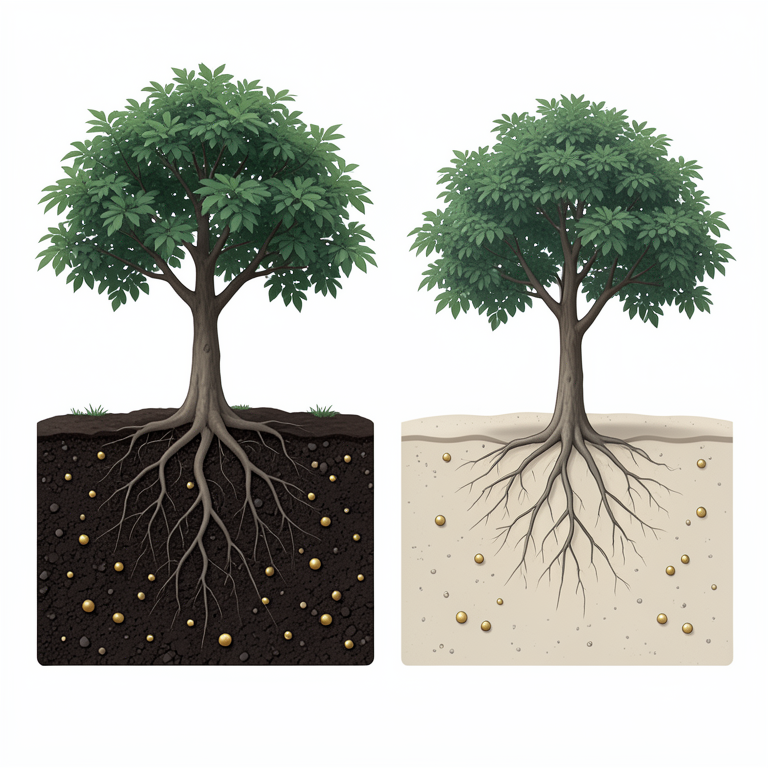
Comparative Soil Restoration
AI-generated conceptual illustration (Emblica officinalis and Azadirachta indica trees in degraded soil). It explains the idea and does not show study data.
View source evidence ↗Figures & tables
From the original paper Table 1
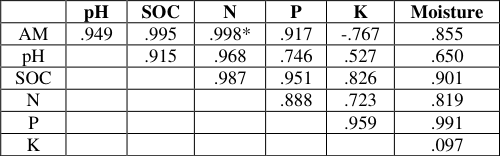 Table 2
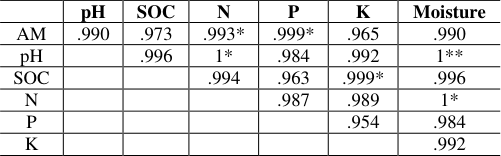 Table 3
Introduction
Degradation of soil has become serious problem especially in tropical region as vast area of land all over the world has been converted into unproductive and degraded lands. India accounts for nearly about 328.7 Mha of the total geographical area and a very large part of its total geographical area (114.01 Mha) of the country is represented as the degraded and waste land land. Eco-restoration through plantation is the most effective technique to reclaim the degraded ecosystem. The Agroforestry has the great potentials to yield, fodder, fuel wood and small timber in addition to food contribute directly to sustainable improvements for rural income along with the reclamation of degraded agricultural lands and helps in the conservation of the tropical forests. Agroforestry system include multipurpose tree species have received wide attention today. According to Parrotta (2000) [8] there is a need to restore degraded areas to improve their productive capacity, environmental functions, and biodiversity value has been widely recognized and requires various human interventions to initiate recovery. Various ecological restoration methods involving planting of tree seedlings have been developed to reforest degraded lands (Lamb et al. 2005 and Kenichi et al. 2007) [6,5] . Selection of ideal tree species for restoration of degraded areas is very important step in degraded ecosystem (Mukhopadhyay et al., 2013; Bohre and Chaubey, 2014) [7,2] . Medicinal plants constitute a considerably large component of natural vegetation in Chhattisgarh. The medicinal plant based agroforestry model are profitable as in recent days a large number of medicinal plant species are considered threatened due to high demand due to their destructive collection practice. Hence, required for conservation and sustainable use and further development of medicinal plant diversity. Soil microorganisms play significant role in soil fertility and ecosystem functioning and thus the soil can be taken as fertility index. Chiti et al., (2007) [3] the demand for a particular mineral nutrient depends on plant internal requirements, whereas the supply of that nutrient primarily depends on its availability and mobility in soils. Without the microbes and their functions, plant species could not be supported by the soil alone (Filcheva et al., 2000) [4] . In this paper deals with the restoration of degraded ecosystem aiming at study in which the changes brought about in physical, chemical and biological properties of soil under the two different medicinal tree species.
Materials and Methods
The present experiment was conducted in the Department Of Forestry, Wildlife and Environmental Sciences, Guru Ghasidas Central University of Bilaspur, Chhattisgarh, India (22.09 N 82.15 E). It's have an elevation of 262m under the plantation of Emlica officinalis and Azadirachta indica. The climate of Bilaspur region is pleasant and mild with minimum temperatures of 10 o C and 45 o C in very hot summers during the seasons. To know the effect of nutrient content of different plantations from rhizosphere of two medicinal plant species were collected from surface soil up to the depth of 0-30 cm at three different sites of plantation under study. Residues were removed before collection and further dried in shade, grounded with pestle-mortar and passed through a 2mm sieve for subsequent analysis. The standard procedures were followed for analysis of soil. The moisture content of fresh soil sample was determined by the methods of association of official analytical chemists (AOAC, 2000) using absorption spectrometer. The macronutrients were determined by organic matter (Walkley-Black method), Nitrogen (Kjeldahl technique), phosphorous (Olsen method) and potassium (Jackson, 1973) [10] and Arbuscular Mycorrhizal (AM) Fungal spore population (Gerdemann and Nicolson, 1963) [9] .
Results and Conclusion
The nutrients content in the present soil sample can be taken as a functional index for soil development. The slightly acidic to neutral pH under the different medicinal plantation forests was suitable for greater availability of nutrients, decomposition of litter and microbial activity. The soil was laterite in all sites and have loamy to sandy loan in texture. The table 1 shows the result of soil physico-chemical of soil under plantation of Emlica officinalis and Azadirachta indica. The pH of soil sample ranged from 5.68-6.37, indicating the soil existence is acidic to slightly neutral in nature. The analyses of soil showed that the soil pH was more acidic in Emlica officinalis plantation than in Azadirachta indica plantation. The organic matter including nitrogen and phosphorus was higher in Emlica officinalis plantation as compared to Azadirachta indica plantation.
| Parameter | Emlica officinalis | — | — | Azadirachta indica | — | — |
|---|---|---|---|---|---|---|
| 0-10 (cm) | 10-20 (cm) | 20-30 (cm) | 0-10 (cm) | 10-20 (cm) | 20-30 (cm) | |
| Soil pH | 5.97+0.19 | 5.72+0.16 | 5.68+0.14 | 6.37+0.25 | 6.25+0. 21 | 6.01+0.19 |
| SOC (%) | 2.23 +0.13 | 1.95+0.06 | 1.65+0.05 | 1.42+0.05 | 1.26+0.3 | 0.98+0.03 |
| N (Kg/ha) | 390 +2.75 | 365+1.33 | 350+1.07 | 287.5+1.71 | 262+1.23 | 232.2+1.05 |
| P (Kg/ha) | 20.2+1.13 | 19+0.35 | 14.2+0.12 | 12.50+0.97 | 11.15+0.05 | 10.25+0.03 |
| K(Kg/ha) | 254+2.50 | 246+2.16 | 322+1.90 | 166+1.81 | 162+1.17 | 154+1.05 |
| Moisture (%) | 37.20+1.35 | 36.90+0.85 | 32.40+0.65 | 33.40+1.15 | 32.0+0.45 | 30.25+1.05 |
Table text extracted from the original PDF; superscript letters are shown inline. The original table image is below.
View original table image
In the present study we have analyzed the effect of AM fungi and nutrient content under the two different medicinal plant species of Emlica officinalis and Azadirachta indica. The medicinal plant species improve the physic-chemical and biological quality of soil. The nutrients and AM fungal population are significantly interrelated to one another. The study showed that the soils under medicinal plant of Emlica officinalis have better enriched with macro-nutrients and organic matter as compared to the soil under Azadirachta indica plant species. The different AM fungal species belonging to genera viz., Acaulospora and Glomus was isolated and identified from the rhizosphere of medicinal plant species of Emlica officinalis and Azadirachta indica. Among these genus Glomus was found to be the most frequent fungus. The distributions AM fungal spore average frequencies have been discussed in Graph 1. The table 2 and 3 show the correlation coefficient among soil Physisco-chemical characteristics and microbial population in Emlica officinalis plantation and Azadirachta indica plantations. The nutrient characteristics like available nitrogen and available phosphorus show a positive correlation with AM fungal population at p< 0.01 significant level.
| — | pH | SOC | N | P | K | Moisture |
|---|---|---|---|---|---|---|
| AM | .949 | .995 | .998* | .917 | -.767 | .855 |
| pH | .915 | .968 | .746 | .527 | .650 | |
| SOC | .987 | .951 | .826 | .901 | ||
| N | .888 | .723 | .819 | |||
| P | .959 | .991 | ||||
| K | .097 |
Table text extracted from the original PDF; superscript letters are shown inline. The original table image is below.
View original table image
Conclusion
The present study help in decreasing pressure for demand and supply and create an opportunity for source of raw material from agroforestry-based model. The better understanding of AM population to understand relation with species and its relation with soil parameters. mycorrhizal associations are important parameters in determining the availability of soil resources to plants. Thus, we can say that the plantation of medicinal plant species play an important role in the conservation of biological diversity, restoration of degraded land and stability of an ecosystem. These medicinal plant species have also provided the favourable medium for various microorganisms for decomposition activities. Thus, this medicinal plants-based agroforestry model practice will help to reclaim the degraded lands. Much research is needed to maximize the benefits that can be accrued from application of these symbiotic associations in reclamation of degraded land and plantation for beneficial profit.
Figures and tables from the paper
| — | pH | SOC | N | P | K | Moisture |
|---|---|---|---|---|---|---|
| AM | .990 | .973 | .993* | .999* | .965 | .990 |
| pH | .996 | 1* | .984 | .992 | 1** | |
| SOC | .994 | .963 | .999* | .996 | ||
| N | .987 | .989 | 1* | |||
| P | .954 | .984 | ||||
| K | .992 |
Table text extracted from the original PDF; superscript letters are shown inline. The original table image is below.
View original table image
References
9 in the original paper- Ali MA, Rehman I, Iqbal A, Din S, Rao AQ, Latif A, et al. Nanotechnology, a new frontier in Agriculture. Adv life sci. 2014;1(3):129-138.
- Bohre P, Chaubey OP. Restoration of Degraded Lands through Plantation Forests. Global journal of science frontier research. 2014;14(1):19-27.
- Chiti T, Certini G, Puglisi A, Sanesi G, Capperucci A, Forte C. Effects of associating a N-fixer species to monotypic oak plantations on the quantity and quality of organic matter in minesoils. Geoderma. 2007;138(12):162-169.
- Filcheva Em, Noustorova M, Gentcheva-Kostadinova SV, Haigh MJ. Organic accumulation and microbial action in surface coal-mine spoils, Pernik, Bulgaria. Ecological Engineering. 2000;15(1-2):1-15.
- Kenichi S, Ernesto AC, Patrick BD. Application of Assisted Natural Regeneration to Restore Degraded Tropical Forestlands. Restoration Ecology. 2007;15(4):620-626.
- Lamb D, Erskine PD, Parrotta JA. Restoration of degraded tropical forest landscapes. Science. 2005;310:1628-1632.
- Mukhopadhyay S, Maiti SK, Masto RE. Use of Reclaimed Mine Soil Index (RMSI) for screening of tree species for reclamation of coal mine degraded land. Ecological Engineering. 2013;57:133-142.
- Gerdemann JW, Nicolson TH. Spores of mycorrhizal Endogone species extracted from soil by wet sieving and decanting. Trans. Brit. Mycol. Soc. 1963;46:235244.
- Jackson WA, Flesher D, Hageman RH. Nitrate uptake by dark-grown corn seedlings: some characteristics of apparent induction. Plant Physiology. 1973 Jan 1;51(1):120-7.