
Research article · 2023 · Full text
International Journal of Research in AgronomyCitrus canker: Symptoms, causes, management and its control measures
Volume 6(2) · Pages 01–04 · DOI: 10.33545/2618060x.2023.v6.i2a.173 ↗
Research areasPlant Pathogens and Fungal DiseasesFungal Plant Pathogen ControlBanana Cultivation and Research
Abstract
Author-writtenCitrus fruits of industrial interest include lemons, oranges, mandarins, grapefruits, clementines, limes and other commercially minor ones. A huge amount of agricultural waste is generated yearly all over the globe by citrus fruit industry. The wastes from these productions may be, however, of great nutritional and economic value for their chemical composition, due to their abundance of diverse functional compounds. Citrus canker, caused by the bacterium Xanthomonas citri subsp. citri, affects the leaves, twigs and fruit of citrus plants causing the leaves to drop and unripe fruit to fall to the ground. All types of citrus are affected by the disease.
Summary
Source-checkedPlain-language reading of the full paper, prepared with AI and checked against the text. Each point links to the authors' own words.
Why it matters
- Citrus fruits represent one of the world's largest fruit crops. View evidence ↗
- Citrus canker is a disease caused by the bacterium Xanthomonas citri subsp. citri that targets the fruit, twigs, and leaves, leading to premature fruit and leaf drop. View evidence ↗
- Global citrus production is estimated to exceed 105 million tonnes annually, with oranges making up more than half of that total. View evidence ↗
The question
- The authors aim to cover the key aspects of citrus fruit composition, its nutritional value, and its role in product authentication. View evidence ↗
What they did
- A survey was performed across various citrus-growing regions in Kavre to assess the prevalence of citrus canker. View evidence ↗
- The disease pathogen was isolated in a laboratory and verified using pathogenicity, physiological, and morphological tests. View evidence ↗
- A field study was carried out to identify effective measures for controlling the disease. View evidence ↗
What they found
- The survey found that citrus canker was highly prevalent in Lime. View evidence ↗
- The field study determined that a 1% Bordeaux mixture was effective for disease control. View evidence ↗
- Thiram was found to be the most effective fungicide for checking the disease at concentrations of 500 ppm or higher. View evidence ↗
- In tests on Skaggs Bonanza navel orange trees, 50% Shajunwang was the most effective treatment, achieving up to 94.5% control. View evidence ↗
- Copper hydroxide provided the best disease control at an 800 times concentration when compared to carbendazim, sulfuric acid, streptomycin, and Bordeaux mixture. View evidence ↗
- While copper-based bactericides reduced the spread and incidence of the disease, they were less effective than the use of windbreaks. View evidence ↗
What it means
- The authors conclude that the most effective management strategy is combining resistant cultivars with integrated cultural practices and phytosanitary measures. View evidence ↗
Visual summary
1 visualsIllustrations explain the paper; they do not show study data.
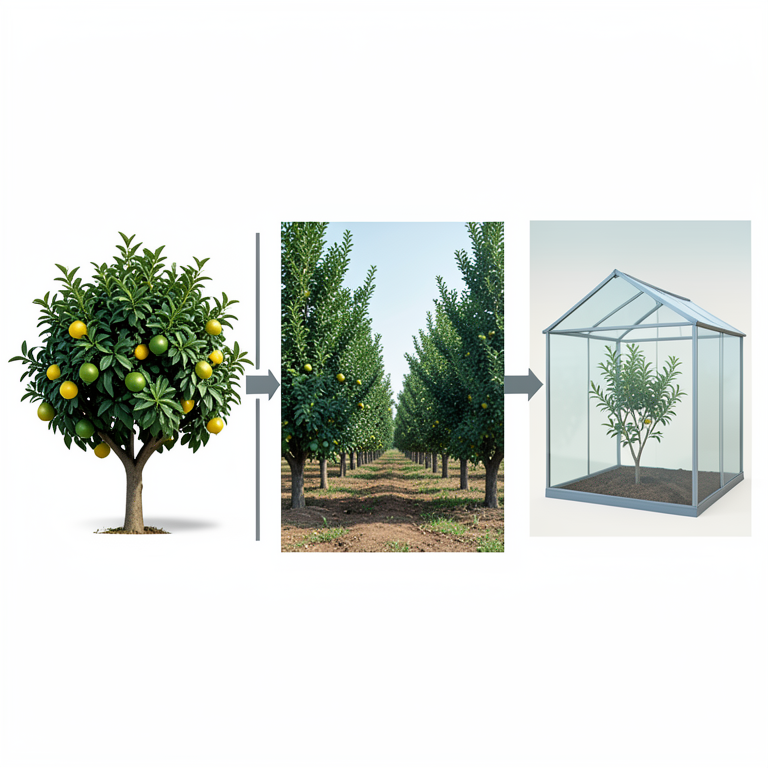
Integrated Management Strategy
AI-generated conceptual illustration (citrus trees). It explains the idea and does not show study data.
View source evidence ↗Introduction
Citrus fruits are one of the largest fruit crops in the world. About 30% of citrus fruits is processed to obtain various products, mainly juice. Similarly, the citrus industry is also the second largest fruit-processing industry, surpassed again by the grape industry, which mainly produces wine. Neither orange juice nor wine can be considered essential foods but they do have an important role in our lives. Although citrus fruits have been consumed since ancient times, citrus processing, as it is known today, was not possible until thermal treatment (to inactivate enzymes and microorganisms) and concentration processes were commercially available. Since then, the citrus industry has developed rapidly, becoming prominent among food industries. Although the consumption of fresh citrus fruits is popular in all producing countries, processed products must still be considered almost as luxury products. Breakfast with orange juice is only common in developed countries. Thus, citrus industries process value-added products whose quality, nutritional characteristics, and purity are appreciated. Since these three aspects are closely related to composition, the analysis of citrus constituents is a frequent subject of research work, supported by governments and industries. This article covers the most important aspects of citrus fruit composition, its relationship to nutritional value, and its importance for product authentication. Several books have been published on these subjects and the Further reading section lists some of them as well as published composition tables. Citrus canker, caused by the bacterium Xanthomonas citri subsp. citri, affects the leaves, twigs and fruit of citrus plants causing the leaves to drop and unripe fruit to fall to the ground. All types of citrus are affected by the disease.
Economic importance of citrus production
Citrus fruits are the primary fruit crop in international trade in terms of value. Commercially, several species are considered under the term citrus, including lemons (varieties grown from the species Citrus limon), limes (Citrus latifolia and its hybrids), mandarins (Citrus reticulata Blanco), satsumas (Citrus unshiu Marcow), clementines (Citrus clementina Hort. ex Tanaka), common mandarins (Citrus deliciosa Ten) and tangerines (Citrus tangerina Hort. exTanaka), oranges (Citrus sinensis L. Osbeck), grapefruit (Citrus paradisi Macfad. and its hybrids) and pummelos (Citrus maxima Burm. Merr. And their hybrids) (UNECE, 2004).
There are two clearly differentiated markets in the citrus sector: the fresh citrus fruit market, with a predominance of oranges, and the processed citrus products market, consisting mainly of orange juice. Current annual worldwide citrus production is estimated at over 105 million tonnes, with more than half of this being oranges. About one-third of citrus fruit production goes for processing, and more than 80 percent of this is for the production of orange juice. Citrus fruits are grown all over the world. According to the FAO (FAOSTAT, 2006), there are 140 citrus-producing countries. Around 70 percent of the world's total citrus output is grown in the northern hemisphere, in particular in Brazil, countries around the Mediterranean, and the United States. The greatest producer in Europe is Spain, which accounts for more than 55 percent of the European citrus output.
Citrus Canker
Citrus canker was first identified in the United States near the Florida-Georgia border in 1910. From 1910 to 1931, 257,745 grove trees and 3,093,110 nursery trees in 26 counties were destroyed. Canker was considered eradicated in 1933. On September 28, 1995, canker was again discovered in Miami-Dade County, Florida. Despite a 10-year monumental effort to eradicate the disease from Florida, a combination of programmatic challenges and a series of unprecedented storms in 2004 and 2005 spread the disease to the point where eradication was no longer possible. Eradication efforts in Florida ended on January 10, 2006, when the Secretary of Agriculture determined eradication was not possible. Efforts in Florida shifted to containing the disease and establishing criteria under which fruit and nursery stock could safely move out of Florida. Citrus canker was found in Louisiana in 2014 and in Texas in 2016. USDA is working with our state partners to contain the disease.
Description of citrus canker
Domain: Bacteria Phylum: Proteobacteria Class: Gammaproteobacteria Order: Xanthomonadales Family: Xanthomonadaceae Genus: Xanthomonas Species: X. axonopodis Binomial name: Xanthomonas axonopodis
Symptoms and modes of infection
Infection causes lesions on the leaves, stems, and fruit of citrus trees, including lime, oranges, and grapefruit. While not harmful to humans, canker significantly affects the vitality of citrus trees, causing leaves and fruit to drop prematurely; a fruit infected with canker is safe to eat, but too unsightly to be sold. Citrus canker is mainly a leaf-spotting and rind-blemishing disease, but when conditions are highly favourable, it can cause defoliation, shoot dieback, and fruit drop. The disease, which is believed to have originated in Southeast Asia, is extremely persistent when it becomes established in an area. Citrus groves have been destroyed in attempts to eradicate the disease. Countries like Brazil and the United States also suffer from canker outbreaks.
Biology
Xanthomona axonopodis is a rod-shaped Gram-negative bacterium with polar flagella. The bacterium has a genome length of around 5 megabase pairs. A number of types of citrus canker diseases are caused by different path over and variants of the bacterium: The Asiatic type of canker (canker A), X. axonopodis pv.
citri, caused by a group of strains originally found in Asia, is the most widespread and severe form of the disease. Cancrosis B, caused by a group of X. axonopodis pv.
aurantifolii strains originally found in South America are a disease of lemons, key lime, bitter orange, and pomelo. Cancrosis C, also caused by strains within X. axonopodis pv. aurantifolii, only infects key lime and bitter orange. A* strains, discovered in Oman, Saudi Arabia, Iran, and India, only infect key lime.
Pathology
Plants infected with citrus canker have characteristic lesions on leaves, stems, and fruit with raised, brown, water-soaked margins, usually with a yellow halo or ring effect around the lesion. Older lesions have a corky appearance, still in many cases retaining the halo effect. The bacterium propagates in lesions in leaves, stems, and fruit. The lesions ooze bacterial cells that, when dispersed by windblown rain, can spread to other plants in the area. Infection may spread further by hurricanes. The disease can also be spread by contaminated equipment and by transport of infected or apparently healthy plants. Due to latency of the disease, a plant may appear to be healthy but actually be infected. Citrus canker bacteria can enter through a plant's stomata or through wounds on leaves or other green parts. In most cases, younger leaves are considered to be the most susceptible. Also, damage caused by citrus leaf miner larvae (Phyllocnistis citrella) can be sites for infection to occur. Within a controlled laboratory setting, symptoms can appear in 14 days following inoculation into a susceptible host. In the field environment, the time for symptoms to appear and be clearly discernible from other foliar diseases varies; it may be on the order of several months after infection. Lower temperatures increase the latency of the disease. Citrus canker bacteria can stay viable in old lesions and other plant surfaces for several months.
Pathogenicity
Xanthomonas axonopodis has the capability to form a biofilm for attachment to the host. The biofilm is the result of the production of extracellular polysaccharides (xanthan). The biofilm ensures the virulence and epiphytic survival of X. axonopodis pv. citri prior to the development of citrus canker. In addition, the bacteria secrete transcriptional activator-like (TAL) effectors through the type III secretion system. The effector interacts with host machinery to induce transcription for genes that regulate plant hormones such as gibberellin and auxin. the 90 day period after petal fall during fruit formation. The varied size of lesions on citrus fruit is because of the multiple cycle of infections and can reflect different-aged lesions on the same fruit.
Disease cycle
Disease cycle
Management and control
Commercially acceptable management of canker, especially on susceptible cultivars under favourable disease development conditions, is generally difficult. The most effective management of canker is by supplementing the use of resistant cultivars with integrated systems of compatible cultural practices and phytosanitary measures, including quarantine and regulatory programmers. The basic strategies of the specific methods are to avoid, exclude, or eradicate the pathogen, to reduce the amount of inoculum available for infection, to minimize dissemination of the pathogen, and to protect susceptible tissue from infection (Civerolo, 1987) [13] . In canker-free citrus-producing areas, strict quarantine measures are practised aimed at excluding the pathogen. When the canker bacterium is introduced into such an areas (as it was in Florida, USA in 1910, 1984 and 1995) eradication campaign is conducted by uprooting and burning all suspected and infected trees. A new regulation -the "1900-ft.rule" is established recently in USA, requiring the removal and destruction of diseased citrus trees and of all healthy citrus trees within a 1900-ft radius of a diseased tree (Gottwald et al., 2002) [18] .
Chemical control
Different chemicals have been sprayed in different areas over quite long period of time. Among the antibiotics and fungicides treated against Xanthomonas citri, thiram (a fungicide made up of thiuram disulfide and the oxidized dimer of dimethyldithiocarbamate) was the most effective in checking the disease up to 500 ppm or higher concentration. Copper-based bactericides and windbreak trees could significantly reduce the development of the disease. Foliar spray of 100 ppm streptocyclin+0.1% Copper oxychloride on Xanthomonas axonopodis pv. citri infection of 6 years old Kagzi lime was donein Maharashtra, India. The effects of windbreaks and copper-based bactericide applications alone and in combination, the incidence of citrus canker and its spread was observed. Copper-based bactericide did reduce disease incidence and spread but not as effective as windbreaks. Skaggs Bonanza navel orange tree, which were treated by spraying different concentrations of compounds including 56% cuprous oxide, agro-streptomycin, 77% copper hydroxide and 50% Shajunwang (fungicide), results showed that the best treatment was 50% Shajunwang which achieved up to 94.5% control. Testing of copper hydroxide, carbendazim, sulfuric acid, streptomycin and bordeaux mixture for control of Xanthomonas citri (Xac) (X. axonopodis pv. citri) on citrus trees, the result showed that copper hydroxide gave the best disease control at 800 times concentration.
Biocontrol Agents
Citrus is a genus of flowering plants belonging to the family Rutaceae. It originated in Australia, New Caledonia, and New Guinea (Liu et al., 2012) [20] . Citrus fruits provide an ample supply of vitamin C, folic acid, minerals, fiber, and various phytochemicals such as carotenoids, flavonoids, and limonoids which have tremendous health benefit. They contain no fat or cholesterol and have low sodium levels. (Paul and Shaha, 2004; Ramful et al., 2010) [19,21] .
Cultural Agents
In countries where the disease is well established and severe, only the more resistant types of citrus, such as Valencia oranges and mandarins may be profitable. In regions where canker is endemic, certain cultural practices are used to reduce the severity of the disease. It is imperative to avoid working in infected orchards when the trees are wet from dew or rain. The reduction of wind is another primary concern. Wind speeds are reduced by deployment of windbreaks on the perimeter of the orchard or between the rows (Figure 33) Reduction of wind speed lowers the probability of direct penetration of stomates by bacteria as well as entry of wind-induced injuries on foliage and fruit.
Conclusion
Hence, a survey was conducted in different parts of citrus growing regions of Kavre to determine the status of the disease citrus canker in the area. It was found that the disease was prevalent in high status in Lime. The pathogen of the disease was isolated in the lab and confirmed by morphological, physiological and pathogenicity test. Furthermore, field study was conducted to find the effective control measure of the disease and it was found that Bordeaux mixture 1% was effective in controlling the disease.
References
8 in the original paper- Peltier GL, Frederich WJ. Effects of weather on the world distribution and prevalence of citrus canker and citrus scab. Agr. Res. 1926:32:147-164.
- Pruvost O, Hartung JS, Civerolo EL, Dubois C, Perrier X. Plasmid DNA fingerprints distinguish pathotypes of Xanthomonas campestris pv. citri, the causal agent of citrus bacterial canker disease. Phytopathology. 1992:82;485-490.
- Rao GP. Citrus diseases and their control in Andhra State. Andhra Agric. 1954;1:187-192.
- Rao YP, Hingorani MK. Survival of Xanthomonas citri (Hasse) Dowson in leaves and soil. Indian Phytopath. 1963;16:362-364.
- Schaad NW, Vidaver AK, Lacy GH, Rudolph K, Jones JB, Evaluation of proposed amended names of several Pseudomonads and Xanthomonads and recommendations. Phytopathology. 2000;90:20-213.
- Schaad NW, Vidaver AK, Lacy GH, Rudolph K, Jones JB. Evaluation of proposed amended names of several Pseudomonads and Xanthomonads and recommendations. Phytopathology. 2000;90:20-213.
- Graham JH, Gottwald TR, Riley TD, Cubero J, Drouillard DL. Survival of Xanthomonas campestris pv. citri (Xcc) on various surfaces and chemical control of Asiatic citrus canker (ACC). Proc. Intn. Citrus canker Res.Workshop. June 20-22, 2000, Ft. Pierce, Florida; c2000.
- Ramful D, Bahorun T, Bourdon E, Tarnus E, Aruoma OI. Bioactive phenolics and antioxidant propensity of flavedo extracts of Mauritian citrus fruits: Potential prophylactic ingredients for functional foods application. Toxicology. 2010 Nov 28;278(1):75-87.