
Research article · 2023 · Full text
International Journal of Advanced Biochemistry ResearchNutritional assessment of adolescent children in slums with reference to certain vitamins
Volume 7(2S) · Pages 01–03 · DOI: 10.33545/26174693.2023.v7.i2sa.181 ↗
Research areasChild Nutrition and Water Access
Abstract
Author-writtenAdolescence is the most important phase in human development. As per the UNISEF (United Nations International Children’s Emergency Fund) Report 2019, Oct 31, more than 80% of adolescents in India suffer from “hidden hunger” (a form of undernutrition). Whereas, this is the period where the developing body is in need of increased nutrition. Adolescents are deficient in nutrients such as iron, folic acid, zinc, vitamins etc. 50 healthy and 50 underprivileged adolescence from the slum area were distributed as group I and 2 respectively within the age of 14-18 years. The study parameters i.e. Vitamin A, E, C levels were evaluated and the results indicated significant differences in the test study group.
Summary
Source-checkedPlain-language reading of the full paper, prepared with AI and checked against the text. Each point links to the authors' own words.
Why it matters
- Undernourishment during childhood and adolescence is a significant global health issue and a major cause of illness and death, particularly within Indian slums. View evidence ↗
- A 2019 UNICEF report indicated that over 80% of adolescents in India experience 'hidden hunger,' a form of undernutrition. View evidence ↗
- Vitamins are critical for biological functions including growth, wound healing, bone and tissue maintenance, and immune system operation. View evidence ↗
The question
- The study aimed to measure the levels of specific nutrients (vitamins A, E, and C) in adolescents living in slums. View evidence ↗
What they did
- The study enrolled 100 age- and sex-matched subjects (14-18 years old), divided into a test group of 50 adolescents from slums and a control group of 50 healthy adolescents from higher socio-economic backgrounds. View evidence ↗
- Adolescents with systemic diseases, such as cancer, HIV, or other infectious diseases, were excluded from the research. View evidence ↗
- Serum levels of vitamins A and E were measured using the HPLC kit method, while vitamin C was measured using the DNPH method. View evidence ↗
- Statistical analysis was performed using standard deviation, student's t-test, and p-values to compare the test group against the control group. View evidence ↗
What they found
- Serum Vitamin A levels were significantly lower in the slum adolescent group (393.27±78.21 ng/ml) compared to the control group (551.69±41.24 ng/ml), with a p-value ≤0.001. View evidence ↗
- Serum Vitamin E levels were significantly lower in the slum adolescent group (11.62±4.09 μg/ml) than in the control group (15.17±1.13 μg/ml), with a p-value ≤0.001. View evidence ↗
- Serum Vitamin C levels showed a significant decrease in the slum adolescent group (28.95±9.61 mg %) compared to the control group (83.24±6.22 mg %), with a p-value ≤0.001. View evidence ↗
- The authors attribute the severe vitamin C deficiency in slum adolescents to a lack of regular access to fresh fruits and vegetables. View evidence ↗
What it means
- The authors conclude that micronutrient levels are decreased in slum adolescents, suggesting that the growth process during adolescence increases the demand for these nutrients. View evidence ↗
- The authors recommend that providing a healthy diet and clean drinking water to adolescents in slums should be treated as a priority. View evidence ↗
- Due to budget and time constraints, the study did not provide dietary recommendations or nutritional supplements to the participants. View evidence ↗
- The authors note that including pre- and post-intervention studies would have enhanced the data. View evidence ↗
Visual summary
2 visualsIllustrations explain the paper; charts are replotted from the paper's own table values.
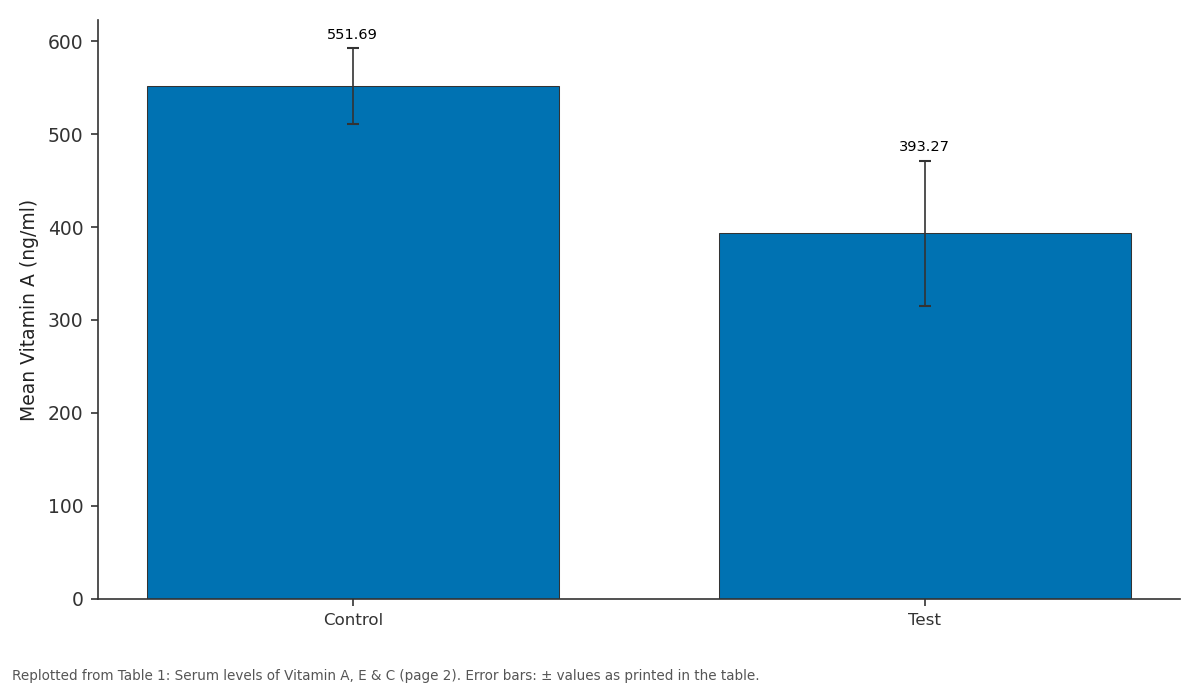
Mean: Control vs Test
Replotted from Table 1 (page 2) of the original paper. Every bar is the paper's own table value.
View source evidence ↗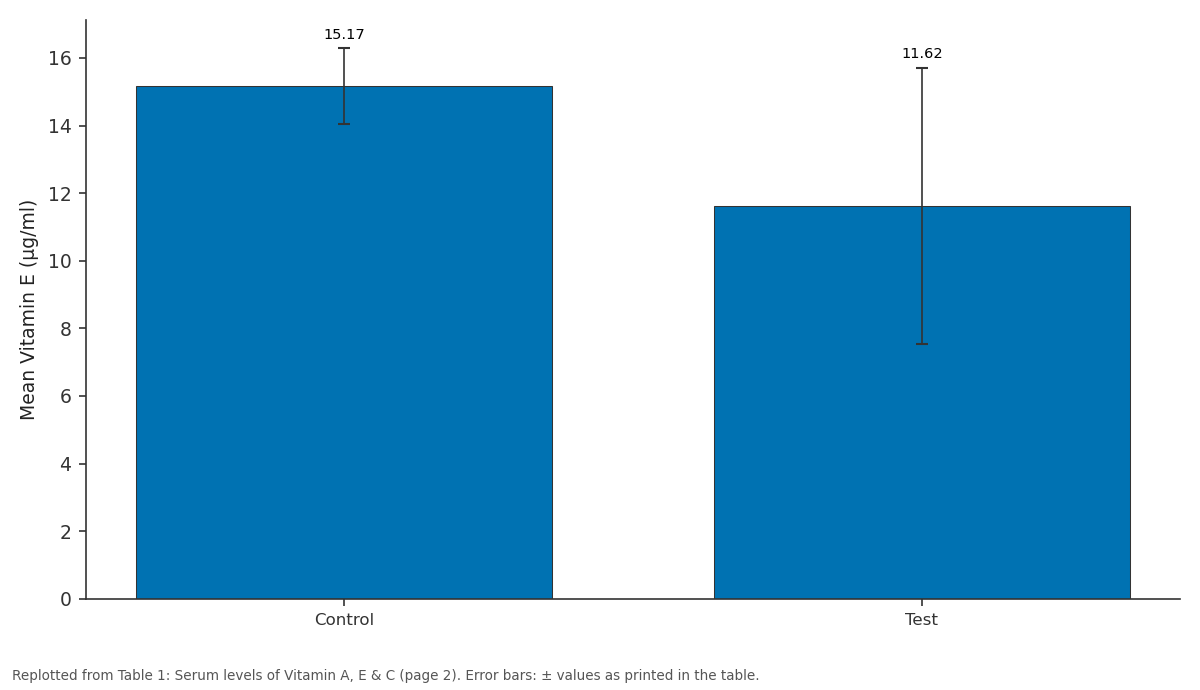
Mean: Control vs Test
Replotted from Table 1 (page 2) of the original paper. Every bar is the paper's own table value.
View source evidence ↗Figures & tables
From the original paper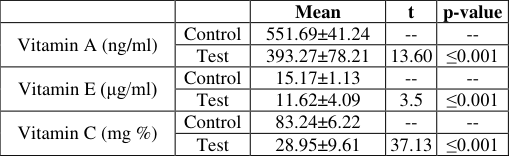 Table 1
Introduction
Childhood/teenage undernourishment is a major health problem in India, especially in slums. It is one of the most common causes of morbidity and mortality among children and adolescent throughout the world [1] . Adolescence is a period where increased nutrition is a crucial requirement. On 31 st October 2019, UNISEF (United Nations International Children's Emergency Fund) released a report on "Adolescents, Diets & Nutrition: Growing well in a changing World 2019". It declared that 80% of adolescents in India suffer from "Hidden Hunger". Hidden hunger is a form of under-nutrition where the intake and absorption are inversely proportional. Factors that contribute to such conditions is consumption of low intake of nutrition / poor diet leading to infections and poor survival. Vitamins are essential nutrients required in small quantities and play a major role in growth and development, repair and healing wounds, maintaining healthy bone and tissues, for the proper functioning of an immune system and other biological functions [2,3] . These slum adolescents are deficient in nutrients such as iron, folic acid, vitamins A, E and C. Therefore, the present study was undertaken to gauge the levels of these certain nutrients.
Material & Methods
The following study was carried out at Govandi, a healthcare centre run by BYL Nair Charitable Hospital. 100 subjects were enrolled which were distributed in two groups of 50 each. 50 healthy controls and 50 adolescents as test group in the age of 14-18 years, age and sex-matched. The test group belonged to lower socio-economic strata as they belong to slum.
Inclusion & exclusion criteria 50 healthy adolescents in age 14 to 18 years belonging to non-slum areas basically belonging from good economic strata were assessed for nutritional status. 50 undernourished adolescents in the same age group belonging to underprivileged areas/slum belonging to lower socio-economic income group were included. The adolescents having systemic disease like HIV, cancer, infectious diseases etc were excluded from the study. The study was approved by the institutional Ethics Committee. Written Consents were obtained from the subjects' parents as the study group included minors.
Sample collection
The subjects were given prior information about blood collection. The blood was withdrawn by vein puncture using sterile disposable needles and syringes. After collection, the blood was allowed to clot at room temperature for 1-2 hrs. The serum was separated and used for testing vitamins. Vitamin A and E were estimated by HPLC kit method [4,5] and vitamin C by DNPH method [6] . The data of all groups were compared with controls using appropriate statistical tests, standard deviation, students 't' test and p-value.
Results & Discussion
The present study was carried out to gauge the levels of certain vitamins in the adolescent population in the Mumbai slums. All the estimated vitamins were found to be significantly decreased in the adolescence as compared to the control group (Table 1) 40% & 15% more micronutrients are required in adolescents for their adult weight and height respectively. Lack of this intake can affect /delay sexual development and slower their overall growth and development. Serum Vitamin A levels (Table 1) were found to be significantly decreased compared to the controls (393.27 ng/dl±78.21 and 551.69 ng/dl±41.24 respectively). Our results are at par with Ikpeazu Ebele et al. [7] , Henrietta O et al. [8] and Chipulkar et al. [9] , where the levels of the micronutrient were found to be significantly depleted.
| — | — | Mean | t | p-value |
|---|---|---|---|---|
| Vitamin A (ng/ml) | Control | 551.69±41.24 | -- | -- |
| Test | 393.27±78.21 | 13.60 | ≤0.001 | |
| Vitamin E (μg/ml) | Control | 15.17±1.13 | -- | -- |
| Test | 11.62±4.09 | 3.5 | ≤0.001 | |
| Vitamin C (mg %) | Control | 83.24±6.22 | -- | -- |
| Test | 28.95±9.61 | 37.13 | ≤0.001 |
Table text extracted from the original PDF; superscript letters are shown inline. The original table image is below.
View original table image
Vitamin A is also said to play an important role in iron absorption [10] . Biswas AB and his associates in their research has demonstrated that vitamin A deficiency is directly linked to reproduction, fetal development, immune system, cell differentiation & proliferation [11] . Vitamin E is a known antioxidant scavenging free radicals and molecular oxygen. Vitamin E is naturally found in food of plant origin, especially whole grains, seeds and oils. For the antioxidant property to be more effective, the intake should be appropriate [12] . Malnutrition leads to vitamin E deficiency proceeding towards consequential conditions like anaemia, frequent infections [13] . A decrease in vitamin E status may be observed highly due to its antioxidant property scavenging the free radical. Vitamin C (Ascorbic acid) is an essential component involved in many crucial functions like, it prevents scurvy, helps in normal functioning of blood vessels, helps in growth, repair of skin, bone connective tissues etc. It also helps in absorption of important mineral iron which is an essential part of RBC. Its also involved in wound healing, it also protects cells against free radical damage [14] . Our result is in accordance with Ravindran RD et al. [15] , Bansal PG [16] , and En-Obong et al. [8] all observed declined levels of vitamin C. In a slum, adolescent populations there barely are chances of getting fresh fruits & vegetables regularly. This leads to severe deficiency symptoms including right from bleeding gums, dry skin, feeling weak, tired etc.
This study clearly exhibit that all the micronutrients are decreased in the adolescent population leaving in the study slum area. This strongly suggests the fact that the demand for micronutrients increases in the adolescence due to the growth process.
Conclusion
While there are no second thoughts on how malnutrition affects human body. In conclusion, our study emphasises on how the most common problem -malnutrition i.e deficiency of micronutrients affects the quality of life. Adolescence is a vulnerable point of life where nutritional requirement is a must. A healthy diet, clean drinking water which is a basic necessity is most important to provide optimal support and cognitive development in the adolescence. The study is indicative that the adolescence living in slum are deprived of this basic necessity and this is to be provided and taken into consideration on priority.
Limitations
Unfortunately, due to time and budget constraint, we could not extend this study by providing proper dietary recommendations and/or nutritional supplements to the study group. Pre and post-studies could have added the advantage to current study data.
References
13 in the original paper- Pal A, Pari AK, Sinha A, Dhara PC. Prevalence of under-nutrition and associated factors: a cross-sectional study among rural adolescents in West Bengal, India. Int. J Pediatr Adolesc Med. 2017;4(1):9-18.
- Jacob JA, Nair MK. Protein and micronutrient supplementation in complementing pubertal growth. Ind. J Paediatrics. 2012;79(1):S84-91.
- Brenhouse HC, Schwarz JM. Immuno adolescence: neuroimmune development and adolescent behaviour. Neurosci Biobehav Rev. 2016;70:288-299.
- Ikekpeazu E, Neboh E, et al. Serum levels of iron, total iron-binding capacity and vitamin A in maternal and cord blood. Curr Pediatr Resear. 2010;14(1):9-13.
- Henrietta N, Odoh IF, Ikwuagnwu OE. Plsma vitamin A and C status of in-school adolescents and associated factors in Enugu State, Nigeria. J Health Popul Nutr. 2003;21(1):18-25.
- Chiplonkar SA, Agte VV, Mengale SS, et al. Are lifestyle good predictors of retinol and vitamin C deficiency in apparently healthy adults? Eur J Clin Nutr. 2002;56(2):96-104.
- Allen LH, Rosado JL, Casterline JE, et al. Lack of haemoglobin response to iron supplementation in anaemic Mexican preschoolers with multiple micronutrient deficiencies. Am J Clin Nutr. 2000;71(6):1485-94
- Biwas AB, Mitra NK, Chakraborty I, et al. Evaluation of vitamin A status during pregnancy. J Indian Med Assoc. 2000;98:525-29.
- Oliveira NR, Jaime PC. The meeting between sustainable rural development and health promotion in the food guide or the Brazilian population. Health and Society. 2016;25:1108-21.
- Abrol P, Sharma N, Lal H. Vitamin E status in protein energy malnutrition. IJCB. 1997;12(2):125-7.
- Johnson L. Vitamin C deficiency. Merck Manual Consumer Version Medically reviewed. Accessed 2 nd Dec 2022. Available at: Vitamin C Deficiency - Disorders of Nutrition -Merck Manuals Consumer Version; c2022.
- Ravindran RD, Vashist P, Gupta SK, et al. Prevalence and risk factors for vitamin C deficiency in north and south India: a two-centre population-based study in people aged 60 years and over. PLoS One. 2011;6(12):e28588.
- Bansal PG. Plasma vitamin C status of adolescent girls in a slum of Delhi. Indian Pediatr. 2014;51(11):932-3.