
Research article · 2021 · Full text
International Journal of Research in AgronomyEvaluating the compatibility of highland sorghum {Sorghum Bicolor (L.) Moench} varieties for relay-intercropping with chickpea [Cicer Arietinum (L.)] at highland areas of west Hararghe, Ethiopia
Volume 4(2) · Pages 170–178 · DOI: 10.33545/2618060x.2021.v4.i2a.145 ↗
Research areasAgronomic Practices and Intercropping Systems
Abstract
Author-writtenRelay-intercropping is a type of multiple cropping system that ensures the maximum production of component crops (sorghum and chickpea) through wise use of farmland resource. Nowadays, the two key challenges of developing countries including Ethiopia are the fast growing food demand and lower rate of food crop production. West Hararge highlands of study site is a potential area for production of sorghum and chickpea and sorghum is main food crop. Hence, farmers have been producing these crops since right now but its production is so low mainly due to farmland scarcity. The lower rate of crop production due to farmland scarcity could be tackled through adopting compatible sorghum-chickpea relay-intercropping system enables the farmer to produce two or more crops on the same plot of land in one production year. However, this practice is not well adopted at study area of the west Hararghe highlands. Therefore, field study was aimed at evaluating compatibility of highland sorghum varieties for relay-intercropping with chickpea for maximum productivity of sorghum and chickpea. Treatments were composed of one chickpea variety relay-intercropped with eight varieties of highland sorghum (Jiru, Dibaba, Adelle, Chiro, Chelenko, AL70, Local & ETS-2752) at physiological maturity of sorghum varieties in 1:2 row arrangements (1row Sorghum: 2 row chickpea) uniformly forming eight combinations along with two sole crops (sorghum and chickpea) as control. Hence, a total of ten treatments were arranged in a randomized complete block design (RCBD) with three replications. According to analysis of variance, treatments were significantly (p < 0.01) affected the plant height, days to 50 % flowering, days to physiological maturity, dry biomass yield, grain yield and thousand seed weight of sorghum, and highly significantly (p < 0.01) affected stand count, number of pods per plant and grain yield of chickpea, however, plant height, number of seeds per pod and hundred seed weight of chickpea were non-significantly (p > 0.05) affected by the treatments. The highest 4.21 tha-1 & 2.33 tha-1 grain yield of sorghum and chickpea respectively were recorded from relay-intercropping 1row Jiru var. with 2 row Chickpea and sole chickpea respectively. With this result, the 13.78 % extra grain yield of sorghum was recorded due to relay-intercropping over sole-cropping. Thus, relay-intercropping of 2 row Jiru var. with 2row chickpea showed best performance in grain yield of sorghum. Moreover, the highest total land equivalent ratio of 1.93 was recorded from relay-intercropping 1 row Jiru var. with 2row Chickpea indicating yield advantage over sole-cropping system. In general, the result of this study confirmed that sorghum-chickpea relay-intercropping is best option to maximize the productivity of sorghum and chickpea. Therefore, since, the highest total land equivalent ratio was obtained from relay-intercropping1row Jiru var. with 2 row Chickpea for maximum productivity of component crops, then could be recommended for the study area of West Hararghe highlands.
Summary
Source-checkedPlain-language reading of the full paper, prepared with AI and checked against the text. Each point links to the authors' own words.
Why it matters
- Developing countries, including Ethiopia, face the dual challenges of rapidly increasing food demand and low rates of food crop production. View evidence ↗
- In the West Hararghe highlands, sorghum is a primary food crop, but production is limited by the scarcity of available farmland. View evidence ↗
- Relay-intercropping of sorghum and chickpea is proposed as a solution to farmland scarcity because it allows multiple crops to be grown on the same plot within one year. View evidence ↗
The question
- The study aimed to evaluate which highland sorghum varieties are most compatible for relay-intercropping with chickpea to maximize the productivity of both crops. View evidence ↗
What they did
- The field experiments were conducted in the highland areas of the West Hararge Zone during the 2017-2019 cropping seasons. View evidence ↗
- The study tested eight highland sorghum varieties (Jiru, Dibaba, Adelle, Chiro, Chelenko, AL70, Local, and ETS-2752) relay-intercropped with one chickpea variety in a 1:2 row arrangement, using sole crops as controls. View evidence ↗
- Ten treatments were organized using a randomized complete block design (RCBD) with three replications. View evidence ↗
- Researchers measured growth and yield parameters for sorghum (flowering/maturity days, height, biomass, seed weight, and grain yield) and chickpea (height, stand count, pods, seeds per pod, seed weight, and grain yield). View evidence ↗
What they found
- The highest sorghum grain yield was 4.21 t ha⁻¹ from the Jiru variety relay-intercropped with chickpea, compared to 3.63 t ha⁻¹ for sole-cropped sorghum. View evidence ↗
- Chickpea grain yield was highest in sole-cropping (2.33 t ha⁻¹) and lowest when relay-intercropped with the Chiro sorghum variety (1.07 t ha⁻¹). View evidence ↗
- Sole-cropping increased chickpea grain yield by 54.08% compared to relay-intercropping. View evidence ↗
- The total land equivalent ratio (LER) ranged from 1.25 to 1.93, with the Jiru variety relay-intercropped with chickpea showing the highest LER of 1.93. View evidence ↗
- All sorghum-chickpea relay-intercropping combinations had land equivalent coefficient (LEC) values between 0.36 and 0.89. View evidence ↗
What it means
- The authors recommend relay-intercropping one row of Jiru sorghum with two rows of chickpea for the West Hararghe highlands to maximize the productivity of both crops. View evidence ↗
Visual summary
3 visualsIllustrations explain the paper; charts are replotted from the paper's own table values.
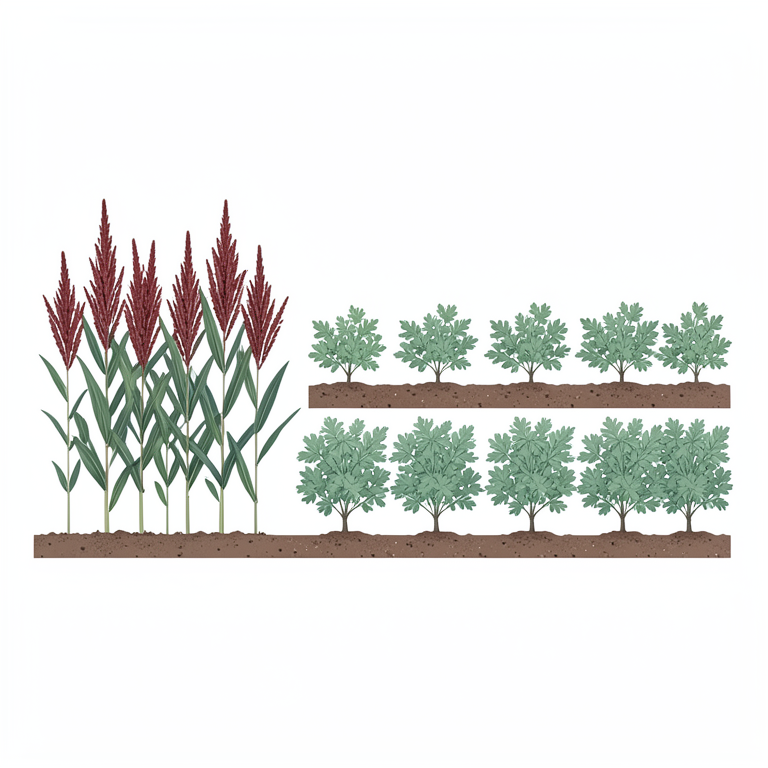
Relay-Intercropping Layout
AI-generated conceptual illustration (highland sorghum and chickpea plants in a field). It explains the idea and does not show study data.
View source evidence ↗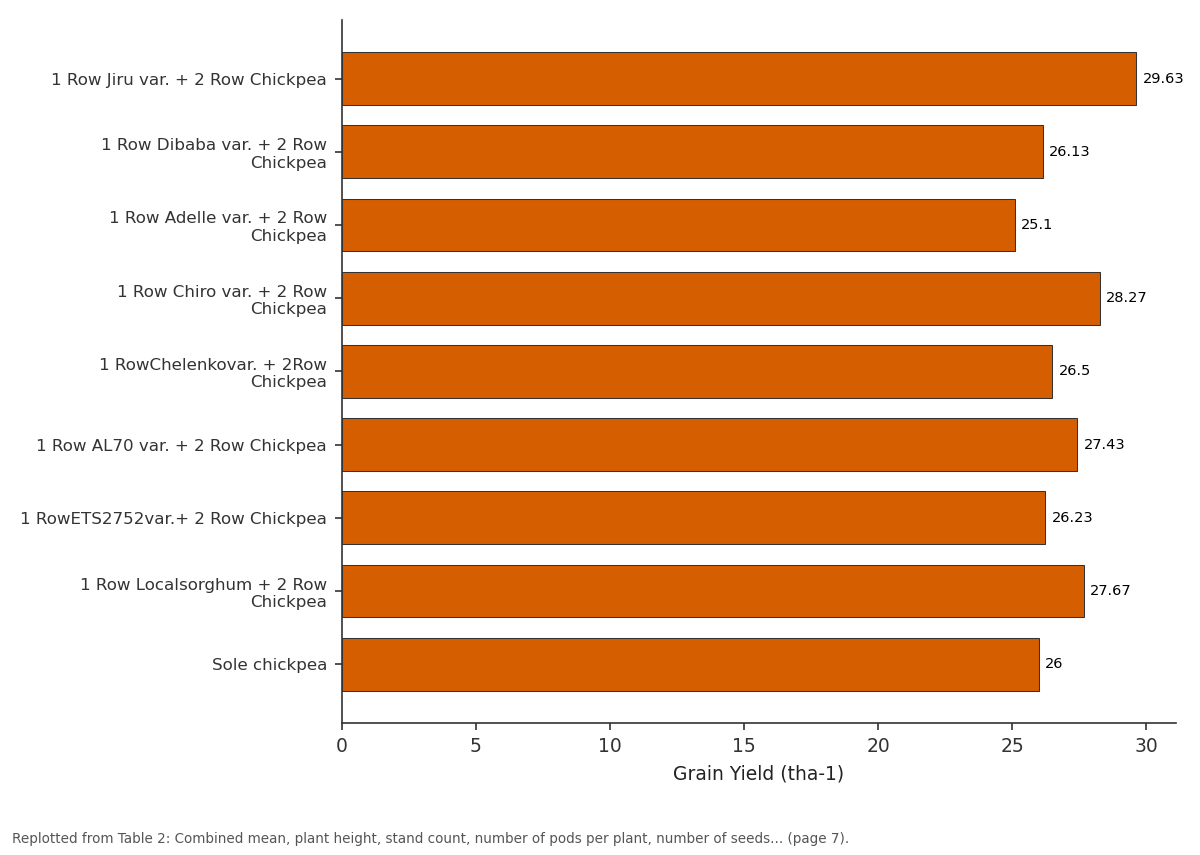
Hundred Seed Weight (g): 1 Row Jiru var. + 2 Row... vs 1 Row Dibaba var. + 2... vs 1 Row Adelle var. + 2... vs 1 Row Chiro var. + 2... vs 1 RowChelenkovar. +...
Replotted from Table 2 (page 7) of the original paper. Every bar is the paper's own table value.
View source evidence ↗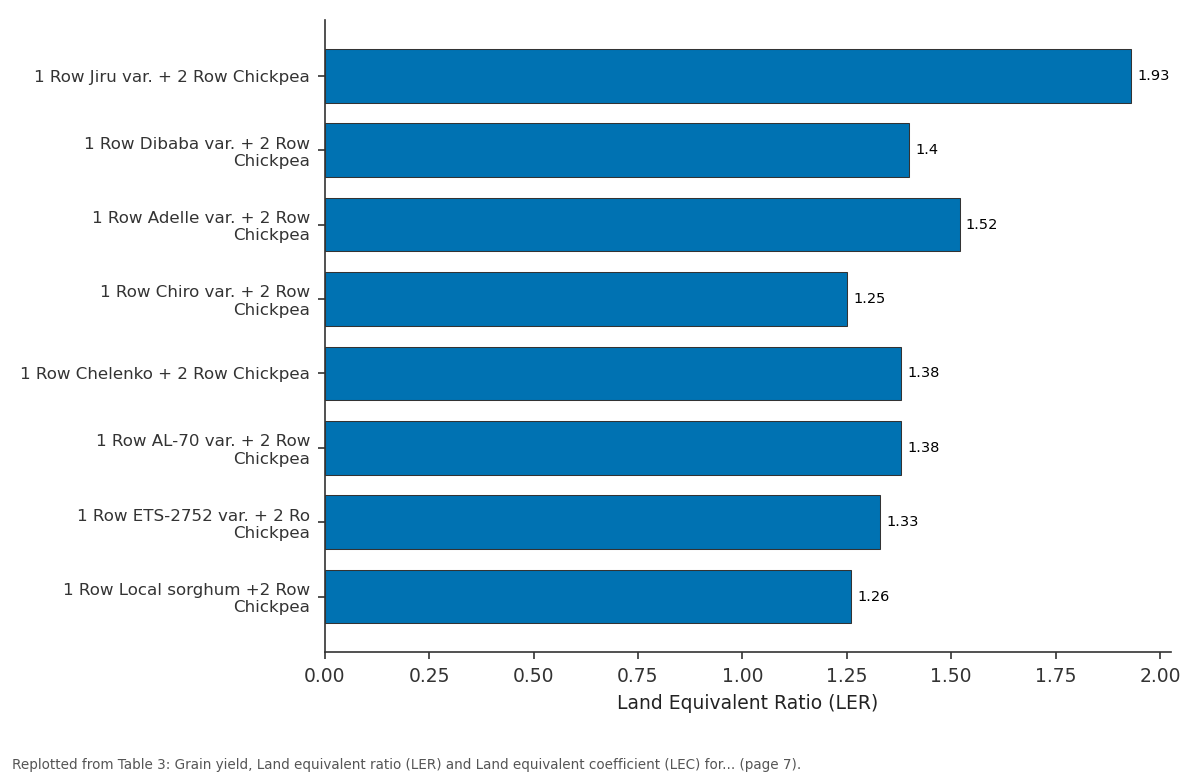
Tler: 1 Row Jiru var. + 2 Row... vs 1 Row Dibaba var. + 2... vs 1 Row Adelle var. + 2... vs 1 Row Chiro var. + 2... vs 1 Row Chelenko + 2 Row...
Replotted from Table 3 (page 7) of the original paper. Every bar is the paper's own table value.
View source evidence ↗Figures & tables
From the original paper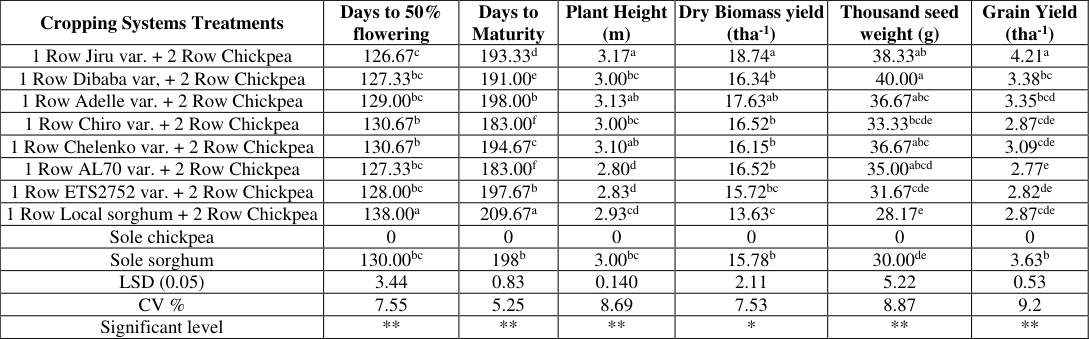 Table 1
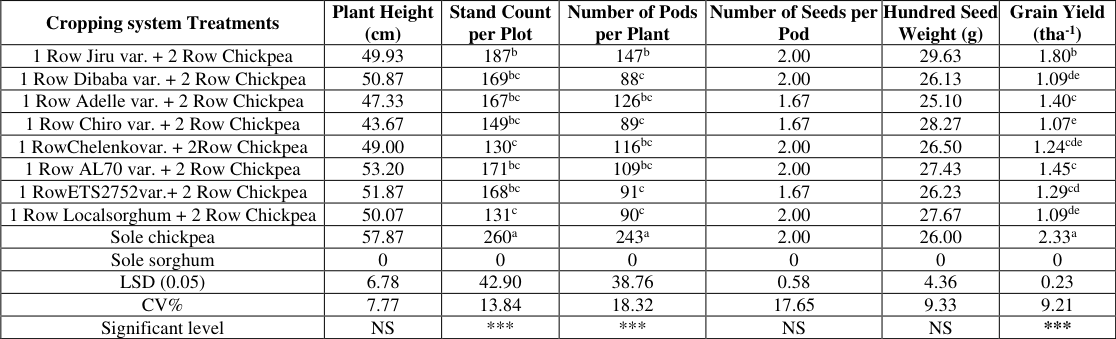 Table 2
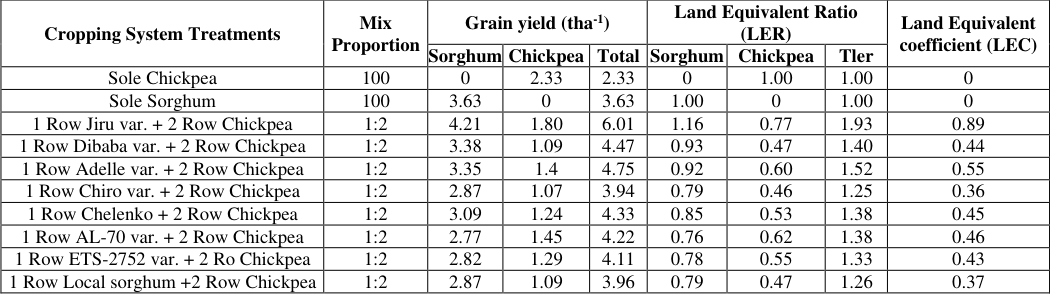 Table 3
Introduction
The sorghum [Sorghum bicolor (L.) Moench] crop is originated in Africa about 5000 years ago. Poehlman and Sleper (1995) [25] reported that the greatest genetic diversity in native sorghum is found in Ethiopia and adjacent areas of Northeast Africa. Ethiopia is probably the original home of sorghum and is the source of many wild and cultivated forms adapted to a wide range of growing conditions (ESIP, 1978). Sorghum [Sorghum bicolor (L.) Moench] is characterized by a diploid set of chromosomes (2n = 20) are several subspecies or races with different morphological and physiological characteristics (Zeller, 2000) [31] . Likewise, sorghum is belonging to Tribe Andropogonae of the family Poaceae.
The genus Sorghum classified into five subgenera: Eusorghum, Chaetosorghum, Heterosorghum, Para-sorghum and Stiposorghum (Garber, 1950) [11] . Dicko et al. (2006) [7] mentioned that the annual wild and domesticated sorghum are tropical origin C4 crop. It is generally self-pollinating, but 5-15 % of plants can out-cross, and the flowers open during the night or early morning. Those at the top of the panicle open first and it takes approximately 6 to 9 days for the entire panicle to flower (Laidlaw and Godwin, 2009) [17] Kumara et al. (2011) [16] expressed that sorghum [Sorghum bicolor (L.)Moench] is the world's fifth most important cereal crop after wheat, rice, maize and barley in terms of production. In the year 2014/15, sorghum production in the world was 60.46 million tons, and its production in 2015/16 was estimated to be 62.02 million tons which could represent an increase of 1.56 million tons or a 2.58 % in sorghum production in the world (USDA, 2015) [30] . It is a staple food for more than half a billion people in the world, 60 percent of whom are in Africa. It is a highly versatile crop with many uses including human food and animal feed, for brewing and bio-fuels. According to Degu et al. (2009) [6] , sorghum [Sorghum bicolor (L.)Moench] is one of the most important cereal crops planted as food insurance in Ethiopia. Based on report of CSA (2017) [4] , in Ethiopia, during 2016/17, sorghum accounted for 14.97% of the total of 87.31% area allotted to cereal (tef, maize, sorghum, and wheat) production. Similarly, as indicated from report of CSA (2017) [4] , sorghum is the third important cereal after tef and maize in terms of area coverage and volume of production. It was grown on 1,881,970.73ha of land and grain yield during 2016/2017 "Meher" season was 47,520,956.041 quintal) from the total production of 253,847,239.63 quintal of major cereal crops (maize, tef, wheat, and sorghum). Moreover, the national estimated average grain yield of sorghum in Ethiopia is 2525 kgha -1 (CSA, 2017) [4] . In Ethiopia, sorghum is grown in almost all regions occupying an estimated total land area of 1.68 million ha and its national average productivity of 2.5 tons ha -1 (CSA, 2017) [4] . It covers 16.36% of the total area allocated to grains (cereals, pulses, and oil crops) and 19.5% of the area covered by cereals. The chickpea, [Cicer arietinum (L.)] crop belongs to the family Fabaceae, within the tribe Cicerae. It is a self-pollinated, diploid, annual grain legume crop. Chickpea is grown in more than 50 countries (89.7% area in Asia, 4.3% in Africa, 2.6% in Oceania, 2.9 % in the Americas and 0.4% in Europe). India is the largest producer accounting for 64% of the total chickpea production. FAOSTAT (2012) [9] revealed that global production of chickpea is nearly 11 million tones and India is the major producer accounting for 64% of the total chickpea production. It is a major source of high quality protein in human diet and also provides high quality crop residues for animal feed. In Ethiopia, chickpea [Cicer arietinum (L.)] accounts more than 17 % of legumes with a production of 0.47 million tons on an area of 258,486.29 ha (CSA, 2016) [4] with the engagement of over one million households. Chickpea also helps to maintain soil fertility through biological nitrogen fixation and contributes to the sustainability of cropping systems in the cereal-legume crop rotations. Relay-intercropping is the type of multiple cropping system refers to planting of succeeding crop before harvesting the preceding crop without leaving the land fallow between the two successive crops. In Ethiopia, crop production has been based on multiple cropping involving cereals and legume crops of diverse species, either in rotation or multiple cropping. As mentioned by Chandrasekaran et al. (2010) [32] , multiple cropping is the practice of growing two or more crops on the same plot of land in one production year. Multiple cropping has long been practiced in different agro-ecologies of Ethiopia. For example, tef has been sparsely mixed intercropped with sorghum in the northern parts of the country, whereas maize has also been relay-intercropped with tef in the Southern parts of the country. Getachew et al. (2007) reported that in the Eastern parts of the Ethiopia, maize and sorghum are commonly mixed intercropped or row intercropped with common bean by peasant farmers In Ethiopia, traditionally, sorghum is cultivated in many cropping systems such as mono cropping, mixed and various forms of intercropping systems and in rotation with different crops. However, production and productivity of this crop has been limited to the lower levels, which is below 2 ton per hectare (CSA, 2011) [3] . Likewise, West Hararge highlands of study site is sorghum potential area and sorghum is main food crop. In addition, at this study area, farmers have been growing sorghum as main food crop and chickpea since now, however, its annual production is so low to meet fast growing food demands mainly due to small farmland holding per individual farmer. The lower rate of crop production due to small farmland holding size could be tackled through adopting compatible sorghum-chickpea relayintercropping system ensures efficient land resource utilization that enabling the farmer to produce two or more crops on the same land in one production year. However, this practice is not well adopted at study area of West Hararghe highlands. Therefore, objective of the field study is to evaluate compatibility of high land sorghum varieties for relayintercropping with chickpea for maximum productivity of sorghum and chickpea for the study area of west Hararghe highlands.
Materials and Method 2.1. Experimental area description
Field experiment was conducted from 2017-2019 cropping seasons at highland areas of west Hararge Zone. West Hararghe Zone is subdivided into three major climatic zones known to be highland locally known as Dega (12.49 %), mid-land or Woinadega (38%), and dry or Kola (49.5 %). The topography of the zone is characterized by steep slopes in the highlands and mid-plains in the lowland areas. Mean monthly minimum temperature ranging from 16 -20 o C and maximum is 24-28 o C. Rainfall is dispersed the year in to two rainy seasons such as Belg from February to April and Meher or main season rains fall from June to September with small showers in dry months. Annual average rainfall ranges from below 700 mm for the lower Kolla to nearly 1,200 mm for the higher elevations of woinadega and dega areas.
Treatments and Experimental Procedure
Field study was carried out from 2017-2019 cropping season to evaluate the compatibility of highland sorghum varieties for relay cropping with chickpea for increased productivity of sorghum and chickpea. At physiological maturity of sorghum, one chickpea variety was relay-intercropped with eight highland sorghum varieties (Jiru, Dibaba, Adelle, Chiro, Chelenko, AL70, and ETS2752 & Local) at 1:2 row arrangement (1row sorghum: 2row chickpea) uniformly as 1row sorghum with 2row chickpea forming eight combinations along with two sole crops (sorghum and chickpea) were used as control to evaluate the effect of relay-intercropping system. Thus, a total of ten cropping system treatments were arranged in a randomized complete block design (RCBD) with three replications. Both relay-inter-cropped as well as sole-cropped sorghum were planted at uniform planting spacing of 0.75 m and 0.25 m inter-row and intra-row respectively to accommodate a plant population of 53,332 ha -1 . However, chickpea was relayintercropped with physiologically matured sorghum varieties at 1:2 row arrangements as 1row sorghum with 2 row chickpea uniformly to accommodate a plant population of 187, 500 ha -1 . However, a planting spacing of 0.4m and 0.1m inter-row and intra-row respectively were used for sole chickpea to have a plant population of 250,000ha -1 .
Land Preparation and Sowing
Experimental field was well tilled, leveled and divided into three blocks and thirty (30) individual plots. The size of each plot was 6m and 4m inter-row and intra-row spacing respectively. Spacing between an individual plots was 0.5m while between blocks was 1m. Seed sowing operation was done in two phases. In the first phase, sorghum seeds were sown on a well prepared plots at 0.75 m and 0.25 m inter-row and intra row spacing respectively. The planting spacing of 0.75 m and 0.25 m was used for both relay-intercropped as well as sole-cropped sorghum. In the second phase, chickpea seeds were inter-planted in rows of sorghum stand at physiological maturity of sorghum but before harvesting. Thus, at physiological maturity of sorghum, chickpea was relay-intercropped with sorghum varieties in 1:2 row arrangements uniformly as 1row sorghum with 2 row chickpea. A planting spacing of 0.4m x 0.1m was used for sole-cropped chickpea.
Data Collection
The sorghum [Sorghum bicolor (L.) Moench] component Under sorghum component, parameter data collected were composed of days to 50% flowering, days to physiological maturity, plant height, dry biomass yield, thousand seed weight and grain yield. Hence, days to 50 % flowering was recorded by counting the number of days from planting to the date at which 50 % of the plants in a plot produced flower. Similarly, days to physiological maturity was determined by counting the number of days from planting until the date at which 90% of the panicles per plot reached physiological maturity. Plant height was measured from the ground level to the tip of five randomly taken plants from the net plot area at physiological maturity and the average values were taken for analysis. Dry biomass yield (tha -1 ) was also measured from the net plot area including leaves, stems and seeds which were harvested during physiological maturity and it was weighed after sun drying. Thousand seeds weight (g1000 seeds -1 ) was determined by taking weight of thousand seeds at 12.5% moisture content, weighed using sensitive balance and recorded in gram. Grain yield (tha -1 ) was estimated from net plot area and measured using sensitive balance and adjusted to 10% seed moisture content using a digital moisture tester and converted in to ton basis per hectare. Adjusted yield was calculated using Hellevang (1995) [33] formula.
The chickpea [Cicer arietinum (L.)] component
Under the chickpea component, parameter data collected were comprised a plant height, stand count, number of pods per plant, number of seeds per pod, hundred seed weight and grain yield. Plant height was determined at harvest maturity, after harvest ten randomly selected plants from the middle six rows of each plot were taken and the height of sample plant was measured using meter tape and total height of sample plants was divided by total sample plants and their average values were used for analysis. All yield and yield component data were collected at harvest. Number of pods per plant was determined by counting the total number of pods per plant from five randomly selected plants from middle rows of each plot and divided by sample plants and then average values were used for analysis. Number of seed per pod was determined by counting total number of seeds of ten sample plants from middle rows of each plot and divided by the total number of pod of sample plants and average values per pod were used for analysis. Hundred seed weight (g100seed -1 ) was determined by taking two samples of 100 seeds per plot and weighing using sensitive balance. Grain yield (tha -1 ) was measured using sensitive balance and then adjusted to 10 % seed moisture content using digital moisture tester and converted to hectare basis. Adjusted yield was calculated by using the following formula (Hellevang, 1995) [33] .
Evaluating the Effect of Relay-Intercropping System
The effect of relay-intercropping in relation to yield advantage over the mono-cropping was estimated using land equivalent ratio (LER) and land equivalent coefficient (LEC) procedures. These procedures also used to compare relay-intercropping with sole cropping in relation to growth resource utilization. Hence, the benefit of relay-intercropping system as compared to solecropping was evaluated in terms of land equivalent ratio and land equivalent coefficient and they expressed using the following formulas.
Where YS and YCP are the yields of sorghum and chickpea as sole while YIS and YICP are the yields of relay-intercropped sorghum and chickpea respectively. Another procedure used to evaluate the advantage of relay-intercropping system over solecropping was land equivalent coefficient (LEC) and expressed using the following formulas.
Data Analysis
All agronomic data collected were subjected to analysis of variance (ANOVA) and analyzed using R software (R 3.4.1) and Means that differ significantly were separated using the LSD procedure at 5% level of significance
Results and Discussion
The sorghum [Sorghum bicolor (L.) Moench] components 3.1. Days to 50% flowering According to combined analysis of variance, cropping system treatments were differed significantly at P<0.01 probability level in days to 50% flowering of sorghum (Table 1). The analysis results of days to 50% flowering were arranged in an ascending orders: 126.67 days, 127.33 days, 128 days, 129 days, 130.67 days & 138 days. Thus, due to treatment variability, results of days to 50% flowering were statistically different and ranged from 126.67-138 days (Table 1). The longest days to 50% flowering of 138 was recorded from relay-intercropping 1row Local sorghum with 2 row Chickpea whereas the shortest days to 50% flowering of 130 was obtained from sole-cropped sorghum. The difference between the longest and shorter days to flowering was 8 days. This is showing that relay-intercropping 1 row Local sorghum with 2row Chickpea took additional 8 days to reach its 50% flowering over sole sorghum. The longest days to 50% flowering of sorghum due to relayintercropping might be due to compatibility and absence of interspecific competition between component crops for growth resources. In addition, the longest days to 50% flowering from relay-intercropped local sorghum with chickpea might be due to genetic makeup of local sorghum influencing it to use the longest number of days to reach its 50% flowering when relayintercropped with chickpea. As it is being a local sorghum variety, needs additional number of days to reach its 50% flowering than the rest relay-intercropped sorghum varieties over sole-cropped sorghum. On the other hand, with this result, sorghum-chickpea relay-intercropped combinations such as 1row Dibaba with 2 row Chickpea, 1 row Adelle with 2row Chickpea, 1row ETS-2752 with 2row Chickpea and 1row Al-70 with 2 row Chickpea were shared statistically similar grade in days to 50% flowering of sorghum.
| Cropping Systems Treatments | Days to 50% flowering | Days to Maturity | Plant Height (m) | Dry Biomass yield (tha-1) | Thousand seed weight (g) | Grain Yield (tha-1) |
|---|---|---|---|---|---|---|
| 1 Row Jiru var. + 2 Row Chickpea | 126.67c | 193.33d | 3.17a | 18.74a | 38.33ab | 4.21a |
| 1 Row Dibaba var, + 2 Row Chickpea | 127.33bc | 191.00e | 3.00bc | 16.34b | 40.00a | 3.38bc |
| 1 Row Adelle var. + 2 Row Chickpea | 129.00bc | 198.00b | 3.13ab | 17.63ab | 36.67abc | 3.35bcd |
| 1 Row Chiro var. + 2 Row Chickpea | 130.67b | 183.00f | 3.00bc | 16.52b | 33.33bcde | 2.87cde |
| 1 Row Chelenko var. + 2 Row Chickpea | 130.67b | 194.67c | 3.10ab | 16.15b | 36.67abc | 3.09cde |
| 1 Row AL70 var. + 2 Row Chickpea | 127.33bc | 183.00f | 2.80d | 16.52b | 35.00abcd | 2.77e |
| 1 Row ETS2752 var. + 2 Row Chickpea | 128.00bc | 197.67b | 2.83d | 15.72bc | 31.67cde | 2.82de |
| 1 Row Local sorghum + 2 Row Chickpea | 138.00a | 209.67a | 2.93cd | 13.63c | 28.17e | 2.87cde |
| Sole chickpea | 0 | 0 | 0 | 0 | 0 | 0 |
| Sole sorghum | 130.00bc | 198b | 3.00bc | 15.78b | 30.00de | 3.63b |
| LSD (0.05) | 3.44 | 0.83 | 0.140 | 2.11 | 5.22 | 0.53 |
| CV % | 7.55 | 5.25 | 8.69 | 7.53 | 8.87 | 9.2 |
| Significant level | ** | ** | ** | * | ** | ** |
Table text extracted from the original PDF; superscript letters are shown inline. The original table image is below.
View original table image
Days to Physiological Maturity
According to analysis of variance, days to physiological maturity of sorghum was highly significantly (P<0.01) influenced due to treatment effect (Table 1 1). Hence, analysis results of days to physiological maturity were statistically differed and ranged from 183 -209.67days (Table 1). The longest days to physiological maturity of 209.67 was recorded from relay-intercropped sorghum at 1row Local sorghum var. with 2 row Chickpea while the shortest days to physiological maturity of 198 was obtained from sole-cropped sorghum (Table 1). The range between the longest and shortest days to physiological maturity was about 12 days, which is indicating that relay-intercropped sorghum was reaches its physiological maturity after 12 days of sole sorghum. Among sorghum-chickpea relay-intercropped combinations, 1row Local sorghum var. with 2row Chickpea was caused the longest days to physiological maturity. The reason why among sorghumchickpea relay-intercropped combinations, the longest days to physiological maturity was recorded from relay-intercropped local sorghum was might be due to genetic makeup of local sorghum enabled it to use the longest number days to reach its physiological maturity when relay-intercropped with chickpea over sole sorghum, and also could be due to absence interspecific competition between component crops for growth resource utilization.
The combined analysis of variance showed that cropping system treatments were varied significantly at p < 0.01 probability level in plant height of sorghum (Table 1). The analysis results of plant height were 2.80m, 2.83m, 2.93m, 3m, 3.10m, 3.13m & 3.17m. Thus, analysis results were statistically differed and ranged from 2.80 -3.17m. The tallest plant height of 3.17m was recorded from relay-intercropping of 1row Jiru var. with 2row Chickpea followed by 3.13m from 1row Adelle var. with 2row Chickpea & 3.1m from 1row Chelenko var. with 2row Chickpea, and they were not statistically different (Table 1). However, the shortest plant height of 3m was recorded from sole-cropped sorghum (Table 1).
The difference between leading tallest and the shortest plant height was 0.17m. This is also indicating that due to relayintercropping the plant height of sorghum was increased by 5.36% over sole-cropping. On the contrary, the plant height of sorghum was reduced by 5.36% due to sole-cropping. The tallest plant height of sorghum due to relay-intercropping might be due to compatibility between component crops and also could be due to absence of interspecific competition between component crops for growth resource utilization. The tallest plant height of sorghum due to relay-intercropping over sol-cropping was in line with the finding of Enyi (1973) [8] reported that intercropping sorghum with cowpea/ or pigeon pea tended to increase its height. Similarly in agreement with the report of Ibrahim (1994) [15] , most mixtures showed higher plant height than sole cropped one. According to finding of Merkeb et al. (2016) [22] who reported that highest plant height was recorded from sorghum-groundnut relay-intercropping in single and double alternate row arrangements. Hence, among sorghumchickpea relay-intercropped combinations, 1row Jiru var. with 2row Chickpea followed by 1row Adelle var. with 2row Chickpea & 1row Chelenko var. with 2row Chickpea were showed the best performance in plant height of sorghum.
Dry Biomass Yield (tha -1 )
According to analysis of variance, cropping system treatments were differed significantly at p < 0.05 probability level in dry biomass yield of sorghum (Table 1). The analysis results of 13.63 tha -1 , 15.72 tha -1 , 15.78 tha -11 , 16.15 tha -1 16.34 tha -1 , 16.52 tha -1 , 17.63 tha -1 & 18.74 tha -1 were statistically different and ranged from 13.63-18.74 tha -1 . With this, the highest dry biomass yield of 18.74tha -`w as recorded from relayintercropping 1row Jiru var. with 2row Chickpea while the lower dry biomass yield of 15.78 tha -1 was obtained from solecropped sorghum (Table 1). The range between the highest and lower dry biomass yield was 2.96 tha -1 . This is to show that dry biomass yield of sorghum was increased by 15.80% due to relay-intercropping over sole-cropping. On the contrary, dry biomass yield of sorghum was reduced by 15.80% due to solecropping. The highest dry biomass yield of sorghum due to relay-intercropping was might be due to compatibility and absence of interspecific competition between component crops for growth resources. Generally, relay-intercropping of 1row Jiru var. with 2row Chickpea showed best performance over the rest combinations evaluated in dry biomass yield of sorghum. Sorghum-chickpea. Relay-intercropped combinations such as 1 row Dibaba var, with 2row Chickpea, 1row Chiro var. with 2 row Chickpea, 1row Chelenko var. with 2row Chickpea, 1row AL70 var. with 2row Chickpea were statistically at par with sole sorghum in dry biomass yield of sorghum.
The combined analysis of variance showed that the thousand seed weight of sorghum was significantly (p < 0.01) affected by the cropping system treatments (Table 1). The analysis results of thousand seed weight were 28.17g, 30g, 31.67g, 33.33g, 35g, 36.67g, 38.33g &40g. Hence, analysis results were statistically dissimilar one another and ranged from 28.17-40g. The highest mean thousand seeds weight of 40g was recorded from relayintercropping 1row Dibaba var. with 2 row Chickpea followed by 38.33g from 1row Jiru var. with 2 row Chickpea, 36.67g from 1row Adelle var. with 2row Chickpea & 1row Chelenko var. with 2 row Chickpea and 35g from 1row AL70 var. with 2row Chickpea while the lower thousand seed weight of 30g was obtained from sole-cropped sorghum (Table 1).
The range between the leading highest and lower thousand seeds weight of sorghum was 10g. This increment in thousand seeds weight of sorghum due to relay-intercropping over sole-cropping was 25%. The highest thousand seeds weight of sorghum due to relay-intercropping could be due to absence of interspecific competition between component crops for growth resource utilization. In general, relay-intercropping 1row Dibaba var. with 2row Chickpea was superior over rest treatment combinations in thousand seeds weight of sorghum. Again, with this result, relay-intercropping of 1row ETS-2752 var. with 2row Chickpea and sole sorghum were statistically at par in thousand seed weight of sorghum (Table 1).
Grain Yield (tha -1 )
According to combined analysis of variance, treatments were highly significantly (P<0.01) differed in grain yield of sorghum (Table 2). The analysis grain yield results of 2.77 tha -1 , 2.82tha -1 , 2.87tha -1 , 3.09tha -1 , 3.35 tha -1 , 3.38tha -1 , 3.6 tha -1 & 4, 21tha -1 were statistically varied one another and ranged from 2.77 -4.21tha -1 . The highest grain yield of 4.21tha -1 was recorded from relay-intercropped sorghum at 1row Jiru + 2row Chickpea while the lower grain yield of 3.63tha -1 was obtained from solecropped sorghum (Table 1). The range between the highest and lower grain yield was about 0.58tha -1 indicating yield advantage of 13.78% due to relay-intercropping over mono-cropping. On the contrary, grain yield of sorghum was reduced by 13.78% due to sole-cropping. The yield advantage due to relay-intercropping over monocropping was in agreement with the finding of Nyambo et al (1980) [34] who reported that relay-intercropped sorghum with soybean gave 59% more return per hectare than mono cropped sorghum. Salih (2002) [26] also reported that the grain yield of sorghum was increased when intercropped with soybean. Similarly, another supporting idea was reported by Merkeb et al. (2016) [22] who mentioned that relay-intercropping of sorghum with groundnut in single and double alternate row arrangement was gave significantly higher grain yield of sorghum. The highest grain yield of sorghum due to relay-intercropping could be due to complementarity between sorghum and chickpea. This idea is agreed with the finding of Aliyu and Emechebe (2006) [2] who revealed that higher grain yield may be attributed to the effectiveness of cropping system. Another reason for this also could be due to efficiently use of growth resources and conversion ability to the grain yield. Hence, relayintercropping 1row Jiru var. with 2row Chickpea was superior over the rest treatments. Nevertheless, all sorghum-chickpea relay-intercropped combinations except 1row Jiru var. with 2row Chickpea were caused reduced grain yield as compared to sole-cropped sorghum. It could be due to incompatibility and presence of interspecific completion between components crops for growth resource utilization.
| Cropping system Treatments | Plant Height (cm) | Stand Count per Plot | Number of Pods per Plant | Number of Seeds per Pod | Hundred Seed Weight (g) | Grain Yield (tha-1) |
|---|---|---|---|---|---|---|
| 1 Row Jiru var. + 2 Row Chickpea | 49.93 | 187b | 147b | 2.00 | 29.63 | 1.80b |
| 1 Row Dibaba var. + 2 Row Chickpea | 50.87 | 169bc | 88c | 2.00 | 26.13 | 1.09de |
| 1 Row Adelle var. + 2 Row Chickpea | 47.33 | 167bc | 126bc | 1.67 | 25.10 | 1.40c |
| 1 Row Chiro var. + 2 Row Chickpea | 43.67 | 149bc | 89c | 1.67 | 28.27 | 1.07e |
| 1 RowChelenkovar. + 2Row Chickpea | 49.00 | 130c | 116bc | 2.00 | 26.50 | 1.24cde |
| 1 Row AL70 var. + 2 Row Chickpea | 53.20 | 171bc | 109bc | 2.00 | 27.43 | 1.45c |
| 1 RowETS2752var.+ 2 Row Chickpea | 51.87 | 168bc | 91c | 1.67 | 26.23 | 1.29cd |
| 1 Row Localsorghum + 2 Row Chickpea | 50.07 | 131c | 90c | 2.00 | 27.67 | 1.09de |
| Sole chickpea | 57.87 | 260a | 243a | 2.00 | 26.00 | 2.33a |
| Sole sorghum | 0 | 0 | 0 | 0 | 0 | 0 |
| LSD (0.05) | 6.78 | 42.90 | 38.76 | 0.58 | 4.36 | 0.23 |
| CV% | 7.77 | 13.84 | 18.32 | 17.65 | 9.33 | 9.21 |
| Significant level | NS | *** | *** | NS | NS | *** |
Table text extracted from the original PDF; superscript letters are shown inline. The original table image is below.
View original table image
According to the analysis of variance, treatments were showed non significant (p > 0.05) difference for plant height of chickpea (Table 2). Non-significant difference between cropping system treatments for plant height of chickpea was might be due to incompatibility between component crops.
Stand Count per Plot
The combined stand count at harvest of chickpea was differed significantly at p < 0.001 probability level due to treatment difference effect (Table 2). With this, the analysis results of stand count per plot of 130, 131, 149, 167, 168, 169, 171, 187 & 260 were arranged in an ascending order to compare one another (Table 2) and ranged from 130-260 per plot. From this, the highest stand count per plot of 260 was recorded from the solecropped chickpea while the lowest stand count per plot of 130 & 131 were obtained from relay-intercropped chickpea at 1row Chelenko var. with 2row Chickpea and 1row Local sorghum with 2row Chickpea combinations respectively, and they were statistically at par (Table 2). The range between the highest and the lowest stand count per plot were 130 & 129 per plot. Sorghum-chickpea relay-intercropping combinations such as 1 row Dibaba var. with 2row Chickpea, 1 row Adelle var. with 2 row Chickpea, 1row Chiro var. with 2 row Chickpea, 1row AL70 var. with 2row Chickpea and 1 row ETS2752 var. with 2row Chickpea were not statistically different from one another in stand count of chickpea (Table 2). Similarly, 1 Row Chelenkovar with 2 Row Chick and 1 Row Local sorghum with 2Row Chickpea combinations were also caused statistically at par stand count of chickpea. The highest stand count per plot of chickpea due to sole-cropping might be due to having dense plant population per hectare because of absence of shading effect and interspecific competition for resources, however, the reverse is true for relay-intercropped combinations with lowest stand count per plot of chickpea.
Number of Pods per Plant
The number of pods per plant of chickpea was highly significantly (p < 0.001) affected by the treatments (Table 2). In line with the finding of Lulie et al. (2016) [19] who reported that cropping system had significant (p < 0.05) effect on number of pods per plant. The analysis results of pod number per plant (88, 89, 90, 91, 109, 116, 126, 147 & 243) were statistically dissimilar and ranged from 88-243 per plant. The highest number of pod per plant of 243 was obtained from the sole chickpea while the lowest number of pods per plant of 88, 89, 90 & 91 respectively were obtained from relay-intercropping 1row Dibaba var. with 2row Chickpea, 1row Chiro var. with 2row Chickpea, 1row Local sorghum with 2row Chickpea and 1row ETS2752 var. with 2row Chickpea combinations respectively and they were statistically at par (Table 2). The difference between the highest and lowest number of pods per plant was from 152-155. This is indicating that the number of pods per plant of chickpea was increased from 62.55-63.79% due to sole-cropping over the relay-intercropping. On the contrary, the pod number per plant of chickpea was reduced from 63.79-62.55% due to relay-intercropping. The highest pod number per plant from sole-cropped chickpea was could be due to absence of interspecific competition for resources and could be due to efficiently use of growth resources (sun light, water, plant nutrient etc.) to enhance maximum pod production. Since it was mono-cropped there was no shading effect against it then, growth and pod production of sole-cropped chickpea was so good. The production of lowest number of pods per plant of chickpea due to relay-intercropping over might be due to presence of severe interspecific competition between sorghum and chickpea for growth resources. Reduction in pod number per plant of chickpea due to relay-intercropping was in agreement with the report of Subramanian and Rao (1980) [36] who revealed that intercropped pigeon pea with sorghum was showed that number of pods per plant in intercropped pigeon pea was less than the sole crop. Similarly, Ghosh (2004) [13] reported that pod number of groundnut was lower in groundnut-cereal intercropped than in monoculture. However, reduction in pod number of chickpea due to relay-intercropping could be due to incompatibility and presence of interspecific competition between sorghum and chickpea for resources and also could be due to shading effect due to taller crop/or sorghum. Taller crop suppresses growth of dwarf crop and negatively affect pod production. In line with the result of Hassan and Nader (1980) [37] who found that intercropping maize with pigeon pea inhibited vegetative growth of pigeon pea in comparison with mono-cultural pigeon pea.
Number of Seeds per Pod
The analysis of variance showed that the number of seeds per pod were non-significantly (p > 0.05) affected by the treatments (Table 2). With this, non-significant difference between cropping system treatments for number of seeds per pod of chickpea was might be due to incompatibility between sorghum and chickpea crops.
Based on the analysis of variance, the hundred seed weight of chickpea was non-significantly (p > 0.05) influenced due to treatment effect (Table 2). Non-significant difference between cropping system treatments for hundred seed weight of chickpea was might be due to incompatibility between sorghum and chickpea crops.
Grain Yield (tha -1 )
According to combined analysis of variance, cropping system treatments were differed significantly at p < 0.001 probability level in grain yield of chickpea (Table 2).The analysis grain yield results of 1.07 tha -1 , 1.09 tha -1 , 1.24 tha -1 , 1.29 tha -1 , 1.40 tha -1 , 1.45 tha -1 , 1.80 tha -1 & 2.33 tha -1 were statistically varied and ranged from 1.07-2.33tha -1 (Table 2). Hence, the highest grain yield of 2.33 tha -1 was recorded from sole-cropped chickpea whereas the lowest grain yield of 1.07 tha -1 was obtained from relay-intercropped chickpea at 1row Chiro var. with 2row Chickpea (Table 2). The difference between the highest and lowest grain yield of chickpea was 1.26 tha -1 .This is showing grain yield of chickpea was increased by 54.08% due to sole-cropping over relay-intercropping. This result is in line with the finding of Merkeb et al. (2016) [22] who reported that both soybean and groundnut planted as pure stands were caused greater yield than produced from intercropped with sorghum. The highest grain yield from sole chickpea was could be due to absence of interspecific competition for growth resources utilization and also could be due to efficiently use of growth resources and conversion ability to the grain yield. In agreement with the finding of Merkeb et al., (2016) [22] who reported that the higher yield of sole soybean and groundnut could be attributed to the least competition in pure standsand as compared to intercropped with sorghum. Another reason also could be due to absence of shading effect by taller crop which suppresses growth of dwarf crop. This is in agreement with finding of Ljoyah M. O (2014) [18] who reported that higher yield of soybean form sole cropping than that of produced from intercropped soybean was due to shading effect of maize over soybean. In addition, reduction in grain yield of chickpea due to relayintercropping with sorghum was in line with the report of Reddy (1980) [35] who expressed that yield of pigeon pea in other mixed stands was greatly decreased, especially intercropping of sorghum with cow pea. The lowest grain yield production due to relay-intercropped chickpea could be due to incompatibility and presence of interspecific competition between sorghum and chickpea for growth resources. In line with the report of Merkeb et al. (2016) [22] who revealed that grain yield of groundnut was recorded relatively lower from intercropping with sorghum due to severe competition for growth resources. Muoneke et al. (2007) [23] also reported that grain yield reduction in soybean intercropped with maize and sorghum was attributed the yield depression due to interspecific competition and depressive effect of the cereal. Shading effect due to taller crop also could be another reason for lowest grain yield from relay-intercropped chickpea since shading effect due to taller crop suppresses growth of dwarf crop.
Evaluating the Effect of Relay-Intercropping System
The cereal-legume relay-intercropping practice is one of the multiple cropping system which plays vital role in maximizing the productivity and production of the component crops per unit area through efficient land resource utilization over monocropping. It is in constituent with the report of Sullivan (2003) [28] who mentioned that one of the most important reasons for relay-intercropping system ensures an increased and diverse productivity per unit area over sole-cropping. Hence, evaluating effectiveness of the relay-intercropping system is worthy and a must. So the benefit of the relay-intercropping system was evaluated using land equivalent ratio (LER) and land equivalent coefficient (LEC) procedures.
Land Equivalent Ratio (LER)
Based on the result of this study, the total land equivalent ratio values of 1.25, 1.26, 1.33, 1.38, 1.4, 1.52 & 1.93 were ranged from 1.25 -1.93. Thus, the highest total land equivalent ratio of 1.93 was recorded from relay-intercropping 1row Jiru var. with 2row Chickpea while the lowest total land equivalent ratio of 1.25 was obtained from relay-intercropping 1row Chiro var with 2row Chickpea combinations (Table 2). As the total land equivalent ratio values from 1.25 -1.93 were greater than 1.00, indicating the advantage of relay-intercropping system over the sole cropping. This is in agreement with the finding of Natarajan and Willey (1986); Sullivan (2001) [27] who reported that total land equivalent ratio values greater than 1.00 show advantage of intercropping while below 1.00 show disadvantage. Therefore, the highest total land equivalent ratio of 1.93 obtained from relay-intercropping 1row Jiru var. with 2row Chickpea was the best cropping system to maximize the productivity and production of the component crops over the sole-cropping and then recommended for the study area.
Land Equivalent Coefficient (LEC)
Similarly, the result of this study showed that all land equivalent coefficient values of 0.36. 0.37, 0.43, 0.44, 0.45, 0.46, 0.55 and 0.89 due to sorghum-chickpea relay-intercropping was ranged between 0.36-0.89. Hence, sorghum-chickpea relayintercropping system was caused the land equivalent coefficient values from 0.36 -0.89 and they were greater than 0.25 (25%) indicating yield advantage over sole-cropping (Table 3).This is in agreement with the report of Adetiloye et al. (1983) [1] who explained that minimum expected productivity coefficient (25%) for two-crop combination is a yield advantage obtained when land equivalent coefficient values greater than 0.25. Hence with this result, all sorghum-chickpea relay-intercropping arrangements caused land equivalent coefficient values of greater than 0.25 (25%) indicating yield advantage over sole cropping, which is in consistent with the finding of Egbe (2005) who reported that LEC values greater than the critical in intercropped sorghum-haricot bean at different row arrangements.
| Cropping System Treatments | Mix Proportion | Grain yield (tha-1) | — | — | Land Equivalent Ratio (LER) | — | — | Land Equivalent coefficient (LEC) |
|---|---|---|---|---|---|---|---|---|
| Sorghum | Chickpea | Total | Sorghum | Chickpea | Tler | |||
| Sole Chickpea | 100 | 0 | 2.33 | 2.33 | 0 | 1.00 | 1.00 | 0 |
| Sole Sorghum | 100 | 3.63 | 0 | 3.63 | 1.00 | 0 | 1.00 | 0 |
| 1 Row Jiru var. + 2 Row Chickpea | 1:2 | 4.21 | 1.80 | 6.01 | 1.16 | 0.77 | 1.93 | 0.89 |
| 1 Row Dibaba var. + 2 Row Chickpea | 1:2 | 3.38 | 1.09 | 4.47 | 0.93 | 0.47 | 1.40 | 0.44 |
| 1 Row Adelle var. + 2 Row Chickpea | 1:2 | 3.35 | 1.4 | 4.75 | 0.92 | 0.60 | 1.52 | 0.55 |
| 1 Row Chiro var. + 2 Row Chickpea | 1:2 | 2.87 | 1.07 | 3.94 | 0.79 | 0.46 | 1.25 | 0.36 |
| 1 Row Chelenko + 2 Row Chickpea | 1:2 | 3.09 | 1.24 | 4.33 | 0.85 | 0.53 | 1.38 | 0.45 |
| 1 Row AL-70 var. + 2 Row Chickpea | 1:2 | 2.77 | 1.45 | 4.22 | 0.76 | 0.62 | 1.38 | 0.46 |
| 1 Row ETS-2752 var. + 2 Ro Chickpea | 1:2 | 2.82 | 1.29 | 4.11 | 0.78 | 0.55 | 1.33 | 0.43 |
| 1 Row Local sorghum +2 Row Chickpea | 1:2 | 2.87 | 1.09 | 3.96 | 0.79 | 0.47 | 1.26 | 0.37 |
Table text extracted from the original PDF; superscript letters are shown inline. The original table image is below.
View original table image
Conclusion and Recommendation
Relay-intercropping is a type of multiple cropping system that ensures the maximum crop production through enabling to produce two or more crops on the same plot of land in one production year. Nowadays, the two key challenges of developing countries including Ethiopia and study area of the west Hararghe highlands, are fast growing food demand and lower rate of food crop production. West Hararge highlands of study site is potential area for production of sorghum and chickpea and sorghum is main food crop. At study area, farmers have been producing these crops since right now. However, annual food crop production is at lower rate to meet fast growing food demands mainly due to small farmland holding size per individual farmer. The low food crop production problems could be tackled through adoption of cereal-legume multiple cropping that is compatible sorghum-chickpea relay-cropping system to maximize crop production per unit area as it ensures efficient land resource utilization enabling the farmer to produce two or more crops on the same plot of land in one cropping year. Therefore, based on the result of this study, the highest total land equivalent ratio was recorded from relay-intercropping of 1row Jiru var. with 2row Chickpea for maximum productivity of sorghum and chickpea and then recommended for the study area of west Hararghe highlands.
Acknowledgments
First of all, we would like to thank almighty God for helping us to start and successfully complete this work.
References
27 in the original paper- Adetiloye PO, Ezedinma FOC, Okigbo BN. A land coefficient concept for evaluation of competitive and productive interactions on simple complex mixtures. Ecological Modelling. 1983;19:27-39.
- Aliyu BS, Emechebe AM. Effect of Intra-and inter-row mixing of sorghum with two varieties of cowpea on host crop yield in a Striga hermonthica infested field. African Journal of Agricultural Research. 2006 Sep 30;1(2):024026,
- Central Statistical Agency (CSA-2011). Agricultural sample survey 2010/2011 (2003 E.C.); Report on area and production of major crops, Volume I, Statistical Bulletin; April 2011, Addis Ababa.
- CSA, Agricultural sample survey report on area and production of major crops. Private peasant holdings, Meher season 2016/2017, (2009 EC).
- CSA (Central Statistical Agency), 2017. Crop production forecast sample survey, (2009 E.C.). Report on area and crop production forecast for major crops (For Private Peasant Holding, Meher Season). The Federal Democratic Republic of Ethiopia. Statistical Bulletin, Addis Ababa, Ethiopia; c2015. p. 16.
- Degu EA, Debello K, Belete. Combining ability study for grain yield and yield related traits of grain sorghum (Sorghum bicolor L.) in Ethiopia. Acta Agronomica Hungarica. 2009 Jun 1;57 (2):175-184.
- Dicko MH, Gruppen H, Traore AS, Voragen AGJ, Van Berkel WJH. Sorghum grain as human food in Africa: relevance of content of starch and amylase activities. African Journal of Biotechnology. 2006;5(5):384-395.
- Enyi. Effect of intercropping maize or sorghum with cow peas, pigeon peas or beans. Exp. Agric. 1973 Jan;9(1):8390.
- ESIP, Sorghum Improvement (Ethiopia): An Evaluation, Phase. 1978.I-3-P-72-0095, Phase II-3-P-74-0023. FAO (Food and Agriculture Organization). 2012. FAOSTAT Database faostat.fao.org/.
- Garber ED. Cytotaxonomic studies in the genus Sorghum. Univ. Calif. Pub. Bot. 1950;23:283-361.
- Ghosh PK. Growth, yield, competition and economics of groundnut/cereal fodder intercropping systems in the semiarid tropics of India. Field Crop Research. 2004 Aug 10;88(2-3):227-237.
- Helle ang Kenneth. Grain Moisture Content Effects and Management. North Dakota State Extension Publication AE; c1995. p. 905. http://www.ag.ndsu.edu/extensionaben/documents/ae905.pd f. [Accessed Sep 2014]
- Ibrahim AES. Forage yield of sorghum -cow pea mixtures under different levels of nitrogen in the Sudan Gezira. Univ. Khartoum J Agric. Sci. 1994;2(1):15-26.
- Lulie B, Worku W, Beyene S. Determinations of haricot bean (Phaseolus vulgaris L.) planting density and spatial arrangement for staggered intercropping with maize (Zea mays L.) at Wondo Genet, Southern Ethiopia. Acad. Res. J Agric. Sci. Res. 2016;4(6):297-320.
- Mead R, Willey RV. The concept of a land equivalent ratio and advantages in yields from intercropping. Exp. Agric. 1980;16:219-228.
- Maphosa TM, Maphosa TM. Growth, Nodulation and Yield Response of Promiscuous and Non-promiscuous Soybean Cultivars to Inoculation in Different Soil Types under Glasshouse and field Conditions. (Doctoral dissertation, University of Limpopo). Chapter. 2015;1(3):1-59.
- Merkeb F, Melkei Z, Bogale T, Takele A. Influence of intercropping sorghum with legumes to control Striga (Striga hermonthica) in Pawe, North Western Ethiopia. World Scientific News. 2016;53(3):204-215.
- Muoneke CO, Ogwuche MAO, Kalu BA. Effect of maize planting density on the performance of maize/soybean intercropping system in a Guinea Savannah Agroecosystem. Afri. J. Agric. Res. 2007 Dec 31;2(12):142-145.
- Natarejan M, Willey RW. the effect of water stress on yield advantages of intercropping systems. Filed Crops Research. 1986;13:117-131.
- Taleshmikayeil MN, Vahedi A, Tagizadeh R. Effect of seed inoculation with Rhizobium strains of symbiotic bacteria (Rhizobium japonicum) on biological and grain yield of two varieties of soybean (Glycin max L.). International Journal of Agronomy and Plant Production. 2013;4(10):2742-2745.
- USDA (United States of Department of Agriculture). World Sorghum Production 2014/2015. https://www.world sorghum production.com / Accessed on July 8, 2017
- Waymark D. 1997. The soybean: The golden crop of the future. Agricultural Review. 2015;4:37-39.
- Zeller FJ. Sorghum (Sorghum bicolor L. Moench): utilization, genetics, breeding. Bodenkultur, 2000;51(1):7185.
- Rudski LG, Lai WW, Afilalo J, Hua L, Handschumacher MD, Chandrasekaran K, Solomon SD, Louie EK, Schiller NB. Guidelines for the echocardiographic assessment of the right heart in adults: a report from the American Society of Echocardiography: endorsed by the European Association of Echocardiography, a registered branch of the European Society of Cardiology, and the Canadian Society of Echocardiography. Journal of the American society of echocardiography. 2010 Jul 1;23(7):685-713.
- Treen AJ, Nyambo BT, Kabissa JC. Red bollworm and cotton production in Tanzania. Ukiriguru Progress Report. 1980:25.
- Erman LD, Hayes-Roth F, Lesser VR, Reddy DR. The Hearsay-II speech-understanding system: Integrating knowledge to resolve uncertainty. ACM Computing Surveys (CSUR). 1980 Jun 1;12(2):213-53.
- Willey RW, Rao MR. A competitive ratio for quantifying competition between intercrops. Experimental Agriculture. 1980 Apr;16(2):117-25.