
Research article · 2018 · Full text
International Journal of Advanced Biochemistry ResearchStudy on the concentration of tertiary butyl hydroquinone in selected brands of instant noodles without their spices in Port Harcourt, Nigeria
Volume 2(1) · Pages 37–40 · DOI: 10.33545/26174693.2018.v2.i1a.113 ↗
Research areasConsumer Attitudes and Food LabelingNutrition and Health Studies
Abstract
Author-writtenBackground/Aim: The use of synthetic antioxidants to maintain products condition to consumer’s end is broadly used in food industries. Tertiary butyl hydroquinone (TBHQ) is a synthetic aromatic organic compound that is commonly used in food to serve as an antioxidant and preservative. This study evaluated the concentration of TBHQ in four (4) widely sold brand instant noodles and consumed in Port Harcourt, Nigeria; W, X, Y, and Z which represented Indomie, Tummy-Tummy, Supreme and Masters Noodles respectively. Methodology: This study employed the use of High-Performance Liquid Chromatography (HPLC) for the analysis of the noodles samples. The results obtained were compared with FAO/WHO maximum level of TBHQ in such foods (200mg/kg). The noodles alone were analyzed for TBHQ without their spices.Results: The results obtained revealed that Y-Noodles had the highest TBHQ concentration (23.6841µg/10g) while W-noodles had the least concentration (0.4789 µg/10g) of TBHQ. Z-Noodles had (22.2315 µg/10g) and X-Noodles had (10.9924 µg/10g). All concentrations of TBHQ in all brands of noodles evaluated were below the maximum level of FAO/WHO. Conclusion: This study suggests that caution in frequent consumption of noodles is imperative, and a continuous evaluation of TBHQ in noodles is recommended as an increase in the concentration of TBHQ can be cytotoxic and deleterious to the consumers. This study thus ensures the safety of processed food consumed associated with the high rate of noodles consumption.
Summary
Source-checkedPlain-language reading of the full paper, prepared with AI and checked against the text. Each point links to the authors' own words.
Why it matters
- Tertiary butyl hydroquinone (TBHQ) is a synthetic organic compound used in the food industry as a preservative and antioxidant. View evidence ↗
- Antioxidants are used to prevent lipid oxidation, which otherwise degrades the flavor and odor of food products. View evidence ↗
- High levels of TBHQ are a concern because it has been shown to be cytotoxic and can cause DNA damage and apoptosis in certain human cells. View evidence ↗
The question
- The study aimed to evaluate the concentrations of TBHQ in selected brands of instant noodles sold and consumed in Port Harcourt, Nigeria. View evidence ↗
What they did
- The researchers analyzed four brands of noodles purchased from grocery shops in Port Harcourt: Indomie (W), Tummy Tummy (X), Supreme (Y), and Masters (Z). View evidence ↗
- High-Performance Liquid Chromatography (HPLC) was used to analyze the TBHQ concentrations in the noodle samples. View evidence ↗
- The measured concentrations were compared against the FAO/WHO maximum permissible level of 200 mg/kg. View evidence ↗
- Sample preparation involved grinding and sieving 5g of noodles, which were then soaked in absolute methanol and stirred at 200 rpm for 2 hours. View evidence ↗
What they found
- Supreme noodles (Y-Noodles) contained the highest concentration of TBHQ at 23.6841 µg/10g. View evidence ↗
- Indomie noodles (W-Noodles) had the lowest concentration of TBHQ at 0.4789 µg/10g. View evidence ↗
- Masters noodles (Z-Noodles) and Tummy Tummy noodles (X-Noodles) contained 22.2315 µg/10g and 10.9924 µg/10g of TBHQ, respectively. View evidence ↗
What it means
- The authors concluded that while TBHQ concentrations were negligible, consumers should still exercise caution in their intake. View evidence ↗
- The authors warn that consistent ingestion can lead to bioaccumulation in body tissues, potentially becoming toxic and causing diseases. View evidence ↗
- The authors recommend continuous evaluation of TBHQ in noodles to monitor any increases in concentration that could be harmful to consumers. View evidence ↗
Visual summary
1 visualsIllustrations explain the paper; they do not show study data.
The TBHQ Paradox
AI-generated conceptual illustration (instant noodles and human cells). It explains the idea and does not show study data.
View source evidence ↗Figures & tables
From the original paper Table 1
 Figure 1
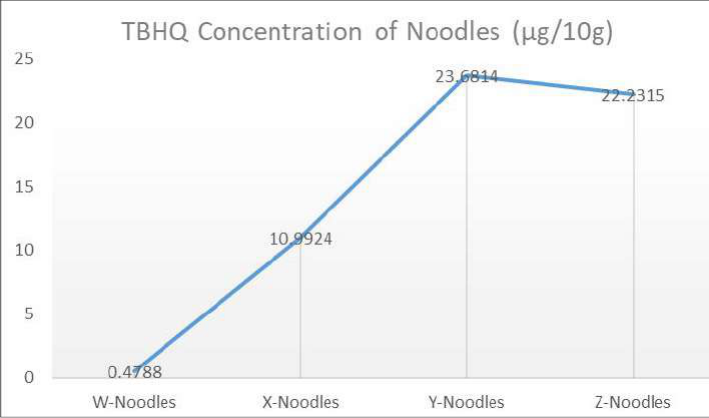 Figure 2
Introduction
The use of synthetic Antioxidants in the food industries has found wide application. This is due to the potency of the antioxidants to retain the products original state to the end consumers. In synthetic state, antioxidants are used in food during processing, storage and distribution of the food until they get to the consumers because of their ability to avert lipid oxidation [1] . Oxidation of lipids in food results in deterioration of the quality of the product, especially the flavor and odor. A combination of scavenging free radicals, chelating pro oxidative metals, quenching singlet oxygen and photosensitizers, and inactivating lipoxygenase are implied by antioxidants to slow down the oxidation rates of foods [2] . Noodles are among the most available, affordable and convenient foods in the market and consumed among people of all socioeconomic status including both urban and rural areas of the country [3] . It is believed that Asian noodles originated from China as early as 5000 BC [4,5] . Instant noodles are consumed in more than 80 countries and have become internationally recognized food. World Instant Noodles Association reported that Nigeria was the eleventh largest consumer of instant noodles in the World in 2019 [6]. Noodles with sodium stearoyl lactylate (SSL) had a better quality product such as; improved tensile strength, cutting force and elasticity, whereas the addition of lecithin, MG or SFAE had a negative impact on the strength of extruded noodles [7] . Synthetic Antioxidants are widely used to prevent rancidity in food and of all studied, TBHQ revealed to have the best antioxidant activity [4] . Tert-butylhydroquinone (TBHQ) also known as 2-(1, 1dimethylethyl)-1, 4-benzenediol (NIST Chemistry web book) is a synthetic phenolic antioxidant used in frying process with highly unsaturated vegetable oils. TBHQ has been reported as the most effective synthetic phenolic antioxidant used for stabilizing edible oils, because of its diphenolic structure and heat-stable properties, it also showed excellent synergism with other antioxidants [8,9] . The health risk as well as benefits of TBHQ in food products has been reported, thus, the strict restriction of its usage in food products. TBHQ showed a non-typical mode of cell death and proved cytotoxic toward human monocytic leukemia cells, caused apoptosis and significantly promoted DNA damage [10] . Along with sodium nitrite, it promoted forestomach carcinogenesis [9] . Due to the strict regulations on TBHQ, there is need to develop effective and convenient analytical methods for analytically monitoring the concentration of TBHQ in food products [11] . Vision disturbances have been reported when humans consume TBHQ, causes liver enlargement, neurotoxic effects, convulsions, and paralysis in laboratory animals [12] . The European food safety authority (EFSA) and the united states food and drug administration (FDA), as well as the Joint FAO/WHO Expert Committee on food additives (JECFA) have evaluated TBHQ and determined that it is safe to consume at the concentration allowed in food been 200mg/kg [13] . It is in view of these assertions that this study was conducted to evaluate the concentrations of TBHQ in selected brands of Instant Noodles sold and consumed in Port Harcourt, Rivers State in Nigeria, West Africa Source: Commons.wikimedia.org
Materials and Methods
Materials and Methods
Materials and Reagents
Noodles, blender, weighing balance, magnetic stirrer, methanol, filter paper, centrifuge and high-performance liquid chromatography (HPLC). Noodles samples sold in Port Harcourt were purchased from grocery shops and labeled W-Noodles (Indomie), X-Noodles (Tummy Tummy), Y-Noodles (Supreme), and Z-Noodles (Masters). Methanol and 2-(1,1-dimethylethyl)-1, 4-benzenediol (analytical grade and were purchased). Water was purified using distillatory system twice to meet the requirement of HPLC grade water.
Instrumentation
Instrumentation
Preparation of Standard Solution
Stock solution of the reference compound was made by weighing 0.001g of reference standard into a test tube, the standard was dissolved with 10ml of absolute methanol. Each of the standard was then agitated for 10 minutes using vortex mixer and filtered using micron filter into the sample bottle.
Sample Preparation and Extraction
Samples were ground, sieved (70 mesh), weighed (5g), soaked with absolute methanol and stirred at 200rmp for 2hrs. Samples were then centrifuged at 400rmp for 15mins. The supernatant was decanted, filtered using 0.45 µm filter membrane, degassed, and injected to HPLC using a micro syringe [14] . The result showed that W-noodles had the least concentration of TBHQ while Y-Noodles had the highest concentration of TBHQ. The concentrations were all below the FAO/WHO maximum level in food.
Results
Results
Discussion
This study evaluated the concentration of TBHQ in common Instant Noodles sold and consumed in Port Harcourt, Nigeria. TBHQ has been reported to be used as a preservative and antioxidant in food products to protect against Oxidative deterioration or rancidity, thus extending the storage stability in the food product. The result as shown in Table 1 and Figure 2, revealed that TBHQ had the highest concentration of 23.6841µg/10g in Y noodles with brand name; Supreme noodles. The least concentration (0.4789 µg/10g) of TBHQ was observed in W noodles with brand name Indomie Noodles. X noodles (Tummy Tummy) had 10.9924 µg/10g) while Z noodles (Masters Noodles) had a concentration of 22.2315 µg/10g of TBHQ. A higher concentration of synthetic phenolic antioxidants than normal in food products when consumed has been reported to be associated with carcinogenicity, cytotoxicity, oxidative stress induction and endocrinedisrupting effects [15] . The concentrations of TBHQ in all tested noodles were below the FAO/WHO maximum level, thus, healthy for consumption. A study showed a beneficial potency of TBHQ to protect L6 myoblasts against the toxicity induced by sodium palmitate due to a synergistic activation of different signaling pathways such as Nrf2 and NF-κB [16] . However, via the process of bioaccumulation of xenobiotics in the body, a low concentration of a substance can undergo bioaccumulation if consistently consumed to become cytotoxic and can fragment the DNA [17] . Consumption of TBHQ in high/ long term doses (1-4 grams) has been associated with various disorders such as; DNA damage, affect estrogen levels in women, hyperactivity in children, asthma, dermatitis, nausea, vomiting, tinnitus (ringing in the ears) etc. In also lead to development of cancerous precursors in the stomach [18] . TBHQ caused a concentration-dependent increase in CYP1A1 at the mRNA and activity levels in human HepG2 cells, thus can directly induce cyp1a1 gene expression in an AHR-dependent manner and may represent a novel mechanism by which TBHQ promotes carcinogenicity [19] . The Joint FAO/WHO Expert Committee on Food Additives (JEFSA), and the World Health Organization (WHO) concluded that dogs are most sensitive to TBHQ, so should have an accepted daily intake (ADI) of 0-0.7 mg/kg body weight (BW) [20] . Also, since human exposure to TBHQ depends largely on consumed fats containing TBHQ,
| SAMPLES | TBHQ Concentration (µg/10g) | TBHQ Concentration (mg/kg) | FAO/WHO Maximum level (mg/kg) |
|---|---|---|---|
| W-Noodles | 0.4789 | 0.04189 | 200 |
| X-Noodles | 10.9924 | 1.09924 | 200 |
| Y-Noodles | 23.6841 | 2.36841 | 200 |
| Z-Noodles | 22.2315 | 2.22315 | 200 |
Table text extracted from the original PDF; superscript letters are shown inline. The original table image is below.
View original table image
Children and infants should have Acceptable Daily Intake of TBHQ higher than adults (1.3mg/kgBW) because Children take more fats due to their energetic requirements [20] . The average intake of TBHQ as established by Codex General Standard for food additives varies; USA (90%), Australia and New Zealand (180%) of the ADI. It has been reported that the best estimate of the national average intake of TBHQ for the USA ranges from 50% while China (100%) [21,22] . The use of TBHQ as a food additive are legalized thus: Australia (200 mg/kg), Brazil (200 mg/kg), China (200 mg/kg), the USA (200 mg/kg) and Iran (120 mg/kg). Several studies have observed that the concentration of TBHQ in some foods were all below the permissible range; (corn oil: 115 mg/kg [23] , Brazil nut crude oil: 82.37 mg/kg [24] , butter/margarine: 153.1-180.3 mg/kg and snacks: 160.7-180.7 mg/kg [25] ). This present study also reported the TBHQ concentration of selected Instant Noodles sold in Port Harcourt, Nigeria to be below the permissible limit.
Conclusion
In conclusion, TBHQ had its concentration in Instant Noodles tested as negligible, however, caution should be employed in its intake. This is because, via the process of bioaccumulation in the body tissues, it can become deleterious, toxic and possibly cause disorders and diseases when ingested consistently as is the case in many homes in Port Harcourt, Nigeria.
Figures and tables from the paper
References
24 in the original paper- Alexandre ACS, Albergaria FC, Lara Maria dos Santos Ferraz e Silva, Fernandes LAC, Gomes MES, Pimenta CJ. Effect of natural and synthetic antioxidants on oxidation and storage stability of mechanically separated tilapia meat, LWT-Food science and Technology. 2022;154:1-8, 112679, ISSN 0023-6438, https://doi.org/10.1016/j.lwt.2021.112679.
- Choy AL, May BK, Small DM. The effects of acetylated potato starch and sodium carboxymethyl cellulose on the quality of instant fried noodles Food hydrocolloids. 2012;26(1):2-8. DOI: 10.1016/j.foodhyd.2011.02.001.
- Okoronkwo NC, Mbaeyi-Nwaoha IE, Eze CR, Nwakama CG. Production and evaluation of noodles from rice, African yam-bean and orang-leshed sweet potato flour blends. Journal of food stability. 2020;3(3):40-61. DOI: 10.36400/J.Food.Stab.3.3.20200035.
- Fu BX. Asian noodles: history, classification, raw materials and processing. Food Research International. 2008;41(9):888-902. https://doi.org/10.1016/j.foodres.2007.11.007.
- Hou G, Kruk M. Asian noodle technology. International Food Research Journal. 1998;19:309-313. https://www.scirp.org/(S(oyulxb452alnt1aej1nfow45))/r eference/ReferencesPapers.aspx?ReferenceID=1353184
- World instant noodle association, expanding market. 2011. https://instantnoodles.org/en/
- Shiau SY. Effects of emulsifiers on dough rheological properties and the texture of extruded noodles. Journal of Texture Studies. 2004;35:93-103. https://doi.org/10.1111/j.1745-4603.2004.tb00824.x
- Shahidi F, Zhong Y. Antioxidants: Regulatory status Bailey's Industrial Oil and Fat Products. (USA: Wiley), 2005, 491-512. https://doi.org/10.1002/047167849X.bio035.pub2
- Okubo T, Yokoyama Y, Kano K, Kano I. Cell death induced by the phenolic antioxidant tertbutylhydroquinone and its metabolite tert-butylquinone in human monocytic leukemia U937 cells. Food Chem Toxicol. 2003;41(5):679-688. DOI: 10.1016/s02786915(03)00002
- Rashidi L, Gholami Z, Nanvazadeh S, Shabani Z. Rapid Method for Extracting and Quantifying Synthetic Antioxidants in All Edible Fats and Oils. Food Anal. Methods. 2016;9:2682-2690. https://doi.org/10.1007/s12161-016-0443-4
- National Center for Biotechnology Information. PubChem Compound Summary for CID 16043, tertButylhydroquinone. https://pubchem.ncbi.nlm.nih.gov/c ompound/tert-Butylhydroquinone. Accessed 2022 June 30.
- FAO/WHO Food standards. CODEX Alimentarius, updated up to the 42 nd session of the codex alimentarius commission, 2019. https://www.fao.org/gsfaonline/additives/details.html;js essionid=D15C05FE59400FFD3137F976556FC93D?id =190&d-3586470-o=2&d-3586470-s=5
- Sutanto S, Purwanto MGM. Rapid reversed-phase high performance liquid chromatography assay of Tertbutylhydroquinone content in food products. IOP Conference Series: Earth and Environmental Science, The 2nd International Conference on Natural Resources and Life Sciences (NRLS-2018) 23-24 August 2018, 293. Ibis Styles Hotel, Surabaya, Indonesia.
- Xu X, Liu A, Hu S, Ares I, Martínez-Larrañaga MR, Wang X, et al. Synthetic phenolic antioxidants: Metabolism, hazards and mechanism of action. Food chemistry. 2021;353:129488. https://doi.org/10.1016/j.foodchem.2021.129488
- Posadas-Rodríguez P, Posadas-Rodríguez NE, González-Puertos VY, Toledo-Pérez R, VenturaGallegos JL, Zentella A, et al. TBHQ Induces a Hormetic Response That Protects L6 Myoblasts against the Toxic Effect of Palmitate. Oxidative medicine and cellular longevity, 2020, 3123268. https://doi.org/10.1155/2020/3123268
- Eskandani M, Hamishehkar H, Ezzati Nazhad Dolatabadi J. Cytotoxicity and DNA damage properties of tert-butylhydroquinone (TBHQ) food additive. Food Chem. 2014;153:315-320. DOI: 10.1016/j.foodchem.2013.12.087
- Botes S. TBHQ-Why this preservative should be avoided. Natural News, published Monday, 2011 February 14. https://www.naturalnews.com/031318_TBHQ_food_pr eservatives.html
- Gharavi N, El-Kadi AO. tert-Butylhydroquinone is a novel aryl hydrocarbon receptor ligand. Drug Metab Dispos. 2005;33(3):365-372. DOI: 10.1124/dmd.104.002253.
- Gharavi N, Haggarty S, El-Kadi AO. Chemoprotective and carcinogenic effects of tert-butylhydroquinone and its metabolites. Curr Drug Metab. 2007;8(1):1-7. DOI: 10.2174/138920007779315035
- Suh HJ, Chung MS, Cho YH, Kim DH, Kim KW, Han CJ, et al. Estimated daily intakes of butylated hydroxyanisole (BHA), butylated hydroxytoluene (BHT) and tert-butyl hydroquinone (TBHQ) antioxidants in Korea. Food Addit Contam. 2005;22(12):1176-1188. DOI: 10.1080/02652030500195288
- Joint FAO/WHO Expert Committee on Food Additives Geneva, Switzerland), World Health Organization & Food and Agriculture Organization of the United Nations Evaluation of certain food additives: fifty-first report of the Joint FAO/WHO Expert Committee on Food Additives World Health Organization, 1998, 2000. https://apps.who.int/iris/handle/10665/42245
- Oliveira JT, Regitano-d′Arce, MA. Determining economical TBHQ doses for corn oil stability. Food Sci. Technol., 2004;24(3):413-418. https://doi.org/10.1590/S0101-20612004000300020
- Gutierrez EMR. Oxidative stability of Brazil nut (Bertholletia excelsa) crude oil. Master's Dissertation, Luiz de Queiroz College of Agriculture, University of São Paulo, Piracicaba, 1995. DOI: 10.11606/D.11.2019.tde-20191218-114954. Retrieved 2022-06-30, from www.teses.usp.br
- Shasha DC, Magogo, Dzomba P. Reversed Phase HPLC-UV Quantitation of BHA, BHT and TBHQ in Food Items Sold in Bindura Supermarkets, Zimbabwe. International Research Journal of Pure and Applied Chemistry. 2014;4(5):578-84. DOI: 10.9734/IRJPAC/2014/10419.
Cited by 1
From OpenAlex, OpenCitations and reference lists read by Scinovex
- Selective carbon-based electrode modified with electrochemically molecularly imprinted poly-melamine (EMIP-M) for square wave voltammetry detection of TBHQ ↗
Indra Noviandri, Dian Ayu Setyorini, Regina Pasaribu, Nurhayati, Nur Anisa Rosyiidah, Henry Setiyanto et al. · Next Materials · 2026
Tertiary butylhydroquinone (TBHQ) is a phenolic additive typically added to food ingredients as a preservative. Generally, adding TBHQ to food ingredients enhances stability, especially for substances prone to oxidation. However, the Department of Health has restricted the use of TBHQ due to potential carcinogenic effects. This study developed a voltammetric method for TBHQ determination using Electrochemically Molecularly Imprinted Poly-Melamine (EMIP-M)…
❝ 3PDF