
Research article · 2018 · Full text
International Journal of Advanced Biochemistry ResearchBiotechnology: A panacea to climate change disasters- Brief review
Volume 2(2) · Pages 70–73 · DOI: 10.33545/26174693.2022.v6.i2a.111 ↗
Research areasGlobal Energy and Sustainability Research
Abstract
Author-writtenMan’s activity and/ or inactivity continually impedes the environment in many ways. Sometimes, these impediments could be negative with catastrophic consequences. Emission of greenhouse gases, desert encroachment, deforestation, global warming, and general environmental degradation by different human practices poses a lot of threat to this planet. It has therefore become imperative to explore novel ways or technologies in checkmating hazards emanating from these disasters. Biotechnology which simply refers to the use of living organisms or their parts particularly microorganisms to produce materials for human and animal uses comes in handy. This paper’s aim is to briefly review some of the advantages of applying this technology in mitigating hazards arising from climate change. Focus will be centered on agricultural and industrial biotechnology more as a result of their involvement in land and environmental related matters. Manipulation of crops via genetic engineering for varieties with stress resistance, phytoremediation, tissue culture of orphan crops, and so many other biotechnological practices will be examined so as to highlight their role in stemming disasters caused by climate change. In conclusion, the paper will attempt to explain the reason why developing countries like Nigeria should also join the global race in curtailing this menace via her indigenous biotechnology.
Summary
Source-checkedPlain-language reading of the full paper, prepared with AI and checked against the text. Each point links to the authors' own words.
Why it matters
- Human activities, including deforestation and the emission of greenhouse gases, are causing environmental degradation and global warming, which threaten the planet. View evidence ↗
- Industrial emissions are linked to approximately 315 annual natural disasters, affecting 68.5 million people and causing $131.7 billion in economic losses. View evidence ↗
- Droughts, floods, storms, and wildfires make up about 93% of these disasters, with wildfires causing the majority of the losses. View evidence ↗
The question
- The authors aim to review the advantages of using biotechnology to mitigate the hazards caused by climate change. View evidence ↗
What they did
- The review focuses specifically on agricultural and industrial biotechnology due to their relevance to land and environmental issues. View evidence ↗
- The authors examine practices such as genetic engineering for stress-resistant crops, phytoremediation, and tissue culture of orphan crops. View evidence ↗
What they found
- Agricultural activities contribute approximately 25% of greenhouse gas emissions, specifically acting as a major source of methane (48%) and nitrous oxide (52%) from some farmlands. View evidence ↗
- The use of genetically modified crops can reduce greenhouse gas emissions by more than 25%. View evidence ↗
- Without urgent action, increased soil salinity is estimated to make 30% of arable land uncultivated within 25 years, potentially rising to 50% in the following three decades. View evidence ↗
- Global warming and the drying of water bodies could render approximately 25 million acres of land useless for dry season farming every year. View evidence ↗
- The global agricultural sector consumes about 70% of the earth's available fresh water, a figure expected to rise with temperature fluctuations. View evidence ↗
- Developing countries are estimated to require an additional 120 million hectares of cultivated land to feed their growing populations. View evidence ↗
What it means
- The authors conclude that no single solution exists for climate change; instead, various biotechnological and conventional techniques must be used together for maximum effect. View evidence ↗
- The authors recommend that national policies integrate local, conventional, and modern biotechnologies to improve the resilience of local crop varieties. View evidence ↗
- The authors state that current biotechnological measures are not sufficient on their own and that further novel innovations are required. View evidence ↗
Visual summary
1 visualsIllustrations explain the paper; they do not show study data.
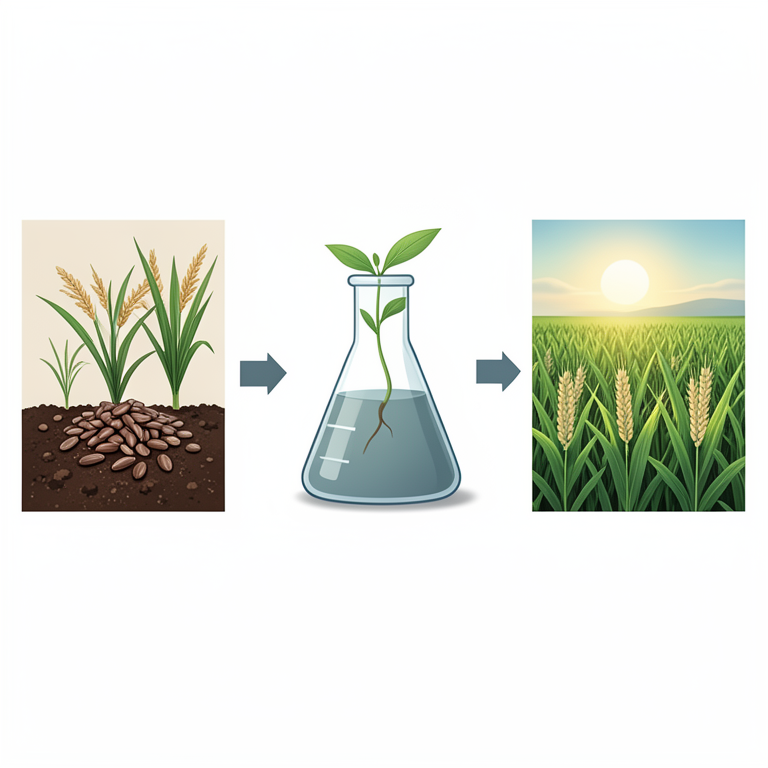
Synergistic Mitigation Strategy
AI-generated conceptual illustration (diverse agricultural crops including rice, maize, and wheat). It explains the idea and does not show study data.
View source evidence ↗Introduction
The shift in climate patterns as a result of diverse environmental pollution from natural systems and other human activities generally referred to as climate change now accounts for about 1°C rise in global warming. This phenomena might likely increase to 1.5 °C in some years to come if current emission rates are not checked [1] . Across the globe, about 315 cases of diverse natural disasters are recorded annually and they are mainly connected to some industrial emissions. Globally, about 68.5 million people have been affected by these disasters with concomitant economic losses of about $131.7 billion. Among these array of calamities, droughts, floods, storms, and wildfires accounts for approximately 93%. Majority of the losses is due to wildfires alone [2] . Sectors of human endeavour affected the most include food, water, health, ecosystem, human habitat and infrastructure. This occurrences was what led to the Paris agreement in 2015 whose main goal was the reduction in global warming of at least 2 °C by the year 2100. Biotechnology within the context of this brief review could simply be defined as the use of living organisms to make goods and other useful products for human consumption. As such, biotechnology involves activities like waste treatment, prevention of environmental hazards, production of commodity chemicals, manufacture of therapeutic compounds like vaccines and antibiotics, and the production of transgenic microbes, plants, and animals among other activities [3] . All these examples mentioned above fall into one or more classes of branches of biotechnology namely; environmental, medical/pharmaceutical, industrial, and agricultural biotechnologies. Practices like emission of greenhouse gases, desertification, deforestation, industrial pollution, etc. all increase global warming and generally affect the environment negatively. Due to the broad field of biotechnology and the need to discuss only areas important to climate change issues, this write up will only limit itself to environmental and agricultural biotechnologies. These are fields concerned with distortions in both water and land utilization giving rise to persistent water scarcity and food/livestock shortages. For example, places that are liable to drought and low rainfall may have to look for crops that withstand such unfriendly conditions and new clones of livestock and poultry must be able to augment for the shortfall in local varieties. This is where the field of biotechnology positively assist in curbing these effects by using modern genetic manipulations to create novel breeds with desirable traits [4] . Modern biotechnology has greatly helped genetically modified crops to counteract the effects of climate change in variety of ways around the world through practices like production of bio fertilizers and energy efficient farming. This article will be reviewing some of the strategies adopted to mitigate climate change disasters. The techniques may be conventional as practised over so many years ago and other novel biotechnological procedures used presently. Conventional mitigation technologies focuses on reducing fossil-based carbon dioxide emissions in the atmosphere and other processes meant to capture and sequester the compound. It is very obvious to state here that this normal mitigation efforts alone are not sufficient to meet the targets stipulated by the Paris agreement and therefore, utilization of other options appears inevitable. While various technologies presented may still be at an incubation stage of development, biogenic-based sequestration techniques have come of age to a certain extent and can be utilized almost immediately. The United Nations Intergovernmental Panel on Climate Change (IPCC) defines climate change as the "mean change in the climatic conditions of an area or variability of its properties over a period of time". These changes could be caused by both anthropogenic and natural factors like rise in solar cycles, volcanic eruptions and continental drift [5] . Research has shown that agricultural activities by themselves contribute about 25% to greenhouse gas emissions and serve as a major source of methane (48%) and nitrous oxide (52%) from some farwlands for instance. Greenhouse gases by nature puncture the atmospheric shield leading to rise in temperature in our planet. These gases like carbon dioxide (CO 2 ), methane (CH 4 ), nitrous oxide, hydrofluorocarbons (HFCs) and sulphur hexaoxide (SF 6 ) are mainly emitted from different industrial ventures and after a period of time their concentration in the atmosphere increases causing massive global warming [6] . Climate change mitigation strategies mostly aims at reducing the negative impact human activities exert on land and water bodies. For example, reducing concentration of greenhouse gasses emitted into the atmosphere by controlling the release of industrial effluents and emissions of radioactive materials may be some steps that will protect the earth from these adverse effects. In addition, reforestation and other sinks (natural absorbents and adsorbents) can also be used as panacea to these emissions. Some biotechnology related techniques in use for mitigation purposes at present include tissue culture, bioremediation, biosorption, bioleaching, normal and molecular marker assisted breeding and genetic manipulation [7] . Reduction of carbon emission using bio fuels, sequestration of carbon, less use of chemically synthetized fertilizers, etc. are other activities that have also been successfully applied. This brief review is therefore meant to briefly x-ray the importance and interventions some of these biotechnological techniques have brought to bear in dealing with potential disasters emanating from climate change issues. Suffice to say here that an assessment once presented in the IPCC special report covered the impacts and projected risks associated with two levels of global warming i.e 1.5°C and 2°C. The report shows the negative effect of global warming on freshwaters, food security, ecosystems, human health, urbanization as well as poverty and changing structures of communities. The report further revealed climate change impact on key economic sectors such as tourism, energy and transportation. Findings from the report shows that most of the impacts assessed have lower associated risks at 1.5°C compared to 2°C warming level [8] . The conclusion was that our planet may likely reach 2°C within in few years to come and increase in warming levels beyond this point would amplify higher risk effects. For example, water stress would carry double risk under a 2°C level compared to 1.5°C. An increase of 70% in population affected by fluvial floods was projected under the 2°C scenario compared to 1.5°C, especially in some part of the world like USA, Europe and Asia. Double or triple rates of species extinction in terrestrial ecosystems are projected under the 2°C level compared to 1.5 °C [9] . All these accounts simply shows that the world is in a current state of climate emergency and this is the reason this essay will dissect a few of the mitigation strategies that might curb this imminent catastrophe if wellarticulated and implemented.
Natural mitigation processes
It's a well-known fact that energy-related emissions are the main cause for increased greenhouse gas levels in the atmosphere; hence conventional mitigation methods are those focused on both the supply and demand sides of energy utilization. Mitigation efforts discussed in most literature cover technologies and techniques that are deployed to two areas namely power on the supply side and transportation and buildings on the demand side. Power generation requires huge amount of logistics which in turn churns out tremendous energy for use in different agricultural ventures for example. Sometimes this utilizes a lot of organic compounds which releases so much carbon into the atmosphere. As such, within the power sector, decarbonization has been achieved through the introduction of renewable energy and carbon capture/storage. On the supply side, switching to low-carbon fuels such as natural gas and renewable fuels include gains made through the deployment of energy-efficient processes and sector-specific technologies that reduce energy consumption, as well as ending the use of fuel switch from fossil-based fuels to renewable ones [8] .
Green House Gas emissions reduction
Some agricultural practices like the use of synthetic fertilizers, over grazing, and deforestation contribute a quarter of all greenhouse gases released into the atmosphere. However, the application of biotechnology is one of the most reliable solution to this menace. This could be through the use of novel techniques like energy efficient farming, carbon sequestration and less utilization of inorganic fertilizers [7,8] . Planting genetically modified crops reduces the amount of greenhouse gases emitted into the atmosphere by more than 25%. This could be due to the fact that since such crops do not need much maintenance as regular crops; farmers also do not expend much fuel to power their machinery. In 2011 alone, reduction strategies adopted for removing these obnoxious gages was equal to removing about 27 billion kilogram of carbon dioxide from the atmosphere or about 11.9 million cars from the road for one year. This is because, the simple use of genetically modified crops in farming allow farmers to use less fuel as a result of not riding on farm equipment for long, leading to a reduction of total carbon emissions into the atmosphere [9] .
Energy efficient farming
Currently, green biotechnology which refers to bioremediation of contaminated agricultural fertile lands and breeding of resistant hybrid plants through the use of specialized techniques have been utilized in solving global hunger. This is attributed to the fact that there's production of resistant plants breeds which have the potential to face both biotic and abiotic strain. This technologies allow farmers to use less energy together with environmentally friendly fertilizers in food production which assist in carbon sequestration. Production of bio fuels from both traditional and Genetically Modified (GM) plants like oilseed, sugarcane, rape seed and jatropha also reduce the adverse effects of pollution as a result of transport activities on the farm by using environmentally friendly fuels. Efficient farming help in cleaning the atmosphere through planting of perennial non edible oil-seeds by directly serving as a raw material in the production of bio diesel for use in the energy sector. These oil when blended with fossil fuels reduce carbon emission greatly [10] .
Sequestration of atmospheric carbon
Carbon sequestration simply refers to situation where carbon containing substances particularly carbon rich compounds like carbon dioxide is removed from the atmosphere. These phenomena recycles carbon back to the soil and removes or reduce its concentration in the atmosphere thereby decarbonizing the environment. From this point of view, carbon sequestration could be seen as one of the best ways to check the effect of climate change by depleting the ever-increasing concentration of carbon dioxide and carbon monoxide in the atmosphere. One efficient way of achieving this is conservation tillage. Here, crops are covered with more than 30% of soil surface with crop residue after planting to reduce erosion that can lead to huge nutrient leaching which itself may impact the soil negatively. In a nutshell, carbon sequestration enhances better cycling of nutrients and prevent their losses among other key benefits to farmers [11] .
Reduction in the use of synthetic fertilizers
The use of synthetic fertilizers in modern agriculture has led to contamination of the environment due to release of chemicals that could become toxic to the soil at higher concentration. These kind of fertilizers contribute to the formation as well as release of certain greenhouses gasses like nitric oxide. This might be from fertilizers containing ammonium chloride, ammonium sulphate, sodium nitrate and calcium nitrate in their combination. Biotechnology has assisted in reducing the application of these synthetic fertilizers by using genetic engineering techniques to fix soil nitrogen through Rhizobium species. Another strategy is planting crops that uses nitrogen more efficiently. An example of such crops is genetically modified Canola which has been shown to significantly reduce the amount of nitrogen fertilizers that filter into the atmosphere or leach into soil and water ways [12] .
Crop adaptation through Biotechnology
On a general scale, climate change leads to reduction in crop yield due to inadequate rainfall, extreme temperatures, growth of weeds, attack from of pest and diseases among other numerous challenges. One possible way of dealing with such global problem is applying agricultural biotechnologies that combat the negative effects such changes usually pose to food security and sustainable agriculture by using genetic manipulation. This engineering can lead to creation of clones with drought, stress resistance, and many other desirable traits. Changes in climatic condition pose a lot of setback in land and water use. Some of these include salinity, drought, high temperatures and chemical toxicity. Let us remember that the agricultural sector worldwide uses about 70% of the available fresh water on earth and this is likely to increase as temperature keeps fluctuating. As a result of this, about 25 million acres of land may become useless each year in terms of dry season farming if water bodies keep drying up due to global warming. It has also been estimated that increased salinity in arable land will lead to about 30% uncultivated land within the next 25 years and this number will reach up to 50% in another three decades if urgent actions are not put in place. The consequence of all these is increased food shortage and global hunger [13] .
What does the future holds
Climate change have brought a lot of clear impediments now to clean environment and there is no indication that these will abate in the nearest future. Actions must therefore be taken to use timely interventions in preventing unpredictable and undesirable outcomes. The world population which is currently at over 7 billion is estimated to hit 8 billion by 2025 and peak at about 9 billion in 2050. According to some studies carried out, developing countries will need to cultivate about 120 million additional hectares of land for feeding their ever increasing population. Therefore, modern agricultural science and particularly agricultural biotechnology should be tailored towards boosting food production. Efforts should be put in place to incorporate local and conventional biotechnologies with modern biotechnology strategies within national policies in order to increase resilience of local crop varieties against changes in environmental dynamics [14] .
Conclusion
Due to current state of climate change menace across the globe, there is need for immediate development of viable mitigation mechanisms. It is important to note that there is no single solution to tackle these challenges and that all technologies and techniques discussed in this review with others not mentioned here must be synergized for maximum result. Decarbonization efforts alone are not enough to meet the targets stipulated by the Paris agreement; therefore, the utilization of an alternative containment approach should be continuously applied [15] . Once again, we need to be reminded that agricultural biotechnology can contribute positively towards climate change mitigation through reduction in greenhouse gas emissions, carbon sequestration, less fuel use via energy efficient farming and use of organic fertilizers. This measures help to improve agricultural productivity and protect the ecosystem from extreme weather event. However they are not sufficient on their own. As such, novel biotechnological innovations are still needed to counteract climate related problems threatening global peace and food security.
References
13 in the original paper- Bach LT, et al. CO 2 removal with enhanced weathering and ocean alkalinity enhancement: potential risks and co-benefits for marine pelagic ecosystems. Front Clim. 2019. https://doi.org/10.3389/fclim.2019.00007
- Bataille C, et al. A review of technology and policy deep decarbonization pathway options for making energy-intensive industry production consistent with the Paris Agreement. J Clean Prod. 2018;187:960-973. https://doi.org/10.1016/j.jclepro.2018.03.107
- Bustreo C, et al. How fusion power can contribute to a fully decarbonized European power mix after 2050. Fusion Eng Des. 2019;146:2189-2193. https://doi.org/10.1016/j.fusengdes.2019.03.150
- Chauhan SK, et al. Environmental aspects of biofuels in road transportation. Environ Chem Lett. 2009;7:289299. https://doi.org/10.1007/s10311-008-0185-7
- Chen H, et al. Upcycling food waste dige state for energy and heavy metal remediation applications. Resour Conserv Recycl X 2019;3:100015. https://doi.org/10.1016/j.rcrx.2019.100 015
- Collura S, et al. Miscanthus × Giganteus straw and pellets as sustainable fuels. Environ Chem Lett. 2006;4:75-78. https://doi.org/10.1007/s10311-0060036-3
- Michalski J, et al. The role of renewable fuel supply in the transport sector in a future decarbonized energy system. Int J Hydrog Energy. 2019;44:12554-12565. https://doi.org/10.1016/j.ijhydene.2018.10.110
- Ming T, et al. Fighting global warming by climate engineering: is the Earth radiation management and the solar radiation management any option for fighting climate change? Renew Sustain Energy Rev. 2014;31:792-834. https://doi.org/10.1016/j.rser.2013.12.032
- Nakajima T, et al. Carbon sequestration and yield performances of Miscanthus × giganteus and Miscanthus sinensis. Carbon Manag. 2018;9:415423. https://doi.org/10.1080/17583004.2018.1518106
- Oni BA, et al. Significance of biochar application to the environment and economy. Ann Agric Sci. 2020. https://doi.org/10.1016/j.aoas.2019.12.006
- Osman AI. Catalytic hydrogen production from methane partial oxidation: mechanism and kinetic study. Chem Eng Technol. 2020;43:641-648. https://doi.org/10.1002/ceat.201900339
- Osman AI, et al. Production and characterisation of activated carbon and carbon nanotubes from potato peel waste and their application in heavy metal removal. Environ Sci Pollut Res. 2019;26:37228-37241. https://doi.org/10.1007/s11356-019-06594-w
- Stringer LC, Dyer JC, Reed MS, Dougill AJ, Twyman C, Mkwambisi D. Adaptation to climate change, drought and desertification: Local insights to enhance policy in Southern Africa. Environment Sciences Policy. 2009;12:748-765. 10.1016/j.