
Research article · 2019 · Full text
International Journal of Horticulture and Food ScienceEffect of soil application of bi- fertilizer on yield and quality of banana Cv. Grand Naine
Volume 1(1) · Pages 28–29 · DOI: 10.33545/26631067.2019.v1.i1a.10 ↗
Research areasBanana Cultivation and Research
Abstract
Author-writtenA field experiment was conducted during 2016-17 at banana Research Station, Nanded to study the effect of Soil application of bio-fertilizer on yield and quality of banana. Bio-fertilizers Viz. Trichoderma harzianum, Azospirillum lipoferum and Phosphate solubilizing bacteria (PSB) were applied through soil at 25g per plant in split doses soil application of bio-fertilizer is applied with 100 percent recommended dose of fertilizer considering the effectiveness of soil application of bio-fertilizer along with 100 percent and 75 percent dose of recommended dose of fertilizer. Treatment T9 i.e. 100 % RDF + Trichoderma harzianum + Azospirillum +PSB @ 25gper plant recorded significantly maximum yield (114.20 Mt/ ha) Reducing sugar (11.37) non-reducing sugar (4.67) and total sugar (16.21).
Summary
Source-checkedPlain-language reading of the full paper, prepared with AI and checked against the text. Each point links to the authors' own words.
Why it matters
- Banana is a significant tropical fruit crop and a rich source of carbohydrates, with India producing 27% of the global supply. View evidence ↗
- Integrated nutrient management is used to maintain soil fertility and optimize nutrient supply to sustain crop productivity. View evidence ↗
- Banana yield is most affected during the bunch development stage and the early vegetative phase, specifically up to the 3rd and 6th months after planting. View evidence ↗
The question
- The study aimed to evaluate how the soil application of bio-fertilizers affects the yield and quality of banana. View evidence ↗
What they did
- The research was a field experiment conducted in 2016-17 at the Banana Research Station in Nanded using a Randomized Block design with nine treatments and three replications. View evidence ↗
- Bio-fertilizers (Azospirillum lipoferum, Phosphate Solubilizing bacteria, and Trichoderma harzianum) were applied at 25g per plant in two split doses: one at planting and one 75 days later. View evidence ↗
- Treatments varied between 75% and 100% of the Recommended Dose of Fertilizer (RDF), combined with different combinations of the three bio-fertilizers. View evidence ↗
What they found
- The highest banana yield of 114.20 Mt/ha was achieved using treatment T9 (100% RDF plus all three bio-fertilizers). View evidence ↗
- Treatment T9 resulted in the significantly maximum Total Soluble Solids (TSS) of 22.8 Brix. View evidence ↗
- The maximum non-reducing sugar content of 4.64% was recorded in treatment T9. View evidence ↗
- Treatment T9 produced reducing sugars of 11.37%, which was statistically similar to the results of treatment T5. View evidence ↗
- Treatment T9 recorded the significantly maximum total sugar content of 16.21%. View evidence ↗
- The maximum bunch weight per plant was 23.80 kg, achieved by treatment T9. View evidence ↗
What it means
- The authors conclude that providing more nutrients through organic sources likely improved bunch weight and yield because banana is an exhaustive plant. View evidence ↗
Visual summary
3 visualsIllustrations explain the paper; charts are replotted from the paper's own table values.
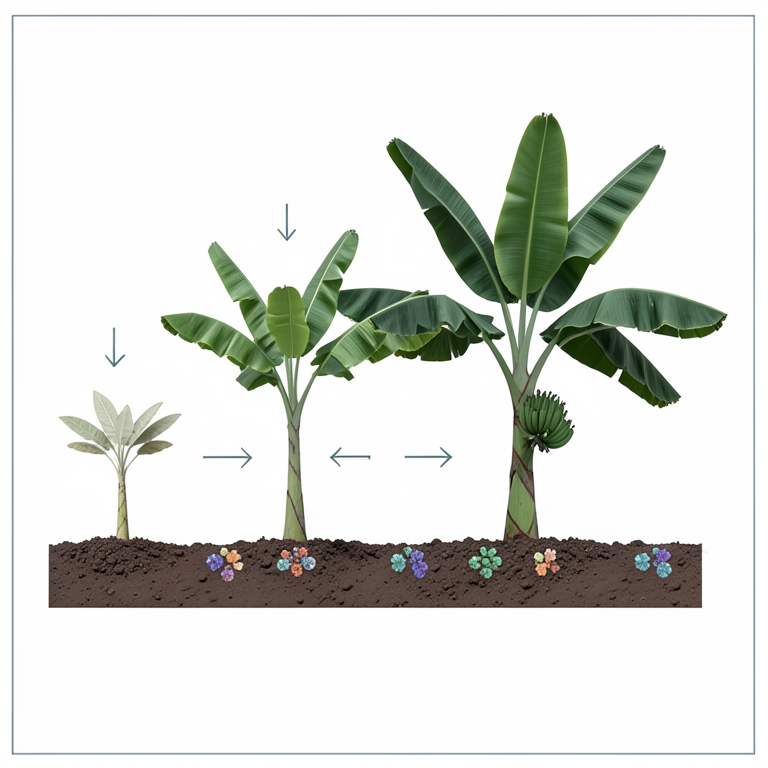
Treatment Comparison Layout
AI-generated conceptual illustration (Banana plants (Cv. Grand Naine)). It explains the idea and does not show study data.
View source evidence ↗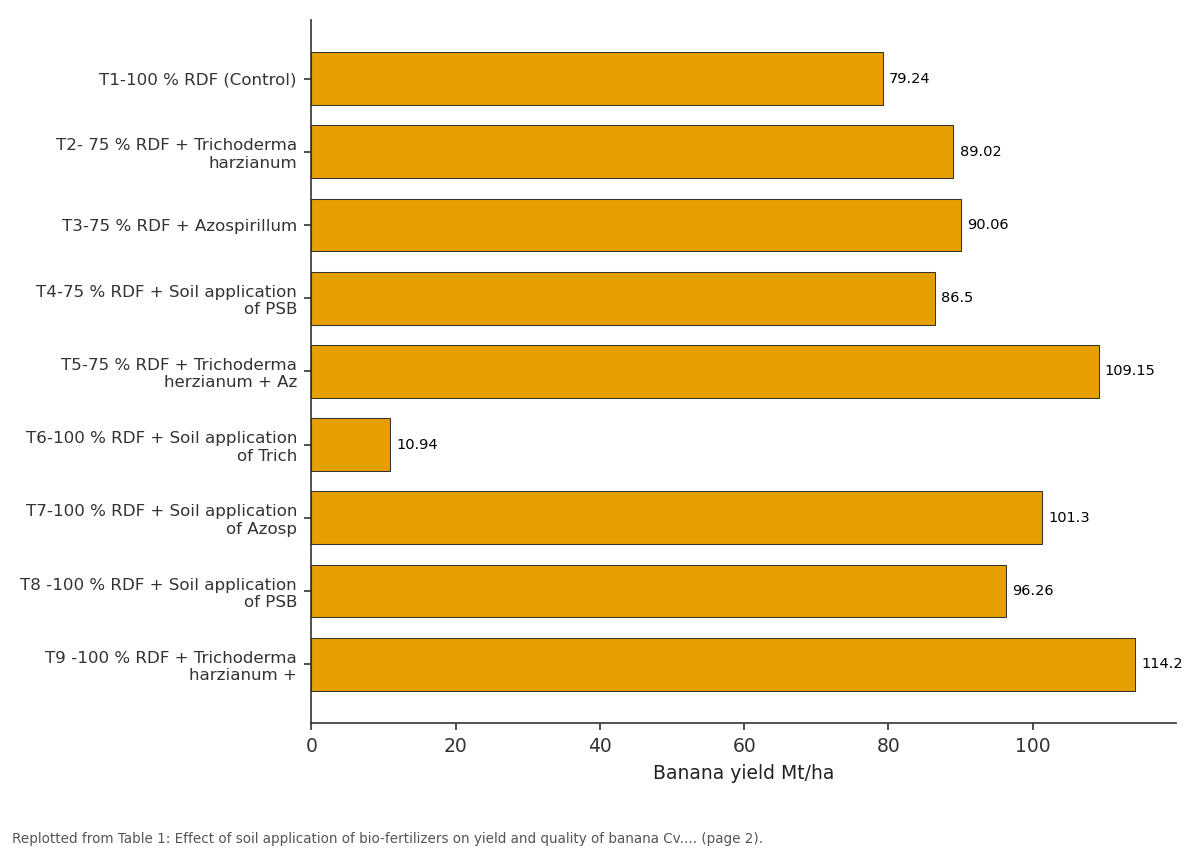
Banana yield Mt/ha: T1-100 % RDF (Control) vs T2- 75 % RDF +... vs T3-75 % RDF +... vs T4-75 % RDF + Soil... vs T5-75 % RDF +...
Replotted from Table 1 (page 2) of the original paper. Every bar is the paper's own table value.
View source evidence ↗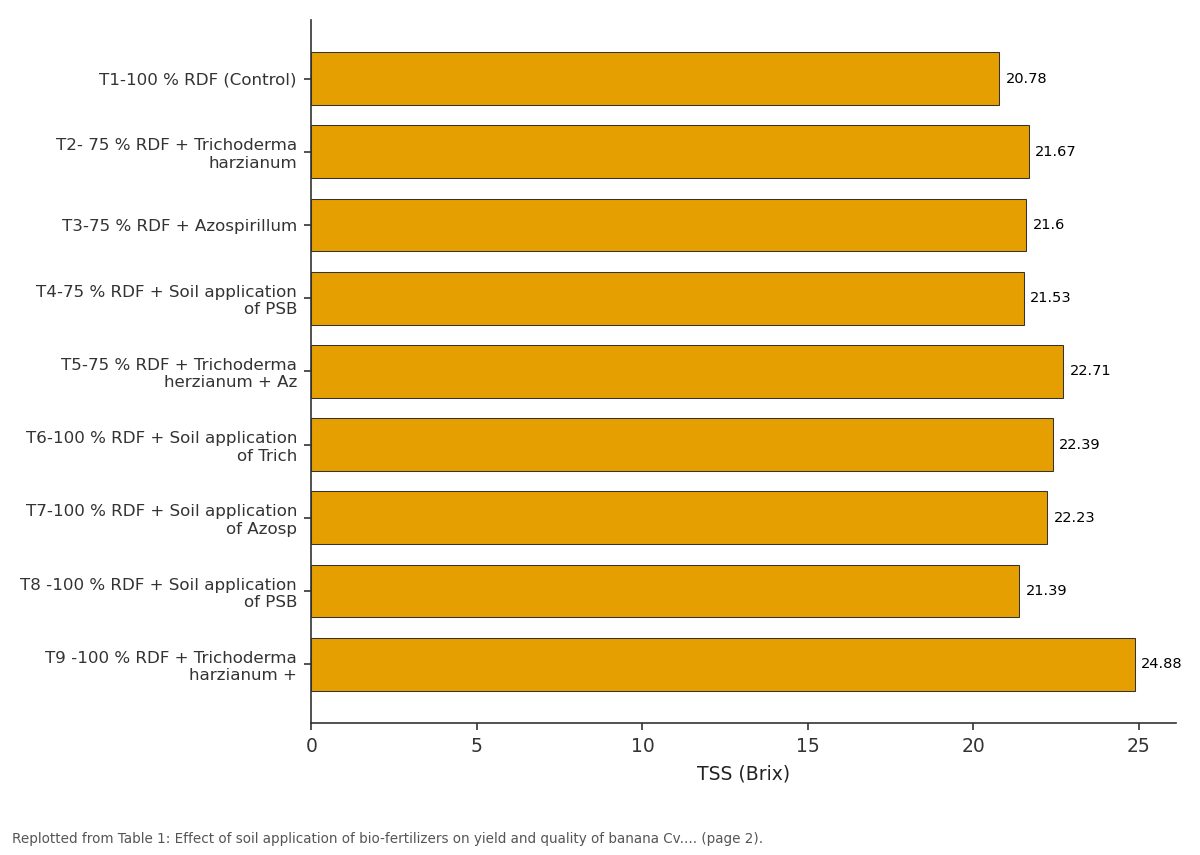
TSS (Brix): T1-100 % RDF (Control) vs T2- 75 % RDF +... vs T3-75 % RDF +... vs T4-75 % RDF + Soil... vs T5-75 % RDF +...
Replotted from Table 1 (page 2) of the original paper. Every bar is the paper's own table value.
View source evidence ↗Figures & tables
From the original paper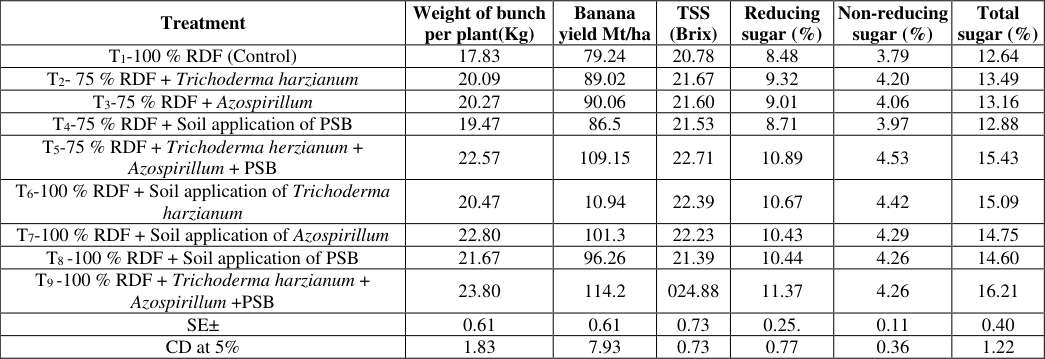 Table 1
Introduction
Banana (Musa spp) is one of the important fruit crop of the tropics. The fruits are rich source of carbohydrate India is the largest producer of banana contributing 27% of the world production. Integrated nutrient management is found beneficial for maintenance of soil fertility and plant nutrient supply to an optimum level sustaining crop productivity through optimization of benefits from all possible sources of plant nutrient is an integrated manner. It was found that early vegetative phase of growth of banana especially upto to 3 rd and 6 th month after planting and bunch development stage are the critical stages of banana at which yield is affected (Prameela 2010) [4] . Combine application of 100 per cent recommended dose of fertilizer (RDF) along with FYM 10 kg per plant and phosphate solablizing bacteria (PSB) and Azospirillum each at 25g per plant increased pseudoslem height crop duration and yield attributes (Bhalerao et at. 2009) [3] Tricoderma strains are know to be induce resistance in plants present investigation was carried out at Banana Research Station, Nanded during the year 2016-17 on soil application of bio -fertilizer on yield and quality of banana. Cv Grand Naine.
Materials and Methods
The experiment was conducted at Banana Research Station Nanded of Vasantrao Naik Marathwada Krishi Vidyapeeth, Parbhani during the year 2016-17. The experiment was conducted in Randomised Block design with three Replication nine treatments. Recommended spacing 1.5 m 1.5 M was maintained. Grand Naine tissue calculate sapling were used as planting material. Bio-fertilizer Azosprilum lipoforum Phosphate Solublizing bacteria and Tricoderma harzianum @25 g per plant in two split doses at the time of planting and 75 days afler planting T 1 -100% RDF Control, T 2 -75 RDF + Tricoderma harzianum, T 3 -75 % RDF + Azospirillum, T 4 -75 % RDF+ soil application of PSB, T 5 -7 5%. RDF + Trcodema harzianum + Azospirilium + PSB, T 6 100 %s RDF + soil application of Trichoderma harziannum + Azosprillum + PSB T 7 100 %s RDF + soil application Azospirillulm, T 8 100 %s RDF + soil application PSB T 9 -100 %. RDF + Trcodema harzianum +Azospirilium + PSB. Observation on growth yield and quality of banana were recorded.
Result and Discussion
Results presented in Table 1 revealed that the significant results were observed due to application of bio-fertilizer in respect of yield and quality.
| Treatment | Weight of bunch per plant(Kg) | Banana yield Mt/ha | TSS (Brix) | Reducing sugar (%) | Non-reducing sugar (%) | Total sugar (%) |
|---|---|---|---|---|---|---|
| T1-100 % RDF (Control) | 17.83 | 79.24 | 20.78 | 8.48 | 3.79 | 12.64 |
| T2- 75 % RDF + Trichoderma harzianum | 20.09 | 89.02 | 21.67 | 9.32 | 4.20 | 13.49 |
| T3-75 % RDF + Azospirillum | 20.27 | 90.06 | 21.60 | 9.01 | 4.06 | 13.16 |
| T4-75 % RDF + Soil application of PSB | 19.47 | 86.5 | 21.53 | 8.71 | 3.97 | 12.88 |
| T5-75 % RDF + Trichoderma herzianum + Azospirillum + PSB | 22.57 | 109.15 | 22.71 | 10.89 | 4.53 | 15.43 |
| T6-100 % RDF + Soil application of Trichoderma harzianum | 20.47 | 10.94 | 22.39 | 10.67 | 4.42 | 15.09 |
| T7-100 % RDF + Soil application of Azospirillum | 22.80 | 101.3 | 22.23 | 10.43 | 4.29 | 14.75 |
| T8 -100 % RDF + Soil application of PSB | 21.67 | 96.26 | 21.39 | 10.44 | 4.26 | 14.60 |
| T9 -100 % RDF + Trichoderma harzianum + Azospirillum +PSB | 23.80 | 114.2 | 024.88 | 11.37 | 4.26 | 16.21 |
| SE± | 0.61 | 0.61 | 0.73 | 0.25. | 0.11 | 0.40 |
| CD at 5% | 1.83 | 7.93 | 0.73 | 0.77 | 0.36 | 1.22 |
Table text extracted from the original PDF; superscript letters are shown inline. The original table image is below.
View original table image
Significantly differences in weight of bunch per plant and yield of banana (Mt/ha) were observed. Significantly maximum weight of bunch per plant were recorded by the treatment T 9 i.e. application of 100% RDF along with soil application of Trichoderma harziarnum + Azosprillum and PSB @ 25gm per plant (23.80 kg per plant). Treatment T 7 i.e. 100 percent RDF with soil application of Azosprillum @25gm per plant (22.80 kg per plant) and treatment T5 i.e. 75 % RDF with soil application of Trichoderma harziarnum which were found at par with each other as compared with rest of the treatment under study.
Significantly maximum yield of banana (114.20 Mt/ha) were obtained from treatment T 9 i.e. 100 percent RDF with soil application of Tricoderma harzianum + Azospirillum and PSB @25gm per plant followed by the treatment T 5 i.e. RDF will soil application of Trichoderma harziarnum + Azospirillum and PSB@ 25gm per plant (109.15Mt/ha). banana being an exhaustive plant availability of more nulnent through organic source might have helped to get better weight of bunch and yield per hector.
TSS
Significantly maximum T.S.S. (22.8 Brix) was recorded by treatment T 9 .i.e 100 percent RDF with soil application of Trichoderma harziarnum+Azospirillum and PSB. However, it was statistically at par with treatemt T 9.j.e 100% percent RDF with Soil application of Trichodema harzianum, Azospinllum and PBS. However, it was statically at par with treatment T 5. An improvement fruit quality (TSS) could be due to the involvement of organic manures. The beneficial influence can also be attributed to bio-fertilizers particularly Azospirillum and PSB application. These finding are in concordance with the results of (Athani and Hulamani 2000) [2] .
Non reducing and Reducing Sugar
Significantly maximum non-reducing sugars (4.64%) was recorded by the treatment T 9 .i.e 100 percent RDF with soil application of Trichoderma harzianum + Azospirillum and PSB 9. However it was at par with treatment T 5 the reducing Sugar was affected by treatment T 9 T 9 .i.e 100 percent RDF with soil application of Trichoderma harzianum+ Azospirillum and PSB. Reducing sugars (11.37%) However, it was found significantly at par with treatment T 5. i.e. 7 5%. RDF + Trcodema harzianum +Azospirilium + PSB. These was confirmation with (Vanilarasau and Balakri shanamurthey. 2014) [5] .
Total sugar
The treatment T 9 i.e.100% RDF + soil application of Trichoderma harzianum a Azospirillum +PSB produced maximum (16.21%) total sugars was found at par with treatment T 5, i.e. 7 5%. RDF + Trcodema harzianum + Azospirilium + PSB.
References
5 in the original paper- Athanl SI, Hwamaril NC, Shirole AM. Effect of Vermicompost on Yield of banana CV. Rajapun. Soath Indian. An Horticalture. 1990; 47(1-6):4-7.
- Athani SJ, Hulamani NC. Effect of vermicompot on fruit yield and quality of banana CV. Rajapuri [musa AAB] Karnataka Journal of Agricaltral sciences. 2000; 47(1-6):4-7.
- Bhalerao NM, Patil NM, Badgujar CD, Patil DR. Studies on integrated nutrient management for tissue cultured Graind Naine banana. Indian I. Agri. Res. 2009, 43-107-12.
- Premeela P. Indentificaleon of critical stages of weed compition and effect of weed Compition of in banana variety palaya Kodan. J crop. Weed. 2010: 6-59-62.
- Vanilarasu K, Balakrishramurthy G. Eftect of organic manures and amendments on quality attributes and shelf life of banana CV. Grand Naine. Agrotechnology. 2014; 3:1.