
Research article · 2019 · Full text
International Journal of Horticulture and Food ScienceStudies on standardization of period for softwood grafting in dry land fruit crops
Volume 1(1) · Pages 55–56 · DOI: 10.33545/26631067.2019.v1.i1b.11 ↗
Research areasPlant Disease Management TechniquesPlant and Fungal Interactions ResearchPlant Pathogens and Fungal Diseases
Abstract
Author-writtenAn experiment was conducted during 2005-2006 at central ursery scheme V.N.M.K.V, Parbhani. Three separate experiment carried out on Jamun, Tamarind and Custard apple. An experiment carried out in Complete Randomized Design with three replications and twelve treatments. Significantly maximum final percent success was recorded in a Jamun grafting was carried out on 1st February (99.33 percent). In tamarind on 1st march (71.66 percent) and in custard apple 1st February (94.99 percent).
Summary
Source-checkedPlain-language reading of the full paper, prepared with AI and checked against the text. Each point links to the authors' own words.
Why it matters
- Dry land horticulture is a critical sector in Maharashtra, where approximately 70% of the total land is used for rainfed agriculture. View evidence ↗
- Tamarind, Jamun, and Custard apple are key dry land fruit crops that allow for the productive use of marginal lands, such as riverbanks and bunds. View evidence ↗
- Softwood grafting has gained popularity due to perceived advantages over other propagation methods. View evidence ↗
The question
- The study aimed to standardize the optimal time period for performing softwood grafting in dry land fruit crops. View evidence ↗
What they did
- Experiments were conducted between 2005 and 2006 at the central nursery scheme of V.N.M.K.V, Parbhani, focusing on Jamun, Tamarind, and Custard apple. View evidence ↗
- The research used a Complete Randomized Design featuring twelve different treatments and three replications. View evidence ↗
- The success of the grafting was measured and recorded at two intervals: 30 days (initial success) and 90 days (final success) after the procedure. View evidence ↗
What they found
- For Jamun, the highest final success rate was achieved with grafting on February 1st, reported as 99.33% in the abstract and 98.33% in the results section. View evidence ↗
- Tamarind showed the highest final success rate of 71.66% when grafting was performed on March 1st. View evidence ↗
- Custard apple achieved its highest final success rate of 94.99% when grafted on February 1st. View evidence ↗
- The lowest initial success rate for Jamun was recorded on September 1st at 46.67%. View evidence ↗
- In contrast to other crops, Tamarind had its minimum final success rate of 20.00% when grafted on February 1st. View evidence ↗
What it means
- The authors conclude that the high success rate in February for certain crops is likely due to optimal humidity, moderate temperatures, and the biochemical status of the plants. View evidence ↗
- The authors suggest that dormancy from November to February allows for the storage of food materials in the scion, which contributes to better grafting success. View evidence ↗
Visual summary
1 visualsIllustrations explain the paper; they do not show study data.
Experimental Timeline
AI-generated conceptual illustration (softwood fruit tree saplings). It explains the idea and does not show study data.
View source evidence ↗Figures & tables
From the original paper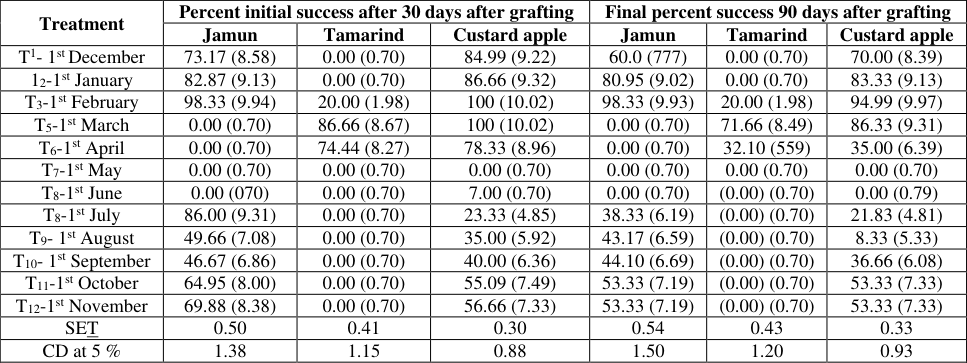 Table 1
Introduction
India is the endowed with different agro climatic regions. Dry land horticulture has become important aspect of horticulture specialiy in Maharashtra about 70%.of the total land comes under rainfed agriculture This type of farming attains a greater importance. Tamarind, Jamun and Custard apple are important dry land fruit crops of the state. These crops bring in the use of waste land of the farm such as a bunds, riverbanks and places where cultivation of grain crops is rather difficult. In the recent year softwood grafting has become popular because of its added advantages over other mango, sapota, (Amin. 1978) [1] . Therefore an investigation was planned studies on standardization of period for softwood grafting in dry land fruit crops.
Materials and Methods
The experiment was conducted entitled standardization of period for softwood grafting in dry land fruit crops ciz. Jamun, Tamarind and Custard apple was carried out at central nursery. scheme VNMKV, Parbani studies were carried out in were different sets. Three separate experiment were carried out on Jamun, Tamarind and Custard apple 2005-2006. The experiment was conducted in complete Randomized design with three Replication. T 1 -Grafting on 1 st December 2004, T 2-Grafting on 1 st January 2005, T 3 -Grafting 1 st February 2005, T 4-Grafting on 1 st march 2005, T 5-Grafting on 1 st April 2005, T 6 -Grafting on 1 st may 2005 T 7 -Grafting on 1 st June 2005, T 8 -Grafting 1 st July 2005, T 9 -Grafting on 1 st August 2005, T 10-Grafting on 1 st September 2005, T 11 -Grafting on 1 st October 2005 and T 12 -Grafting on 1 st November 2005. In Jamun budsticks were taken from local selection. In Tamannd the scion budsticks were taken from pratishthan and Custard apple budshsticks were used from Balanager. The softwood grafting in Jamun, Tamarind and Custard apple was done. Observations were recorded 30 days and 90 days after grafting.
Result and Discussion
Data presented in Table 1. The data showed that maximum initial success was obtained in case of Grafting was carried out on 1 st February. Higher success in the month of February in Jamun and minimum percent success was obtained on 1 st September (46.67percent) in Jamun. In Tamarind maximum initial percent success was obtained when Grafting was carried out on 1 st march (86.66 percent) followed by 1 st April (74.44 percent). In Tamarind maximum success was obtained in the month of February grafting. During the period from march to April the maximum and minimum temp ranged from 31 0 c to 32 0 c these conditions are favourable for rapid growth (Hartman and kestar (1972) [4] . In custard apple significantly maximum initial, percent success was obtained 1 st February and 1 st march.
| Treatment | Percent initial success after 30 days after grafting | — | — | Final percent success 90 days after grafting | — | — |
|---|---|---|---|---|---|---|
| Jamun | Tamarind | Custard apple | Jamun | Tamarind | Custard apple | |
| T1- 1st December | 73.17 (8.58) | 0.00 (0.70) | 84.99 (9.22) | 60.0 (777) | 0.00 (0.70) | 70.00 (8.39) |
| 12-1st January | 82.87 (9.13) | 0.00 (0.70) | 86.66 (9.32) | 80.95 (9.02) | 0.00 (0.70) | 83.33 (9.13) |
| T3-1st February | 98.33 (9.94) | 20.00 (1.98) | 100 (10.02) | 98.33 (9.93) | 20.00 (1.98) | 94.99 (9.97) |
| T5-1st March | 0.00 (0.70) | 86.66 (8.67) | 100 (10.02) | 0.00 (0.70) | 71.66 (8.49) | 86.33 (9.31) |
| T6-1st April | 0.00 (0.70) | 74.44 (8.27) | 78.33 (8.96) | 0.00 (0.70) | 32.10 (559) | 35.00 (6.39) |
| T7-1st May | 0.00 (0.70) | 0.00 (0.70) | 0.00 (0.70) | 0.00 (0.70) | 0.00 (0.70) | 0.00 (0.70) |
| T8-1st June | 0.00 (070) | 0.00 (0.70) | 7.00 (0.70) | 0.00 (0.70) | (0.00) (0.70) | 0.00 (0.79) |
| T8-1st July | 86.00 (9.31) | 0.00 (0.70) | 23.33 (4.85) | 38.33 (6.19) | (0.00) (0.70) | 21.83 (4.81) |
| T9- 1st August | 49.66 (7.08) | 0.00 (0.70) | 35.00 (5.92) | 43.17 (6.59) | (0.00) (0.70) | 8.33 (5.33) |
| T10- 1st September | 46.67 (6.86) | 0.00 (0.70) | 40.00 (6.36) | 44.10 (6.69) | (0.00) (0.70) | 36.66 (6.08) |
| T11-1st October | 64.95 (8.00) | 0.00 (0.70) | 55.09 (7.49) | 53.33 (7.19) | (0.00) (0.70) | 53.33 (7.33) |
| T12-1st November | 69.88 (8.38) | 0.00 (0.70) | 56.66 (7.33) | 53.33 (7.19) | (0.00) (0.70) | 53.33 (7.33) |
| SET | 0.50 | 0.41 | 0.30 | 0.54 | 0.43 | 0.33 |
| CD at 5 % | 1.38 | 1.15 | 0.88 | 1.50 | 1.20 | 0.93 |
Table text extracted from the original PDF; superscript letters are shown inline. The original table image is below.
View original table image
Minimum initial percent success was recorded when grafting was done on 1 st may and june given zero percent of success. The data presented in table1 significantly highest final success was obtained when grafting was carried out on 1 st February (98.33 per cent).Zero percent success was observed when grafting was done on 1 st march 1 st April, 1 st may, 1 st June in Jamun. The highest percent success (98.33percent) in the month of February may be due to the favourable internal and external conditions like optimum humidity, moderate temperature and biochemical status. After harvesting of fruits, leaf fall is common in Jamun, plants go in dormant condition from November to February. At this period, sufficient food maternal is stored in the scion which help for better sucess and higher grafting. These results are in agreement with the earlier results are reported Gojamguned (1993) [3] and Chauvatia and Singh (1999) [2] in Jamun. In Tamarind significantly maximum final per cent success was found when grafting was carried out on 1 st March (71.66 percent). Minimum success was found when grafting was carried out on 1 st February (20.00 percent). The results obtained in present study are in accordance with the finding in march shinde (1990). That softwood grafting in march or the first of week of April (after harvesting and before flowering) resulted in highest success. Reddy (2000) [5] reported that in tamarind (100 percent) success was recorded in March. Zero percent final success was recorded when grafting was carried out on 1 st one 1 st July, 1 st August, 1 st September, 1 st October and 1 st November. In custard apple significantly highest final success (94.99 percent) was obtained in case of grafting carried out on 1 st February. Lowest success was obtained when grafting was carried out on1 st July. Higher success in the month of February may be due to the favourable in internal and external conditions like optimum humidity moderate temperature and bio-chemical status. After harvesting of fruits, leat fall is common in custard apple. Plants go in dormant condition from November to February. At this period sufficient food material is stored in the scion which helps for better success. Pawar et al. (2003) reported that heights per cent success was obtained when grafted on 1 st February. These results are in agreement with results reported by Kulkarni (1990) Gojamgunde (1993) [3] .
References
5 in the original paper- Amin RS. Softwood grafting a new technique for hardwood plants curr. Sci. 1978; 47:468-469.
- Chauvatia RS, Singh P. Standarizaltion of method and time of propagation on in custard apple cv. Sindhan local under saurabhlra conditions, Horticultural T. 1999; 12(2):1-7.
- Gojamgunde MD. Studie on situ softwood grafting on some dryland fruits crops viz. Custard apple (Annona saqumosa l), jamun (Syzygium cuminni) and tamarnindus indica) M.SC (Agri) thesis submitred to MAU, Parbhani, 1993.
- Hartman, Kester. Plant propagation principle and practice pp. prentice Hall of India pvt. Ltd. New Delhi, 1972, 461-476.
- Reddy BS, Patil DR, Patil HB, Thamiah. Effect of time on success of detached grafting tamarind. Advances IN Agriculture Research in India. 2000; 10:141-143.
Cited by 1
From OpenAlex, OpenCitations and reference lists read by Scinovex
- Effect of season and environmental conditions on softwood grafting of sapota under Saurashtra region of Gujarat cv. Kalipatti ↗
KD Mithapara, K. M. Karetha · Journal of Pharmacognosy and Phytochemistry · 2020
An investigation on “Effect of season and environmental conditions on softwood grafting of sapota under Saurashtra region of Gujarat cv. Kalipatti” was carried out at Hi-Tech Horticulture Park, Department of Horticulture, JAU, Junagadh during the year 2019-20. The treatments comprised of three level of season (S) viz., S1 = February-March (Summer), S2 = June-July (Kharif), S3 = September-October (Winter) and