
Research article · 2019 · Full text
International Journal of Horticulture and Food ScienceBioactive chemical composition and insecticidal potential of Mitracarpus villosus [Swartz] DC for the management of stored product beetles
Volume 1(1) · Pages 65–69 · DOI: 10.33545/26631067.2019.v1.i1b.14 ↗
Research areasInsect Pest Control StrategiesAgricultural pest management studies
Abstract
Author-writtenControl of insect pests attacking stored food grain has become a major concern in the developing nations to ensure food security. A study was carried out to explore the biochemical composition and insecticidal potential of Mitracarpus villosus as grains protectant for the post-harvest protection of stored grains. Results revealed that the plant possess insecticidal properties as the fumigant and repellent activity was significantly (p
Summary
Source-checkedPlain-language reading of the full paper, prepared with AI and checked against the text. Each point links to the authors' own words.
Why it matters
- Insect pest infestations cause significant economic damage and reduce the quality of stored food grains. View evidence ↗
- While synthetic insecticides and fumigants are effective, their widespread use causes adverse effects on human consumers and the environment. View evidence ↗
- Plant-based extracts are being explored as safer, biodegradable alternatives to synthetic pesticides due to their lower toxicity to non-target organisms. View evidence ↗
The question
- The study aimed to investigate the repellent and fumigant toxicity of the bioactive chemical composition of Mitracarpus villosus against stored beetle infestations. View evidence ↗
What they did
- Plant extracts were obtained from pulverized M. villosus using a Soxhlet apparatus with solvents of increasing polarity over 7-8 hours. View evidence ↗
- The study tested the extracts on three adult beetle species: Sitophilus oryzae, Rhyzopertha dominica, and Tribolium castaneum. View evidence ↗
- Fumigant activity was tested by exposing adult insects to doses of 5-40 µg/L for 24 hours in 0.85-liter desiccator chambers. View evidence ↗
- Gas chromatography-mass spectrometry (GC-MS) was used to analyze the purity and identify the bioactive chemical components of the active sub-fractions. View evidence ↗
What they found
- Exposure to a dosage of 100 µg/l of the active sub-fraction resulted in 100% mortality for all tested stored grain beetles within 48 hours. View evidence ↗
- Among the tested species, S. oryzae was the most susceptible to the extract at 24 hours, while T. castaneum was the most tolerant. View evidence ↗
- The LC50 values for the active fraction were lowest for S. oryzae (24.96 µL/L), followed by R. dominica (29.15 µL/L) and T. castaneum (34.14 µL/L), confirming S. oryzae's higher susceptibility. View evidence ↗
- GC-MS identified several principal compounds, with Methyl 20-methyl-heneicosanoate (99%), Heptadecanoic acid (95%), and Tetracosanoic acid (93%) being the most prominent. View evidence ↗
- Repellency increased with dosage, where the highest concentration (1.587 mg/cm²) was significantly more effective at repelling insects than the lowest concentration (0.080 mg/cm²). View evidence ↗
What it means
- The authors conclude that M. villosus can be developed as a natural biofumigant and a promising protectant for controlling storage beetle infestations. View evidence ↗
Visual summary
3 visualsIllustrations explain the paper; charts are replotted from the paper's own table values.
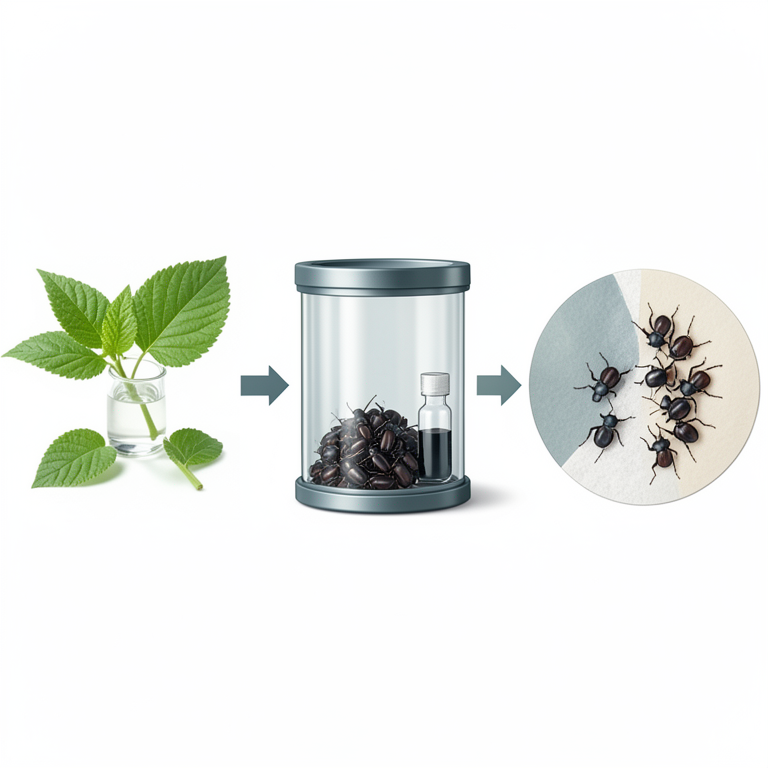
Experimental Workflow
AI-generated conceptual illustration (Mitracarpus villosus plants and stored product beetles). It explains the idea and does not show study data.
View source evidence ↗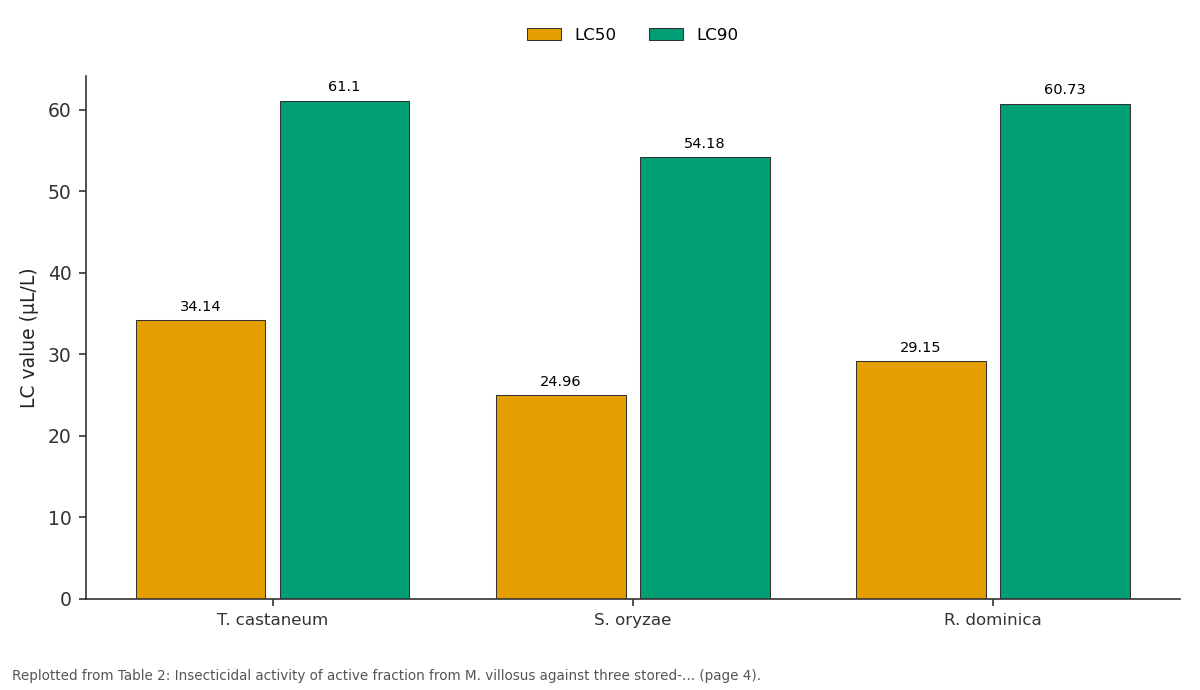
LC50 and LC90: T. castaneum vs S. oryzae vs R. dominica
Replotted from Table 2 (page 4) of the original paper. Every bar is the paper's own table value.
View source evidence ↗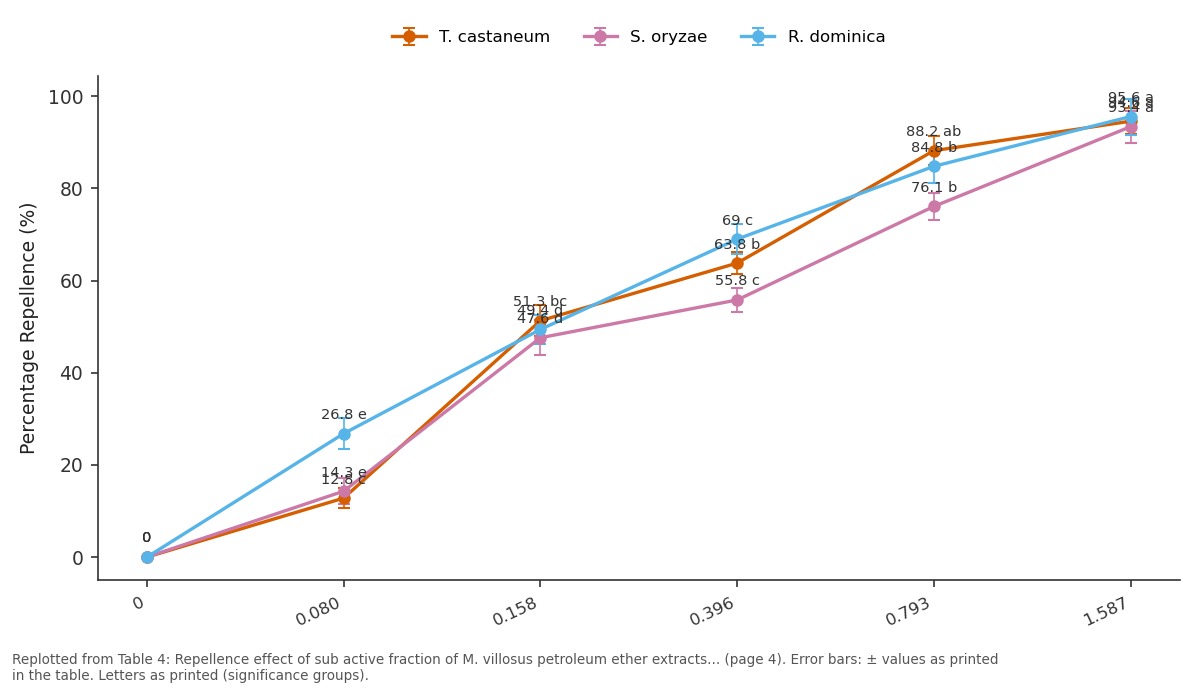
T. castaneum and S. oryzae and more: 0 vs 0.080 vs 0.158 vs 0.396 vs 0.793
Replotted from Table 4 (page 4) of the original paper. Every bar is the paper's own table value.
View source evidence ↗Figures & tables
From the original paper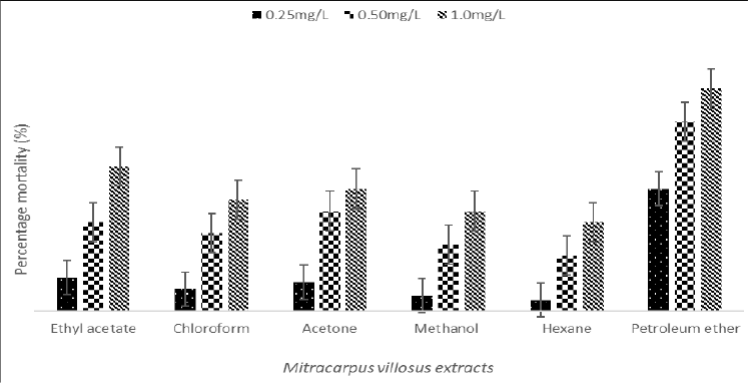 Figure 1
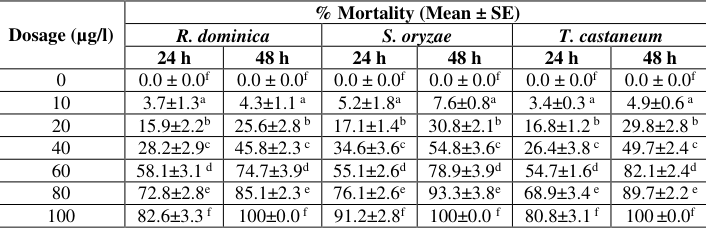 Table 1
 Table 2
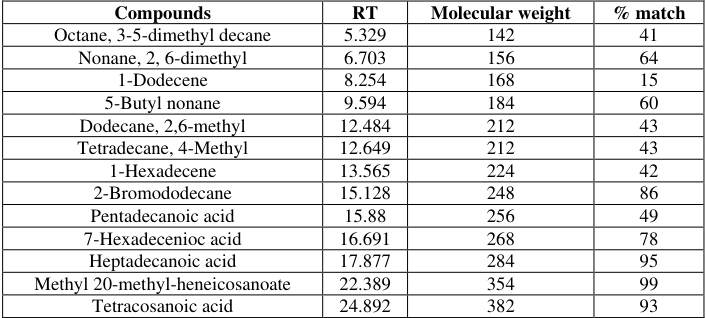 Table 3
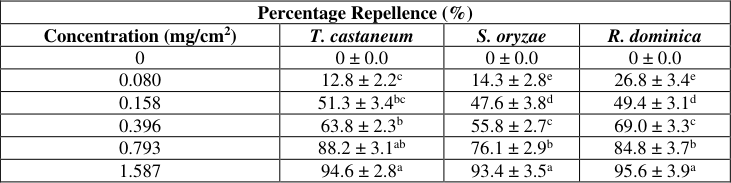 Table 4
Introduction
Stored food grains suffer heavy loss due to insect pest infestation leading to economic damage and deteriorates the quality of food grains and food products. Sitophilus oryzae, Rhyzopertha dominica and Tribolium castaneum ranks as the most important pest of stored cereals worldwide. The larvae and adult cause damage to grains by feeding inside them causing maximum seed damage, weight loss and infested seeds are less nutritious and unfit for human consumption (Rawat and Srivastava, 2011) [20] . Management of stored beetles against insect infestation is known currently to depend on the use of various insecticides and fumigants (Park et al. 2003) [18] . These chemicals are effective for insect pest control but produce several adverse effects on the consumers and environment due to their indiscriminate and enormous use. These drawbacks have necessitated the search for sustainable alternatives that are readily available, affordable and less detrimental to the environment (Ileke et al. 2013) [13] . Recently, researchers have focus considerable attention towards screening plant secondary chemical compounds for developing insecticides for the control of stored product insect pests and various findings has confirmed that plant bioactive compounds are capable of controlling insect pests extending sub lethal effects on their biological processes (Awoyinka et al. 2006, Rahman & Talukder 2006, Tarigan et al. 2016) [8,19,21] . The use of plant extracts and plant products is gaining attention due to proven specificity, low toxicity to non-target organisms and low residual toxicity in the ecosystem and may offer sustainable, biodegradable environmentally friendly and safer alternative to synthetic insecticides by acting as promising grain protectants. Mitracarpus villosus [Swartz] DC (Family: Rubiaceae) is an annual herb which is widely used in the traditional system of medicine as an antibiotic for the management of several disease conditions (Jegede et al. 2005 [14,3,5] . The plant has been reported to contain various classes of secondary metabolite which are responsible for its bioactivity (Ekpendu et al. 1994 [11,14,4] . In spite of various chemical compounds isolated from this plant, most of the reported bioactivity studies focused only on the antimicrobial activity ignoring completely its insecticidal potentials. Hence the present study was taken up to investigate the potential fumigant toxicity and repellent action of M. villosus bioactive chemical composition as a food grains protectant against stored beetles infestation.
Materials and Methods
Matured M. villosus was collected from Rufus Giwa Polytechnic, Owo, Ondo State, Nigeria, washed with tap water, shade dried at room temperature and powdered using electrical blender. Extract from the pulverized plant materials was obtained with the help of a Soxhlet apparatus, sequentially with a series of solvents of increasing polarity viz., petroleum ether, hexane, ethyl acetate, chloroform, acetone and methanol for 7-8 hrs. The extracts were evaporated and concentrated with rotary evaporator under low pressure, below 60 ˚C to make it solvent free. Adult S. oryzae, R. dominica and T. castaneum were collected from the infested wheat grains obtained from local grocery store at Ima Keithel market, Manipur, Imphal, India. These insects were reared with the clean and uninfected wheat grains in a glass jar at 30 °C ± 1 °C, 70 ± 5% relative humidity (RH) with sufficient aeration. The cultures contained all developmental stages of the respective species and the pooled mixture of individual species served as mixed-age cultures for the plant extract fumigant activity tests. The active extract (10g) was subjected to column chromatography using a glass column (length, 50 cm; diameter, 3 cm) packed with silica gel (60-120 mesh) and eluted with Hexane followed by a stepwise gradient of ethyl acetate and methanol. Ten fractions of 300 ml each was collected, concentrated under reduced pressure, and assayed for insecticide activity. Fractions showing insecticide activity were pooled into active fractions and further concentrated. Active fraction was once again loaded on to a silica gel column (length, 50 cm; diameter, 3 cm) eluted with a stepwise gradient mixture of hexane, ethyl acetate and methanol. The active sub-fractions showing insecticidal activity was pooled and collected. The purity of the active sub fractions was analyzed by using GC-MS. The GC-MS analysis of the active fractions of M. villosus bioactive chemical compounds were analyzed using an Agilent Technologies 7890A gas chromatograph equipped with an Agilent Technologies 5975C inert XL EI/CI mass selective detector operated in electron impact mode. The HS-SPME medium polar fiber was conditioned for 15 minutes at 250 °C, prior to the experiment to fully remove any contaminants. Helium was used as the carrier gas at a flow rate of 1ml/min and detector gases were hydrogen and air. Initial column oven temperature was 40 °C for 3 minutes and then it was increased at 10 °C/min up to 280 °C, where it was held for 3 minutes and maintained constant for 16 minutes. The sample was analyzed in the full scan mode with a scan speed of 10,000 amu/s, a mass range of 40-300 m/z and a sampling frequency of 25 spectra/s; interface and ion source temperatures were 250 and 200 °C, respectively. Identification of the bioactive components in the sample was based on retention times and Mass spectra were compared with those in the Wiley 275 L mass spectral library. The insecticidal activity of M. villosus extracts dissolved in a known volume of methanol was carried out by fumigant toxicity against T. castaneum at varying concentrations (5 -100 µg/ L) in desiccators (0.85-l) that served as the fumigation chambers. Ten adult T. castaneum were released into each desiccator, a Whatman No. 1 filter circle (9 cm size) was placed to serve as an evaporating surface for injecting extracts. For each concentration there were five replicates with equal number of untreated control replicates. Active extract (Petroleum ether), which showed maximum fumigant activity, was selected for the isolation of the insecticide compounds. In another experiment fumigant activity of the active sub fractions and its bioactive compounds were tested on R. dominica, S. oryzae, and T. castaneum. The adult insects were exposed to a range of doses of active sub fractions and its bioactive compounds (5 -40 µg/ L) for 24 h in desiccators (0.85-l) that served as the fumigation chambers under ambient laboratory conditions. For each insect species, there were five replicates per dose with an equal number of untreated control replicates with a Whatman No. 1 filter circle (9 cm size) placed to serve as an evaporating surface for injecting extracts. Gas-tight micro syringes were used for injecting the fumigant. The death rate of pest was observed after 24 h of exposure and LC 50 were determined from dose response data using probit analysis (Finney, 1971) [12] . Repellence effect of the plant bioactive compound was conducted by dividing filter papers (Whatman N∘ 1, diameter 9 cm) into two halves and were treated with 0.5ml 50:50 petroleum ether and ethyl acetate sub fraction applied as uniformly as possible with a pipette to one half of the filter paper. The treated filter papers were air dried, and then placed at the centre of each Petri dish. Ten adult insects were released in the middle of each disk and covered with plastic tape with some holes to prevent insects from escaping. (Ambadkar & Khan, 1994) [11] . The numbers of insects that settled on each half of paper disks were recorded after 2 and 4 h from the beginning of the test. Percentage of repellency (PR) was calculated as follows and the repellency (%) was calculated by following formula:
The study was arranged in a Completely Randomised Design and replicated five times. Percentage motarlity data were transformed using arcsine transformations prior analysis and were later subjected to one way analysis of variance (ANOVA). Significant differences between treatments were determined using Tukey's multiple range test at P ≤ 0.05 with SPSS statistical analysis software (Version 22.0). Probit analysis was equally done to determine the LD 50 .
Results
Results from the insecticidal activity tested by fumigation against T. castaneum showed that M. villosus extracted with petroleum ether was more effective in exerting adult mortality 24 h after infestation than other solvent sources. The insect mortality increased significantly with increase in dosage (Fig 1). Thus, the results obtained suggest good potential for the use of M. villosus for insecticidal activity. Fumigant activity of sub active fraction of M. villosus extract clearly demonstrated that the plant bioactive compounds possessed potent fumigant activity against the stored grains beetles (S. oryzae, R. dominica and T. castaneum) as all the treatments were found significantly superior in mortality of the beetles compared to control (Table 1). Insect mortality was found to be dosage-exposure time dependent as the sub active fraction dosage and exposure period increases mortalities also increased with stored grains beetles exposed to 100 µg/l resulted in 100% mortalities within 48h of treatment. It was also observed that insecticidal activity of the plant extract was significantly (p<0.005) influenced by insect species; in all the treatments T. castaneum was more tolerant than other insect pests while S. oryzae was more susceptible at 24h in all treatments. The active fraction of M. villosus extract had LC50 values of 34.49, 24.96, 29.15 μL/L and LC99 61.10, 54.18 and 60.73 μL/L against T. castaneum S. oryzae and R. dominica respectively. In all the treatments S. oryzae was more susceptible than other insect pests (Table 2). The bioactive chemical composition of the active fractions (petroleum ether 50: ethyl acetate 50) of M. villosus was summarized in Table 3. A total of 13 bioactive chemical composition were identified and the principal chemical compounds in the active sub fractions were Methyl 20methyl-heneicosanoate (99%), Heptadecanoic acid (95%), Tetracosanoic acid (93%), 2-Bromododecane (86%), 7-Hexadecenioc acid (78%), Nonane, 2, 6-dimethyl (64%), 5-Butyl nonane (60%), Dodecane, 2,6-methyl (43%), Tetradecane, 4-Methyl (43%) and Octane, 3-5-dimethyl decane (41%). The toxicological effects of the plant extract can be attributed to the presence of the various chemical components identified as the main bioactive volatile components and act as insecticides to the stored grains insect pest. The repellency rates of the insect pests that visited the stored food grains impregnated with M. villosus sub active fraction were influenced by the concentrations of extracts as shown in Table 4. Repellency rate increased proportionally with doses which translated that the highest concentration of 1.587 mg/cm 2 significantly (P<0.005) repelled more of the insect compared the lowest concentration of 0.080 mg/cm 2 (Table 4). Also the results indicates that repellent activity of the M. villosus sub active fraction varied depending on the insect species with intervals of time.
| Percentage Repellence (%) | — | — | — |
|---|---|---|---|
| Concentration (mg/cm2) | T. castaneum | S. oryzae | R. dominica |
| 0 | 0 ± 0.0 | 0 ± 0.0 | 0 ± 0.0 |
| 0.080 | 12.8 ± 2.2c | 14.3 ± 2.8e | 26.8 ± 3.4e |
| 0.158 | 51.3 ± 3.4bc | 47.6 ± 3.8d | 49.4 ± 3.1d |
| 0.396 | 63.8 ± 2.3b | 55.8 ± 2.7c | 69.0 ± 3.3c |
| 0.793 | 88.2 ± 3.1ab | 76.1 ± 2.9b | 84.8 ± 3.7b |
| 1.587 | 94.6 ± 2.8a | 93.4 ± 3.5a | 95.6 ± 3.9a |
Table text extracted from the original PDF; superscript letters are shown inline. The original table image is below.
View original table image
| Compounds | RT | Molecular weight | % match |
|---|---|---|---|
| Octane, 3-5-dimethyl decane | 5.329 | 142 | 41 |
| Nonane, 2, 6-dimethyl | 6.703 | 156 | 64 |
| 1-Dodecene | 8.254 | 168 | 15 |
| 5-Butyl nonane | 9.594 | 184 | 60 |
| Dodecane, 2,6-methyl | 12.484 | 212 | 43 |
| Tetradecane, 4-Methyl | 12.649 | 212 | 43 |
| 1-Hexadecene | 13.565 | 224 | 42 |
| 2-Bromododecane | 15.128 | 248 | 86 |
| Pentadecanoic acid | 15.88 | 256 | 49 |
| 7-Hexadecenioc acid | 16.691 | 268 | 78 |
| Heptadecanoic acid | 17.877 | 284 | 95 |
| Methyl 20-methyl-heneicosanoate | 22.389 | 354 | 99 |
| Tetracosanoic acid | 24.892 | 382 | 93 |
Table text extracted from the original PDF; superscript letters are shown inline. The original table image is below.
View original table image
| Insects | LC50 | LC90 | Slope ± SE | Chi-square |
|---|---|---|---|---|
| T. castaneum | 34.14 | 61.10 | 3.13±0.57 | 24.59 |
| S. oryzae | 24.96 | 54.18 | 2.73±0.65 | 10.15 |
| R. dominica | 29.15 | 60.73 | 3.02±0.82 | 18.32 |
Table text extracted from the original PDF; superscript letters are shown inline. The original table image is below.
View original table image
| Dosage (µg/l) | % Mortality (Mean ± SE) | — | — | — | — | — |
|---|---|---|---|---|---|---|
| R. dominica | S. oryzae | T. castaneum | ||||
| 24 h | 48 h | 24 h | 48 h | 24 h | 48 h | |
| 0 | 0.0 ± 0.0f | 0.0 ± 0.0f | 0.0 ± 0.0f | 0.0 ± 0.0f | 0.0 ± 0.0f | 0.0 ± 0.0f |
| 10 | 3.7±1.3a | 4.3±1.1 a | 5.2±1.8a | 7.6±0.8a | 3.4±0.3 a | 4.9±0.6 a |
| 20 | 15.9±2.2b | 25.6±2.8 b | 17.1±1.4b | 30.8±2.1b | 16.8±1.2 b | 29.8±2.8 b |
| 40 | 28.2±2.9c | 45.8±2.3 c | 34.6±3.6c | 54.8±3.6c | 26.4±3.8 c | 49.7±2.4 c |
| 60 | 58.1±3.1 d | 74.7±3.9d | 55.1±2.6d | 78.9±3.9d | 54.7±1.6d | 82.1±2.4d |
| 80 | 72.8±2.8e | 85.1±2.3 e | 76.1±2.6e | 93.3±3.8e | 68.9±3.4 e | 89.7±2.2 e |
| 100 | 82.6±3.3 f | 100±0.0 f | 91.2±2.8f | 100±0.0 f | 80.8±3.1 f | 100 ±0.0f |
Table text extracted from the original PDF; superscript letters are shown inline. The original table image is below.
View original table image
Discussion
M. villosus is a promising food grains protectant with regards to the use of botanicals as both the crude plant extracts and its chromatographic sub active fractions produced toxic effects by fumigant activity which is strategic for the management of food grains insect pests as fumigants are able to penetrate deeper into storage packaging and structures. It is evident that, duration of exposure, insect species and the dosage of plant extract played an important role in exerting the lethal effects and this support the findings of Abdullah et al. (2017) [1] . Repellency is an important property to be considered in controlling insect pests of stored food grains, because the higher the repellency, the lower the infestation and percentage grains damage and weight loss. The sub active fraction of M. villosus extract exhibited repellent effect at the different doses used in relation to insect species because there is positive correlation between repellency and doses in which repellency increased with increase of doses. This is an indication of the presence of bioactive chemical substances present in the plants that makes the insect move away from the source of the stimulus. This is consistent with the findings of Ukeh and Umoetok (2011) [22] , Ogbonna et al. (2014) [17] in which bioactive compound isolated from Zingiber officinale is found to be good repellents to T. castneum, R. dominica and Prostephanus truncatus. Jemaa and Khouja (2011) [15] also substantiate the fact that some plants secrete volatile substances that lure insect away from them. The observed insecticidal and repellent properties might be attributed to the synergistic effects of its wide array of major and minor bioactive components and this study authenticates the earlier findings by Abdullahi et al. (2011) [2] , Degri and Mailafiya (2013) [10] , Adesina and Ileke (2014) [6] , Adesina (2014) [7] and Mamadou et al. (2014) [16] who all reported reported the insecticidal activity of M. villosus against Culex quinquefasciatus larvae, Helicoverpa armigera, Podagrica spp, Acanthomia tomentosicoliss and stored grains insect infestation respectively. The reduction in the boring, sucking and feeding activities of these insect pests might be partly due to their repulsion by M. villosus extract (Babarinde et al. 2008) [9] . While, Yusuf and Muhammed (2009) [24] attributed the reduction in Callosobruchus maculatus infestation in stored cowpea to the strong pungent odour and taste of M. villosus leaf powder.
Conclusion
1. Bioactive compounds identified from the plant is responsible for the strong fumigant and repellent effects exhibited against the storage beetles. 2. The plant could be successfully developed as a natural biofumigant and incorporated as a promising grain protectant for the control of storage beetle infestations. 3. For the plant extracts and their bioactive compound to be adopted as novel food grains protectant, further research is required to determine its safety for human health.
Acknowledgement
AcknowledgmentThe first author highly appreciate, The Director, Institute of Bioresources and Sustainable Development, Takyelpat, Imphal, Manipur, India for providing all necessary laboratory facilities required for the research work and The Word Acedemy of Science (TWAS), Italy for providing the Research Fellowship under Research and Advance Training Fellowship Programme.
References
24 in the original paper- Abdullah A, Magdi AAM, Ahmed AZ. Efficacy of Some Botanical Oils against Stored-product Pest Cowpea Beetle, Callosobruchus maculatus (F.) (Coleoptera: Bruchidae). Int. J. Entomol. Zool. Stud. 2017; 2(1):5-9.
- Abdullahi K, Abubakar RA, Umar MS, Gwarzo MM, Ibrahim HM. Studies on larvicidal efficacy of aqueous extracts of Striga hermonthica (Delile) Benth and Mitracarpus scaber (Zucc) on Culex quinquefasciatus (Culicidae) mosquito larvae. J. Med Plants Res. 2011; 5(21):5321-5323.
- Abere TA, Onwukaeme DN, Eboka CJ. Pharmacognostic evaluation of the leaves of Mitracarpus scaber Zucc (Rubiaceae). Trop J Pharm. Res. 2007; 6(4):849-853.
- Aboh MI, Olayinka BO, Adeshina GO, Oladosu P, Ibrahim K. Antifugal Activities of Phyto Compound from Mitracarpus villosus [Sw.] DC from Abuja, Nigeria. British Microbiol. Res. J. 2015; 7(3):151-158.
- Adamu A, Musa D, Egharevba HO. Bioactive chemical compounds and pharmacological prospect of Mitracarpus villosus (Swartz) DC-a review. Asian Biochem. Pharma. Res. 2017; 2(7):99-113.
- Adesina JM, Ileke DK. Insecticidal Efficacy of Mitrocarpus villosus and Momordica charantia Extracts for the Control of Flea Beetles Podagrica spp. Jacq. (Coleoptera: Chysomelidae) on Okra Abelmoschus esculentus (L.) Moench, Med. Plant Res. 2014; 4(1):1-5.
- Adesina JM. Field Assessment of insecticidal efficacy of some plant aqueous extracts in reducing cowpea podsucking bug Acanthomia tomentosicoliss Stal (Hemiptera: Coreidae) infestation and damage. Arch. Phytopath. Plant Prot. 2014; 47(18):2213-2220.
- Awoyinka OA, Oyewole IO, Amos BM, Onasoga OF. Comparative pesticidal activity of dichloromethane extracts of Piper nigram against Sitophilus zeamais and Callosobruchus maculatus. Afr. J. Biotech. 2006; 5(24); 2446-2449.
- Babarinde SA, Adebayo MA, Odeyemi K. Insecticidal properties of some plants as crop protectants against pests. Afr. J. Biotech. 2008; 7:1187-1191.
- Degri MM, Mailafiya DM. Potentials of Mitracarpus villosus (L.) and Balanites aegyptiaca (Del.) Plant Extracts and Cypermethrin in the Management of Tomato Fruitworm (Helicoverpa armigera Hubner) Damage in Maiduguri, Nigeria. Int. J. Agric. Res. Sus. Food Suff. 2013; 1(1):01-06.
- Ekpendu TO, Akah PA, Adesumoju AA, Okogun JI. Anti-inflammatory and antimicrobial activities of Mitracarpus scaber extracts. Pharma, Biol. 1994; 32(2):191.
- Finney DJ. Probit analysis. 3 rd ed. Cambridge University Press, New York. 1971, 333.
- Ileke K, Bulus D, Aladegoroye A. Effects of Three Medicinal Plant Products on Survival, Oviposition and Progeny Development of Cowpea Bruchid, Callosobruchus maculatus (Fab.) (Coleoptera: Chrysomelidae) Infesting Cowpea Seeds in Storage. Jordan J. Biol. Sci. 2013; 6(1):61-66.
- Jegede IA, Kunle OF, Ibrahim JA, Ugbabe G, Okogun JI. Pharmacognostic investigation of leaves of Mitracarpus vilosus (S.W.) D.C. Afr. J. Biotech. 2005; 4(9):957-959.
- Jemaa MJ, Khouja ML. Composition and repellent efficacy of essential oil from Laurus nobilis against adults of Lasioderma serricorne. Tunisia J. Plant Prot. 2011; 6:29-41.
- Mamadou D, Kouassi Y, Dagobert KK, Jan K, Koffi EK, Bleu GD, Mamadou D. Testing of Insecticidal Extract from Mitracarpus scaber Zucc. (Rubiale: Rubiaceae) against four stored food product insect pests in Ivory coast. Int. J. Entomol. Res. 2014; 2(2):81-86.
- Ogbonna CU, Eziah VY, Owusu EO. Bioefficacy of Zingiber officinale against Prostephanus truncatus Horn (Coleoptera: Bostrichidae) infesting maize. J. Biopest. 2014; 7(2):177-185.
- Park IK, Lee SG, Choi DH, Park JD, Ahn YJ. Insecticidal activities of constituents identified in the essential oil from leaves of Chamaecyparis obtuse against Callosobruchus chinensis (L.) and Sitophilus oryzae (L.). J. Stored Prod. Res. 2003; 39(4):375-384.
- Rahman A, Talukder FA. Bioefficacy of some plant derivatives that protect grain against the pulse beetle, Callosobruchus maculatus. J. Insect Sci. 2006; 6(3):10.
- Rawat S, Srivastava M. Evaluation of qualitative and quantitative losses caused by Callosobruchus chinensis to some pulses. Journal of Entomological Research. 2011; 35(2):117-120.
- and Callosobruchus maculatus (Coleoptera: Bruchidae). J. Biopest. 2016; 9(2):135-147.
- Ukeh DA, Umoetok BA. Repellent effects of five monoterpenoid odours against Tribolium casteneum and Rhyzopertha dominica in Calabar, Nigeria. Crop Prot., 2011; 30:1351-1355.
- Yang K, Wang C, Lei NS, Guo Z Geng, Du S. Chemical Composition and Bioactivity of Essential Oil of Atalantia guillauminii against Three Species Stored Product Insects. J. Oleo Sci. 2011; 64(10):1101-1109.
- Yusuf SR, Muhammed YS. Potentials of bitter melon (Momordica balsamina L.) and Asthma plant (Mitracarpus villosus L.) leaf powder in the protection of stored cowpea against cowpea bruchid damage. Savanah J. Agric. 2009; 4:54-61.
Cited by 4
From OpenAlex, OpenCitations and reference lists read by Scinovex
- Medicinal uses, phytochemistry, and pharmacological activities of Mitracarpus species (Rubiaceae): A review ↗
Abiche Ekalu · Scientific African · 2020
In ethnomedicine, Mitracarpus species offer a wide range of applications, such as in the treatment of toothache, headache, dyspepsia, amenorrhea, venereal diseases, liver diseases, leprosy, wounds, burns, cuts, boils, eczema, mycosis, scabies, sore throat, respiratory diseases, hepatitis, jaundice, rashes, ringworm, inflammation, diabetes, and lice. Bioactive secondary metabolites such as psychorubrin, ursolic acid, rutin, kaempferol-3-O-rutinoside, kaempferol, stigmasterol, and quercetin among others,…
❝ 19PDF - Bioactive constituents and fumigant toxicity of Datura metel extracts as grain protectant and progeny emergence inhibition of Callosobruchus maculatus (Coleoptera: Bruchidae) ↗
Jacobs Mobolade Adesina · Journal of Plant Diseases and Protection · 2022
❝ 7 - Phytochemical analysis and toxicity assessment of Strychnos nux-vomica L. (Loganiaceae) against the grubs of the rhinoceros beetle, Oryctes rhinoceros Linnaeus 1758 (Coleoptera: Scarabaeidae) ↗
Karuppiah Jeya, Mohamed Meeran, Subramanian Arivoli, Samuel Tennyson · Next research. · 2026
❝ 0 - Determination of the Effects of Biopesticides (at Several Lethal Concentrations) from Dioscorea bulbifera L. Leaf Extract Against Cryptotermes cynocephalus Light ↗
Ade Ayu Oksari, Rohmatul Uzhmiyyah, Devy Susanty, Fathan Hadyan Rizki, Arinana Arinana, Irvan Fadli Wanda et al. · BIO Web of Conferences · 2025
Dioscorea bulbifera leaves contain secondary metabolite compounds that can potentially control Cryptotermes cynocephalus. Preliminary tests show the toxicity of D. bulbifera leaf extract as a bioinsecticide, but further tests need to be carried out based on the results obtained. This research aims to determine the toxicity of further D. bulbifera leaf extract tests based on solvents and concentration range variations.…
❝ 0PDF