
Research article · 2019 · Full text
International Journal of Agriculture Extension and Social DevelopmentDisplaced farmers perception of resource- use conflicts as an obstacle to household food security and food safety in Abia State, Nigeria
Volume 2(2) · Pages 20–23 · DOI: 10.33545/26180723.2019.v2.i2a.27 ↗
Research areasRangeland Management and Livestock EcologyFood Security and Health in Diverse PopulationsTransboundary Water Resource Management
Abstract
Author-writtenConflicts occasioned by different land users have become common place now. When farmers are displaced from their ancestral home due to conflicts involving pastoralists, life becomes difficult and unbearable. This paper investigates displaced farmers perception of resource use conflicts as an obstacle to household food security and food safety. A total of 300 displaced farmers were selected for interview and data obtained were analyzed using mean and standard deviation. Result showed that conflicts create food shortage (M=3.43), destroys food stocks (M=3.57), disrupts production processes (M=3.28), reduced farm investment (M=3.19), among others. Again, during conflict situation, food items are easily contaminated with mean score of 3.27, foods are handled with dirty hands (M=2.58), unsafe water could be used to prepare food (M=3.31), outbreak of food borne illness (M=2.92), poor quality of food eaten (M=3.31), among other reasons. It is recommended that adequate food be supplied to the displaced farmers in the form of aid, water supply be provided to displaced farmers and health facilities put in place to handle case of illness and to avoid spread of illnesses.
Summary
Source-checkedPlain-language reading of the full paper, prepared with AI and checked against the text. Each point links to the authors' own words.
Why it matters
- Communal conflicts are often caused or made worse by competition over scarce resources, specifically water and land. View evidence ↗
- People who lose land rights because of conflict often experience deep poverty, falling income levels, and food insecurity due to decreased productivity. View evidence ↗
- Because agriculture is the primary activity for rural populations in Africa, communal violence seriously impacts the availability of and access to food. View evidence ↗
The question
- The study aims to investigate how displaced farmers perceive resource-use conflicts as obstacles to their household's food safety and food security. View evidence ↗
What they did
- The research was conducted in Abia State, Nigeria, specifically in areas where conflicts between Fulani nomads and crop farmers have occurred. View evidence ↗
- The study used a sample of 300 crop farmers selected from a total list of 3,005 farmers affected by conflicts. View evidence ↗
- Data on the effects of conflicts were analyzed using mean scores derived from a 4-point Likert scale (ranging from strongly disagree to strongly agree). View evidence ↗
- A discriminating mean value of 2.5 was used; any result equal to or greater than 2.5 was considered to be a significant effect. View evidence ↗
What they found
- The disruption of the food production process was perceived as a major effect of conflict, with a mean score of 3.60. View evidence ↗
- The destruction of food stocks was identified as a significant obstacle to food security, scoring a mean of 3.57. View evidence ↗
- Farmers perceived that conflicts create food shortages, with a mean score of 3.43. View evidence ↗
- Conflicts were seen to hinder the promotion of investment and savings, with a mean score of 3.19. View evidence ↗
- Regarding food safety, the lack of proper cleaning of food items was the highest rated obstacle, with a mean score of 3.70. View evidence ↗
- The use of unsafe water for food preparation was perceived as a significant safety risk, with a mean score of 3.37. View evidence ↗
- Over-exposure of food to room temperature was identified as a safety concern with a mean score of 3.37. View evidence ↗
- The outbreak of food-borne illnesses due to contamination was perceived as an effect of conflict, with a mean score of 2.92. View evidence ↗
What it means
- The authors recommend providing displaced farmers with food aid, clean water supplies, and health facilities to manage and prevent the spread of illnesses. View evidence ↗
- The authors conclude that resource-use conflicts have serious negative implications for both food safety and food security. View evidence ↗
Visual summary
3 visualsIllustrations explain the paper; charts are replotted from the paper's own table values.
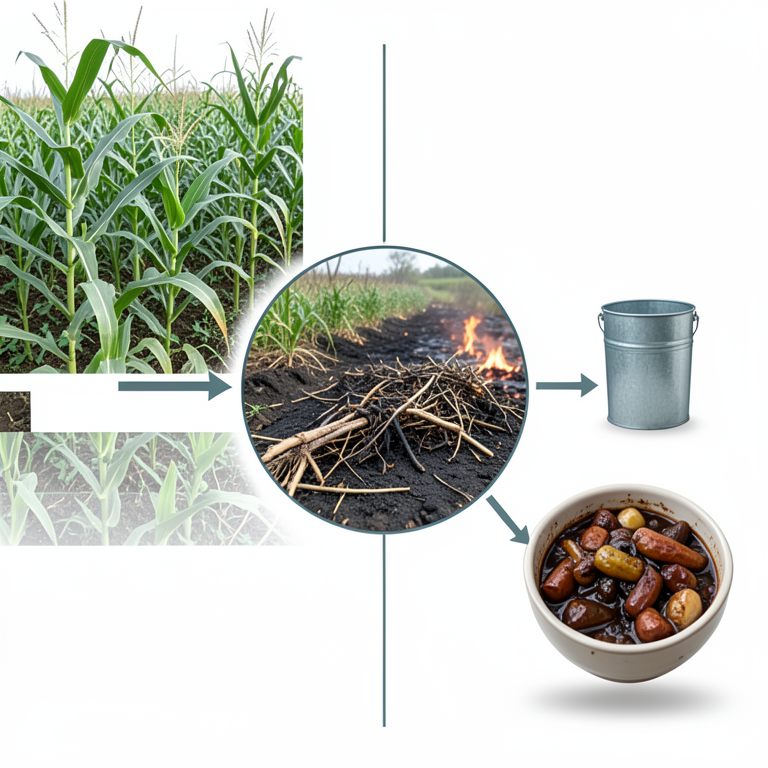
Conceptual Flow of Conflict Impact
AI-generated conceptual illustration (Cassava and maize crops in a rural Nigerian farmland setting). It explains the idea and does not show study data.
View source evidence ↗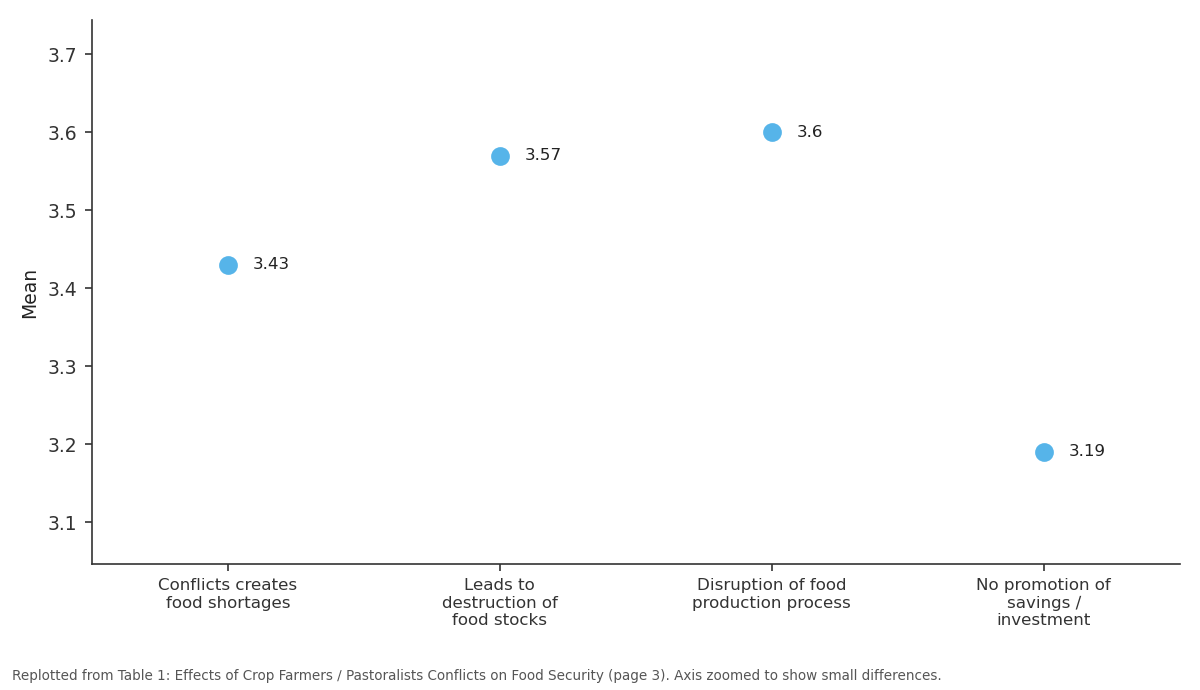
Mean: Conflicts creates food... vs Leads to destruction of... vs Disruption of food... vs No promotion of savings...
Replotted from Table 1 (page 3) of the original paper. Every bar is the paper's own table value.
View source evidence ↗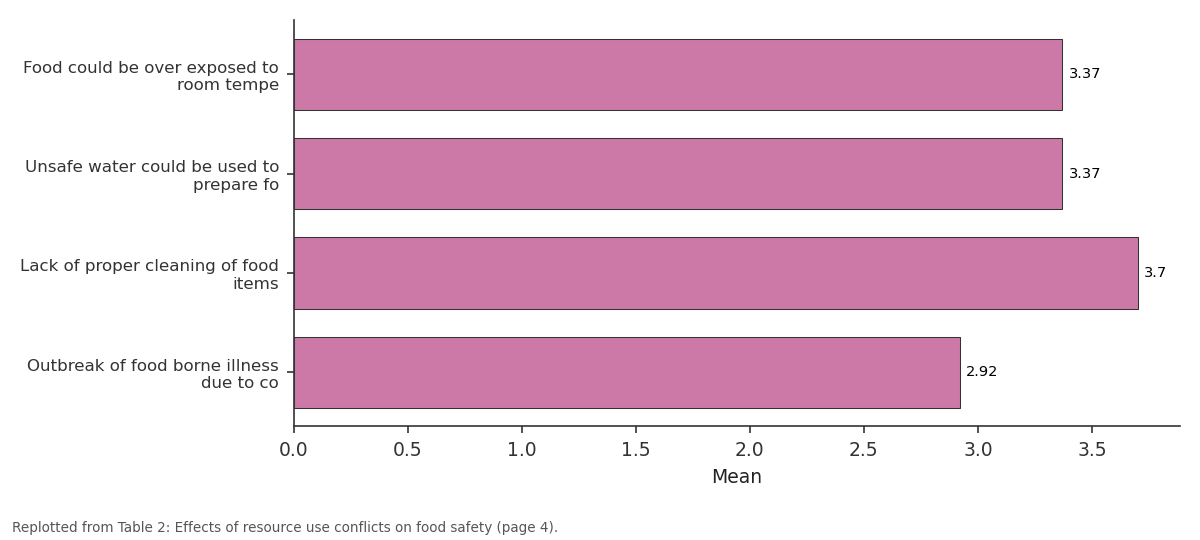
Mean: Food could be over... vs Unsafe water could be... vs Lack of proper cleaning... vs Outbreak of food borne...
Replotted from Table 2 (page 4) of the original paper. Every bar is the paper's own table value.
View source evidence ↗Figures & tables
From the original paper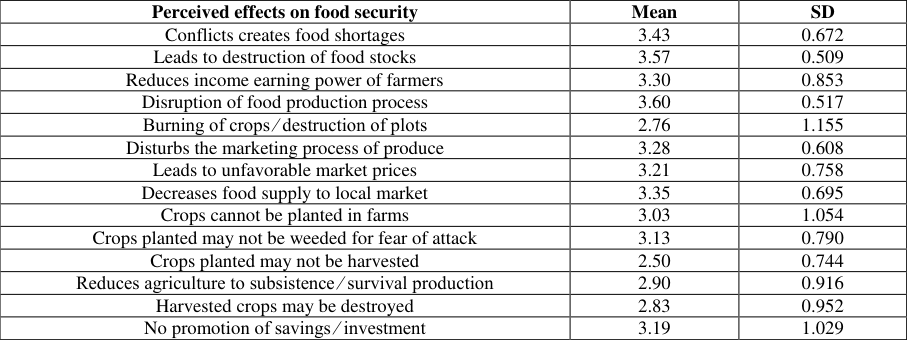 Table 1
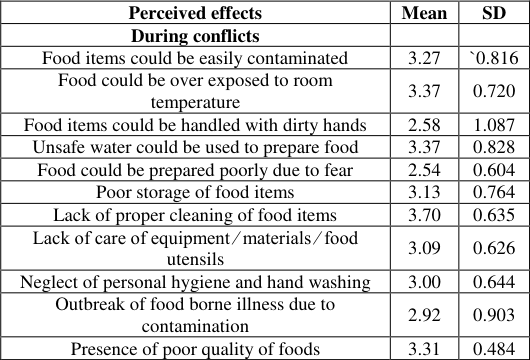 Table 2
Introduction
Competition over scarce resources, particularly land and water, often causes or exacerbates communal conflict (Homer-Dixon, 1999; Ban, 2007) [6,7] and these conflicts have the potential to escalate to civil war when either certain groups or powerful individuals are perceived to be supporting tacitly or otherwise, one communal group at the expense of the other (Kahl, 2006) [8] . In the process of utilizing these scarce resources for the diverse, complex and competing socio-economic activities of the people, conflicts over access and management of these resources often arise. These conflicts significantly vary in dimension and process depending on the groups involved (Famoriyo, 1983) [9] . While some conflicts arise between similar resource users such as between one farming community and another, others occur between different resource users. Examples include conflict between pastoralists and crop farmers or between foresters and crop farmers. Similarly, conflicts may take different dimensions as some are non-volatile while others are volatile (Ehrlich, 1975) [10] . In the study area, land is the major cause of conflict because of the importance and attachment to land. Again, the world over, land remains an important natural capital for every nation and individuals, and because of this, it's not unusual that there is land conflict across the world, especially in developing nations where a huge population depends on agriculture for their livelihood (Wehrmann 2008; Kairaba 2000) [5,1] . In most African countries, land conflict commonly arise at the countries' boarder level, district boarder, among ethnic groups, in the community over common land, between individuals over boundary (Mamo, 2006) [3] . Land conflict between individuals is the most common type of conflict in the rural communities of Africa and yet in many cases, conflict at this level lacked big attention from the authority (Mamo, 2006) [3] . Because of lack of attention by the authorities over land conflict at the rural community, some vulnerable people like women and orphans have continued to lose their rights to land to the greedy people. Some people have lost their lives due to land fight and some incidences of land conflict creates hatreds among the parties involved which goes on from generation to another. Moreover, the individuals who lose their rights to land due to conflict find themselves in deep poverty, due to decline in productivity, food insecurity and a fall on the income level. The increase in the incidences of land conflict in Africa is largely being attributed to the failure of existing land tenure systems to address the challenges that hinders use of land in more effective way, which would permit investment and enhance productivity. The struggle for land is also being exacerbated by increase in population, resource scarcity and other factors like technological change, improved terms of trade for agriculture and demand for land for nonagricultural use (Deininger & Castagnini, 2005) [2] . Sjaastad, Derman & Odgaard (2007) [4] also looked at exclusion and relative deprivation as major cause of conflict in Africa. These conflicts have caused severe displacement of people. www.extensionjournal.com Displacement of people is one of the most direct effects of communal conflict on food security. Of the 33.3 million internally displaced persons in the world (exclusive of the development-induced displacement), 15 million internally displaced persons can be found in Africa, with an increase of 7.5% between 2013 and 2014 and Nigeria hosting over 3.300,000 IDPs (Osagioduwa & Oluwakorede, 2016) [14] . The issue of human displacement in Africa involves more of internally displaced persons than refugees (United Nations Human Committee on Rights [UNHCR], 2012). This is due to the fact that after the Cold War, armed conflict took on a new dimension to include wars between non-state actors within the state and the sovereign state unlike the pre-Cold War era which saw armed conflict as conflict between sovereign states (Emmanuelar, 2015) [13] . As the number of internally displaced persons continue to increase, attempts at mitigating this crisis becomes more challenging for troubled countries. Notably, global efforts at managing displacement have concentrated more on refugees than internally displaced persons, yet the internally displaced person's crisis equally constitutes a challenge to global civilization (Osagioduwa & Oluwakorede, 2016) [14] . Most of these people needed temporary food assistance until they can return to their homes or find new livelihoods. Contributing to meeting the food needs of refugees places an additional burden in recipient community where food security is already marginal often leading to acute food shortages. In Africa, which has most of its population residing in rural areas, communal violence or conflicts has serious implication of access and availability of food, since agriculture is the main preoccupation of rural population. The production of crops and rearing of livestock is the main economic activity of the people. Therefore communal conflicts have serious implication on food system. Often, warring communities or parties tactically resort to manipulation over access to food and livestock. Thus, food insecurity has become an effect of communal conflict (Messer and Cohen, 2004) [11] . Communal conflict is correlated to food security and under most circumstances depresses production and income from cash crops and livestock. This reduction in production and income has serious implication on food security with the capacity to reduce coping capacity of those depending on food resources for their livelihood. According to the Food and Agricultural Organization (2007) communal violence costs Africa over $120 billion worth of agricultural production during the last third of the 20th century, given the importance of agricultural livelihood to overall economic wellbeing, especially in conflict prone areas of Africa. Not only has communal conflicts limit production of food, it has the propensity to deny people access to food and availability of food supply. Today most conflicts and post conflict zones in sub-Saharan Africa are home to substantial numbers of food insecure people most of them displaced. In most cases, population in need of food only account, for small percentage of the total food insecure people. Hence, African countries are zones of high chronic food insecurity mainly due to conflicts of various dimensions. Tonah ( 2006) is of the view that since the sahelian drought of the 1970s and 1980s, and the accompanying migration of a huge number of pastoralists into the fringes of the humid forest zone of West Africa, there has been a massive increase of the incidence of farmers-herders conflict. Cases of farmers-herders conflict are widespread in Nigeria in recent times. For instance, in Densina Local Government of Adamawa State, 28 people were feared killed, about 2,500 farmers were displaced and rendered homeless in the hostility between cattle rearers and farmers in the host community in July 2005. Nweze (2005) stated that many farmers and herders have lost their lives and herds, while others have experienced dwindling productivity in their herds. This was supported by Ajuwon (2004), as cited by Nweze (2005) in his observation that in Imo State for instance between 1996 and 2005, 19 people died and 42 people were injured in the farmers-herders conflicts and the violence that often accompanied such conflict. The conflicts are a threat to peace and national stability. It also has implication for tribal co-existence, Nigeria being a multiethnic and a multi-tribal nation. The result of the study would be useful for a further understanding of farmers-herders conflicts in other states of Nigeria and other West African countries. For several decades, in Nigeria and in the study area, land conflicts between individuals and groups have been common with little concern either on settling it or on finding out the food safety and food security consequences. As these conflicts occur people continue to lose their lands and become poorer due to reduced farming land size leading to hunger, food insecurity and more. This study therefore seeks to investigate the effects of resource use conflicts on food security and safety of displaced farmers.
Methodology
This study was conducted in Abia State because conflicts have occurred between crop farmers and Fulani nomads in two local areas of the State. The state shares common boundaries to the north with Ebonyi State; to the south and southwest with Rivers State; and to the east and southeast with Cross River and Akwa Ibom States, respectively. To the West is Imo State, and to the Northwest is Anambra State. The state covers an area of about 5,243.7 sq.km which is approximately 5.8 percent of the total land area of Nigeria. A three stage sampling technique was adopted in the process of sample selection. The first stage was the purposive selection of two local government areas with conflict occurrence namely Umunneochi and Ugwunagbo. The second stage was the purposive selection of Isuochi and Lokpanta communities from Umunneochi Area, while Uturu was selected from Ugwunagbo Area. The third stage involved the proportionate selection of 105 crop farmers from a total of 1050 affected farmers from Isuochi community, and 69 crop farmers from a total of 695 crop farmers from Lokpanta and a selection of 126 affected crop farmers from a total of 1260 affected farmers from Uturu. This gave a total sample size of 300 crop farmers selected from the household lists of 3,005 crop farmers affected by the conflicts obtained and compiled by various agencies of the State (Office of the Governor on Peace and Conflict Resolution; Local Government and Chieftaincy affairs). The household heads were used as the sampling unit. The household heads included widows who fend for themselves www.extensionjournal.com and family. Again, mean was also computed for objectives 1 and 2 which looked at effects of conflicts on food security on a 4 point Likert type rating scale of strongly agree, agree, disagree and strongly disagree assigned values of 4,3,2,1. The values were added and divided by 4 to obtain a discriminating mean value of 2.5. Any value with mean equal to or greater than 2.5 was considered effects and vice versa.
Results and Discussion
Resource use conflicts as an obstacle to household food security Table 1 shows that when communities in rural areas the world are affected by conflicts involving different landusers such as pastoralists and crop framers, the food security of the local residents is in jeopardy. Conflicts affect food security by creating severe food shortages as indicated by a mean (M) response of 3.43. This situation disrupts both upstream input market and downstream output markets which serves as a transport link between producers and consumers. Conflicts leads to destruction of food stocks (M=3.57) giving rise to shortages\scarcity which affects demands for food. Reduces income earnings power of people (M=3.330), disrupts production process (M=3.60), disrupts marketing processes (M=3.28), reduces food supply (M=3.35) by hindering transportation, reduces investment and savings (M=3.19) and prevents the planting of crops (M=3.03). What the above means is that during conflicts, agricultural lands become inaccessible for years, harvest are destroyed, fields and plots cannot be cultivated, the rural population already displaced from their ancestral homes are prevented from farming thereby creating breech in agricultural and food production leading to food insecurity. On the other hand, agriculture may become for survival and reduces to subsistence by farmers who may wish to stay back at the risk of their lives. This affects negatively the food security situations of the household. Therefore, the disruption of the production process or displaced farmers inability to cultivate affects directly the commands they have over food of their household. This is because of abandonment of farms and homes for refuge seeking elsewhere. This decision to leave home or farm is the last, a farmer could take as it means losing control of every productive assets. From this points onwards, the displaced farmer (fleeing farmer) is at the mercy of others or even or by even food aid. Again, conflicts disturb the marketing process of produce by cutting off access to roads, disturbing transport and prohibit marketing transactions to take place. Displaced household becomes food insecure because it cannot command food in the market. When food production, storage and distribution are imperiled, the supply of food to local markets will decrease, while the demand for food increases. This will push food prices upward-thereby impoverishing the displaced farmers. Conflicts therefore, reduce food availability, food access, stability and utilization which are core elements in food security. It also leads to poverty, high infant mortality, inequality and declining per capital incomes.
| Perceived effects on food security | Mean | SD |
|---|---|---|
| Conflicts creates food shortages | 3.43 | 0.672 |
| Leads to destruction of food stocks | 3.57 | 0.509 |
| Reduces income earning power of farmers | 3.30 | 0.853 |
| Disruption of food production process | 3.60 | 0.517 |
| Burning of crops ∕ destruction of plots | 2.76 | 1.155 |
| Disturbs the marketing process of produce | 3.28 | 0.608 |
| Leads to unfavorable market prices | 3.21 | 0.758 |
| Decreases food supply to local market | 3.35 | 0.695 |
| Crops cannot be planted in farms | 3.03 | 1.054 |
| Crops planted may not be weeded for fear of attack | 3.13 | 0.790 |
| Crops planted may not be harvested | 2.50 | 0.744 |
| Reduces agriculture to subsistence ∕ survival production | 2.90 | 0.916 |
| Harvested crops may be destroyed | 2.83 | 0.952 |
| No promotion of savings ∕ investment | 3.19 | 1.029 |
Table text extracted from the original PDF; superscript letters are shown inline. The original table image is below.
View original table image
Resource-use Conflicts as an Obstacle to Food Safety
During emergency situations, such as conflicts and or civil strife, food may become difficult to obtain. Crops may be destroyed both in field and in store, animals are stolen ∕ killed, food supplies disrupted and people may be forced to flee to areas of safety with no access to food. With a discriminating mean (M) index of 2.50, table 2 shows that the safety of whatever food there is may be affected, resulting in a greater risk of epidemics of food borne disease. During conflicts, foods items are easy contaminated (M=3.27) making them unclean, unsafe and unfit for human consumption. The contamination could be by pathogens, bacteria and other diseases organisms. Food items for consumption may be over exposed to room temperature (M-3.37) killing the vital nutrient in food such food item useful for building the immune system and allowing the growth of bacteria of take place. Displaced farmers could easily handle foods with dirty hands (M=2.58), use of unsafe and unclean water to prepare foods (M=3.33), foods could be prepared poorly due to fear (M=2.54) and hand washing is essential for promotion of good health and long life. Displaced farmers who handle foods with unclean hands may risk being sick due to contact with microbes causing illness. When the hands are not washed and foods are handled they become unsafe for consumption. Again, use of unclean water for food preparation makes food items not safe for eating. This happens when water supply is limited or even scarce and the available could be used or rationed to serve plenty purposes. When those food items are cooked with fear and in a hurry www.extensionjournal.com because of feeling of attacks, certain dangerous microbes survive the heating process and may cause illness when eaten. Other obstacles involves poor storage of food items (M=3.13) both prepared and unprepared. Food items need to be stored well and kept out of bad condition pending their use. Properly stored food items are safe for consumption, unlike poorly stored foods. Proper storage prevents contamination and growth of bacteria and other organisms on food items. Conflict situation do not permit ∕ support the proper storage of food items because the foods could easily be stolen by other displaced farmers or attacked by enemies. Lack of proper cleaning of food items (M=3.70), lack or care of equipment, materials and food utensils (M=3.0) and neglect of personal hygiene (M==3.00) all effects of resource use conflicts on food safety of displaced farmers. The safety of food is affected by the cleanliness or lack of it. The utensils ∕ equipment used for preparation when cleaned affect the safety of the foods for consumption. Personal hygiene of the displaced farmers also affect the safety and quality of the food items. The outbreaks of food borne illness (M=2.92) affect food safety and leads to poor quality. Conflict situation exposes foods and households to serious danger.
| Perceived effects | Mean | SD |
|---|---|---|
| During conflicts | ||
| Food items could be easily contaminated | 3.27 | `0.816 |
| Food could be over exposed to room temperature | 3.37 | 0.720 |
| Food items could be handled with dirty hands | 2.58 | 1.087 |
| Unsafe water could be used to prepare food | 3.37 | 0.828 |
| Food could be prepared poorly due to fear | 2.54 | 0.604 |
| Poor storage of food items | 3.13 | 0.764 |
| Lack of proper cleaning of food items | 3.70 | 0.635 |
| Lack of care of equipment ∕ materials ∕ food utensils | 3.09 | 0.626 |
| Neglect of personal hygiene and hand washing | 3.00 | 0.644 |
| Outbreak of food borne illness due to contamination | 2.92 | 0.903 |
| Presence of poor quality of foods | 3.31 | 0.484 |
Table text extracted from the original PDF; superscript letters are shown inline. The original table image is below.
View original table image
Conclusion
Conflicts have serious implication for food security and food safety as seen in the study. It leads to shortages, scarcity and total crop failure, leads to destruction of food stocks. During conflicts, food items could be easily contaminated, food could be over exposed to room temperature and spoil. Food items could be handled with dirty hands, unsafe water could be used to prepare food, food could be prepared poorly due to fear, poor storage of food items, lack of proper cleaning of food items, and lack of care of equipment/material/food cooking utensils.
References
15 in the original paper- Kairaba A. "Rwanda county case study" Paper prepared for "integrating land issues into policy reduction strategies and broader development agenda: A regional workshop on land issues in Africa and middle East Kampala Uganda. Land Net Rwanda/World Bank, 2002.
- Deininger K, Castagnini R. "Incidence and impact of land conflict in Uganda," Bank-Development Economics Group, 2005, World Bank Policy Research Working Paper No.3248.
- Mamo Land H. Local Custom and State Policies. Land tenure, land disputes and dispute settlement among the Arsii Oromo of Southern Ethiopia, Shoukado book sellers Kamigyo, Kyoto 602, Japan, 2006.
- Sjaastad E, Derman B, Odgaard R. (ed) Chapter 1). Conflict over Land and Water in Africa. Published by James Currey Ltd., 2007.
- Wehrmann B. Land Conflict: A practical guide to dealing with land disputes. Published by Deutsche Gesellschaft für; Technische Zusammenarbeit (GTZ) GmbH 56726 Eschborn, Germany, 2008.
- Homer-Dixon, T. Environment, Scarcity, and Violence. Princeton, Princeton University Press, 1999.
- Ban, K. A Climate Culprit in Darfur. Washington Post, 2007.
- Kahl C. States, Scarcity, and Civil Strife in the Developing World. Princeton, Princeton, 2006.
- Famoriyo S. Impact of Land Tenure on Agricultural Production in Nigeria. Paper presented at the Second World Congress on Land Policy, Harvard Law School, Cambridge, Massachusetts, 1983.
- Ehrlich I. Participation in illegitimate activities: A Theoretical and Empirical Investment. Journal of Political Economy. 1975; 81(3):521-522.
- Messer E, Cohen MJ. Breaking the links between Conflict and Hunger in Africa, Washington DC: International Food Policy Research Institute, 2004.
- FAO. National Programme for Food Security: FAO's union of a world without hunger -Rome: Food and Agricultural Organization, 2007.
- Emmanuelar I. Insurgency and humanitarian crises in Northern Nigeria: The case of Boko Haram. African Journal of Political Science and International Relations. 2015; 9(7):284-296. DOI. 10.5897/AJPSIR2015.0789
- Osagioduwa E, Oluwakorede OT. Management of Internally Displaced Persons in Africa: Comparing Nigeria and Cameroon. African Research Review, 2016; 10(1):193-210.
- United Nations High Commissioner for Refugees. Internally displaced persons. Retrieved from http://www.unhcr.org/4444afce0.pdf.ly displaced women in, West Darfur United Nations, 2012.
Cited by 2
From OpenAlex, OpenCitations and reference lists read by Scinovex
- Improving Food Safety Culture in Nigeria: A Review of Practical Issues ↗
Helen N. Onyeaka, Osmond C. Ekwebelem, Ukpai Agwu Eze, Queeneth I. Onwuka, Job Chinagorom Aleke, Ogueri Nwaiwu et al. · Foods · 2021
As a developing nation and the most populous nation in Africa, Nigeria has enormous challenges connected with food safety culture. To produce and provide safe, secure and nutritious food, consumers and food businesses must abide by a set of shared values known as food safety culture. In Nigeria, food safety culture is a complex subject due to Nigeria's heterogeneous and…
❝ 50PDF - Climate change, natural resource conflicts and insecurity in Nigeria: implication for food security ↗
Sarah Edore Edewor, Agatha Osivweneta Ogbe · Frontiers in Nutrition · 2026
Introduction: Climate change and rising insecurity have intensified natural resource conflicts in Nigeria, posing serious threats to agricultural productivity and household food security. This study examines the climate-conflict-food security nexus, focusing on how environmental changes contribute to conflicts and how these dynamics affect economic performance and food security outcomes. Methods: The study utilized data from the 2018/2019 General Household Survey…
❝ 5PDF