
Research article · 2020 · Full text
International Journal of Research in AgronomyLarge-plot based performance evaluation of pigeon pea (Cajanus cajan L. Millsp.) Varieties for grain yield and agronomic traits under irrigation condition in Mandura District, North-West, Ethiopia
Volume 3(1) · Pages 08–12 · DOI: 10.33545/2618060x.2020.v3.i1a.24 ↗
Research areasGenetic and Environmental Crop StudiesAgricultural pest management studiesPlant Genetic and Mutation Studies
Abstract
Author-writtenThe experiment was conducted during the offseason at Mandura district, North-West, Ethiopia under irrigation condition with the objective, to test and evaluate the adaptability and performance of seven introduced ESA pigeonpea varieties for grain yield and other agronomic traits with standard check during 2017/2018 cropping season. The agronomic traits evaluated and tested were stand count at initial, days to flowering, days to maturity, plant height, and stand count at harvest, seeds per pod, seeds per plant, wilt score, hundred seed weight and usable grain yield per hectare. The evaluated materials showed three maturity class i.e. early, medium, and long durations. Among the tested materials, ICEAP-00557 scored the highest grain yield (2349kg/ha), followed by ICEAP-00576-1 (1737kg/ha), however, the standard check ICEAP-87091 score was comparatively inferior (1390kg/ha). At times there was great variability in the biomass of the varieties which deserves serious attention for the producers. Thus, it was suggested the existence of sufficient variability for key economic yield that gives an option for promoting for high socio-economic performance through adaptation and commercialization.
Summary
Source-checkedPlain-language reading of the full paper, prepared with AI and checked against the text. Each point links to the authors' own words.
Why it matters
- Pigeonpea is a significant tropical grain legume used for food, animal feed, and improving soil fertility. View evidence ↗
- The crop is valued for being hardy and drought-resistant, with a root system that improves soil structure and water retention. View evidence ↗
- In the study area, seed production is limited by a lack of widely adapted improved varieties and poor popularization of existing ones. View evidence ↗
The question
- The study aimed to evaluate the performance and adaptability of seven introduced Eastern and Southern Africa (ESA) pigeonpea varieties compared to a standard check. View evidence ↗
What they did
- The trial was conducted under irrigation during the 2017/2018 offseason in the Mandura district of North-West Ethiopia, at an elevation of 1195 meters. View evidence ↗
- Seven genotypes from ICRISAT were tested alongside a standard check variety, ICEAP-87091. View evidence ↗
- The study used a non-replicated single plot design with total plot sizes of 50 square meters and a net data collection area of 30 square meters. View evidence ↗
- Measured parameters included grain yield per hectare, plant height, days to flowering and maturity, seed weight, and wilt disease scores. View evidence ↗
What they found
- The variety ICEAP-00557 achieved the highest usable grain yield at 2348.21 kg/ha, while the lowest was ICEAP-00040 at 927 kg/ha, and the standard check yielded 1390 kg/ha. View evidence ↗
- The top-performing variety showed a 68% yield advantage over the standard check (Dursa) and a 153% advantage over the worst-performing variety. View evidence ↗
- Plant height varied significantly among genotypes, ranging from 91.2 cm for the check variety to 212 cm for ICEAP-00932. View evidence ↗
- The number of seeds per plant ranged from 721.2 in ICEAP-00932 to 1281.2 in ICEAP-00850. View evidence ↗
- Wilt disease did not cause severe damage during the 2017 cropping season, as indicated by the 1-3 scale scores. View evidence ↗
What it means
- The authors conclude that large-plot performance evaluations are an effective way to fast-track the promotion and adoption of pigeonpea technology in the region. View evidence ↗
- The authors recommend the introduction and commercialization of public domain cultivars across different geographies to improve farmer livelihoods. View evidence ↗
- The harvest stand count for variety ICEAP-00040 was negatively affected by nocturnal damage from wild animals. View evidence ↗
Visual summary
1 visualsIllustrations explain the paper; they do not show study data.
Yield Comparison
AI-generated conceptual illustration (pigeon pea plants (Cajanus cajan)). It explains the idea and does not show study data.
View source evidence ↗Figures & tables
From the original paper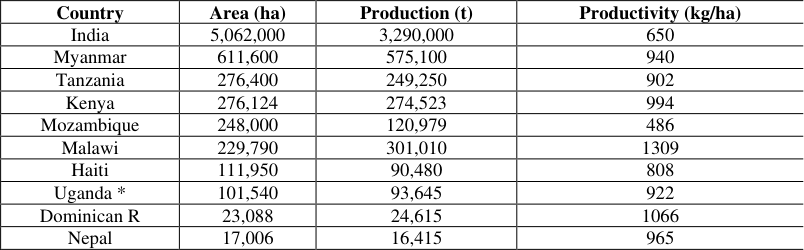 Table 1
 Table 2
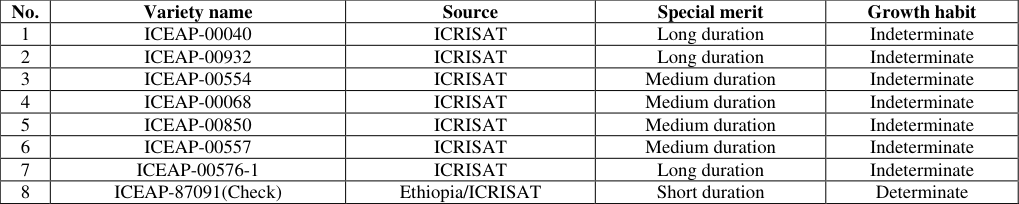 Table 3
 Table 4
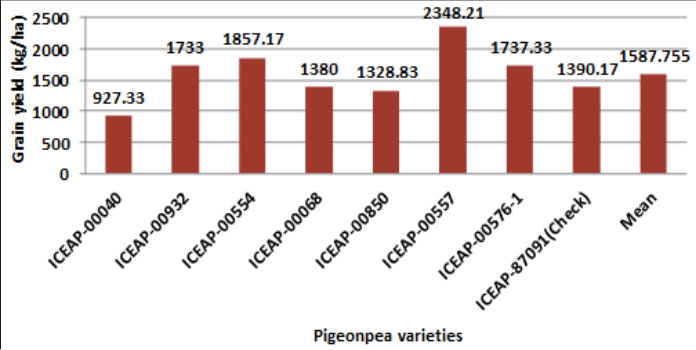 Figure 1
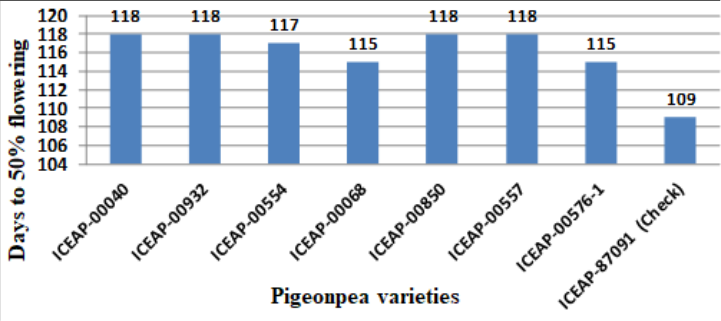 Figure 2
 Figure 7
 Figure 6
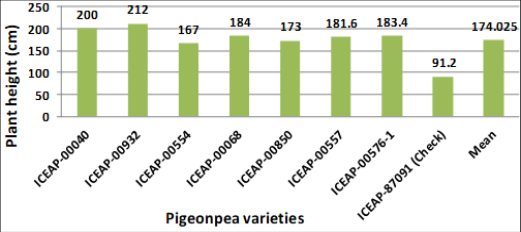 Figure 5
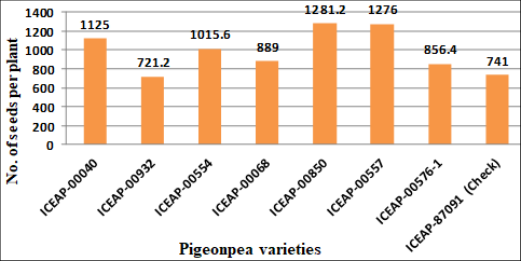 Figure 4
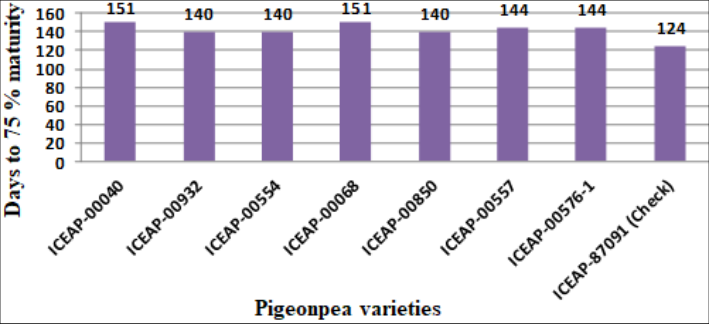 Figure 3
Introduction
Pigeonpea [Cajanus cajan (L.) Millspaugh] is the sixth most important legume crop in the world. The top ten producer countries are India, Myanmar, Tanzania, Kenya, Mozambique, Malawi, Haiti, Uganda, Dominican Republic, and Nepal (Table 1). It is a tropical grain legume and is among important pulses grown for food, feed and soil fertility improvement. Apart from the use of grain, farmers make use of pigeonpea in various ways depending on their ethnic groups and locality [1] . Pigeon pea is fast growing, hardy, widely adaptable, and drought resistant [3] . The extensive root system of Cajanus cajan improves soil structure by breaking plow pans, and enhances water holding capacity of the soil. Though mainly cultivated for its edible seeds, Cajanus cajan can be considered a multipurpose species [10] . Pigeon pea stems are a good fuel source, valued for its fast growing habit though their energy value is half that of charcoal. Stems and branches of pigeon pea are also used for basketry. In Colombia, pigeon peas are cultivated for feed but once for beans and once for forage [4] . Medicinal uses of pigeonpea to treat ailments such as dizziness, snake bite, measles are determined by farmers' location and ethnic group [1] . It is often cross pollinated (20-70%) out crosses crop with 2n=2x=22 diploid chromosome number belongs to the family Leguminoseae. India is considered as the native of pigeonpea (Van der Maesen, 1980) because of its natural genetic variability available in the local germplasm and the presence of its wild relatives in the country [2] . Pigeon pea is a prolific seed producer: seed yield varies from 0.5 to 2 t/ha in the world [3] . World production of pigeon peas was 4.85 million t in 2014 [3] .The main producers were India (3.29 million t, 65% of world production), Myanmar (0.57 million t), Malawi (0.3 million t), Kenya (0.28 million t), Tanzania (0.25 million t). Most of the production occurred in Asia (79.1%), followed by Africa (17.6%) and the Americas (2.5%) [3] . Even if there is no systematic scoring and national data base, in Ethiopia the crop is found distributed all over the geographies in North (Wollo), South East (Bale), Southern Region, Western regions and central parts of the country growing in patches and intercropped.
| Country | Area (ha) | Production (t) | Productivity (kg/ha) |
|---|---|---|---|
| India | 5,062,000 | 3,290,000 | 650 |
| Myanmar | 611,600 | 575,100 | 940 |
| Tanzania | 276,400 | 249,250 | 902 |
| Kenya | 276,124 | 274,523 | 994 |
| Mozambique | 248,000 | 120,979 | 486 |
| Malawi | 229,790 | 301,010 | 1309 |
| Haiti | 111,950 | 90,480 | 808 |
| Uganda * | 101,540 | 93,645 | 922 |
| Dominican R | 23,088 | 24,615 | 1066 |
| Nepal | 17,006 | 16,415 | 965 |
Table text extracted from the original PDF; superscript letters are shown inline. The original table image is below.
View original table image
It has an estimated 30-45000 ha of land coverage (Asnake, field assessment observation). Pigeon pea is used as a contour hedge in erosion control [3] . An N-fixing legume does not need inoculation before sowing. However, rhizobial population nodulating Cajanus cajan on the study area were phenotypically diverse and symbiotically effective [5] . Pigeonpea research in Ethiopia started early in the 1970s by the Institute of Agricultural Research (IAR) at Nazret National Horticultural Centre, with short-duration cultivars introduced from Makerere University, the Dominican Republic and later from Guyana, IITA and ICRISAT-India (Amare Belay, personal communication). The pigeonpea improvement program started with germplasm introduction from ICRISAT and neighboring countries with the objective to identify high yielding, disease and pest tolerant cultivars [7] . Production in Eastern and Southern Africa (ESA) is however faced with many challenges [6] . Metekel zone is potential for the production of major food crops, such as maize, sorghum, finger millet, rice and major pulses like common bean, soybean, mungbean, pigeonpea, and cowpea. So far, at national level, three pigeonpea varieties have been officially registered / released since 2009 either for feed or food. However, the production of seed pigeonpea in the current agroecological area is limited, due to shortage of widely adapted improved pigeonpea varieties, both biotic and abiotic factors, and limited scale up and/or popularization of pigeonpea varieties. Therefore, the evaluation of seven introduced pigeonpea varieties, particularly for the study area (mandura district) can be taken as one key step of tackling for the shortage of improved pigeonpea varieties and technologies.
Materials and Method 1 Description of study area
Mandura district is located at, metekel zone, North-Western part of Ethiopia, with elevation of above sea level 1195 meter, It lies between 36 0 20.264 ʹ East longitudes and 11 0 02.344 ʹ North latitudes, with mean average temperature of 33.3 o C and 15.3 o C (maximum & minimum) respectively. It receives a maximum of 950 mm rainfall per annum. However, the rainfall pattern was uni-modal. The area is suitable for the production and/or cultivation of cereals and lowland crop species including pigeon pea. The land was sown corn last season (year): hence, crop rotation practice undertaken purposely. Site and associated environmental variables where pigeon pea genotypes tested were presented (Table 2).
Test materials
The performance evaluation of seven introduced pigeonpea genotypes was, received from ICRISAT, during 2017/2018 cropping season under irrigation condition. The materials were medium to late maturity types, however, the standard check, ICEAP-87091, was an early maturing variety (Table 3).
| No. | Variety name | Source | Special merit | Growth habit |
|---|---|---|---|---|
| 1 | ICEAP-00040 | ICRISAT | Long duration | Indeterminate |
| 2 | ICEAP-00932 | ICRISAT | Long duration | Indeterminate |
| 3 | ICEAP-00554 | ICRISAT | Medium duration | Indeterminate |
| 4 | ICEAP-00068 | ICRISAT | Medium duration | Indeterminate |
| 5 | ICEAP-00850 | ICRISAT | Medium duration | Indeterminate |
| 6 | ICEAP-00557 | ICRISAT | Medium duration | Indeterminate |
| 7 | ICEAP-00576-1 | ICRISAT | Long duration | Indeterminate |
| 8 | ICEAP-87091(Check) | Ethiopia/ICRISAT | Short duration | Determinate |
Table text extracted from the original PDF; superscript letters are shown inline. The original table image is below.
View original table image
Measured parameters
Sowing of planting materials (entries) was conducted on December 08, 2017. All agronomic practices implemented properly. NPS fertilizer was applied at a rate of 25 kg per hectare. Frequency of irrigation was applied every seven days. The agronomic characters/traits/ evaluated under this study were stand count at emergence, stand count at harvest, days to 50% flowering, days to 75% maturity, wilt disease score (1-3) Scale, plant height, pods -1 plant, seeds -1 pod, harvested usable grain yield -1 -hectare, hundred seed weight(g). The average numbers of seeds in a pod, pods per plant, seeds per plant, plant height (cm) were determined from randomly selected five plants per plot. For the rest of the cases, standardized experimental procedure was followed in scoring and sampling for parameters.
Field layout and design
The experimental materials were laid out in non-replicated single plot design, with plot size of 5.0 meter *10.0-meter-long (50m 2 ), Spacing between experimental plots was 1.0 meter, spacing between planting rows was 1.0 meter, spacing between seeds/planting materials was 0.5 meter, and seed depth at planting was 3-5centimeters. The net plot area used for data generation was 3.0 meter * 10.0 meter long (30.0 m 2 ).
Data analysis and interpretation
Descriptive statistics was employed using Excel-2010 and XLSTAT 2014 in analyzing the parameters
Results and Discussion
The result of the simple statistics (descriptive) analysis revealed that there are high variabilities in economic yield among the tested pigeonpea genotypes. A yield variability of more than double magnitude was recorded in the test materials, which gave an opportunity in selecting best adapted materials for the test and similar agroecologies. Thus, highest usable grain yield was scored by ICEAP-00557 (2348.21 kg/ha) (Figure 1:) and (Table 4.). The result revealed the new super technologies had 153% advantage over the poor performing variety and 68% over the standard check Dursa (ICEAP-87091). The current result was among the highest score of pigeonpea globally (Figure 1:). In the other cases, the number of seeds per plant varied from 721.2 (ICEAP-00932) to 1281.2 (ICEAP-00850) (Figure 4:), the plant height ranged between 91.2 cm (ICEAP-87091) to 212 cm (ICEAP-00932). (Figure 5). Long to medium duration varieties had large value hundred seed mass (Table 4.) and [9] . There was substantial difference for days to 75% maturity among the materials implying the materials grouped under short, medium and long duration types (Figure 3), and can be used in different resource areas. ICEAP-00040, ICEAP-00932, and ICEAP-00576-1 have took 151 days to 75% maturity (long duration), whereas ICEAP-00554, ICEAP-00068, ICEAP-00850, and ICEAP-00557 took 140 days (medium duration) (Figure 3). However, the check, Dursa (ICEAP-87091), took only 124 days to mature, which was an early type variety. Pigeonpea is an often-cross pollinated crop (20-70%) by agent of insects. 1 The medium to long duration matured varieties had high canopy, with large volume of biomass, proving pigeonpea as multipurpose plant, its leaves: sources of fodder, and nutrition, pod wall/seed coat: sources of feed, seeds, and food, etc. The variation of stand count at harvest inICEAP-00040 was lower than others due to damage by wild animals at night however; any variation other than this was linked to initial seed germination (viability) (Pigeon pea data 2018.xls).
| Characters | Range | Min. | Max. | Mean | SE | SD | CV % |
|---|---|---|---|---|---|---|---|
| Days to 50% flowering | 9 | 109 | 118.00 | 116.00 | 1.101946 | 3.116774 | 2.69 |
| Days to 75% maturity | 27 | 124 | 151.00 | 141.75 | 3.004460 | 8.497898 | 5.99 |
| Number of seeds per plant | 560 | 721.2 | 1281.20 | 988.175 | 78.802596 | 222.88740 | 22.56 |
| Plant height (cm) | 120.80 | 91.20 | 212.00 | 174.025 | 12.867424 | 36.394573 | 20.91 |
| Hundred seed weight | 6 | 12.5 | 18.5 | 14.642857 | 0.80706910 | 2.13530414 | 14.58 |
| Usable grain yield | 1420.88 | 927.33 | 2348.21 | 1587.755 | 151.17104 | 427.57628 | 26.93 |
Table text extracted from the original PDF; superscript letters are shown inline. The original table image is below.
View original table image
Conclusion
The current large plot based performance evaluation of East African released pigeon pea cultivars confirmed adaptation test can be applied for fast track technology promotion and adoption in the region. Based on the performance, at field condition variation occurred among the tested materials. Usable grain yield ranged from 927kg/ha (ICEAP-00040) to 2349kg/ha (ICEAP-00557), while the standard local check gave 1390kg/ha. A 68% yield advantage over the locally adapted cultivars is substantially feasible indicator of the test values for the new technologies. Due to multipurpose (food, fodder, feed, fuel, fence, soil fertility improvement, etc.) nature of pigeonpea; research and development work should be one part of lowland pulses research program. Pigeonpea genetic resource need to be exploited for further characterization and identification of useful traits in the crop improvement programs as commended [1] .Therefore, we recommend the introduction, test validation and commercialization of public domain cultivars in different geographies for commercial production and future improvement of pigeonpea and its ultimate impact in the livelihood of farmers and stakeholders in the country.
Abbreviations
Abbreviations
Acknowledgement
We thank ICRISAT for the introduction of materials and Pawe Agricultural Research Center for the facilitation and coordination of the work from beginning to end.
Figures and tables from the paper
References
10 in the original paper- Ayenan MAT, Ofori K, Ahoton LE, Danquah A. Pigeonpea [(Cajanus cajan (L.) Millsp.)] production system, farmers' preferred traits and implications for variety development and introduction in Benin. Agriculture & Food Security. 2017; 6(1):48.
- Millsp.] germplasm. Journal of Food Legumes. 2019; 32(1):60-63.
- Heuzé V, Thiollet H, Tran G, Delagarde R, Bastianelli D, Lebas F, et al. Pigeon pea (Cajanus cajan) seeds, 2016.
- Heuzé V, Thiollet H, Tran G, Delagarde R, Bastianelli D, Lebas F, et al. Pigeon pea (Cajanus cajan) forage, 2016.
- Degefu T, Wolde-meskel E, Adem M, Fikre A, Amede T, Ojiewo CO, et al. Morphophysiological diversity of rhizobia nodulating pigeon pea (Cajanus cajan L. Millsp.) growing in Ethiopia. African Journal of Biotechnology. 2018; 17(6):167-177.
- Kaoneka SR, Saxena RK, Silim SN, Odeny DA, Ganga Rao NVPR, et al. Pigeonpea breeding in eastern and southern Africa: challenges and opportunities. Plant Breeding. 2016; 135(2):148-154.
- Mula MG, Saxena KB, Lifting the level of awareness on pigeonpea-a global perspective. International Crops Research Institute for the Semi-Arid Tropics, 2010.
- Gwata ET, Silim SN, Mgonja M. Impact of a new source of resistance to Fusarium wilt in pigeonpea. Journal of Phytopathology. 2006; 154(1):62-64.
- Gwata ET, Silim SN. Utilization of landraces for the genetic enhancement of pigeonpea in eastern and southern Africa, 2009.
- Domoguen RL, Saxena KB, Mula MG, Sugui F, Dar WD. The multiple uses of pigeon pea, 2010.
Cited by 6
From OpenAlex, OpenCitations and reference lists read by Scinovex
- Effect of processing methods on the nutrient, antinutrient, functional, and antioxidant properties of pigeon pea (Cajanus cajan (L.) Millsp.) flour ↗
Abdulmajid Haji, Tilahun A. Teka, Tizazu Yirga Bereka, Tess Astatkie, Henock Woldemichael Woldemariam, Markos Makiso Urugo · Journal of Agriculture and Food Research · 2024
Pigeon pea ( Cajanus cajan ) is an important grain legume in tropical regions, including Ethiopia. Yet its nutritional value is often limited due to the presence of antinutritional factors and limited studies on how traditional processing methods affect the nutritional, antinutritional, functional, and antioxidant properties of the flour. This study investigates how traditional processing methods—soaking, germination, cooking, and roasting—affect…
❝ 11PDF - Performance Evaluation of Pigeon Pea (Cajanus cajan L. Millsp.) Variety for Registration in the Lowland Areas of Ethiopia ↗
Tariku Simion, Dembele Ersulo, Asnake Fikre · Advances in Agriculture · 2022
There were few released pigeon pea varieties in Ethiopia. This study was primarily conducted to diversify the availability of varieties, thus addressing socioeconomic cross-cutting issues. From eight pigeon pea genotypes after continuous evaluation, one variety, including the local check, was promoted with the objectives of evaluating the agronomic performance and registering a new variety in lowland areas of Ethiopia. The…
❝ 6PDF - On-farm Pre-extension Demonstration of Newly Released Pigeon pea (Cajanus cajan) Technology with Proper Agronomic Practices in Gamo and Konso Zones of Southern Ethiopia ↗
Lakamo L. Lemma, Abebaw B. Wada, Melese E. Bune · Global Journal of Agricultural Innovation Research & Development · 2024
Pigeon pea is widely cultivated by Ethiopian farmers, but its production remains low despite suitable conditions. This is partly due to inadequate demonstration of new pigeon pea varieties with proper agronomic practices. To address this, Arba Minch Agricultural Research Center released a new variety, Ashenafi, which showed promise in adaptation trials. However, its farmer preference and socio-economic benefits were not…
❝ 1PDF - Screening of pigeonpea [Cajanus cajan (L.) Millsp.] against Tur Pod fly, Melanagromyza obtusa (Malloch) (Diptera: Agromyzidae) in long duration pigeonpea genotypes ↗
Rohit Sharma, Ram Keval · Journal of Entomology and Zoology Studies · 2021
The pigeonpea was infested with the number of insect pests at various stage of crop growth. Out of which the incidence pattern of C. gibbosa was studied. The result of the investigation pertaining to the “Screening of pigeonpea [Cajanus cajan (L.) Millsp.] against Tur Pod fly, Melanagromyza obtusa (Malloch) (Diptera: Agromyzidae) in long duration Pigeonpea genotypes” was carried out in…
❝ 1PDF - Evaluation and molecular characterization of vegetable type pigeonpea ( Cajanus cajan (L.)) genotypes for nutritional quality and yield attributing traits ↗
Sandeep Kumar Singh, Gopalina Maity, Pravin Vishwanath Jadhav, Sanghamitra Samantaray · Cogent Food & Agriculture · 2025
Pigeonpea (Cajanus cajan) is an important legume valued for its high protein and diverse uses. This study evaluated 16 vegetable-type pigeonpea genotypes at the green pod stage for agronomic traits, nutritional quality, and genetic diversity using Start Codon Targeted (SCoT) markers. Significant genotypic variation was found in chlorophyll content, leaf area, plant height, and yield components. Green pod yield per…
❝ 0PDF - Estimation of heterosis for yield and yield contributing characters in CGMS based pigeonpea [Cajanus cajan (L.) mill sp.] hybrids ↗
MR Lokhande, JE Jahagirdar, AG Jadhav, SS Gote · International Journal of Chemical Studies · 2021
The objective of present study is to estimate the standard heterosis among parents and crosses to find out promising cross combinations for seed yield and its components. The experimental material comprised of 40 crosses along with 13 parents (5 lines and 8 testers) and a standard check BDN 716. The experiment was laid out in Randomized Block Design with two…
❝ 0PDF