
Research article · 2020 · Full text
International Journal of Horticulture and Food ScienceEffect of plant growth regulators on yield and yield attributing characteristics of mango (Mangifera indica L) cv. Dashehari
Volume 2(1) · Pages 52–54 · DOI: 10.33545/26631067.2020.v2.i1a.39 ↗
Research areasPlant Physiology and Cultivation StudiesLeaf Properties and Growth MeasurementPlant Growth Enhancement Techniques
Abstract
Author-writtenThe present investigation entitled “Effect of plant growth regulators on yield and yield attributing characteristics of mango (Mangifera indica L.) cv. Dashehari” was carried out at the instructional Farm, Dept. of Horticulture, College of Agriculture, IGKV, Raipur (C.G) during the year 2017-18 employing Randomized Block Design with three replications. Three levels of NAA i.e., 15, 25 and 35 ppm, three levels of GA3 i.e. 15, 25 and 35 ppm and three levels of 2, 4-D i.e. 15, 25 and 35 ppm were sprayed at pea and marble stage of fruit development. All the treatments significantly influenced the number of fruits retained at pea, marble and harvesting stage of fruit growth and development as compared to the control. Foliar application of 35 ppm GA3 at pea and marble stage of fruit development increased number of fruits (880.49) as well as total yield (135.46 kg/plant). Physical characters of fruit viz., Fruit Length (11.65cm) and width of fruits (6.82cm), average fruit weight (177.84g), volume (173.63g) and pulp weight (130.41g) were also improved with the foliar application of 35 ppm GA3. While, stone weight (25.39g) and peel weight (19.02g) was reduced with the foliar application of 35 ppm NAA and 25 ppm foliar application of 2, 4-D. Among the different concentrations of plant growth regulators; the foliar application of 35 ppm NAA, 35 ppm GA3, 35 ppm 2, 4-D were found to be optimum concentration by which yield and yield attributing characteristics of fruits can be significantly influenced.
Summary
Source-checkedPlain-language reading of the full paper, prepared with AI and checked against the text. Each point links to the authors' own words.
Why it matters
- Mango is a highly cultivated tropical fruit native to the Indo-Burma region and is globally significant. View evidence ↗
- Mangoes are nutritionally dense, providing significant amounts of vitamins A and C, as well as essential calories and minerals. View evidence ↗
- Horticultural practices using foliar sprays of growth regulators like NAA and GA3 can be used to improve mango yield and quality by reducing fruit drop. View evidence ↗
The question
- The study aimed to investigate how different plant growth regulators affect the yield and yield-attributing characteristics of the Dashehari mango cultivar. View evidence ↗
What they did
- The study employed a Randomized Block Design with three replications. View evidence ↗
What they found
- The application of 35 ppm GA3 resulted in the highest number of fruits (880.49) and the highest total yield (135.46 kg/plant). View evidence ↗
- Foliar application of 35 ppm GA3 improved physical fruit characteristics, including length (11.65 cm), width (6.82 cm), weight (177.84 g), volume (173.63 g), and pulp weight (130.41 g). View evidence ↗
- Compared to the control group, all plant growth regulator treatments significantly affected the number of fruits retained throughout the development stages. View evidence ↗
Visual summary
3 visualsIllustrations explain the paper; charts are replotted from the paper's own table values.
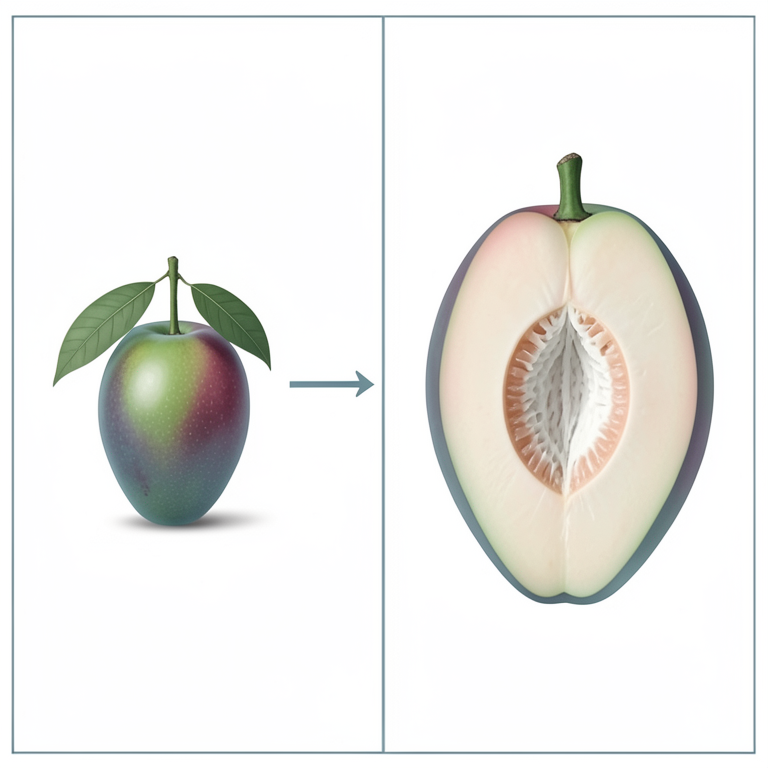
Effect of GA3 on Mango Fruit
AI-generated conceptual illustration (Mango (Mangifera indica L) cv. Dashehari fruits and tree). It explains the idea and does not show study data.
View source evidence ↗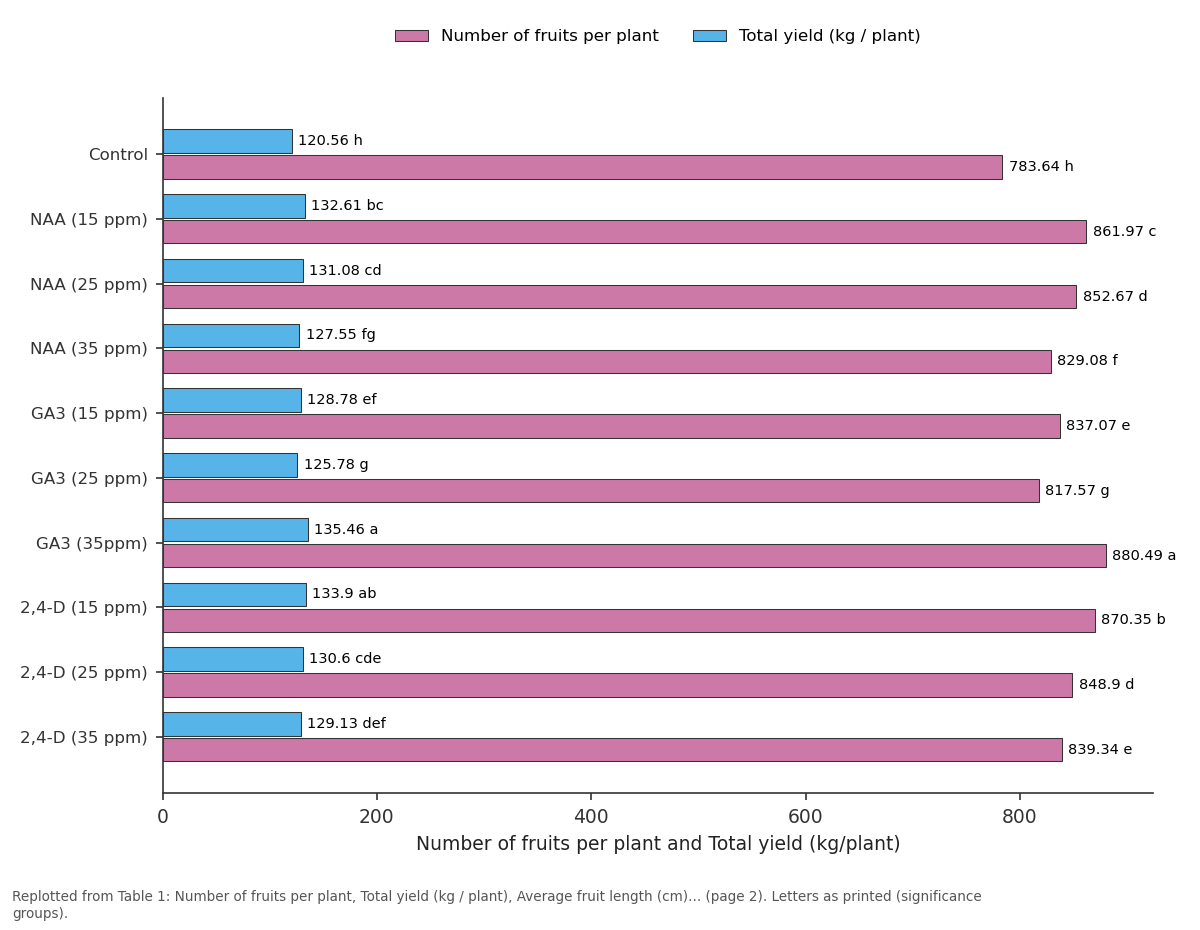
Number of fruits per plant and Total yield (kg / plant): Control vs NAA (15 ppm) vs NAA (25 ppm) vs NAA (35 ppm) vs GA3 (15 ppm)
Replotted from Table 1 (page 2) of the original paper. Every bar is the paper's own table value.
View source evidence ↗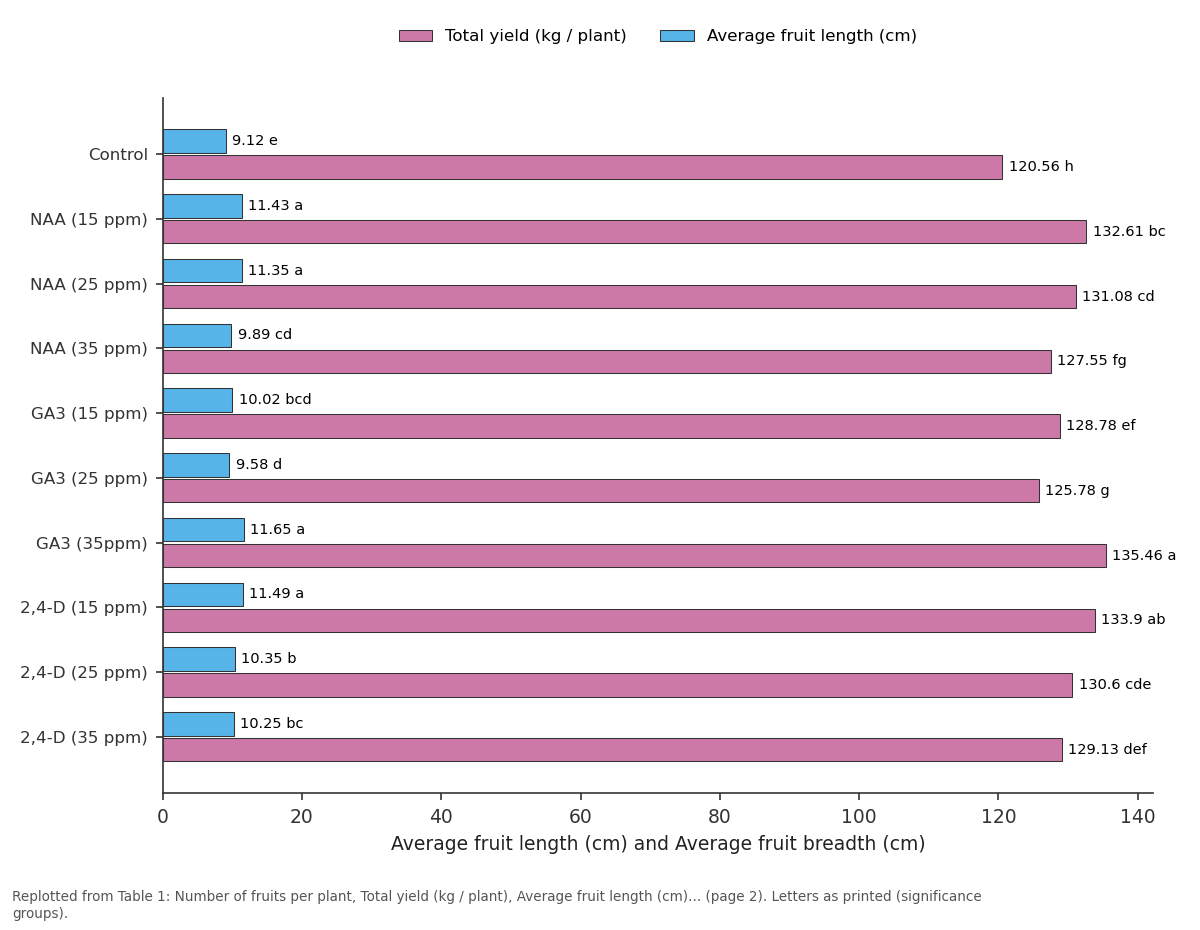
Total yield (kg / plant) and Average fruit length (cm): Control vs NAA (15 ppm) vs NAA (25 ppm) vs NAA (35 ppm) vs GA3 (15 ppm)
Replotted from Table 1 (page 2) of the original paper. Every bar is the paper's own table value.
View source evidence ↗Figures & tables
From the original paper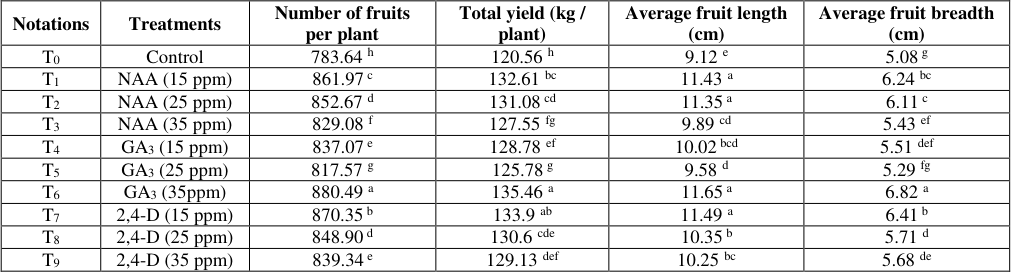 Table 1
 Table 2
Introduction
Mango (Mangifera indica L.) is the native of Indo-Burma region (De Candole, 1904 [4] and Mukherjee, 1951), belongs to the family Anacardiaceous. It is one of the most cultivated and favorite fruit of the tropics and has developed its own importance all over the world. Being a useful and delicious fruit, it is the part of culture and religion since time immemorial. Besides taste and its good qualities, it is called "The King of Fruits". Mango (Mangifera indica L.) is cultivated in the Indian subcontinent for well over 4000 years (De Candole, 1904) [4] . The fruit is highly nutritive and delicious with excellent flavour. It is an excellent source of vitamin A and C (4800 IU and 13mg/100mg) respectively, as well as good source of calories, protein, total carbohydrate, fat, cholesterol, sodium, potassium. The pulp is a rich source of beta carotene, sucrose, glucose and fructose. Mango fruit is utilized at all stages of its development both in its immature and mature or ripe stage and can also be processed into products such as jams, juices, cut fresh fruit, dried chips, fruit concentrate and fruit leather. Mango is one of the most extensively exploited fruits for food, juice, flavor, fragrance and color. (Bayarri et al., 2001) [2] . In India flowering period starts from January and extended up to April. The flowering period of mango is usually of short duration of 2 to 3 weeks; low temperature may extend it, whereas higher temperature may shorten it. The numbers of flower in one panicle varies between 1000-6000, depending upon the cultivars and age of the tree. The time it takes for mango trees to produce mature, harvest-ready fruit from the time of flowering ranges from 100 to 150 days, depending on the cultivar, growing region and various weather factors. Fruit varies according to cultivar variety and growing location. Most varieties bear fruit between May and September. Fruit production is heaviest during June and July. Foliar spray of growth regulators (NAA and GA3) could be used as one of these horticultural practices that reduce fruit drop, enhance yield and fruit quality of mangoes (Anila and Radha, 2003) [1] . NAA application induced high positive effect in reducing fruit drop (Chattha et al. 1999) [5] . Moreover, NAA application reduced flowers drop and gave high flowers retention and increased yield as well as improved fruit quality of mango (Haidery et al., 1997 [6] and Vejendela et al., 2008). Many investigators found that spraying mango trees with NAA at different concentrations (20, 25 and 40 ppm) respectively, increased fruit set and fruit retention (Oksher et al., 1980 [7] and Singh and Ram, 1983) [9] . Auxin is well known as inhibitors of ethylene action in a number of plants (Beyer, 1976).
Material and methods
Twenty two years old mango trees, planted at 10 x 10 m spacing were used for experiment, which was carried out during the year 2017-18 at instructional farm, Dept. of Horticulture, College of Agriculture, IGKV, Raipur. Chhattisgarh is reputed for producing early maturing and best quality of Dashehari mango. Therefore, above said variety was selected for the present investigation. Thirty healthy, vigorous and uniform, disease free, bearing trees of about twenty years of age were selected for the experiment. Selected trees were kept under uniform cultural practices, i.e. irrigation, weeding and hoeing etc. Plant growth regulators were sprayed on 25 th February and 11 th March 2017 from 9.00 a.m. to 2.00 p.m. Three levels of NAA i.e., 15, 25 and 35 ppm, three levels of GA3 i.e. 15, 25 and 35 ppm and three levels of 2, 4-D i.e. 15, 25 and 35 ppm were sprayed at pea and marble stage of fruit development. In all the treatments, solutions were sprayed on fruit and foliage of the tree. The total numbers of fruits per plant were recorded at each harvest. The total number of fruits per plant were calculated after completion of harvesting. For length of fruits, fruits were harvested at maturity stage from each treatment and with the help of vernier calipers their length was measured in centimeters and under each treatment average length was recorded. Fruit breadth was also measured with the help of vernier calipers. From each treatment, five fruits were weighed separately on sensitive electronic balance and average value of fruit weight was recorded in gram. For calculating fruits volume, measuring cylinder of one litre capacity was taken and filled with water upto the marks, then the mango fruits were dipped into the water, some amount of water displaced and it was measured. This displaced amount of water was equal to the volume of fruits. Specific gravity is a single non-destructive test which is employed for judging maturity of the fruit and was calculated by dividing the fresh weight of fruit and fruit volume. By subtracting the weight of stone and peel from the weight of the whole fruits the weight of pulp was calculated.
Wt. of pulp = Total wt. of fruit -(Wt. of stone + Wt. of peel)
From each treatment the peel of three fruits were removed and on sensitive electronic balance weighed separately then average peel weight was recorded in gram. The pulp free stones of three fruits from each treatments were weighed on sensitive electronic balance and average stone weight was recorded in grams. At each harvest, weight of fruits per plant were recorded separately. Then the total weight of harvested fruit were calculated at final harvest in kilogram.
Results and discussion
Analysis of variance (ANOVA) showed significant difference amongst yield and yield attributing characteristics of mango (Table 1, 2). Generally, all treatments of plant growth regulators significantly enhanced the yield and yield attributing characteristics of mango. The Maximum number of fruits (880.49), yield per plant 135.46 kg, fruit length 11.65 cm, fruit breadth 6.82 cm, fruit weight 177.84 g, fruit volume 173.63 cc, peel weight (21.34 g), pulp weight 130.41 g was recorded under T6 and minimum stone weight 25.39 g was recorded under T3 presented in table 2 and 3. The positive effect on yield was due to their favorable influence on yieldattributing characters like increase in fruit retention, size and weight of individual fruit. It might be due to reason that application of GA3 accelerated the fruit growth and fruit size by increasing, elongation or enlargement of cells and greater accumulation of sugars and water in expanded cells.
| Notations | Treatments | Number of fruits per plant | Total yield (kg / plant) | Average fruit length (cm) | Average fruit breadth (cm) |
|---|---|---|---|---|---|
| T0 | Control | 783.64 h | 120.56 h | 9.12 e | 5.08 g |
| T1 | NAA (15 ppm) | 861.97 c | 132.61 bc | 11.43 a | 6.24 bc |
| T2 | NAA (25 ppm) | 852.67 d | 131.08 cd | 11.35 a | 6.11 c |
| T3 | NAA (35 ppm) | 829.08 f | 127.55 fg | 9.89 cd | 5.43 ef |
| T4 | GA3 (15 ppm) | 837.07 e | 128.78 ef | 10.02 bcd | 5.51 def |
| T5 | GA3 (25 ppm) | 817.57 g | 125.78 g | 9.58 d | 5.29 fg |
| T6 | GA3 (35ppm) | 880.49 a | 135.46 a | 11.65 a | 6.82 a |
| T7 | 2,4-D (15 ppm) | 870.35 b | 133.9 ab | 11.49 a | 6.41 b |
| T8 | 2,4-D (25 ppm) | 848.90 d | 130.6 cde | 10.35 b | 5.71 d |
| T9 | 2,4-D (35 ppm) | 839.34 e | 129.13 def | 10.25 bc | 5.68 de |
Table text extracted from the original PDF; superscript letters are shown inline. The original table image is below.
View original table image
References
10 in the original paper- Anila R, Radha T. Studies on fruit drop in mango varieties J Trop Agric. 2003; 41:30-32.
- Bayarri S, Calvo C, Costell E, Durán L. Influence of color perception of sweetness and fruit flavor of fruit drinks Food Science & Technology International. 2001; 7:399-404.
- Behera T.K, Rath S, Dora D.K. Effect of growth regulators and urea on fruit retention in mango Orissa J Agri Res. 1994; 7:41-44.
- Candole AD. Origin of cultivated plants Vegal paul Trench and company London, 1904, 1-67.
- Chattha G.A, Anjum M.A, Hussain A. Effect of various growth regulators on reducing fruit drop in mango (Mangifera indicia L), International Journal of Agriculture, 1999.
- Haidery G.A, Jalal-Ud-Din B, Ghaffoor A, Munir M. Effect of naphthalene acetic acid (NAA) on the fruit drop, yield and quality of mango (Mangifera indica L) cultivar Langra Scientific Khyber (Pakistan) 1997; 10(1):13-20.
- Oksher A.K, Ramachandran C, Pyhodath J.S. Effect of planofix on fruit set in mango Agric Res J Kereale, 1980; 17(1):105.
- Sharma T.R, Nair P.K, Nema M.K. Effect of foliar spray of urea, KNO3 and NAA on fruiting behaviours of mango cv. 'Langra', Orissa Journal of Horticulture. 1990; 18(1-2):42-47.
- Singh R.S, Ram S. Studies on the use of plant growth substances for fruit retention in mango cv. Dashehari Ind J Hort. 1983; 40(3/4):188.
- Vejendla V, Maity P.K, Bank B.C. Effect of chemicals and growth regulators on fruit retention, yield and quality of mango cv. Amrapali, Journal of Crop and Weed. 2008; 4(2):45-46.
Cited by 2
From OpenAlex, OpenCitations and reference lists read by Scinovex
- Effect of Foliar Spray of Micronutrients and Plant Growth Regulators on Flowering, Fruit Pomology and Oil Yield ↗
B. C. Srujan, Saket Mishra, Vijay Bahadur · International Journal of Plant & Soil Science · 2023
Aim: To determine the effect of different micronutrient applications olive for its growth quality. Study Design: Randomized Block Design was used in experiments. Place and Duration: The present investigation was carried out at the Department of Horticulture, Naini Agricultural Institute, Sam Higginbottom University of Agriculture Technology and Sciences, Prayagraj, Uttar Pradesh during the 2021-2022. Methodology: The use of micronutrients sprays…
❝ 2PDF - Effect of humic acid and plant growth regulators on economic returns and profitability of mango cv. Amrapali
Harshit Jangid, Rajnee Sharma, C. S. Pandey, Alpana Singh, R. K. Sahu, Umesh Singh · International Journal of Research in Agronomy · 2026
The present investigation was conducted to assess the effect of humic acid and plant growth regulators on economic returns and profitability of mango (Mangifera indica L.) cv. Amrapali under high-density planting. The experiment was carried out during 2024–25 and 2025–26 at the Horticulture Complex, Maharajpur, Department of Horticulture, College of Agriculture, JNKVV, Jabalpur, Madhya Pradesh. The experiment comprised four levels of humic acid (0, 1.0, 1.5 and 2.0%) and five plant growth regulator treatments, viz., control, GA3 @ 40 ppm, NAA @ 40 ppm, triacontanol @ 500 ppm and salicylic acid