
Research article · 2020 · Full text
International Journal of Research in AgronomyPerformance evaluation of released tef variety, kora at different locations of Southwestern Ethiopia
Volume 3(1) · Pages 42–44 · DOI: 10.33545/2618060x.2020.v3.i1a.30 ↗
Research areasUrban and Rural Development ChallengesBanana Cultivation and ResearchAfrican Botany and Ecology Studies
Abstract
Author-writtenA field experiment was conducted during 2016/17 using one released variety Kora and local check at different locations of southwestern Ethiopia. The objective of the trial was to to check adaptability and stability of grain yield of kora variety. The trial was conducted at Jimma/Melko, Somodo, Gooma, Bedele, Saja and Omonada using single plot design with the plot size of 10m x 10m and spacing was 20cm between rows and 10cm between plants. Phenological, agronomic and grain yield data were taken. There was significant variation in grain yield indicated the differential response of the varieties to test location for the trait. The variety Kora was performed well over the local check in across locations.
Summary
Source-checkedPlain-language reading of the full paper, prepared with AI and checked against the text. Each point links to the authors' own words.
Why it matters
- Tef is a critical staple food grain in Ethiopia, supporting 70 million people and occupying 3.02 million hectares of land annually. View evidence ↗
- Tef production in Ethiopia is limited by a low national average productivity of 1.6 ton ha-1 and a tendency for the crop to lodge. View evidence ↗
- Multi-environment trials are used to scientifically evaluate the stability, yield, and adaptability of crop cultivars to maximize their value. View evidence ↗
The question
- The study aimed to evaluate the stability and adaptability of the grain yield of the Kora tef variety across various locations in southwestern Ethiopia. View evidence ↗
What they did
- The field experiment took place during the 2016/17 season, comparing the released Kora variety against a local check. View evidence ↗
- The trial used a single plot design (10m x 10m) with 20cm row spacing and 10cm plant spacing across six locations: Jimma/Melko, Somodo, Gooma, Bedele, Saja, and Omonada. View evidence ↗
- Fertilization varied by soil type, with light soils receiving 40kg N and 60kg P2O5 per hectare, and black soils receiving 60kg N and 60kg P2O5 per hectare. View evidence ↗
- Researchers measured grain yield, shoot biomass, days to heading, and days to maturity per plot, while plant height and panicle length were averaged from five random plants per plot. View evidence ↗
What they found
- The Kora variety had a mean of 46.6 days to heading (range 43-52), while the local check had a mean of 45 days (range 41-48). View evidence ↗
- Days to maturity for the Kora variety ranged from 86 to 97, compared to a range of 83 to 100 and a mean of 91.5 days for the local check. View evidence ↗
- The Kora variety had a mean plant height of 72.5cm (range 62-78cm), which was slightly higher than the local check's mean of 71.6cm (range 61.8-78cm). View evidence ↗
- Panicle length was similar between the two, with Kora averaging 39.7cm (range 23.8-46cm) and the local check averaging 39.9cm (range 23.8-47.4cm). View evidence ↗
- The Kora variety showed a biomass yield range of 28.5 to 35.2 qt/ha, while the local check ranged from 21.2 to 29.3 qt/ha. View evidence ↗
- The Kora variety achieved a higher mean grain yield of 9.42 qt/ha (range 6.6-13.7) compared to the local check's mean of 9 qt/ha (range 4.8-12). View evidence ↗
What it means
- The authors recommend the Kora variety based on the field results, though they note that further evaluation across more seasons and with more released varieties is necessary. View evidence ↗
- The authors state that identifying stable genotypes is challenging due to the interaction between the genotype and the environment. View evidence ↗
Visual summary
3 visualsIllustrations explain the paper; charts are replotted from the paper's own table values.
Study Layout Concept
AI-generated conceptual illustration (Tef plants (Eragrostis tef) in diverse Ethiopian landscapes). It explains the idea and does not show study data.
View source evidence ↗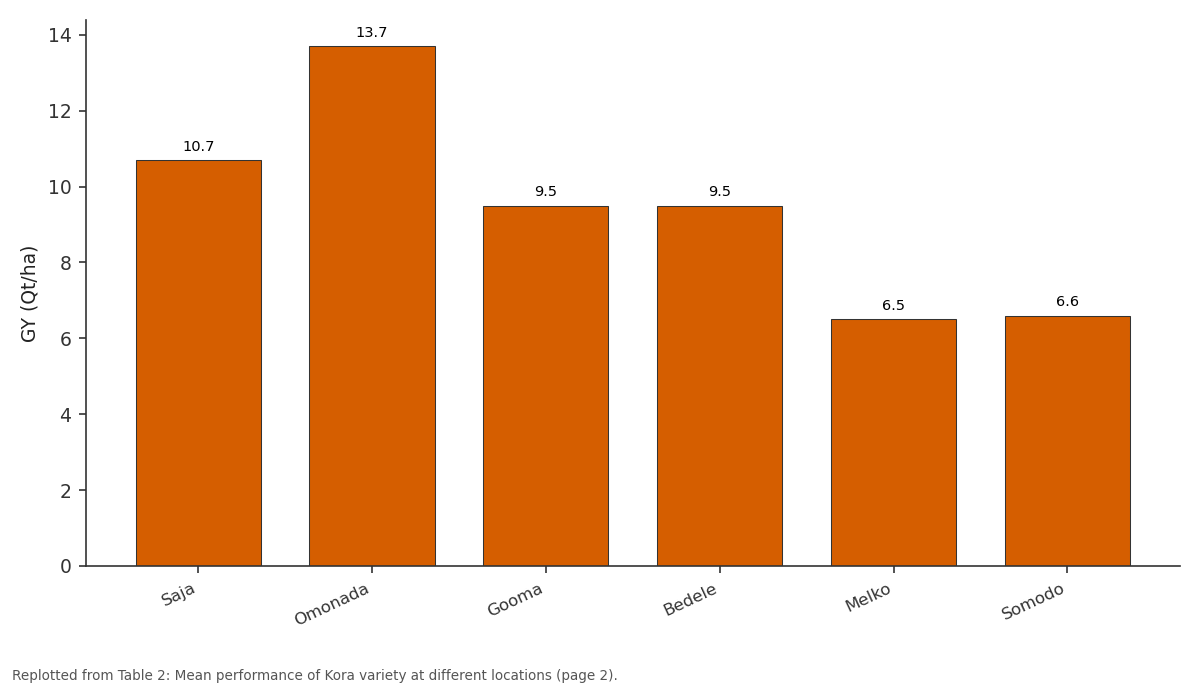
GY (Qt/ha): Saja vs Omonada vs Gooma vs Bedele vs Melko
Replotted from Table 2 (page 2) of the original paper. Every bar is the paper's own table value.
View source evidence ↗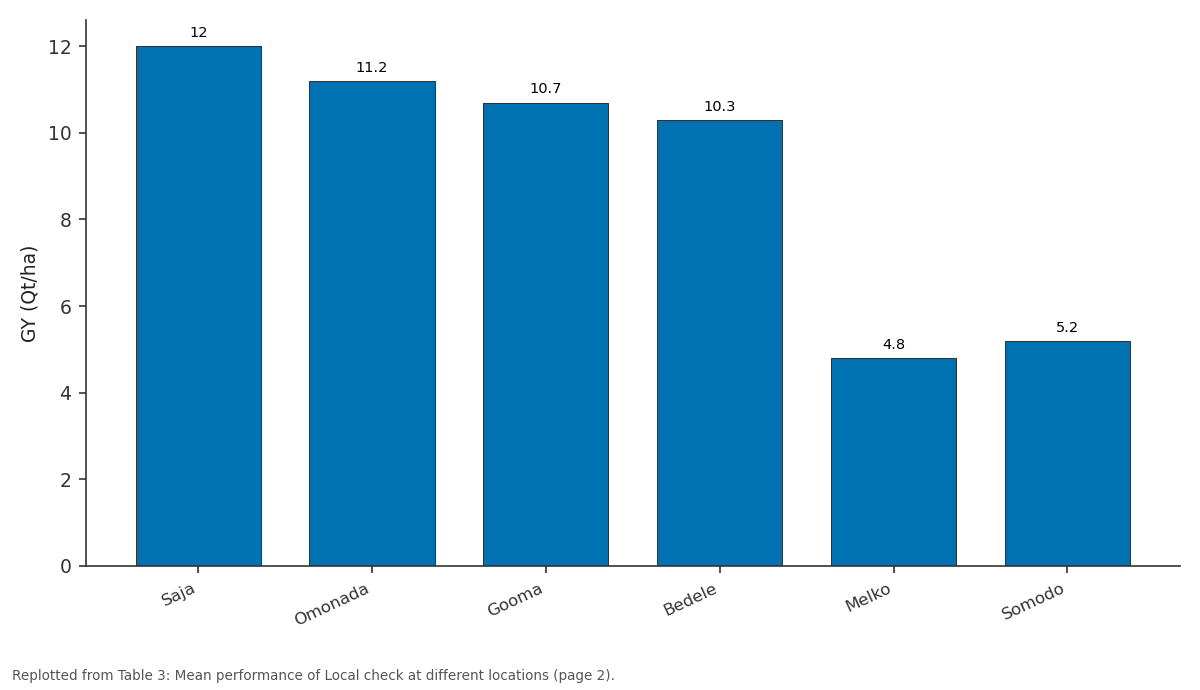
GY (Qt/ha): Saja vs Omonada vs Gooma vs Bedele vs Melko
Replotted from Table 3 (page 2) of the original paper. Every bar is the paper's own table value.
View source evidence ↗Figures & tables
From the original paper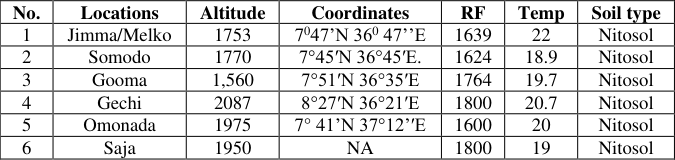 Table 1
 Table 2
 Table 3
Introduction
Tef (Eragrostis tef (Zucc.) Trotter) belongs to the family poaceae, subfamily Eragrostideae, tribe Eragrosteae and genus Eragrostis. It is a C4, self pollinated, chasmogamous anuual cereal. It has a fibrous root system with mostly erect systems, although, some cultivars are bending or elbowing types (Mulu, 1999) [7] . The genus contains about 350 species of which tef is the only cultivated species. Fifty four Eragrostis species are found in Ethiopia, out of which fourteen are known to be endemic. Tef is the major Ethiopian cereal grown on 3.02 million hectares annually (CSA, 2015) [2] , and serving as staple food grain for 70 million people. The crop constitutes 30% of the total area allocated to cereals and contributes more than 20% of the total cereals production (CSA, 2015) [2] . The major constraints in Ethiopia's tef husbandry are low productivity (national average 1.6 ton ha -1 ) and susceptibility to lodging. The straw (chid) is an important source of feed for animals. Tef was also a resilient crop adapted to diverse agro-ecologies with reasonable tolerance to both low (especially terminal drought) and high (water logging) moisture stresses. Tef, therefore, is useful as a low-risk to farmers due to its high potential of adaptation to climate change and fluctuating environmental conditions. Studies on genotype and environment interaction have been considered an important progress in contemporary statistical genetics. As such, the adaptability of tef varieties should be evaluated before they are produced and promoted. The main purpose of multi environment trial is to evaluate the adaptability, yield and stability of tested cultivars and to provide a scientific basis for maximizing the value of cultivars. These trials are keys to demonstrating and popularizing new crop cultivars (Correa et al., 2016; Tao et al., 2016) [1] . Therefore, the objective of the study was to check adaptability and stability of grain yield of kora variety across different locations of southwestern Ethiopia.
Materials and Methods
Materials and Methods
Description of Kora Variety
DZ-Cr-438 (RIL No.133B) is released as Ethiopian tef variety christened "Kora" in 2014 (MoA,2014.Kora is white seeded high yielding potential variety resulting from a simple cross and released as an alternative variety to Quncho. The grain yield performance on research station ranged from 2.5-3.2 ton ha -1 and farmers fields, the grain yield ranged from 2-2.8 ton ha - 1 . Kora takes 46 days to emerge panicles (head) and 113 days to mature. It is 102.5cm tall in total plant height with average panicle length of 37.3cm which account for over 36% of the total plant height. It has variegated (yellow and red) lemma color, purple anther color, loose panicle form and very white seed color. It got an immense farmers attention due to its yielding potential, very white seed color and good straw yield (straw yield is no less important than grain yield) at participatory variety selection trials.
Description of the Study Areas
Description of the Study Areas
Experimental Design and Management
The trial was conducted using single plot design under rain-fed conditions. Sowing was done manually in rows and spacing between rows and plants was 20cm and 10cm respectively. Spacing between plots was 1m and plot size of 10m x 10m with the total of 50 rows per plot. Seed rates were based on the recommendation which was 6g/plot for plot size 2m x 2m and the trial planted in two farmers in all locations. Plots were fertilized with 40kg of N and 60kg P 2 O 5 per hectare for light soils and 60kg N and 60kg P 2 O 5 per hectare for black soils (Vertisols). All DAP was applied at planting while urea was applied in split; half at the time of planting and the remaining half at tillering stage. In addition, other relevant field trial management practices were carried out throughout the experimentation period across all locations as per the recommendations
Data collection
Data on days to heading, days to maturity, shoot biomass and grain yield were assessed on plot basis. On the other hand, plant height and panicle length were recorded on previously selected and tagged five random samples of plants from the central parts of each plot. Mean values of the five random samples of plants per plot were then used for the analysis of data collected on individual plant basis.
Result and Discussion
Result and Discussion
Days to Heading and Maturity
Many studies have indicated the presence of substantial variation among tef genotypes for different traits of tef. Habte et al., (2011) [3] reported highly significant genotype variation for days panicle emergence and maturity, plant height, culm and panicle length, basal culm diameter, shoot biomass and grain yield, harvest index, lodging and thousand seed weight. Both days to heading and maturity differed significantly among the tef genotypes (Kora and local check). Days to heading ranged from 43 to 52 Kora variety and 41 to 48 local check with mean of 46.6 and 45 both Kora variety and local check respectively. Similarly, days to maturity ranged from 86 to 97 for Kora (Table 2) and 83 to 100 with the mean of 91.5 for local check (Table 3). (Kebebew et al., 2001b) [4] .
| Locations | Traits | — | — | — | — | — |
|---|---|---|---|---|---|---|
| DH | DM | PH (cm) | PL (cm) | SHB (Qt/ha) | GY (Qt/ha) | |
| Saja | 45 | 86 | 78 | 40.3 | 25.3 | 12 |
| Omonada | 48 | 83 | 68 | 44.2 | 29.3 | 11.2 |
| Gooma | 41 | 100 | 79.6 | 47.4 | 24.5 | 10.7 |
| Bedele | 43 | 95 | 61.8 | 42.2 | 28.8 | 10.3 |
| Melko | 47 | 87 | 71.2 | 23.8 | 21.2 | 4.8 |
| Somodo | 45 | 98 | 71.2 | 41.4 | 25.3 | 5.2 |
| Mean | 45 | 91.5 | 71.6 | 39.9 | 25.7 | 9 |
Table text extracted from the original PDF; superscript letters are shown inline. The original table image is below.
View original table image
| Locations | Traits | — | — | — | — | — |
|---|---|---|---|---|---|---|
| DH | DM | PH (cm) | PL (cm) | SHB (Qt/ha) | GY (Qt/ha) | |
| Saja | 48 | 92 | 75 | 42.8 | 28.5 | 10.7 |
| Omonada | 52 | 86 | 78 | 42 | 33.8 | 13.7 |
| Gooma | 43 | 97 | 62 | 46 | 31.5 | 9.5 |
| Bedele | 45 | 93 | 70.2 | 42 | 35.2 | 9.5 |
| Melko | 48 | 86 | 75 | 23.8 | 30.5 | 6.5 |
| Somodo | 44 | 95 | 75 | 41.4 | 28.5 | 6.6 |
| Mean | 47 | 91.5 | 72.53 | 39.67 | 31.33 | 9.42 |
Table text extracted from the original PDF; superscript letters are shown inline. The original table image is below.
View original table image
Biomass yield and Grain yield
Mean difference was observed among the tef genotypes for both biomass and grain. Biomass yield ranged from 28.5 to 35.2 with the mean of 25.7qt/ha for the variety Kora and 21.2 to 29.3 with the mean of 25.7qt/ha for local check. Grain yield from 6.6 to 13.7 with the mean of 9.42qt/ha for Kora variety and 4.8 to 12 with mean of 9qt/ha for the local check. The variation in quantitative traits for location to location was due to the diversity of locations and presence of significant genotype by environment interaction. The mean yield of a genotype depends on type of genotype (G), environment (E) and interaction of genotype and environment (GEI) among them. Evaluation of Genotype by environment interaction among them. Evaluation of genotype by environment interaction was considered as the most important for agronomists to develop improved genotypes as the mean yield performance of genotypes grown at different environments may differ significantly creating difficulties in the selection of genotypes (Medinan, 1992) [5] .
Conclusion and Recommendation
It is apparent that the phenotype of crop plants is a joint contribution of both genes as well as environment. The genotype by environment interaction reduces association between phenotypic and genotypic values and leads to bias in the estimates of gene effects and combining ability for various characters sensitive to environmental variation. Such traits are less amenable to selection. The process of identification of stable genotype is difficult because of genotype by environment interaction. Generally, based on field evaluation and data result in tested locations, variety Kora was recommendable, but further evaluation needed using a large number of released variety and different seasons.
Figures and tables from the paper
| No. | Locations | Altitude | Coordinates | RF | Temp | Soil type |
|---|---|---|---|---|---|---|
| 1 | Jimma/Melko | 1753 | 7047’N 360 47’’E | 1639 | 22 | Nitosol |
| 2 | Somodo | 1770 | 7°45′N 36°45′E. | 1624 | 18.9 | Nitosol |
| 3 | Gooma | 1,560 | 7°51′N 36°35′E | 1764 | 19.7 | Nitosol |
| 4 | Gechi | 2087 | 8°27′N 36°21′E | 1800 | 20.7 | Nitosol |
| 5 | Omonada | 1975 | 7° 41’N 37°12’′E | 1600 | 20 | Nitosol |
| 6 | Saja | 1950 | NA | 1800 | 19 | Nitosol |
Table text extracted from the original PDF; superscript letters are shown inline. The original table image is below.
View original table image
References
7 in the original paper- Correa AM, Gonçalves MC, Teodoro PE. Pattern analysis of multi-environment trials in common bean genotypes. Biosci. J., 2016; 32: 328-336
- CSA, 2015. The Federal Democratic Republic of Ethiopia, Central Statistical Agency (CSA), Agricultural Sample Survey 2014/15 (2007 E.C.),Volume I, Report on Area and Production of Major Crops (Private Peasant Holdings, Meher Season), Statistical Bulletin 278, May 2015, Addis Ababa, Ethiopia.
- Habte J, Endashaw B, Kebebew A. Genetic variability in released tef [Eragrostis tef (Zucc.) Trotter] varieties of Ethiopia. Crop Science Society of Ethiopia (CSSE). Sebil Vol. 13. Proceedings of the Thirteenth Biennial Conferences, 31st Dec. 2008 to 2nd Jan. 2009. Addis Ababa, Ethiopia. 2011.
- Medinan RC. Some exact conditional tests for the multiplicative model to explain genotype environment interaction. Heredity, 1992; 69:128-132.
- MoA. Ministry of Agriculture, Plant Variety Release, Protection and Seed Quality Control Directorate, Crop Variety Register, Addis Ababa, Ethiopia., 2014, 17.
- Mulu A, Hailu T, Kebebew A, Nguyen HT. Genetic characterization of two Eragrostis species using AFLP and morphological traits.Hereditas., 1999; 130:33-40.
- Tao L, Ali J, Marcaida M, Angeles O, Franje NJ, Revilleza JE et al. Combining Limited Multiple Environment Trials Data with Crop Modeling to Identify Widely Adaptable Rice Varieties. Plos One, 2016; 11:e0164456.
Cited by 2
From OpenAlex, OpenCitations and reference lists read by Scinovex
- Exploring the phenotypic diversity of Eragrostis tef for biomass and grain production under optimum growth conditions ↗
Mitiku A. Mengistu, Won Cheol Yim, Juan K. Q. Solomon, John C. Cushman · Frontiers in Plant Science · 2025
Introduction Tef or Teff [Eragrostis tef (Zucc.) Trotter)] is a C4 photosynthesis tropical grass species within the Poaceae valued for its high-quality forage, fodder, and highly nutritious, gluten-free grain while showing great potential as a bioenergy crop due to its high biomass productivity and climate resilience. Here, we document the extensive phenotypic diversity of 368 E. tef accessions within the…
❝ 3PDF - EVALUATION OF RELEASED TEF (ERAGROSTIS TEF [ZUCC.] TROTTER) VARIETIES AT SOUTHWESTERN PART OF ETHIOPIA ↗
Tegegn Belete · Innovare Journal of Agricultural Sciences · 2022
Objective: The objective of the study was to evaluate performance and identify high yielding and stable variety for southwestern part Ethiopia and recommend identified varieties for large scale production. Experimental Materials: Eight nationally released tef varieties were included in the study. The materials were obtained from Debre Zeit Agricultural Research Center (DZARC). Design and Trial Management: The experiment was conducted…
❝ 0PDF