
Research article · 2020 · Full text
International Journal of Research in AgronomyAssessment on the current status of on-farm diversity and farmer’s perception for landraces crops at Eastern Hararghe, Ethiopia
Volume 3(2) · Pages 70–78 · DOI: 10.33545/2618060x.2020.v3.i2a.76 ↗
Research areasAgronomic Practices and Intercropping SystemsAgricultural Innovations and PracticesAgriculture and Rural Development Research
Abstract
Author-writtenEthiopia is centre of origin for crops such as: sorghum, teff, coffee and enset and is centre of diversity for many others such as: wheat, barley, Ethiopian mustard, chickpea lentils and finger millet. Similarly in eastern Hararghe its diverse agro-ecology, a total of 15 land race crop species was identified with 36 accessions from 2 regions and 7 woreda. From total 15 farmer variety of crop and 36 accession, sorghum are the highest accession and more cultivated in study area and it account 13 accession (36.1%). From the total survey of woreda, Qarsa is the most diverse crop species since it has a wide agro-ecology and holds ten crop species 66.7% of total crop in study area. Jarso is the second crop diversity in study area it hold eight crop species (53.3%). Sofi and Babile are the third crop diversity in study area it hold four crop species each (26.7%). Expansion of chat and replacement of modern variety in study area are the most loss of farmer variety it holds 45% and 40% respectively. Six farmer crop species in study area like Badu Oanyii, Shakoo, Bukuri, Minjar, Barley and wheat are threatened in study area due to Replacement of modern variety, no good test and low value market, birds’ interest, lack of fodder, weed and drought. Therefore, creating awareness for local farmers on how to manage the crop effectively (sowing, weeding, harvesting and storing) and conserve the landrace variety. More agricultural research should be conducted on the characters and requirement of the crops for various regions and environments to conserve landrace variety.
Summary
Source-checkedPlain-language reading of the full paper, prepared with AI and checked against the text. Each point links to the authors' own words.
Why it matters
- Ethiopia is regarded as one of the world's richest centers for genetic resources and a vital source for the conservation of crop genetic diversity. View evidence ↗
- Traditional crop varieties, or landraces, provide farm-level resilience against production shocks because they are more stable and adapted to marginal environments over time. View evidence ↗
- Genetic erosion, the loss of genetic variability, is problematic because it makes crops more susceptible to abiotic and biotic stresses. View evidence ↗
The question
- The study aimed to document the diversity of crop landraces and assess their current status in the eastern Hararghe region of Ethiopia. View evidence ↗
- The research also sought to evaluate farmer perceptions regarding the loss and threats to traditional crop varieties in eastern Hararghe. View evidence ↗
What they did
- The researchers used a community-based cross-sectional design, distributing questionnaires in English, Afan Oromo, and Amharic to 160 purposively selected household heads. View evidence ↗
- Data collection in 2020 included interviews with 10 key informants per kebele and focus group discussions with experts and elder farmers. View evidence ↗
- To ensure accuracy, the identified landraces were validated through consultations with agricultural extension experts, development agents, and researchers from the Ethiopian Biodiversity Institute. View evidence ↗
What they found
- The study identified 15 landrace crop species comprising 36 accessions across 7 woredas and 2 regions. View evidence ↗
- Sorghum was the most cultivated crop and had the highest number of accessions, accounting for 13 accessions (36.1%). View evidence ↗
- The primary causes of landrace loss were the replacement by modern varieties (45%) and the expansion of chat cultivation (40%). View evidence ↗
- Six specific crop species, Badu Qanyii, Shakoo, Bukuri, Minjar, Barley, and wheat, are threatened by factors including modern variety replacement, low market value, pests, and drought. View evidence ↗
What it means
- The authors recommend creating awareness among local farmers regarding effective crop management and the conservation of landrace varieties. View evidence ↗
- The authors state that further agricultural research into crop characteristics and requirements across different environments is necessary to conserve landraces. View evidence ↗
Visual summary
1 visualsIllustrations explain the paper; charts are replotted from the paper's own table values.
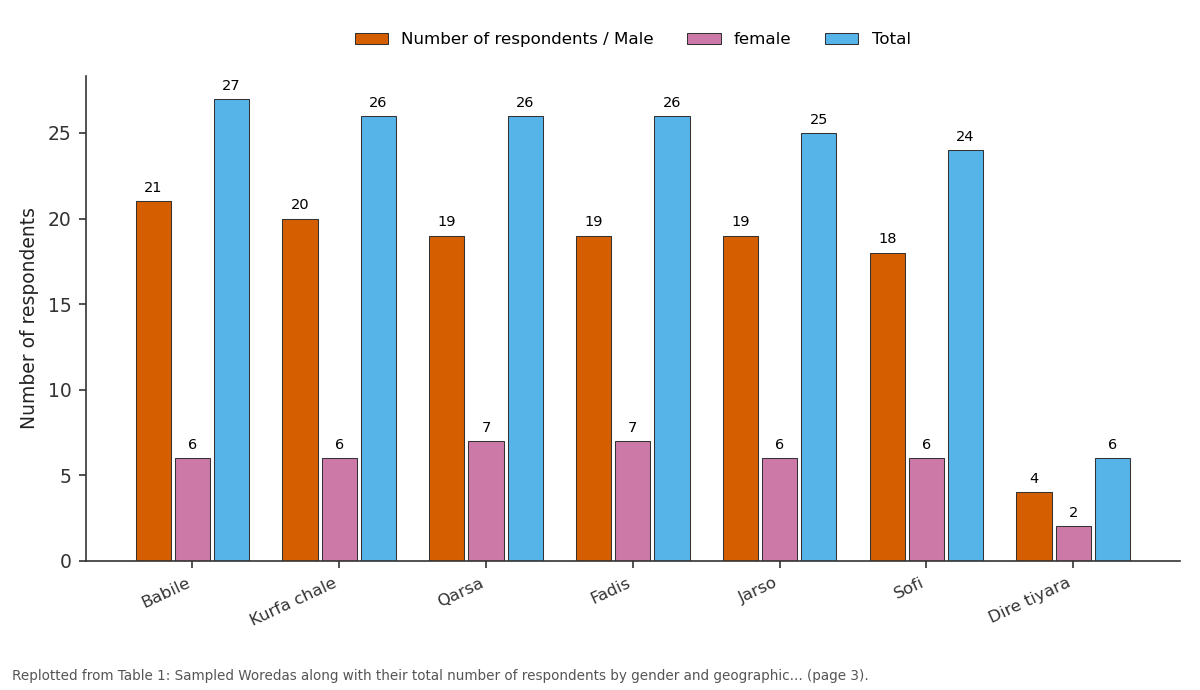
Number of respondents / Male and female and more: Babile vs Kurfa chale vs Qarsa vs Fadis vs Jarso
Replotted from Table 1 (page 3) of the original paper. Every bar is the paper's own table value.
View source evidence ↗Figures & tables
From the original paper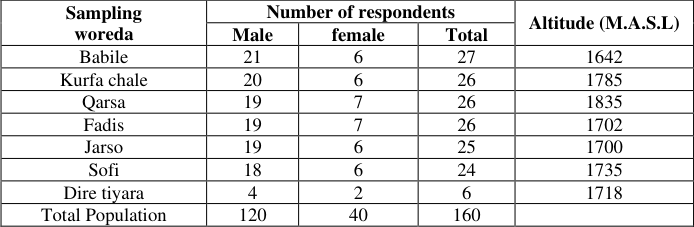 Table 1
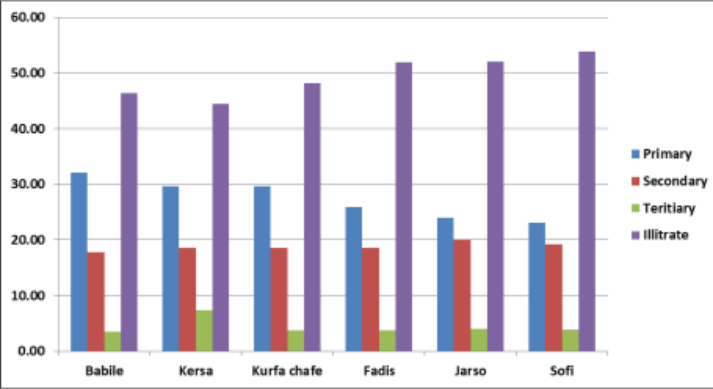 Figure 1
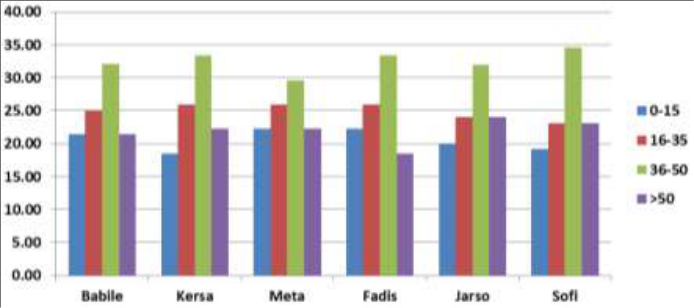 Figure 2
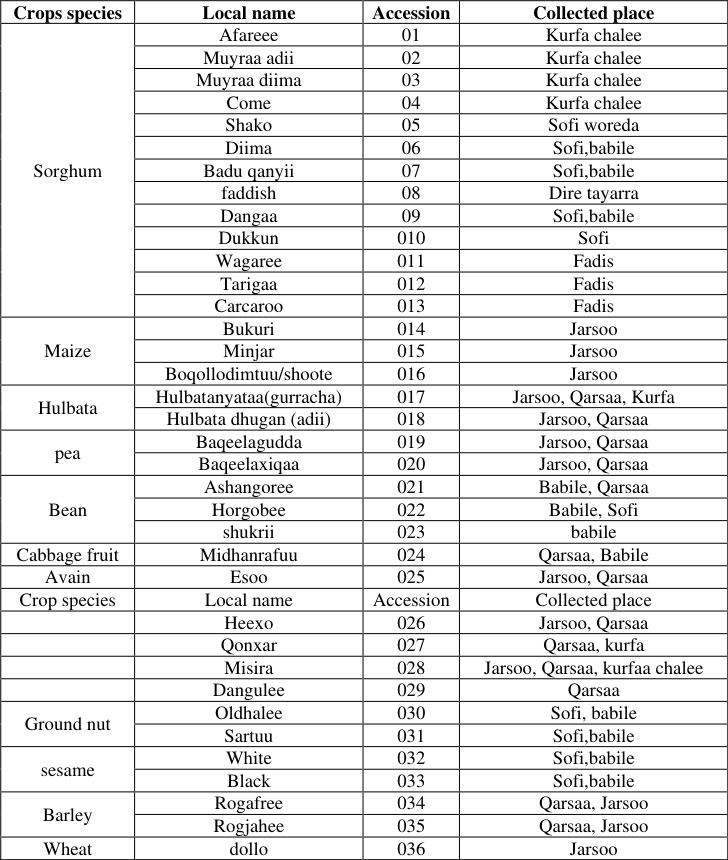 Table 2
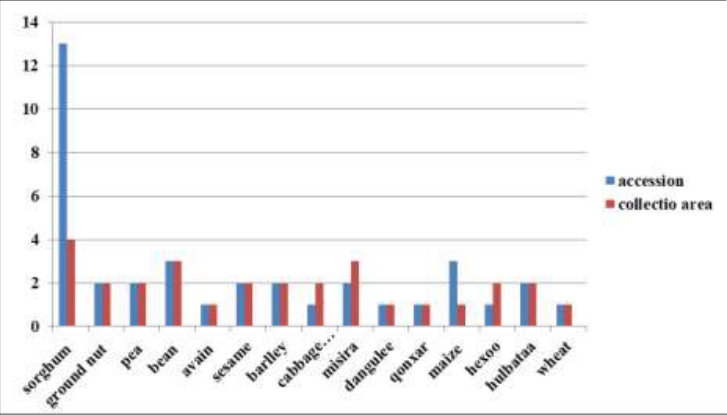 Figure 1
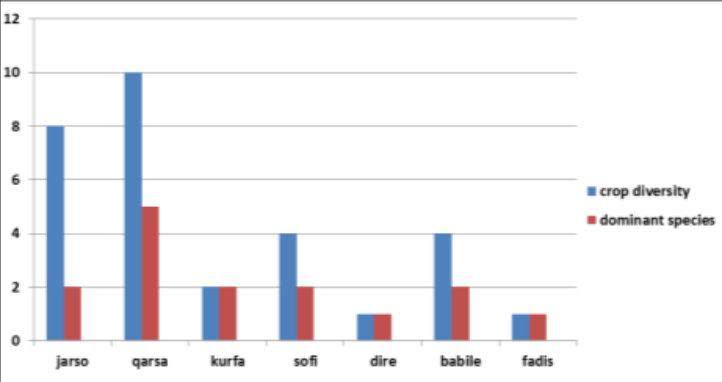 Figure 2
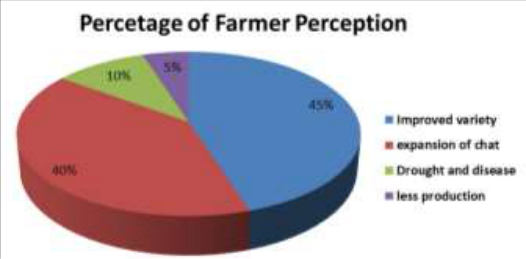 Figure 3
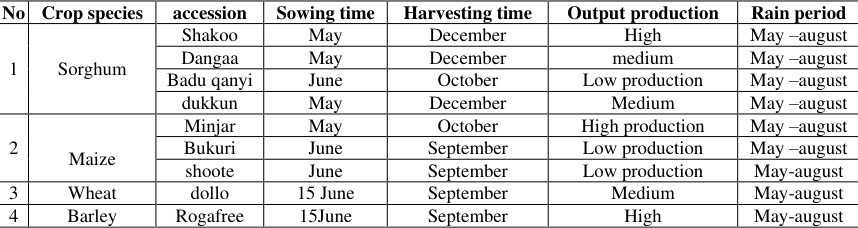 Table 3
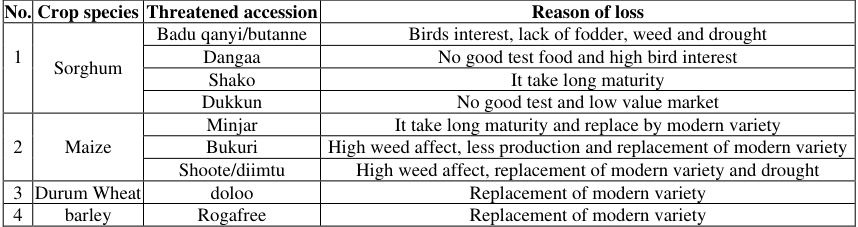 Table 4
Introduction
Ethiopia is recognised as an important source of the public goods associated with crop genetic diversity conservation. Ethiopia is considered as one of the richest genetic resource centers in the world. The Ethiopian region is characterized by diverse agro-ecology, which account for the huge diversity of biological resources that exist in the country (Mekbib, 2007) [28] . These biological resources are the enormous genetic diversity of the various crop plants grown in the country. For many crop species, Ethiopia is considered to be the centre of origin and diversity, for example, tef (Eragrostis tef), buna (Coffea arabica), nou (Guizotia abyssinica), geeshoo (Rhamnus prinoides), enset (Ensete ventricosum), Yam (Dioscorea abyssinica) and chat (Catha edulis) are distributed over a wide range of agro-ecological areas in the country (Vavilov, 1977; Harlan, 1969; Worede, 1991) [37,14,38] . These diverse genetic resources are used and managed in various ways by farmers' communities. The indigenous plant species, their wild relatives and weedy species which form the basis of Ethiopia's crop genetic resources are highly prized for their potential value as sources of important variations for crop improvement programs (Mulualem and Bekeko, 2014) [31] . Crop genetic resources constitute the building blocks of modern agricultural production to feed the growing of people currently we face (Mulualem, 2017) [30] . They form as the raw material from which new varieties have been systematically bred to meet the growing need for more food (FAO, 2004a). Besides, crop genetic resources are important sources of genes for crop improvement and resistance to major biotic and a biotic stress (Xiao et al., 1996) [39] . In many cases, small-scale farmers mainly depend on local genetic diversity to ensure sustainable production utilization and meet their livelihood needs. Loss of genetic choices as reflected by loss of traditional crop varieties diminishes farmers' capacities to cope with changes in pest and disease infection that leads to yield instability and loss (Teshome, 2006; UNEP, 2010) [36] .
Landraces or traditional varieties have been found to have higher stability (adaptation over time) in marginal environments, and thus their cultivation may contribute to farm level resilience in the face of production shocks (FAO, 1998; Ceccarelli and Grando 2002) [5] . The number of crop accessions of Ethiopian origin that have been introduced to various international and foreign national crop improvement programs and seed companies is enormous which accounts more than 1800 for wheat and more than 4500 for sorghum, around 2500 for barley and more than 900, large numbers are also reported for chickpea, lentil and finger millet (ICPPGR/FAO, 1997). Genetic erosion refers to loss of genetic variability over space and time. It could be detected at various levels of taxonomic units such as at a species, population, or biodiversity level as well as at different geographic ranges. In real sense, it represents either the loss of entire populations or the loss or change in frequency of specific alleles particularly, rare alleles or allele combinations present within a population or in a given species as a whole. It commonly occurs in native (indigenous) species and often caused by human-driven or -related activities. The term was publicly used to refer to the loss or replacement of primitive races and varieties usually called landraces in the case of cultivated plants. One of the negative consequences of genetic erosion is that it increases susceptibility to biotic and abiotic stresses (Bernhard, Schmid, 1994) [4] and, hence, reduces evolutionary potential and reproductive fitness of a given population or species over space and time (Douglas J. Futuyma, 1979 and Sinauer, Sunderland, 1979) [6] . Moreover, limited attention has been given to assess the diversity and conservation of indigenous crop genetic resources. As a result, some of indigenous crop genetic resources in Ethiopia are endangered, even they may be lost before they characterize and conserve (Mulualem, 2017) [30] . Accordingly, in order to avert the problem and for mitigating production bottlenecks and supporting food security especially in resource-poor countries, in situ conservation of genetic resources especially in areas of domestication or origin, where diversity of genetic resources is concentrated, is very essential (FAO,1996; Maurico. R. Bellon and J. Edward. Taylor, 1993) [25] . Likewise, maintaining on-farm genetic diversity and farmers' indigenous knowledge along with their behavioral practices of keeping landraces of ancestral crop populations are also another equally important strategy for conserving crop species (M. R. Bellon and J. E. Taylor, 1993; L. Guarino, 1995) [25, 23] . Keeping the landraces and/or reversing their loss is absolutely essential since they are potential sources of materials for modern and stable selection breeding and for developing lines that are resistant to biotic and abiotic stresses. Even though, Ethiopia is one of those countries regardless of being the world's rich biodiversity center and harboring a variety of distinct food crops, attempts made so far to conserve the crop is very less except few explorations and rescue collections targeting maintenance under ex situ conditions at the Ethiopian Biodiversity Institute (EBI), formerly established as the Plant Genetic Resources Centre of Ethiopia (PGRC/E) through the International Board on Plant Genetic Resources in 1974 (currently the International Plant Genetic Resources Institute (IPGRI). Still, on-farm genetic resource conservation and research activities targeting improvement of indigenous crops received less attention in several countries (A. A. Orlov 1929; H. P. Huffnagel, 1961) [1,13] . In recent days, the country is under severing threat of loss in genetic diversity and most of the indigenous food crops are at risk of total extinction (K. Hammer and Y. Teklu, 2008; J. Orabi et al; 2007; M. Girma, 2014) [21,17,24] . Landraces are among those crops regardless of their valuable and distinct agronomic traits (H. R. Harlan and M. L. Martini, 1936) [14] . Their cultivation is declining from time to time and in recent decades, only practiced by smallholder farmers for subsistence use only. The present study has, therefore, been initiated with the following objectives: To document diversity of crop landrace and assessing its current status in eastern Hararghe of Ethiopia To assess perception of farmers on loss of land race and threaten farmers variety in eastern Hararghe.
Methodology 2.1. Description of the Study Area
The study zone is located in the eastern part of Oromia National Regional State and Harari region (figure 1). The administrative capital of the zone is Harar town which is located at a distance of 526 Km from Addis Ababa. The zone has the total area of 24,247.66 km2 and is geographically located between 70321-90441 North latitude and 410101-430161 East longitudes (EHFEDO, 2012) [8] . The physiographic condition of the zone is characterized by plateaus, rugged dissected mountains, deep valleys, gorges and plains. There are various prominent and Peaks Mountains in the zone like Kundudo and Gara Mullata mountain chain are the major ones. The zone is bordered by West Hararghe zone in the west, Bale zone in the south, Somali National Regional State in the east and south-east, and Dire Dawa Administrative Council in the north. Harari Regional State is encircled by the East Hararghe zone. Harari is one of nine national regional states in Ethiopia having nineteen kebeles (lower administrative level). Geographically, the area is located between 42003' 30''-420.16' 24''E and 90.11-90,24 o E N with an altitude ranging from 1300-1600 m.a.s.l. The mean annual rainfall the area is 636.7mm and the mean annual temperature is 19 o C. Generally the region has a total area of 334km2 (HBC, 2016). Agroecologically of eastern Hararghe zone is divided into highland, midland and lowland areas that cover 11.4%, 26.4% and 62.2% of the total area of the zone, respectively. It receives annual rainfall of 1,200 to 2000 mm. The average temperature varies from 100 o C to 150 o C. The midland agro-ecological zone has an altitude of 1,500-2,300 m.a.s.l. with annual rainfall ranging from 600 to 2000 mm. Low agro-ecological zone, which covers a total area of 14,076 ha, is found in the south eastern and northern parts of the zone bordering Bale zone, Somali Regional State and Dire Dawa Administrative Council. As elsewhere in the country, agriculture is the dominant economic activity and the base of livelihood of the majority of the residents of both study area similar. In the farming system, there are three production systems in East Hararghe zone. These are the mixed farming (crop and livestock production), the pastoral and the transitional (agro-pastoral farming). The mixed farming and the pastoral areas account for about 40 and 50% respectively, (EHFEDO, 2012) [8] . The agro-pastoral system, which is practiced in lowland areas accounts for 10% of East Hararghe zone area.
Methods of data collection and research design
A community based cross-sectional research design was employed focusing on selected farmers' districts and kebeles within a district that were identified after a rapid preliminary informal survey and discussions with the Zone and districts agricultural bureau experts. The information was gathered from both primary and secondary sources. Data were collected with farmers who cultivate farmer variety crop on farm land and harvest collection area through a questioner, household interview, and focus group discussions (FGD) using key informants and personal observations at different farm fields. Questionnaire method was used with the intention of setting information from a wide range of sources (respondents) regarding the indigenous knowledge and practices involved in crops landraces farming, management, conservation, and utilizations in the study areas. The questionnaire was written in English and translated into local languages such as 'Afan Oromo' and 'Amharic' and distributed to the selected 160 household heads. The household heads were purposively selected based on the preliminary survey and documents from district agricultural offices. In addition, all the required age groups and sexes including elder women household heads were intentionally involved to guarantee good coverage of the required diversity in indigenous knowledge. Interview questions were used to authenticate the information generated through the questionnaires. In this regard, semi structured questions that address matters regarding the cereal crops landraces currently or used to be cultivated, extents of their production challenges, and major utilizations were presented. The 10 key informants from each kebele were carefully selected during the harvesting cropping season in 2020 from the household heads of both sexes and different age groups involved in the questionnaire method based on their willingness and rich practical knowledge on crop species production, conservation, and utilization in the areas. Focal group discussions were carried out with selected crop species growing elders and experts to complement the information obtained from individual farmers and to minimize missing data. The key informants involved were well recognized elder farmers aged 50 or more and spent their entire lives in the localities and were engaged in barley farming and seed selection. Open group discussions regarding the reasons why barley landraces are left marginalized, main factors for the current decline in production of the landraces, and their general views regarding the benefits of the landraces were presented. Finally, after thorough discussion, consolidate ideas were noted. Agricultural extension experts and development agents (DAs) at all the selected districts and Peasant Association levels, as well as experienced researchers at Ethiopian biodiversity institute, the regional institution located in the study zone and mandated for research on cereal crops (maize, barley, sorghum and wheat) were consulted to cross-check whether the landraces identified by the local farmers were really landraces or improved varieties. Furthermore, secondary data from the Ethiopian Biodiversity Institute (EBI) and Horticulture and crops directorate researchers and well experienced experts were used to validate the landraces and screen the improved and exotic varieties released through the formal system.
Data Analysis
The collected qualitative and quantitative data were mostly analysed and summarized by table. The data on level of land race threat and local name was analysed by descriptive statics such as, Table, graph and percentage by using excel Microsoft.
Result and Discussion
Result and Discussion
Sociodemographic characteristics of the study population and its implications.
In the present study, the marital status from total of 160 respondents were interviewed from the seven districts (20 from each) of which the majority were male respondents 140 (87.5%) and the rest 20 (12.5%) were female respondents (Table 1). Males are more involved in agricultural practices as compared to females in all the study districts and their respective kebeles. Active participation of women are dominant in other activities like selling and buying chat because income generated from crop production is too low as compared to chat. Other reality that pushes female from agricultural crop activities toward production of chat is that they are yet under cultural impositions that prohibited their active participation in owning farmlands. According to this study most of the respondents (88.8%) used to grow Sorghum for more than 50 years old revealing their rich knowledge and behavioral practices in cereal crop and others landrace production. Hence, it suggests appropriateness of the study population in providing sufficient and valuable information regarding the landraces under cultivation or used to be cultivated over the last couple of decades (20 to 30 years ago) along with the main challenges of production and main utilizations. Even though, most of the respondents have rich indigenous knowledge-based agricultural practices, larger proportion of the respondents (147 or 91.88%) had less than primary school education. Thus, they have been involved in different crop landrace selection, conservation, and maintenance processes.
| Sampling woreda | Number of respondents | — | — | Altitude (M.A.S.L) |
|---|---|---|---|---|
| Male | female | Total | ||
| Babile | 21 | 6 | 27 | 1642 |
| Kurfa chale | 20 | 6 | 26 | 1785 |
| Qarsa | 19 | 7 | 26 | 1835 |
| Fadis | 19 | 7 | 26 | 1702 |
| Jarso | 19 | 6 | 25 | 1700 |
| Sofi | 18 | 6 | 24 | 1735 |
| Dire tiyara | 4 | 2 | 6 | 1718 |
| Total Population | 120 | 40 | 160 |
Table text extracted from the original PDF; superscript letters are shown inline. The original table image is below.
View original table image
Table 1: Sampled Woredas along with their total number of respondents by gender and geographic positioning used in the present study. With regard to educational status 49.45% of them were uneducated, 30.0% of them studied informal education while 27.40% of them studied primary education and 18.77% them were educated up to Secondary High School (9-10) whereas 4.37% of them were tertiary education (figure 1). Large number of the respondent in the study area were illiterate meaning they didn't write and read followed by the second largest number were primary school. From the recruited 160 respondents, highest age group were between 36-50 (32.51%) followed by 16-35 (24.98%) (Figure 2). Respondent above 50 years old were account 21.91% followed by age between 0-15 account (20.6%).
Sampling woreda
Sampling woreda
Number of respondents
Number of respondents
On-farm Conservation of landrace
On -farm conservation involves farmers' continued cultivation and management of a diverse set of crop populations in the agro ecosystem where the crop evolved or in secondary centres of diversity. It depends on farmers' active participation based on their reasons and incentives for maintaining diversity (Bellon et al., 1997) [3] . Crop genetic diversity is unequally distributed around the world and is concentrated in centres of diversity that often coincide with centres of crop domestication (Gepts, 2006) [12] . 'Through farming practices (time of planting, thinning, and seed selection), farmers are able to keep landraces adapted to their growing conditions and socio-cultural preferences. The objective of on-farm conservation is therefore to maintain crop evolution in farmers' fields, farms and landscapes. The reason to maintain evolutionary processes in crops is 'to generate new potentially useful genetic variation, which in turn contributes to maintain the capacity of agricultural and food systems to adapt to change, particularly if it is unpredictable' (Bellon, 2009) [2] . All number of respondents raised their idea that we keep our landrace crops as it is not to become extinct. Additionally they said that government and non government should be with do on it in order to keep the life span of this landrace crops. In line with this idea Faith et al. (2010) [10] proved that what economists call option values, which are to do with the idea that maintaining diversity keeps our options open to benefit from unanticipated future uses of biodiversity. A crucial aspect of on-farm conservation is the seed systems that are associated with the maintenance and management of landraces in centers of crop diversity (Pautasso et al., 2012) [32] . A seed system refers to the interrelated set of participants, rules, interactions and infrastructure by which farmers obtain seed or planting material through time and space. Historically seed systems have been in the hands of farmers and communities, and are usually referred to as local, informal or traditional seed systems.
Identified status of farm land race
Landraces is an important genetic resource that has been included in international treaties and national decrees that protect and enhance their use in their local environments. However, legislation is needed to make it possible to market landraces as diversified genetic materials. National and international legislation was designed primarily to protect trade and return royalty income to expensively-funded plant breeding programs; as landraces become more attractive to use in local food production and sustainability, legislation changes are needed to facilitate this trend and to promote exportation and exchange of landrace diversity and encourage their use (Jaradat, 1992a; Joshi and Witcomb, 2003) [19,20] . Totally 33 accessions of land race farmers variety are identified in study area that holds 15 crop species. From the total of 33 accession sorghum are most high accession holds 9 (27.27%)
and highly cultivated in study area. Maize and bean are the second holds high accession its 3 in number (9.0%). Hulbata, misira (Lentil), Ground nut, pea and barley are the 3 rd holds high accession it two accessions (6.0%).When the rest of crops hold one accession each (3.0%) see (table 2). From the recruited 160 respondents and conducted research survey showed that more crop diversity were recorded in Qarsa woreda followed by Jarso which account 10 (66.7%) and 8 (53.3%) crop species respectively (Figure 2). In the same way Babile and Sofi woreda are the 3 rd crop diversity in study area and both are hold 4 crop species (26.7%). Dirre and Fadis woreda are the least crop diversity in study are it account only one crop species (6.7%).
| Crops species | Local name | Accession | Collected place |
|---|---|---|---|
| Sorghum | Afareee | 01 | Kurfa chalee |
| Muyraa adii | 02 | Kurfa chalee | |
| Muyraa diima | 03 | Kurfa chalee | |
| Come | 04 | Kurfa chalee | |
| Shako | 05 | Sofi woreda | |
| Diima | 06 | Sofi,babile | |
| Badu qanyii | 07 | Sofi,babile | |
| faddish | 08 | Dire tayarra | |
| Dangaa | 09 | Sofi,babile | |
| Dukkun | 010 | Sofi | |
| Wagaree | 011 | Fadis | |
| Tarigaa | 012 | Fadis | |
| Carcaroo | 013 | Fadis | |
| Maize | Bukuri | 014 | Jarsoo |
| Minjar | 015 | Jarsoo | |
| Boqollodimtuu/shoote | 016 | Jarsoo | |
| Hulbata | Hulbatanyataa(gurracha) | 017 | Jarsoo, Qarsaa, Kurfa |
| Hulbata dhugan (adii) | 018 | Jarsoo, Qarsaa | |
| pea | Baqeelagudda | 019 | Jarsoo, Qarsaa |
| Baqeelaxiqaa | 020 | Jarsoo, Qarsaa | |
| Bean | Ashangoree | 021 | Babile, Qarsaa |
| Horgobee | 022 | Babile, Sofi | |
| shukrii | 023 | babile | |
| Cabbage fruit | Midhanrafuu | 024 | Qarsaa, Babile |
| Avain | Esoo | 025 | Jarsoo, Qarsaa |
| Crop species | Local name | Accession | Collected place |
| Heexo | 026 | Jarsoo, Qarsaa | |
| Qonxar | 027 | Qarsaa, kurfa | |
| Misira | 028 | Jarsoo, Qarsaa, kurfaa chalee | |
| Dangulee | 029 | Qarsaa | |
| Ground nut | Oldhalee | 030 | Sofi, babile |
| Sartuu | 031 | Sofi,babile | |
| sesame | White | 032 | Sofi,babile |
| Black | 033 | Sofi,babile | |
| Barley | Rogafree | 034 | Qarsaa, Jarsoo |
| Rogjahee | 035 | Qarsaa, Jarsoo | |
| Wheat | dollo | 036 | Jarsoo |
Table text extracted from the original PDF; superscript letters are shown inline. The original table image is below.
View original table image
Farmers' Perceptions on Replacement and Loss of Traditional Crop Varieties
Farmers in the study districts purposely maintain landraces to address various needs. The main traits farmers use to prefer a given variety over the other were maturity, yield potential, suitability for animal feed, grain size, grain color, tillering capacity, market demand, condition of the soil and product volume. Similar to current result, Eticha et al. (2008) [9] , the selection criteria for landraces of barley reflect adaptations to changing farming conditions, and responses to the socioeconomic and cultural factors that shape farmers priorities. In the same way a study made on enset showed that the biggest uses of landraces are for kocho, bulla, amicho, fiber and medicine (Zerihun et al., 2016) [40] . A study made on wheat indicated a wide range of variations among landraces for the traits studied which help farmers with an opportunity to make a choice of genotypes that fit their purpose (Zewdie et al., 2014) [41] . This survey study also showed that replacement of modern variety was the most farmer variety loss (45%) in study area. Expansion of chat was the second loss of farmer variety in eastern Hararghe area (40%). Another possible factor that leads to loss of landrace variety in the study area were repeated drought and weed disease followed by less production of land race variety in study area were 3 rd and 4 th the loss of farmer variety respectively. Most of farmers in the study area said that it is become harder to find traditional varieties of crops due to their replacement by the new ones as the traditional varieties are becoming less productive, no longer tolerant to drought, susceptible to diseases and incompatible with the type of soil farmers are dealing with. In line with current result, farmers understood the general pattern of yield deterioration in their own varieties (Heisey and Brennan, 1991) and make a replacement decision accordingly. Respondent in the study were different view and perception in time of sowing, maturity and harvesting (Table 3). The accession of sorghum shako, dangaa and dukkun and accession of maize minjar have late maturity in study area according to match with rain period of the area. However, shako and minjar have high production. Since, it is late maturity not interested by people according with rain fall period. Inversely, other accession like baduqanyi, bukri and shoote have short maturity but their also low production and due to other factor like highly effect of striga, high bird interest are major problem as farmer replace other new variety.
| No | Crop species | accession | Sowing time | Harvesting time | Output production | Rain period |
|---|---|---|---|---|---|---|
| 1 | Sorghum | Shakoo | May | December | High | May –august |
| Dangaa | May | December | medium | May –august | ||
| Badu qanyi | June | October | Low production | May –august | ||
| dukkun | May | December | Medium | May –august | ||
| 2 | Maize | Minjar | May | October | High production | May –august |
| Bukuri | June | September | Low production | May –august | ||
| shoote | June | September | Low production | May-august | ||
| 3 | Wheat | dollo | 15 June | September | Medium | May-august |
| 4 | Barley | Rogafree | 15June | September | High | May-august |
Table text extracted from the original PDF; superscript letters are shown inline. The original table image is below.
View original table image
Threatened farmer crop species, season of sowing and harvesting
Data recorded from survey result showed that four crop species in study area were threatened due to different factor (
Conclusion and Recommendation
Ethiopia is recognised as an important source of the public goods associated with crop genetic diversity conservation, as it is a primary or secondary centre of diversity for several crops. Ethiopia is centre of origin for crops such as: sorghum, teff, coffee and enset, and is centre of diversity for many others such as: wheat, barley, Ethiopian mustard, chickpea lentils and finger millet. Similarly eastern Hararghe has diverse agro-ecology. A total of 15 land race crop species was identified with 36 accessions from 2 regions and 7 woreda. From total 15 farmer variety of crop and 36 accession, sorghum are the highest accession and more cultivated in study area it account 13 accession (36.1%). Maize and bean are the second high accession in study area it account three accession each (8.3%). Misir, ground nut, hulbat, pea, barley and sesame are the third high accession it account two accession each (5.6%). The remaining crop species like qontor, dangule, wheat, cabbage fruit and avain are the least hold accession it account one each (2.8%). From the total survey of woreda, Qarsa is the most diverse crop species since it wide agro-ecology it hold ten crop species 66.7% of total crop in study area. Jarso is the second crop diversity in study area it hold eight crop species (53.3%). Sofi and babile are the third crop diversity in study area it hold four crop species each (26.7%). Kurfa chale woreda is followed Sofi and Babile it hold two crop species (13.3%). Dire and Fadis is the least crop diversity in study was it mostly cultivates only one species (6.7%). Expansion of chat and replacement of modern variety in study area were the most loss of farmer variety it holds 45% and 40% respectively. Repeated drought and weed disease and less production of land race variety in study area were 3 rd and 4 th the loss of farmer variety respectively. Six farmer crop species in study area like Badu Qanyii, Shakoo, Bukuri, Minjar, Barley and wheat were threatened in study area due to Replacement of modern variety, no good test and low value market, bird's interest, lack of fodder, weed and drought. Therefore, the following recommendation is used for future conservation: Continuous study of each crop diversity and genetic erosion and conservation on -farm and awareness creation on onfarm land race conservation, sustainable utilization and use of farmer variety Creating awareness for local farmers on how to manage the crop effectively (sowing, weeding, harvesting and storing) and conserve the landrace variety. More agricultural research should be conducted on the characters and requirement of the crop for various regions and environments to conserve landrace variety.
Figures and tables from the paper
| No. | Crop species | Threatened accession | Reason of loss |
|---|---|---|---|
| 1 | Sorghum | Badu qanyi/butanne | Birds interest, lack of fodder, weed and drought |
| Dangaa | No good test food and high bird interest | ||
| Shako | It take long maturity | ||
| Dukkun | No good test and low value market | ||
| 2 | Maize | Minjar | It take long maturity and replace by modern variety |
| Bukuri | High weed affect, less production and replacement of modern variety | ||
| Shoote/diimtu | High weed affect, replacement of modern variety and drought | ||
| 3 | Durum Wheat | doloo | Replacement of modern variety |
| 4 | barley | Rogafree | Replacement of modern variety |
Table text extracted from the original PDF; superscript letters are shown inline. The original table image is below.
View original table image
References
39 in the original paper- Orlov, "The barley of Abyssinia and Eritrea," Bulletin ofApplied Botany, Genetics and Plant Breeding 1929;20:283-345.
- Bellon MR. Do we need crop landraces for the future? Realizing the global option value of in situ conservation. In: Kontoleon, A., Pascual, U. and Smale, M. (eds) Agrobiodiversity and Economic Development. Routledge, London and New York, 2009, 51-61.
- Bellon MR, Pham JL, Jackson MT. Genetic conservation: a role for rice farmers. In: Maxted, N., Ford-Lloyd, B.V. and Hawkes, J.G. (eds) Plant Conservation: the In Situ Approach. Chapman and Hall, London, 1997, 263-289.
- Bernhard Schmid. "Effects of genetic diversity in experimental stands of Solidagoaltissima: evidence for the potential role of pathogens as selective agents in plant populations," Journal of Ecology 1994;82(1):165-175.
- Ceccarelli S, Grando S. Plant Breeding with Farmers Requires Testing the Assumptions of Conventional Plant Breeding: Lessons from the ICARDA Barley Program in D.A. Cleveland and D. Solerieds. Farmers, Scientists and Plant Breeding Integrating Knowledge and Practice CABI International NY, 2002.
- Futuyma J. Evolutionary Biology, Sinauer, Sunderland (MA), 1979.
- Tadesse D, Asres T. "On farm diversity of barley landraces in North Western Ethiopia," International Journal of Biodiversity and Conservation 2019;11(1):1-7.
- EHFEDO. East Haraghe Zone Finance and Economic Development Office. Annual report of 2012.
- Eticha F, Berghofer E, Grausgruber H. Characterization and Utilization of barley (Hordeum vulgare L.) landraces in the highlands of West Shewa, Ethiopia. Plant Genetic Resources 2008;7:154-162.
- Faith DP, Magallon S, Hendry AP, Conti E, Yahara T et al. Ecosystem services: an evolutionary perspective on the links between biodiversity and human well-being. Current Opinion in Environmental Sustainability 2010;2:1-9.
- Gepts P. Plant genetic resources conservation and utilization: the accomplishments and future of a societal insurance policy. Crop Science 2006;46:2278-2292.
- Huffnagel HP. Agriculture in Ethiopia, Food and Agriculture Organization (FAO), Rome, 1961.
- Harlan HR, Martini ML. Problems and Results of Barley Breeding, USDA Yearbook of Agriculture, Washington DC, US Government Printing Office, 1936.
- Harar Biodiversity Center Over view of Socio Economic Data on Eastern Ethiopia Region Unpublished), Harar, Ethiopia, 2016.
- ICCPPGR/FAO (1997), FAO: Plant Genetic Resources, FAO-Rome, Italy, http://web.icppgr.fao.org/
- Orabi J, Backes G, Wolday A, Yahyaoui A, Jahour A. "The Horn of Africa as a center of barley diversification and a potential domestication site," Theoretical and Applied Genetics 2007;14:1117-1127.
- JR. Ethiopia: A Centre of Diversity. Journal of Economic Botany 1969;23:309-314.
- Joshi KD, Witcomb JR. The impact of participatory plant breeding (PPB) on landrace diversity: A case study of highaltitude rice in Nepal. Euphytica 2003;134:117-125.
- K, Teklu Y. "Plant genetic resources: selected issues from genetic erosion to genetic engineering," Journal of Agriculture and Rural Development in the Tropics and Subtropics 2008;109:15-50.
- Guarino L. "Secondary sources on cultures and indigenous knowledge systems," in Collecting Plant Genetic Diversity Technical Guidelines, L. Guarino, V. R. Rao, and R. Reid, Eds., CAB International, Wallingford, UK, 1995, 195-228.
- Guarino L. "Secondary sources on cultures and indigenous knowledge systems," in Collecting Plant Genetic Diversity Technical Guidelines, Guarino L, Rao VR, Reid R. Eds., CAB International, Wallingford, UK, 1995, 195-228.
- Girma M. "Genetic erosion of barley in North Shewa Zone of Oromiya Region, Ethiopia," International Journal of Biodiversityand Conservation 2014;6(3):280-289.
- Bellon MR, Taylor JE. "Farmer soil taxonomy and technology adoption," Economic Development and Cultural Change 1993;41:764-786.
- Bellon MR, Taylor JE. "Farmer soil taxonomy and technology adoption," Economic Development and Cultural Change 1993;41:764-786.
- McGuire S. Farmers' management of sorghum diversity in eastern Ethiopia, In C. Almekinders and W. de Boef (Eds.) Encouraging Diversity: the conservation and development of plant genetic resources, London: Intermediate Technology Publications, 2000.
- Mekbib F. Intra-specific folk taxonomy in sorghum (Sorghum bicolor (L.) Moench) in Ethiopia: folk nomenclature, classification, and criteria. Journal of Ethnobiology and Ethno medicine 2007;3(38):1-18.
- Mulatu E. Seed Systems and Small-Scale Farmers: A Case Study of Ethiopia. PhD Thesis. University of the Free State, South Africa 2000.
- Mulualem T. Genetic Diversity, Path Coefficient Analysis, Classification and Evaluation of Yams (Dioscorea spp.) in Southwest Ethiopia. PhD dissertation, Haramaya University, Ethiopia, 2017.
- Mulualem T, Bekeko Z. Diversity and conservation of wild crop relatives for source of resistance to major biotic stress: Experiences in Ethiopia. Journal of Gene tic and Environmental Resources Conservation 2014;2(3):331-348.
- Pautasso M, Aistara G, Barnaud A, Caillon S, Coomes O et al. Seed exchange networks for agrobiodiversity conservation. A review. Agronomy for Sustainable Development 2012. doi:10.1007/s13593-012-0089-6.
- Brush SB. "Genetic erosion of crop populations in centers of diversity: a revision," Proceedings of the Technical Meeting on the Methodology of the FAO World Information and Early Warning Systems on Plant Genetic Resources, University of California, Rome, Italy, 1999, 3444.
- Wright S. "Evolution in Mendelian populations," Genetics 1931;16(2):97-159.
- Tanto T, Demissie A. A comparative study of genetic diversity of four major crops managed of Ethiopia, Institue of biodiversity Conservation and research, Addis Ababa 2000.
- Teshome H. Local Crop Genetic Resource Utilization and Management in Gindeberet, West Central Ethiopia. MSc Thesis, Norwegian University of Life Sciences, Norway, 2006.
- Vavilov NI. The origin, variation, immunity, and breeding of cultivated plants. In: Selected writings of N. I. Vavilov, Chronica Botanica 1977;13:1-16.
- Worede M. Crop genetic resources conservation and utilization: An Ethiopian perspective, science in Africa: Achievements and prospects. Proceedings of the symposium of the American association for advancement of science, Washington, DC, USA 1991, 46.
- Xiao J, Yuan L, Mc Cough SR, Tanks S. Genetic diversity and its relationship to hybrid performance and heterosis as revealed by PCR based markets. Theoretical and Applied Genetics 1996;92:637-643.
- Zerihun Y, Kassahun T, Awole Z, Guy B. Exploiting indigenous knowledge of subsistence farmers" for the management and conservation of Enset (Ensete ventricosum (Welw.) Cheesman) (Musaceae family) diversity on-farm. Journal of Ethnobiology and Ethnomedicine 2016;12(1):34.
- Zewdie B, Paul CS, Anthony JGG. Assessment of on-farm diversity of wheat varieties and landraces; evidence from farmer"s fields in Ethiopia. African Journal of Agricultural Research 2014;9:2948-2963.