
Research article · 2020 · Full text
International Journal of Agriculture Extension and Social DevelopmentCertain types and prevention of fungal influence of peaches
Volume 3(2) · Pages 33–34 · DOI: 10.33545/26180723.2020.v3.i2a.54 ↗
Research areasPlant Physiology and Cultivation StudiesAgricultural Development and Policies
Abstract
Author-writtenMoniliosis, klyasterosporiosis, leaf wrinkles, flour-dew diseases cause serious damage to the peach tree. The fungi that cause them not only cause this plant, but also cause serious damage to other fruit trees. In the fight against them, it is necessary to organize the work in accordance with the recommendations.
Summary
Source-checkedPlain-language reading of the full paper, prepared with AI and checked against the text. Each point links to the authors' own words.
Why it matters
- Peach trees are susceptible to several fungal diseases, including moniliosis, klyasterosporiosis, leaf wrinkles, and flour-dew, which cause serious damage. View evidence ↗
- The fungi affecting peach trees are problematic because they can also cause serious damage to other types of fruit trees. View evidence ↗
- Fungal diseases play a significant role in the loss of crop yield for peach trees. View evidence ↗
The question
- The authors aim to introduce and describe the various fungal diseases that affect peach trees. View evidence ↗
What they did
- The paper identifies Monilia cinerea Bon, an immature fungus of the order Hypho-mycetales, as the causative agent of moniliosis. View evidence ↗
- The paper identifies Clasterosporium carpophilum Aderh, an immature fungus of the order Hyphomycetales, as the causative agent of klyasterosporiosis. View evidence ↗
- The paper identifies Sphaerotheca rannosa Lev. f. persicae Woronich. as the causative agent of flour dew in peaches. View evidence ↗
What they found
- Klyasterosporiosis can cause up to 30% damage to peach trees and affect 50-60% of the fruits in some years. View evidence ↗
- Flour dew significantly impacts young seedlings, causing them to stop growing. View evidence ↗
- In older trees, flour dew reduces yields by 5–7% and impairs the winter survival of damaged branches. View evidence ↗
- The conidia of Monilia cinerea typically measure 9.5–12x6.9 μm, though this varies by temperature and substrate. View evidence ↗
- The conidia for klyasterosporiosis are multicellular (1 to 7 barriers) and measure 23-65x10-18 microns. View evidence ↗
- The cleistothecia of Sphaerotheca rannosa f. persicae are spherical, brown when ripe, and 70-125 μm in diameter. View evidence ↗
- The authors recommend disinfecting tree cut areas using 1% copper sulphate followed by garden grease. View evidence ↗
- A 4% Bordeaux liquid spray is recommended when buds begin to sprout. View evidence ↗
- Fungicides such as Entolikur, Entoxlorok, and Ziram Scort should be applied 3-4 times, starting after flowering and continuing every 2 weeks. View evidence ↗
What it means
- The authors conclude that most of the peach crop can be saved if the recommended control methods are implemented. View evidence ↗
Visual summary
1 visualsIllustrations explain the paper; they do not show study data.
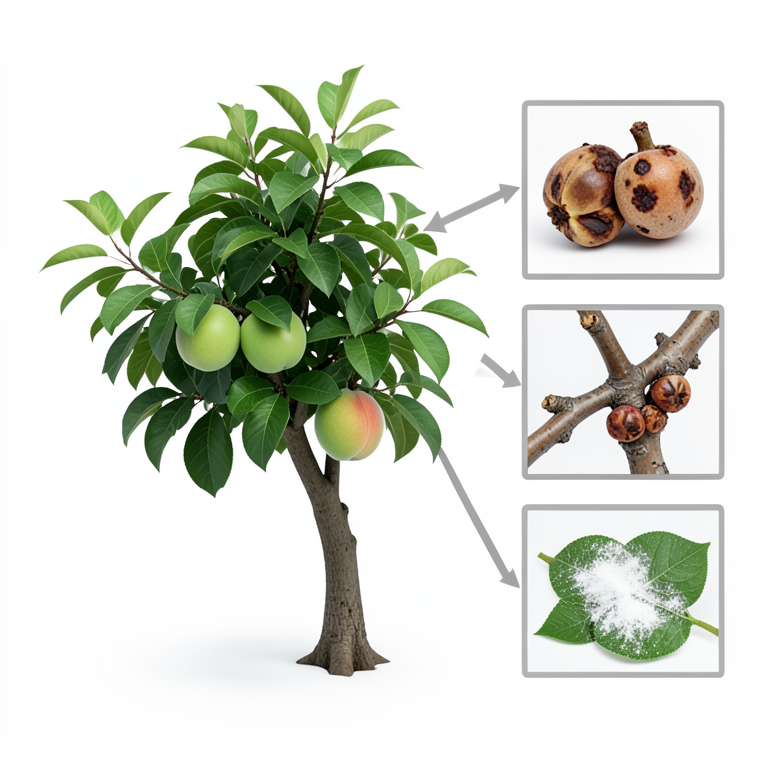
Overview of Peach Fungal Pathogens
AI-generated conceptual illustration (peach tree (Prunus persica)). It explains the idea and does not show study data.
View source evidence ↗Introduction
Satisfying the demand of the population for food products in the period of market economy in our country remains one of the most important tasks facing agriculture today. Peach trees are being planted in many parts of the country. The role of diseases that damage them in the loss of yield of these trees is great. Here we will introduce you to the fungal diseases that fall on the peach tree. Monilioz. Peach tree is one of the most common pests that are planted almost everywhere. It occurs during the entire vegetation period of plants. In the spring, the flowers turn brown and dry out, the young leaves wither and dry out, causing the death of fruiting branches and annual branches. All damaged parts of the plant are stored in the tree until spring next year. In humid weather, they are formed cushion pads -spores of the pathogen. The disease spreads very quickly. Damaged inflorescences and twigs appear to be burnt, so the disease is often referred to as monilial burn. This disease should not be confused with the damage of flowers from the early frosts observed in early spring. The causative agent of moniliosis in the peach tree -Monilia cinerea Bon, a broadly specialized immature fungus belonging to the order Hypho-mycetales, it infects about 12 species of legume fruit crops (cherry, plum, etc.). The pathogen produces mycelial and conidial spores. The size of the conidia (typically 9.5-12x6.9 μm) may vary depending on the developing substrate and temperature conditions. In some areas, the causative agent of moniliosis of peach fruit is the bag period -Monilinia cinerea Hon. can form. In this case, in the winter-affected organs of the plant, along with conidial spores, apothecia are formed, in which sac-like sacs develop. The sacs are elliptical, single-celled, colorless, size 10.6-15.2x5.6-7.6 μm. They are a primary source of infection, such as conidia. Throughout the summer, M. cinerea causes persistent damage to tree branches and twigs, and especially fruits. They first appear as small brown spots, then grow rapidly and occupy the entire fruit. On their surface appear ashy pillows. The rotten fruit twists, dries, and some of them hang on the tree until spring. Clyasterosporiosis. The disease is very common everywhere. It infects leaves, buds, flowers, buds, fruits, twigs and branches. On the leaves appear round (up to 2-5 mm in diameter), light brown spots with reddish-brown or dark pink border. After 1-2 weeks, the spots shed and holes form in the leaves. When the damage is severe, the spots often join and shed. Damaged leaves partially or completely dry out and fall off. On twigs and buds the disease appears in the form of small round, orange-red spots (the middle is much lighter in color than the edges). The causative agent of klyasterosporiosis is a man-sub Clasterosporium carpophilum Aderh immature fungus of the order Hyphomycetales. In plant tissues, it enters the cell and forms mycelium, which causes its death. The mycelium spreads locally and each spot should be considered as an independent lesion site. It takes 2-4 days (depending on temperature and variety tolerance) from the time of damage to the appearance of the stain. 5-7 days after infestation, conidial spores are formed in the form of clusters on the underside of the leaf. Conidia are short, elbow-shaped, colorless or yellowish-brown. Conidia elongate-ovate or inverted, multicellular (barriers 1 to 7, depending on age), initially colorless, then yellowishbrown, size 23-65x10-18 microns. At high humidity and temperatures from 5 to 400C (comfortable range 19-250S) they grow and form a tumor-like tube that enters the plant tissue orally and directly through the bark. The pathogen overwinters in the form of mycelium and conidia (usually covered with glue in the fall) in the remains of infected plants. In the spring, under the influence of precipitation, the glue is washed away, the conidia are empty, and with raindrops fall on the healthy plants. In the mycelium, new spores begin to form. In some years, the damage to peach trees is up to 30%, and the damaged fruits reach 50-60%. In damaged leaves, the amount of www.extensionjournal.com chlorophyll and sugar decreases, while the amount of total nitrogen increases. Damaged fruits reduce both sugar content and weight. Leaf wrinkles. This fungal disease infects peaches, plums and sometimes cherry twigs, leaves and fruits. As a result of the disease, the growth rate of the tree slows down and winter cold temperatures can cause more severe damage to the affected trees. If the disease recurs over several years, it can cause very severe damage to the trees. There are several types of this disease that damage the berries: Taphrina deformans -infects peach trees, and for this reason, it is called the disease of peach leaf wrinkles. Oidium. The disease is most often observed in peaches, plums, cherries, cherries and apricots. When dry and hot days come after the rains, the disease manifests itself strongly. The disease mainly affects the leaves and twigs, and even fruits. They first appear as white dust, then black dots -cleistothecia -are formed, and as a result the dust appears dark gray. Cleistothecia are rare, so the dust in them is always hungry. The causative agent of flour dew -Sphaerotheca rannosa Lev. f. persicae Woronich., and in other leguminous fruit crops -Podosphaera tridactyla sac fungus. Both species belong to the order Erysiphales, and they differ in their mutual cleistothecia: in the first they have simple tumors, and in the second -dichotomous branching. In each cleistothecia, a single sac with 8 sacs develops. Sph. rannosa f. The cleistothecia in persicae are spherical, brown when ripe, 70-125 μm in diameter. The sacs are broadly ovoid, size 70-125x55-80 μm, the sacs are singlecelled, elliptical, size 22-25x14-15.6 μm. Sph. rannosa f. persicae overwinter in the form of mycelium on infected young branches, in the spring they form new conidial spores, which are the primary source of infection. The cystic period plays a secondary role in the maintenance of infection, as cleistothecia are degraded by various saprophytes in autumn and winter. Flour dew mainly causes great damage to young seedlings, under the influence of the disease they stop growing. The disease causes less damage to older trees, however, damaged branches spend the winter poorly, and yields are reduced by 5-7%. In the fight against diseases of the peach tree, it is very important to carry out disease control measures in nurseries, young and old gardens in conjunction with agro-technical measures. Nurseries should be located at least 500 m away from gardens and protected forests that protect the gardens. It is forbidden to include roses in the rotation of peach seedlings. Application of fungicides to plants in nurseries to prevent the development of moniliosis, flour dew and other diseases is carried out after the first pair of true leaves on seedlings and after the emergence of buds on seedlings, the second and subsequent every 15 days. It is recommended to spray insecticides with fungicides. In autumn, the fallen leaves in the nursery are collected and burned, plowing between rows. When digging seedlings, their roots are carefully inspected. Seedlings with bacterial cancer detected in the main root and root collar are discarded. The soil where the damaged tree grows is disinfected with chlorinated lime and buried. Young and fertile gardens.
In the autumn-winter period Collect the leaves, burn them, or use them for compost. Running around the body and plowing between rows; Cutting off the dried branches and fruit bodies of trutoviks, digging up dead trees, and burning them all. Disinfect the cut areas of trees with 1% copper sulphate and cover the surface with garden grease; Spraying lime-sulfur decoction (OOQ) on trees. Bleaching of tree trunks and skeletal branches with 20% lime milk with the addition of copper sulphate, this measure disinfects the bark externally and protects it from cold blows.
In the spring-summer period Repeated whitening of tree trunks and skeletal branches with 20% lime milk; Spraying the plants with 4% Bordeaux liquid when the buds begin to sprout or begin to sprout; Treatment of plants 3-4 times with fungicides (Entolikur, Entoxlorok, Ziram Scort). The first treatment is carried out immediately after flowering trees, the second and subsequent ones every 2 weeks. Pruning the branches in early spring against flour dew in the gardens significantly reduces the amount of disease infestation.
Conclusion
There are many diseases that can be found in the peach tree, among which the most dangerous diseases mentioned above. These diseases lead to a significant decrease in yield or deterioration of quality. This will save most of the crop if the above recommended methods are used to control the disease.
References
2 in the original paper- XX. Nuraliev Agricultural phytopathology. Tashkent, 2013
- Hasanov B, Ochilov RO, Kholmurodov EA, Gulmurodov RA. Fruit and nut trees, citrus, berry bushes and vine diseases and their control. -Tashkent, 2010.