
Research article · 2021 · Full text
International Journal of Research in AgronomyReview for agronomic schedule maize- based cropping systems for haricotben under planting time arrangements in Dera South Gonder Ethiopia
Volume 4(1) · Pages 85–93 · DOI: 10.33545/2618060x.2021.v4.i1a.125 ↗
Research areasAgronomic Practices and Intercropping SystemsAgriculture and Rural Development ResearchAgricultural Innovations and Practices
Abstract
Author-writtenField experiments were conducted at Dera District south Gonder experimental field site, Fogra National Rice Research and Training Center from June to October during the years 2020 and 2021 cropping seasons. The aim of the study was to determine optimum time of intercropping haricot bean into the maize based cropping system under conservation tillage practices, The experiment was laid out in split-plot design, with tillage practices a) Tied-ridge and b) Zero-tillage as main plot and time of intercropping haricot bean 1) Planting haricot bean simultaneously with maize, 2) Planting haricot bean 15 days after maize was planted and 3) planting haricot bean 30 days after maize was planted as sub-plots. Intercropping was assessed on the basis of the performance of the main and component crops indices as grain yield, biomass weight, partial and total LER and competitive indices such as relative crowding coefficient (K), aggressivity (A), competitive ratio (CR) and system productivity index (SPI). There was no interaction between tillage practices and time of intercropping haricot bean in any of the indices studied. Main effects of tillage practices had no significant effects on all the indices considered during both 2020 and 2021 growing seasons, but grain yield, biomass weight, partial and total LER tended to be higher in the tied-ridge treatment during 2020 and vis-versa during 2021seasons. The results obtained showed that the greatest intercrop yields of maize and haricot bean were obtained when both crops were planted at the same time. In both years, highest total land equivalent ratio (LERt) values were obtained when planting of maize and haricot bean was done at the same time followed by planting of haricot bean 15 days after maize was planted indicating the advantages of intercropping over the sole planting. Partial LERm was always higher than LERb during 2010 season and vis-versa during 2011 season. The results of competitive indices indicate that maize was the dominant crop in the mixture as measured by the positive values of A, and the high values of Km than Kb in the mixture. On the other hand, CR values of haricot bean were higher than maize in the mixture suggesting haricot bean was more competitive than maize in the intercropping system. Moreover, the data of SPI indicated that intercropping haricot bean at the same time with maize had higher SPI during both 2010 and 2011 season. In conclusion, intercropping of haricot bean simultaneously with maize exhibited an overall advantage over the other time of intercropping and sole cropping in terms of grain yield, partial LERm, LERb and LERt and competitive ratio indices and could therefore be recommended for Central rift valley areas of Ethiopia where maize and haricot bean are major crops.
Summary
Source-checkedPlain-language reading of the full paper, prepared with AI and checked against the text. Each point links to the authors' own words.
Why it matters
- Maize and haricot bean are critical food crops for smallholder farmers in Ethiopia's semi-arid central rift valley, but their productivity is limited by poor soil fertility and drought. View evidence ↗
- Tied-ridge cultivation and zero-tillage are established methods for conserving soil water in the semi-arid regions of Ethiopia. View evidence ↗
- Intercropping is used as a strategy for crop intensification to increase the productivity of land per unit area. View evidence ↗
The question
- The study aimed to identify the best timing for intercropping haricot bean into a maize-based system using conservation tillage. View evidence ↗
What they did
- Experiments were conducted from June to October in 2020 and 2021 at the Dera District south Gonder experimental field site. View evidence ↗
- The study used a split-plot design comparing two tillage practices (tied-ridge and zero-tillage) and three intercropping times (simultaneous, 15 days after maize, and 30 days after maize). View evidence ↗
- The researchers used the Melkassa II maize variety (120-day maturity) and the Awash-I haricot bean variety. View evidence ↗
- Performance was measured using grain yield, biomass weight, Land Equivalent Ratio (LER), and competitive indices including aggressivity, competitive ratio, and system productivity index. View evidence ↗
What they found
- The highest intercrop yields for both maize and haricot bean occurred when the crops were planted simultaneously. View evidence ↗
- The highest total Land Equivalent Ratio (LERt) was achieved with simultaneous planting, followed by planting haricot bean 15 days after maize. View evidence ↗
- Haricot bean was more competitive than maize in the intercropping system, as indicated by a competitive ratio (CR) greater than one for haricot bean and less than one for maize. View evidence ↗
- Simultaneous intercropping of haricot bean and maize produced the highest system productivity index (SPI) in both study years compared to delayed planting. View evidence ↗
What it means
- The authors conclude that simultaneous intercropping of haricot bean and maize is superior to delayed intercropping or sole cropping and recommend this practice for the Central rift valley of Ethiopia. View evidence ↗
- The authors recommend that farmers combine soil moisture conservation practices with maize-haricot bean intercropping to optimize resource use and increase sustainable productivity. View evidence ↗
Visual summary
3 visualsIllustrations explain the paper; charts are replotted from the paper's own table values.
Experimental Layout
AI-generated conceptual illustration (Maize and common bean plants in an agricultural field). It explains the idea and does not show study data.
View source evidence ↗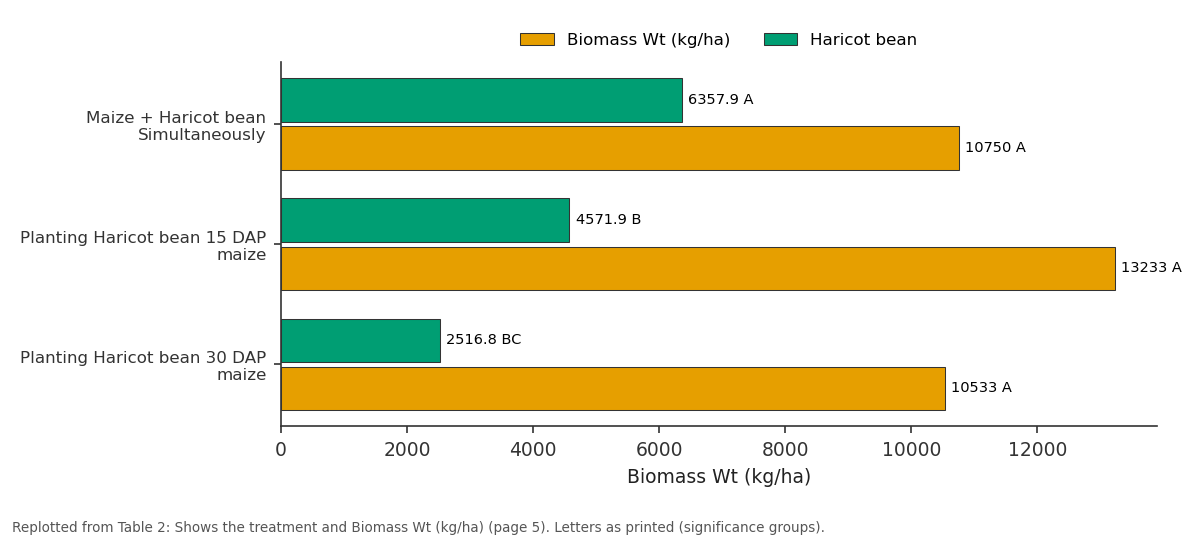
Biomass Wt (kg/ha) and Haricot bean: Maize + Haricot bean... vs Planting Haricot bean... vs Planting Haricot bean...
Replotted from Table 2 (page 5) of the original paper. Every bar is the paper's own table value.
View source evidence ↗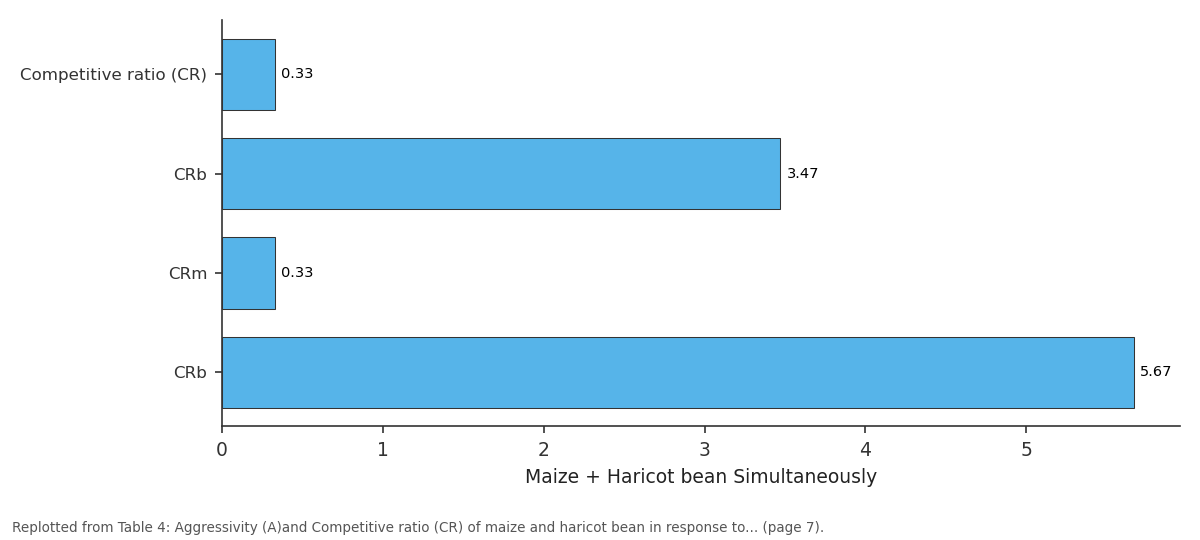
Maize + Haricot bean Simultaneously: Competitive ratio (CR) vs CRb vs CRm vs CRb
Replotted from Table 4 (page 7) of the original paper. Every bar is the paper's own table value.
View source evidence ↗Figures & tables
From the original paper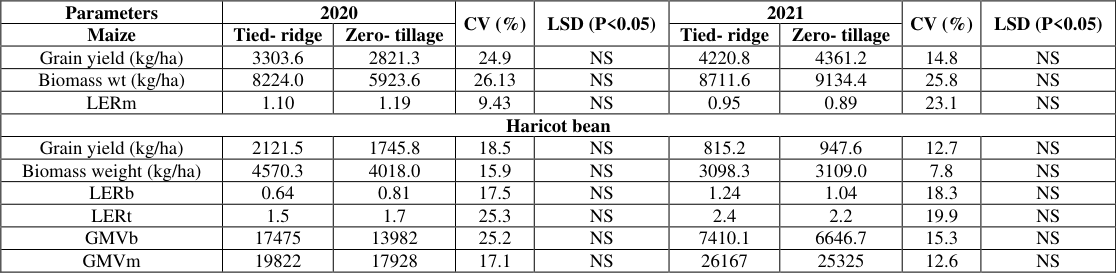 Table 1
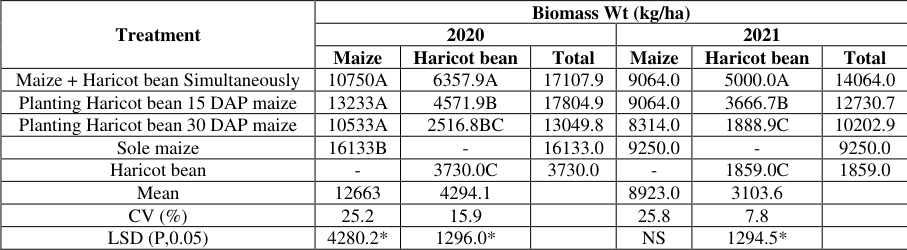 Table 2
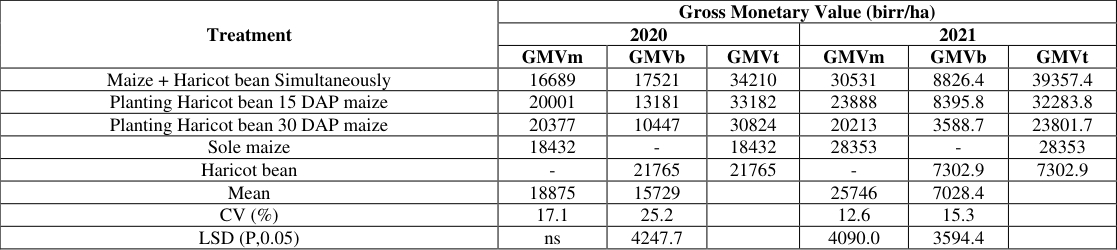 Table 3
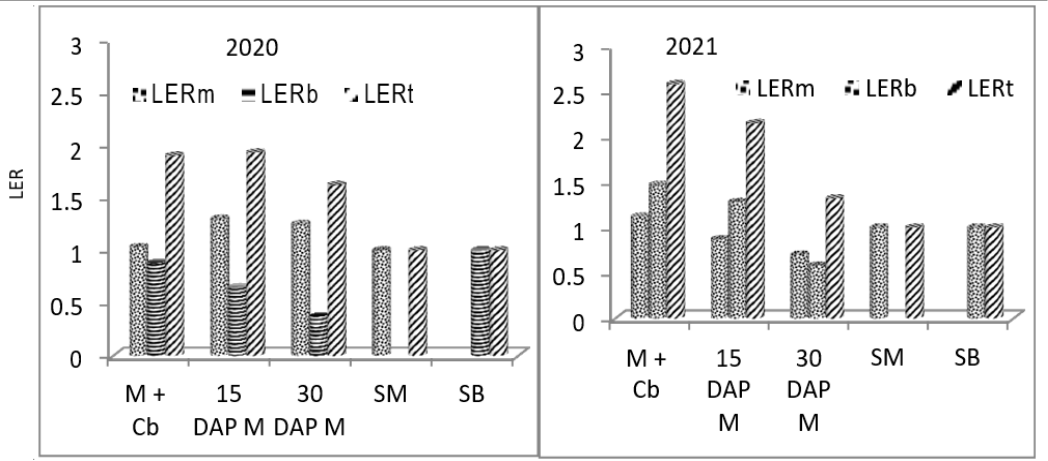 Figure 1
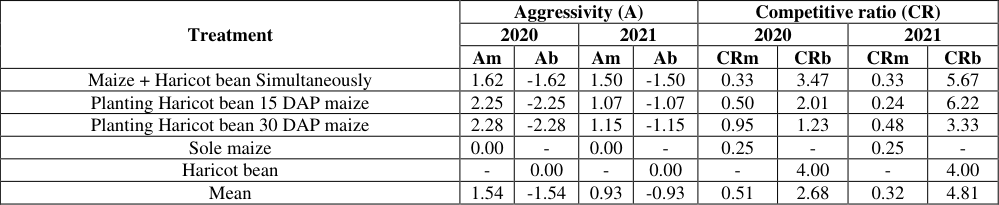 Table 4
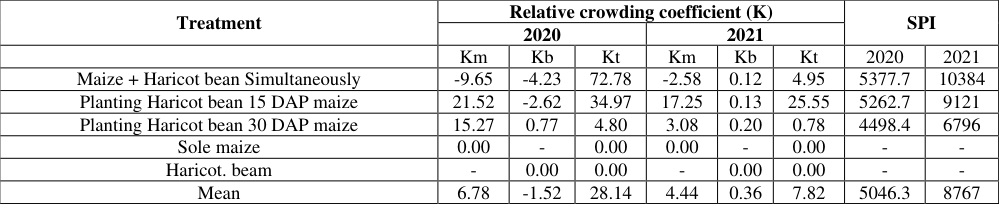 Table 5
Introduction
Maize and haricot bean are important food crops for smallholder farmers in the semi-arid central rift valley areas of Ethiopia. However, due mainly to drought stresses and poor soil fertility conditions, productivity of these crops is low. Under the conditions prevailing in the semi-arid central rift valley areas of Ethiopia, management practices that optimize water conservation and efficient use of rainfall have long been an area of priority research. Although adoption rate is very low, promising results have been registered in the development of soil moisture conservation technologies. Conservation tillage practices such as tied-ridge cultivation and zero-tillage are proven technologies for soil water conservation predominantly in the semi-arid areas Ethiopia (Tewodros, et al., 2005) [29] . Tied ridge cultivation (TRC) reduces rainfall run-off and soil erosion, and so can increase soil moisture availability and crop yield under a variety of semi-arid conditions. Tied ridge cultivation is the most effective technique for soil moisture conservation and thus increasing crop yield in zones with annual rainfall of less than 800 mm. Results found at Melkassa indicated that highest grain yield of maize and sorghum was obtained from plants grown in the furrows of tied ridges (Reddy and Kidane, 1993) [19] . The practice also tends to improve crop response to fertilizer application. In below normal rainfall years and on-farm sites of acute moisture stress, fertilizer use without soil moisture conservation practice (tied ridge) was found to be non-responsive. Conservation agriculture (CA) is recommended as a practice for sustainable crop production that simultaneously preserves soil and water resources (Hobbs, et al., 2008) [11] . Given the positive effects of CA on soil and water conservation, environmental health, and economic viability, it has been regarded as an environment-friendly technology and has been applied worldwide (Lahmar, 2010) [15] . Previous studies conducted in Ethiopia and other parts of Africa showed that conservation tillage practices that involve the retention of surface crop residues were effective in reducing evaporation losses and increasing water storage and water use efficiency (Tewodros, et al., 2005) [29] . This approach involves minimum disturbance of the soil surface by using an ox-drawn ripper tine to open the planting furrow. The practice has been recommended as a soil, water and draught-power conservation strategy and also reduces labor and time (Worku and Hussen, 2004) [25] . Several experiments were conducted to determine the effectiveness of conservation tillage over the traditional practice at different locations for different crops (tef, Maize and Sorghum) and has been reported that conservation tillage gave higher yields than the conventional tillage (Tewodros, et al., 2005) [29] .
Intercropping is considered as one of crop intensification strategies to increase agricultural productivity per unit area of land. Intercropping commonly used agricultural cropping practice and is growing more crops (21). There many justifications for farmers to adopt intercropping (15). One way towards better farming is to look for the most effective associated cropping of leguminous crops with non-leguminous one (6). In intercropping, growth and yield of legumes will be less than the major crop (20). The overall arrangement and the relative proportion of component crops are important in determining yields and production. The potential benefits of both TRC and conservation tillage practices, however, were tested only under sole crop conditions at various locations. Since tied ridge cultivation and conservation tillage practices can increase soil moisture retention, the practices may also extend the duration of crop growth in the post-rainy period (after the rains have stopped and while soil moisture is being depleted) and therefore reduce the risk of drought stress. It is believed that by using TRC and conservation tillage, it is possible to extend the growth period by at least 30 days (Tewodros et al., 2005) [29] . Thus, in most years the length of the growing season can be extended between 115 to 130 days. One of the most important strategies to increase crop production in smallholder farmers in the semi-arid areas is development of improved cropping system that intensifies land use efficiency and can make effective use of growth resources (water, nutrient, light, etc.). Intercropping is one of the cropping systems practiced for higher crop production advantages per unit area. The vital features of intercropping systems are that they exhibit intensification in space and time, competition between and among the system components for light, water and nutrients and the proper management of these interactions. In light of these the system is considered among the agricultural practices associated with sustainable crop production (Tolera, 2003) [31] . Since the use of conservation tillage (Tied-ridge and zero-tillage) extends the growth period by effectively conserving soil moisture, integrating intercropping practice to these tillage practices can maximize growth resources use and increase crop production. Increased crop production (over-yielding) often observed in intercrops compared to sole crops has been attributed to enhanced resource use (Szumigalski and Van-Acker, 2008) [37] . For intercropping to be more productive it is recommended that component crops differ greatly in growth duration so that their resource requirement for growth resources occurred at different times (Hailu, 2015) [10] . It is strongly believed that if legumes are intercropped in a timely manner, competition with the companion crop (maize) for light, water and nutrients can be minimized. At present, there is a lack of information on the effectiveness of determining time of intercropping in the semiarid areas of Ethiopia. This study was, therefore, conducted with the aim of comparing the effects of TRC and conservation tillage practices on the performance of maize and haricot bean in intercropping, quantify the productivity and competitive indices of these common crops by determining appropriate time of intercropping haricot bean to the main crop maize using moisture conservation practices and evaluate the impact of intercropped haricot bean on the companion maize crop. He selection of an appropriate intercropping system is quite complex as the success of intercropping systems depend much on the interactions between the component species, the available management practices, and the environmental conditions (Lithourgidis et al., 2011) [33] . Therefore, economically viable intercropping largely depends on adaptation of intercrop pattern and selection of compatible crops (Seran and Brintha, 2009) that maximize positive interaction and minimize competition. In the high lands of central Kenya, intercropping of maize with common bean, cow pea (Vigna unguiculata L.), and groundnut (Arachis hypogaea L.) in paired rows of legume between paired maize rows resulted high crop productivity and economic benefits relative to the conventional intercropping systems of single row of legume in between maize rows.
Materials and Methods
The study was conducted for two years during 2020 to 2021 crop growing season on the Fogera National Research experimental Dera field site under rainfed conditions in a semiarid area. The field has a typical clay loam soil that is too low in organic carbon (%) and total N (%) to fulfill the N demand of crops grown in the area and to maintain the soil N dynamic constant (Yusuf and Mesfin, 2006) [26] . and shows good response to moisture conservation practices. The experimental design was a split plot in a randomized complete block design and replicated three times. The treatments consisted of two in-situ soil moisture conservation practices, 1) Tied ridge cultivation and 2) Zero tillage assigned as main plot and three time of haricot bean intercropping into maize, a) planting haricot bean simultaneously with maize, b) intercropping haricot bean 15 days after maize is planted (DAP) c) intercropping haricot bean 30 days after maize is planted (DAP) as sub-plots. Tied-ridges were made 35 cm high constructed at every 6m length and closed at both ends of the row. Before planting, no herbicides was used, but there was about 10 to 15% dry weeds on the zerotillage plots which were later harvested and left on the ground as mulch. After planting, growing weeds were also continually weeded and left as ground cover. Maize was planted at 80 cm space between ridges/rows and 25 cm within rows and at the time of intercropping haricot bean was planted at a recommended proportion of two rows of maize and one row of haricot bean at a plant spacing of 10 cm. Plot size was 4.50 m x 5 m = 22.50 m2. Medium duration (120 day maturing) maize variety Melkassa II and haricot bean variety of Awash-I was used in this study. Fertilizer was as per the recommendation and so 50 KG/HA OF Urea as source of N was applied in split, half each at planting and when the maize plant reached at knee height and 100 kg/ha of DAP as source of P was applied at planting. During the study period data collected included agronomic data such as above ground biomass of haricot bean and maize were estimated at harvest from 3 m2 per plot and were dried at 60 oC for 72 hrs. to determine dry matter yield. Grain yield, 1000 seed weight, plant height, cob weight plant-1, number of cobs plot-1, number of pods per plant, number of seeds per pod, and other yield components were also recorded, but grain yield and dry matter yield are reported here. Gross monetary value (GMV) was calculated for maize and haricot bean each, using the expression below. GMV = Grain yield (kg ha-1) × unit price (Eth. Birr kg-1)
The market price for maize and haricot bean at the time of crop harvest around Welenchity was estimated at Eth. Birr 6.00 kg-1 and Eth. Birr 7.75 kg-1, respectively. The total gross monetary value (GMVt) was then estimated by addition of the GMVm and GMVb. The advantage and disadvantages of intercropping were determined using the land equivalent ratio (LER) which was used as the criterion for mixed stand advantage as both maize and haricot bean were common crop species (Willey and Osiru, 1972) [23] . In particular, LER indicates the efficiency of intercropping for using the resources of the environment compared with mono-cropping. Land Equivalent ratio a measure commonly used to evaluate the performance of an intercropping system was computed from yields of maize and haricot bean in the intercropping system and sole crop.
For a maize/haricot bean association The LER was calculated as: LERb + LERm LERm = (Ymi/Ysm); LERb = (Ybi/Ysb) Where mi and sm are the yields of maize in intercropping and sole maize, respectively, and bi and sb the corresponding yields of haricot bean The competitive relationships between the two crops were determined using the relative crowding coefficient (k) and aggressivity (A) values using the formulae suggested by Willey (1979) [22] as indicated below:
Where Ysm is the pure culture yield of maize, Ysb the pure culture yield of haricot bean, Ymi the mixed culture yield of maize, Ybi the mixed culture yield of haricot bean, Zm the sown proportion of maize and Zb is the sown proportion of haricot bean. The crowding coefficient (K) is a measure of the relative dominance of one species over the other in an intercrop (Banik, et al., 2006) [4] . Willey (1979) [22] emphasized that each component crop in the intercropping system has its K value. Accordingly, a component crop with higher K value is the dominant and that with low K value is dominated. The yield advantage in the intercropping system as designated by Kt is determined by the product of the K of component crops. When the Kt is greater than one there is a yield advantage, when Kt is equal to one there is no yield advantage, and when it is less than one there is a disadvantage. Aggressivity (A) is often used to indicate how much the relative yield increase in 'a' crop is greater than that of 'b' crop in an intercropping system (Dhima et al. 2007) [6] . It determines the competitive ability of a crop when grown in association with another crop. In particular, if A is 0, both crops are equally competitive, if Acereal is positive then the cereal species is dominant, and if Acereal is negative then the cereal species is the dominated species. Competitive ratio (CR) is only used as a measure of intercrop competition (inter-specific comptetion) between species in the system (Trydeman et al., 2004) [32] . The CR gives a better measure of competitive ability of the crops and is also advantageous as an index over crowding coefficient and aggressivity (Willey and Rao, 1980) [24] . The CR represents simply the ratio of individual LERs of the two component crops and takes into account the proportion of the crops in which they are initially sown. The CR is calculated according to the following formula:
According to Esmaeili, (2011) [7] when CR is below 1 there is a positive benefit and the species can be grown in a mixture. If CR > one, indicates the base crop is competitor, while values < one implies the minor component crop is profusely suppressed the base crop or (Willey and Rao, 1980) [24] if CRcereal = 0, both crops are equally competitive, if CRcereal is positive then the cereal species is dominant, if CRcereal is negative then the legume is profusely suppressed the cereal species and is considered dominant species. Another index for assessing intercrops is the system productivity index (SPI), which standardizes the yield of the primary crop (cereal) in terms of the primary crop (legume) (Odo 1991) [17] . System productivity index (SPI) was calculated as; SPI = (Ysm / Ysb x Ybi) + Ymi (Odo, 1991) [17] . Where: SPI = System productivity index, Ysm and Ysb = Mean yield of maize and haricot bean in sole cropping, Ybi and Ymi = Yield of maize and haricot bean in intercropping.
Statistical Analysis
Since there was a variation in the recorded seasonal climate data during the two growing seasons of the study period, an analysis of variance was performed for each year for a split-plot design using Statistix V8 (Analytical Software, Tallahassee, FL, USA). For significant main treatment effect and treatment interaction effects, LSD at 0.05 probability level means separation was applied.
Results (Experimental Design) Weather conditions
The rainfall data indicated that there is a variation in amount and distribution between the two growing seasons, 2020 and 2021. The amount of rainfall during 2020 growing season was higher and the distribution more even than 2011. During the beginning of the growing season in June and during end of the season in September 2021 rainfall was much lower than during the same season in 2020, suggesting that crops have experienced some degree of moisture stresses at seedling establishment stage and flowering and/or grain filling stage due to low amount of rainfall during on set and cessation of the season, respectively, during 2021 than 2020 season.
The total seasonal amount of rainfall was 590.4 mm and 468.4 mm and the annual total rainfall was 982.2 mm and 611.3 mm during 2020 and 2021, respectively
Main treatment effect of Tillage Practices
The main effect of tillage practices (tied-ridge and zero tillage) was not significant (p < 0.05) on any of the indices studied during 2010 and 2011 growing seasons (Table 1). In the present study soil water content over the study period was not recorded, however, the result suggested that the performance of both tiedridge and zero tillage in soil moisture conservation is comparable. This finding is in accordance to the results of similar studies reported by Tewodros et al., 2005 [29] who reported that the effects of tied-ridge and zero tillage practices were not significantly different in soil moisture conservation, grain and dry matter yield. The results however, indicated that grain yield (kg ha-1), biomass weight (kg ha-1), and partial and total LER of maize and haricot bean tended to be higher in the tied-ridge than zerotillage during 2010 growing season and vice versa during 2011 season. The tendency to produce higher grain and dry matter yield during higher rainfall season in 2010 in the tied-ridge treatment may be related to the relatively higher soil water stored and increase infiltration as opposed to zero-tillage where excess water was lost as run off. The results of Tewodros, et al., 2005 [29] suggested that zero-tillage did not increase grain, dry matter yield and water use efficiency when the precipitation is realistically sufficient or increased in the semi-arid areas. During 2011 season, the relatively higher grain and dry matter yield in zero-tillage practice as compared to tied-ridge practice may be associated with the amount of rainfall during which below average rainy season, evapo-transpiration rate might have been reduced due to the accumulated mulches which were added over a series of weed harvests, and resulted to more soil moisture conservation resulting into increased biomass production with subsequent improved assimilate translocation, partitioning and consequential increase in grain yield.
| Parameters | 2020 | — | CV (%) | LSD (P<0.05) | 2021 | — | CV (%) | LSD (P<0.05) |
|---|---|---|---|---|---|---|---|---|
| Maize | Tied- ridge | Zero- tillage | Tied- ridge | Zero- tillage | ||||
| Grain yield (kg/ha) | 3303.6 | 2821.3 | 24.9 | NS | 4220.8 | 4361.2 | 14.8 | NS |
| Biomass wt (kg/ha) | 8224.0 | 5923.6 | 26.13 | NS | 8711.6 | 9134.4 | 25.8 | NS |
| LERm | 1.10 | 1.19 | 9.43 | NS | 0.95 | 0.89 | 23.1 | NS |
| Haricot bean | ||||||||
| Grain yield (kg/ha) | 2121.5 | 1745.8 | 18.5 | NS | 815.2 | 947.6 | 12.7 | NS |
| Biomass weight (kg/ha) | 4570.3 | 4018.0 | 15.9 | NS | 3098.3 | 3109.0 | 7.8 | NS |
| LERb | 0.64 | 0.81 | 17.5 | NS | 1.24 | 1.04 | 18.3 | NS |
| LERt | 1.5 | 1.7 | 25.3 | NS | 2.4 | 2.2 | 19.9 | NS |
| GMVb | 17475 | 13982 | 25.2 | NS | 7410.1 | 6646.7 | 15.3 | NS |
| GMVm | 19822 | 17928 | 17.1 | NS | 26167 | 25325 | 12.6 | NS |
Table text extracted from the original PDF; superscript letters are shown inline. The original table image is below.
View original table image
Discussion
Main treatment effect of time of intercropping haricot bean to maize. The main treatment effect of time of intercropping haricot bean to the maize crop was not significant (p < 0.05) on the grain yield of maize during 2020, but significantly influenced during 2021 season (Table 2). The result revealed that in 2021 season, intercropping haricot bean simultaneously with maize tended to reduce maize grain yield as opposed to delayed planting. The result implies that during high rainfall season, planting haricot bean simultaneously with maize, favored the fast growing and early maturing haricot bean a competitive advantage over maize of effectively making use of resources (soil nutrient and water) for increased growth and grain yield. This corroborates with the findings of Ghosh, et al., 2006 [9] . In 2011 crop season, significantly highest maize grain yield was produced when haricot bean was planted simultaneously with maize as against delayed intercropping probably due to the effect of soil moisture stress during stand establishment at the beginning of the season which has severely reduced grain yield of haricot bean. The soil moisture deficit that occurred during seedling stage had reduced the competitive ability of haricot bean as it is very susceptible to drought stress. On the other hand, main treatment effect of time of intercropping was significant on the grain yield of haricot bean during both 2020 and 2021 crop season. With delayed time of intercropping haricot bean to the maize crop, there was a significant decline in the grain yield of haricot bean during both 2020 and 2021 crop season and maize during 2021 growing season. The results of highest grain yield of both maize and haricot bean when time of intercropping haricot bean is done at the same time with maize is in accordance with other reports on cereal crops with forage legumes (Mpairwe, et al. 2002) [16] , food legumes (Amujoyegbe and Elemo, 2013) [1] . Reported to interfere with light interception and thus yields of intercropped cowpea were reduced (Reddy and Visser, 1997) [20] . The yield response of haricot bean to delayed introduction to the maize stand was in line with the results obtained by Amujoyeg be and Elemo, (2013) [1] in maize/cowpea intercropping. Generally, irrespective of planting time treatment, grain yield of haricot bean during 2020 season was much higher than 2021. The higher grain yield of haricot bean during 2020 than 2021 season may suggest that relatively better rainfall have created favorable conditions for the growth of haricot bean. The decline in grain yield of both maize and haricot bean in the system with delayed time of intercropping haricot bean to the maize stand during 2021 may be associated to early cessation of rainfall which might have impaired complete grain filling.
| Treatment | Biomass Wt (kg/ha) | — | — | — | — | — |
|---|---|---|---|---|---|---|
| 2020 | 2021 | |||||
| Maize | Haricot bean | Total | Maize | Haricot bean | Total | |
| Maize + Haricot bean Simultaneously | 10750A | 6357.9A | 17107.9 | 9064.0 | 5000.0A | 14064.0 |
| Planting Haricot bean 15 DAP maize | 13233A | 4571.9B | 17804.9 | 9064.0 | 3666.7B | 12730.7 |
| Planting Haricot bean 30 DAP maize | 10533A | 2516.8BC | 13049.8 | 8314.0 | 1888.9C | 10202.9 |
| Sole maize | 16133B | - | 16133.0 | 9250.0 | - | 9250.0 |
| Haricot bean | - | 3730.0C | 3730.0 | - | 1859.0C | 1859.0 |
| Mean | 12663 | 4294.1 | 8923.0 | 3103.6 | ||
| CV (%) | 25.2 | 15.9 | 25.8 | 7.8 | ||
| LSD (P,0.05) | 4280.2* | 1296.0* | NS | 1294.5* |
Table text extracted from the original PDF; superscript letters are shown inline. The original table image is below.
View original table image
In contrast to the grain yield, time of intercropping haricot bean to maize crop has no significant effect on the biomass weight of maize during 2011 (Table 3). But biomass weight of maize in 2010 and that of haricot bean during both 2010 and 2011 crop season was significantly influenced by time of introducing haricot bean to maize crop (Table 3). Accordingly, highest biomass weight of maize during 2010 season was obtained when maize was sole planted followed by introducing haricot bean to maize 15 days after maize was planted. Biomass weight of sole maize was significantly (p < 0.05) higher than the mixture during 2020 season, however, there was no significant difference from the intercropping system during 2021 The high amount of rainfall received in 2020 has created favorable conditions for the development of higher biomass weight. The response of biomass weight of haricot bean in the intercropping system followed similar trends to the grain yield during both seasons. Accordingly, highest biomass weight (kg ha -1 ) of haricot bean was produced when haricot bean was planted simultaneously with maize and significantly (p < 0.05) decreased with delayed time of intercropping haricot bean.
| Treatment | Gross Monetary Value (birr/ha) | — | — | — | — | — |
|---|---|---|---|---|---|---|
| 2020 | 2021 | |||||
| GMVm | GMVb | GMVt | GMVm | GMVb | GMVt | |
| Maize + Haricot bean Simultaneously | 16689 | 17521 | 34210 | 30531 | 8826.4 | 39357.4 |
| Planting Haricot bean 15 DAP maize | 20001 | 13181 | 33182 | 23888 | 8395.8 | 32283.8 |
| Planting Haricot bean 30 DAP maize | 20377 | 10447 | 30824 | 20213 | 3588.7 | 23801.7 |
| Sole maize | 18432 | - | 18432 | 28353 | - | 28353 |
| Haricot bean | - | 21765 | 21765 | - | 7302.9 | 7302.9 |
| Mean | 18875 | 15729 | 25746 | 7028.4 | ||
| CV (%) | 17.1 | 25.2 | 12.6 | 15.3 | ||
| LSD (P,0.05) | ns | 4247.7 | 4090.0 | 3594.4 |
Table text extracted from the original PDF; superscript letters are shown inline. The original table image is below.
View original table image
In terms of both grain yield and biomass weight the combined yield of maize and haricot bean in the intercropping system were higher than sole maize or haricot bean suggesting the advantages of intercropping over sole planting (Table 2 and3). For example, the total grain yield advantages of combined maize and haricot bean over the sole maize and haricot bean ranged from 55 % to 84 % in 2010. Similar results have been reported in Sorghum-Mung bean-Soybean (Arshad and Ranamukhaarachchi, 2012) [2] intercropping and tef-faba bean (Getachew, et al., 2006) [8] mixed cropping, sorghum-soybeancowpea intercropping (Lemessa, et al., 2015) [14] . The results of 2011 season however, indicated that the advantages gained by combining maize and haricot bean over sole maize was minimal ranging from 7 % to 32 % in the intercropping haricot bean 15 DAP maize and simultaneous planting treatments, respectively. Delayed intercropping haricot bean 30 DAP maize remarkably reduced (-21 %) the combined grain yield of maize and haricot bean over sole maize probably due to occurrence of terminal drought or early cessation of rainfall. The grain yield advantages by combining maize and haricot bean over sole haricot bean ranges from 295 % to 561 %. The reason for wider yield gap between combined maize and haricot bean over sole haricot bean is due to the effects of soil moisture stress on haricot bean which had remarkably reduced grain yield during 2021 season relative to 2020 season. In addition to agronomic parameters used to compare the advantages of any cropping system in small scale farming conditions, total gross monetary (TGMV) value is also used to evaluate economic advantages of intercropping system. The results of this study indicated that intercropping of haricot bean to the maize system was advantageous than sole maize and/or sole haricot bean cropping and among the time of intercropping treatments, simultaneous planting of haricot bean was more advantageous than delayed intercropping haricot bean to the maize system. (Table 4). Generally, the advantages of GMVt accrued from time of intercropping haricot bean treatments over the sole maize and haricot bean followed similar trends to that of the total grain yield obtained from similar treatments. Similar results are reported from intercropping of sorghum with soybean and cowpea (Lemessa, et al., 2015) [14] . The advantages of intercropping over sole planting have also been observed in the data of LER which is given in Figure 1. Time of introducing haricot bean to the maize crop had a significant (p < 0.05) effect on the partial LERb during 2020 and partial LERm and LERt during 2021. However, the partial LERm in the intercropping system during 2020 was always above unity (1.00) indicating the advantages of intercropping over sole cropping. Partial LERm during 2021 season decreased with delayed time of haricot bean intercropping (Figure 1) and the highest partial LERm was obtained by intercropping haricot bean at the same time with maize. The increase in partial LERm during 2010 with delayed intercropping of haricot bean is associated with the increase in maize grain yield as with delayed intercropping. The results of this study is in agreement to the report of Tamiru, 2014 [34] in haricot bean/maize relative time of inter-planting study who reported that highest partial LERm was recorded with delayed intercropping of haricot bean to maize stand. On the other hand, the decline in partial LERm during 2011 season was a consequence of decrease in maize grain yield with delayed time of intercropping haricot bean as well as the effect of terminal drought stress which have remarkably reduced grain yield of maize. Partial LERb during both 2020 and 2021 was significantly different among time of haricot bean intercropping to maize crop. ) [34] . The probable reason for the below unity values of partial LERb during 2010 season could be due to the increasing trend of maize grain yield with delayed intercropping of haricot bean which had a negative effects on haricot bean growth and development as opposed to the sole haricot bean grain yield. This result is in accordance with the reports of Amujoyegbe and Elemo, (2013) [1] . However, during 2011 when there was below average rainfall season, the highest partial LERb value was obtained as with early time of intercropping haricot bean to the maize crop. During the same season LERm was below unity with delayed time of introducing haricot bean as opposed to LERb which had above unity of 1.47 and 1.28
| Treatment | Aggressivity (A) | — | — | — | Competitive ratio (CR) | — | — | — |
|---|---|---|---|---|---|---|---|---|
| 2020 | 2021 | 2020 | 2021 | |||||
| Am | Ab | Am | Ab | CRm | CRb | CRm | CRb | |
| Maize + Haricot bean Simultaneously | 1.62 | -1.62 | 1.50 | -1.50 | 0.33 | 3.47 | 0.33 | 5.67 |
| Planting Haricot bean 15 DAP maize | 2.25 | -2.25 | 1.07 | -1.07 | 0.50 | 2.01 | 0.24 | 6.22 |
| Planting Haricot bean 30 DAP maize | 2.28 | -2.28 | 1.15 | -1.15 | 0.95 | 1.23 | 0.48 | 3.33 |
| Sole maize | 0.00 | - | 0.00 | - | 0.25 | - | 0.25 | - |
| Haricot bean | - | 0.00 | - | 0.00 | - | 4.00 | - | 4.00 |
| Mean | 1.54 | -1.54 | 0.93 | -0.93 | 0.51 | 2.68 | 0.32 | 4.81 |
Table text extracted from the original PDF; superscript letters are shown inline. The original table image is below.
View original table image
The response of aggressivity (A) and competitive ratio (CR) of maize and haricot bean in the intercropping system during 2020and 2021 is presented in Table 5. The result of An indicated that maize was the dominant crop in the mixture as measured by the positive values during both 2020 and 2021 crop season irrespective of time of intercropping haricot bean to maize. During 2020 season, with delayed in the time of intercropping haricot bean to maize crop, A of maize was on increasing trend. On the other hand, the highest positive. A value of maize was recorded when haricot bean was intercropped at the same with maize. Unique feature of this index is that if the A value of one of the component crop is positive the other crop becomes negative and as the A value is greater, the higher is the difference in the competitive abilities of component crops. In this system the increasing trend of positive. A values of maize during 2010 season indicated that competitive ability of maize became greater with delayed time of intercropping haricot bean. Competitive ratio (CR) is used to assess the degree of competition between different species in the intercropping system (Trydeman et al., 2004) [32] . The result of CR, for haricot bean was higher than maize at all time of intercropping haricot bean to the maize system. Although the results suggest that both crops are compatible for intercropping, it was clear that haricot bean had exhibited dominance over maize in the system, suggesting that haricot bean (CR > one) was more competitive than maize (CR < one), (Table 5). As with A, with delayed in the time of haricot bean intercropping the values of CR for maize tended to increase and that of haricot bean consistently declined during both 2020 and 2021 seasons indicating that haricot bean is more competitive if planted simultaneously with maize before stand establishment. In this system, the growing condition suggests that CR appeared to be influenced more by phenology and growth characteristics of the species in the system. Maize is a slow growing and long maturing species as opposed to that of haricot bean a fast growing and early maturing species. By the time haricot bean was planted simultaneously with maize, haricot bean had faster stand establishment and matures earlier when maize was at medium vegetative stage. It is therefore, surmised that this characteristic gives a competitive advantage to haricot bean to exploit and make effective use of growth resources than the slow growing and late maturing companion crop. This result corroborates the findings of Tobita, et al., (1996) [30] and Ghosh, et al., (2006) 9[] . On the other hand, by the time haricot bean was delayed planted 15 and 30 days in to the system, maize was at full stand establishment, vegetative stages, and deeper root growth to enable it exploit efficiently solar radiation, plant nutrient and moisture resources in the soil profile (Berntsen et al., 2004) [5] . Generally, maize had higher relative crowding coefficient (Km) value than haricot bean Kb indicating that maize is more competitive than its associate haricot bean (Banik et al., 2000, Dhima et al., 2007) [3,6] (Table 6). The negative K values for maize during 2020 and 2021 season and that of haricot bean during 2020 season suggest that in this mixture there was no yield advantage or disadvantage (Takim, 2012) [27] . With delayed time of haricot bean intercropping, the Km value are above one during both 2020 and 2021 seasons, indicating yield advantages of maize over haricot bean in this intercropping system. Similar results have been reported by Banik et al., 2000 [3] , Dhima et al., 2007 [6] . The total Kt during both 2020 and 2021 is always above ones again demonstrating a yield advantage of intercropping system. The system productivity index (SPI) which standardized the yield of the secondary crop (haricot bean) in terms of the primary crop (maize) and also identified the combinations that utilized the growth resources most effectively and maintained a stable yield performance indicated that intercropping of haricot bean at the same time with maize produced the highest SPI than delayed intercropping during both 2020 and 2021 season. SPI consistently declined with delayed intercropping of haricot bean (Table 6). This result indicated that intercropping haricot bean at the same time with maize was the most profitable practice. Similar results are reported in sorghum and cowpea intercropping (Oseni, 2010) [18] . From the results of this study, it may be concluded that there is a scope for farmers to increase maize and haricot bean productivity in the semi-arid central rift valley areas of Ethiopia, by integrating improved soil moisture conservation practices (Tied-ridge and zero-tillage) and intercropping system in the maize and haricot bean production system. The productivity of the system could further be improved and sustained by planting maize and haricot bean simultaneously which increased productivity of both maize and haricot bean by avoiding competition between the species during early stand establishment. Farmers should therefore, be encouraged to practice soil moisture conservation practices together with intercropping maize and haricot bean to sustainably increase productivity of the system and optimize use of resources.
| Treatment | Relative crowding coefficient (K) | — | — | — | — | — | SPI | — |
|---|---|---|---|---|---|---|---|---|
| 2020 | 2021 | |||||||
| Km | Kb | Kt | Km | Kb | Kt | 2020 | 2021 | |
| Maize + Haricot bean Simultaneously | -9.65 | -4.23 | 72.78 | -2.58 | 0.12 | 4.95 | 5377.7 | 10384 |
| Planting Haricot bean 15 DAP maize | 21.52 | -2.62 | 34.97 | 17.25 | 0.13 | 25.55 | 5262.7 | 9121 |
| Planting Haricot bean 30 DAP maize | 15.27 | 0.77 | 4.80 | 3.08 | 0.20 | 0.78 | 4498.4 | 6796 |
| Sole maize | 0.00 | - | 0.00 | 0.00 | - | 0.00 | - | - |
| Haricot. beam | - | 0.00 | 0.00 | - | 0.00 | 0.00 | - | - |
| Mean | 6.78 | -1.52 | 28.14 | 4.44 | 0.36 | 7.82 | 5046.3 | 8767 |
Table text extracted from the original PDF; superscript letters are shown inline. The original table image is below.
View original table image
Conclusion
Maize yield was observed to increase by intercropping it with haricot bean. For the same fertilizer levels the maize yield is found to be higher than the sole planting when faba bean is intercropped with it. This finding is supported by a number of research results which reported an increase in the cereal yield component because of cereal-legume intercropping. After 4 years systematic field experiments on maize and haricot bean intercropping, (Li et al. 2007) [35] confidentially reported that the maize yield in the intercropping over yield the sole maize yield by 43 %. They found that maize over yielding resulted ported that there is a possibility of nitrogen nutrient transfer from the legume to the cereal which could improve the yield of the cereal during the intercropping of a cereal with a legume. The total land productivity was improved in the intercropping systems supported by higher total LERs. The highest LER at Dera 1site 2.6 indicate that a land size which is double than the one used for the intercrops would have been required to get equivalent yield by planting the crops separately (Willey, 1991) [36] . Similarly the maximum LER value at Dera Two site at 1.5, indicate additional 0.5 unit of land would have been needed to get equal yield by planting maize and haricot bean in pure stands. LER was.
Acknowledgement
AcknowledgmentsThe author extends a special gratitude to the National Rice Research and Traning center FNRRTC and south gonder agricultural office Dera, Fogra Agricultural district and research experimental trial demonstration pilot area and district donating their time, critical evaluation, constructive comments, and invaluable assistance toward the improvement of this very manuscript
References
35 in the original paper- Amujoyegbe BJ, Elemo K. Productivity of maize /cowpea intercrop as influenced by time of introducing cowpea and nitrogen fertilizer rates in southwestern Nigeria. Agricultural Science Research Journal. 2013 Jul;3(7):186193.
- Arshad M, Ranamukhaarachchi SL. Effects of legume type, planting pattern and time of establishment on growth and yield of sweet sorghum-legume intercropping. Australian Journal of Crop Science. 2012 Aug 1;6(8):1265-1274
- Banik P, Sasmal P, Ghosal K, Bagchi DK. Evaluation of mustard (Brassica compestris var. Toris) and legume intercropping under 1:1 and 2:1 row-replacement series system. J. Agro. Crop Sci. 2000 Jul;185(1):9-14.
- Banik P, Midya A, Sarkarand BK, Ghose SS. Wheat chickpea intercropping systems in an additive series experiment: Advantages and weed smothering. European. Journal. Agronomy. 2006 May 1;24(4):325-332.
- Berntsen J, Hauggaard-Nielsen H, Olesen JE, Petersen BM, ES Jensen, Thomsen A. Modeling Dry Matter Production and Resource Use in Intercrops of Pea and Barley. Field Crops Research. 2004 Jun 10;88(1):69-83. DOI: http://dx.doi.org/10.1016/j.fcr.2003.11.012
- Dhima KV, Lithourgidis AS, Vasilakoglou JB, Dordas CA. Competition indices of common vetch and cereal intercrops in two seeding ratio. Field Crops Research. 2007 Feb 1;100(2-3):249-256. doi:10.1016/ j.fcr.2006.07.008
- Esmaeili A, Sadeghpour A, Hosseinia SMB, Jahanzada E, Chaichia MR, Hashemi M. Evaluation of seed yield and competition indices for intercropped barley (Hordeum vulgare) and annual medic(Medicago scutellata). International Journal of Plant Production. 2011;5:395-404.
- Getachew Agegnehu, Amare Ghizaw, Woldeyesus Sinebo. Crop productivity and land-use efficiency of a teff/faba bean mixed cropping system in a tropical highland environment. Experimental Agriculture. 2006 Oct;42(4):495-504.
- Ghosh PK. Growth, yield, competition and economics of ground nut/cereal fodder intercropping systems in the semiarid tropics of India. Field Crops Research. 2004 Aug 10;88(2-3):227-237. DOI: 10.1016/j.fcr.2004.01.015.
- Hailu Gebru. Review on the Comparative Advantage of Intercropping Systems. Journal of Biology, Agriculture and Healthcare. 2015;5(9):28-38
- Hobbs PR, Sayre K, Gupta R. The role of conservation agriculture in sustainable agriculture, Philos. Trans. R. Soc. B. 2008 Feb 12;363(1491):543-555.
- Ijoyah MO, Jimba J. Effects of planting methods, planting dates and intercropping systems on sweet potato-okra yields in Makurdi, Nigeria. Agricultural Science Research Journals. 2011;1(8):184-190.
- Jeranyama P, Hesterman OB, Sheaffer CC. Medic planting date effect on dry matter and nitrogen accumulation when clear-seeded or intercropped with corn. Agronomy Journal. 1998 Sep;90(5):601-606.
- Kinde Lamessa, Sharma JJ, Tessema Taye. Influence of cowpea and soybean intercropping pattern and time of planting on yield and GMV of sorghum based on intercropping system. International Journal of Plant Breeding and Crop Science. 2015;2:055-064
- Lahmar R. Adoption of conservation agriculture in Europe lessons of the KASSA project, Land Use Policy. 2010 Jan 1;27(1):4-10.
- Mpairwe DR, Sabiiti EN, Ummuna NN, Tegegn A, Osuji P. Effect of Intercropping cereal crops with forage legumes and source of nutrients on cereal grain yield and fodder dry matter yields. Africa Crop Science Journal. 2002;10(1):8197.
- Odo PE. Evaluation of short and tall sorghum varieties in mixture with cowpea in the Sudan savanna of Nigeria. Land equivalent ratio, grain yield and system productivity index. Experimental Agriculture. 1991 Oct;27(4):435-441. DOI: 10.1017/S0014479700019426
- Oseni TO. Evaluation of Sorghum-Cowpea Intercrop Productivity in SavannaAgro-ecology using Competition Indices. J. Agricultural Sciences. 2010 Sep 1;2(3):229-234
- Reddy KC, Visser PL. Cowpea intercrop growth and yield as affected by time of planting relative to millet. Africa Crop ci. J. 1997;5(4):351-357.
- Teshome Y. Determination of appropriate maize haricot bean arrangement in intercropping in North Ethiopia. Int. J Agric. Nutr. 2020;2(2):43-48. DOI: 10.33545/26646064.2020.v2.i2a.62
- Willey RW. Intercropping its importance and research needs. I. Competition and yield advantages. Field Crop Abst. 1979;32:1-10.
- Willey RW, Osiru DSO. Studies on Mixtures of Maize and Beans (Phaseolus vulgaris) with ParticularReference to Plant Population. Journal of Agricultural Science. 1972 Dec;79(3):517-529. DOI: http://dx.doi.org/10.1017/S0021859600025909
- Willey RW, Rao MR. A competitive ratio for quantifying competition between intercrops. Experimental Agriculture. 1980 Apr;16(2):117-125. DOI: 10.1017/ S0014479700010802
- Worku Burayu, Hussen Harrun. The role of conservation tillage on crop production under dryland condition. In: Proceedings of the workshop on conservation tillage. Organized and Sponsored by SG2000/Ethiopia. Melkassa Agricultural Research Center. SG2000, January 2004, Addis Ababa, Ethiopia; c2004.
- Takim FO. Advantages of Maize-Cowpea Intercropping over Sole Cropping through Competition Indices. Journal of Agriculture and Biodiversity Research. 2012 Jul;1(4):53-59.
- Hirpa T. Response of maize crop to spatial arrangement and staggered interceding of haricot bean. International Journal of Environment. 2014 Sep 13;3(3):126-38.
- Tewodrose Mesfine, Girma Abebe, Abdel-Rahman M, AlTawaha. Effect of Reduced Tillage and Crop Residue Ground Cover on Yield and Water Use Efficiency of Sorghum (Sorghum bicolor (L.) Moench) Under Semi-Arid Conditions of Ethiopia. World Journal of Agricultural Sciences. 2005;1(2):152-160
- Tobita S, Katayama K, Matsunaga R, Adu-Gyamfi JJ, Ito O, Rao TP. Soil nitrogen as a limiting factor in the intercropping system of sorghum and pigeonpea. JIRCAS International Agriculture Series no. 1996;3:441-451.
- Tolera A. Effect's nitrogen, phosphorus farmyard manure and population of climbing bean on the performance of maize (Zea mays L.)/climbing bean (Phaseolus vulgaris L.) intercropping system in Alfisols of Bako. An MSc Thesis Presented to the School of Graduate Studies of Alemaya University, 2003, 1-75.
- Trydeman KM, Hauggaard-Nielsen H, Jornsgard B, Steen JE. Comparison of Interspecific Competition and N Use in Pea-Barley, Faba Bean-Barley and Lupine-Barley Intercrops Grown at Two Temperate Locations. Journal of Agricultural Science. 2004 Dec;142(6):617-627. DOI: http://dx.doi.org/10.1017/s0021859604004745.
- Lithourgidis AS, Dordas CA, Damalas CA, Vlachostergios D. Annual intercrops: an alternative pathway for sustainable agriculture. Australian journal of crop science. 2011 Apr 1;5(4):396-410.
- Mohammed S, Tamiru D. The burden of diarrheal diseases among children under five years of age in Arba Minch District, southern Ethiopia, and associated risk factors: a cross-sectional study. International scholarly research notices. 2014;2014.
- Li M, Cha DJ, Lai Y, Villaruz AE, Sturdevant DE, Otto M. The antimicrobial peptide-sensing system aps of Staphylococcus aureus. Molecular microbiology. 2007 Dec;66(5):1136-47.
- Mann RW, Jantz RL, Bass WM, Willey PS. Maxillary suture obliteration: a visual method for estimating skeletal age. Journal of Forensic Science. 1991 May 1;36(3):781-91.
- Szumigalski AR, Van-Acker RC. Intercropping: Land equivalent ratios, light interception, and water use in annual intercrops in the presence or absence of in-crop herbicides. American Agronomy Journal. 2008 Jul;100(4):1145-1154.