
Research article · 2021 · Full text
International Journal of Agriculture Extension and Social DevelopmentAn appraisal of techno-dynamics structure of on-farm textile innovation development in Ondo state, Nigeria
Volume 4(1) · Pages 90–98 · DOI: 10.33545/26180723.2021.v4.i1b.72 ↗
Research areasFirm Innovation and Growth
Abstract
Author-writtenThe study aimed at appraising techno-dynamics structure of on-farm textile innovations development in Ondo State of Nigeria. It assessed cultural-systematic factor and, analysed socio- economic characteristics of the techno- dynamics structure influencing development of the innovation. Public Agricultural Development Programme’s agency in the State was selected, and snowball sampling procedure was used in selecting four Agricultural Research Institutes for the study. Purposive sampling procedure was employed in selecting a total of 78 research and 90 extension staff. Key informant interviews schedule, questionnaire, and Focus Group Discussions were used to generate information. Descriptive statistics was applied in summarizing data collected and correlation analysis for determining relationship between development and techno-dynamics structure. Finding from social survey highlighted low level of development for on-farm textile innovation. Technical knowledge given to farmers was not adequate enough to support development and, the innovations suffered customary lag. On-farm textile development lacked appropriate innovation emergence and dissemination approach. At p<0.01 and p<0.05 the following techno-dynamics variables showed significant relationship with development viz: accessible innovation transfer system (r = -0.597**), staff training needs(r = 0.391*), marketing mechanism(r = 0.475*), and funding system (r = 0.371*). It is therefore suggested that, government should consent to statutory policies and principles of innovation emergence and transfer. Policy makers and administrators should monitor and strengthen interaction between all related institutes for the introduced innovation. Adequate funding should also be provided for research and extension activities on on-farm textile development.
Summary
Source-checkedPlain-language reading of the full paper, prepared with AI and checked against the text. Each point links to the authors' own words.
Why it matters
- Historically, the textile sector in Nigeria was a critical source of foreign revenue and the largest employer of labor after the government. View evidence ↗
- The discovery of petroleum in the mid-1970s shifted government and public interest away from farming and on-farm textile activities. View evidence ↗
- To address rising unemployment and poverty, the Nigerian government initiated various rural economic empowerment and development policies. View evidence ↗
The question
- The study aimed to appraise the techno-dynamics structure of on-farm textile innovation development in Ondo State, Nigeria. View evidence ↗
What they did
- The study interviewed 76 researchers, 90 extension staff, 180 residents, and 90 on-farm textile farmers. View evidence ↗
- Data was collected using questionnaires, key informant interview schedules, and Focus Group Discussions. View evidence ↗
- The researchers used frequency counts and correlation analysis to analyze the collected data. View evidence ↗
What they found
- Staff training needs (r=0.391), staffing (r=0.366), and the accessible innovation transfer system (r=-0.597) showed significant relationships with the development of on-farm textile innovation. View evidence ↗
- The adoption rate of introduced on-farm textile innovations in Ondo State was found to be low across all surveyed areas. View evidence ↗
- Approximately 82.6% of respondents stated that research results were primarily used for staff promotions via journal publications rather than for public application. View evidence ↗
- Credit access for farmers was very limited, with 78.6% of those registered in cooperative societies being denied credit. View evidence ↗
What it means
- The authors conclude that on-farm textile innovation development in Ondo State is low due to a 'customary lag' in its techno-dynamics structure. View evidence ↗
- The authors recommend that the government strengthen and monitor the interaction between research, extension, and other supportive institutes. View evidence ↗
Visual summary
2 visualsIllustrations explain the paper; charts are replotted from the paper's own table values.
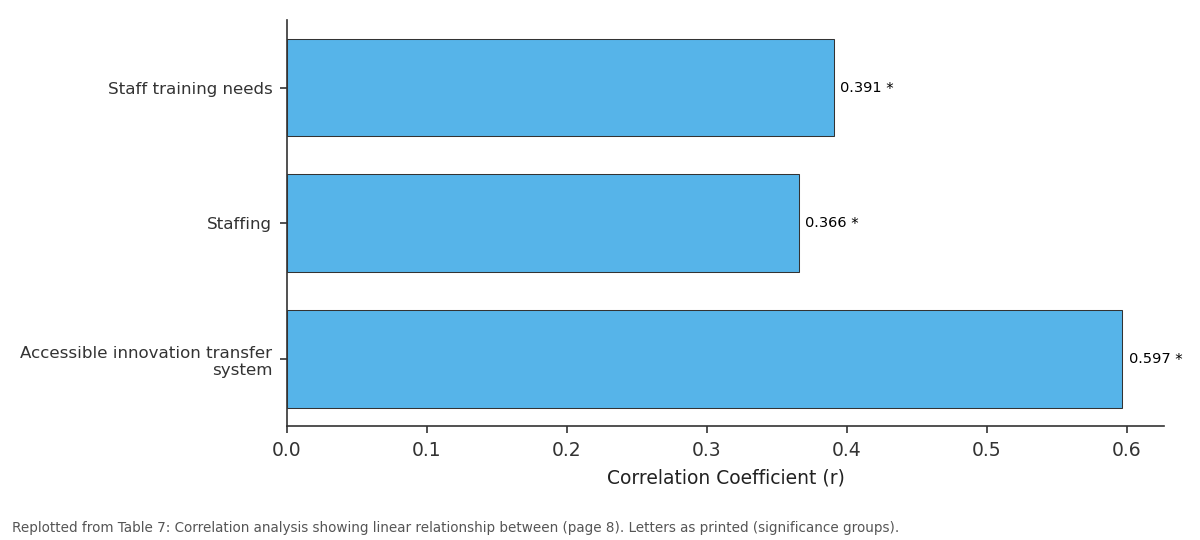
Co-efficient (r): Staff training needs vs Staffing vs Accessible innovation...
Replotted from Table 7 (page 8) of the original paper. Every bar is the paper's own table value.
View source evidence ↗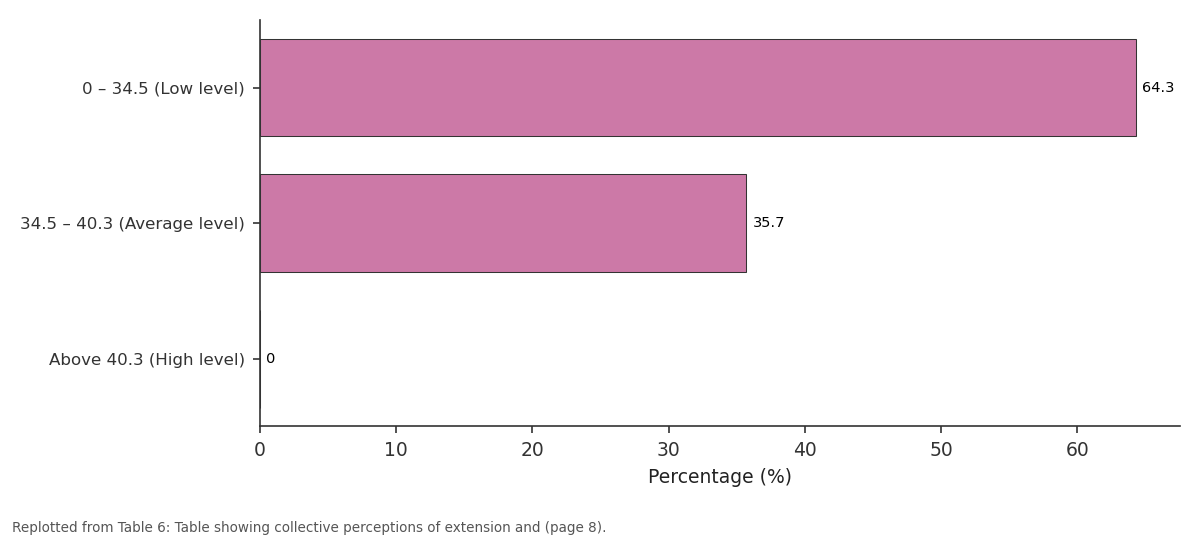
Percentage: 0 – 34.5 (Low level) vs 34.5 – 40.3 (Average... vs Above 40.3 (High level)
Replotted from Table 6 (page 8) of the original paper. Every bar is the paper's own table value.
View source evidence ↗Figures & tables
From the original paper Table 1
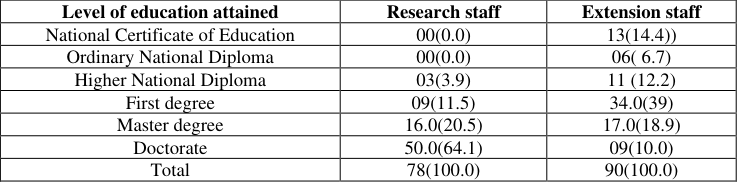 Table 2
 Table 3
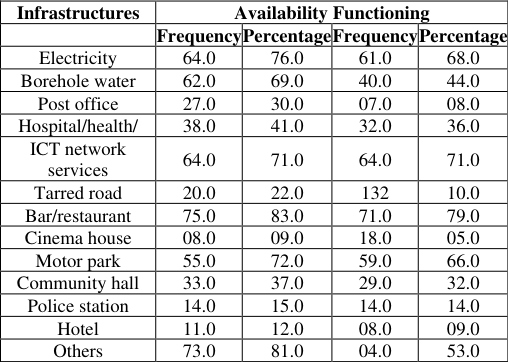 Table 4
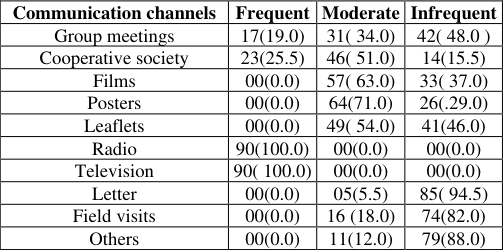 Table 5
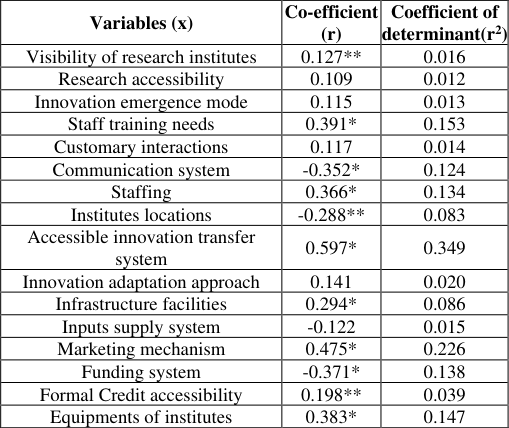 Table 7
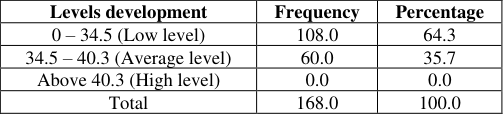 Table 6
Introduction
At pre-independent era in Nigeria, textile was an imperative source of foreign revenue. The sector was tagged largest employer of labour after government (Dike, 2019) [13] and, a core area of research activities. For growth, textile was integrated into extension programme of rural and agricultural development. Foremost objectives of this scope of extension services were to; create productive and smallscale employment, increase domestic supply of fibres to feed local industries and keep pace with rising demand for its products, and expand textile exports, toward increase in national economic development (Akinbode and Agboola, 1986) [4] . To achieve these goals along with agricultural productions, government strengthened textile extension services for fibres production and processing, to the extent of organizing standard marketing board for natural fibre production Nseobong (2017) [20] . Alao (1984) noted that, research and extension recorded success on rural and agricultural development till early 80's in Nigeria. The discovering of petroleum oil and commencement of its processing in mid 70's diverts government and its citizenry interest from farming, mostly on-far textile activities like fibres and dyes productions. Nigerian been an agrarian society with farming as the mainstay was ushered into mass unemployment because of the above occurrences. In 1983 cotton marketing board along with others farm marketing systems were proscribed by the government and every other affiliated organisations, mostly research and extension activities became partially moribund. By mid 80's, economic austerity set-in and the conception of Structural Adjustment Programme (SAP) at this period further fuelled the stringent economic crisis. By and large extension services recorded failure rather than success, and such failure was principally entrenched in the system formal institutions that formed technologies technodynamics structure. On the part of the policy-makers and administrators, importance of food technologies were exaggerated while other areas of extension are relegated to background, and the key role of labour management in the whole process of economic development was taken for granted. Such an attitude results in unrealistic programming and under effective action. Jibowo (1998) [17] specified the tasks of improving rural community through extension services as been ill -defined in direction, and content are over whelming for the agent, who then falls back on administrative duties as an excuse for not visiting the field. Government officials responsible for agricultural improvement are led to believe that no significant progress www.extensionjournal.com action can be made unless new capitals are made available, mainly from foreign sources and new inputs reclaimed through expensive projects (Alao, Agboola. and Olaniyan, 1996) [7] . For the modified extension services simple and effective action were delayed while foreign aid in form of complicated machinery's or sophisticated techniques often do not yield the expected benefits, because they are expensive and seldom appropriate for Nigeria culture (Ajila, 2011) [2] . This fact was confirmed with abandoned equipments littering extension services stations in Nigeria. It was the partial and neglect at the planning stage of most projects that had led to series of emergencies and failure in extension services, and these emergencies usually transmits to shortages. Such failure came either from bad central planning or an over ambitious programmers which allows effort on a country-wide scale with resources equal only to one thirds of the country or engages simultaneously half a dozen schemes Idachaba (1997) [16] , all of which will compete for the same administrative resources (Agbamu, 2005). Sani, et al. (2015) [24] noted that, information gathering has been inefficient, criteria of cost -effectiveness are not applied, poorer people are often neglected and information were acquired, owned and analysed mainly or only by outsider. Level of unemployment and poverty in Nigeria became unmanageably lofty in which some citizen started picking from dust-bin in late 80's. In an effort to combat these serious problems, government geared toward initiating streams of rural economic empowerment and development policies as an approach for creating job. Since then, every government succession has sustained this approach. Example of these Programme are United Nations Development Programme (UNDP), International Fund for Agricultural Development (IFAD), Agricultural Development Programmes (ADPs), Food and Agricultural Organisation (FAO), National Economic Empowerment and Developments (NEEDs), Directorate of Food, Roads and Rural Infrastructure (DIFRRI), National Orientation Agency (NOA), National Accelerated Food Production Programme (NAFPP), Green Revolution (GR), Operation Feed the Nation (OFN) and, others. These efforts had yielded little or no impact on rural population, and the gradient line for poverty unremittingly increases (Handley et al., 2009 and Gate, 2014) [15,14] . The manifestation of the global economic crisis further deepened poverty in Nigeria. Part of government efforts in responds to the International Monetary Fund recommendations on global financial crisis was revisiting and strengthened of textile innovations entrepreneurship development with the approval of special fund called Textile Upgrading Fund (TUF) in 2010. Before this period, Textile Development Fund policy was established in 1997. Again, on-farm and non-farm textile innovations including off-farm textile activities received government supports through making provisions for diverse incentives such as inputs distribution, accessible loans and trainings, refurbished and empowered ginneries among others. Importations of textile goods were banned and supported with vigorous training and campaign on all mass media toward adoption of local textile goods. Again in 2015, government launched the National, Cotton, Textile and Garment Enterprise policy and backed it up with released of fund, mostly for fibre production. Recent effort is the establishment of Textile Revival Implementation Committee (TRIC) to drive the initiative for achieving selfsufficient in cotton production and textile materials. Dike (2019) [13] identified that, the federal government mandated the Central Bank of Nigeria to make special funds available for the production of textiles and garments locally, again N19.18 billion was approved to finance nine ginneries. In 2020, central Bank of Nigeria also approved N50 billion tagged Revival Fund for Textile Industry among other special funds (The Nation, 2020) [27] . For effectiveness, every formal institutes relating to fibre production like agricultural research and extension were tasks and strengthened. Howbeit, each institute operates a unique structure for efficiency. Structure indoctrination factors are very vital in any organisation on the perspective that it controls sequences of practical steps for addressing issues. It's spelt out functions of each department or unit involved in the system or the authority vested on them. Vlad (2007) [28] noted that, when institutional support for any system is weakened, it habitually attributed to weak coordination hence; it remains fundamental instruments for effective performances in every system. If unifying integration with full purpose of holistic development is inevitable for textile technologies, there must be linkage among all the institutes and this should be an integral part of the structure that need be coordinated effectively. Integration includes formal and informal finance, administrative and information links among institutes. Formal link includes such mechanisms as coordinated plans of action, collaborative groups' task, and regular exchange of information and materials (CTB, 2020 and Stephen, 1994) [9,26] . Informal links broadly includes personal contacts between colleagues and incidental exchanges of information. Cernea (1999) [10] opined that although, cooperation across disciplinary fences is difficult, even across additional bureaucratic wall has become virtually impossible, but only the well orchestrated joint efforts of technical and social expert towards a project in the extension system can produce a harmonized effectiveness. [11] . The data generated were subjected to frequency counts and correlation analysis.
Sample selection and research instruments
Sample selection and research instruments
Measurement of variables
Operationalized variables for this study were dependent (development) and independent variables (techno-dynamics structure). The dependent variable (Y) was measured by adoption and serviceability of the introduced innovations. Respondents were subjected to opinion statement on fivepoint Likert scale; strongly Agreed (SA), Agreed (A), Undecided (U), Disagreed (D), and Strongly Disagreed (SD). The statements of opinion for this variable were tied around, adoption and serviceability indicators such as rate innovation introduction, training and knowledge adequacy, awareness, project relative advantage, benefit-returns, compatibility among others. The five points were quantified ranging from 5 to 1. Then in order to calculate the minimum T-score that represent "Agreement" for the each indicator, the mean of the T-score for Undecided and Agree (centralised point) was calculated, and any group whose Tscore was significantly equal to or higher than the minimum Tscore for Agreement was accepted, and T-score that is less than was rejected. The responses were categorised into three level of development, using the development mean score and standard deviation viz: High level of development = mean score + standard deviation. Low level of development = mean scorestandard deviation. Average level of development = any score less than or equal to high level of development, but higher than or equal to low level of development. The independent variables(X) were measured by cultural-systematic factors, and socio-economic characteristics of the techno-dynamic structure. For example variables reviewed under the culturalsystematic factors include visibility of research system, accessible technologies transfer system, customary interaction, innovation emergence approach, staff training needs and others. Also, credit and marketing system, including inputs supplies, functional infrastructure facilities, funding among others were used in measuring socioeconomic characteristics of the techno-dynamics structure.
Data analysis
Descriptive statistical techniques such as frequency, percentages, mean and standard deviation were used to describe and summarized the collected data. Correlation analysis was applied in detecting the relationship between development and techno-dynamics structure of on-farm textile innovation.
Results and Discussions 3.1 Cultural-systematic factor of techno-dynamics structure:
Procedures for superior technologies generation and transfer approach directed at solving problems encounter by farmers was examined under this factor:
Visibility of research institutes
Findings on visibility of research institutes for on-farm textile innovations revealed that, there was no autonomous agricultural research institutes located in the studied area. www.extensionjournal.com All (100%) the researchers specified there are agricultural research activities that were based and directed by university. Research activities in agriculture often take place outside the State and coordinated by Agricultural Research Institutes of Southwest region of Nigeria. In support of Oladimeji (2006) [23] programmes seated in the selected institutes. Thorough examination shows that, there were justifiable but very few on-going researches work in on-farm textile innovation mainly on fibers and rubber production. Most Federal and State Universities in the region also had diminutive researches and extension works in on-farm-textile innovations. It shows that there were established and functional research institutes for on-farm textile innovations but located outside the area.
Research accessibility, and innovations emergence mode
Diagnostic survey and prescriptive procedural approach for on-farm textile innovations was viewed from the researchers' perspectives. There were experimental stations for on-farm textile activities in the State but barely functional (100%). This was attached to lack of funding, researchers' proximity, in-security and other logistic supports. In accordance with Alao (1997) [8] , 82.6 percent attested that research results from most institutes were ingrained on journal publication for staff promotion assessments and, often not made available for public application or extension programme. Finding revealed personal interactions between research staff but no cordial alliance within and across related scientific disciplines (73%). Apart from the fact that, each staff seek and enjoyed personal recognition and rewards (100%), departmental security was given more premium (64%) hence, concealed research findings and knowledge from others and public. Procedure for research running toward emergence of technologies was examined. Findings specified that research staff (100%) were involved in problems identification, onstation research (OFR), and technologies evaluation for certain projects in their institutes but not for on-farm textile. While the introduced on-farm textile innovation emerged from problem identification and definition by external bodies outside Research Institutes of the region (97%), none of the Scientists participated in the innovation generation and prioritizing for multi-locational trials or multiplications. Most recent superior generic on-textile species were generated by agencies like Mahyco Nigeria Private Limited, Institute of Agricultural Research (IAR) in Ahmadu Bello University, Zaria and others. It was revealed that, the National Agricultural Extension and Research Liaison Services (NAERLS) in the region was occasionally involved in the innovation diffusion. This is an indication that, research running for emergence of on-farm textiles superior varieties were born outside the environment hence, the introduced innovation was not farmers or community based problems oriented. Research should come closer to farmer's field through extension organization for efficient problem identification including Monitoring and Evaluation (M&E) FMARD (2019). Feedback from M&E will aid in developing solutions befitting local situations.
Training needs and customary interactions
Training needs for effective and efficient staff performances in agricultural research and extension institutes were reviewed. Thorough study into research institutes highlighted training (on-job and off'-thejob) opportunities within and outside the nation for researchers. All have enjoyed these opportunities but its actualization frequency was rated average (100%) which was due to tight administrative bureaucracies. Research staff habitually accessed in-service trainings through local and international conferences, seminars, and workshops. Mean values of international conferences attended within years under review was 4 + 1, and 9 + 2 for local workshops/seminars. The researchers often tour outside their domain in connection with job specification and performance hence, they are externally oriented relating to the job. It was specified that the studied research institutes do organized workshops and seminars on a regular basis with an average attendants within and outside the country. Again, sixty six percent of the researchers were often not attending Monthly Technical Review Meetings (MTRMs) but, 69.5 percent regularly attends annual technical review meetings. Apart from the fact that 89.1 percent was of the opinion that MTRMs had become less important and inconsistence due to unvarying repetitions of same issues, as well as poor financial supports, 51.0 percent also attached the absenteeism to in-efficient time. Extension and inputs agencies attendance was confirmed as higher and steadfast at such meeting. All (100%) the selected researchers had constant visits to other research institutes but, with an average of 1.5 visits on the introduced innovation. In supports of Adesoji and Aratunde (2012) [1] , interaction between research and extension staff as well as inputs suppliers take place mostly at conferences (96%). Eighty nine percent disagreed that there were interactions between researchers and inputs providers but explained that, inputs dealers relates more directly with the farmers. This might connote customary lag between institutes hence, no interactions. In-depth analysis of training needs for extension staff development revealed that there were provisions for shortterm trainings (on-job and off-the-job) within and outside the nation and, were opened to all staff. The staff claimed that such provisions are not often accessible due to underfunding, political manoeuvrings, and tight administrative bureaucracies. Fifty nine percent identified such opportunities as repeatedly circulates at the agency higher echelon. However, all (100%) the studied extension staff have contacted induction and in-service training through workshops, seminars, and conferences. Little above average (54%) was qualified for the assigned job in the www.extensionjournal.com agency and 46.0 percent were not. This was adjudged based on the respondent's trainings background. The extension staff had an average value of 7 + 1 for local seminars attendance and, seventeen percent had attended between 1-2 international seminars outside the country. Extension regularly organized in-house workshops, trainings and seminars that were made mandatory to all staff, and attendants are often reasonable. While 93.0 percent identified intermittent academic interaction between research and extension, 12.0 percent had an average conferences and workshops attendance with researchers. Fifty one percent frequently attends the Monthly Technical Review Meetings and 49.0 percent was seldom. The statutory monthly and fortnightly interactive sessions were not constants. Just 26.0 percent of the staff regularly attends annual national thematic workshops for rural and agricultural development. Research and extension in the studied area were not practicing staff-rotation or exchange which is another method of interactive training. The study identified the extension staff (83%) to have moderately attended group meetings with farmers and, all (100%) frequently travelled within their job administrative area. While 85.3 percent had moderate visits to other LGAs within the State, 51.0 percent had reasonable visits to other States of Nigeria and, 17.0 percent had visited other nation of the world. Staff trips are repeatedly connected with job specification and performance.
Staffing, equipments and, locations of institutes
Resources for job performances in research and extension institutes were examined. According to finding, both institutes were inadequately staffed and equipped but research has more staff and equipments than extension (100%). Most available equipments are obsolete with more of such been housed at extension agency. Research engaged more academically qualified staff than extension in which less than average (46%) of the extension staff' have basic training in agriculture and, 54.0 percent do not. The above claimed was adjudged based on staff level of education and trainings background as presented in table 2 Extension housed more locally trained personnel's than research, and staff of both institutes lack basics specialty training in textile subject matter contents. This implied that research and extension lack knowledge in on-farm textile subject content. To teach skills, training should be a balance mix of theory and field practice, and trainers must have good understanding of the subject contents. Extension workers would confidently explain new practice to farmers only if he can demonstrate it clearly. Without this ability, agents cannot maintain credibility with beneficiaries. Findings identified research and extension as been located at far distance away from each other. Most research institutes were located in core metropolis mostly the State headquarters with its staff domiciled in this same area. While extension head office was seated at the State capital and its fields training centres were housed within each of the LGA's main office. Most LGA's offices were located at the pheri-urban area, where 89.0 percent of its staff domiciled. This is an indication that the innovation generation and transfer system workforces domiciled outside the targeted beneficiaries environment. In accordance with Cernea (1999) [10] , this finding identified that the research institutes workers are better paid and exposed to several local and internal benefits than the extension staff.
| Level of education attained | Research staff | Extension staff |
|---|---|---|
| National Certificate of Education | 00(0.0) | 13(14.4)) |
| Ordinary National Diploma | 00(0.0) | 06( 6.7) |
| Higher National Diploma | 03(3.9) | 11 (12.2) |
| First degree | 09(11.5) | 34.0(39) |
| Master degree | 16.0(20.5) | 17.0(18.9) |
| Doctorate | 50.0(64.1) | 09(10.0) |
| Total | 78(100.0) | 90(100.0) |
Table text extracted from the original PDF; superscript letters are shown inline. The original table image is below.
View original table image
Accessibility of innovation transfer system and, innovations adaptation approach
The mechanism for innovations transfer to farmers was examined from extension staff perspectives. Finding shows that, there were functional public agricultural innovation transfer institutes in the studied area that were involved in general agricultural programme and dissemination. Apart from activities of the Agricultural Development Programmes (ADP's) of the Ministry of Agriculture, there were Federal (1) and State (1) Universities with Faculties of Agriculture running extension training programme. The respondents (100%) specified that, these Universities dwells more on research than extension activities. The ADP's agency hardly had interaction with these higher academic institutes. Some Non-governmental organisations involvement in innovation transferred in the studied area were also identified. Adaptation approach which represents practices on managing innovation good-fit to a locality was examined. Packages of the introduced innovations were as indicated in the Table 3. In-depth analysis revealed extension staff (100%) as not been involved at the planning phase except at the execution of the project. While 94.8 percent were not involved in problem identification and definition for descriptive and diagnostic survey that produced the innovations, neither were they involved in prioritizing and technologies evaluation for multi-locational trials. This is in accordance with Ajila and Farinde (2015). Seventy five percent of the extension staff were not involved in joint field day and report writing with the researchers on the innovation. About 35.0 percent had an average of 2 visits to on -stations relating toon-farm textile innovation. Majority (79%) participated in on-farm adaptive research (OFAR), 83.0 percent on Fortnightly Training session (FNTs) and, 67.0 percent in Small Plot Adoption Trials (SPATs).
| Subsets | Strata | Packages |
|---|---|---|
| On-farm | Plant fibre | Latex, plant fibre (cotton, coir, kenaf, jute, hemp, etc), cane/rattan, dyes and others. |
| On-farm | Animal fibre | Skin and hide production, protein fibre (silk, fur and wool) and others. |
Table text extracted from the original PDF; superscript letters are shown inline. The original table image is below.
View original table image
Socio-economic characteristics:
The following supportive facilities for the structure were assessed
Inputs and marketing mechanism
Thorough investigation to availability and affordability of inputs for the innovation revealed all (100%) extension and research staff to have disagreed that inputs are constantly supplied, available where and when needed. They also disagreed that inputs are adequately enough whenever they are available and supply is in high rate respectively. Identified major types of inputs supplies to farmers were seeds, fertilizers, herbicides, pesticides, cutlass, hoes and spraying machines. Inputs distribution seldom takes place at LGA's offices but, all (100%) staff identified government through political parties and some ad-hoc teams as directly involved in distributing inputs. While the extension agency focused mainly on given advisory and technical services to farmers, inputs from government were often sold at subsidized price. Direct involvement of government in distributing inputs and identification of problem are breach of statutory rules for appropriate innovation emergence and transfer. Finding revealed that marketing mechanism center for introduced innovation was located outside the State. Produce Liaison Office (PLO) was created at each LGA's head office where farmers deposit produces awaiting buyers. Buyers 'visits were neither fixed nor constant. Howbeit, whenever produce arrived PLO, it was been weighed, and officer in charge keeps record on behalf of the marketing agent who complete the transaction on arrival through e-payment. It shows that there was a steady and standard marketing scheme for on-farm textile produces, but farmers were not involved in determining prices. Dissonances in this marketing system include farmers' subjection to long waiting period for buyers and, must abide with any given price.
Funding and credit supply
In-depth examination on funding and credit supply for the innovation identified public extension agency as been sponsored by the three tier of government in Nigeria (Federal, State and Local), while research were solely sponsored by Federal government. Budgets prescriptions for extension activities were always rigid and allocations were neither adequate nor received on time but, budget prescription and allocation for research were moderately flexible and adequate with little delay. However, no allocation was released on on-farm textile innovation to research and extension agency, neither are there external bodies for its sponsorship under the reviewed years. Persistently, on-farm textile produce have a fixed price nationwide depend on the grade. In support of NEEDS (2015), research and extension staff disclosed that government have recently removed all form of tax payment on farmers produces Examination of credit supply system to support farmers on introduced innovation showed the extension to have regularly formed cooperative societies and, encouraged farmers to join. They expressed that farmers are easily reached through cooperative groups for information and trainings. According to finding, there was formal credit facilities made available and beneficiaries were introduced to these facilities through cooperative system. Record shows that 21.4 percent of the farmers who registered with the cooperative societies are able to accessed credit but, 78.6 percent were denied. The denial was based on following factors; administrative bureaucracies, inability to meet the system requirements, and political manoeuvring. It was identified that those who regularly benefit from such credit were not farmers. Analysis revealed credit suppliers as constantly function independent of either extension or research agencies even on information toward identification of stipulated members. This implied no operational interaction between credit supply and other related institutes for the introduced innovations. Supplies must be made available if improved practices were to be adopted (Akinnagbe and Adonu, 2014) [5] . Political, nepotism, roles usurp and, mismanagements are major highlighted hindrances to on-farm textile innovation development in the State. Other challenges include lack of adequate improved seeds and credit supplies to farmers.
Infrastructure facilities
Finding revealed that research have functional and well maintained but insufficient project vehicles than extension. Research staff (93%) has moderate access to project vehicles, while 71.0 percent of extension workers seldom does. Most available vehicles for extension projects are repeatedly not in good condition and hardly functional due to poor maintenance. Transportation is an integral part of extension activities for trainings and visiting farmers. Due to insufficient projects vehicles, extension staff (100%) visits to beneficiaries' communities were often made through public transports, and the most accessible means of transportation was motor cycles with high charges. While research have an averagely comfortable and furnished office for staff (89%), 51.0 percent of extension staff has no personal office. Among 49.1 percent of extension workers that possessed personal office, such offices are not well furnished and, most equipments were outdated and bad. Studied extension and research institutes have accesses to electricity and ICT (Information and Communication Technologies) network. Most offices in research institute were provided with ICT gadgets (such as computer, and internet devices), while 26.0 percent of the extension offices were provides with such gadgets. Extension staff over and over again accessed ICT network through personal cellular phone for most official assignments, because of www.extensionjournal.com inconsistence electricity supplied. Beneficiaries' farms sites represent work field for extension agency. While most (89%) farm locations were not motorable, only 11.0 percent did. Eighty seven percent of research staff enjoyed good and motorable road to the office. It was revealed that, extension (86%) has access to larger land hold than research (77%), but the available research landhold was sufficient for targeted experimental works. Data in Table 3 shows infrastructures available at extension work field. Good roads and electricity would enhance good communication network, and ensure quick and efficient accessibility of an environment
Communicating system
Communication channels accessible to research and extension were examined. Major identified information channels accessible to research for inter and intracommunication are internets, journals, newsletters/bulletins, phones and, films/CD (100%) respectively. The used of any of this channel was based on good fit to recipients' environment. Accessible channels to extension are meetings, visits, radio, television, film, posters, pamphlets, phones and letters. Accessibility and usage rate of these channels differs in the extension and was as presented in Table 4. Channels commonly used for internal communication in extension were meetings, phones and letters (100%) respectively. Information communicating system in the studied research and extension agencies was top-bottom and partially opened. Major and common channels of disseminating information to farmers often used by extension in Ondo State were radio and television (100%) respectively, and somewhat leaflets, posters and film shots. The mean value of television technical advisory services given on the introduced innovation was 17+ 1.5. The mean value of radio technical messages given was 34+2.1. Beneficiaries ought to be contacting the innovation in every week through mass media and meetings, but this became somewhat impossible due to other innovations that compete for same inadequate resources in the agency. Rate of field visits made by staff was low. The average number of field visits made on the innovation was 8 + 0.6 out of expected 72 statutory visits within the reviewed years. During discussion it was revealed that most visits made were limited to nearby farmers in the pheri-urban. Group meetings and cooperative societies were seldom used. Odewumi and Okunade (2016) [21] identified face-face and visual communication aids as most effective communication system in informal education. From this finding, there are indications that farmers have no personal contact with staff of extension and researchers for participatory training in the introduced innovation. This was again attached to wide areas with few available staff to cover by means of little logistic supports. Defects of the identified cosmopolitans or formal channels (radio, television and, prints) include deprivation of beneficiaries opportunities to clarify information or ask question towards good interpretations and understandings, because such channel's inbuilt simply support one-way communicating approach. Fifty seven percent of the extension staff claimed to have listened and received information from farmers, which had led to remedial changes in some aspects of the introduced innovation. General acceptable language of Ondo State is Yoruba. All (100 %) extension staff were fluent in speaking Yoruba language, only 42.0 percent of the researchers can speak the language glibly. It was revealed that the studied society have multiple language indexes and intonation that were difficult to understand. Languages generally represent a vital instrument in teaching and learning process. It aids interpretation and understanding of messages. Since, the field staff could speak the general language of the farmers; these make interpretations of communicated information easier.
| Infrastructures | Availability Functioning | — | — | — |
|---|---|---|---|---|
| Frequency | Percentage | Frequency | Percentage | |
| Electricity | 64.0 | 76.0 | 61.0 | 68.0 |
| Borehole water | 62.0 | 69.0 | 40.0 | 44.0 |
| Post office | 27.0 | 30.0 | 07.0 | 08.0 |
| Hospital/health/ | 38.0 | 41.0 | 32.0 | 36.0 |
| ICT network services | 64.0 | 71.0 | 64.0 | 71.0 |
| Tarred road | 20.0 | 22.0 | 132 | 10.0 |
| Bar/restaurant | 75.0 | 83.0 | 71.0 | 79.0 |
| Cinema house | 08.0 | 09.0 | 18.0 | 05.0 |
| Motor park | 55.0 | 72.0 | 59.0 | 66.0 |
| Community hall | 33.0 | 37.0 | 29.0 | 32.0 |
| Police station | 14.0 | 15.0 | 14.0 | 14.0 |
| Hotel | 11.0 | 12.0 | 08.0 | 09.0 |
| Others | 73.0 | 81.0 | 04.0 | 53.0 |
Table text extracted from the original PDF; superscript letters are shown inline. The original table image is below.
View original table image
Development of on-farm textile innovations 3.3.1 Adoption
Analysis identified the rate at which innovation was been introduced to the beneficiaries in Ondo State as low (100%). According to available records expected average number of specialize subject matter to be introduced within years under reviewed was ≥16. The average introduced was 3.2 +0.6. More than average (60%) of the rural residents were aware, but few (8%) showed interest and tried the innovation. At the ends less than 5.0 percent were users of the innovation. These adopters majored in other economics activities, at the same time they are members of textile producer association. The average fibre yield was 950kg/hectare as against expected 4.5 ton/hectare (approximate) and 2,193kg/hectare of latex as against not less than 4,500kg /hectare. Adoption of the introduced innovation was low (100%) in the State.
Serviceability
Fitness and influence of the introduced innovation on beneficiaries' communities and psychosocial ethics was studied. The on-farm textile farmers (100%) rated serviceability of the innovation as low. This rating viewed socio-technical profiles and benefits-return of the innovation. The respondents signified that improved genetically modified textile technologies such as, Bt cotton with superior farming system over the existing ones were introduced. Knowledge and skills gained by respondents (82%) over the existing textile activities was low as indicated. The farmers' rated project profitreturns value as low and, ability to start and operate on a small scale capacity as average. The accessibility aptitude of the innovation was low. Ninety six percent rated the innovation time-efficient aptitude and complexity values as average respectively. The innovation displayed an average landefficient capacity with moderate yield per hectare over the existing one. The innovation compatibility value to the environment was average, but farmers were not satisfied with the innovation dissemination approach. This was due to inadequacies of technical skills in handling the innovations by farmers and poor accessibility of inputs and credit system. Result indicated the mean values of development limits for on -farm textile innovation as 37.4, with standard deviation of 2.9. Table 6 shows that, 64 .3 percent of the respondents had development limit between 0 and 31.2 (Low level) and, 35.7 percent had development limit between 31.2.and 43.0. (Average level). This implies that the level of on-farm textile innovation development in Ondo State was low.
| Levels development | Frequency | Percentage |
|---|---|---|
| 0 – 34.5 (Low level) | 108.0 | 64.3 |
| 34.5 – 40.3 (Average level) | 60.0 | 35.7 |
| Above 40.3 (High level) | 0.0 | 0.0 |
| Total | 168.0 | 100.0 |
Table text extracted from the original PDF; superscript letters are shown inline. The original table image is below.
View original table image
Results of Correlation Analysis
In other to examine relationship between techno-dynamics structure of on-farm textile innovation and its development, the data was subjected to correlation analysis. Result in Table 6 showed relationship at p<0. 01 and p<0.05 level of significant between development of on-farm textile innovation and cultural-systematic variables [Staff training needs (r= 0.391*), Staffing (r = 0.366*), accessible innovation transfer system (r = -0.597*)]: Socio-economic characteristics [communication system (r = 0.352*), Infrastructure facilities (r = 0.294*), Funding system (r= -0.371*), accessible marketing mechanism (r=0.475*)]. Research accessibility, customary interaction credit accessibility, and innovation emergence and adaptation mode show positive but not significant relationship with development. This might be attached to the fact that principles which sustained these variables operations are mismanaged. Positive correlation simply means that the more the magnitude of variation in these factors, the higher the development. The coefficient of determination (r 2 ) explained of variation in the development of the innovation, which was attributed to each of the technodynamics structure related variables analyzed.
Conclusions and Recommendations
From the above findings it could be concluded that development of on-farm textile innovation in Ondo State was low and its techno-dynamics structure experienced customary lag. The following variables were identified to have strong influence on development viz as: accessible innovation transfer system, infrastructure facilities, marketing mechanism, institutes equipments, staff training needs and staffing. Research staff have access to better staff hygienic factors including foreign benefits than their counterpart in the extension institute. For effective agricultural development, research and extension staff need not only be aware of new technologies, but must participate Kolawole and Torimiro (2005) [18] in the technology emergence, evaluation, and adaptation. Since extension staff are working directly with farmers, they should be supported by researchers mostly SMSs when offering advice on most technological problems and in turn be able to advise researchers on problems faced by farmers. The experienced customary lag between related institutes made these impossible hence low developments. It is therefore suggested that, government should strengthen and monitor good research-extension interaction including others supportive institutes. Established policies on technologies emergence, adaptation and transfer should be preserved without interference for any political reasons. Adequate equipments and funding provision should be made accessible for research and extension work. Effective public marketing board with human face needs to be established and, extension agency should be backed up with adequate functioning infrastructures.
Figures and tables from the paper
| Zones | Blocks (LGA’s) |
|---|---|
| Owo | Ifelodun, Akure North, Akure South, Owo, Ose, Akoko South-East, Akoko South -West, Akoko North- East, Akoko North-West, |
| Ondo | Ikale, Ifedore, Idanre, Ile-Oluji/Oke-Igbo, Odigbo, Irele, Ilaje/Eseodo. Bolorunduro, Okitipupa. |
Table text extracted from the original PDF; superscript letters are shown inline. The original table image is below.
View original table image
| Communication channels | Frequent | Moderate | Infrequent |
|---|---|---|---|
| Group meetings | 17(19.0) | 31( 34.0) | 42( 48.0 ) |
| Cooperative society | 23(25.5) | 46( 51.0) | 14(15.5) |
| Films | 00(0.0) | 57( 63.0) | 33( 37.0) |
| Posters | 00(0.0) | 64(71.0) | 26(.29.0) |
| Leaflets | 00(0.0) | 49( 54.0) | 41(46.0) |
| Radio | 90(100.0) | 00(0.0) | 00(0.0) |
| Television | 90( 100.0) | 00(0.0) | 00(0.0) |
| Letter | 00(0.0) | 05(5.5) | 85( 94.5) |
| Field visits | 00(0.0) | 16 (18.0) | 74(82.0) |
| Others | 00(0.0) | 11(12.0) | 79(88.0) |
Table text extracted from the original PDF; superscript letters are shown inline. The original table image is below.
View original table image
| Variables (x) | Co-efficient (r) | Coefficient of determinant(r2) |
|---|---|---|
| Visibility of research institutes | 0.127** | 0.016 |
| Research accessibility | 0.109 | 0.012 |
| Innovation emergence mode | 0.115 | 0.013 |
| Staff training needs | 0.391* | 0.153 |
| Customary interactions | 0.117 | 0.014 |
| Communication system | -0.352* | 0.124 |
| Staffing | 0.366* | 0.134 |
| Institutes locations | -0.288** | 0.083 |
| Accessible innovation transfer system | 0.597* | 0.349 |
| Innovation adaptation approach | 0.141 | 0.020 |
| Infrastructure facilities | 0.294* | 0.086 |
| Inputs supply system | -0.122 | 0.015 |
| Marketing mechanism | 0.475* | 0.226 |
| Funding system | -0.371* | 0.138 |
| Formal Credit accessibility | 0.198** | 0.039 |
| Equipments of institutes | 0.383* | 0.147 |
Table text extracted from the original PDF; superscript letters are shown inline. The original table image is below.
View original table image
References
28 in the original paper- Adesoji SA, Aratunde Tunde. Evaluation of the linkage system of Research Extension-Farmers in Oyo: Lesson for Agricultural Extension Administrators. Journal of Agricultural Extension and Rural Development 2012;4(20):561-568.
- Ajila KO. An Evaluation of Effectiveness of Textile Extension Services in Ondo State of Nigeria. Unpublished Ph. D Thesis. Obafemi Awolowo University, Nigeria 2011, 96.
- Ajila KO, Farinde AJ. Knowledge and Skill Practices in Systemic Programming for Textile Extension Services of Agricultural Development Journal of Agricultural and Rural D evelopment 2012;10:96-101. Swaziland.
- Akinbode IA, Agboola TO. The Effectiveness of Project Performance Budgeting System in Agricultural Development Management. Ife Journal of Agriculture 1986;1(2):81-100.
- Akinnagbe Oluwole Mathew, Adonu Anthony Uchechukwu. Rural Farmers Sources and Use of Credit in Nsukka Local Government Area of Enugu State, Nigeria. Asia Journal of Agriculture Research 2014;8(4):195-203.
- Alao JA. Agricultural Extension Services: Efficiency and Effectiveness. Report of Strategies for the Fifth National Development Plan 1986-1990-1996, 18-27.
- Alao JA, Agboola AF, Olaniyan OF. Determinants of Appropriate Technologies for Sustainable and Development. Journal of Nigeria Rural Sociology Association of Nigeria 1996;12(9):61-68
- Alao JA. Role and Requisitions of Technology in Transforming Traditional Agriculture. Journal of Rural Development and Regional Planning. Nigeria 1997;8(2):13-19.
- CBT. Community Box Tool 2020. https://ctb.ku.edu/en/table-of-content/improvingServices.
- Cernea MM. Farmer Organizations and Institution Building for Sustainable Development. Regional Development Dialogue 1999;8(2):181-182.
- Daneji MI. Agricultural Development Intervention Programmes in Nigeria (1960 to Date): A Review. Savannah Journal of Agriculture 2011;6(1):98-113.
- Dare Ojo Omonijo, Sunday Oluwadare Wright Toluwalase, Oluwamuyiwa Akinrele Oludayo, Onyekwere Oliver Chizaran Uche. Impact of Agricultural Development Programme (ADP) on Rural Dwellers in Nigeria: A Study of Isan-Ekiti. International Research Journal of Finance and Economics 2011, 128(2014). https://.www.internationalresearchjournaloffinanceande conomics.com.
- Dike Onwuamaeze. Efforts by the Federal Government and Central Bank of Nigeria to Revive the Textile and Garment Sector 2019. https://www.thisdaylive.com.
- Gate B. Agricultural Development Strategy Overview. Annual Letter 2014. www.gatesfoundation.org/WhatWeDwww.gatesoundati ono/GlobalDevelopment/AgriculturalDevelopment
- Handley G, Higgins K, Sharma B, Bird K, Cammack D. Poverty and Poverty Reduction in Sub-Saharan Africa: An Overview of Key Issues. London: Overseas Development Institute 2009.
- Idachaba FS. Instability of National Agricultural Research Systems in Sub-Shara African. Lessons from Nigeria. International Services for National Agricultural Research Report 1997;9(13):91-106.
- Jibowo AA. Andagogigal Transmission: The Secret of National Food Surplus. Inaugural Lecture Series 96. Obafemi Awolowo University, University Press Limited. Ile Ife 1989, 2-4.
- Kolawole OD, Torimiro DO. Participatory Entrepreneurship Development for Grassroots Transformation: A factor Analysis. Journal of Human Ecology 2005;18(3):192-198.
- Needs. National Economic Empowerment and Development Strategies Report XIV. National Planning Commission Periodical, Nigeria 2005, 2(166.).
- Nseobong Ekong Nkango. The Role of Marketing Board in Nigeria, 1974-86: Development or Exploitation. Journal of Economic History 2017;11(2014):156-169.
- Odewumi II, Okunade EO. Influence of Socioeconomic Characteristics in Participation in Fadama II project in Ekiti Local Government Area of Kwara State, Nigeria. Journal of Rural Sociology 2016;16(1):34-42.
- Odsadep. Ondo State Agricultural Development Project. Annual Reports. Akure. Ondo State 2012.
- Oladimeji Idowu Oladele, Jun-Ichi sakagami, Kazunobu Toriyama. Research -Extension-Farmers Linkages System in Sourthwestern Nigeria. Journal of Food, Agriculture and Environment 2006;l4(1):197200.
- Sani BM, Omenessa Z, Sambo I, Abdullah J, Yuguda M. Effect of Agricultural Information Delivery Approach on Far ming: Access to Agricultural Information in Nigeria. Journal of Agricultural and Food Information 2015;16:72-79.
- Sarah Huber, Kritin Davis, Karin Lion. Nigeria: Indepth Assessment of Extension and Advisory Services. Developing Local Extension Capacity Project. USAID Cooperative Agreement. No. AID-OAA-L-16-0002 2017.
- Stephen Waters-Adams. Collaboration and Action Research: A Cautionary Tale. Educational Action Research 1994;2(2):195-210. https://doi.org/10.1080/0965079940020205
- The Nation https://thenationline.ng.net/cbn-approvesn50b-revival-fund-for-textile-industry 2020.
- Vlad Mykhnenko. Strengths and Weaknesses of Weak Coordination: Economic Institutions, Revealed Comparative Advantages and Socio-Economic Performance of Mixed Market Economies in Poland and Ukraine. OUP066-Hancke, Delhi 2007, 351-378. https://www.ifa.org/documents/38714170/39135645/str engthening