
Research article · 2021 · Full text
International Journal of Agriculture Extension and Social DevelopmentRural livelihood activities/services performed by community based women organization (CBWOs) in Imo and rivers states, Nigeria
Volume 4(1) · Pages 06–09 · DOI: 10.33545/26180723.2021.v4.i1a.63 ↗
Research areasAgricultural Innovations and PracticesRangeland Management and Livestock EcologyMicrofinance and Financial Inclusion
Abstract
Author-writtenThe study was undertaken to identify rural livelihood services/activities carried out by CBWOs in Imo and Rivers States. 240 CBWOs were used for the study. The major livelihood services performed by CBWOs in Imo state were women advocacy (97.6%), weeding (97.6%), visitation to fellow members (96.8%), earth movement (erosion control) (95.2%), attendance at meeting (95.2%), sweeping (93.6%), Agro-processing (93.6%), Publicity (92.8%), loading of working materials (92.0%) and water fetching (90.4%). In Rivers state CBWOs who played active and effective roles in supporting women advocacy (100%), weeding (100%), visitation to members (100%), agro-processing (92.5%) and earth movement (96.7%). The overall performance of the livelihood services were in agricultural and rural development projects. This means that improving lives of members and others is a major thrust of CBWOs.
Summary
Source-checkedPlain-language reading of the full paper, prepared with AI and checked against the text. Each point links to the authors' own words.
Why it matters
- Rural communities in developing nations are often identified as the most neglected areas. View evidence ↗
- In Nigeria, women are critical to food security, producing between 60% and 80% of household food. View evidence ↗
- Women's organizations serve as essential forums for addressing concerns, organizing communal work, and seeking financial assistance. View evidence ↗
The question
- The study aimed to identify the rural livelihood roles performed by Community-Based Women Organizations (CBWOs) in Imo and Rivers States, Nigeria. View evidence ↗
What they did
- The research was conducted across Imo and Rivers States in Nigeria. View evidence ↗
- The study utilized a sample of 240 community-based organizations, with 240 questionnaires distributed. View evidence ↗
- A two-stage random sampling technique was used to select local government areas and then specific women organizations. View evidence ↗
- Data collection involved structured questionnaires and interview schedules, which were analyzed using percentages and frequency tables. View evidence ↗
What they found
- In Imo State, CBWOs were highly active in women advocacy (97.6%), weeding (97.6%), member visitation (96.8%), erosion control (95.2%), and meeting attendance (95.2%). View evidence ↗
- In Rivers State, CBWOs showed maximum activity (100%) in women advocacy, weeding, and member visitation, as well as high activity in earth movement (96.7%) and agro-processing (92.5%). View evidence ↗
- CBWOs in Imo State played a moderate role in activities such as digging drainage (69.6%), offloading materials (65.6%), planting (64.8%), clearing (60%), and healthcare provision (60%). View evidence ↗
- Overall, 82% of the active services provided by the groups were focused on agricultural and developmental projects. View evidence ↗
What it means
- The authors conclude that the role of women in the agricultural development process is fundamental to the development of rural areas. View evidence ↗
- The primary purpose of these organizations is to unite women to improve their socio-economic status and contribute to the development of their communities. View evidence ↗
Visual summary
3 visualsIllustrations explain the paper; charts are replotted from the paper's own table values.
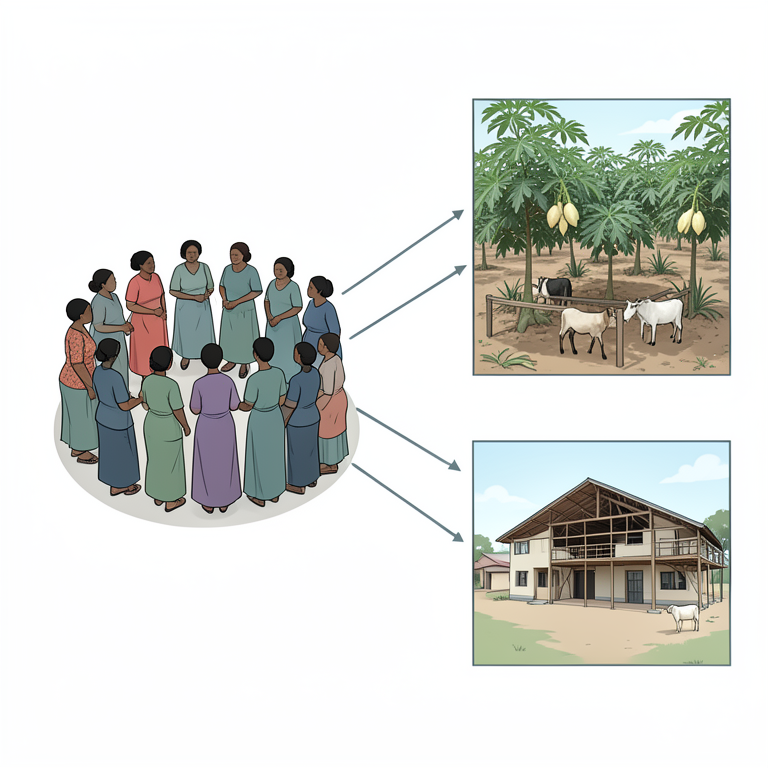
CBWO Livelihood Focus
AI-generated conceptual illustration (Rural Nigerian women in a village setting). It explains the idea and does not show study data.
View source evidence ↗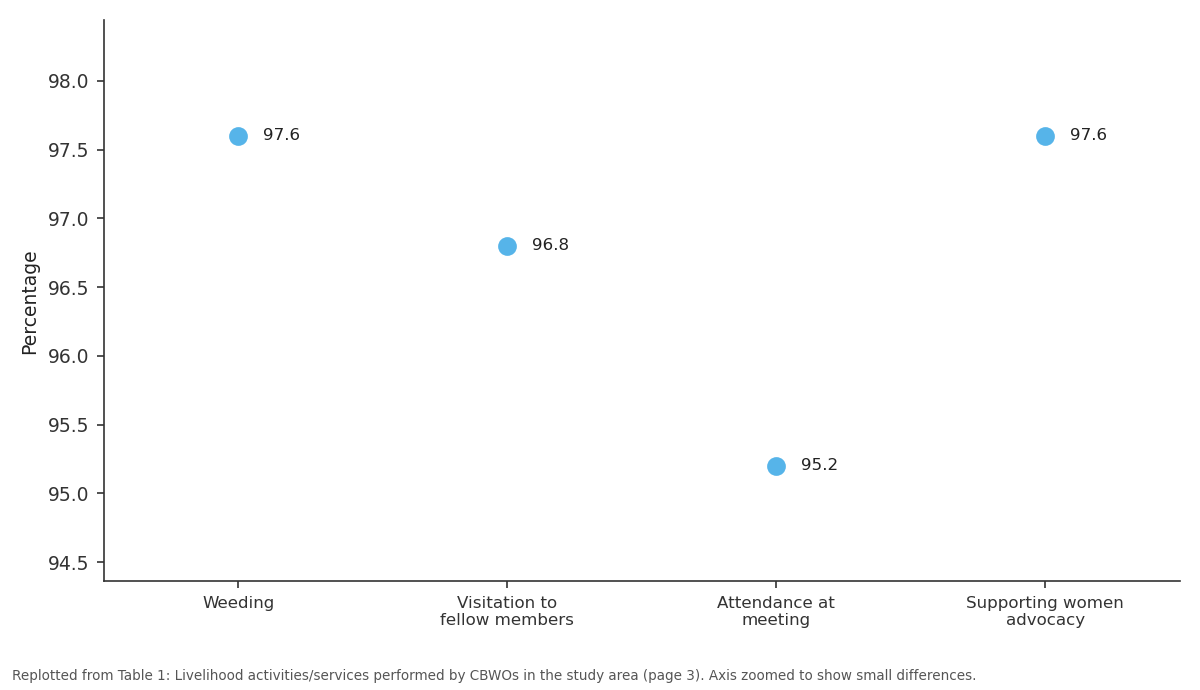
Percentage: Weeding vs Visitation to fellow... vs Attendance at meeting vs Supporting women...
Replotted from Table 1 (page 3) of the original paper. Every bar is the paper's own table value.
View source evidence ↗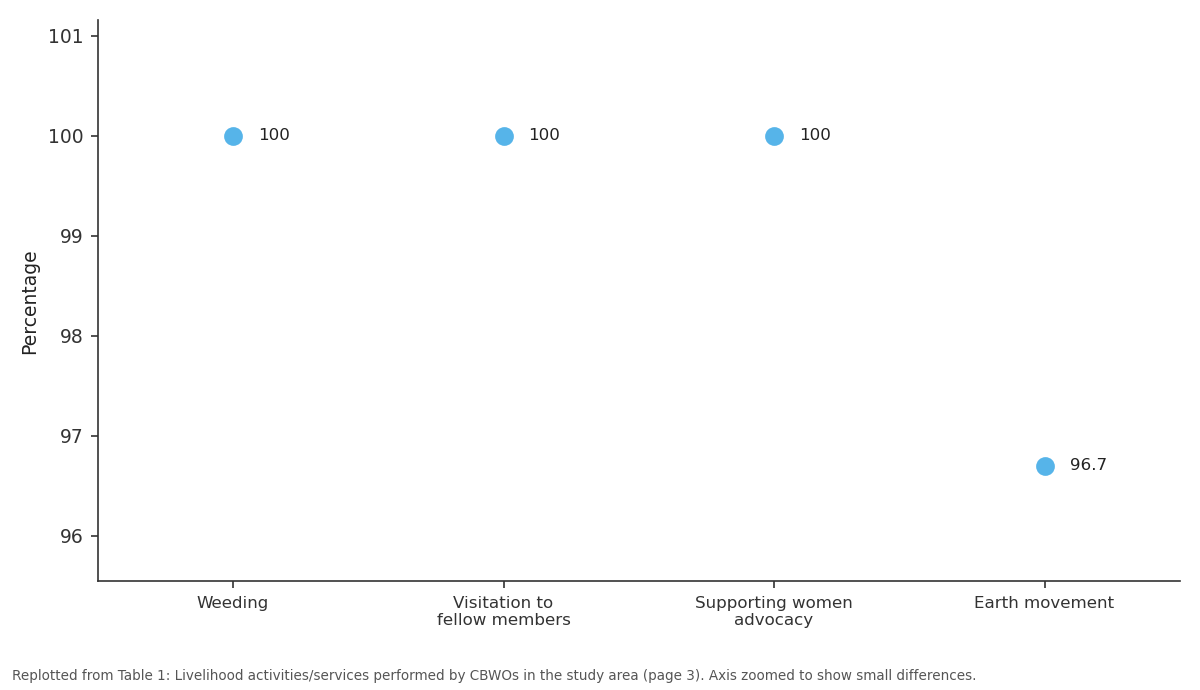
Percentage: Weeding vs Visitation to fellow... vs Supporting women... vs Earth movement
Replotted from Table 1 (page 3) of the original paper. Every bar is the paper's own table value.
View source evidence ↗Figures & tables
From the original paper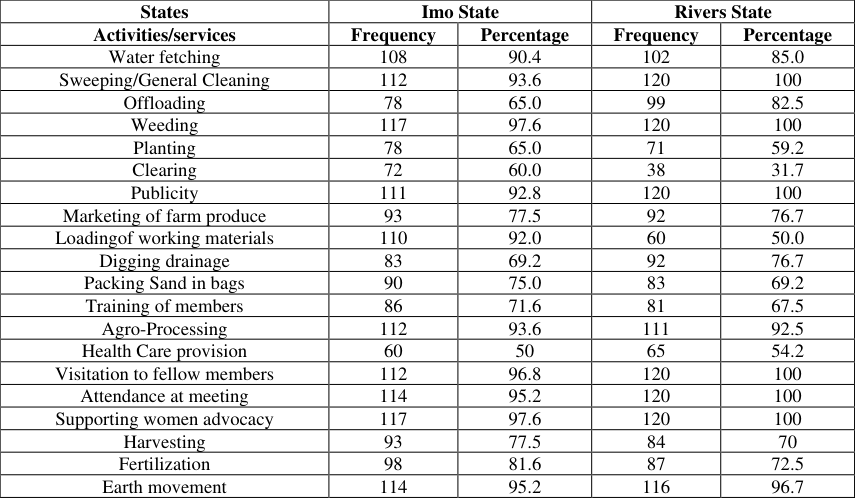 Table 1
Introduction
Rural communities have been commonly identified in many works as the most neglected areas in developing nations (Oko, 2010) [12] . Over the years, the quest for accelerated improvement in the worth of life of the communities has remained an issue of great concern to the government (Oko, 2010; Nwosu, 2013) [12,8] . The improvement and worth of lifecycle of the community members brings change /transformation which metamorphoses to development. The clamor for developing rural areas, and providing a cushion to improve the total well-being of the communities has encouraged agricultural development. According to Ekong (2003) [3] , Nigeria, like most developing countries, has periodic development plans or annual budget which spells out development programmes to be accomplished within a specific period where agricultural development features prominently. Nwosu (2011) [7] has described agricultural development as one dimension of the multifaceted complex process of development that aims at enhancing the productive capacity of the agrarian area through the change of the rural economy from being a rustic, subsistence agricultural economy to a modern commercialized agricultural enterprise. Food and Agricultural Organization (FAO) (2003) [4] stated that in most regions of world, women in agriculture play very important role in food security as revenue recipients, nurturers and administrators of natural resources and biodiversity. Yet, all these important roles are often mitigated by constrained access to land, labor, capital and technology. However, food, safety and domestic well-being are clear motives for protecting or enhancing women's access and control over land and other productive resources. In addition, it is generally accepted that wealth controlled by women are conscientiously used to enhance household food security, total well-being of the family and it reduces malnutrition of the children. Sequel to the above, Adzongo (2008) [1] also reported that in the past, women farmers were wrongly referred to as "farm laborers" or just "housewives". This signifies that their contributions were not adequately measured. But today, this perceived role is changing. Women are active in all facets of development, especially in food crop production. Food and Agricultural Organization (FAO, 2003) [4] , avers that rural women are responsible for half of the world's food production and have a conspicuous role in agriculture at all levels. In developing countries such as Nigeria, women produce between 60 and 80 percent of household food and they are also the world's producers of staple crops such as rice, and wheat, maize etc. which guarantees up to 90 percent food intake of the rural poor and their communities in general. In support of the above assertion, Anikpo (2000) [2] added that women are more committed than men in agricultural activities in Sub-Saharan Africa (SSA), Nigeria inclusive. About 73% of them are involved in cash crop production, arable and vegetable gardening, 16% in post-harvest activities and 15% in agro-forestry. Also, findings from a study financed by the United Nations Development Programme (UNDP) revealed that women make-up 60 -80% of agricultural labor force in Nigeria, depending on the region, and they produce two-thirds of food crops. FAO (2008) [5] observed that women seem to have a wider www.extensionjournal.com social network because of their engagement in religious, cultural, agricultural and social activities which are community-based. Similarly, Ogolo (1995) [10] affirms that community participation in development programmes could be facilitated by the use of voluntary organizations such as women organizations. These organizations have been reported by Odurukwe (2003) [9] to be religious-based, service-based or socio-cultural based and women organizations are more effective and play very significant roles in the actualization of the community felt needs. Women organizations are forums where women talk about their problems and concerns; communal work activities; organize for financial assistance and seek interventions in areas of need. These organizations are avenues of empowerment when effectively explored and it extends development to women in the rural areas. It also serves as enlightenment for education on issues that boost gender participation. In IFADassisted projects, women earned higher status, respect and decision-making power based on their participation in groups or co-operatives. The aim is not just to interact with groups as conducts for project resources, but to help them evolve into viable, selfsustaining community organizations (International Fund for Agricultural Development, 2015). Therefore, Community-Based Women Organizations (CBWOs), according to Wikipedia, are all such organization, institutions or congregation of people, which have local area/village-based presence, maturity and structural arrangements. In the same vein, they are civil society, non-profits organization which runs on voluntary basis and are self-funded. Many are merged, with a written constitution, having Board of Directors, while others are informal. Community Development seeks to challenge the causes and effects of poverty and inequality and offer new opportunities to those lacking choice, power and resources. Community Development empowers people and involves them in making changes they identify to be important and which when put to use, develop their skills, knowledge and experience. Community Development is about collective action. All community development projects have an antipoverty, anti-exclusion focus and promote participation of people experiencing poverty and exclusion at all levels, work from community development principles and methods, provide support and act as a catalyst for community development activity, act as a resource in the communities of which they are part, provide co-ordination and cooperation between community, voluntary and statutory groups in their areas and involve representatives of groups which experience poverty and social exclusion within their management structures. Community-based development projects (CBDP) are designed for one major purpose of improving the lives of the members both economically and socially. Because they are community based substantial involvement of the community at all stages of project increases its performance. This is because they feel part of the team and develop more ownership (Sakala, 2004) [14] . In Nigeria, Ogunlela and Mukhtar (2009) [11] observed that various women groups and organizations have emerged. Such groups and organizations have contributed substantially to the gains women farmers have recorded and the voice that they now have in overall national policy on agricultural development. Example of such group is the Women Farmers Advancement Network (WOFAN), a private initiative founded in the 1990s, whose headquarters is in Kano, Nigeria. The main drive of WOFAN include: providing a forum through which members of rural Nigeria communities can express themselves, formation of community groups to bring in access to agricultural credit and insurance, facilities and introducing labor-saving technologies, including modern farm implements and the use of solar energy. In addition, WOFAN also assists women farmers in their health and agricultural technology. It has since inevitably expanded to address other needs. Rahman (2008) avers that the rural women played a pivotal role that is crucial to the overall success of efforts directed at agricultural and rural development. In addition, the position and capability of women meeting the challenges of agricultural and rural development cannot be overemphasized. They shoulder the primary responsibility for food security in Africa, yet development agencies have devoted minimal resources to researching the impact of their agricultural policies and new techniques on the well-being of Africa's women farmers. Similarly, much of Sub-Saharan Africa is matrilineal, with women's access to land being (through usufruct rights) through their husband's lineage group. Thus, the major aim of this work is to identify the rural livelihood roles performed by CBWOs in Imo and Rivers States.
Methodology
The study was carried out in Imo and Rivers States. Imo has three Agricultural zones namely Owerri zone, Orlu zone and Okigwe zone. Two stage sampling technique was used in selecting CBOs. The first stage involved the random selection of four local government areas from each of the zones, to give a total of 12 local government areas. In the second stage, 10 community based women organizations were randomly selected in the following arrangement -4 Women groups, 3community development unions and 3 -Co-operative societies to make up the required 10 Community Based Women Organisations per local government. On the whole 120 community-based organizations were used for the study in Imo. Rivers State on the other hand is divided into 3 agricultural zones namely, zone I crop zone in Bori, zone II, fishing zone in Andoni, and zone III, crop/livestock in Omuma by the Rivers State Agricultural Development Project (RISADP). Two stage sampling technique was used in selecting CBOs. The first stage involved the random selection of four local government areas from each of the zones, to give a total of 12 from Rivers State. In the second stage, 10 community based women organizations were randomly selected in the following arrangement -4 Women groups, 3community development unions and 3 -Co-operative societies to make up the required 120 Community Based Organisations per local government. On the whole 240 community-based organizations were used for the study for the two states. A total of 240 questionnaires were distributed. Data were collected by use of structured questionnaire and interview schedule and analyzed using percentages presented in frequency table an www.extensionjournal.com
Results and Discussion
Livelihood activities/services performed by CBWOs in the study area Table 1 showed various livelihood services performed by CBWOs in both Imo and Rivers States. However, CBWOs Imo State played active roles in the following activities; supporting women advocacy (97.6%) (which assist in improving respect for and the protection of women's human rights and elimination of discrimination, which in turn, is necessary to achieve full equality between men and women), weeding (97.6%), visitation to fellow members (96.8%), earth movement (erosion control) (95.2%), attendance at meeting (95.2%). Others are sweeping (93.6%), Agro-processing (93.6%), Publicity (92.8%), loading of working materials (92.0%) and water fetching (90.4%). Furthermore, women in Imo CBWOs played a moderate role in offloading of working materials (65.6%), planting (64.8%), clearing (60%), digging drainage (69.6%) and health care support/provision to members (60%). This is contrary to Rivers State CBWOs who played active and effective roles in supporting women advocacy (100%), weeding (100%), visitation to members (100%), agroprocessing (92.5%) and earth movement (96.7%). On the overall performance of the group, 82% of their active services were in agricultural and developmental projects, indicating high performance when compared with the expected roles. The result confirms the findings of United Nations Development Programme (2000) [2] , which observed that around the world, resilient and resourceful rural women contribute in a multitude of ways through different livelihood strategies to lifting their families and communities out of poverty. In other words, the fast changing time has brought many new interests and responsibilities into women's orbit. Thus, the role played by women in agricultural development process is fundamental to development. Therefore, these roles are played in meeting the challenges of agricultural development which are crucial to the development of women and fulfillment of their economic potentials.
| States | Imo State | — | Rivers State | — |
|---|---|---|---|---|
| Activities/services | Frequency | Percentage | Frequency | Percentage |
| Water fetching | 108 | 90.4 | 102 | 85.0 |
| Sweeping/General Cleaning | 112 | 93.6 | 120 | 100 |
| Offloading | 78 | 65.0 | 99 | 82.5 |
| Weeding | 117 | 97.6 | 120 | 100 |
| Planting | 78 | 65.0 | 71 | 59.2 |
| Clearing | 72 | 60.0 | 38 | 31.7 |
| Publicity | 111 | 92.8 | 120 | 100 |
| Marketing of farm produce | 93 | 77.5 | 92 | 76.7 |
| Loadingof working materials | 110 | 92.0 | 60 | 50.0 |
| Digging drainage | 83 | 69.2 | 92 | 76.7 |
| Packing Sand in bags | 90 | 75.0 | 83 | 69.2 |
| Training of members | 86 | 71.6 | 81 | 67.5 |
| Agro-Processing | 112 | 93.6 | 111 | 92.5 |
| Health Care provision | 60 | 50 | 65 | 54.2 |
| Visitation to fellow members | 112 | 96.8 | 120 | 100 |
| Attendance at meeting | 114 | 95.2 | 120 | 100 |
| Supporting women advocacy | 117 | 97.6 | 120 | 100 |
| Harvesting | 93 | 77.5 | 84 | 70 |
| Fertilization | 98 | 81.6 | 87 | 72.5 |
| Earth movement | 114 | 95.2 | 116 | 96.7 |
Table text extracted from the original PDF; superscript letters are shown inline. The original table image is below.
View original table image
Conclusion
CBWOs performed several livelihood services. These were weeding, visitation to fellow members, earth movement (erosion control), attendance at meeting, sweeping, agroprocessing, publicity, loading of working materials, and fetching water. The essence is bringing women together to improve their socio-economic life, raise their standard of living and contribution to the development of their immediate communities.
References
14 in the original paper- Adzongo PI. Gender and Healthcare policies in Agriculture and Rural Development in gender issues in Agriculture and Rural Development proceedings of the first National conference of the society for Gender in Agriculture and Rural Development held at University of Agriculture, Makurdi, Nigeria, May 26-28 (eds) M.O Obasi EP, Ejembi JB Ayoola and EE Adebayo 2008, 244-246.
- Anikpo M. Perspective in Gender Studies and Women Development Programmes Agenda for the new Millennium. Keynote Discussion paper at the 1 st Gender Studies Conference organized by the Department of English studies, University of Port Harcourt May 11-13, 2000.
- Ekong EE. Introduction to Rural Sociology, Dove Educational Publishers, Uyo, Nigeria 2003.
- FAO. Women in Agriculture Development Series. Gender Issues in Rural Food Security in Developing Countries, Rome, Italy 2003.
- FAO. Corporate Document Repository. Gender and participating in Agricultural Development Planning 2008. www.yahoo.com, retrieved 14-5-08.
- International Fund for Agricultural Development www.extensionjournal.com (IFAD). Rural Poverty Report 2013: The Challenge of ending Rural Poverty. Oxford: Oxford University Press 2013.
- Nwosu IE. Agricultural Development in Nigeria: A conceptual Approach: In Rural Agricultural and Environmental Sociology in Nigeria. In Adedoyin, S.F (Ed) Nigeria. Andkoland publishers Nigeria Limited 2011.
- Nwosu IE. Theories of Rural Development in Agricultural extension and rural Development, promoting indigenous knowledge (ed) by Ike Nwachukwu Nigeria: Lamb House Publications, Umuahia, 2013, 226.
- Odurukwe SN. Capital formation strategies among rural women in Abia State, implications for agricultural commercialization. Paper presented at the international workshop on Gender of commercialization of small holder agriculture. Workshop jointly organized IITA and FAO between 14-16 May, 2003 at IITA Ibadan 2003.
- Ogolo MB. Grassroots participation in rural development: A study of selected infrastructure in some communities of River State An unpublished Ph.D Thesis submitted to the Department of Agricultural Extension and Rural Development, University of Ibadan 1995.
- Ogunlela YI, Mukhtar AA. Gender Issues in Agriculture and Rural Development in Nigeria. The Role of Women in Humanity and Social Sciences Journal 2009;4(1):19-30, 19-28.
- Oko O. The concept of rural development: an overview; in essential issues in Rural Development. In Obasi, Oko and Nnamdi Erondu (eds) Nigeria. Centre for research and manpower Development (CREMD) 2010.
- Rahama AA. The Role of African and Asian Women Leaders in empowering rural women in the context of rights and Development Issuese in Afro-Ashian Journal of Rural Development. 2011; 34(1).
- Sakala SS. Towards establishing sustainability of community based development projects. Unpublished Research report, University of St. Clements, Lusaka, Zambia. Retrieved on October 5,2011 from, 2004 http://findarticles.com
Cited by 4
From OpenAlex, OpenCitations and reference lists read by Scinovex
- Potential of non-timber forest products in contribution on rural livelihood ↗
Jit Narayan Sah, Uday Kumar Singh, Rajan Kumar Sah · Journal of Medicinal Plants Studies · 2021
Introduction: Non-Timber Forest Products (NTFPs) are rich sources of forest and contribute of rural livelihoods in fulfilling their subsistence needs and household level income. This research explores the present status of potential NTFPs, influential factor for their collection with contribution for upliftment of rural livelihood. Methods: The inventory method for bio-physical data and social data for livelihood was used using
- Agropreneurship intentions among agricultural and entrepreneurship graduates in Nigeria
Anoke Amechi Fabian, Eze Solomon Uchechukwu, Ifeanyi Innocent Nwoye, Odumu Ato Victor · International Journal of Research in Agronomy · 2022
It is clear that despite the self-acclaimed giant of Africa by Nigeria and Nigerians and being the highest oil-producing nation in Africa, Nigeria has been unable to translate its oil wealth into raising the living standard for her growing population. This study investigates the Agropreneurship intentions among agricultural and entrepreneurship graduates in Nigeria. The study adopted a qualitative research design with six participants. A telephone interview was used to source the relevant data from the respondents. Data generated were transcribed, reviewed, and harmonized. Thematic categories
- Evaluation of NAIP with special reference to level of knowledge and adoption of HYV of wheat (GW-273) cultivation in Banswara District of Rajasthan ↗
Santosh Devi Samota, K.L. Dangi, RN Sharma · Journal of Pharmacognosy and Phytochemistry · 2021
National Agricultural Innovation Project (NAIP) focuses on four components which aimed at ICAR as the catalyzing agent for the management of change in the Indian National Agricultural Research System; research on sustainable rural livelihood security; basic & strategic research in frontier areas of Agricultural Sciences and multiple technology options in holistic and integrated manner in order to increase their productivity
- Livelihood strategies policy intensification and diversification farming system in Gambella region agricultural investment of agro pastoral and pastoral areas of Ethiopia
Yalew Teshome, Nigatu Bogale, Belayeneh Nigussie · International Journal of Agriculture and Nutrition · 2021
Ethiopian government uses agricultural investment as one of the most important and effective strategies for economic growth, food security, and poverty reduction in the country. Since the mid-2000s, government has awarded millions of hectares of fertile land to foreign companies. This study explores the impact of large-scale. Agriculture investment and its consequences to local livelihoods in Gambella Region, Ethiopia. Gambella people survival and their identity are strongly tied to the land and the rivers that run through it. However, currently, foreign and local investors grab the farm area