
Research article · 2021 · Full text
International Journal of Agriculture Extension and Social DevelopmentMutuality of extension-farmer communication methods in dissemination of postharvest technology information in Kwara State
Volume 4(1) · Pages 201–205 · DOI: 10.33545/26180723.2021.v4.i1c.174 ↗
Research areasAgricultural Innovations and PracticesICT in Developing CommunitiesICT Impact and Policies
Abstract
Author-writtenThe medium of communication employed by agricultural extension officers in the dissemination of postharvest technology and information influences the adoption rate in a social system. The exploratory study assessed the forms of communication used in disseminating postharvest information; factors considered in selecting forms of communications used and the feedback effectiveness of communication forms used by extension officers. A multistage purposive sampling technique was used to select 75 field extension workers of Kwara Agricultural Development Project (KWADP) on which a structured interview schedule was administered. Descriptive statistics such as frequency and percentages were used to analyze the collected data. Findings show that agricultural extension workers utilized Audio, visual, written methods as well as social media platforms. Audio methods such as general meetings (85.3%), farm visits (86.7%) and telephone calls (70.7%) are the most widely used methods while written forms such as advisory booklets (33.3%), articles (28.0%) and personal letters (21.3%) are the least employed methods. The number of Farmers to be reached (69.3%); nature of message to be disseminated (74.7%) and characteristics of end-users 72.0% were the major factors considered by extension workers in selecting forms of communications to be used in dissemination efforts. Also, Audio methods such as farm visits (38.7%) radio (37.3%), home visits (28.0%) and general meeting (26.7%) were considered to be the most effective communication methods. It is recommended that the effective communication methods used by the extension agents should be strengthened to further enhance innovation dissemination and adoption by the farmers.
Summary
Source-checkedPlain-language reading of the full paper, prepared with AI and checked against the text. Each point links to the authors' own words.
Why it matters
- Improved post-harvest technologies are critical because they reduce food losses, enhance food safety and quality, and increase profits for crop growers and processors. View evidence ↗
- Post-harvest food losses are a global concern as they cause income loss for industry actors and contribute to food insecurity by reducing available food for consumers. View evidence ↗
- Nigeria faces a shortage of agricultural extension agents, with a national average ratio of 1:3011, significantly higher than the FAO recommendation of 1:800. View evidence ↗
What they did
- The researchers used a multistage sampling technique to select 75 field extension workers from the Kwara Agricultural Development Project (KWADP). View evidence ↗
- Primary data was gathered from the participants using a structured questionnaire. View evidence ↗
- Data analysis was performed using SPSS, employing descriptive statistics including means, percentages, and frequency counts. View evidence ↗
What they found
- The most widely used spoken communication methods were farm visits (86.7%), general meetings (85.3%), telephone calls (70.7%), and radio (58.7%). View evidence ↗
- Among written communication forms, extension guides were the most common (76%), followed by bulletins (53.3%) and leaflets (50.7%). View evidence ↗
- WhatsApp was the most common social media platform used for dissemination (76%), compared to Facebook (45.3%). View evidence ↗
- Key factors influencing the choice of communication method included the nature of the message (74.7%), farmer characteristics (72%), the number of farmers to reach (69.3%), availability of the form (68%), and cost (65.3%). View evidence ↗
- The most frequently introduced technologies were hermetic storage (80%), improved yam barns (65.3%), improved maize cribs (65.3%), cassava stem trenches (58.7%), and fish smoking kilns (57.3%). View evidence ↗
- Extension workers identified audio methods, specifically farm visits, radio, home visits, and general meetings, as the most effective for communication. View evidence ↗
What it means
- The authors recommend strengthening the communication methods already identified as effective to improve the adoption of innovations by farmers. View evidence ↗
- The authors suggest that research institutes, such as the Nigerian Stored Products Research Institute, should increase efforts to make proven technologies accessible to end users. View evidence ↗
Visual summary
2 visualsIllustrations explain the paper; charts are replotted from the paper's own table values.
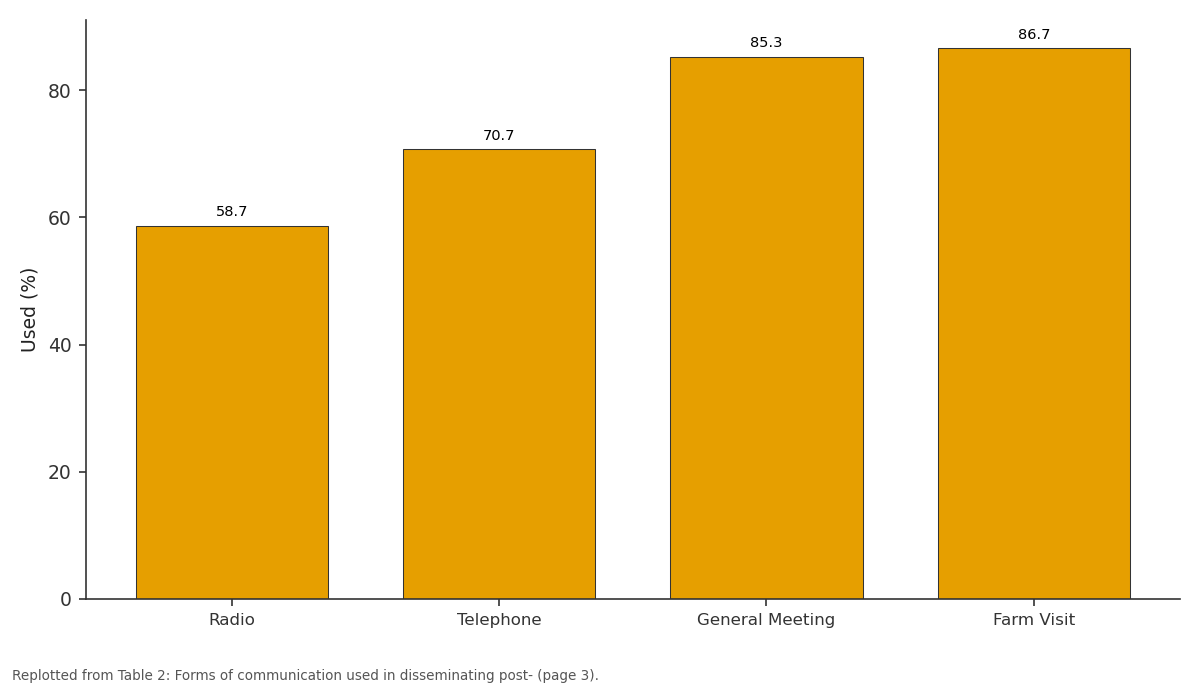
Used (%): Radio vs Telephone vs General Meeting vs Farm Visit
Replotted from Table 2 (page 3) of the original paper. Every bar is the paper's own table value.
View source evidence ↗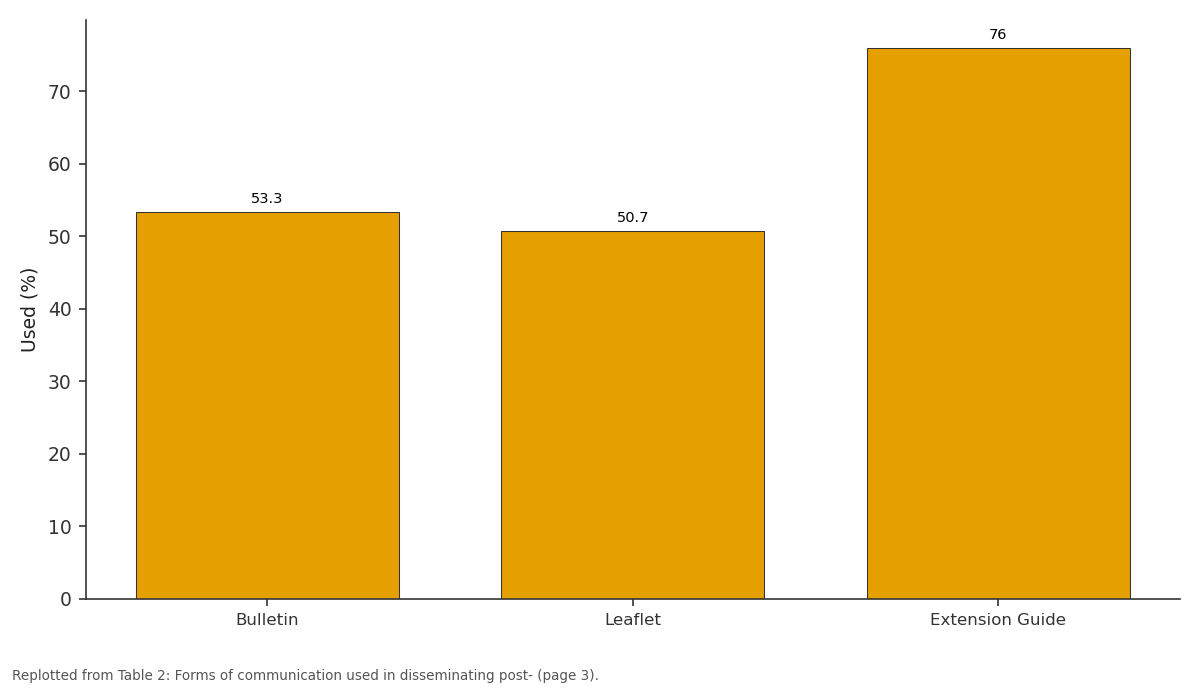
Used (%): Bulletin vs Leaflet vs Extension Guide
Replotted from Table 2 (page 3) of the original paper. Every bar is the paper's own table value.
View source evidence ↗Figures & tables
From the original paper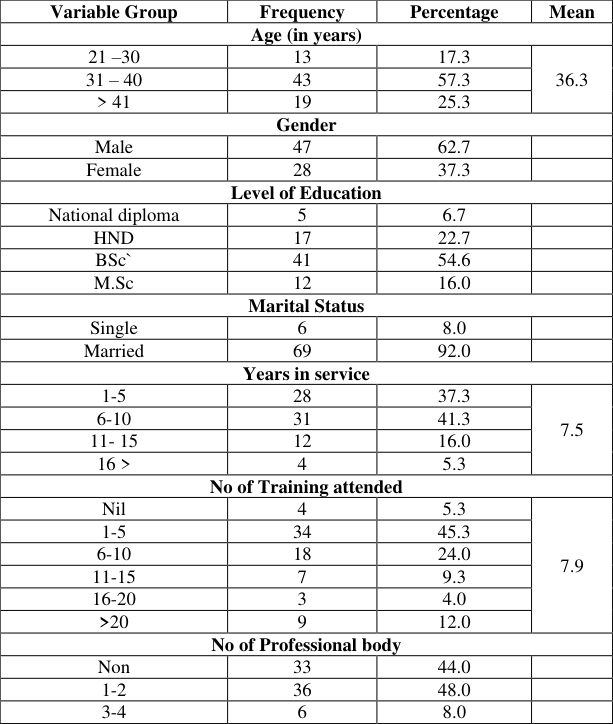 Table 1
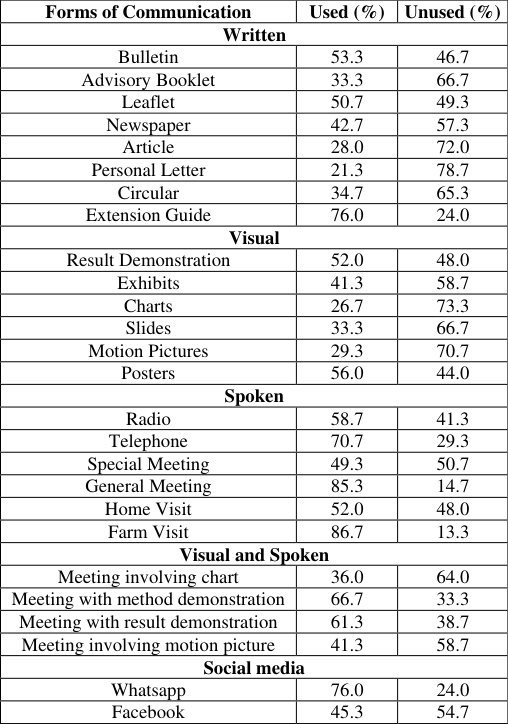 Table 2
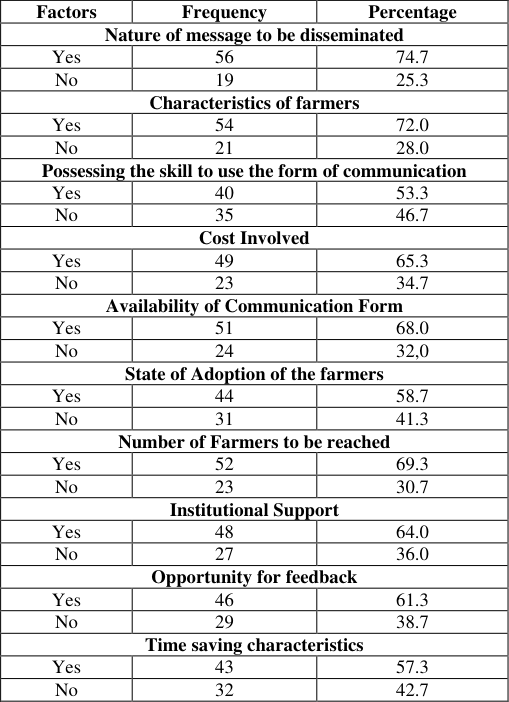 Table 3
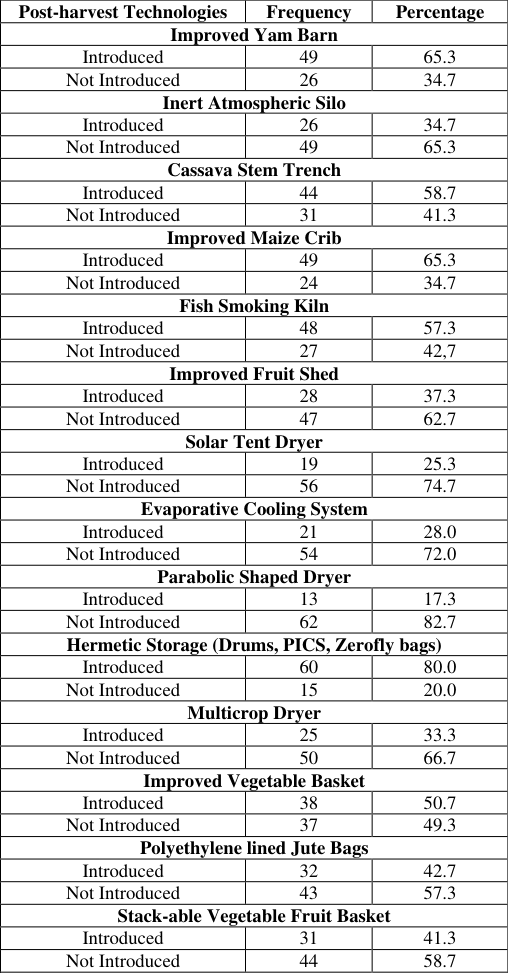 Table 4
Introduction
Post-harvest technologies are important parts of any agricultural system and are vital in all circumstances, whether there is surplus or deficit (Vilane, Shongwe, Motsa, &Shongwe, 2012) [10] . Utilizing improved post-harvest technologies often results in reduced food losses, improved overall quality and food safety, and a higher profit for growers and processors of crops (Tashi, 2015) [9] . Post-harvest food losses are a major concern and occur in most food distribution chains throughout the world. Not only do losses constitute lost income to farmers, processors and traders but they also contribute to food insecurity, a loss of food means less food is available for the consumer. The aim of agricultural extension is to disseminate agricultural technologies to improve the productivity of farmers' welfare and household nutritional status (Fabiyi, 2015) [4] . From the foregoing, extension has been recently defined as "systems that facilitate the access of farmers, their organizations and other market actors to knowledge, information and technologies; facilitate their interaction with partners in research, education, agribusiness, and other relevant institutions; and assist them to develop their own technical, organizational and management skills and practices". (Christoplos, 2010) [1] . It is the function of the extension agents or workers to employ the extension methods which provide opportunities for rural people to learn and which stimulate mental and physical activities among the people. Usually the objectives set out to achieve in training during post-harvest knowledge transfer determines the approach. In all, post-harvest programs, building knowledge and skills are as important as the communication technique and relationship between trainees and the extension agents. It is therefore, important for extension practitioners to employ the combination of many extension methods to improve the dissemination of agricultural technology to end-users especially in the postharvest value chain.
Problem statement
The extension agents also have a lot of problems and challenges; they are still few in number with low extension agents to farmers' ratio. While Food and Agricultural Organization (FAO) recommends one extension agent to 800 farmers, the ratio in Nigeria ranges from 1:1000 in Imo State to 1:10, 568 in Bayelsa State with national average of 1:3011 (NAERLS, 2012) [7] . The major method of technology dissemination employed by extension workers in the study area is through face-to-face dissemination during the monthly technology review meeting (MTRM) and fortnight training (FNT), which has become inadequate to equip the agricultural extension workers (Olaitan et al., 2017) [8] . Hence, this study was out to investigate if there are other forms employed by agricultural extension workers in the study area to disseminate agricultural information especially post-harvest technology dissemination. of KWADP in Patigi, Shao and Igbaja, while fifteen (15) respondents were selected in zone A (Kaima), due to few numbers of Extension officers compared with other zones, making a total of seventy-five (75) respondents for the study. The primary data for this study was collected with the aid of a structured questionnaire. Data were analysed using statistical package for social science (SPSS). Descriptive statistical tools such as frequency counts, percentages, mean, were used to analyse the data collected. The results in Table 1, shows that, the mean age of extension officers in the study area is 36 years, with a modal age class of 31-40. This implies that the respondents are still in their productive years and should be highly responsive to disseminating useful and practical information to farmers, this is in line with. Who noted that age is an important factor that influences people's attitude, skills, and aspirations? There are more male (62.7%) than females (37.3%) extension officers in the study area. This is in tandem with report of Swanson, that female extension agents were few than their male counterparts. 92% of the respondents were married. The majority of the respondents were educated with a higher concentration (54.6%) having a B.Sc degree. It is generally assumed in Nigeria that extension job is a low status job fit only for job applicants possessing low academic qualifications (Ejembi et al., 2006) [3] . The result of this study contradicts this view. It indicates high knowledge structure of extension workforce compared to www.extensionjournal.com what existed in few decades ago. Extension officers in the study area had an average of 8 years of working experience. This implies that the respondents have been involved in extension services for quite a number of years and should be sufficiently experienced in communicating agricultural information from researchers to farmers. The table also shows that majority of the respondent attended training. 48% are members of 1-2 professional bodies whereas 44% do not belong to any professional body. Table 2, shows that for written form of communication, majority (76%) of the respondent disseminates information through the use of extension guide, 53.3% through bulletin and 50.7% through leaflets. This implies that extension guides is the most extensive form of written communication used by extension officers to disseminate post-harvest information in the study area. Result demonstration. Furthermore, for spoken form of communication, farm visit (86.7%), general meeting (85.3%), telephone (70.7%) and radio (58.7%) are the major methods used by the extension officers disseminates post-harvest information. This may be as a result of the fact that these methods give farmers opportunity to be active participants during the teaching and learning process as they allow sharing and exchange of information between the extension agent and the farmers. For audio and spoken methods, 66.7% disseminate information through meeting with method demonstration and 61.3% through meeting with result demonstration, this means that meeting with both method and result demonstrations were the most widely used visual and spoken form of communication. This result corroborates that of Yekinni, & Afolabi, (2019) [11] who reported that the major extension communication methods used by the extension agents to disseminate agricultural information to respondents were farm visit (89.2%) and home visit (78.5%), contact farmers (73.3%), method demonstration (51.7%) result demonstration (42.5%), and radio (20.0%) 76% of the extension officers used WhatsApp while 45.3% used Facebook. This implies that Whatsapp is the most common social media used by the respondent in disseminating post-harvest information. The greater number of respondents that used Whatsapp could be as a result of its popularity and cheap network subscription. According to Kamani, et al., (2016) [6] , over 27 billion messages are sent by over 300 million users every day on Whatsapp, in addition to text messaging, Whatsapp users can also make audio and video calls, send each other images, videos, audio media messages, etc. with little cost (Devesh, Mahesh & Sushil, 2017) [2] . This result is similar to the works of Iwuchukwu, Eke, & Nwobodo, (2019) [5] . Who reported that Facebook and WhatsApp were social media that the majority of the extension agents used for communication, although, they reported that Facebook (82.4%) had a higher percentage used as compared to Whatsapp (74.2%). post-harvest information. No single rule of thumb can be given for the selection and use of the various extension communication methods to ensure success in all situations, however, the following factors are considered by the extension officers in the study area. The most important factors considered includes, nature of message to be disseminated (74.7%), Characteristics of the farmers (72%), number of farmers to be reached (69.3%), availability of communication form (68%) and cost involved (65.3%).
| Forms of Communication | Used (%) | Unused (%) |
|---|---|---|
| Written | ||
| Bulletin | 53.3 | 46.7 |
| Advisory Booklet | 33.3 | 66.7 |
| Leaflet | 50.7 | 49.3 |
| Newspaper | 42.7 | 57.3 |
| Article | 28.0 | 72.0 |
| Personal Letter | 21.3 | 78.7 |
| Circular | 34.7 | 65.3 |
| Extension Guide | 76.0 | 24.0 |
| Visual | ||
| Result Demonstration | 52.0 | 48.0 |
| Exhibits | 41.3 | 58.7 |
| Charts | 26.7 | 73.3 |
| Slides | 33.3 | 66.7 |
| Motion Pictures | 29.3 | 70.7 |
| Posters | 56.0 | 44.0 |
| Spoken | ||
| Radio | 58.7 | 41.3 |
| Telephone | 70.7 | 29.3 |
| Special Meeting | 49.3 | 50.7 |
| General Meeting | 85.3 | 14.7 |
| Home Visit | 52.0 | 48.0 |
| Farm Visit | 86.7 | 13.3 |
| Visual and Spoken | ||
| Meeting involving chart | 36.0 | 64.0 |
| Meeting with method demonstration | 66.7 | 33.3 |
| Meeting with result demonstration | 61.3 | 38.7 |
| Meeting involving motion picture | 41.3 | 58.7 |
| Social media | ||
| 76.0 | 24.0 | |
| 45.3 | 54.7 |
Table text extracted from the original PDF; superscript letters are shown inline. The original table image is below.
View original table image
| Variable Group | Frequency | Percentage | Mean |
|---|---|---|---|
| Age (in years) | |||
| 21 –30 | 13 | 17.3 | 36.3 |
| 31 – 40 | 43 | 57.3 | |
| > 41 | 19 | 25.3 | |
| Gender | |||
| Male | 47 | 62.7 | |
| Female | 28 | 37.3 | |
| Level of Education | |||
| National diploma | 5 | 6.7 | |
| HND | 17 | 22.7 | |
| BSc` | 41 | 54.6 | |
| M.Sc | 12 | 16.0 | |
| Marital Status | |||
| Single | 6 | 8.0 | |
| Married | 69 | 92.0 | |
| Years in service | |||
| 1-5 | 28 | 37.3 | 7.5 |
| 6-10 | 31 | 41.3 | |
| 11- 15 | 12 | 16.0 | |
| 16 > | 4 | 5.3 | |
| No of Training attended | |||
| Nil | 4 | 5.3 | 7.9 |
| 1-5 | 34 | 45.3 | |
| 6-10 | 18 | 24.0 | |
| 11-15 | 7 | 9.3 | |
| 16-20 | 3 | 4.0 | |
| >20 | 9 | 12.0 | |
| No of Professional body | |||
| Non | 33 | 44.0 | |
| 1-2 | 36 | 48.0 | |
| 3-4 | 6 | 8.0 |
Table text extracted from the original PDF; superscript letters are shown inline. The original table image is below.
View original table image
Objectives of the study
Objectives of the study
Results and Discussion
Results and Discussion
Conclusion
Spoken methods such as general meetings, farm visits and telephone calls are the most widely used methods, posters for visual method, extension guide for written, while meeting with method demonstration for visual and spoken. The number of Farmers to be reached; nature of message to be disseminated and characteristics of end-users were the major factors considered by extension workers in selecting forms of communications to be used in dissemination efforts. Also, Audio methods such as farm visits, radio, home visits and general meeting were considered to be the most effective communication methods used by the extension workers.
Figures and tables from the paper
| Factors | Frequency | Percentage |
|---|---|---|
| Nature of message to be disseminated | ||
| Yes | 56 | 74.7 |
| No | 19 | 25.3 |
| Characteristics of farmers | ||
| Yes | 54 | 72.0 |
| No | 21 | 28.0 |
| Possessing the skill to use the form of communication | ||
| Yes | 40 | 53.3 |
| No | 35 | 46.7 |
| Cost Involved | ||
| Yes | 49 | 65.3 |
| No | 23 | 34.7 |
| Availability of Communication Form | ||
| Yes | 51 | 68.0 |
| No | 24 | 32,0 |
| State of Adoption of the farmers | ||
| Yes | 44 | 58.7 |
| No | 31 | 41.3 |
| Number of Farmers to be reached | ||
| Yes | 52 | 69.3 |
| No | 23 | 30.7 |
| Institutional Support | ||
| Yes | 48 | 64.0 |
| No | 27 | 36.0 |
| Opportunity for feedback | ||
| Yes | 46 | 61.3 |
| No | 29 | 38.7 |
| Time saving characteristics | ||
| Yes | 43 | 57.3 |
| No | 32 | 42.7 |
Table text extracted from the original PDF; superscript letters are shown inline. The original table image is below.
View original table image
| Post-harvest Technologies | Frequency | Percentage |
|---|---|---|
| Improved Yam Barn | ||
| Introduced | 49 | 65.3 |
| Not Introduced | 26 | 34.7 |
| Inert Atmospheric Silo | ||
| Introduced | 26 | 34.7 |
| Not Introduced | 49 | 65.3 |
| Cassava Stem Trench | ||
| Introduced | 44 | 58.7 |
| Not Introduced | 31 | 41.3 |
| Improved Maize Crib | ||
| Introduced | 49 | 65.3 |
| Not Introduced | 24 | 34.7 |
| Fish Smoking Kiln | ||
| Introduced | 48 | 57.3 |
| Not Introduced | 27 | 42,7 |
| Improved Fruit Shed | ||
| Introduced | 28 | 37.3 |
| Not Introduced | 47 | 62.7 |
| Solar Tent Dryer | ||
| Introduced | 19 | 25.3 |
| Not Introduced | 56 | 74.7 |
| Evaporative Cooling System | ||
| Introduced | 21 | 28.0 |
| Not Introduced | 54 | 72.0 |
| Parabolic Shaped Dryer | ||
| Introduced | 13 | 17.3 |
| Not Introduced | 62 | 82.7 |
| Hermetic Storage (Drums, PICS, Zerofly bags) | ||
| Introduced | 60 | 80.0 |
| Not Introduced | 15 | 20.0 |
| Multicrop Dryer | ||
| Introduced | 25 | 33.3 |
| Not Introduced | 50 | 66.7 |
| Improved Vegetable Basket | ||
| Introduced | 38 | 50.7 |
| Not Introduced | 37 | 49.3 |
| Polyethylene lined Jute Bags | ||
| Introduced | 32 | 42.7 |
| Not Introduced | 43 | 57.3 |
| Stack-able Vegetable Fruit Basket | ||
| Introduced | 31 | 41.3 |
| Not Introduced | 44 | 58.7 |
Table text extracted from the original PDF; superscript letters are shown inline. The original table image is below.
View original table image
References
11 in the original paper- Christoplos I. Mobilising the Potential of Rural and Agricultural Extension. Neuchatel Group. CTA (2013) ICTs: Transforming agricultural extension. An ediscussion; c2010. p. 4-5.
- Devesh T, Mahesh C, Sushil S. Whatsapp for farmers: Enhancing the scope and coverage of traditional agricultural extension. International Journal of Science, Environment and Technology. 2017;6(4):2190-2201.
- Ejembi EP, Omoregbee FE, Ejembi SA. "Farmers' assessment of the training and visit extension system in central Nigeria: Evidence from BarkinLadi, Plateau State. Journal of Social Sciences. 2006;12(3):207-212.
- Fabiyi EF. Impact of Agricultural Extension on Adoption of Soyabean Innovations in Bauchi, Nigeria. Case Studies Journa. l ISSN (2305-509X). 2015 April;4(4):5
- Iwuchukwu Eke Nwobodo. Perception of Extension Personnel on Suitability and Benefits of Using social media in Communicating Agricultural Information in Enugu State, Nigeria. Journal of Agricultural Extension. 2019, 23(3). https://dx.doi.org/10.4314/jae.v23i3.15
- Kamani KC, Ghodasara YR, Soni NV, Parsaniya PS. Empowering Indian agriculture with Whatsapp: A positives step towards digital India. International Journal of Agriculture Sciences. 2016;8(13):1210-1212.
- National Agricultural Extension and Research Liaison Services (NAERLS), Executive Summary of Agricultural performance survey of 2012 wet season in Nigeria. 2012.
- Olaitan TR, Adesiji GB, Owojaiye OB, Adereti FO. Assessment of the Usage of Social Media among Agricultural Extension Workers in Kwara State, Nigeria. Journal of Agricultural Research and Development. 2017;16(1):31-38
- Tashi S. The Prospect of Organic Farming in Bhutan. Rheinischen Friedrich-Wilhelm-Universitat, Bonn, Germany. 2015.
- Vilane BRT, Shongwe MI, Motsa NM, Shongwe VD. Adoption of Postharvest Technologies Used by Smallholder Farmers in Swaziland. African Journal of Agricultural Research. 2012;7(35):4983-4995.
- Yekinni O, Afolabi C. Farmers' Assessment of the Effectiveness of Extension Communication Methods Used in Ogbomoso Agricultural Zone of Oyo-State Nigeria. Journal of Agricultural Extension. 2019;23(3):126-134. Retrieved from https://journal.aesonnigeria.org/index.php/jae/article/vie w/1827