
Research article · 2021 · Full text
International Journal of Agriculture Extension and Social DevelopmentAssessment of extension agents' promotion strategy on sustainable agroforestry management practices in Kwara State, Nigeria
Volume 4(1) · Pages 206–211 · DOI: 10.33545/26180723.2021.v4.i1c.175 ↗
Research areasAgriculture and Rural Development Research
Abstract
Author-writtenThis research assessed the agroforestry promotion strategy adopted by the extension agents (EAs) in Kwara state, Nigeria. It investigated the agroforestry management practices promoted by the EAs, the promotion strategy employed and the constraints faced in the promotion of sustainable agroforestry management practices in the study area. Census technique was adopted to select 120 extension agents in the study area. Data were analysed using both descriptive and inferential statistics such as frequency, percentage, mean and regression analysis respectively. The average age of the respondents was 40years. Most (68.3%) of the respondents were males while females accounted for 31.7%. Also, majority (93.3%) of the respondents were married with an average household size of 7memers. Furthermore, the study showed that multipurpose trees on cropland, improved fallow in shifting cultivation and shelterbelt were ranked 1st, 2nd and 3rd respectively. Extension agents mostly (MS=3.6) promoted sustainable agroforestry management practices through interpersonal contact with the farmers. Likewise, the research revealed that shortage of extension agents and inadequate support from the government were the major constraints inhibiting promotion of sustainable agroforestry management practices in the state. The result of the analysis revealed that age (b= 0.33, p<0.05) and years of working experiences (b=-.038 p<0.05) significantly influenced the promotion strategy used by the EAs. In conclusion, agroforestry management practices were mainly promoted through interpersonal contact with the farmers and emphasis were on shelterbelt, multipurpose and improved fallow in shifting. It is therefore recommended that other areas of agroforestry should be promoted by the EAs and government should provide adequate support to extension services in the state.
Summary
Source-checkedPlain-language reading of the full paper, prepared with AI and checked against the text. Each point links to the authors' own words.
Why it matters
- Agriculture is a critical sector for Nigeria's economy, contributing 22.4% to the overall Gross Domestic Product in the first quarter of 2022. View evidence ↗
- Sustainable land management is a major challenge in Nigeria, and agroforestry is used as a solution to maintain land systems and increase soil fertility. View evidence ↗
- Extension agents serve as the essential link for transferring research findings and technical advice to farmers to ensure food security and economic development. View evidence ↗
The question
- The study aimed to assess the agroforestry management practices promoted by extension agents in Kwara State, Nigeria, the strategies they used, and the constraints they encountered. View evidence ↗
What they did
- Data were collected using a well-structured questionnaire designed to address the study's specific objectives. View evidence ↗
- The analysis employed descriptive statistics (frequencies, percentages, means, and standard deviations) and inferential statistics, specifically regression analysis. View evidence ↗
What they found
- The extension agents had a mean age of 40 years, with 52.5% aged 36-45; the majority were male (68.3%) and married (93.3%). View evidence ↗
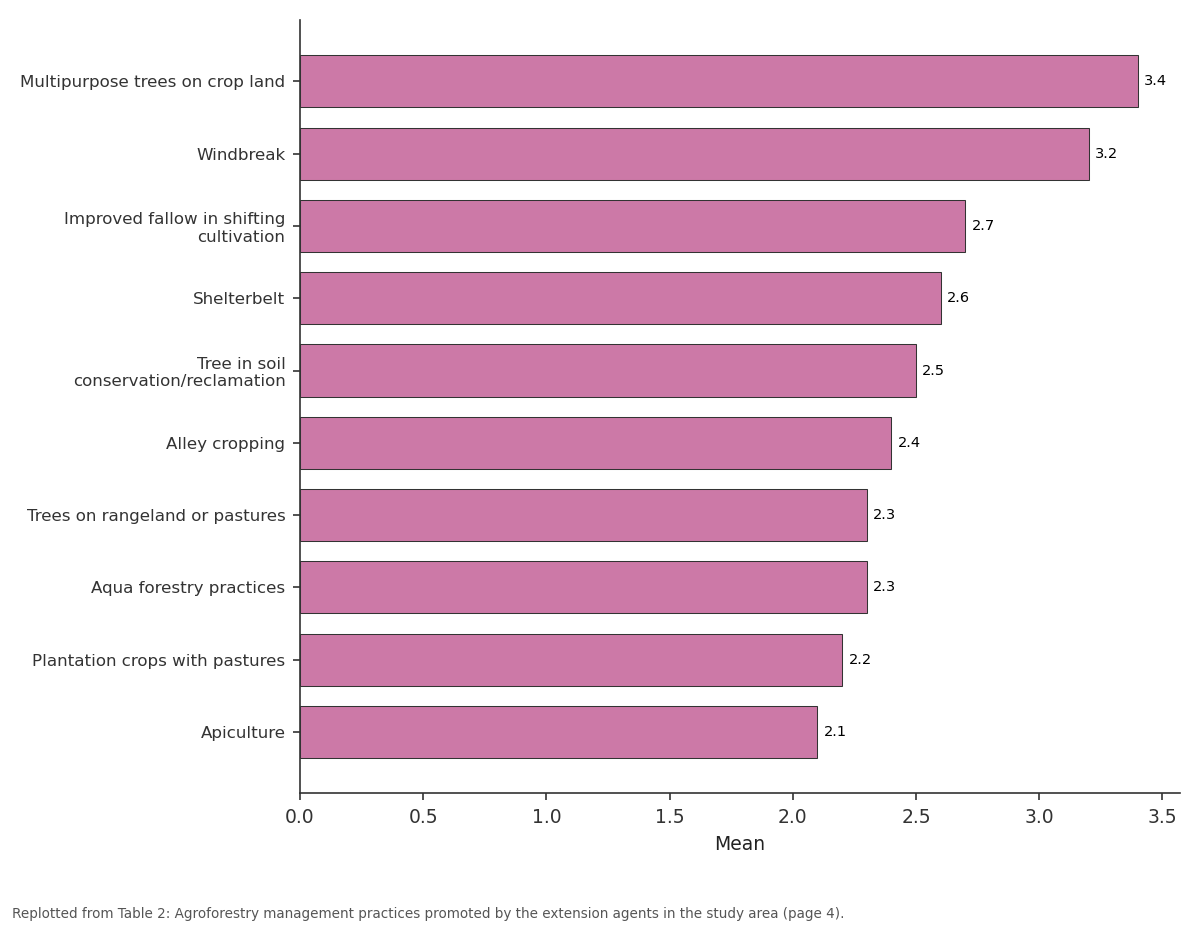
- The most promoted agroforestry practices were multipurpose trees on cropland (mean 3.4), followed by windbreaks, improved fallow in shifting cultivation, shelterbelts, and trees for soil conservation. View evidence ↗
- Interpersonal contact was the most frequently used promotion strategy (mean 3.64), followed by mass media and group methods. View evidence ↗
- The primary constraints inhibiting the promotion of agroforestry were a shortage of extension agents relative to farmers and poor government support. View evidence ↗
What it means
- The authors concluded that extension agents primarily promote multipurpose trees, improved fallow, and shelterbelts using interpersonal contact. View evidence ↗
- The authors recommend that extension institutions encourage a wider variety of agroforestry practices and that the government provide more support to extension services. View evidence ↗
Visual summary
2 visualsIllustrations explain the paper; charts are replotted from the paper's own table values.
Mean: Multipurpose trees on... vs Windbreak vs Improved fallow in... vs Shelterbelt vs Tree in soil...
Replotted from Table 2 (page 4) of the original paper. Every bar is the paper's own table value.
View source evidence ↗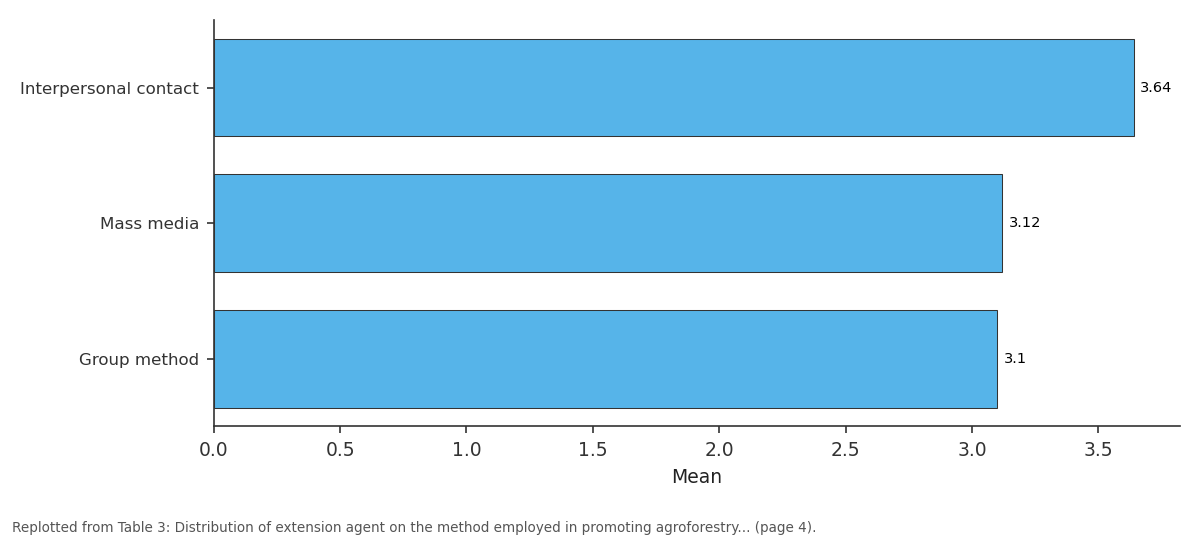
Mean: Interpersonal contact vs Mass media vs Group method
Replotted from Table 3 (page 4) of the original paper. Every bar is the paper's own table value.
View source evidence ↗Figures & tables
From the original paper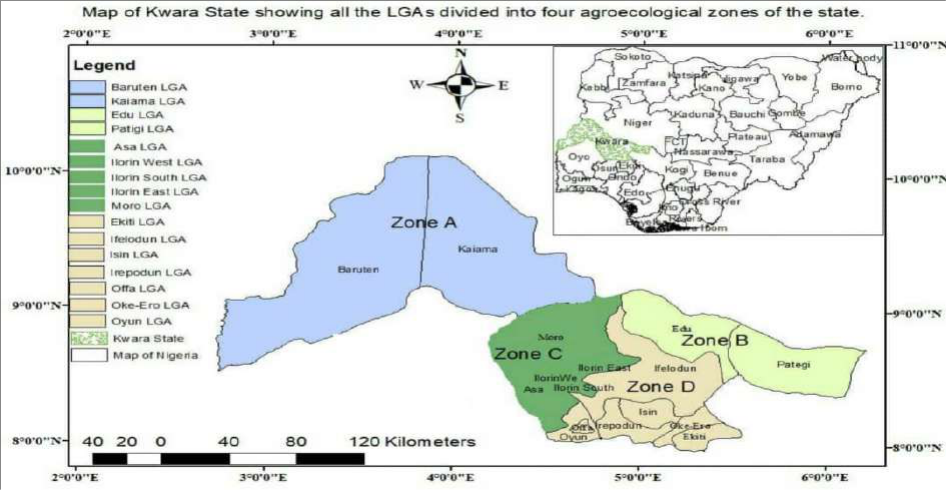 Figure 1
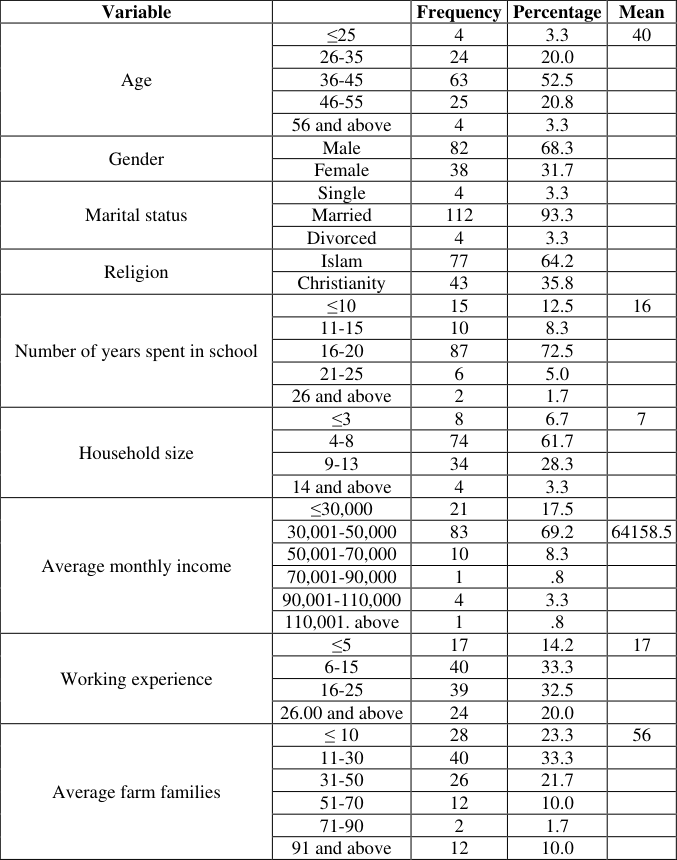 Table 1
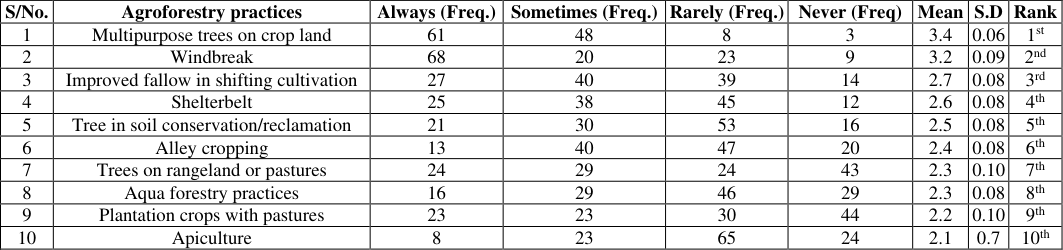 Table 2
 Table 3
 Table 4
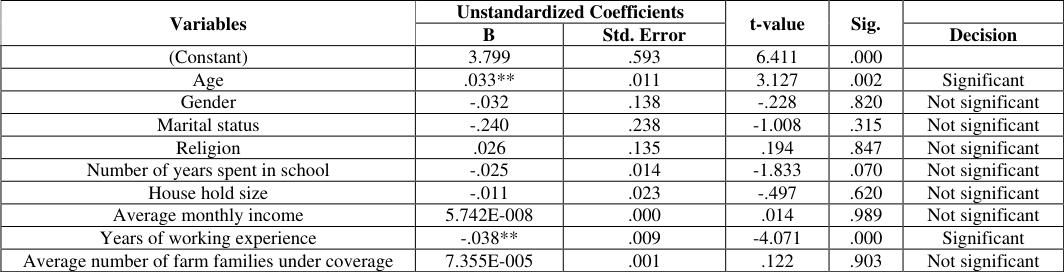 Table 5
Introduction
Despite the booming of oil and telecommunication sectors in Nigeria, agriculture still remains the key sector contributing to the country economy. Antai, Udo, and Effiong (2016) [6] stated that the sector employs many of the country labour forces and contributes largely to the non-oil earnings. According to National Bureau of Statistics (2022) [11] , agriculture sector contributed 22.4% to the overall Gross Domestic Product in the first quarter of 2022. However, several challenges are presently threatening agricultural stability in developing countries especially Nigeria. One of the most significant threats is land use management. Though, farmers have used and practiced agroforestry farming system as a panacea. Agroforestry is concerned with sustainable land management practices. These practices aimed at helping land-owners (farmers) in sub-humid regions to maintain and manage land system. This is in order to increase soil fertility as well as better household income through production of food and wood throughout the year. The practices in turns contribute to the development of the nation's economy. The practices entail cultivation of trees and shrubs with crops and/or keeping of livestock in a place. This is an age long technology used by different countries and nations to maintain system of food production throughout the year (Adeola, 2015) [1] . Agroforestry practices enable farmers to have diverse sources of income through harvesting of different farm products such as fruits, firewood, fodder, timber and many more throughout the year. Furthermore, it creates job opportunities through processing of tree products which then increase rural communities' economy and the country gross domestic products (GDP). The potential of agroforestry to contribute to sustainable development has been recognized in international policy (FAO, 2015) [9] . According to Amonum, Babalola, & Agera (2009) [4] , there are three basic types of agroforestry which are agrisilviculture (planting of crops and trees), silvopastoral (rearing of animals and tree planting) and agrosilvopastoral (it entails crop cultivation, pasture and trees planting). In Nigeria, some of the agroforestry system being practiced by farmers include, Taungya farming, integrated Taungya, improved fallow in shifting, Alley-cropping (hedge row intercropping), Alley farming, Shelterbelts, Windbreaks etc. all these are being done to ensure lands are available for agricultural practices with right nutrients. Hence, to harness the full potential of agroforestry farmers need to be well informed and educated on the practices through agricultural extension services activities. Agricultural extension is saddled with the responsibility of disseminating relevant agricultural information and knowledge that are capable of ensuring food security and economic development of the nation. According to Ijeoma & Adesope (2015) [10] , the roles of extension do not limit to transfer of technology and farmers' training but it assisting farmers and rural dwellers to form agricultural cooperatives, and copping with marketing challenges. Extension services www.extensionjournal.com also provide assistance on issue of public interest in agarian society. This include conservation of resources, health issue, food security and agricultural production, food safety, nutrition, family education, and youth development and partnering with a broad range of service providers and other agencies. More so, agricultural extension activities remain one of the strategies for rural development throughout the world (Anaeto et al., 2012) [5] . Extension agents are the bridge between researchers, industry and farmers. The responsibility of transferring research findings to farmers rests mainly on the extension agents. Thus, extension agents need to adopt various teaching techniques and promotion strategies to be able to adequately perform these tasks. In developing countries like Nigeria, the rural dwellers largely depend on extension agents for technical advice and information. Therefore, success of agricultural programme, food security, economy diversification and poverty eradication depend greatly on extension personnel (Ezeh, 2013; Akinwale, 2017) [8] . Hence, this research work assessed the promotion strategies adopted by extension agents on sustainable agroforestry management practices in Kwara State, Nigeria.
Objectives of the study
The following objectives were formulated to guide the study, to: 1. Describe the socioeconomic characteristics of the extension agents in Kwara state, Nigeria; 2. Identify agroforestry management practices promoted by the extension agents in the study area. 3. investigate extension teaching strategy employed in the promotion of sustainable agroforestry management practices in the study area.
4. Identify constraints faced in the promotion of sustainable agroforestry management practices in the study area.
Hypothesis Testing
Socio-economic characteristics of the extension agents do not determine the sustainable agroforestry management practices strategies using in the study area.
Methodology The Study Area
The study was conducted in Kwara state, Nigeria (figure I).
The state is geographically located on N 8° 30' 0", E 4° 32' 60" with a forecasted population of 3,551,023 in the year 2022 (National Population Commission, 2020) [12] . The state has land area of 36,825km 2 ( 14
Population of the Study
The study population comprise all the public extension agents in Kwara state, Nigeria.
Sampling Technique and Sample Size
There are 120 extension agents with the Kwara state Agricultural Development Programme (KWADP) in all the four zones (A, B, C, and D.). Census technique was used to www.extensionjournal.com select all the 120 extensions agents in the study area.
Data Collection and Measurement of Variables
The data for the study were collected from the respondents with the aid of well-structured questionnaire which was designed in view of the objectives of the study.
Both the independent and dependent variables were measured. Socio-economic characteristics of the respondents were measured in the actual number. Types of Agroforestry management being promoted by respondents were captured with the use of frequency count. Frequency of sustainable agroforestry management practices being promoted were elicited using four Likert type scale of always (3), sometimes (2) rarely (1) and never (0). Also, constraints to the extension agents' ability to promote agroforestry management. Were measured on a three points likert type scale of very severe (3) severe (2) not severe (1)
Method of Data Analysis
Data were analysed with the use of descriptive and inferential statistics such as frequencies, percentages, mean (x), standard deviation (SD) and regression analysis. From the Table 1, it was revealed that the mean age of the respondent was 40 years. Most of the respondents (52.5%) were between 36-45 years, 20.8% were between 46-55 years, 20.0% were between 26 -35 years, while 3.3% of the respondents were below 25 years and above 56 years respectively. This agrees with the findings of Alabi and Ajayi (2018) [3] , and Aliu (2018) where it was revealed that Extension agents had mean age of 39. This indicated that most of the extension agents were in their active ages which can aid dissemination of agricultural information. Also, the Table indicated that majority (68.3%) were male and mostly married (93.3). This implies that more males were involved in extension services to ensure sustainable agriculture. This is in consonant with the findings of Ayansina and Adeogun (2017) [7] , Alabi and Ajayi (2018) [3] . The Table further revealed that majority the mean number of years spent in www.extensionjournal.com school by the respondents is 16years. This agrees with the findings of Suvedi and Ghimire (2015) [13] who asserted that majority of respondents spent 16 years in school. The results of the analysis revealed that most of the respondents had an average household size of 4 to 8 (61.7%), 28.3% had household size of 7 members. 61.7% had between 4-8 while 3.3% had above 14 household members. It was further revealed that 33.3% of the respondents had working experience between 6 to 15 years, 32.5% of the extension agent had a working experience between 16 to 25 years, 20% had a working experience above 25 years, 14.2% had a working experience below 6 years. The average years of working experience by the respondents was 17 years. Furthermore, the results of the analysis reveal that most of the respondents who participated in the study had an average farm family of 11 to 30 (33.3%), 23.3% had an average farm family less than 10, 21.7% had an average farm family between 31 to 50, 10% had an average farm family between 51 to 70, 10% had an average farm family above 90, while 1.7% of the extension agents had an average farm family between 71 to 90.
| Variable | — | Frequency | Percentage | Mean |
|---|---|---|---|---|
| Age | ≤25 | 4 | 3.3 | 40 |
| 26-35 | 24 | 20.0 | ||
| 36-45 | 63 | 52.5 | ||
| 46-55 | 25 | 20.8 | ||
| 56 and above | 4 | 3.3 | ||
| Gender | Male | 82 | 68.3 | |
| Female | 38 | 31.7 | ||
| Marital status | Single | 4 | 3.3 | |
| Married | 112 | 93.3 | ||
| Divorced | 4 | 3.3 | ||
| Religion | Islam | 77 | 64.2 | |
| Christianity | 43 | 35.8 | ||
| Number of years spent in school | ≤10 | 15 | 12.5 | 16 |
| 11-15 | 10 | 8.3 | ||
| 16-20 | 87 | 72.5 | ||
| 21-25 | 6 | 5.0 | ||
| 26 and above | 2 | 1.7 | ||
| Household size | ≤3 | 8 | 6.7 | 7 |
| 4-8 | 74 | 61.7 | ||
| 9-13 | 34 | 28.3 | ||
| 14 and above | 4 | 3.3 | ||
| Average monthly income | ≤30,000 | 21 | 17.5 | |
| 30,001-50,000 | 83 | 69.2 | 64158.5 | |
| 50,001-70,000 | 10 | 8.3 | ||
| 70,001-90,000 | 1 | .8 | ||
| 90,001-110,000 | 4 | 3.3 | ||
| 110,001. above | 1 | .8 | ||
| Working experience | ≤5 | 17 | 14.2 | 17 |
| 6-15 | 40 | 33.3 | ||
| 16-25 | 39 | 32.5 | ||
| 26.00 and above | 24 | 20.0 | ||
| Average farm families | ≤ 10 | 28 | 23.3 | 56 |
| 11-30 | 40 | 33.3 | ||
| 31-50 | 26 | 21.7 | ||
| 51-70 | 12 | 10.0 | ||
| 71-90 | 2 | 1.7 | ||
| 91 and above | 12 | 10.0 |
Table text extracted from the original PDF; superscript letters are shown inline. The original table image is below.
View original table image
Results and Discussion
Results and Discussion
Socio-economic Characteristics of the Extension Agents
Objective 2: Identify agroforestry management practices promoted by the extension agents in the study area Table 2 revealed that multipurpose trees on cropland was mostly promoted by the extension agents with the highest mean score of 3.4 which was ranked 1 st . This is followed by windbreak, improved fallow in shifting cultivation, shelterbelt, trees in soil ranked 2 nd , 3 rd , 4 th , and 5 th respectively. However other agroforestry practices have a mean score below the cut-off point which implies that they are not frequently promoted by the extension agents in the study area. The finding is in consonant with findings of Akinwalere and Okunlola (2019) [2] while it in contradiction to the findings of Ezeh, (2013) [8] who opined that tree in soil are not frequently practiced. From the Table, it is indicated that interpersonal contact (3.64) teaching method is the most frequently used by the extension agent while mass media and group method were the second and third respectively. It shows that extension mostly meet farmers one on one during the farm or home visit. While group meeting was rarely used in the promotion of sustainable agricultural practices. Results in the Table 4 showed the constraints facing by extension agents in the promotion of agroforestry management. Shortage in the extension agents' ratio to farmers (ranked 1 st ) was the preponderant constraint faced in the promotion of sustainable agroforestry management practices in the state while poor government support (ranked 2 nd ) was ranked second. This is evident in that government does not in any capacity take agroforestry management development into consideration, the extension agents only struggle for themselves. Lack of effective communication facilities contributed to constraints faced in promoting agroforestry management practices in the study area.
| S/No. | Constraints | Very severe Freq. (%) | Severe Freq. (%) | Not severe Freq. (%) | Mean | Rank |
|---|---|---|---|---|---|---|
| 1 | Shortage of extension agents to farmers | 73 (60.8) | 44 (36.7) | 3 (3.4) | 2.61 | 1st |
| 2 | Poor government support | 66 (55.0) | 52 (43.3) | 2 (1.7) | 2.53 | 2nd |
| 3 | Lack of effective communication facilities | 55 (45.8) | 60 (50) | 5 (4.2) | 2.44 | 3rd |
| 4 | High level of illiteracy among farmers | 28 (23.3) | 56 (46.7) | 36 (30.0) | 1.93 | 4th |
| 5 | Farmers rigidity to old method of agroforestry practices | 25 (20.8) | 56 (46.7) | 39 (32.5) | 1.88 | 5th |
| 6 | High level of corruption among farmers | 18(15.0) | 53 (44.2) | 49 (40.8) | 1.74 | 6th |
Table text extracted from the original PDF; superscript letters are shown inline. The original table image is below.
View original table image
| S/No. | Agroforestry practices | Always (Freq.) | Sometimes (Freq.) | Rarely (Freq.) | Never (Freq) | Mean | S.D | Rank |
|---|---|---|---|---|---|---|---|---|
| 1 | Multipurpose trees on crop land | 61 | 48 | 8 | 3 | 3.4 | 0.06 | 1st |
| 2 | Windbreak | 68 | 20 | 23 | 9 | 3.2 | 0.09 | 2nd |
| 3 | Improved fallow in shifting cultivation | 27 | 40 | 39 | 14 | 2.7 | 0.08 | 3rd |
| 4 | Shelterbelt | 25 | 38 | 45 | 12 | 2.6 | 0.08 | 4th |
| 5 | Tree in soil conservation/reclamation | 21 | 30 | 53 | 16 | 2.5 | 0.08 | 5th |
| 6 | Alley cropping | 13 | 40 | 47 | 20 | 2.4 | 0.08 | 6th |
| 7 | Trees on rangeland or pastures | 24 | 29 | 24 | 43 | 2.3 | 0.10 | 7th |
| 8 | Aqua forestry practices | 16 | 29 | 46 | 29 | 2.3 | 0.08 | 8th |
| 9 | Plantation crops with pastures | 23 | 23 | 30 | 44 | 2.2 | 0.10 | 9th |
| 10 | Apiculture | 8 | 23 | 65 | 24 | 2.1 | 0.7 | 10th |
Table text extracted from the original PDF; superscript letters are shown inline. The original table image is below.
View original table image
Objectives 3: Extension method employed in promoting agroforestry practices
Objectives 3: Extension method employed in promoting agroforestry practices
Objective Four: Constraints to the promotion of sustainable agroforestry mmanagement practices
Objective Four: Constraints to the promotion of sustainable agroforestry mmanagement practices
Hypothesis
Socio-economic characteristics of the extension agents do not determine their strategies in the promotion of sustainable agroforestry management practices in the study area.
Regression analysis showing the relationship between the selected socioeconomic characteristics and sustainable agroforestry management practices promotion strategies in the study area 5 shows the regression analysis to identify determinants of promotion strategy using by extension agents on sustainable agroforestry management practices in the study area. The regression model with nine variables produced R 2 =0.243, p<0.05, a low R square value. The R square value was 0.243, which implies that the significant independence variables "years of working experience" and age accounted for about 24.3% of the variation in the extension agents' promotion strategy adopted on sustainable agroforestry management practices. Hence, the result shows a positive and significant relationship between years of working experience (b= -.038 p< 0.05), and age (b=0.33) on promotion strategy extension agents used on sustainable agroforestry management practices in Kwara. Therefore, as the age of extension agents increases, the promotion strategies using on sustainable agroforestry management practices increases. Extension agents with requisite age possess more knowledge needed to promote agroforestry management practices. The influence of years of working experience indicates that most of the extension agents have been on the field for a long time. Two of the nine variables included in the analysis are significant in predicting the promotion strategy of extension agents (p< 0.05). Thus, based on this result the null hypothesis was rejected. The results shows that the socio-economic characteristics of extension agents are significantly related with their promotion strategy on sustainable agroforestry management practices.
Summary of the findings
The study revealed that the average age of the respondents was 40 years and males accounted for 68.3% of the extension agents in the study area. 93.3% of the respondents were married with mean household size of 7members. It further revealed that the average monthly income earned and experience of the respondents is N64, 158.50 and 17 years respectively. More so, the study showed that multipurpose trees on cropland, improved fallow in shifting cultivation and shelter belt were promoted by the extension agents accordingly. Also, interpersonal promotion strategy was mostly used in the promotion of sustainable agroforestry management practices in the study. The promotion of sustainable agroforestry management practices is mostly affected by shortage of extension personnel and inadequate support from the government. Hypothesis testing showed a significant positive relationship between the years of experience (b= -.038 p<0.05) and age (b= 0.33 p<0.05) on extension agents promotion strategy on sustainable agroforestry management practices. This implies that the more the year of working experience and age possessed by the extension agents the more the strategy used on sustainable agroforestry management practices promotion. Year of working experience and age therefore are the only determinant extension agents' promotion strategy and it significantly affects sustainable agroforestry management practices in the study area. Therefore, the hypothesis for this study was rejected.
Conclusion and Recommendations
Based on the findings of study, it is therefore concluded that sustainable management practices mainly promoted by the extension agent are planting of multipurpose trees on cropland, improved fallow in shifting cultivation and shelter belt through interpersonal contact with the farmers. However, shortage of extension personnel is one of the challenges inhibiting this promotion. It is therefore
Figures and tables from the paper
| S/No. | Agroforestry practices | Always Freq. (%) | Sometimes Freq. (%) | Rarely Freq. (%) | Never Freq. (%) | Mean | S.D | Rank |
|---|---|---|---|---|---|---|---|---|
| 1 | Interpersonal contact | 79(65.8) | 39 (32.5) | 2(1.7) | 0 (0) | 3.64 | 0.51 | 1st |
| 2 | Mass media | 21 (17.5) | 94 (78.3) | 4 (3.3) | 1(0.8) | 3.12 | 0.47 | 2nd |
| 3 | Group method | 28(23 3) | 76(63.3) | 11(9.2) | 5(4.2) | 3.10 | 0.70 | 3rd |
Table text extracted from the original PDF; superscript letters are shown inline. The original table image is below.
View original table image
| Variables | Unstandardized Coefficients | — | t-value | Sig. | — |
|---|---|---|---|---|---|
| B | Std. Error | Decision | |||
| (Constant) | 3.799 | .593 | 6.411 | .000 | |
| Age | .033** | .011 | 3.127 | .002 | Significant |
| Gender | -.032 | .138 | -.228 | .820 | Not significant |
| Marital status | -.240 | .238 | -1.008 | .315 | Not significant |
| Religion | .026 | .135 | .194 | .847 | Not significant |
| Number of years spent in school | -.025 | .014 | -1.833 | .070 | Not significant |
| House hold size | -.011 | .023 | -.497 | .620 | Not significant |
| Average monthly income | 5.742E-008 | .000 | .014 | .989 | Not significant |
| Years of working experience | -.038** | .009 | -4.071 | .000 | Significant |
| Average number of farm families under coverage | 7.355E-005 | .001 | .122 | .903 | Not significant |
Table text extracted from the original PDF; superscript letters are shown inline. The original table image is below.