
Research article · 2021 · Full text
International Journal of Agriculture Extension and Social DevelopmentEffect of Takradhara & Sankhapuspi Panaka on Anidra (Insomnia)
Volume 4(1) · Pages 173–175 · DOI: 10.33545/26180723.2021.v4.i1c.148 ↗
Research areasPhytochemicals and Medicinal PlantsDrug-Induced Hepatotoxicity and ProtectionComplementary and Alternative Medicine Studies
Abstract
Author-writtenAyurveda, ‘the science of life’, copes with the preservation, maintenance and promotion of good health and cure of disease. In Ayurveda, Nidra (Sleep) is one important component of Trayopsthambh. Ayurveda is medical science which describes physical, mental and spiritual health. As per Ayurveda, Anidra which is due to aggravation of Vata Dosha (Vata Brudhi) [1]. In the Ayurveda system of medicine, Panchakarma has a very effective role for preventive and curative purposes. Takradhara is one among the Panchakarma therapies included under Murdhini Taila. It is the unique Panchakarma measure in which medicated milk is poured over the forehead in a specific manner. Takradhara is very much effective in case of Anidra. For palatine purposes, the Medhya Rasayana like Sankhapuspi Panaka is so effective for curing the disease of Anidra.
Summary
Source-checkedPlain-language reading of the full paper, prepared with AI and checked against the text. Each point links to the authors' own words.
Why it matters
- In the Ayurvedic tradition, sleep (Nidra) is considered a vital component of the three pillars of health (Trayopsthambh). View evidence ↗
- Insomnia, referred to as Anidra in Ayurveda, is attributed to the aggravation of Vata Dosha. View evidence ↗
- Modern societal pressures to achieve financial status and fulfill earthly desires are linked to mental disabilities such as anxiety and insomnia. View evidence ↗
The question
- The study aimed to evaluate how the combination of Takradhara and Sankhapuspi Panaka manages insomnia. View evidence ↗
What they did
- The study was a case report of a 42-year-old married male patient in West Bengal who had suffered from lack of sleep, muscle tension, palpitation, and increased sweating for 3 years. View evidence ↗
- The therapeutic intervention included Takradhara administered daily for 45 minutes every morning for one week. View evidence ↗
- The patient received oral medication of 2 Tola of Sankhapuspi Panaka with water, taken after food in the morning and evening. View evidence ↗
- The treatment plan was supplemented with meditation, Pranayam (including Anuloma and Viloma Bhramari), and various Yogasana. View evidence ↗
- The patient's condition was assessed using the Hamilton’s Anxiety Rating scale. View evidence ↗
What they found
- After 21 days of treatment, the patient's sleep cycle improved, with the patient reporting the ability to sleep for 7-8 hours. View evidence ↗
- On the Hamilton’s Anxiety Rating scale, the insomnia score decreased from 4 before treatment to 1 after treatment. View evidence ↗
- The patient's anxious mood score improved from 3 before treatment to 1 after treatment. View evidence ↗
- The score for tension decreased from 4 before treatment to 2 after treatment. View evidence ↗
- The total Hamilton’s Anxiety Rating scale score for the patient decreased from 23 before treatment to 13 after treatment. View evidence ↗
What it means
- The authors conclude that the combined protocol of Takradhara and Sankhapuspi Panaka is an effective treatment for Anidra. View evidence ↗
- The authors state that larger sample size clinical studies are necessary to further evaluate or establish the treatment plan. View evidence ↗
Visual summary
2 visualsIllustrations explain the paper; charts are replotted from the paper's own table values.
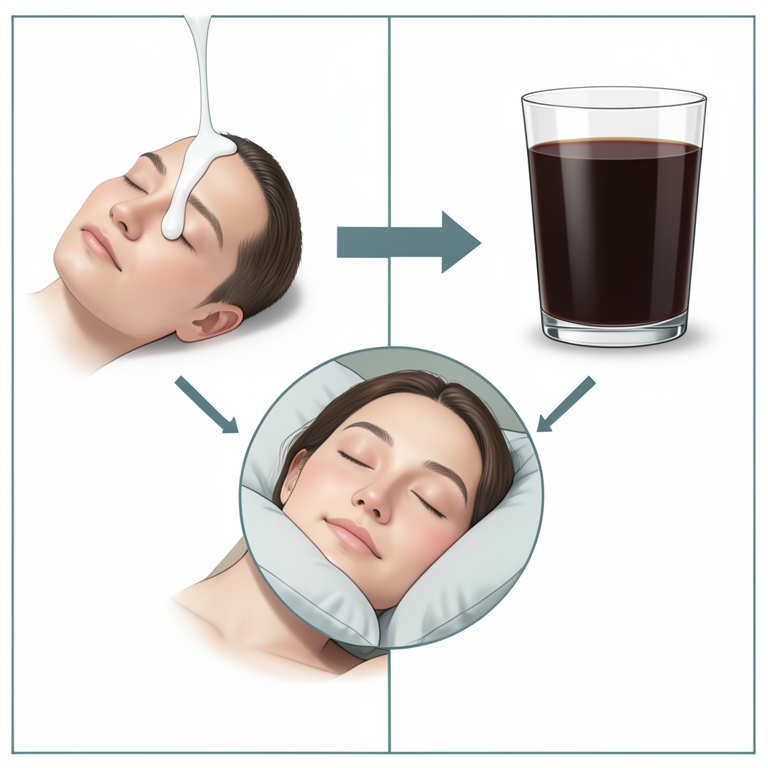
Combined Treatment Protocol
AI-generated conceptual illustration (A human head and a glass of herbal liquid). It explains the idea and does not show study data.
View source evidence ↗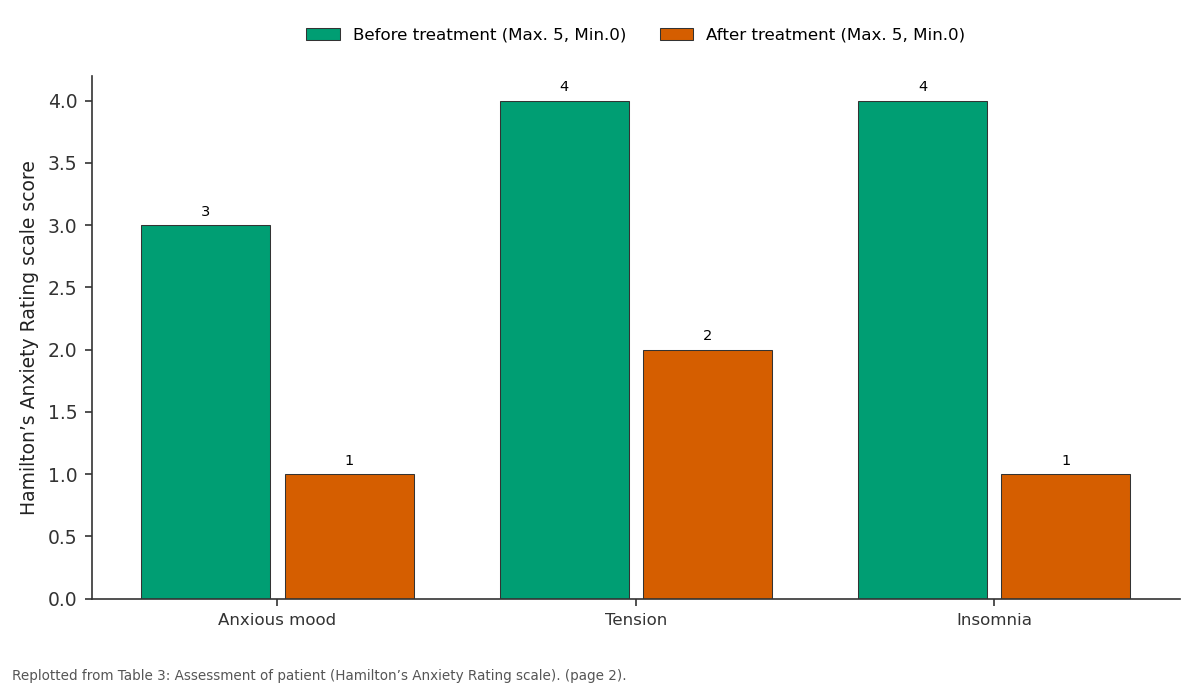
Before treatment (Max. 5, Min.0) and After treatment (Max. 5, Min.0): Anxious mood vs Tension vs Insomnia
Replotted from Table 3 (page 2) of the original paper. Every bar is the paper's own table value.
View source evidence ↗Figures & tables
From the original paper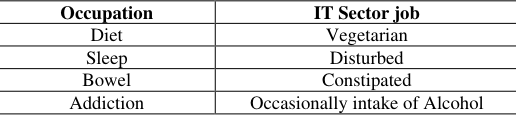 Table 1
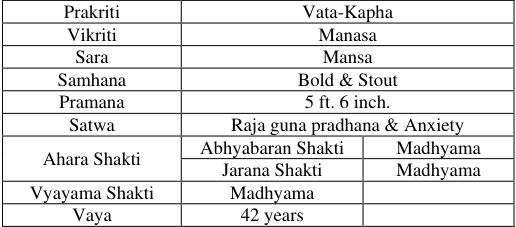 Table 2
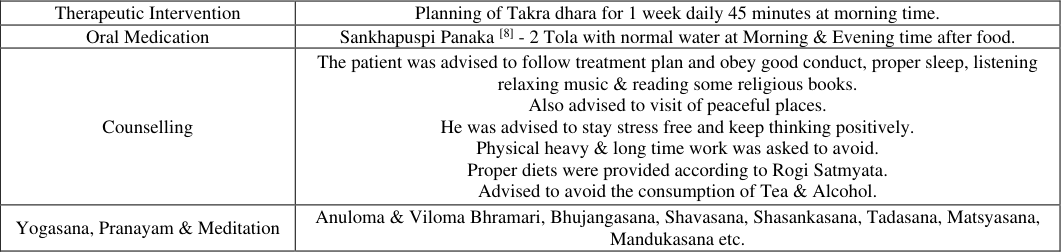 Table 3
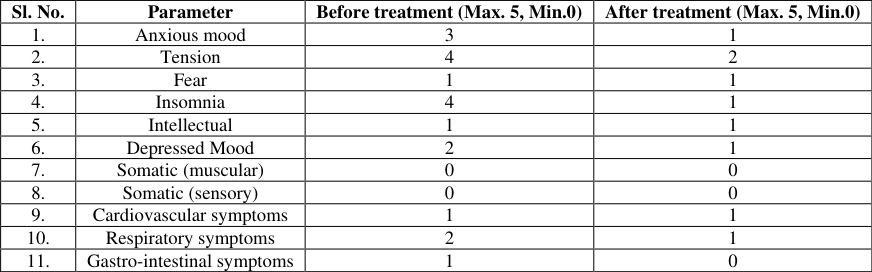 Table 3
Introduction
Ayurveda is a perpetual science of healthy living treasures coping with physical, psychological and spiritual wellness and enrichment of mankind. It covers all the aspects of human life. It is enriched by our great ancient sages through their experience, logic and power of wisdom. Only a healthy and calm life can achieve all four prime goals of life viz. Dharma, Artha, Kaama and Moksha. But in the modern metaphysical society, everyone is trying to gain good financial status and to fulfill all the earthly desires which leads to mental disability like Anidra and Anxiety. Various psychological disorders mentioned in Ayurveda are similar to anxiety disorders. The root cause of Anidra clearly indicates the anxious state of mind. Tarpak Kapha is an auxiliary Dosha of Kapha which nourish the cell of brain leads to restful night sleep. When this Dosha does not balance the brain cell causing Insomnia. Pranavayu, an auxiliary Dosha of Vata, creates a sensitive nervous system and this, together with an aggravated Pranavayu, causes Insomnia. Sadhak Pitta is an auxiliary dosha of Pitta and it can be found in the heart. It controls our emotion, spirituality, decisiveness and desires [2] . Any imbalance creates problem for sufferer such as working too hard and too long ultimately leads to Insomnia. Stress and mood disturbance are the prime causes of the majority of psychiatric disorders. It occurs when the emotional factors cross the state of normalcy and get damaged. Takradhara is very effective in cases of various psycho-somatic disorders. Shirodhara is a unique technique in Panchakarma measures in which medicated milk is poured over the forehead in specific manners. Medhya Rasayana drugs are also effective for the cure of Anidra. Sankhapuspi Panaka is regarded as the best of all the Medhya Rasayana drugs.
Materials and Method
Aims and Objectives 1. To understand the Anidra in Ayurveda and conventional background. 2. To evaluate the role of Takradhara along with Sankhapuspi Panaka in the management of Anidra. 3. To study the better improvement of patient's mental status after treatment.
Case Report
A Muslim married 42 years old Male patient visited the outpatient department (OPD) of Raghunath Ayurved Mahavidyalaya and Hospital, Contai, West Bengal on 08.08.2021 with complaints of lack of sleep, occasional muscle tension, palpitation, and increase sweating for 3 years.
Clinical Findings Chief Complain
Complaining of lack of sleep and anxiety for the last 3 months and burning sensation in the heart region.
Associated complain
Constant worries about work-related stress, occasional muscle tension, palpitation, and increased sweating. Past history-He had been suffering for a long time with www.extensionjournal.com complaints of constant worries due to work-related stress, feeling of restlessness, irritability most of the time. His symptoms are mostly aggravated due to poor socioeconomic problems for the pandemic situation in the last year.
The personal details and clinical observation are reported in Table 1 and Table 2 respectively.
| Prakriti | Vata-Kapha | — |
|---|---|---|
| Vikriti | Manasa | |
| Sara | Mansa | |
| Samhana | Bold & Stout | |
| Pramana | 5 ft. 6 inch. | |
| Satwa | Raja guna pradhana & Anxiety | |
| Ahara Shakti | Abhyabaran Shakti | Madhyama |
| Jarana Shakti | Madhyama | |
| Vyayama Shakti | Madhyama | |
| Vaya | 42 years |
Table text extracted from the original PDF; superscript letters are shown inline. The original table image is below.
View original table image
| Occupation | IT Sector job |
|---|---|
| Diet | Vegetarian |
| Sleep | Disturbed |
| Bowel | Constipated |
| Addiction | Occasionally intake of Alcohol |
Table text extracted from the original PDF; superscript letters are shown inline. The original table image is below.
View original table image
Diagnosis
As per ICD 10 F41.1, [3] it was a case of Generalized Neurotic Disorder based on signs and symptoms of the patient. Assessment of the patient was done using Hamilton's Anxiety Rating scale [4] . The symptoms of Generalized Neurotic Disorder including lack of sleep, tension, emotional disturbance, palpitations, sweating, altered bowel habits etc can be correlated to vata [5] and pitta [6] prakopa lakshanas. Athi chinta or excess thinking is an etiological factor for rasa dhatu dusti [7] which again incites both physical and mental symptoms.
Treatment Plan
Therapeutic Intervention Planning of Takra dhara for 1 week daily 45 minutes at morning time.
Oral Medication
Sankhapuspi Panaka [8] -2 Tola with normal water at Morning & Evening time after food.
Counselling
The patient was advised to follow treatment plan and obey good conduct, proper sleep, listening relaxing music & reading some religious books. Also advised to visit of peaceful places. He was advised to stay stress free and keep thinking positively.
Physical heavy & long time work was asked to avoid. Proper diets were provided according to Rogi Satmyata.
Advised to avoid the consumption of Tea & Alcohol.
Yogasana, Pranayam & Meditation
Anuloma & Viloma Bhramari, Bhujangasana, Shavasana, Shasankasana, Tadasana, Matsyasana, Mandukasana etc.
Results
After 21 days, there was a considerable change in sleeping cycle. It was reported that the condition of the patient was improving. The patient reported that he was able to sleep for 7-8 hours. Now he feels in good mental condition. The assessment is presented below through a table. Ashanti & Snayu daurbalya [9] . Sankhapuspi is having Tridoshshamaka in property, tikta rasa, Snigdha and Picchhila Guna, Sheeta Virya, Madhura Vipaka and Medhya in Prabhava [10] . It is mentioned as the best Medhya Rasayana by Acharya Charaka. Sankhapuspi, will act on Raja Guna by pacifying Vata Dosha because of its Vata-Pitta Samyaka property. In Takradhara, from a certain height when Takra is allowed to fall on the forehead, it generates momentum. The momentum may transfer into voltage and stimulate the nerve in the frontal bone. The impulse is transmitted through cerebrospinal fluid (CSF). This impulse may activate the functions of thalamus and the basal forebrain. Stress and other psycho-somatic disorders like anxiety, depression, hypertension, migraine etc. can be reduced and tranquilized by continuous falling of the liquid substances over the forehead in prolonged Dhara therapy [11] .
Conclusion
Effective combined treatment protocol to treat Anidra.
Patient & Patient's party are happy for recovering disease from the stage of Anidra but, there are need to further big sample size clinical study to evaluate or establish the treatment plan.
Figures and tables from the paper
| Sl. No. | Parameter | Before treatment (Max. 5, Min.0) | After treatment (Max. 5, Min.0) |
|---|---|---|---|
| 1. | Anxious mood | 3 | 1 |
| 2. | Tension | 4 | 2 |
| 3. | Fear | 1 | 1 |
| 4. | Insomnia | 4 | 1 |
| 5. | Intellectual | 1 | 1 |
| 6. | Depressed Mood | 2 | 1 |
| 7. | Somatic (muscular) | 0 | 0 |
| 8. | Somatic (sensory) | 0 | 0 |
| 9. | Cardiovascular symptoms | 1 | 1 |
| 10. | Respiratory symptoms | 2 | 1 |
| 11. | Gastro-intestinal symptoms | 1 | 0 |
Table text extracted from the original PDF; superscript letters are shown inline. The original table image is below.
View original table image
References
5 in the original paper- Patil Abhijeet B. Insomnia (Anidra) and Ayurveda: A Critical Review. IAMJ http://www.iamj.in/posts/2014/images/upload/775_779. pdf
- Vd. Harish Chandra Singh Kushwaha, editor. Charaka Samhita, Ayurved-Dipika's Ayushi Hindi Commentary (Sutra Sthana, Chapter Vol. I, Revised Ed., Varanasi: Chaukhambha Orientalia. 2014;12(08):190.
- Vd. Harish Chandra Singh Kushwaha, editor. Charaka Samhita, Ayurved-Dipika's Ayushi Hindi Commentary (Sutra Sthana, Chapter) Vol. I, Revised Ed., Varanasi: Chaukhambha Orientalia. 2014;12(11):194.
- Vd. Harish Chandra Singh Kushwaha, editor. Charaka Samhita, Ayurved-Dipika's Ayushi Hindi Commentary (Vimana Sthana, Chapter) Vol. I, Revised Ed., Varanasi: Chaukhambha Orientalia. 2014;08(13):659.
- Raghunath Das, et al. Effects of Takradhara on Psychosomatic disorders: A Review. Int. J Res. Ayurveda Pharm, 2020;11(5):135-137. http://dx.doi.org/10.7897/2277-4343.1105155