
Research article · 2021 · Full text
International Journal of Research in AgronomyAntagonistic properties of Trichoderma viride with special reference to vegetable plant diseases
Volume 4(1) · Pages 81–84 · DOI: 10.33545/2618060x.2021.v4.i1a.86 ↗
Research areasAgriculture, Plant Science, Crop Management
Abstract
Author-writtenTrichoderma viride is a fungus which is useful to control soil borne pathogens among these pathogen, Fusarium oxysporum and Alternaria alternata are considered as major pathogen of many economically important vegetable crops. It is isolated from infected vegetable plant material in December 2019. Generally farmers use disease resistant verity and chemical fungicide to control vegetable diseases which is harmful or insufficient, thus we use Bio control methods which is ecofreindly by using dual culture Method. In the present study Trichoderma viride use against Fusarium oxysporum, Alternaria alternata and Colletotrichum capsici inhibitions of mycelial growth of both the pathogens were observed. The highest inhibition showed against Colletotrichum capsici up to 89%, Alternaria alternata 73% and Fusarium Oxysporum 67% after 7 days of incubation. Standard fungicide (Hexaconazole 5ppm) is used to compeer with the test isolates. Trichoderma viride revealed better result than fungicide
Summary
Source-checkedPlain-language reading of the full paper, prepared with AI and checked against the text. Each point links to the authors' own words.
Why it matters
- Vegetables are essential components of the daily diet, providing vital nutrients, vitamins, and minerals that help reduce chronic diseases. View evidence ↗
- Soil-borne pathogens are a global threat that cause significant losses to vegetable crop production. View evidence ↗
- The heavy use of chemical pesticides to combat pathogens can harm humans and animals, disrupt soil biology, and pollute water sources. View evidence ↗
The question
- The study aimed to observe the inhibition of mycelial growth of Fusarium oxysporum, Alternaria alternata, and Colletotrichum capsici using Trichoderma viride. View evidence ↗
What they did
- Infected vegetable leaves and fruits were collected from the Belora district of Jalna between October and December 2019. View evidence ↗
- The dual culture method involved placing 5 mm mycelia of T. viride and the pathogens on opposite sides of PDA plates, with three replicates incubated at 30 ± 2°C for 7 days. View evidence ↗
- Hexaconazole at a concentration of 5ppm was used as a standard fungicide for comparison against the T. viride isolates. View evidence ↗
What they found
- The inhibition of Alternaria alternata by T. viride was 72.22%. View evidence ↗
- The standard fungicide Hexaconazole showed lower inhibition rates than T. viride, with values of 38.88% for C. capsici, 33.33% for A. alternata, and 22.22% for F. oxysporum. View evidence ↗
- Overall, T. viride demonstrated superior antagonistic results compared to the chemical fungicide used in the study. View evidence ↗
What it means
- The authors strongly suggest using T. viride as a bio-control agent to manage vegetable plant diseases, as it is environmentally friendly and may help increase soil fertility and reduce salinity. View evidence ↗
Visual summary
2 visualsIllustrations explain the paper; charts are replotted from the paper's own table values.

Dual Culture Setup
AI-generated conceptual illustration (Trichoderma viride and vegetable fungal pathogens in a Petri dish). It explains the idea and does not show study data.
View source evidence ↗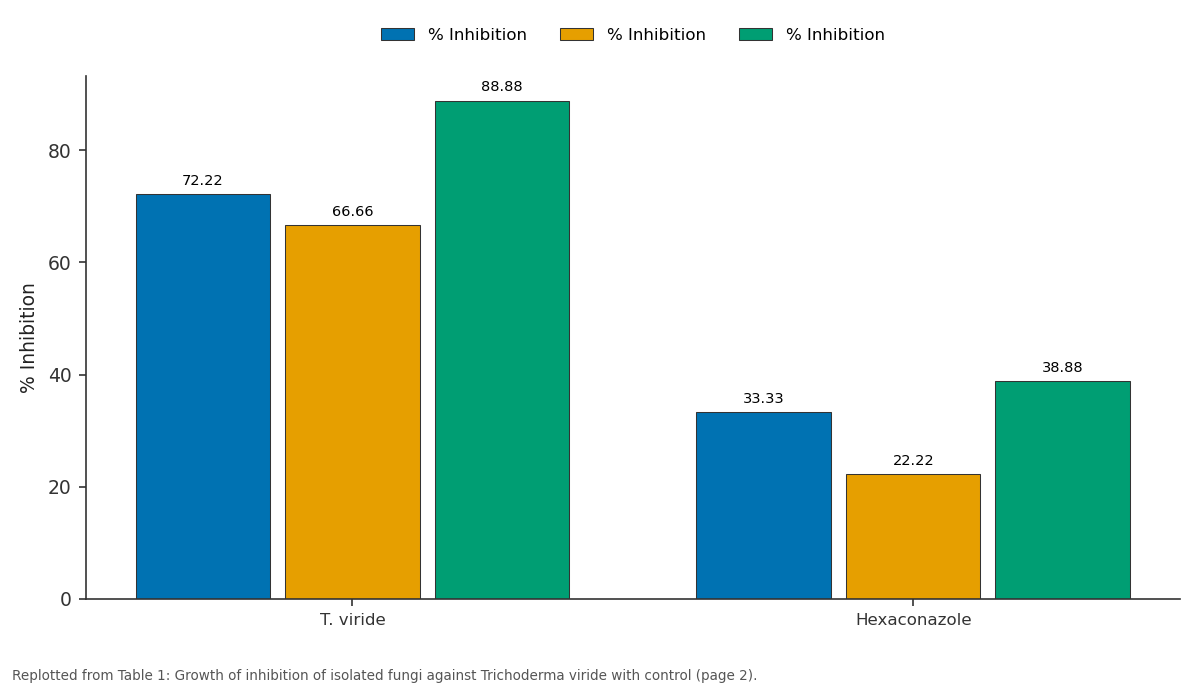
% Inhibition and % Inhibition and more: T. viride vs Hexaconazole
Replotted from Table 1 (page 2) of the original paper. Every bar is the paper's own table value.
View source evidence ↗Figures & tables
From the original paper Table 1
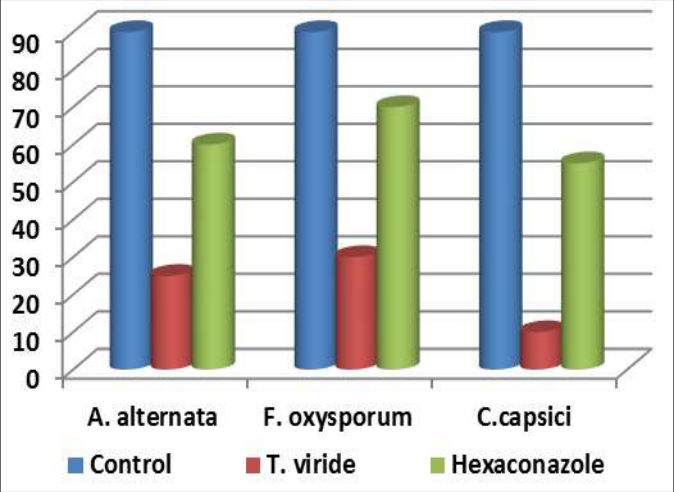 Plate 1
Introduction
Vegetables are very important food in our daily diet it is very rich source of vitamins, minerals, fibers and nutrients which is reduce number of chronic diseases. Soil borne plant pathogens cause serious loss of vegetable crops in all over the world. India is the second most country to produce vegetables due to diverse climatic condition. Now day's agriculture has been facing number of problems of pest and pathogens. Which reduce huge amount of vegetable crop production quantitatively as well as qualitatively. Due to that farmers use high amount of chemical pesticide which is very harmful to the humans as well as animals even it can disturb soil biota and pollute the water reservoirs. Likewise, chemical pesticide may not be realistic nor economical for the control of many soil-borne pathogens. Therefore bio control approach offers an ecofriendly alternative to protect vegetable plants from these fungi. Trichoderma species is one of the most important biological control for possessing different mode of action against plant pathogens, as well as competition of nutrients, mycoparasitism and antibiosis by hydrolytic enzymes namely chitinases, β-glucanases and proteinases (Mendez-Vilas, 2010; Valencia et al., 2011) [8,15] . Trichoderma belongs to Ascomycetes mostly found in soil, on the surface of wood, other fungus and able to utilize various substrates demonstrating their adaptability to different ecological condition (Altomare et al.1999) [1] some strains of Trichoderma speciesare long lasting colonization in root surface they are non-pathogenic to plants, and they produce wide range of antibiotic such as viridin, gliotoxin and antifungal secondary metabolitets (Sivasithamparam and Ghisalberti) [14] . Trichoderma species are very popular for their capability to enhance plant growth up 30% it can help to enhance root growth as well as plant productivity. Trichoderma speceis particularly T. viride and T. harzianum exhibit significant variation among strains with respect to their antagonistic activity and host range (Sivan and Chet, 1989) [13] . Fusarium oxysporum and Alternaria alternata are worldwide distributed, in India huge number of Agricultural crops especially vegetables are widely infected by these fungi. Fusarium yellows or wilts disease cause by these fungi in number of vegetables. A. alternata is a fungus which causes leaf spot disease more than 380 plant species and it also infect upper respiratory tract and Asthma in human. Fungicides are regularly recommended for plant disease control, but may negatively impact on the environment and non-target organisms (Brimner & Boland 2003) [2] .
According to the Chet 1987 [3] Papavizas 1985 [11] Trichoderma species are active mycoparasites against a huge range of economically important aerial and soil-borne plant pathogens, and it is effectively used as a bio pesticide in greenhouse and Agricultural field. Trichoderma viride have been most important to control soil borne pathogens as well as it maintain soil fertility and soil biota. So we used alternative way to ecofriendly management of vegetable plant diseases.
Material and Methods 1) Sample collection and Isolation of fungi
The infected vegetable plant materials (leaf and fruits) were collected from Belora district Jalna between October 2019 to December 2019. The collected plant material were wash with tap water followed by sterilize water then cut in to small pieces on the margin of healthy and diseased tissue after that surface sterilization is done with 4% HgCl2 for 5 minutes then rinse with sterile distilled water, and inoculated on Potato Dextrose Agar plates. The Petri plates were incubated at 30 0 ± 2 0 C for 7 days. Pure culture of trichoderma viride was obtained from department of Microbiology, Institute of Science Aurangabad
2) Identification of vegetable plant pathogenic fungi
Isolated fungi were identified based on morphological and cultural characteristics by standard manuals, maintain pure culture and stored at 4 0 C for further study. (Gilman and Guest)
3) Antagonistic activity of Trichoderma viride
Antagonistic activity of Trichoderma viride was tested against the isolated pathogenic fungi by dual culture method (Morton and Stroube, 1955) [9] . Trichoderma viride and test fungi were inoculated 5 mm mycelia on PDA plate by using cork borer. The mycelium of Trichoderma viride and pathogens were placed opposite side to each other on a PDA plates three replicates were maintained for each, treated plates incubated at 30 ± 2°C for 7 days. Pure culture plates of the pathogens used as control. Seven days after incubation, radial growth of test fungi and Trichoderma viride were measured. Colony diameter of test fungi in dual culture plate was observed and compared with control. The percent inhibition of mycelial growth over control was calculated by following formula.
I
Where, I = Percentage of mycelial growth of inhibition C = Mycelial growth in control. T = Mycelial growth in treated.
4) Antagonistic activity of Hexaconazole:
The Antagonistic activity of the fungicide (Hexaconazole) was used to study the comparative account of the isolated pathogenic fungal inhibition by dual culture method with reference to the Antagonistic activity of the Trichoderma viride (Morton and Stroube, 1955) [9] . [12,10] in the present work results revealed that in the [4] Trichoderma Viridae reduced the colony area of Macrophomina phaseoli by 19.2 and 34.9% by using the dual culture method.
Result and Discussion
Trichoderma spp revealed that (Tv-2) (71.41%) highly inhibited the mycelia growth of pathogen over control by dual culture methad (Faheem et al., 2010) [5] . Trichoderma viride recorded maximum inhibition of mycelial growth (86.2%) of test fungus inciting collar rot of groundnut followed by T. harzianum (80.4%) (Harsukh et al., 2011) [7] . Importance of Trichoderma species were showed against Fusarium oxysporum sp. Carthami causing wilt of safflower and isolates no. 29 and 33 were found to reduce the growth of the pathogen as compared to others (Waghmare and Kurundkar, 2011) [17] . Plant growth harmons such as auxins production and phosphate solubilizing are significant in adaptable plant and root growth in different crops. IAA produced by Trichoderma species was found important for root growth and to increase seedling quality (Gravel et al., 2007) [6] . Trichoderma species are very important for the enhancement of production and quality of vegetable as well as all agricultural crops.
Conclusion
The present study reveals the important role of Trichoderma viride has a very effective antagonistic activity against A. alternata, F. oxysporum and C. capsici as compeer to fungicide (Hexaconazole). Therefore, it could be strongly suggested the potential of Trichoderma viride used as a Bio-control agent for the management of vegetable plant diseases without effecting the environment serving to reduce soil salinity and increase the fertility.
Figures and tables from the paper
| Antagonistic fungi | Radial growth of A. alternata (mm) | % Inhibition | Radial growth of F. oxysporum (mm) | % Inhibition | Radial growth of C. capsici (mm) | % Inhibition |
|---|---|---|---|---|---|---|
| Control | 90 | 00.00 | 90 | 00.00 | 90 | 00.00 |
| T. viride | 25 | 72.22 | 30 | 66.66 | 10 | 88.88 |
| Hexaconazole | 60 | 33.33 | 70 | 22.22 | 55 | 38.88 |
Table text extracted from the original PDF; superscript letters are shown inline. The original table image is below.
View original table image
References
18 in the original paper- Altomare C, Norvell WA, Bjorkman T, Harman GE. Solubilization of phosphates and micronutrients by the plant-growth-promoting and biocontrol fungus Trichoderma harzianum Rifai 1295-22. Applied and Environmental Microbiology 1999;65:2926-2933.
- Brimner TA, Boland GJ. A review of the non-target effects of fungi used to biologically control plant diseases. Agriculture, Eosystems & Environment 2003;100:3-16.
- Chet I. Trichoderma: application, mode of action and potential as a biocontrol agent of soilborne plant pathogenic fungi, In I. Chet (ed.), Innovative approaches to plant disease control. John Wiley & Sons, New York 1987, 137160.
- Etabarian HR. Evaluation of Trchoderma isolates for biological control of charcoal stem rot in melon caused by Macrophomina phaseolina. J Agric. Sci. Technol 2006;8:243-250.
- Faheem Amin, Razdan VK, Mohiddin FA, Bhat KA, Saba Banday. Potential of Trichoderma species as biocontrol agents of soil borne fungal propagules. J Phytol 2010;2(10):38-41.
- Gilman PG, Guest ID. Mycoparasitic and antagonistic inhibition on Phytophtoracinnamomi Rands by microbial agents isolated from manure composts. Plant Pathology Journal 1957;5:291-298.
- Gravel V, Antoun H, Tweddell RJ. Growth stimulation and fruit yield improvement of greenhouse tomato plants by inoculation with Pseudomonas putida or Trichoderma atroviride: Possible role of Indole Acetic Acid (IAA). Soil Biol. Biochem 2007;39:1968-1977.
- Harsukh G, Kalu Rakholiya, Dinesh Vakharia. Bioefficacy of Trichoderma isolates against Aspergillus niger Van Tieghem inciting collar rot in Groundnut (Arachis hypogaea L.). J Plant Prot. Res 2011;51(3):240-247.
- Mendez-vilas A. A review on contributions presented at the BioMicro World 2009 Conference. Am. J Agric. Biol. Sci 2010;5:486-487.
- Morton DJ, Stroube WH. Antagonistic and stimulating effects of soil microorganisms upon sclerotium. Phytopathology 1955;45:417-420.
- Moubarak MY, Abdel-Monaim MF. Effect of bio-control agents on yield, yield components and root rot control in two wheat cultivars at New Valley region, Egypt. J Cereals Oilseeds 2011;2:77-87.
- Papavizas GC. Trichoderma and Gliocladium-biology, ecology, and potential for biocontrol, Annual Review of Phytopathology 1985;23:23-54.
- Ranasingh N, Saturabh A, Nedunchezhiyan M. Use of Trichoderma in disease managemant. Orissa Review, September-October 2006, 68-70.
- Sivan CJ, Chet I. Degradation of fungal cell walls by lytic enzymes of Trichoderma harzianum. J Gene Microbiol 1989;135:675-682.
- Sivasithamparam K, Ghisalberti EL. Trichoderma and Gliocladium 1998;1:139-191.
- Valencia GB, Vargas VH, Soto JNU, Jimenez NN, Corral JH. Trichoderma sp native from chili region of Poanas, Durango, Mexico antagonist against phytopathogen fungi. Am. J. Agric. Biol. Sci 2011, 185-188.
- Vincent JM. Distortion of fungal hyphae in the presence of certain inhibitors. Nature 1947;150:850.
- Waghmare SJ, Kurundkar BP. Efficacy of local isolates of Trichoderma spp against Fusarium oxysporum sp. carthami causing wilt of safflower. Adv. Plant Sci 2011;24(1):37-38.