
Research article · 2021 · Full text
International Journal of Horticulture and Food ScienceFertilizer scheduling through drip fertigation on growth and yield of onion variety Bhima Shakti
Volume 3(2) · Pages 54–56 · DOI: 10.33545/26631067.2021.v3.i2a.102 ↗
Research areasIrrigation Practices and Water Management
Abstract
Author-writtenAn investigation was conducted at Main Agricultural Research Station, University of Agricultural Sciences, Dharwad to know the influence of fertilizer scheduling through drip fertigation on growth & yield of onion (variety: Bhima Shakti) during rabi season of 2017-18 and 2018-19. The experiment included four treatments (T1: Surface irrigation and soil application of RDF, T2: 100% RDF through drip irrigation, T3: 80% RDF through drip irrigation and T4: 60 % RDF through drip irrigation) replicated five times. The fertilizers used were Urea, MOP & 19:19:19 & were completely water soluble. The fertigation was initiated fifteen days after transplanting and was given till fifteen days before harvesting. There were eleven split applications of fertilizers through fertigation at seven days interval. The results of the two years (2017-18, 2018-19 and pooled) revealed that the fertigation at 100 % RDF (T2) was most effective for the growth parameters studied but was on par with 80% RDF (T3). At 75 DAT, the treatment 100% RDF (T2) recorded the highest plant height of 43.34, 51.70 & 47.52 cm, number of leaves 8.0, 7.60 & 7.80 and leaf width of 1.03, 0.81 & 0.92, respectively during 2017-18, 2018-19 & over the years and was on par with 80% RDF (T3) which recorded the height of 41.68, 52.60 & 47.14 cm, number of leaves 7.7, 7.1 & 7.4 and leaf width of 0.83, 0.99 & 0.91 cm, respectively during 2017-18, 2018-19 & over the years. The control treatment (T1) showed lower values for these parameters. Similar trend was observed for yield parameters wherein 100% RDF(T2) recorded the highest equatorial diameter (5.44, 5.49 & 5.47 cm), polar diameter (4.98, 5.34 & 5.16 cm), marketable yield (34.68, 30.31 and 32.50 t/ha) and total yield (37.72, 33.48 and 35.60 t/ha ) and was on par with 80% RDF (T3) with equatorial diameter (5.25, 5.25 & 5.25 cm), polar diameter (4.78, 4.97 & 4.88 cm), marketable yield (32.20, 29.15 & 30.68 t/ha) and total yield (39.30, 30.92 & 35.11 t/ha), respectively during 2017-18, 2018-19 & over the years. The bulbs produced with 100 % RDF (T2) were found better storer with minimum loss in weight of bulbs (4.60 4.88 and 4.74) and rotten bulbs (4.80, 5.00 and 4.90) and was on par with 80% RDF (T3). The control (T1) recorded lower values for all the yield parameters.From this investigation it can be concluded that since 100 per cent RDF & 80 per cent RDF treatments were on par with each other for all the parameters the 80% RDF (T3) treatment can effectively be adopted which helps in saving fertilizer cost nearly 20 per cent with out compromising the parameters studied.
Summary
Source-checkedPlain-language reading of the full paper, prepared with AI and checked against the text. Each point links to the authors' own words.
Why it matters
- Onion is a significant vegetable and spice crop that generates approximately 4000 crores in annual foreign exchange. View evidence ↗
- Fertigation is a technology that improves fertilizer efficiency through uniform water distribution and reduced nitrogen loss from the soil surface. View evidence ↗
- Using fertigation can lower production costs and reduce groundwater pollution by decreasing the total amount of fertilizer required. View evidence ↗
The question
- The study aimed to determine how different fertilizer schedules delivered via drip fertigation affected the growth and yield of the Bhima Shakti onion variety. View evidence ↗
What they did
- The experiment used a randomized block design with four treatments and five replications at the Main Agricultural Research Station, UAS, Dharwad. View evidence ↗
- The four treatments compared surface irrigation with soil-applied recommended dose of fertilizer (RDF) against drip fertigation at 100%, 80%, and 60% of the RDF. View evidence ↗
- Growth parameters were measured 75 days after transplanting, while bulb size and yield were recorded after harvesting and curing. View evidence ↗
What they found
- At 75 days after transplanting, 100% RDF (T2) produced the highest pooled plant height (47.52 cm), leaf number (7.80), and leaf width (0.92 cm), though results were statistically similar to 80% RDF (T3). View evidence ↗
- Bulbs from the 100% RDF treatment (T2) showed the best storage quality, with the lowest pooled weight loss (4.74%) and lowest percentage of rotten bulbs (4.90%). View evidence ↗
- The control treatment (T1) resulted in the lowest pooled marketable yield (22.40 t/ha) and total yield (26.81 t/ha). View evidence ↗
What it means
- The authors conclude that 80% RDF fertigation is the most effective option because it maintains growth and yield parameters while reducing fertilizer costs by approximately 20%. View evidence ↗
Visual summary
3 visualsIllustrations explain the paper; charts are replotted from the paper's own table values.
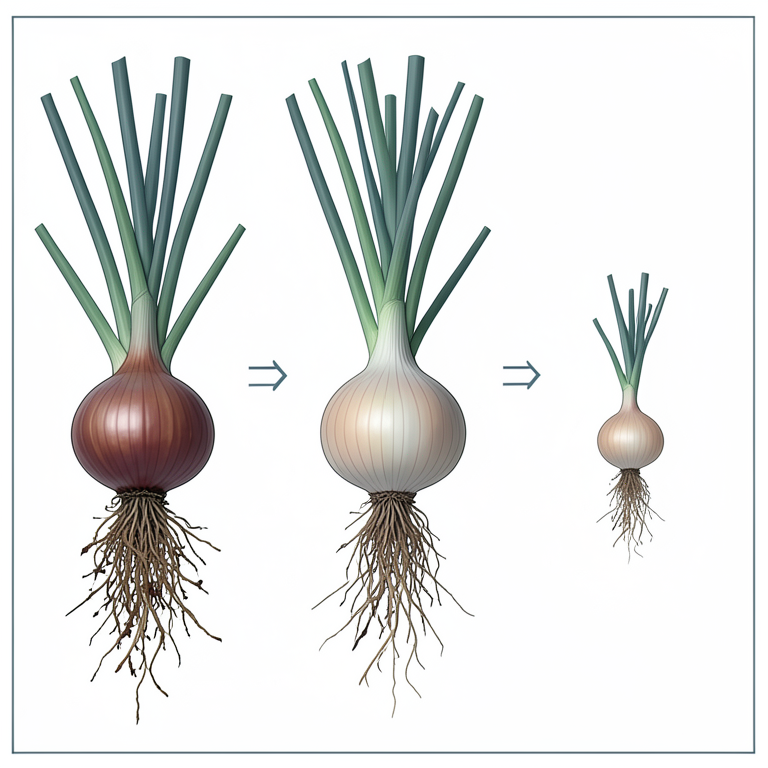
Fertilizer Efficiency Comparison
AI-generated conceptual illustration (onion plants (variety Bhima Shakti) in a field with drip irrigation lines). It explains the idea and does not show study data.
View source evidence ↗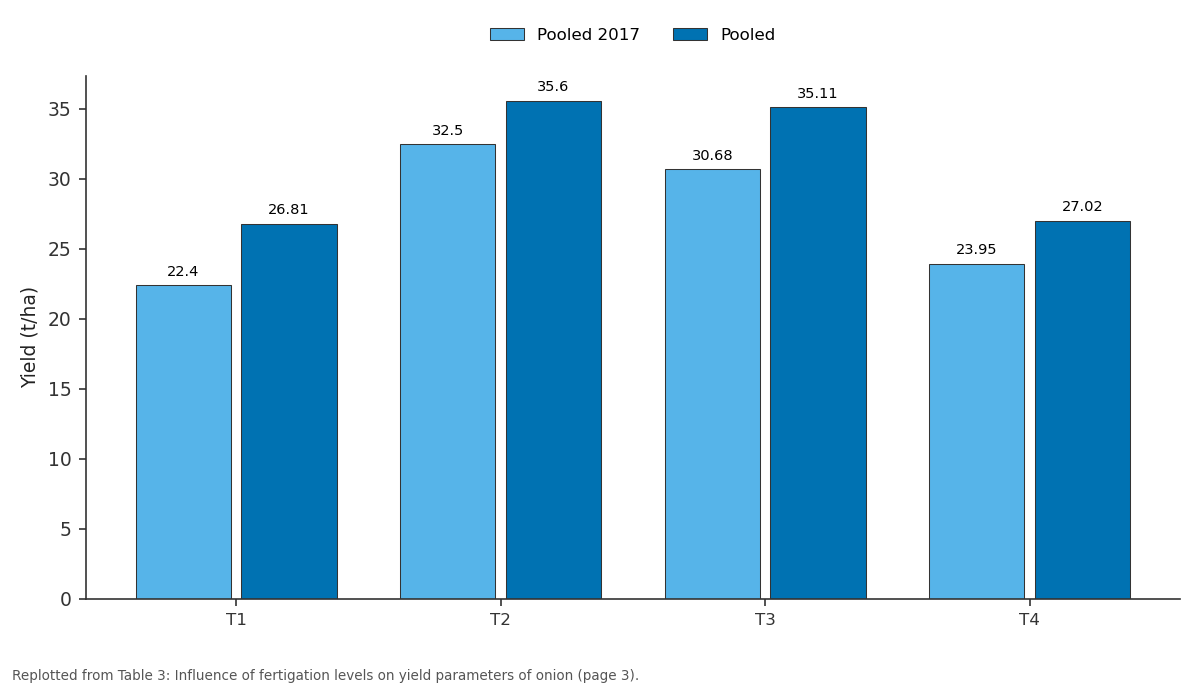
Pooled 2017 and Pooled: T1 vs T2 vs T3 vs T4
Replotted from Table 3 (page 3) of the original paper. Every bar is the paper's own table value.
View source evidence ↗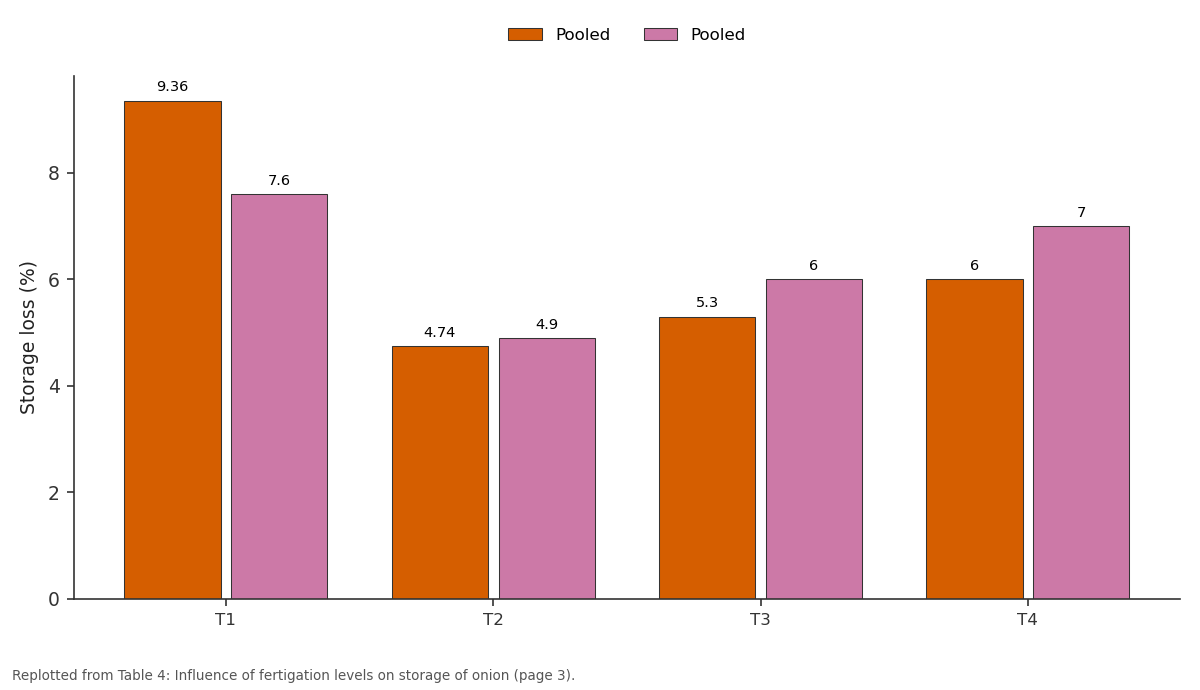
Pooled and Pooled: T1 vs T2 vs T3 vs T4
Replotted from Table 4 (page 3) of the original paper. Every bar is the paper's own table value.
View source evidence ↗Figures & tables
From the original paper Table 1
 Table 2
 Table 3
 Table 4
Introduction
Onion is an important spice cum vegetable crop which earns nearly 4000 crores foreign exchange annually. It is extensively used in processing industry now a days for the preparation of dehydrated onion flakes and powder. Onion is used in homeopathic, unani and ayurvedic medicines. Besides, the more pungent onions manifest strong anti-platelet and blood thinning activities in human blood, potentially adding protection against arteriosclerosis, cardiovascular disease, stroke, diabetes, osteoporosis and heart attack. It is extensively used in Indian kitchen in one or the other form hence, it is regarded as "Queen of Kitchen". Central Asia is the primary centre of origin and the area near East and Mediterranean region is the secondary centre of origin for onion. Many virtues have been attributed in Charaka-Samhita and the references of onion have also been found in Quran and Bible (Jones and Mann, 1963) [3] . Fertigation is a new technology that is being adopted in several horticultural crops. Inorganic fertilizers were probably the first chemicals to be injected into drip system. Fertigation also ensures high efficiency of fertilizers application by uniform and proper distribution of irrigation water into the soil, flexibility of nutrient ratios also avoids nitrogen volatilization from soil surface.
Fertigation not only increase the efficiency in the application of fertilizers and water it is also reducing the amount of fertilizers applied. This in turn reduces the cost of production and also ground water pollution which causes ecological disturbances and health risk by fertilizers leaching and accumulation of nitrates. As such, use of fertigation could really prove as blessing for Indian farming and may pave the way for another green revolution and provide coveted support to boost horticulture and agricultural production. Adoption of advanced and efficient method of application of water and fertilizes through drip irrigation system would go a long way in economizing the scares inputs thus realizing increased productivity. In This regard an investigation was conducted on fertilizer scheduling through drip irrigation in onion variety Bhima Shakti. The details of the experiment and outcome is discussed below.
Material and methods
An investigation on fertilizer scheduling through drip fertigation on growth and yield parameters of onion variety Bhima Shakti was conducted at Main Agricultural Research Station, UAS, Dharwad with four treatments and five replications in randomized block design. The plot size followed was 44 m x 1.2 m on raised beds with spacing of 15 cm x 10 cm. The seeds were sown in the nursery bed during November 2017 and 2018 (rabi) and transplanting was done during December month and all the cultural practices were carried out during the course of investigation according to Directorate of Onion and Garlic Research recommendations. The fertigation was carried out at weekly interval, fifteen days after transplanting and it was stopped fifteen days before harvest of the crop. Observations on growth parameters like plant height, number of leaves and leaf width were recorded 75 days after transplanting. Yield parameters like bulb size & yield were recorded after harvesting and curing. Equatorial and polar bulb diameter were recorded from 5 randomly selected bulbs using vernier calipers and expressed in centimeter. Marketable bulb yield was recorded by separating rotted, sprouted and very small bulbs (<2.5 cm diameter) and weight was recorded. For storage studies, initially 5 kg bulbs in each treatment are kept for storage and loss in weight was recorded 3 months after storage and number of rotten bulbs were recorded.
Treatment details
T1. Surface irrigation at 50 mm CPE: RDF: 110:40:60:30 kg NPKS/ha+5 t compost /ha: 30% N, full of PKS and organic manure as a basal before transplanting: 70% N in two equal splits at 30 and 45 days after transplanting as a top dressing T2. Drip irrigation at 100% PE through drip system-Irrigation at alternate day: 100% RDF (110:40:60:30 kg NPKS/ha) + 5 t compost /ha at 6 days interval: Full dose of organic manure should be applied as a basal before transplanting T3. Drip irrigation at 100% PE through drip system-Irrigation at alternate day: 80% RDF (88:32:48:24 kg NPKS/ha) + 5 t compost /ha at 6 days interval: Full dose of organic manure should be applied as a basal before transplanting T4. Drip irrigation at 100% PE through drip system-Irrigation at alternate day: 60% RDF (66:24:36:18 kg NPKS/ha) + 5 t compost /ha at 6 days interval.
Results and Discussion
The data on fertigation studies revealed that at 75 days after transplanting, the fertigation treatment T2 (100% RDF) had great influence on the plant height (43.34, 51.70 and 47.52 cm), number of leaves (8.00, 7.60 and 7.80) and leaf width (1.03, 0.81 and 0.92 cm) and was on par with T3 (80% RDF) with plant height (41.68, 52.60 and 47.14 cm), number of leaves (7.70, 7.10 and 7.40) and leaf width (0.83, 0.99 and 0.91 cm), respectively during 2017-18, 2018-19 and over the years. The lowest values were obtained in control (T1) with plant height (33.18, 36.66 and 34.92 cm), number of leaves (6.00, 5.00 and 5.50) and leaf width (0.78, 0.48 and 0.63 cm), respectively (Table - The highest values with respect to all the parameters like plant height, number of leaves and yield parameters was observed in onion variety Bhima Shakti in the treatment T2:100 per cent RDF through fertigation followed by T3:80 per cent RDF through fertigation and this might be due to the effective utilization of the fertilizers by the onion crop and response of plants to added nutrients. The increased values for these parameters might be due to increased uptake of primary nutrients and more production of dry matter (Kumar et al., 2001, Khan et al., 2002 [1] and Savitha et al., 2010 [6] and Jeevitha et al., 2018) [2] . This might also attributed to the fact that there is a better utilization of the nutrients by the crop due to less leaching effect and through drip irrigation the water requirement by the plants will be met out from time to time which helps in better growth. The vigorous growth in onion was observed due to production of more leaves, with broader size which helped in the synthesis of more photosynthates and thus resulting in increased accumulation of carbohydrates and other metabolites, which ultimately determined the size and weight of bulbs. Similar findings are also obtained by Kahsay et al. (2010) [4] , Savitha et al. (2010) [6] , Sankar et al. (2008) [5] , Tripathi et al. (2010) [9] and Yadav et al. (2010) [10] in onion.
per cent RDF & 80 per cent RDF treatments were on par with each other for all the parameters the 80% RDF (T3) treatment can effectively be adopted which helps in saving fertilizer cost nearly 20 per cent with out compromising the parameters studied.
Figures and tables from the paper
| Treatments | Plant height (cm) | — | Pooled | No. of leaves | — | Pooled | Leaf width (cm) | — | Pooled |
|---|---|---|---|---|---|---|---|---|---|
| 2017 | 2018 | 2017 | 2018 | 2017 | 2018 | ||||
| T1 | 33.18 | 36.66 | 34.92 | 6.00 | 5.00 | 5.50 | 0.78 | 0.48 | 0.63 |
| T2 | 43.34 | 51.70 | 47.52 | 8.00 | 7.60 | 7.80 | 1.03 | 0.81 | 0.92 |
| T3 | 41.68 | 52.60 | 47.14 | 7.70 | 7.10 | 7.40 | 0.83 | 0.99 | 0.91 |
| T4 | 39.58 | 42.64 | 41.11 | 6.54 | 5.54 | 6.04 | 0.70 | 0.50 | 0.60 |
| SE±m | 1.37 | 1.28 | 1.91 | 0.29 | 0.39 | 0.15 | 0.05 | 0.05 | 0.10 |
| CD @ 5% | 4.22 | 3.95 | 8.61 | 0.89 | 1.20 | 0.68 | 0.15 | 0.16 | 0.46 |
Table text extracted from the original PDF; superscript letters are shown inline. The original table image is below.
View original table image
| Treatments | Equatorial Diameter (cm) of the bulb | — | Pooled | Polar diameter (cm) of the bulb | — | Pooled |
|---|---|---|---|---|---|---|
| 2017 | 2018 | 2017 | 2018 | |||
| T1 | 4.20 | 4.44 | 4.32 | 3.66 | 4.29 | 3.98 |
| T2 | 5.44 | 5.49 | 5.47 | 4.98 | 5.34 | 5.16 |
| T3 | 5.25 | 5.25 | 5.25 | 4.78 | 4.97 | 4.88 |
| T4 | 4.06 | 4.52 | 4.29 | 3.80 | 4.10 | 3.95 |
| SE±m | 0.14 | 0.30 | 0.10 | 0.07 | 0.12 | 0.09 |
| CD @ 5% | 0.43 | 0.92 | 0.47 | 0.22 | 0.36 | 0.42 |
Table text extracted from the original PDF; superscript letters are shown inline. The original table image is below.
View original table image
| Treatments | Marketable yield (t/ha) | — | Pooled 2017 | Total yield (t/ha) | — | Pooled |
|---|---|---|---|---|---|---|
| 2017 | 2018 | 2018 | 2018 | |||
| T1 | 23.22 | 21.58 | 22.40 | 28.72 | 24.90 | 26.81 |
| T2 | 34.68 | 30.31 | 32.50 | 37.72 | 33.48 | 35.60 |
| T3 | 32.20 | 29.15 | 30.68 | 39.30 | 30.92 | 35.11 |
| T4 | 25.70 | 22.20 | 23.95 | 27.70 | 26.34 | 27.02 |
| SE±m | 0.71 | 1.80 | 0.57 | 0.76 | 1.46 | 1.46 |
| CD @ 5% | 2.91 | 5.54 | 2.57 | 2.33 | 4.49 | 6.55 |
Table text extracted from the original PDF; superscript letters are shown inline. The original table image is below.
View original table image
| Treatments | Total weight loss (%) | — | Pooled | Number of rotten bulbs | — | Pooled |
|---|---|---|---|---|---|---|
| 2017-18 | 2018-19 | 2017-18 | 2017-18 | |||
| T1 | 8.60 | 10.12 | 9.36 | 7.40 | 7.80 | 7.60 |
| T2 | 4.60 | 4.88 | 4.74 | 4.80 | 5.00 | 4.90 |
| T3 | 5.20 | 5.40 | 5.30 | 5.60 | 6.40 | 6.00 |
| T4 | 6.00 | 6.00 | 6.00 | 6.80 | 7.20 | 7.00 |
| SE±m | 0.41 | 0.21 | 0.35 | 0.43 | 0.35 | 0.13 |
| CD @ 5% | 1.25 | 0.64 | 1.15 | 1.33 | 1.09 | 0.57 |
Table text extracted from the original PDF; superscript letters are shown inline. The original table image is below.
View original table image
References
10 in the original paper- Khan H, Iqbal M, Abdulghaffor, Waseem K. Various plant spacing and different Nitrogen levels on the growth and yield of onion. (Allium cepa L.). J. Biol. Sci. 2002;2(8):545-547.
- Jeevitha D, Manohar KR, Chimmalagi U. Effect of different spacing and different levels of fertigation on quality parameters and cost economics of onion (Allium cepa L.) hybrid Arka Lalima. Int. J. Chem. Stud. 2018;26(6):445-448.
- Jones HA, Mann LK. Onion botany, cultivation and utilization, world crops onion Books, Leonard Hill Ltd, London, 1963.
- Kahsa YY, Belew D, Abay F. Effect of intra row spacing on plant growth and yield of onion varieties. Afric. J. Agric. Res. 2010;9(10):931-940.
- Sankar V, Lawande KE, Tripathi PC. Effect of micro irrigation practices on growth and yield of garlic (Allium sativum L.) var. G. 41. J. Spi. Aromatic crops. 2008;17(3):230-234.
- Savitha Paramaguru B, Pugalendhi L. Effect of drip fertigation on growth yield of onion. Indian J Hort. 2010;67:334-336.
- Shafeek MR, Nagwa MK, Hassan SM, Singer, Nadia HM. Effect of potassium fertilizer and foliar spraying with etherel on plant development, yield and bulb quality of onion plants (Allium cepa L.). J Appl. Sci. Res. 2013;9(2):1140-1146.
- Singh SP, Verma AB. Response of onion (Allium cepa L.) to potassium application. Indian J Agron. 2001;46(1):182-185.
- Tripathi C, Sankar V, Lawande KE. Influence of microirrigation methods on growth, yield and storage of rabi onion. Indian J. Hort. 2010;67(1):61-65.
- Yadav GB, Khodke UM, Jadhav SB. Response of onion (Allium cepa L.) to irrigation schedules and nitrogen levels under micro-irrigation system. Int J. Agril. Engg. 2010;3(1):59-61.