
Research article · 2021 · Full text
International Journal of Agriculture Extension and Social DevelopmentConstraints faced by tribal women adoption of Vermi compost technology
Volume 4(2) · Pages 138–139 · DOI: 10.33545/26180723.2021.v4.i2b.142 ↗
Research areasAgricultural Economics and PracticesLivestock and Poultry ManagementAgricultural Systems and Practices
Abstract
Author-writtenThe present study reports strategies to overcome constraints vermi compost technology and it was conducted in Narmada district of during the year 2014-2017 with 102 tribal beneficiary and non-beneficiary farmers were developed by prior identification of constraints and suggestions from vermi compost technology. Majority of Beneficiary vermicompost demonstration technology indicated that mortality of earthworm due to high temperature (90.20 per cent) was as major constraint by the respondents ranked first followed by inadequate supply of water/organic wastes material (84.32 per cent), lack of availability of earth worm (74.46 per cent), Difficulties in separation of earthworm from vermicompost (72.54 per cent), Attack of birds/predators/insects especially of poultry, ants (70.59 per cent) Mortality of earthworm during transfer (71.00 per cent), Over burdening in house and farm activities (67.65 per cent), Problem of cracking plastic bed as compare to pakka bed (66.69 per cent), Not earning higher price of varmi compost due to higher production (63.72 per cent), respectively.
Summary
Source-checkedPlain-language reading of the full paper, prepared with AI and checked against the text. Each point links to the authors' own words.
Why it matters
- Vermiculture allows for the conversion of organic waste into a nutritive organic fertilizer, which can be used to produce safe, chemical-free food. View evidence ↗
- The heavy use of agrochemicals since the 1960s increased food productivity but damaged the environment by killing beneficial soil organisms and reducing the natural biological resistance of crops. View evidence ↗
- Some farmers do not adopt vermicomposting technology due to various reasons, including a lack of knowledge and skill in its preparation. View evidence ↗
The question
- The study aimed to identify the major constraints faced by tribal women (both beneficiaries and non-beneficiaries) practicing vermicompost technology in the Narmada District. View evidence ↗
What they did
- The study was conducted in the Narmada district of Gujarat between 2015 and 2017, involving 204 tribal women from 13 villages, split equally between 102 beneficiaries and 102 non-beneficiaries. View evidence ↗
- Data were gathered using face-to-face interviews based on a structured interview schedule. View evidence ↗
- Technical experts reviewed the constraints and suggestions provided by the women to propose strategies for overcoming the most critical issues. View evidence ↗
What they found
- The majority of respondents were in the middle age group (81.37% of beneficiaries and 71.57% of non-beneficiaries) and had primary-level education (52.94% of beneficiaries and 50.00% of non-beneficiaries). View evidence ↗
- A high percentage of both beneficiaries (75.49%) and non-beneficiaries (71.57%) owned small or marginal land holdings. View evidence ↗
- For beneficiary women, the top-ranked constraint was earthworm mortality due to high temperature, reported by 90.20% of respondents. View evidence ↗
- Inadequate supply of water or organic waste material was the primary constraint for non-beneficiaries (88.24%) and the second-highest for beneficiaries (84.32%). View evidence ↗
- Attacks by birds, predators, and insects (specifically poultry and ants) were a significant issue, especially for non-beneficiaries (84.31%). View evidence ↗
- The tendency of plastic beds to crack compared to permanent (pakka) beds was a notable constraint for 73.53% of non-beneficiaries. View evidence ↗
- The most frequent suggestion from beneficiaries (93.13%) was that appropriate species of earthworms should be made available. View evidence ↗
- Non-beneficiaries most strongly suggested (91.18%) the provision of special instruments to isolate earthworms from raw materials. View evidence ↗
- Developing community vermicompost pits to ensure sufficient raw material was suggested by 78.44% of beneficiaries and 65.69% of non-beneficiaries. View evidence ↗
What it means
- The authors conclude that the primary barriers to vermicompost adoption for beneficiary women are high-temperature mortality of earthworms, inadequate water/waste supply, and difficulties in earthworm availability and separation. View evidence ↗
Visual summary
2 visualsIllustrations explain the paper; charts are replotted from the paper's own table values.
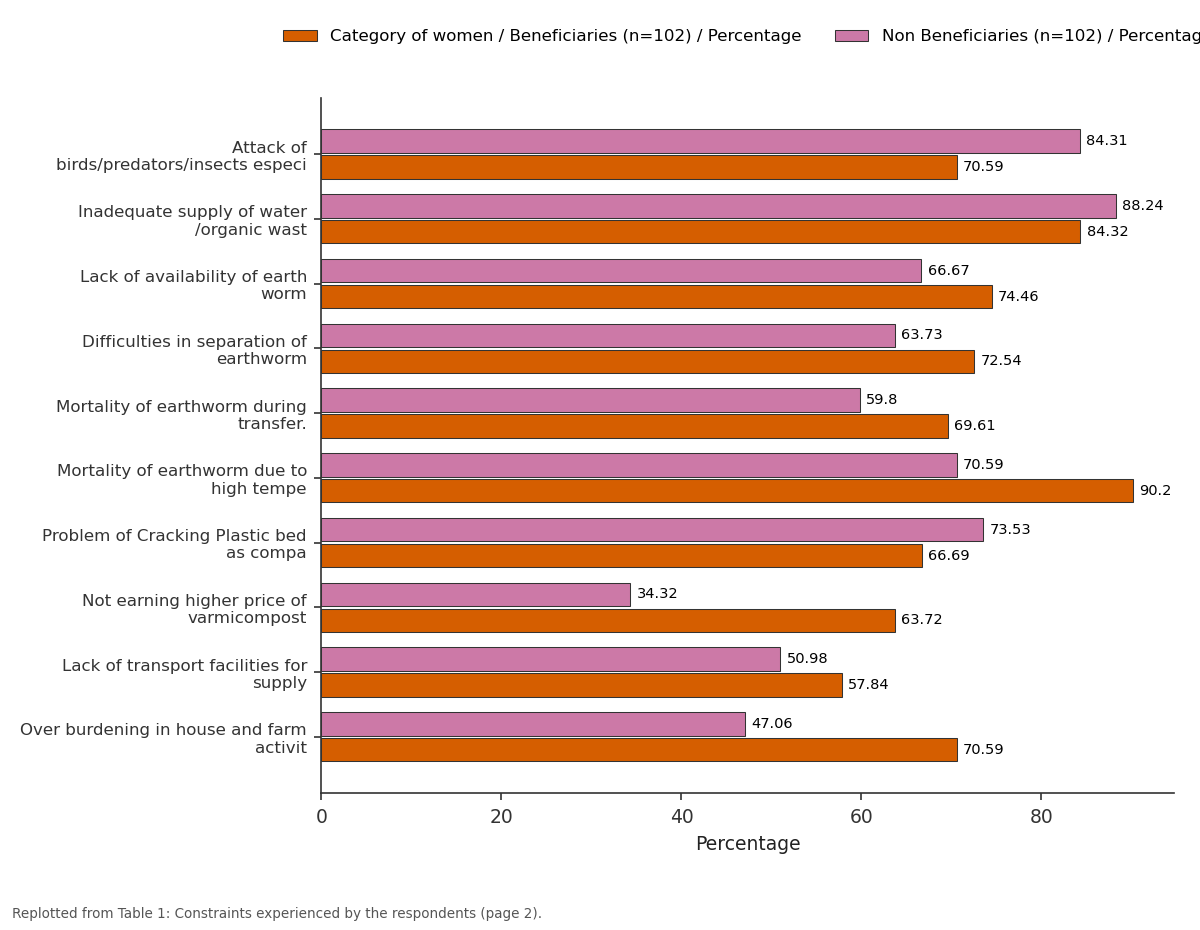
Category of women / Beneficiaries (n=102) /... and Non Beneficiaries (n=102) / Percentage: Attack of... vs Inadequate supply of... vs Lack of availability of... vs Difficulties in... vs Mortality of e
Replotted from Table 1 (page 2) of the original paper. Every bar is the paper's own table value.
View source evidence ↗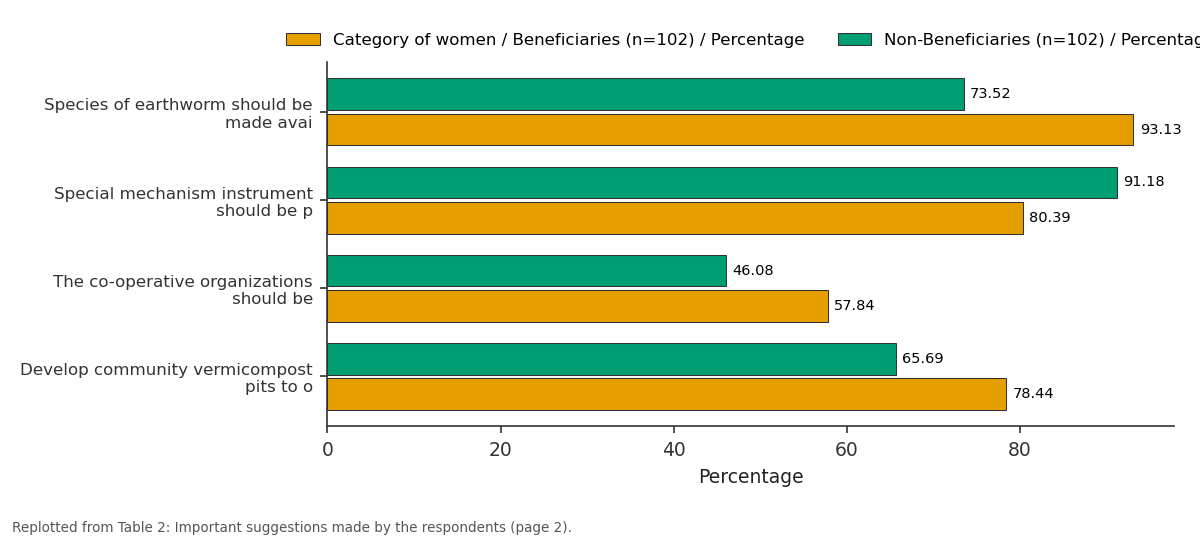
Category of women / Beneficiaries (n=102) /... and Non-Beneficiaries (n=102) / Percentage: Species of earthworm... vs Special mechanism... vs The co-operative... vs Develop community...
Replotted from Table 2 (page 2) of the original paper. Every bar is the paper's own table value.
View source evidence ↗Figures & tables
From the original paper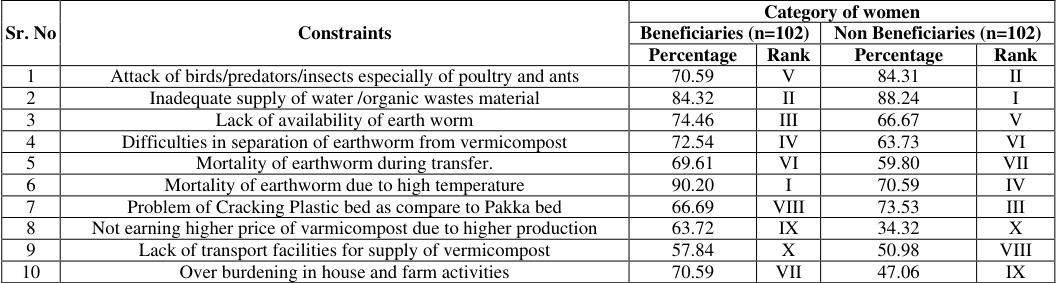 Table 1
 Table 2
Introduction
A revolution is unfolding in vermiculture studies for vermicomposting of diverse organic wastes by waste eater earthworms into a nutritive "organic fertilizer" and using them for production of chemical free safe food in both quantity & quality without recourse to agrochemicals. Heavy use of agrochemicals since the "green revolution" of the 1960s boosted food productivity at the cost of environment & society. It killed the beneficial soil organisms & destroyed their natural fertility, impaired the power of 'biological resistance' in crops making them more susceptible to pests & diseases. Agricultural extension aims is to get new and profitable technology adopted by farmers. Tribal Women Training Centre, Krishi Vigyan Kendra (KVK) working for disseminate and popularize new technologies among the farming community. vermicompost is many farmers do not adopt the it due to various reasons. Among the different reasons, poor knowledge and skill in preparing of vermicompost this technology. With this view, vermicompost technology had major constraints faced by beneficiaries and non-beneficiaries the tribal women practicing vermi compost technology in Narmada District to work out the following specific objectives. Objective 1. To Study profile of tribal women. 2. To identify the constraints faced by tribal women in vermicompost demonstration technology and seek their suggestions.
Methodology
The present study was conducted in narmada district of Gujarat State as it is the jurisdiction of Tribal Women Training Centre, KVK, Dediyapada. The Center had organized demonstration on vermi compost technology on 102 beneficiary of women field or home in 13 villages during 2015 to 2017 beneficiary had selected from same villages who were not beneficiaries under vermicompost demonstration technology Thus, altogether 204 respondents from 13 villages were selected for the study. Data were collected from the respondents through a well-structured interview schedule by employing face to face interview. The opinion of technical experts on constraints and suggestions offered by beneficiaries and non-beneficiaries the tribal women practicing vermi compost technology was screen out and propose the strategy to overcome major constraints on priority basis.
Findings and Discussion 1. Socio-economic profile of the respondents
Socio-economic status of the respondents is an important and integral part of any social science research. The profile study reveals that half of the respondents had 81.37 per cent of beneficiary and 71.57 per cent of non-beneficiary women belong to middle age group, majority of the respondents 52.94 per cent of beneficiary and 50.00 per cent of nonbeneficiary women had educated up to primary level, beneficiaries respondents of 75.49 per cent and (71.57 per cent) non beneficiaries possessed small and marginal land holding, beneficiaries women (88.24 per cent) and (73.53 per cent ) non beneficiaries women possessed less number of livestock (1 to 4 animal), the non-beneficiaries respondents were 85.29 per cent lower to medium innovativeness and beneficiaries women (83.33 per cent) medium to higher innovativeness, beneficiaries women (85.29 per cent) medium to higher extension participation, respectively.
Distribution of respondents according to constraints faced by the tribal women in adoption of vermi compost technology
Distribution of respondents according to constraints faced by the tribal women in adoption of vermi compost technology
Conclusion
Findings of the study presented above can be concluded that beneficiary women indicated that mortality of earthworm due to high temperature (90.20 per cent) was as major constraint by the respondents ranked first followed by inadequate supply of water/organic wastes material (84.32 per cent), lack of availability of earth worm (74.46 per cent), Difficulties in separation of earthworm from vermicompost (72.54 per cent), Attack of birds/predators/insects especially of poultry, ants (70.59 per cent) Mortality of earthworm during transfer (71.00 per cent), Over burdening in house and farm activities (67.65 per cent), Problem of cracking plastic bed as compare to pakka bed (66.69 per cent), Not earning higher price of varmicompost due to higher production (63.72 per cent), majortiy of tribal women had suggested that species of earthworm should be made available (93.13 per cent) followed by special mechanism instrument should be provide for isolation of raw material and earthworm, (80.39 per cent), develop community vermicompost pits to obtain sufficient raw material for vermicompost (78.44 per cent) and The co-operative organizations should be established for marketing (57.84 per cent), respectively.
Figures and tables from the paper
| Sr. No | Constraints | Category of women | — | — | — |
|---|---|---|---|---|---|
| Beneficiaries (n=102) | Non Beneficiaries (n=102) | ||||
| Percentage | Rank | Percentage | Rank | ||
| 1 | Attack of birds/predators/insects especially of poultry and ants | 70.59 | V | 84.31 | II |
| 2 | Inadequate supply of water /organic wastes material | 84.32 | II | 88.24 | I |
| 3 | Lack of availability of earth worm | 74.46 | III | 66.67 | V |
| 4 | Difficulties in separation of earthworm from vermicompost | 72.54 | IV | 63.73 | VI |
| 5 | Mortality of earthworm during transfer. | 69.61 | VI | 59.80 | VII |
| 6 | Mortality of earthworm due to high temperature | 90.20 | I | 70.59 | IV |
| 7 | Problem of Cracking Plastic bed as compare to Pakka bed | 66.69 | VIII | 73.53 | III |
| 8 | Not earning higher price of varmicompost due to higher production | 63.72 | IX | 34.32 | X |
| 9 | Lack of transport facilities for supply of vermicompost | 57.84 | X | 50.98 | VIII |
| 10 | Over burdening in house and farm activities | 70.59 | VII | 47.06 | IX |
Table text extracted from the original PDF; superscript letters are shown inline. The original table image is below.
View original table image
| Sr. No | Suggestions | Category of women | — | — | — |
|---|---|---|---|---|---|
| Beneficiaries (n=102) | Non-Beneficiaries (n=102) | ||||
| Percentage | Rank | Percentage | Rank | ||
| 1. | Species of earthworm should be made available | 93.13 | I | 73.52 | II |
| 2. | Special mechanism instrument should be provide for isolation of raw material and earthworm | 80.39 | II | 91.18 | I |
| 3. | The co-operative organizations should be established for vermicompost marketing | 57.84 | IV | 46.08 | IV |
| 4. | Develop community vermicompost pits to obtain sufficient raw material for vermicompost | 78.44 | III | 65.69 | III |
Table text extracted from the original PDF; superscript letters are shown inline. The original table image is below.
View original table image
References
5 in the original paper- Dhandhukia RD. Constraints experienced by the farmers in adoption of recommended pomegranate cultivation practices in Banaskantha district. M.Sc (Agri.) Thesis (Unpublished). Sardarkrushinagar Dantiwada Agricultural University, Sardarkrushinagar, 2009.
- Jadhav BA. Technological gap in adoption of recommended practices of mango cultivation. M.Sc (Agri.) Thesis (Unpublished). University of Agricultural Sciences. Dharwad, 2009.
- Patel CD, Naik RM, Vejpara VP. Awareness Level of Organic Farming Followers About Organic Farming of South Gujarat. Guj. J. Ext. Edu. 2015;26(1):95-96.
- Nirmala L, Ranganathan G, Asokhan M. Constraints of Biofertilizer adoption. Agril. Extn. Rev. 2002;14:30-31
- Ranganatha AD, Veerabhadriah V, Lalitha KC. Adoption of organic farming practices by small farmers. Agril. Extn. Rev. 2001;13:3-6.